What is Balinese Poleng Cloth?
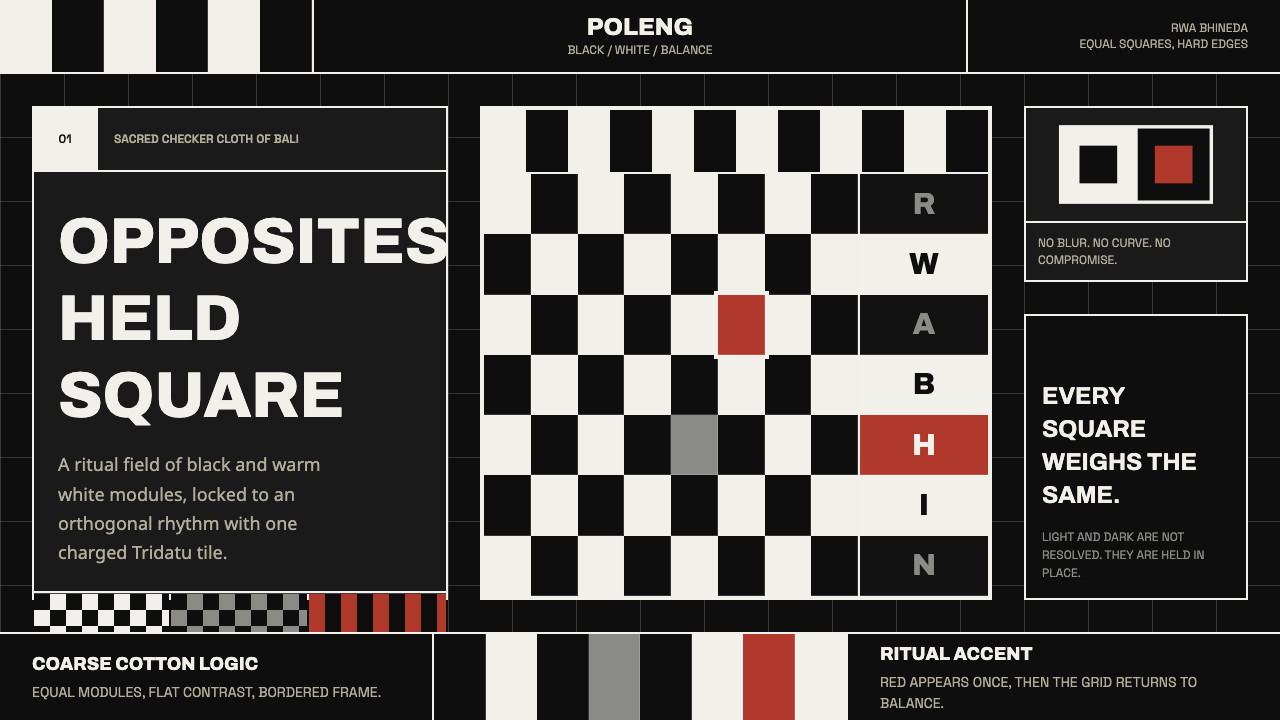
Poleng is Bali's sacred black-and-white checkerboard cloth, a textile grammar of pure duality wrapped around shrines and guardian statues to hold the cosmic balance of opposites in visible form.
Balinese Poleng Cloth in brief
Poleng is the Balinese Hindu checkered cloth — a strict, evenly proportioned grid of alternating black and white squares — that is wrapped around objects and figures understood to hold spiritual power or require protective balance: banyan trees, shrine statues, guardian figures (barong and other temple protectors), and sometimes worshippers themselves during ceremony. The word 'poleng' translates simply as 'square' or 'checkered,' a name that describes exactly what the eye sees and nothing more, because the pattern's meaning is not decorative but cosmological.
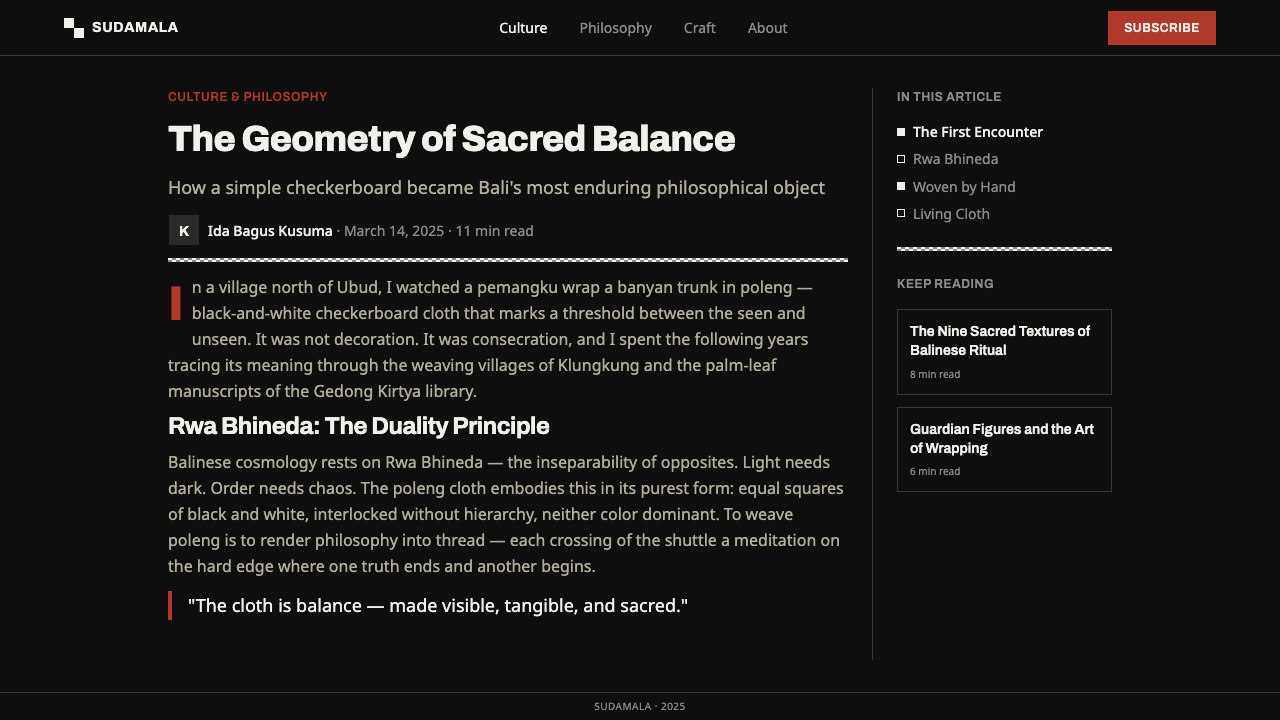
The black and white squares represent Rwa Bhineda, the foundational Balinese Hindu concept of sacred duality — the cosmic balance between opposing forces: good and evil, light and dark, order and chaos, the sacred and the profane. Crucially, Rwa Bhineda is not a moral hierarchy in which one side must defeat the other; it is a doctrine of necessary coexistence, in which both poles must remain present and in equilibrium for the world to function. Poleng cloth makes that abstract cosmological principle visible and wearable: draping it on an object marks that object as a site where these two forces are held, deliberately, in balance.
Visually, poleng is built on absolute contrast and rigorous evenness — the squares are equal in size, orthogonally aligned, and rendered in flat, unmodulated black and white with no gradation between them, because gradation would visually contradict the doctrine of two distinct, coexisting poles. The cloth is coarse cotton, giving the pattern a slightly irregular, hand-woven edge rather than a machine-perfect one. Beyond the core black-and-white, two restrained ritual variants exist: a gray checkered version called Sudamala, used in purification rites, and a version incorporating red alongside the black and white called Tridatu, tied to the Hindu trinity of Brahma, Vishnu, and Shiva.
Where does Balinese Poleng Cloth come from?
Poleng belongs to Bali's living Hindu ritual practice rather than to a datable art movement or a single point of invention — its use has been continuous within Balinese Hindu temple and village life, and its documented, sustained presence in ceremonial contexts through the mid-twentieth century reflects a much older, likely pre-colonial, textile and cosmological tradition. Unlike a style that can be traced to a founding designer or school, poleng's origin is communal and religious: it belongs to the fabric of Balinese Hindu cosmology itself, maintained by priests and temple communities rather than by named artist-innovators.
The cloth's placement is never arbitrary. Poleng is specifically used to mark objects and beings that occupy a liminal or powerful spiritual position — a banyan tree old enough to be considered a dwelling place for spirits, a stone guardian statue flanking a temple gate, a barong figure representing a protective spiritual force in ritual performance. Wrapping poleng around such an object is an act of acknowledgment and containment: it names the object as a site of real spiritual power while simultaneously asserting that this power is held in balance rather than left unchecked, protecting the community from imbalance in either direction — pure malevolence or unchecked sacred force.
Balinese Hindu priests (pedanda and related ritual specialists) and temple custodians, known as pemangku, are the primary custodians of poleng's correct ritual use — determining when and where the cloth is applied, and which of its variants (the standard black-and-white, the purification-linked gray Sudamala, or the trinity-linked red-accented Tridatu) is appropriate to a given ceremony or object. This custodial role means poleng's use is governed by religious protocol rather than aesthetic preference; the pattern is not deployed decoratively by individual choice but according to established ritual convention maintained across generations of temple practice.
Rwa Bhineda, the cosmological doctrine that poleng expresses, sits at the center of Balinese Hindu thought more broadly — it appears in temple architecture, in the layout of villages and family compounds, and in ritual calendars, not only in textile form. Poleng cloth is one of the most visually direct expressions of this doctrine because it renders the balance of opposites as a literal, repeating visual pattern rather than an abstract spatial or temporal arrangement, which is part of why it remains so recognizable and so consistently applied across the island's temple culture into the present day.
What defines the Balinese Poleng Cloth look?
Duality as Structure
The entire pattern is built from exactly two values — black and white — with no third color diluting the contrast in its standard form. This is not a minimal palette chosen for restraint's sake; the two-value structure is the direct visual expression of Rwa Bhineda, and any application of this style needs to preserve that binary clarity rather than softening it into a broader tonal range.
Orthogonal Grid
Squares are laid out in a strict orthogonal checkerboard — equal size, aligned edges, no diagonal shift or offset between rows. This rigor is what separates poleng from a generic checker motif: the grid reads as disciplined and deliberate, closer to a structural module than to a playful pattern, reinforcing the idea of a carefully held balance rather than a casual visual texture.
Flat, Unmodulated Contrast
There is no shading, no gradient, and no soft transition between the black and white fields — each square is a single flat value abutting its neighbor at a hard edge. Any blending between the two tones would visually undercut the doctrine the pattern exists to express: two distinct forces held in balance, not merged into a compromise state.
Coarse Woven Edge
The traditional cloth is coarse cotton, which gives the crisp geometric grid a slightly irregular, hand-woven quality at close range rather than a machine-precise one. This grounds the pattern's severity in something tactile and made-by-hand, preventing it from reading as sterile or purely digital even when the underlying geometry is very exact.
Ritual Color Variants
Beyond the standard black-and-white, two named variants exist for specific ritual purposes: Sudamala replaces black with a gray tone and is associated with purification ceremonies, while Tridatu introduces a restrained amount of red alongside the black and white, tied to the Hindu trinity of Brahma, Vishnu, and Shiva. Both variants preserve the core checkered structure and never abandon it for a different pattern entirely — they modulate the palette, not the grammar.
Applied, Not Framed
Poleng is never encountered as a flat, framed artwork — it is always wrapped, draped, or wound around a three-dimensional object: a tree trunk, a statue, a guardian figure. The pattern is designed to read clearly when it wraps around a curved or irregular form, which is part of why the grid is kept so simple and high-contrast — it needs to remain legible even when distorted by the object beneath it.
Deep Black Anchor
The dominant tonal weight of poleng leans dark: the black squares anchor the composition and give the pattern its gravity, with white functioning as the counterpoint rather than the dominant field. This dark-forward balance distinguishes poleng from a lighter, more neutral checkerboard motif and reinforces its association with weighty, sacred, protective contexts rather than casual or playful ones.

Who shaped Balinese Poleng Cloth?
High priests within Balinese Hindu religious hierarchy oversee the doctrinal and ritual correctness of ceremonies in which poleng cloth plays a role, ensuring that the cloth's placement and variant selection align with established religious meaning rather than personal or decorative preference. Their custodianship keeps poleng's use consistent with the Rwa Bhineda doctrine it expresses, rather than allowing the pattern to drift toward purely ornamental use.
Pemangku are lay temple priests responsible for the day-to-day ritual life of a Balinese temple, including the practical application of poleng cloth to shrine statues, gates, and guardian figures during ceremonies and ongoing temple maintenance. Their role bridges high religious doctrine and the material, hands-on practice of dressing sacred objects — they are the ones who actually wrap the cloth, guided by established convention for which object receives which variant.
The barong — a protective spiritual figure central to Balinese ritual performance — is among the most visible bearers of poleng cloth, worn or draped as part of its embodiment as a guardian force in balance between protective and potentially destructive power. Those who maintain and perform the barong tradition keep poleng's symbolic role visible in a living, performed context rather than only a static, sculptural one.
How do you use Balinese Poleng Cloth today?
Poleng's core transferable asset is its extreme, disciplined use of pure binary contrast — a lesson in how much visual authority two values, used with total consistency, can carry without needing a third color or a gradient to do further work. Applying it well means treating black-and-white contrast as a structural decision rather than a stylistic default, and preserving the pattern's rigor rather than loosening it into a softer checkerboard.
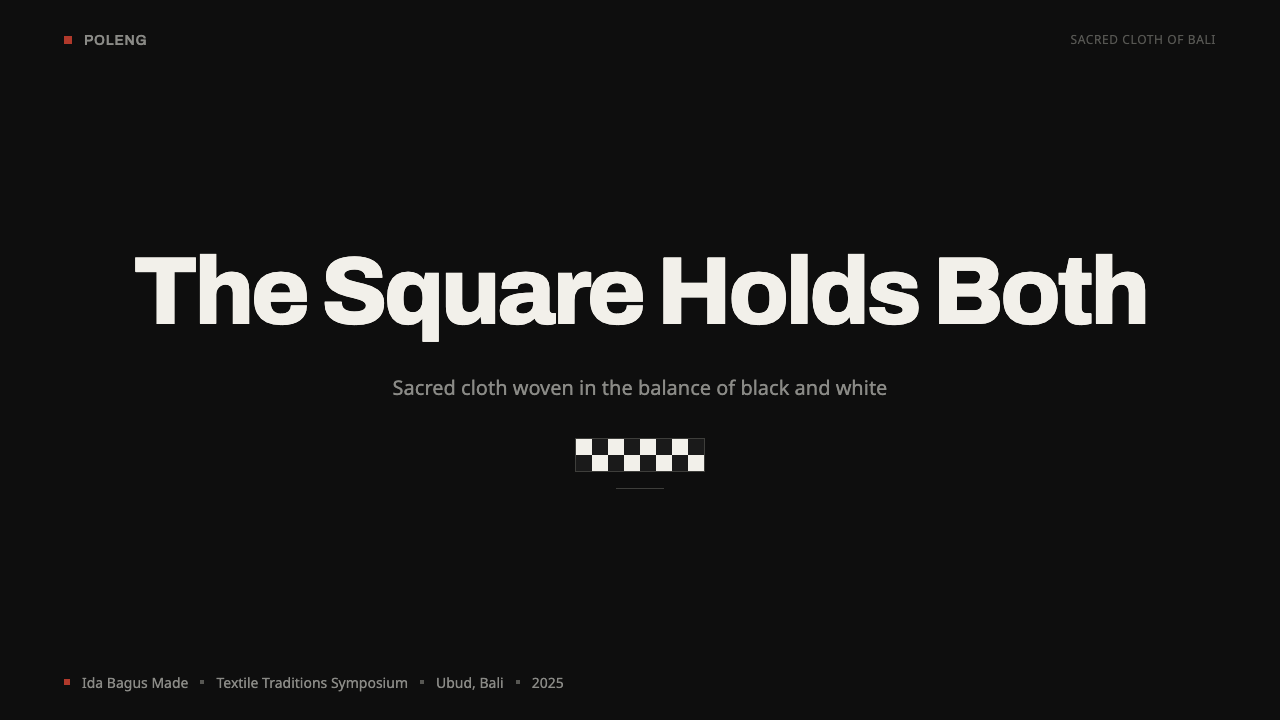
For presentation slides, poleng's binary logic works best as a structural device rather than a full-bleed background: a cover slide can use a tight checkered band as a graphic anchor framing a title set in the deep black tone, while content slides borrow the pattern's discipline more than its literal grid — strict two-tone contrast for emphasis, with a single red accent reserved for the one number or claim that matters most, echoing the restrained role red plays in the Tridatu variant. Data slides can use the checkerboard's orthogonal logic directly as a background grid for tabular or matrix-style data, where the alternating dark and light cells organize information the way the original organizes ritual space.
For web interfaces, poleng's high-contrast, deep-black-anchored palette suits products that want to read as serious, weighty, or protective in tone — security tools, premium dark-mode dashboards, or any product wanting to avoid a light, casual register. The checkerboard grid itself is best used sparingly, as a bordered accent or a background texture at small scale, rather than covering large functional surfaces, since its power comes from restraint and precise placement rather than density of coverage.
For editorial and marketing work, the pattern reads strongly as a graphic device for section dividers, pull-quote frames, or a small motif reserved for moments that should feel weighted or significant — much as the physical cloth is reserved for objects understood to hold real power. A red accent, used exactly once per composition, can borrow the Tridatu variant's restraint to mark the single most important call to action or headline.
A common mistake when applying this style is treating it as a generic checkerboard pattern and scaling it up into a loud, all-over background — doing so drains the pattern of the gravity that comes from its association with sacred, protective use and reduces it to a casual textile motif indistinguishable from unrelated checker patterns in fashion or graphic design. The style works because it is precise, high-contrast, and deployed with intention on specific elements, not because checkerboards are inherently striking; losing that intentionality loses the style entirely.
Balinese Poleng Cloth — FAQ
What does the pattern in poleng cloth actually symbolize?
The black and white squares represent Rwa Bhineda, the Balinese Hindu concept of sacred duality — the necessary coexistence and balance of opposing cosmic forces such as good and evil, light and dark, order and chaos. It is not a symbol of conflict or of one force overcoming the other; it represents the doctrine that both poles must remain present and balanced for the world to function correctly.
Why is poleng wrapped around specific objects rather than used as a general decoration?
Poleng marks objects and figures believed to hold significant spiritual power or occupy a liminal position between the sacred and the ordinary world — ancient banyan trees, temple guardian statues, ritual figures such as the barong. Wrapping the cloth around such an object is a deliberate act that acknowledges its power while asserting that this power is held in careful balance, which is why the cloth is applied with religious intention by priests and temple custodians rather than used as casual decoration.
What are the Sudamala and Tridatu variants of poleng?
Sudamala replaces the standard black with a gray tone and is used specifically in purification ceremonies, while Tridatu adds a restrained amount of red into the black-and-white grid, referencing the Hindu trinity of Brahma, Vishnu, and Shiva. Both are ritual-specific variants rather than free stylistic choices — which variant is used depends on the nature of the ceremony or the object being dressed, determined by religious convention rather than individual preference.
Is poleng unique to Bali, or does similar checkered symbolism appear elsewhere in Indonesia?
Poleng in its specific form — tied to Rwa Bhineda cosmology and applied to sacred objects and guardian figures — is a distinctly Balinese Hindu practice, closely bound to the island's particular blend of Hindu religious doctrine and local ritual life. While checkered patterns appear in many textile traditions worldwide, poleng's meaning is inseparable from Balinese Hindu cosmology specifically, which is why the pattern is treated with religious rather than purely decorative significance on the island.
Does the design style capture poleng's religious meaning, or only its visual pattern?
A design system derived from poleng translates the visual grammar — the strict binary contrast, the orthogonal grid, the coarse-edged texture, the restrained ritual color variants — into a usable aesthetic language for screens and print. It draws on the pattern's formal discipline and visual logic rather than replicating or claiming the specific religious rite itself; the sacred function belongs to Balinese Hindu ritual practice, while the design system borrows its visual principles the way any historical style is studied and applied in new contexts.
Related design styles
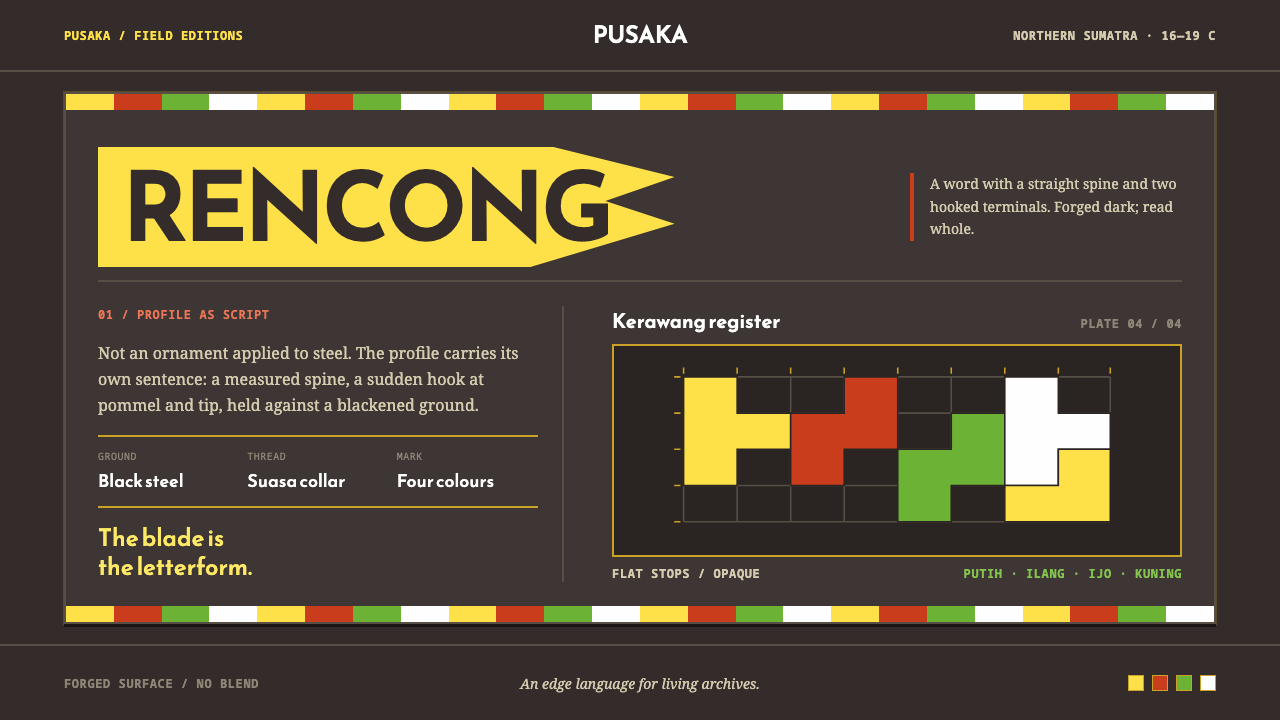 Acehnese Rencong MotifA blade that reads as a word. Flat kerawang red, white, green and yellow lock…
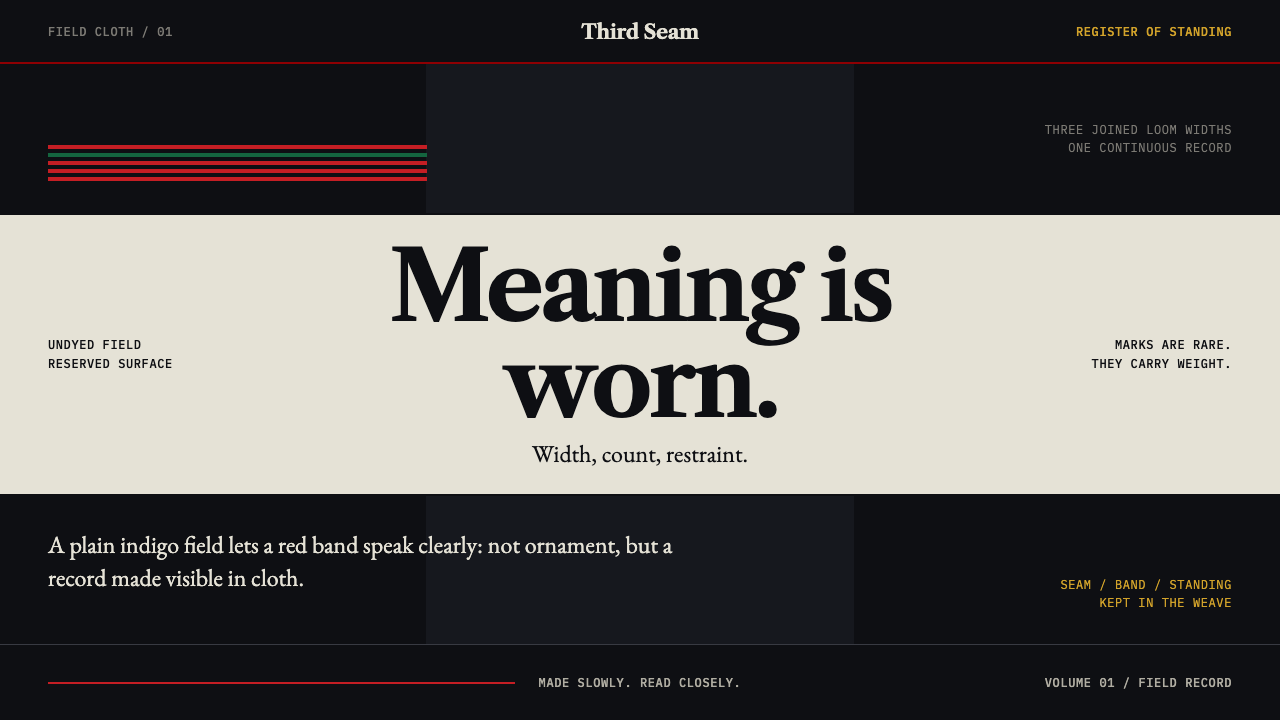 Naga Angami ShawlEvery stripe bears standing. Indigo seams frame rare red bands and one earned…
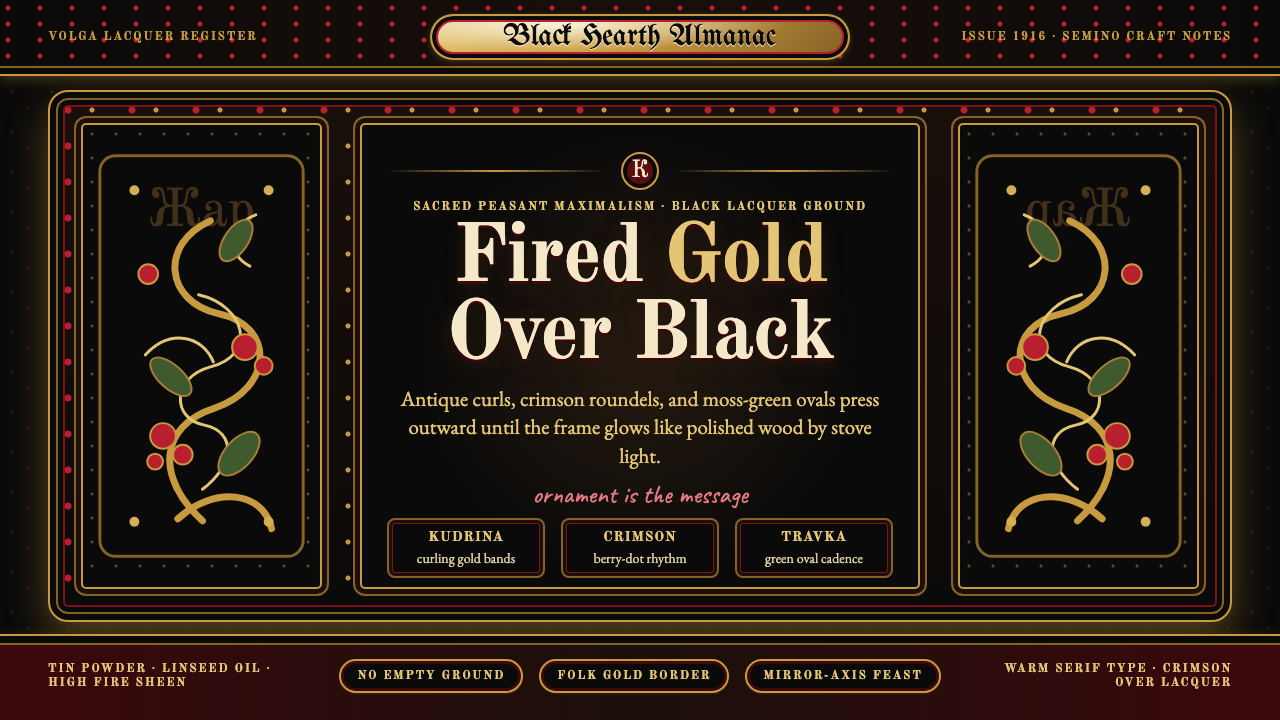 Russian KhokhlomaOrnament is the message. Antique gold curls and crimson dots crowd a black la…
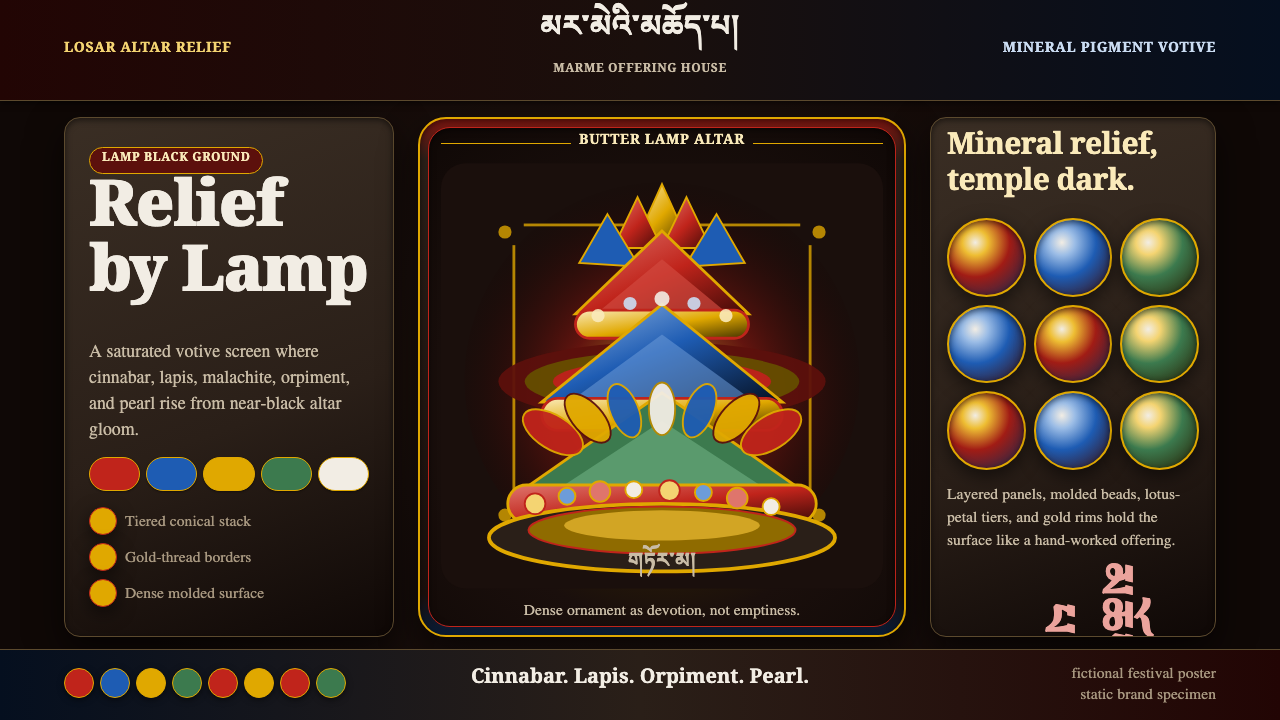 Tibetan Butter SculptureDevotion made dense. Cinnabar, lapis, and gold relief glow from altar black.
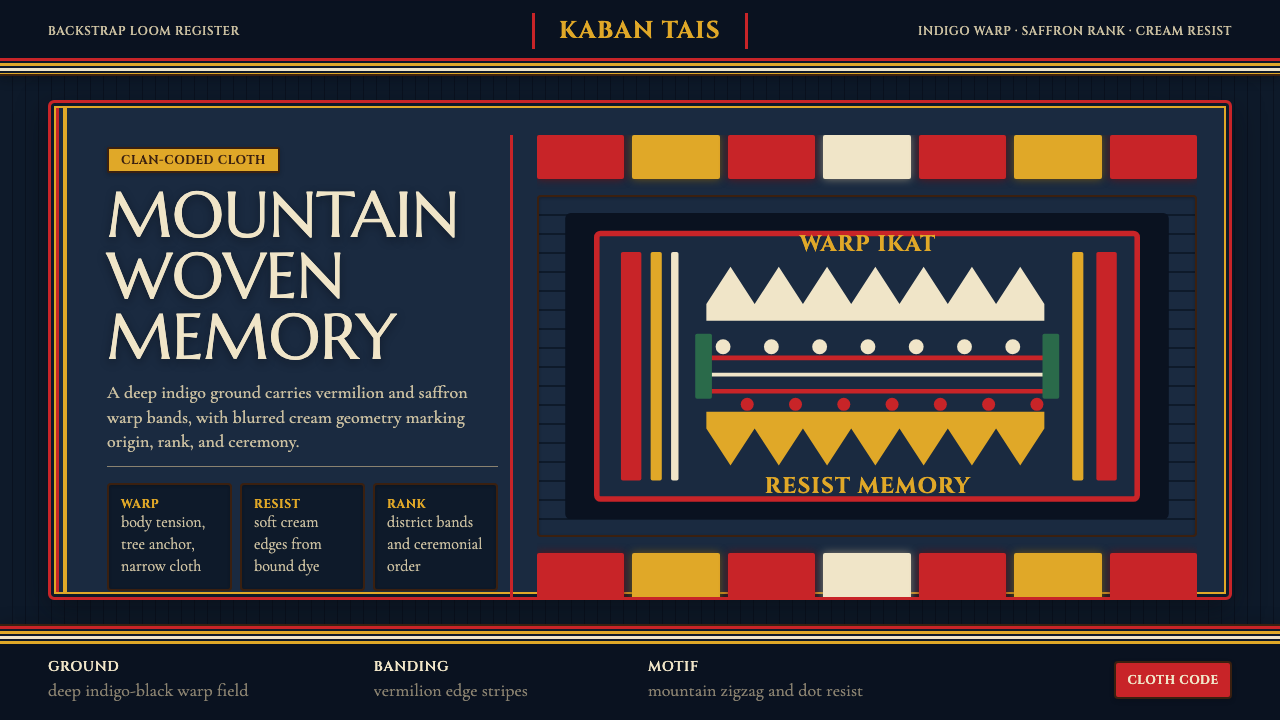 Timorese Tais (Backstrap Loom)Identity woven in darkness. Indigo ground, vermilion bands, saffron stripes,…
 Wood Type SpecimenLoud proof-bed authority. Vermilion slab type locks into a black gridded pres…