What is Sarakatsani Shepherds?
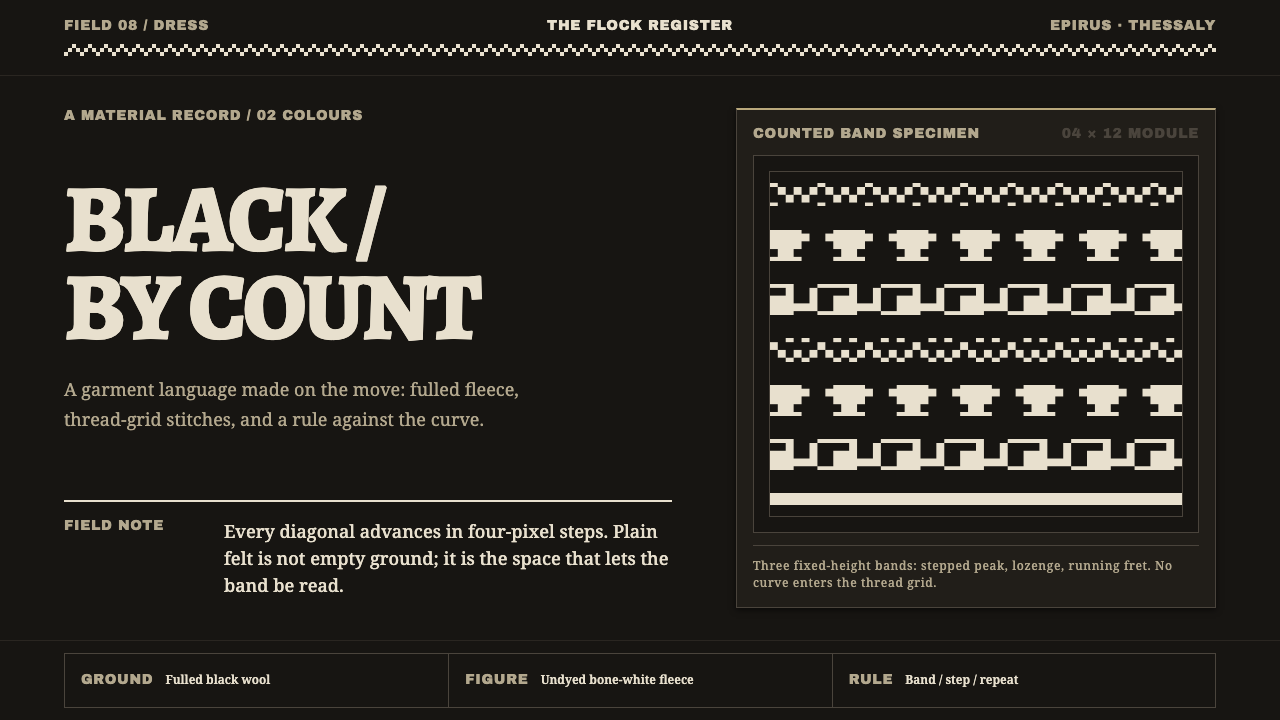
The Sarakatsani made their clothes from the flocks they walked with and reduced them to two colours — matte black wool and bone-white thread — counted into stepped bands that echo Greek vase painting.
Sarakatsani Shepherds in brief
Sarakatsani Shepherds is a design system drawn from the dress of the Sarakatsani, a nomadic pastoral people of northern Greece and the wider Balkans who drove their flocks between summer mountain pasture and winter lowland. Their clothing is the source: a fulled black wool cloak and a woman's over-dress, the fustani, worn above a chemise of undyed bone-white fleece, with ornament counted onto the cloth in horizontal bands. Everything reduces to two colours, and almost everything that is not plain black is a stepped band.
The visual effect is discipline woven into darkness. The ground is matte, the black soaked into thick fulled wool rather than printed on a smooth surface. The white is not the glare of paper but the warm cast of untreated fleece. The pattern is geometric, counted and angular, with no curve anywhere. Wide areas of plain black are left empty on purpose, so the narrow bands of ornament read like a ruled score across a dark page. It is a style that is quiet, severe and exact — the opposite of the exuberant, flowery picture the word 'folk' often suggests.
As a design language it makes an unusual proposition: richness without colour. Hierarchy, rhythm and decoration are all carried by structure — band height, band order, motif density, the proportion of pattern to plain — rather than by hue. Where most dark interfaces reach for a neon accent, this one achieves emphasis by counting.

Where does Sarakatsani Shepherds come from?
The Sarakatsani were transhumant pastoralists: twice a year they moved their flocks between high summer pasture and low winter ground, across Epirus, Macedonia and Thessaly in Greece and into the wider Balkans. Dress in that life had to be warm, hard-wearing, repairable and made from what the flock itself supplied. The result is a wardrobe with an almost closed production loop. Wool was spun, woven, fulled and embroidered inside the community, with no step outsourced, which explains why Sarakatsani dress looks so unlike other Greek regional costume. There is no floral colour and no painted accent. The palette is simply what two kinds of wool give you: fleece fulled into a dense black cloth, and fleece left undyed.
The ornament is counted cross-stitch worked on a thread grid. Because the stitcher follows the weave of the cloth, every diagonal climbs in steps and no line can be a true curve. The vocabulary is correspondingly short: triangles, lozenges, chevrons and the running meander, packed into horizontal bands of fixed height with plain black left between them. On a dark cloak or fustani the white shows mostly where the chemise and the stitching catch the eye, at the sleeves and the hem, so the black body of the garment is punctuated rather than covered. Fixed band height, plain intervals, one repeat per band: the garment is built like a ruled table.
Scholars have long set this geometry beside Greek Geometric vase painting of roughly the eighth century BCE and found the same grammar: banded decoration, stepped triangles and meanders, and the same refusal to let ornament float free of structure. Whether that is continuity, convergence or the shared logic of any counted, rhythmic craft is a question for specialists, and this article claims no direct lineage. What matters for design is that the grammar is demonstrably old, stable and self-consistent, which is why it adapts so well to a system.
The dress is documented from the nomadic period, before the community's settlement in the middle of the twentieth century, and this system's references are ethnographic and museum-based: the writing of John K. Campbell and the folk-costume collections of the Benaki Museum. Its origin is dated before 1900, but it belongs to a way of life rather than a moment. The grammar was fixed by use, repair and repetition, not by a designer's brief.
What defines the Sarakatsani Shepherds look?
Two Colours
Fulled black wool is the field and undyed bone-white fleece is the only contrast; nothing else is introduced. The white is warm and slightly dull, the cast of untreated wool rather than a bright screen white, and the black is dense and unreflective. Hierarchy is made by how much white appears and where it sits, never by adding another hue.
Matte Felted Surface
Because the cloth is fulled, its surface is dense, soft at the edge and non-reflective. On a screen that means no gloss, no glass and no glow: surfaces absorb light rather than emit it, and depth comes from the weight of the black, not from shadows or gradients. A Sarakatsani interface should feel like heavy cloth, not like polished metal.
Counted, Stepped Geometry
Every motif is built on a thread grid, so each diagonal climbs in steps and no true curve exists. The vocabulary is triangles, lozenges, chevrons and the running meander. Translated into an interface, this means square units, stepped diagonals, right-angled terminals and no rounded corners. The pattern should look constructed from a grid, because it was.
Fixed-Height Bands
Ornament is organised into horizontal bands of fixed height, each repeating a single motif, with plain black between them. The band is the layout unit: pattern never drifts across the whole surface or breaks the horizontal order. Think of a ruled page where each band is one line of writing and the black around it is the margin.
Plain Black as Rest
Wide areas of uninterrupted black are intentional, not leftover. The ratio of plain to patterned is high, and that restraint is what gives each band its weight. In digital terms: generous empty space on a matte field, with pattern spent like something precious.
Short, Abstract Vocabulary
The ornament is built from only a handful of abstract motifs, repeated with small variations in scale and combination. It reads as rhythm rather than picture, and the system leaves no room for figurative illustration. Richness comes from repetition and from the order of bands, not from adding new kinds of shape.
Material Dictates Style
Because the community spun, wove, fulled and embroidered the cloth itself, the restraint is an economic fact, not a mood. There are two colours because the flock yields two kinds of wool. The lesson for designers is that the strongest constraints come from material and production, and a system built on such a constraint feels inevitable rather than styled.

Who shaped Sarakatsani Shepherds?
Campbell is one of the two references this system names, and his writing is the scholarly source behind its picture of Sarakatsani life. A reference like this matters to designers because it ties the clothing to its setting, the flock, the family and the seasonal move, instead of treating the pattern as free-floating ornament.
The Greek museum is the other reference this system names, and its folk-costume collections are where dress like this is kept as physical evidence. Collections matter because they fix what the cloth really looked like: the proportion of black to white, the height and order of the bands, the way stitched triangles and meanders repeat.
The seasonal herding life supplies the whole logic of the style: portable, warm, repairable clothing made entirely from the flock. It is the root of both the material palette and the self-sufficient production loop, and the reason this design system treats restraint as a structural fact rather than a taste.
The wider tradition of Greek regional dress and embroidery is the context in which Sarakatsani clothing stands out. Against it, the black-and-white cloth is notable for what it leaves out. The comparison is useful when deciding how much ornament a Sarakatsani-inspired layout can afford.
Greek Geometric decoration, with its banded fields, stepped triangles and meander, is the ancient parallel that scholars set beside the Sarakatsani cloth. It matters here as proof that the same grammar can survive across very different materials and periods, which is exactly what a portable design system needs.
How do you use Sarakatsani Shepherds today?
Sarakatsani Shepherds works best when you want gravity and craft without colour. It is a style of weight and measure, suited to material that deserves a slow read. The first decision is the two-colour rule: a matte black field, a single bone-white contrast, and nothing else. Everything that follows is a question of proportion, how much white and where.
For slides, a cover is a near-empty black field with one stepped band across the lower part and a title in bone-white, leaving most of the surface unmarked. Content slides use a band as the header rule and as the divider between sections; text is set in a single contrast colour with generous margins. Data slides suit counting: bars drawn as stepped blocks, tables ruled by bands, comparison by position and by filled versus outlined shapes rather than by hue.
For web interfaces the style suits documentation, portfolios, heritage and craft brands, textile and wool commerce, and long-form reading. Headers and section breaks become banded strips; cards are separated by plain black rather than by shadows; buttons are square-cornered bone-white blocks. Pricing tiers can be told apart by band density instead of colour. Because the geometry is stepped, keep corners square and edges crisp, and let focus and selection states appear as bands.
In editorial and marketing work the style fits long features, cultural reports, outdoor or pastoral brands and anything with a serious, hand-made story. Monochrome photography sits comfortably in it, and a narrow ornamental band can run down a page margin as a quiet signature. The most persuasive marketing here is the kind that lets the black breathe and trusts the reader.
The common mistakes are all additions. Adding a third colour, such as gold or red, to feel more 'Greek' pulls the system toward the blue-and-white Mediterranean cliché and away from its actual severity. Smoothing the diagonals into curves or rounding the corners removes the thread grid that gives the pattern its logic. Filling the black with texture or glow ruins the matte rest. And reversing the proportion, with a white page carrying black pattern, discards the fact that bone-white is the scarce, precious element here.

Sarakatsani Shepherds — FAQ
Who are the Sarakatsani, and is this a costume replica?
The Sarakatsani were nomadic shepherds of northern Greece and the wider Balkans who moved their flocks between summer pasture and winter lowland. The system is not a costume replica. It takes the structure of their dress, two colours, matte cloth, counted geometry and fixed bands, and applies it to interfaces and documents. The goal is the discipline of the cloth, not its literal appearance.
Why only two colours?
Because the community made its clothing from its own flock. Fulled black wool gave the cloak and the over-dress, undyed fleece gave the chemise, and there was no third material. In design terms the two-colour limit is the idea of the system: when only one contrast is available, structure has to do all the work.
Is the pattern really related to Greek vase painting?
Scholars have placed Sarakatsani ornament next to Greek Geometric vase painting and observed the same grammar of bands, stepped triangles and meanders. Whether that reflects continuity or convergence is a matter for specialists. For design purposes the useful point is that this is a very old, very stable visual grammar that has worked on pottery and on wool alike.
How do I draw stepped diagonals on screen without it looking like retro pixel art?
Build each motif from square units on a regular grid and keep the units large enough to read as cloth, not as a low-resolution screen. Use the pattern in confined bands, with generous plain black around it, so it reads as ornament on a garment rather than as a texture. The origin is a thread grid, so a grid-built look is correct; it is the smoothing and the glow that would be wrong.
Can this style work on a light background?
It is native to a black ground, and the theme is classified as dark. A light variant can keep the banding, the stepped geometry and the two-colour rule, but it loses the central fact that the bone-white element is rare against a dense black field. If you must invert it, keep the pattern sparse and the plain area dominant, so that the ornament is still the exception rather than the rule.
Related design styles
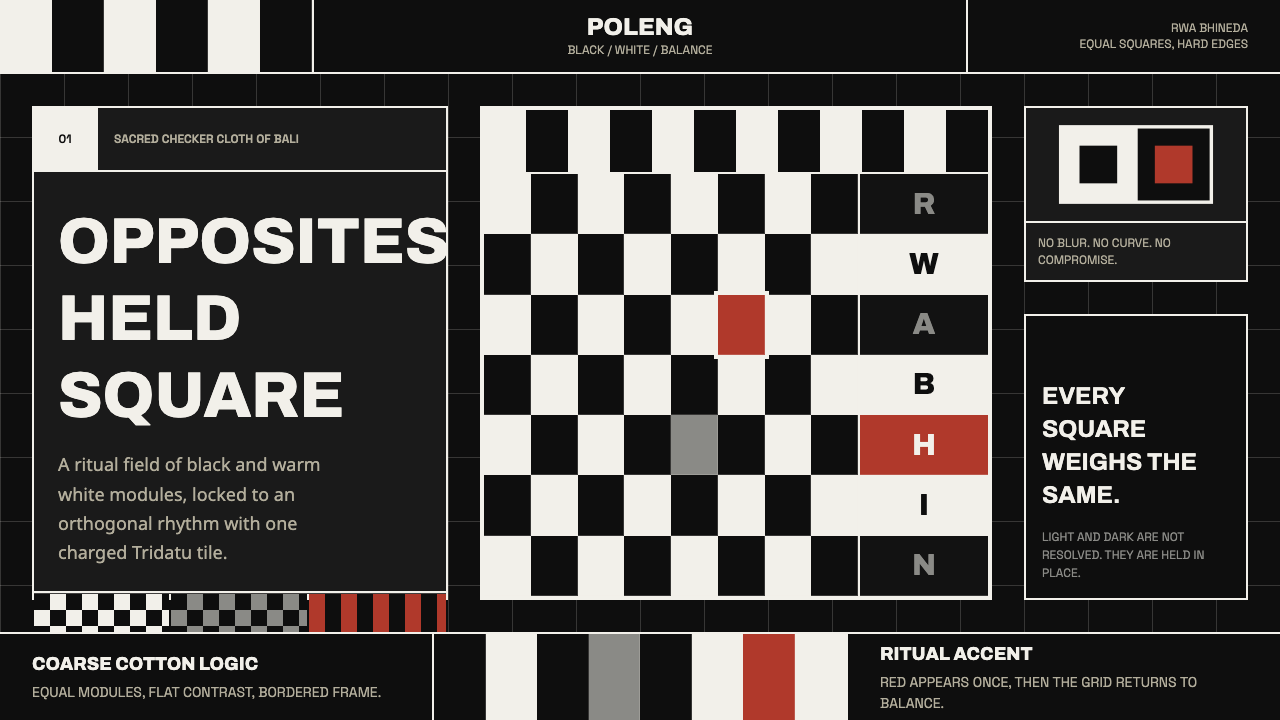 Balinese Poleng ClothSacred duality holds. Black-white squares lock the field; one red tile charge…
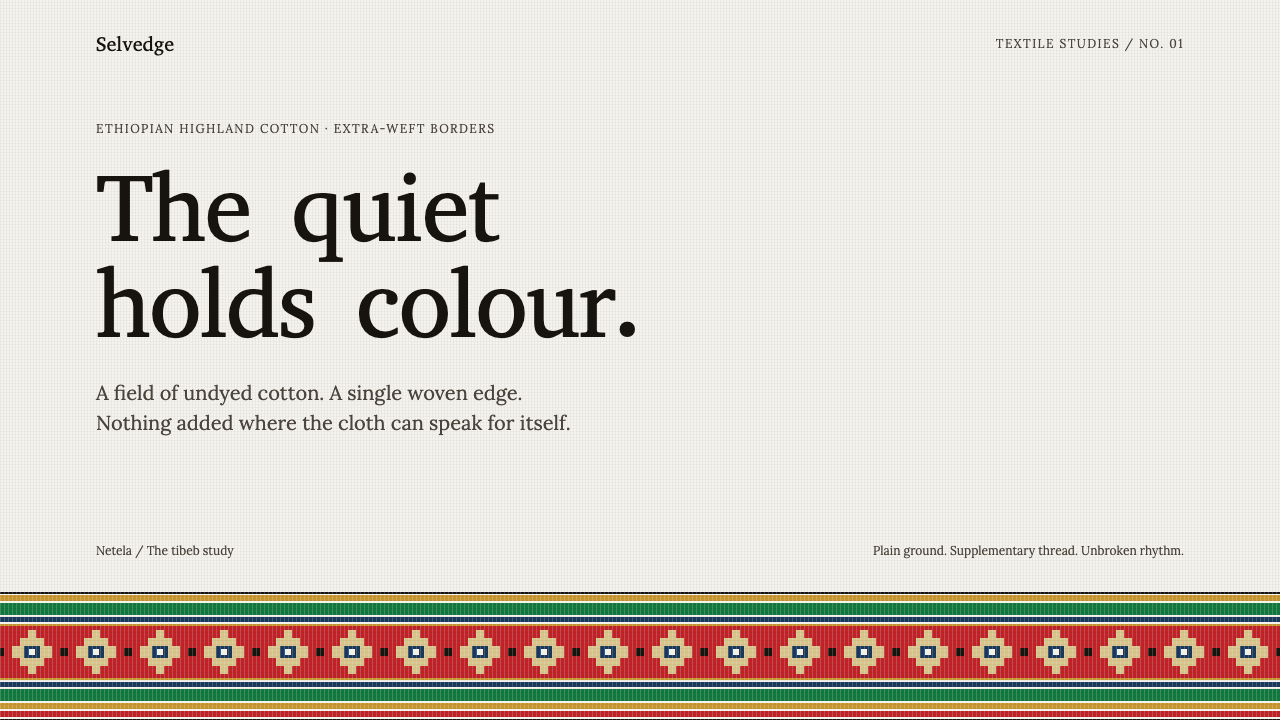 Ethiopian Tibeb BorderThe edge does all the talking. Undyed cotton white meets one dense red, green…
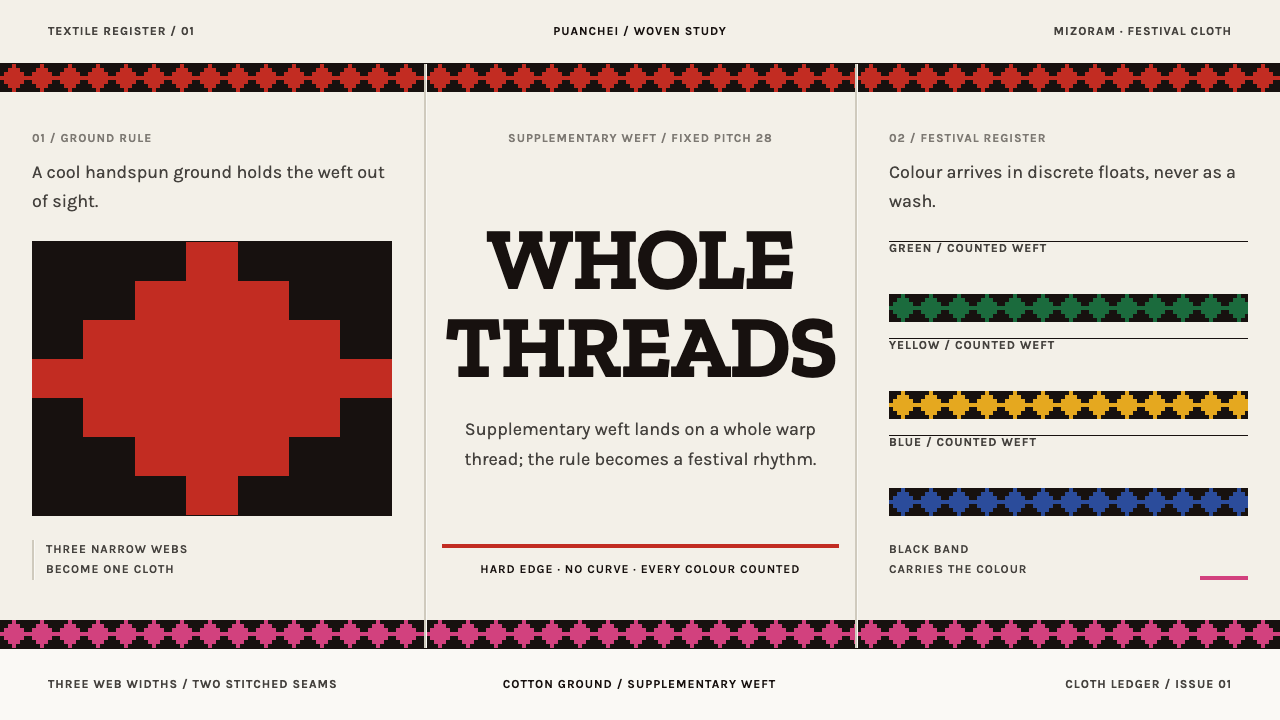 Mizo PuancheiWhole threads make the rhythm. Cool cotton, black bands and stepped festival…
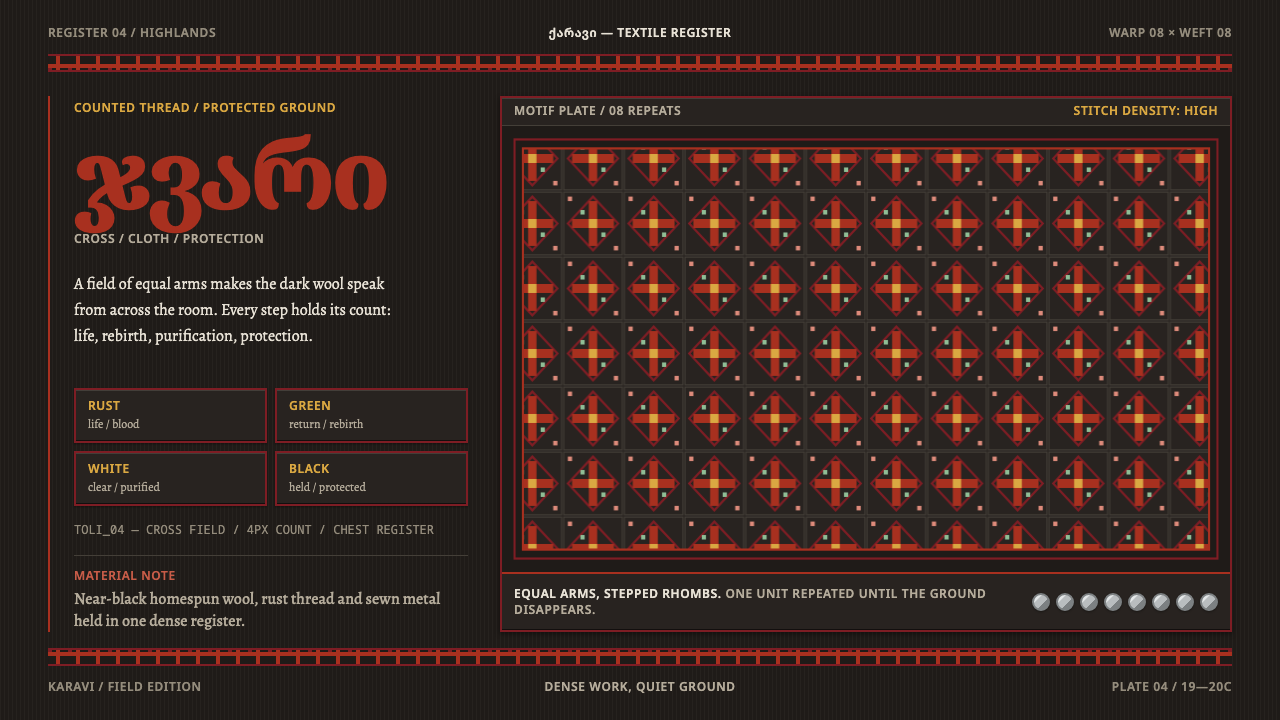 Khevsur Cross EmbroideryDensity carries meaning. Rust crosses tile near-black wool; silver coins punc…
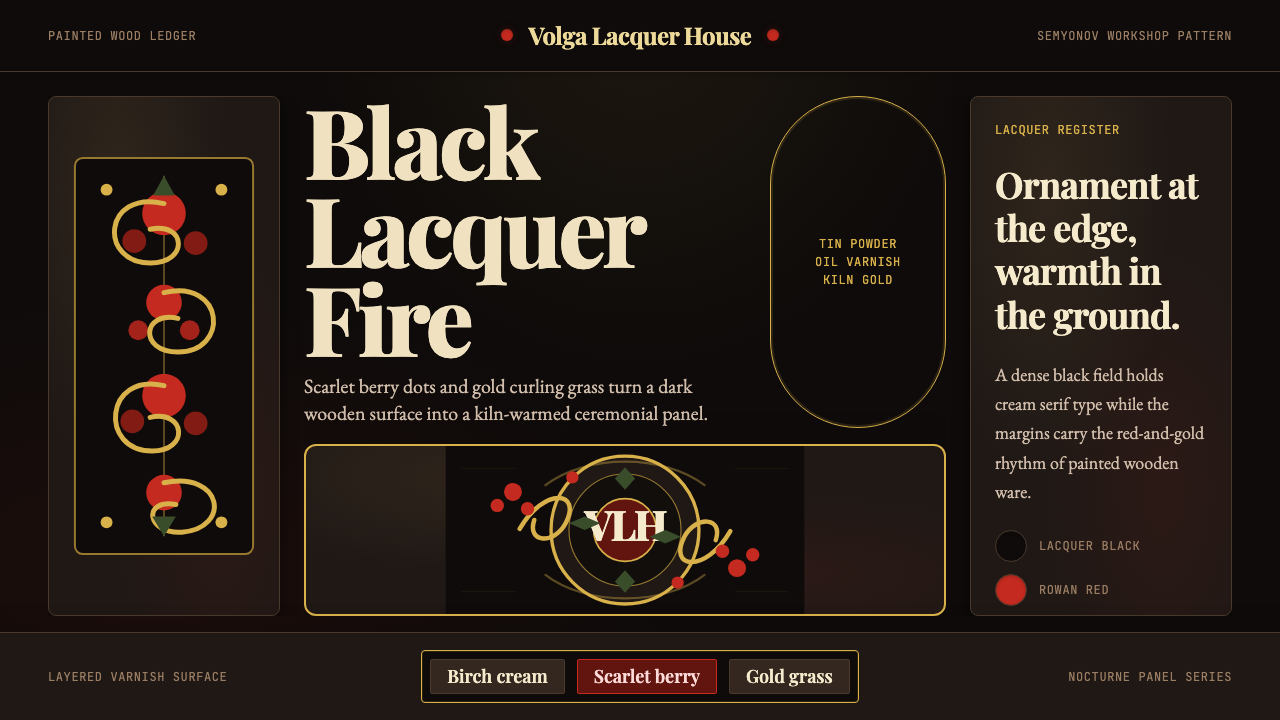 Russian Khokhloma Wood-Red LacquerKiln-fired ornament. Lacquer black, scarlet dots, and Playfair gold curls cro…
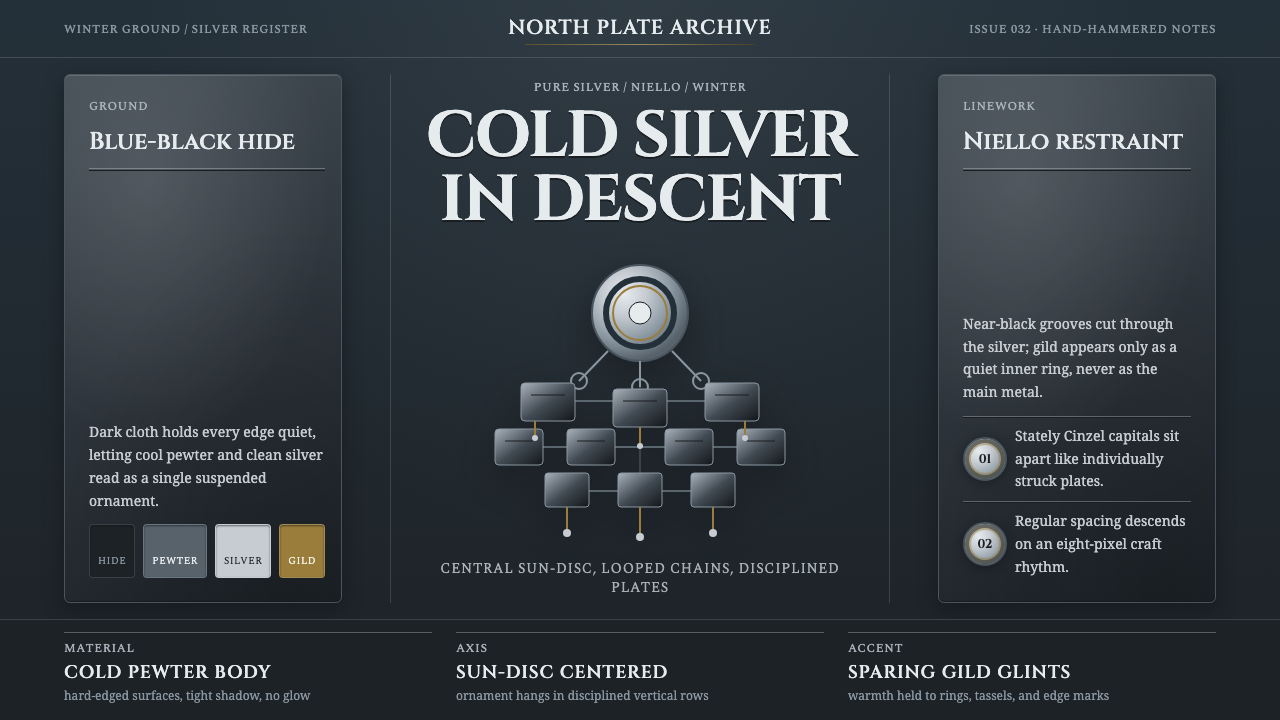 Sakha Yakut Silver BreastplateCold silver hangs in ritual order. Blue-black ground, Roman capitals, and nie…