What is Ethiopian Tibeb Border?
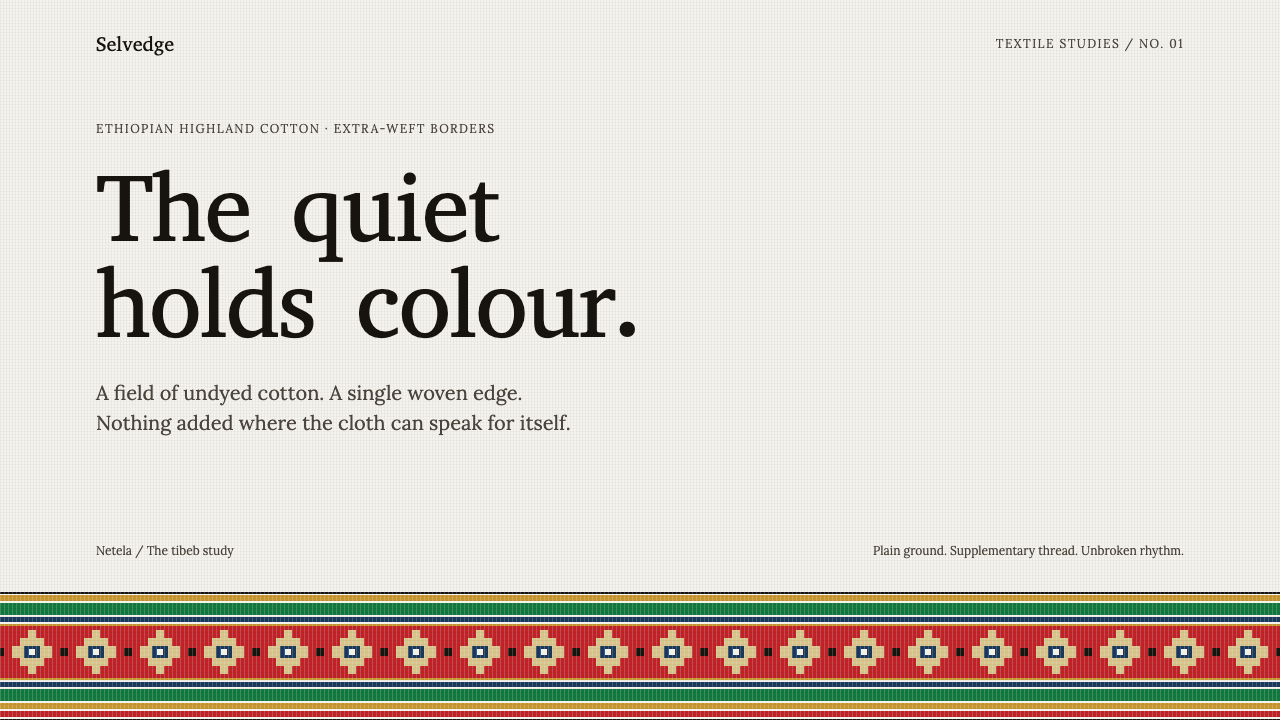
Ethiopian Tibeb spends almost nothing on the field and everything on the edge: a wide, quiet expanse of undyed cotton white, held in place by one dense woven band of red, green and gold.
Ethiopian Tibeb Border in brief
Ethiopian Tibeb is a design style drawn from the netela, the sheer cotton shawl of the Ethiopian highlands, and from the tibeb, the woven border that runs along its edge. The netela is spun from highland shema cotton, woven on a pit loom and left the colour the fibre came in: a cool, faintly translucent white. Everything decorative happens in one place. The tibeb is an extra-weft border laid in along the selvedge, worked in cotton, silk, metallic thread or rayon floss, and it is the only part of the cloth that speaks.
The whole idea is proportion. An enormous quiet field meets a single saturated band at its edge, and the tension between the two is the composition. In Orthodox practice the emptiness of the white is not absence but readiness: the colour signals cleanliness and preparation, so a cloth that dares to stay blank is making a statement rather than running out of ideas. A design system built on the same principle spends its restraint deliberately. It keeps the plane bare and lets one stack of hard-edged woven stripes carry the entire voice of the page.
On screen the style is easy to recognise once you know what to look for. The ground is a cool, slightly bluish white rather than a warm cream, and it is allowed to be very large. The border is dense, saturated and strictly rectilinear: stripes with square ends, small repeating geometric units, and a faint grain of thread running through every band. Red, green and gold belong to the band and almost nowhere else. There are no rounded corners, no gradients, no worn-in texture and no pattern scattered across the open space, because the cloth itself never does any of those things.

Where does Ethiopian Tibeb Border come from?
The netela belongs to a weaving tradition that predates 1900 and is rooted in the Amhara and Shewa highlands of Ethiopia. Its raw material is shema, the cotton of the highlands, spun fine and woven on a pit loom, a loom whose foot treadles sit in a pit beneath the weaver. The work was historically carried by hereditary weaver guilds, the shemane, for whom the craft was a family inheritance. The cloth that comes off the loom is sheer, light and nearly translucent, which is exactly why it is worn as a shawl, layered over other garments rather than stitched into them.
Decoration entered the cloth through the border. The tibeb is a supplementary-weft technique: extra threads are laid into the weave along the selvedge, building a patterned band on top of an otherwise plain ground. Because the border is its own layer of thread, it can be worked in materials the field never touches. Cotton gives a matte body, silk a soft sheen, metallic thread a glint of gold, and rayon floss a hard, bright colour. From about 1898 onward, plain shamma cloth began to carry multicolour tibeb borders, and the multicolour bands associated with the style today date from that period forward.
The cloth lives inside a larger vocabulary of dress. The netela, the shamma and the habesha kemis, the long dress the netela is traditionally worn over, form one family of garments, and the same white-with-border logic runs through all of them. In Ethiopian Orthodox Tewahedo liturgical dress, white is the colour of cleanliness and preparation, which is why the emptiness of the field carries meaning rather than leaving a gap. The borders then come out in full for Enkutatash, the new-year celebration, and for Meskel, the festival of the cross, when festival wear is at its most visible.
The Shiro Meda weaving quarter of Addis Ababa is where pit-loom weavers carry the craft on in the capital, and it gives the tradition a living address. That matters for the design language derived from it. Nothing about the style is nostalgic or distressed. It describes a cloth woven thread by thread, in which the weaver decides how much of the border to build and how much of the field to leave alone. The design system keeps that decision visible: the page is the netela, and the band is the only argument it makes.
What defines the Ethiopian Tibeb Border look?
The Bare Field
The base is undyed cotton white, cool in temperature and faintly translucent, never cream and never paper-yellow. It occupies the overwhelming majority of every layout. Treat it as an active element rather than empty background: the field is what makes the border legible, and filling it with panels, illustrations or tinted bands would destroy the reading the cloth depends on.
The Single Band
All decoration is concentrated in one band along one edge, echoing the selvedge of the cloth. The band is built as a stack of stripes of differing widths, packed tightly with no gaps between them and no soft transitions. One band per composition is the norm. A second band starts to turn a shawl into a patterned fabric, and the proportion that gives the style its authority is lost.
Red, Green and Gold
The band draws on red, green and gold, set against the white as dense, saturated colours with no tint and no transparency. The three behave like a team of woven threads rather than brand colours: they sit side by side inside the band, repeat in rhythm, and stay out of the field. A touch of metallic gold thread gives the band a glint that a flat fill cannot, so gold reads best as a thin warm line rather than a large area.
Hard-Edged Stripes
Stripes are straight, square-ended and rectilinear. Small geometric units repeat along the length of the band the way a pattern repeats along a weaver's warp. Nothing curves, nothing blurs and nothing tapers. Corners stay sharp, because woven thread builds on a right-angled grid, and a sharp corner is therefore the honest expression of the material.
Woven Grain
Every band carries the faint grain of thread, a light texture that shows how the pattern was built. This is texture as evidence of making, not simulated fabric: it is subtle, regular and tied to the stripe it sits in. Photographic cloth backgrounds, heavy canvas effects and artificial wear are all off the table.
Flatness, No Lift
Cloth lies flat, so the style has no use for depth. There are no drop shadows lifting cards off the page, no glassy overlays and no bevels. Separation comes from the contrast between the quiet field and the saturated band, and from a clean line of space between elements, not from simulated elevation.
Quiet Typography
Text rests on the bare field in a calm, unornamented voice: dark, well spaced and generously leaded, with hierarchy built from size and position rather than from colour. The band, not the headline, is the loudest thing in the layout. Where type meets the band, it is set clear of it with ample room, so the border is never asked to compete with the words.

Who shaped Ethiopian Tibeb Border?
The shemane are the hereditary weaver guilds at the root of the tradition. Knowledge of shema cotton, the pit loom and the extra-weft border passed within families, which helps explain why the visual language is so consistent: the proportion of bare field to woven edge reads as a rule handed down rather than a style chosen. For designers, the guilds stand for the idea that restraint can be a craft discipline, not merely a taste.
The weavers of the Shiro Meda quarter in Addis Ababa carry the pit-loom tradition into the present, working in cotton, silk, metallic thread and rayon floss. Their choices of material set the range of the band, from matte cotton to glinting gold, and they are the reason this style is best described in terms of thread rather than ink: the pattern is built, not printed.
The Orthodox Tewahedo church provides the context in which the white of the netela carries meaning, signalling cleanliness and readiness in liturgical dress. It also ties the cloth to the festival calendar, including Enkutatash and Meskel, when borders are most visible. This tradition is why the style treats emptiness as a positive quality instead of a gap waiting to be filled.
How do you use Ethiopian Tibeb Border today?
Ethiopian Tibeb is a style of proportion, so using it well starts with measuring how much of a layout is empty before deciding what goes into the band. A reliable test is to cover the band with a hand: what remains should look finished, calm and almost blank. If it does not, the field has been over-filled, and no amount of polish on the band will rescue the composition.
On presentation slides, the cover is the strongest application. A mostly white slide with a title and subtitle in quiet type, and a single woven-style band running along the bottom or one side, reads instantly and costs nothing. Content slides keep the band as a thin edge strip or a section marker, with text and figures floating on the open white. Data slides suit the style when a chart is allowed to be mostly empty space: use red, green and gold as series colours in dense solid blocks with square ends, and let the white do the work that gridlines and background tints do elsewhere.
For web interfaces, the band works as a structural edge: the top of a header, the side of a navigation rail, or the leading edge of a highlighted card. Dashboards benefit from a bare, white working area with the band reserved for the current section or a critical status. Pricing pages can mark the recommended plan with one band on its edge and leave the other plans plain, which makes the choice legible without a badge. Forms and tables stay white, with hard hairlines and square corners.
In editorial and marketing work, the style supports slow, spacious layouts. A long article can open on a wide white masthead with a band along the top, followed by generous margins and a restrained headline. Campaign pages can use a full-width band as a section divider, repeated only a few times down the page, so that each return feels like the edge of a new cloth. Photography sits best inside the white field with no frame around it, and product shots on white belong comfortably inside the style.
The most common mistake is to treat the three colours as a general palette. Red, green and gold in large fills, on buttons, backgrounds and icons all at once, turns a disciplined cloth into a festival banner and removes the proportion that defines the look. Close behind are wrapping the band around all four sides of every card, scattering border motifs across the open field, rounding the corners of the stripes and overlaying a cloth texture on the white. Each of these spends the restraint the style exists to protect.

Ethiopian Tibeb Border — FAQ
What is the difference between a netela and a tibeb?
The netela is the whole sheer cotton shawl, woven on a pit loom from highland shema cotton and left undyed. The tibeb is the extra-weft border laid in along its edge, in cotton, silk, metallic thread or rayon floss. In design terms, the netela is the page and the tibeb is the band: the page stays quiet, and the band carries every bit of decoration.
Why does the style leave so much of the page empty?
Because the emptiness is part of the meaning. In Orthodox practice the white field signals cleanliness and readiness, so a large blank area is not a missing element but a deliberate one. It also does a practical job: with so much quiet around it, a single band is impossible to miss, and nothing else on the page needs to shout.
Can I use red, green and gold throughout the interface?
It is better not to. The three colours belong to the woven band and work because they are rare. Use them together inside the band, and keep the rest of the interface in white and a dark neutral for text. If you need an interactive accent elsewhere, borrow one of the band colours sparingly rather than introducing a new hue.
Does the style work on a dark background?
Not well. The look depends on a cool, undyed white. On a dark ground the emptiness stops reading as readiness and starts reading as absence, and the saturated band glows instead of looking woven. If a dark variant is unavoidable, keep a large white or near-white panel as the main field and let the dark appear only as a frame around it.
How is this different from other pattern-heavy folk styles?
Most pattern-led folk styles fill the surface. Ethiopian Tibeb does the opposite: it confines the pattern to a single border and leaves the rest of the cloth bare. The discipline is in what is withheld. If a layout scatters motifs across the whole page, it has left this style behind, however closely the individual stripes follow the tradition.
Related design styles
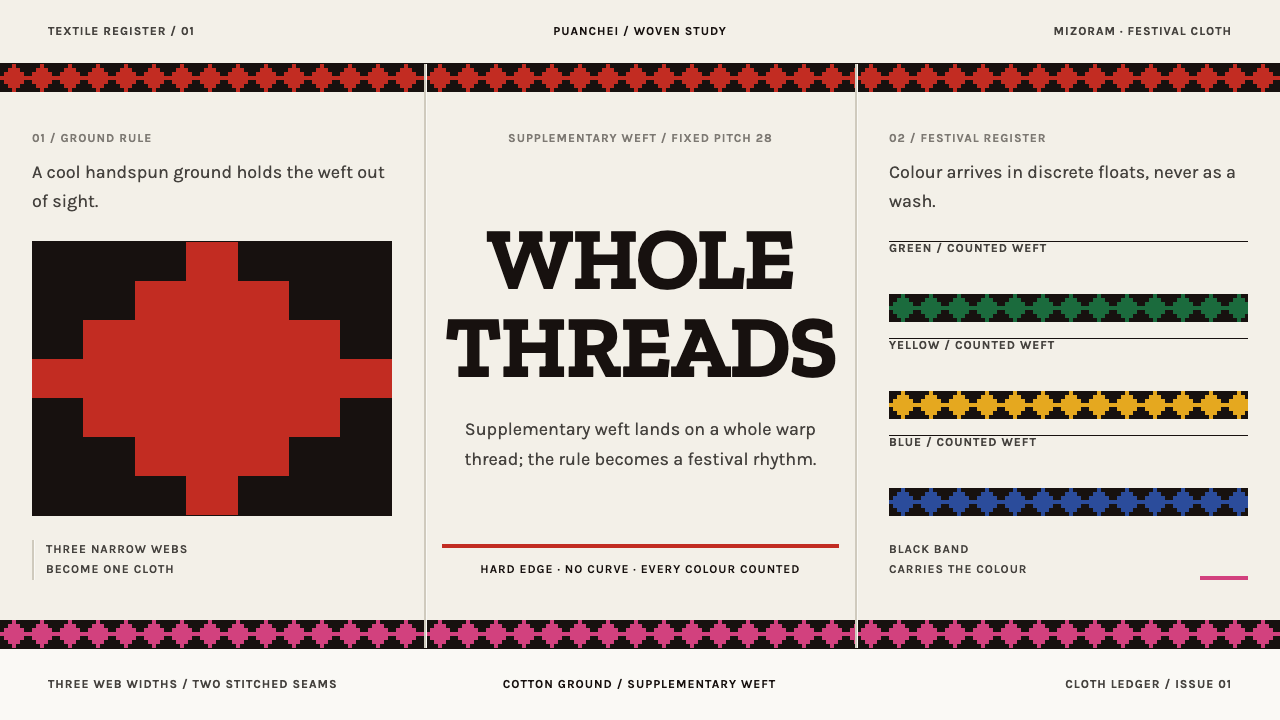 Mizo PuancheiWhole threads make the rhythm. Cool cotton, black bands and stepped festival…
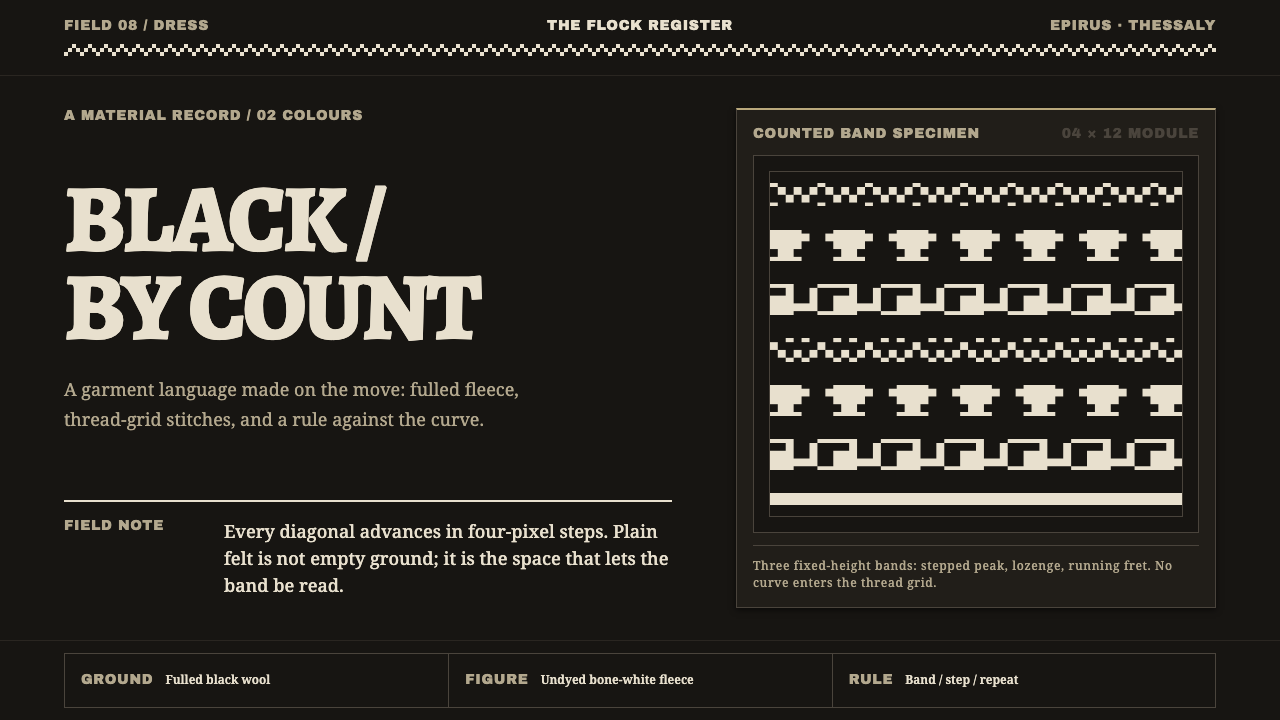 Sarakatsani ShepherdsDiscipline woven into darkness. Bone-white stepped bands count across matte b…
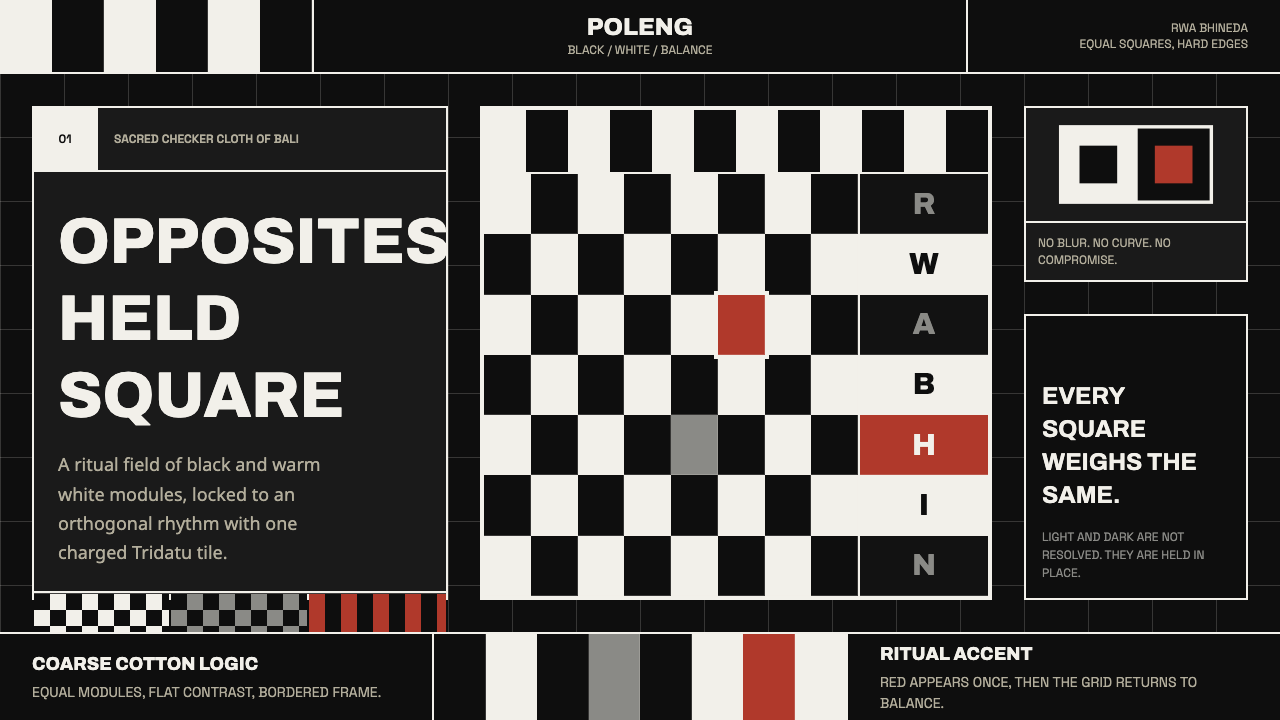 Balinese Poleng ClothSacred duality holds. Black-white squares lock the field; one red tile charge…
 Bamileke Elephant MaskRoyal density. Indigo bead fields lock white triangle rows into ceremonial po…
 Bissau-Guinean Pano de PenteIndigo remembers. Narrow bands and kaolin seams turn weave grammar into pixel…
 Danish Hedebo CutworkOrnament is cut, not applied. Bleached linen and bound shadow turn voids into…