What is Bamileke Elephant Mask?
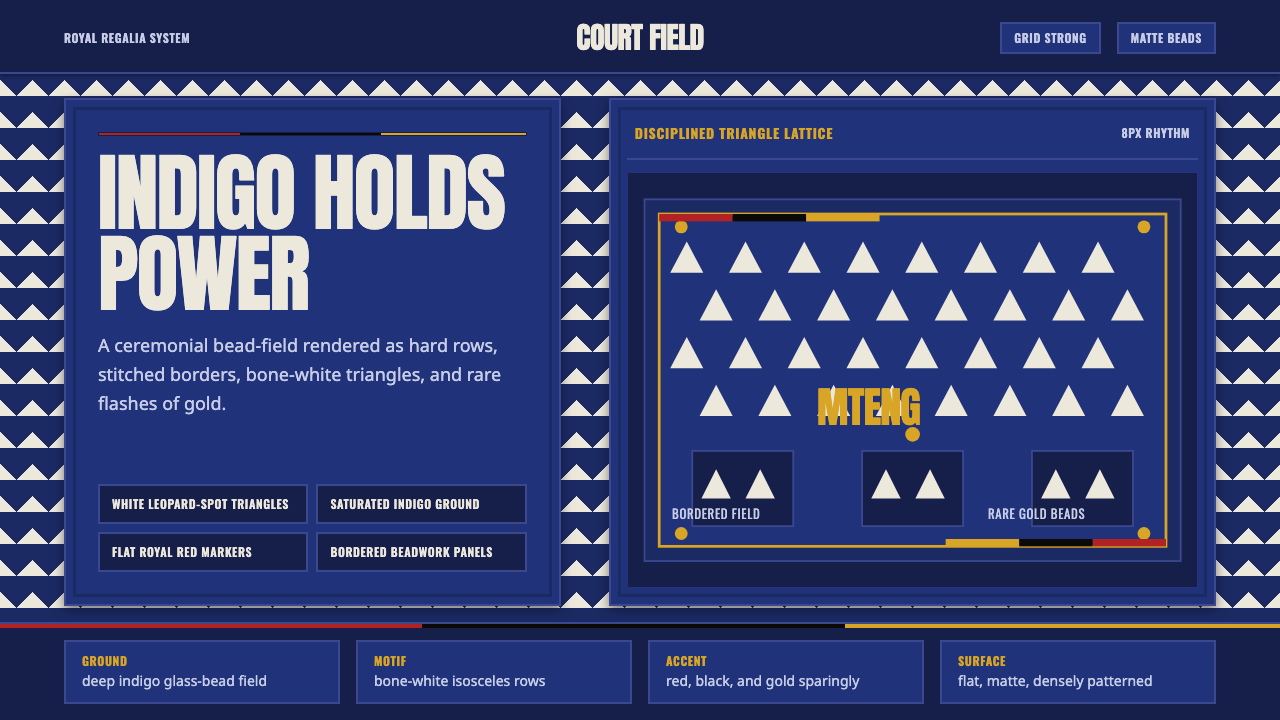
Bamileke Elephant Mask design turns royal regalia into a field of indigo, white triangles, and ceremonial density that feels assembled rather than decorated.
Bamileke Elephant Mask in brief
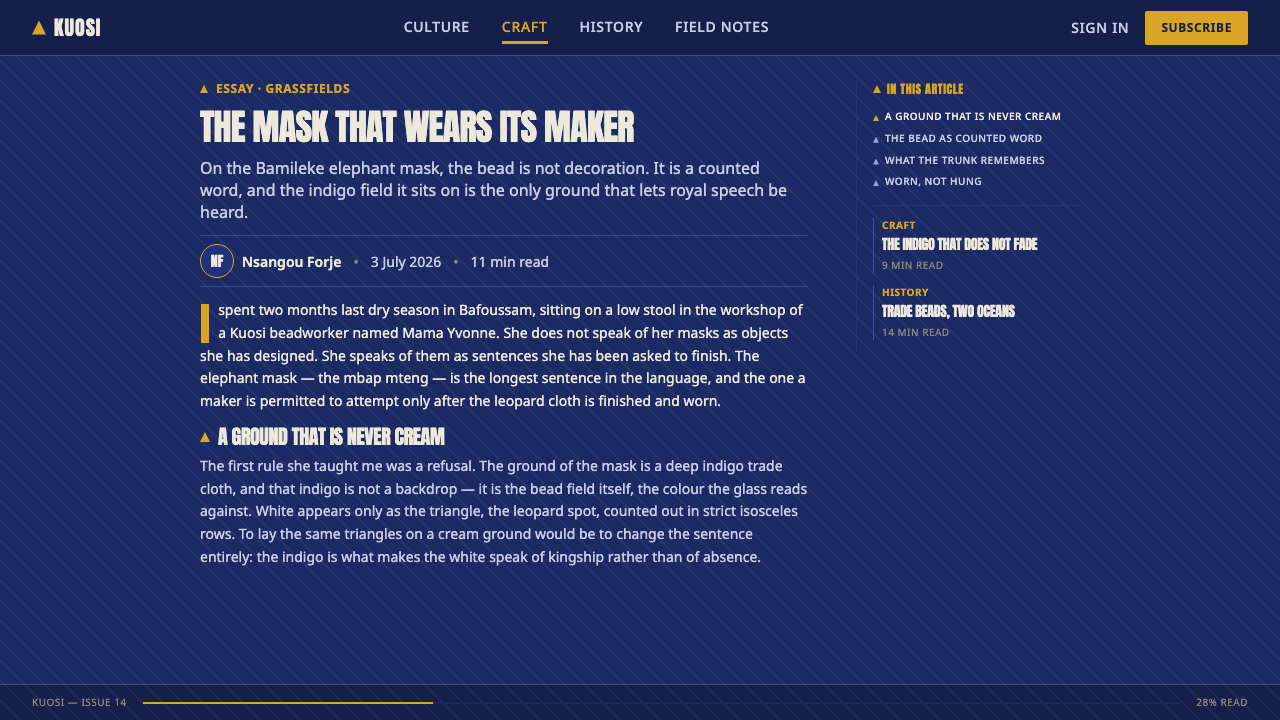
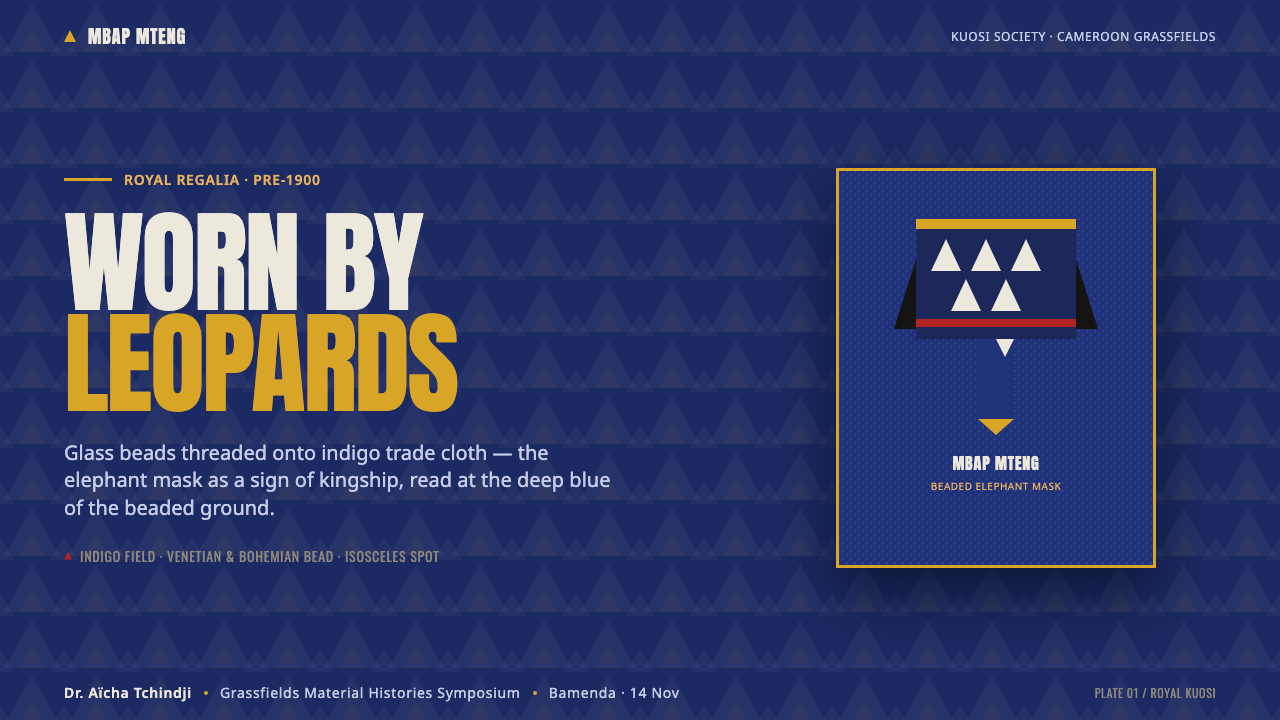
The Bamileke elephant mask, or mbap mteng, belongs to the royal regalia of the Kuosi elephant masking society in the Grassfields kingdoms of Cameroon. It is worn by titleholders close to the fon, or king. Its visual authority comes from accumulation: deep-indigo trade cloth covered in imported Venetian and Bohemian glass beads, ordered into white triangular rows that evoke leopard spots. Elephant and leopard symbolism converge here as signs reserved for royal power.
As a digital design language, the mask becomes a disciplined dark-ground system. Saturated indigo acts as an immovable field rather than a decorative background. White triangles repeat in rows with the firmness of beadwork, while royal red, black, and gold appear sparingly as accent beads. The central sensation is density: many small marks becoming one ceremonial surface.
This is not a soft or atmospheric style. Its surfaces should feel flat, matte, patterned, and deliberate. Repetition creates force, not visual noise; contrast is hard-edged; every accent must look selected from within a tightly controlled regalia rather than added for generic visual interest.
Where does Bamileke Elephant Mask come from?
The tradition belongs to the Bamileke peoples of the Cameroon Grassfields, a Central and West African region whose kingdoms continue a pre-1900 tradition of royal regalia. The mbap mteng is connected to the Kuosi elephant masking society and to the palace world surrounding the fon. Its restricted use is inseparable from its meaning: the mask is not simply an object with an animal image, but a visible sign of proximity to royal authority.
Its material language is shaped by glass-bead embroidery. Imported Venetian and Bohemian glass beads were worked over deep-indigo trade cloth until cloth and beadwork read as one dense surface. The result is visually unlike a painted pattern: each unit is separately placed, yet from a distance the field becomes rigid, shimmering, and unified. That tension between individual bead and collective pattern is essential to the style.
The white triangular rows carry the leopard-spot motif tradition. Their geometry is not casual abstraction. In the regalia, the repeated marks connect leopard symbolism to elephant symbolism, both reserved for royal meaning. Long beaded panels at the front and back evoke the elephant’s trunk and ears when the masquerader dances, making movement part of the visual system rather than an afterthought.
A contemporary interpretation should preserve this source logic. The aim is not to reduce a ceremonial object to an exotic pattern, but to learn from its structured relationships: indigo as ground, white triangular repetition as authority, limited accents as hierarchy, and dense craft as a visible expression of royal presence.
What defines the Bamileke Elephant Mask look?
Indigo Ground
Indigo is the unshakeable visual ground. It should feel saturated, deep, and matte, like trade cloth carrying beadwork rather than a luminous digital void. Large indigo fields create gravity and make every pale mark appear embedded within a royal surface.
Bead-Field Density
The style depends on close repetition. Small units should gather into a continuous field, suggesting painstaking bead embroidery without pretending to be literal texture. Density must remain ordered: the viewer should sense a grid, a rhythm, and accumulated labor.
White Triangle Rows
Hard-edged white triangles are the principal organizing motif. Their repeated rows recall leopard spots while remaining unmistakably geometric. They work best as a procession across the indigo field: firm in silhouette, consistent in rhythm, and never softened into decorative confetti.
Royal Accents
Royal red, black, and gold function like selected accent beads. They should punctuate hierarchy, direction, or important information rather than compete with the indigo-and-white structure. Their rarity is what gives them ceremonial force.
Matte Flatness
Nothing should feel glossy, misty, or softly illuminated. The regalia reads from a distance as a firm patterned plane, so digital surfaces should preserve that decisiveness. Depth comes from overlap, panel rhythm, and contrast, not from simulated lighting.
Ceremonial Hierarchy
The visual system should feel reserved and ranked. A dominant field, repeated motif, and rare accent establish a clear order before any content appears. This makes the style especially suited to work that needs authority, distinction, and a sense of guarded significance.

Who shaped Bamileke Elephant Mask?
Kuosi is the masking society associated with the mbap mteng. Its role establishes the mask as royal regalia rather than general costume, and explains why the elephant form carries ceremonial authority within the Grassfields kingdoms.
The fon is the king at the center of the royal context surrounding the mask. The restriction that only titleholders close to the fon may wear it gives the design system its essential logic of proximity, rank, and controlled display.
Palace bead-embroiderers serving the fon created the dense beadwork language that defines the regalia. Their work transforms imported glass beads and indigo cloth into a surface whose power comes from disciplined placement and cumulative detail.
How do you use Bamileke Elephant Mask today?
For presentation covers, let an indigo field carry the full visual weight. Introduce a disciplined band or cluster of white triangles, then reserve a small royal accent for the title or key marker. The cover should feel like an announcement of rank, not an illustration of a mask. On content slides, keep text areas calm and legible against the pattern, using the repeated motif to frame information rather than occupy every available space.
Data slides can use the triangle row as an ordering device for categories, stages, or repeated measures. Treat charts as part of the bead field: strong pale marks on indigo, with red, black, or gold used only to identify exceptions or priority. Avoid soft multicolored visualizations, because they dissolve the disciplined hierarchy that gives the style its force.
For web interfaces, this language works well for dashboards, member spaces, analytical tools, and premium pricing pages where authority matters. Use indigo as the persistent ground and reserve pale triangular patterning for headers, navigation zones, status bands, or key panels. Important actions should be visibly rare and deliberate, like accent beads placed against a stable field.
For editorial and marketing work, create a contrast between dense ceremonial sections and quieter reading zones. A long-form article can open with an indigo patterned banner, then use restrained triangular dividers or marginal markers to carry the visual identity through the page. The common mistake is to turn the motif into generic wallpaper: if triangles, accents, and patterns appear everywhere with equal intensity, the sense of hierarchy and royal restraint disappears.
Bamileke Elephant Mask — FAQ
Is this style simply a dark geometric pattern?
No. Its geometry comes from a specific royal regalia tradition: white triangular rows evoke leopard spots on an indigo beaded surface, while the elephant mask belongs to the Kuosi society. A successful interpretation preserves density, hierarchy, and ceremonial restraint instead of using triangles as anonymous decoration.
Why are white triangles so important?
They are the central repeated sign in the source material. Arranged in rows, they read as leopard-spot motifs while giving the surface a hard, legible rhythm. Their value lies in disciplined repetition, so changing every triangle into a different decorative shape weakens the connection to the regalia.
Should red, black, and gold all appear prominently?
No. They are described as flashes or accent beads against the indigo and white structure. Use them to distinguish what matters most, not to replace the primary field. When every accent becomes equally loud, the design loses the concentrated authority of beadwork.
Can the style use gradients, glow, or soft shadows?
Those effects work against the source language. The intended reading is flat, matte, hard-edged, and densely patterned, like beadwork becoming a rigid grid at a distance. Create emphasis through contrast, repetition, and panel relationships rather than atmospheric lighting.
Related design styles
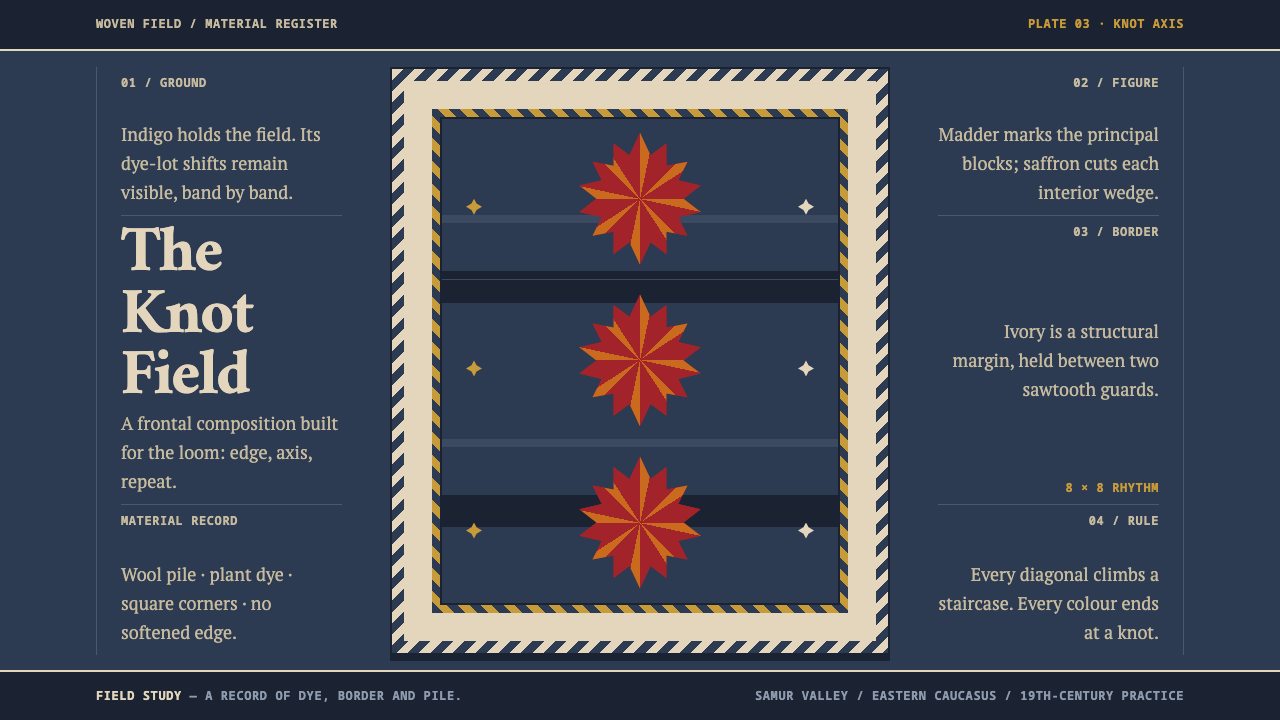 Lezgin Star WeaveKnot logic, made monumental. Madder stars lock into abrash indigo and ivory g…
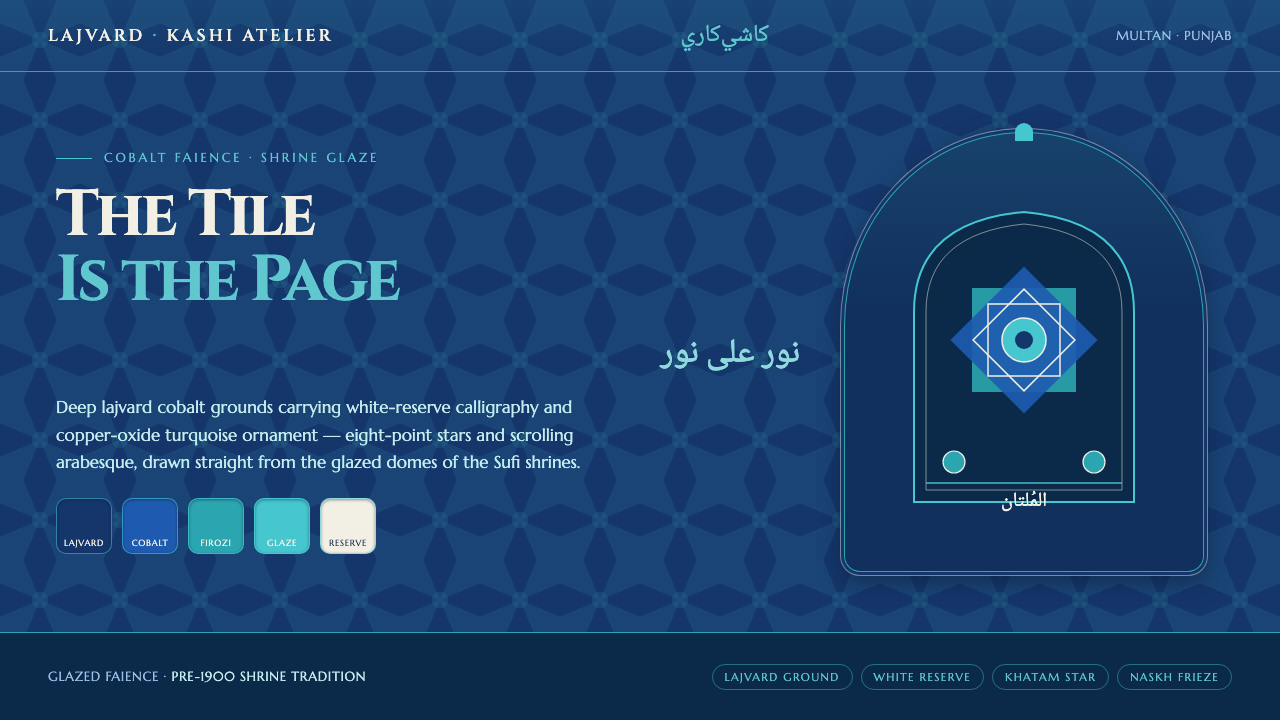 Multani Kashi TileworkThe cobalt tile is the page. Lajvard grounds carry white-reserve script and f…
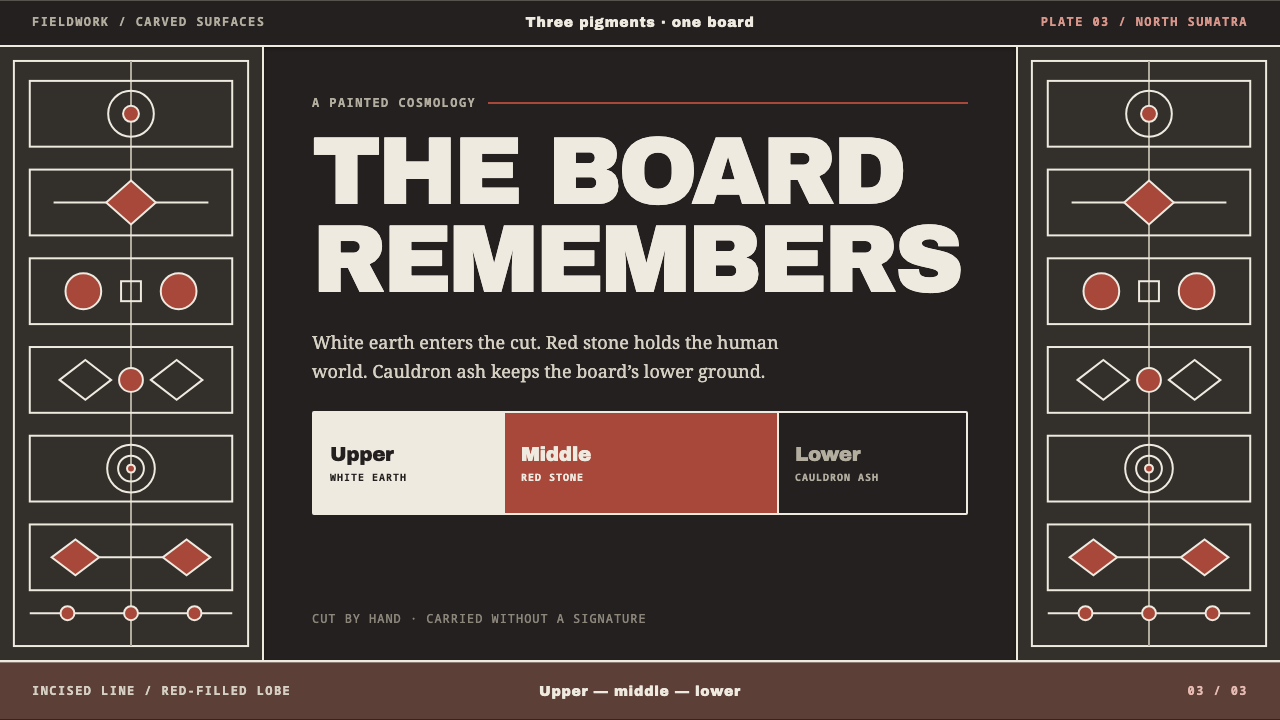 Batak GorgaCosmology cut into wood. Chalk-white lines and batu hula red hold a blackened…
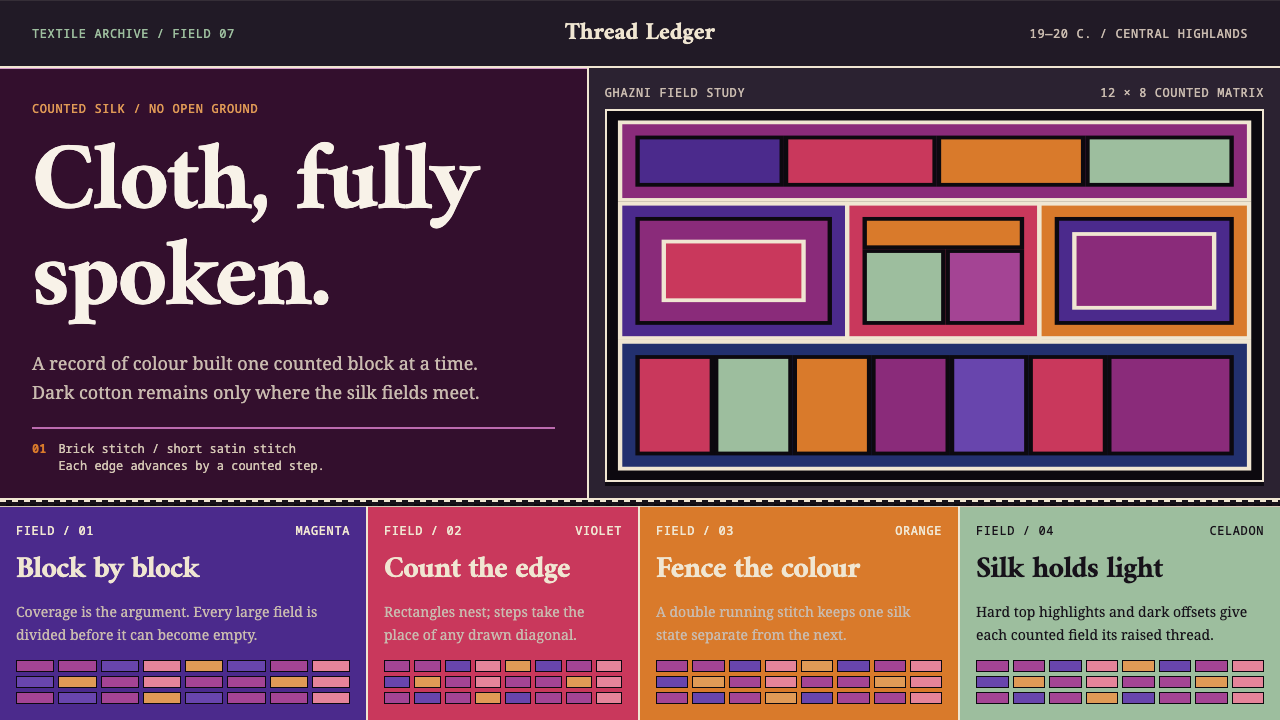 Hazara EmbroideryCoverage is the argument. Magenta silk blocks meet on a dark counted lattice.
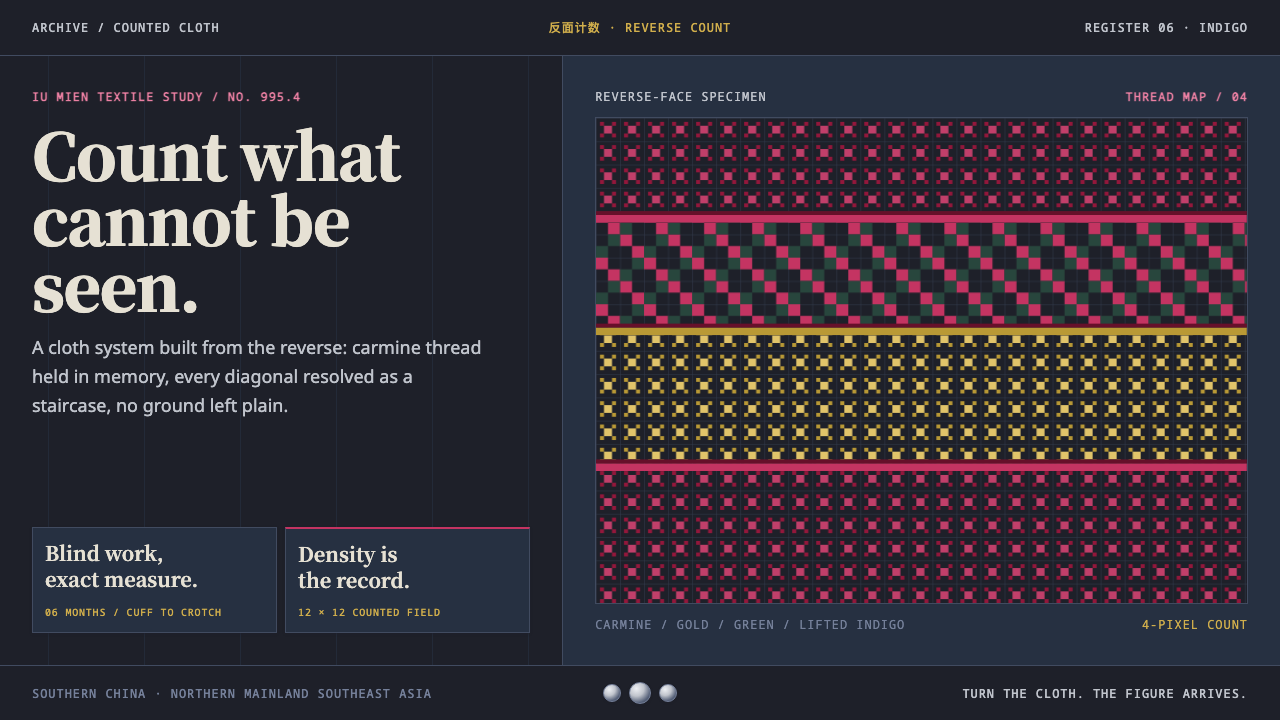 Mien Yao Cross-StitchDensity is the achievement. Carmine counted stitches saturate near-black indi…
 Russian Khokhloma Wood-Red LacquerKiln-fired ornament. Lacquer black, scarlet dots, and Playfair gold curls cro…