What is Russian Khokhloma Wood-Red Lacquer?
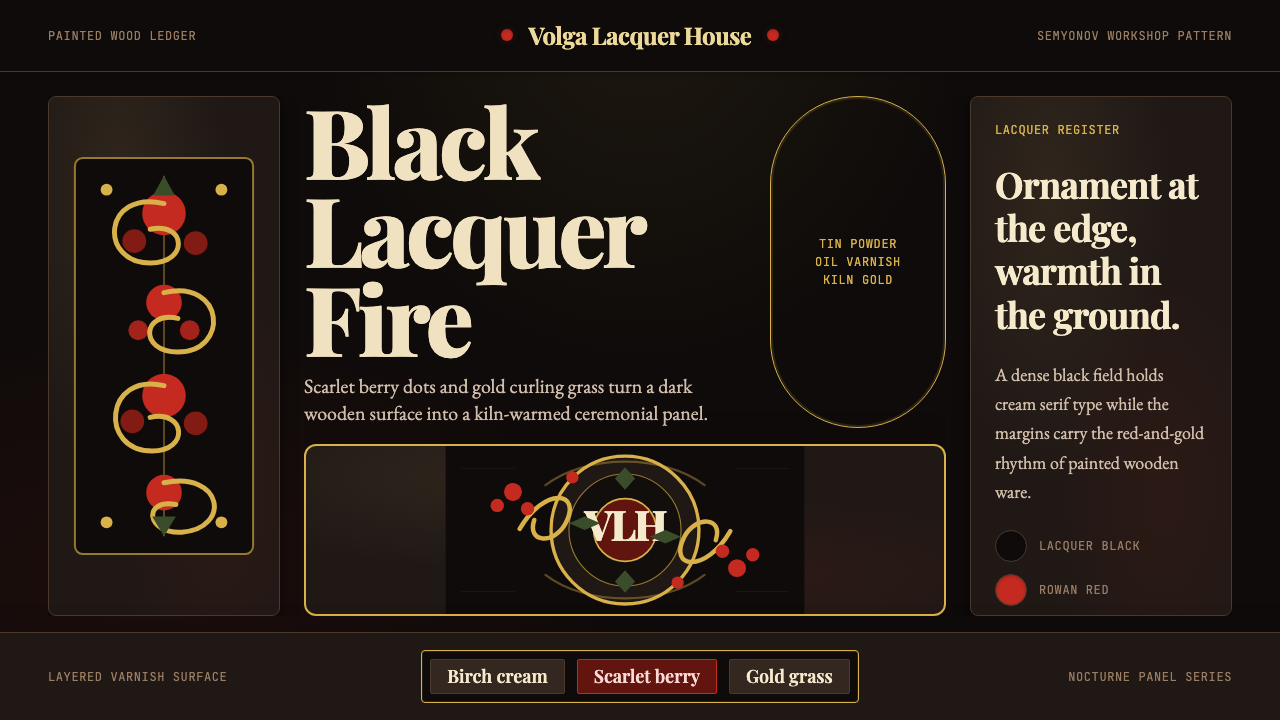
Khokhloma is Russia's kiln-fired folk tradition — lacquer-black grounds, scarlet rowanberries, and gold curlicue ornament that turn every wooden spoon into a piece of ceremony.
Russian Khokhloma Wood-Red Lacquer in brief
Russian Khokhloma Wood-Red Lacquer is a painted-wood decorative tradition originating in the villages around Semyonov in the Nizhny Novgorod region. Its hallmark is a tricolor palette of absolute authority: a lacquer-black ground carries dense networks of scarlet berries and leaves, while gold curlicue grass winds through every available surface. The result is simultaneously abundant and structured — baroque in density yet clearly organized around a central vine logic that the eye can follow from edge to edge.
What makes Khokhloma visually distinctive is the reversal of expectation. Gold is typically reserved for backgrounds in gilded art, but here it becomes the ornamental mark drawn on top — each stroke of gold grass, each berry cluster, each spiral tendril sits over the black ground like fire reflected in dark water. The scarlet acts as a third term between the extremity of black and the warmth of gold, giving the palette a rhythm that feels neither cold nor garish but genuinely festive.
As a design system, Khokhloma offers a template for surfaces that need to feel simultaneously luxurious and folk-rooted — not the refinement of court aesthetics, but the confident beauty of craftspeople who knew exactly what they were doing. The ornament is never tentative. Every painted surface is worked to fullness, with an understanding that restraint in this tradition reads not as elegance but as incompleteness.
Where does Russian Khokhloma Wood-Red Lacquer come from?
The story of Khokhloma begins with a technical deception. In the seventeenth century, Old Believer monks — members of a Russian Orthodox sect who had fled persecution into the forests of the Volga-Oka region — brought with them the skills of icon and liturgical-object painting. When the state attempted to collect taxes from woodturners in the surrounding villages, those craftspeople needed a way to produce goods that could pass as gilded altar-ware without the cost of actual gold leaf. The monks showed them a solution: coat a turned wooden object with silvered tin powder, apply linseed-oil varnish, and fire it in a kiln until the combination transmuted into a warm, convincing gold.
The village of Khokhloma, in what is now Nizhny Novgorod Oblast, became the main market hub where these lacquered wooden objects — spoons, kovsh ladles, bratina communal cups, bowls — were traded and eventually gave the style its name. The craft spread through surrounding villages, with each community developing its own plant motifs and compositional conventions while sharing the core palette: black ground, red berry clusters drawn from the native rowanberry, and the signature gold ornament. By the eighteenth and nineteenth centuries, the style had matured into a recognized regional export, with goods traveling to markets throughout Russia and Central Asia.
The technique itself involves multiple stages of patient preparation. A turned wooden form is coated in clay, then in linseed oil, then in a ground layer, before the tin or aluminum powder is applied. The painter then works in tempera, typically building a composition of plant forms — grasses, berries, flowers, sometimes birds or fish as secondary motifs — over the metallic ground. A final application of oil varnish and a second kiln firing locks the colors and converts the metallic ground to gold. The entire process can take weeks for a single complex piece, which is why the tradition demanded skilled village specialists rather than generalist craftspeople.
The Soviet period brought industrialization to what had been a cottage industry. In 1971, the Khokhloma Artist factory was established in Semyonov as part of broader Soviet efforts to preserve and professionalize folk-art traditions. This institutionalization was a double-edged development: it ensured the survival of Khokhloma techniques through formal training programs and guaranteed markets, but it also standardized some of the natural variation between village painting schools. Key figures in this mid-century revival included Stepan Veselov and Anatoly Strogiy, who documented traditional compositions, and Olga Lushina, whose work in transmitting technique to subsequent generations helped the tradition survive the post-Soviet economic disruption of the 1990s. Today, Khokhloma production continues in Semyonov, with a mix of factory production and individual studio practice.
What defines the Russian Khokhloma Wood-Red Lacquer look?
The Tricolor Palette
Khokhloma's identity is inseparable from its three-color logic: a deep lacquer black provides the ground; a hot, berry-saturated red — drawn from the native rowanberry — supplies the focal ornament; and a warm, fire-kissed gold traces the connecting grass and vine work. No fourth color competes. The palette achieves its richness not through variety but through the extreme contrast between these three terms, each pushed to its fullest expression against the others.
Organic Ornament Density
Khokhloma compositions do not leave ground visible as a design element — the black is the canvas, not the breathing space. Grasses, berries, flowers, and spiraling tendrils fill the surface in interlocking layers, with each motif contributing to a continuous flow rather than standing as an isolated element. The density is disciplined: underlying it is a vine-logic structure, typically a central stem from which all secondary forms radiate, that prevents the ornament from becoming visual chaos.
Gold as Drawing, Not Ground
In most gilded traditions, gold functions as a background that elevates the subject placed upon it. In Khokhloma, the relationship is inverted: gold is the active mark, the calligraphic line, the energetic flourish drawn over darkness. Each blade of grass, each petal, each spiral terminates in a fine point that emphasizes the painted stroke rather than the fill. This linearity gives Khokhloma ornament a handwritten vitality that flat gilded grounds never achieve.
Kiln-Fired Depth
Unlike painted finishes that sit on a surface, authentic Khokhloma lacquer is fused through heat. The final kiln firing does not merely dry the varnish — it chemically transforms the metallic underlayer and locks the painted colors into the lacquer body itself. The resulting surface has a depth that catches light differently than a printed or digitally simulated equivalent: it glows rather than reflects, with a warmth that comes from the material's history of transformation.
Rowanberry as Signature Motif
Among all the botanical elements in the Khokhloma vocabulary — wild strawberries, currants, flowers, herbs — the rowanberry cluster is the most consistently recurring and most immediately identifying. Painted in clusters of small rounded forms, the rowanberry motif carries specific cultural resonance in Russian folk belief: the rowan tree was considered protective, connected to fire and home. In visual terms, the berry cluster provides a focal gathering point within the continuous vine flow, a moment of density that punctuates the ornament's rhythm.
Bilateral Symmetry and Radial Flow
Most Khokhloma compositions on flat surfaces — boards, trays, cabinet panels — are organized around a loose bilateral symmetry, with the central vine or floral cluster as the axis. On rounded forms such as bowls and spoons, the composition adapts to a radial logic, spiraling around the form's axis in a way that reads consistently from any viewing angle. This rotational coherence is one of the tradition's most technically demanding achievements, requiring the painter to visualize the complete composition across a curved surface before placing a single mark.
Festival Register
Khokhloma objects were not everyday utensils in the modern sense — they were produced for markets, celebrations, and gift-giving. The visual register of the style reflects this festive function: nothing is understated, nothing is modest. The palette is pushed to its maximum contrast, the ornament to its maximum density, the lacquer to its deepest gloss. Applied to digital surfaces, this register implies a deliberate choice to make the viewer feel that whatever they are looking at is important, valued, and worthy of elaboration.

Who shaped Russian Khokhloma Wood-Red Lacquer?
Veselov was a master painter active in the mid-twentieth century who contributed to the documentation and transmission of traditional Khokhloma compositional systems. His work helped bridge the gap between the pre-Soviet cottage industry phase and the institutionalized production that followed the 1971 factory establishment, ensuring that the underlying logic of plant-form composition was preserved rather than simply the surface appearance of the style.
Strogiy's contribution lay particularly in the systematic study of historical Khokhloma pieces held in museum collections across Russia. By analyzing and cataloguing the compositional variation between village schools and historical periods, he provided the documentary foundation that allowed the factory revival to draw on authentic source material rather than reconstructing the style from memory or generic folk-art references.
Lushina's significance is primarily pedagogical. Working through the difficult transitional period of the 1990s, when the factory system faced severe economic pressure and many traditional craft industries collapsed, she maintained active teaching programs that kept the technical knowledge of Khokhloma painting alive in the hands of working practitioners. Her students formed the core of the studio tradition that has since grown alongside the factory system.
No single monk is credited by name with the invention of the Khokhloma technique, but the Old Believer communities of the seventeenth-century Volga-Oka forest region are collectively recognized as the originators of the kiln-gilding method that defines the style. Their contribution was not merely technical — they also introduced the icon-painting tradition of compositional richness and the theological association of gold with the divine, which gave Khokhloma its character of sacred seriousness beneath its festive surface.
How do you use Russian Khokhloma Wood-Red Lacquer today?
Khokhloma is one of the most immediately legible folk styles in digital application — its tricolor logic and dense ornamental vocabulary are specific enough to read as a coherent system rather than a generic ethnic decoration. The challenge in applying it correctly is tonal control: the style operates at maximum expressiveness, which means a misapplication tends to feel excessive rather than merely off. Understanding where full intensity serves the design, and where it should be reserved, is the primary skill required.
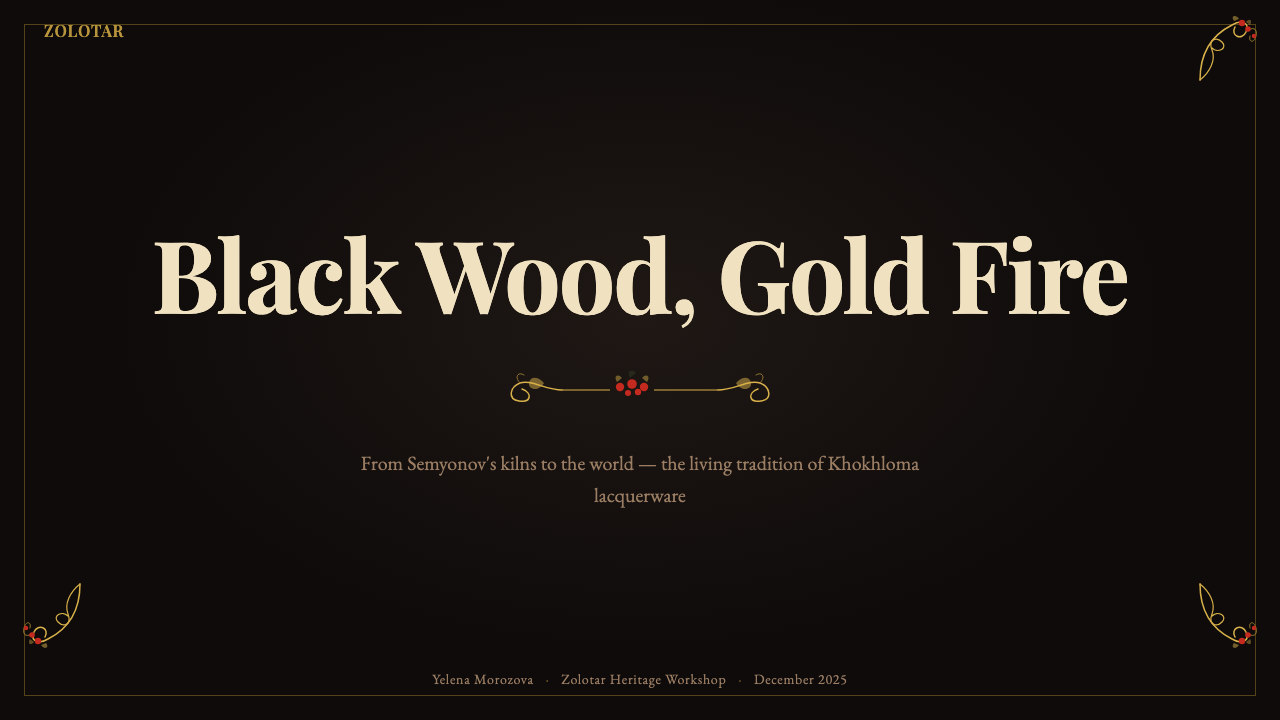
For presentation slides, Khokhloma works most powerfully on covers and section dividers. A cover framing bold title text against a lacquer-dark ground, with gold ornamental elements massed at corners or along margins, establishes the visual register immediately. Content slides should simplify: a dark background with white or warm-toned body text, and perhaps a single Khokhloma-style border element to maintain identity without competing with the information. Data visualization can use the red-and-gold palette for bar fills and accent marks, treating the dark background as the neutral field against which data stands out. The style's natural darkness suits presentations in rooms where screens are ambient — the deep ground absorbs light rather than glaring.
For web interfaces, Khokhloma is best suited to landing pages, hero sections, and premium product showcases rather than utilitarian interfaces. A dashboard built entirely in the Khokhloma register would overwhelm — the density appropriate to a wooden bowl becomes claustrophobic across a screen full of data. Instead, use the palette and ornamental grammar selectively: a dark header or hero panel with gold ornament framing the brand mark, transitioning to a lighter ground for functional content below. Pricing pages can use the full palette for premium tier cards while keeping lower tiers in a neutral variant, using the visual richness as a signal of value difference.
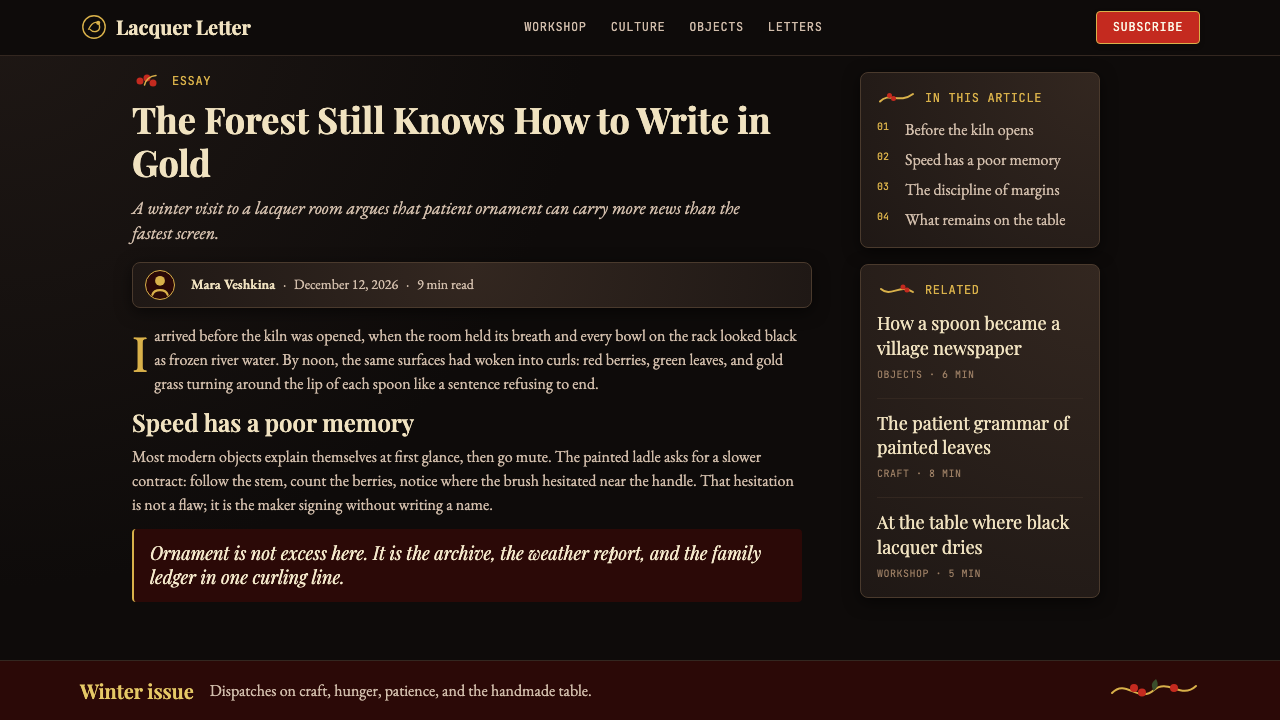
For editorial and marketing work, the style supports opulent title treatments, brand campaigns aimed at cultural resonance, and product photography backgrounds. A food brand evoking artisanal or Eastern European heritage; a spirits label; a festival poster; a luxury goods campaign with Russian cultural associations — all are natural recipients of the Khokhloma vocabulary. Editorial spreads can use a dark-ground panel for pull quotes or chapter openers, with the gold ornament functioning as a typographic surround. Marketing materials targeting Chinese or East Asian audiences should note that the color logic — dark ground, gold and red ornament — shares significant visual DNA with Chinese lacquerware and New Year decoration traditions, making cultural resonance a realistic design goal rather than a stretch.
A common mistake is treating Khokhloma as a texture to apply over an otherwise conventional layout. The style does not function as a pattern overlay — it is a complete compositional logic that requires the design to commit to the dark ground and the ornamental density from the start. Applying a Khokhloma border to a white-ground slide, or using the berry motifs as spot decoration on a clean minimalist layout, produces something that looks neither folk nor contemporary but merely confused. The other frequent error is desaturating the red toward burgundy or coral in an attempt to make the palette feel more contemporary. The rowanberry red of Khokhloma is specific — it operates at full chromatic intensity, and moderating it breaks the three-way tension that makes the palette work.
Russian Khokhloma Wood-Red Lacquer — FAQ
What is the difference between Khokhloma and other Russian folk decorative styles like Gzhel or Zhostovo?
All three are distinct regional traditions with non-overlapping visual identities. Gzhel, from the Moscow region, uses cobalt blue on white porcelain with a fluid, painterly brushstroke quality — it is cool, clean, and relatively spare compared to Khokhloma. Zhostovo, also from the Moscow region, features richly modeled floral bouquets on lacquered metal trays, typically on dark grounds but with shaded, three-dimensional flower forms that are far more naturalistic than Khokhloma's flat plant ornament. Khokhloma's defining difference is its gold-on-black ground, its radically flat decorative language, and the kiln-gilding technique that makes its surface a product of transformation rather than applied paint alone.
Can Khokhloma work effectively in a light-ground digital application, or is the dark background non-negotiable?
The dark ground is structurally central — removing it produces something inspired by Khokhloma rather than genuinely applying the system. On a white or cream ground, the gold element loses most of its visibility and the red loses its luminous quality, since both colors derive their intensity from being surrounded by darkness. A light-ground variant is possible for secondary contexts: white backgrounds with rich red plant ornament and selective gold as an accent can evoke the Khokhloma vocabulary for users who need better readability or contrast with surrounding content. But the primary identity of the style lives in the dark ground, and the highest-impact moments in a design using this system should commit to it fully.
How does Khokhloma relate to the broader tradition of lacquerware across different cultures?
Khokhloma emerged independently from East Asian lacquerware traditions, though the functional similarities are striking: dark grounds, gold and red ornament, plant motifs, and objects valued both as utensils and display pieces appear across Chinese, Japanese, Vietnamese, and Korean lacquer traditions as well. The technical methods differ — East Asian lacquerware typically uses urushi resin applied in carefully controlled layers, while Khokhloma uses oil-based varnish kiln-fired over a tin or aluminum underlayer — but the aesthetic outcomes share a family resemblance rooted in the universal logic of gold and red over darkness. This convergence makes Khokhloma-derived design systems broadly legible as festive and precious across different cultural contexts, beyond the specifically Russian or Slavic reference.
Is Khokhloma appropriate for interfaces where accessibility and readability are priorities?
The dark-ground palette presents real accessibility challenges when applied to body text — dark backgrounds with colored text require careful attention to ensure sufficient contrast ratios, particularly for red text, which is inherently lower in luminance than white or yellow. The most accessible approach within the Khokhloma system is to reserve the full decorative palette for structural and ornamental elements — headers, borders, section markers, illustration — and to use white or very light warm tones for any body text on dark grounds. Interactive elements should use the gold or white variants rather than red as the primary action color, since red action states can create confusion with error or warning signals. The style is genuinely difficult to apply to dense text-heavy interfaces without compromising either the aesthetic or the readability, which is why it is best suited to surfaces where the decorative register is primary and text density is low.
What makes Khokhloma feel authentically folk rather than merely decorative?
Authentic folk design is characterized by what might be called functional ornament — decoration that has grown from the constraints and purposes of a specific craft tradition rather than being applied from outside. In Khokhloma, the ornament is inseparable from the painted surface: the brushstroke logic, the vine structure, the way each motif terminates in a fine point, all reflect the hand of someone who has internalized the system through years of repetition rather than someone who has looked at reference images and approximated the appearance. When applying the style digitally, the distinction between authentic and decorative manifests in commitment to the underlying logic rather than the surface pattern. Using Khokhloma colors with a minimalist grid layout and no organic structure is decoration; building a composition whose density and vine-logic genuinely echoes the traditional structure is a design that speaks the style's language.
Related design styles
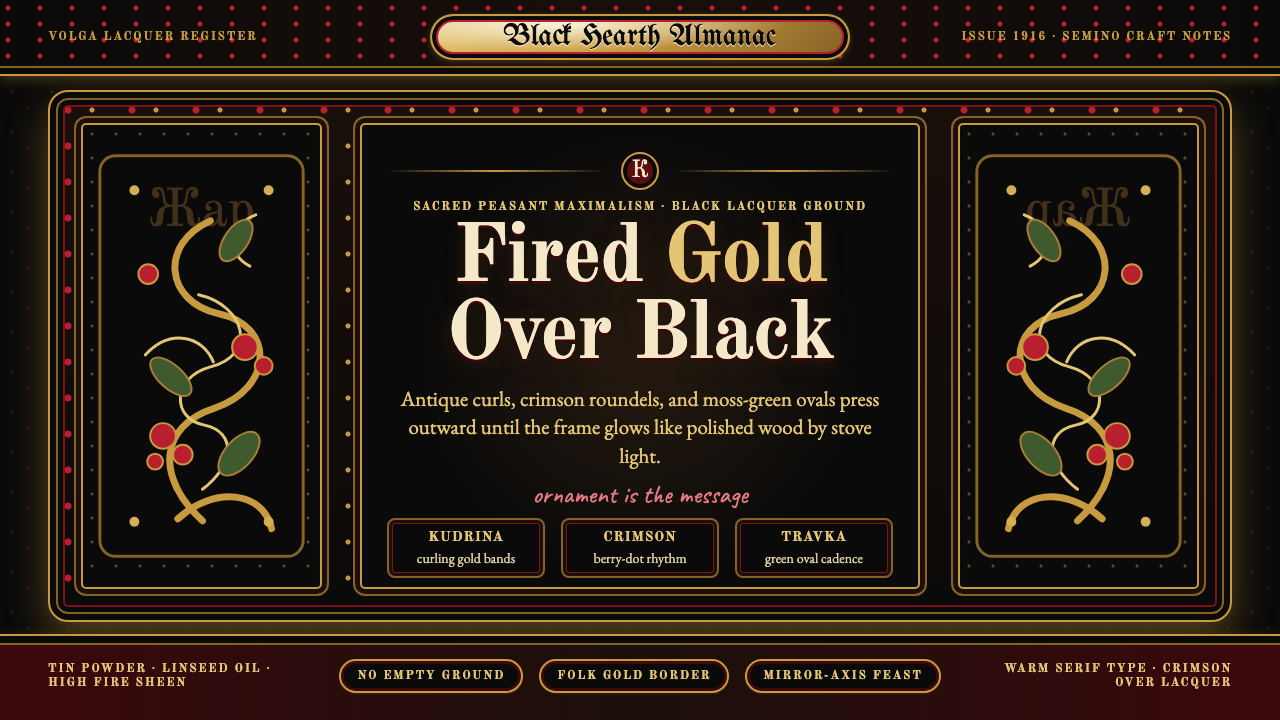 Russian KhokhlomaOrnament is the message. Antique gold curls and crimson dots crowd a black la…
 Tiwi Pukumani PoleBlack ground carries ceremony. Ochre bands, pipeclay dots, and hatch stack li…
 Bamileke Elephant MaskRoyal density. Indigo bead fields lock white triangle rows into ceremonial po…
 Hazara EmbroideryCoverage is the argument. Magenta silk blocks meet on a dark counted lattice.
 Hungarian Matyó VioletFolk embroidery, maximal. Rose-violet and gold blooms blaze gap-free on near-…
 Multani Kashi TileworkThe cobalt tile is the page. Lajvard grounds carry white-reserve script and f…