What is Russian Khokhloma?
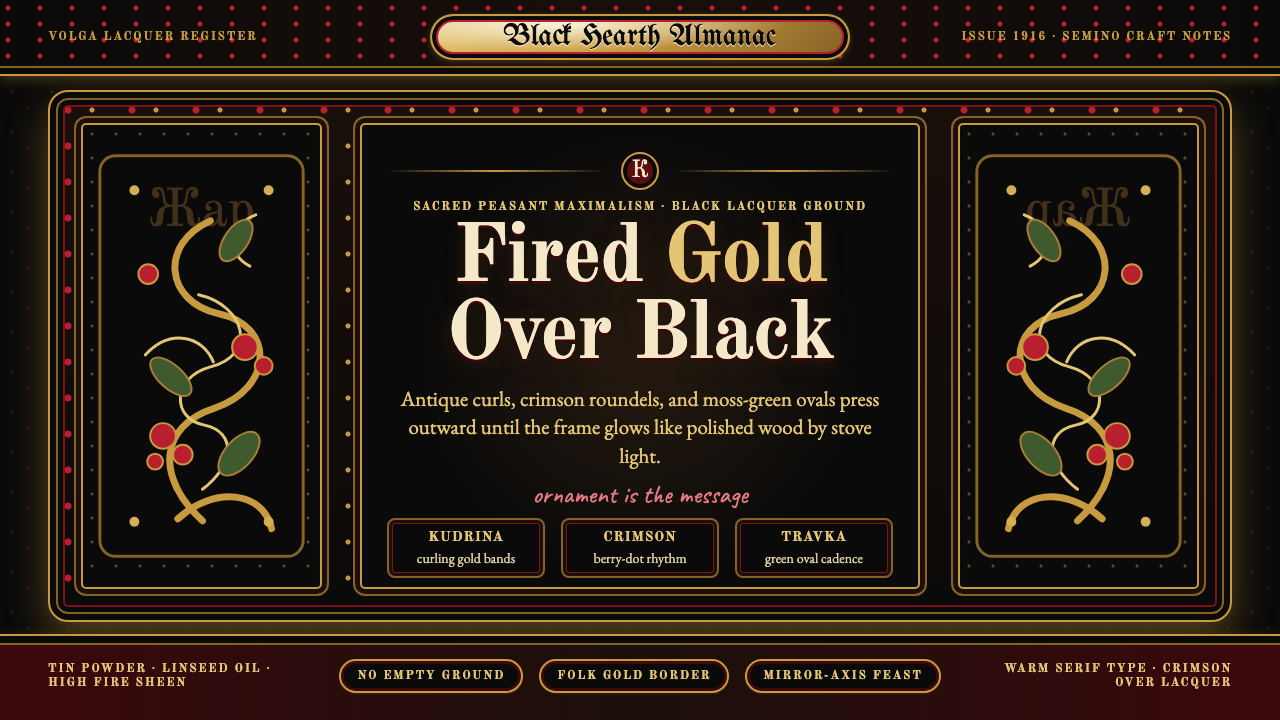
Khokhloma is Russian peasant painting transformed into sacred fire — jet-black lacquer blazing with antique gold, blood-red berries, and curling vines that have crowned Volga woodware for four centuries.
Russian Khokhloma in brief
Khokhloma (Хохлома) is a Russian wood-painting tradition whose visual signature is instantly legible: a ground of deep black lacquer overlaid with curling golden vines, scarlet berries, and stylized wildflowers. The characteristic 'false gold' effect is achieved not with gold leaf but through a firing technique that transforms applied tin powder into a warm, burnished surface — the entire aesthetic rests on this alchemical trick of heat and craft. The result reads simultaneously as firelight reflected on polished lacquer and as an illuminated manuscript unfurled across domestic objects.
The visual system is deliberately maximalist. Every surface is treated as a field to be covered; bare ground is not rest — it is absence. Compositions organize around two principal ornamental grammars: the kudrina, a baroque scroll of large golden curls that crowd one another into a continuous dense canopy, and the travka, a finer tracery of grasses and stems that supports clusters of rowan berries, strawberries, and firebird feathers. These two grammars are rarely mixed; a craftsperson typically commits to one or the other for an entire piece. The symmetry is approximate — hand-painted, with the organic wobble of a living tradition — and this human imprecision is a feature, not a flaw.
Typographically, Khokhloma's visual world calls for forms that match its ceremonial density. Cyrillic letterforms with strong serifs, blackletter-adjacent structures, or decorative Slavic scripts complement the ornamental register of the painting. Weight and formality matter more than geometric precision. Color is not a variable — it is a fixed grammar: gold on black, red on gold, with black outlines sharpening every element against its neighbor. Nothing about Khokhloma is neutral, and nothing about it is meant to be quiet.

Where does Russian Khokhloma come from?
The technique was developed in the mid-seventeenth century in a cluster of villages along the Volga River in what is now Nizhny Novgorod Oblast — among them Khokhloma, Semino, and Khryashchi. The region had long been a center for woodworking: dense forests supplied birch and linden, rivers provided transport routes, and a tradition of carved and painted domestic objects — bowls, spoons, ladles, spinning wheels — already existed. What transformed this local craft tradition into the Khokhloma system was a conjunction of Old Believer monastic culture, foreign trade networks, and the particular chemistry of the firing technique.
Old Believer communities — dissenters who had split from the Russian Orthodox Church following the Nikon reforms of the 1650s — settled in remote Volga villages to practice their faith outside state reach. These communities included monk-painters who brought icon-painting traditions with them: the use of precious materials, the hierarchical organization of ornamental programs, the discipline of pattern as a form of devotional attention. The 'false gold' technique itself may have been adapted from the gold-foil grounds used in icon production — a way of achieving the visual authority of gold without the prohibitive cost of gold leaf. Whatever its precise origin, the method was kept as a trade secret, transmitted within families and workshops across generations.
By the late seventeenth and early eighteenth centuries, Khokhloma ware was traveling significant distances. Merchants carried painted bowls and spoons to the Makariev Fair on the Volga, then to the Nizhny Novgorod Fair, which became one of the largest trade fairs in Russia. The goods reached Persia, Central Asia, and through Dutch and English trading houses, Western Europe. This commercial success encouraged specialization: some villages concentrated on the kudrina scroll style, others on the finer travka grass style. The division between form-painters (who applied the black and red ground) and ornament-painters (who executed the detailed vine and berry work) also became formalized during this period.
The late nineteenth and early twentieth centuries brought both threat and revival. Industrial goods from urban factories began to undercut the market for hand-painted woodware. Responding to this pressure, Russian art philanthropists and reform movements of the Arts and Crafts type — most notably through the efforts of zemstvo organizations — supported the establishment of craft schools and cooperatives in the Volga region. By 1916 a formal cooperative structure had been established in Semino. The Soviet period, paradoxically, gave Khokhloma its widest institutional support: the style was embraced as an expression of authentic Russian folk culture, factory production was organized in Semino under the Khokhlomskaya Rospis enterprise, and the ware was exported internationally as a symbol of Soviet cultural heritage. This mass-production phase standardized certain motifs while keeping the hand-painted character of the surface.
What defines the Russian Khokhloma look?
Color Grammar
The palette is fixed and non-negotiable: a deep black ground, warm antique gold as the primary positive element, and vivid vermilion or crimson red for berries, flowers, and accents. Black outlines reinforce every form. The gold is never cold or bright — it is always the warm, slightly tarnished tone of fired tin, which reads as candlelight rather than metallic shine. Green appears occasionally as leaf color but is always subordinate, never structural. White is almost entirely absent. The entire system operates on the logic of heat and darkness: light emerging from depth.
Ornamental Density
Khokhloma composition is saturated by design. The horror vacui — fear of empty space — is genuine and deliberate. A well-executed Khokhloma piece leaves no significant area of ground uncovered; the vines, grasses, berries, and curling tendrils fill every available quadrant with rhythmic, layered growth. This density is not chaotic: it follows an internal logic of expansion from a central stem or medallion outward, with larger forms anchoring the composition and smaller details filling the interstices. The skill is in maintaining legibility — each berry and leaf remaining individually distinct — within total coverage.
Kudrina and Travka Grammars
The tradition distinguishes two primary ornamental grammars that are rarely combined on a single piece. The kudrina (from the Russian word for curl) is a bold, baroque scroll: large golden spirals unfurl into leaf-like forms and crowd the entire surface, creating an almost architectural canopy of interlocking curves. The travka (from the Russian word for grass) is finer and more botanical: delicate stems support naturalistic clusters of rowan berries, strawberries, and curving leaves, with the black ground still visible between the elements. A master craftsperson's identity is partly expressed by which grammar they favor and how they resolve its internal tensions.
The Fired-Gold Surface
The signature material effect — warm antique gold emerging from a black lacquer ground — is the result of a multi-stage process unique to the tradition. Wooden forms are primed and covered with a clay-based sealant, then coated with tin powder mixed with linseed oil. After the ornament is painted in black and red over this metallic undercoat, the piece is fired in an oven at high temperature. The heat oxidizes the tin through the transparent lacquer layers, converting the entire surface to the characteristic warm gold. This is not a decorative choice — it is the fundamental production method, and its visual quality (slightly uneven, warm, with micro-texture from the brush) distinguishes authentic Khokhloma from flat printed simulations.
Motif Vocabulary
The iconographic vocabulary is drawn from the natural world of the Volga forest and from Orthodox devotional imagery. Rowan berries (ryabina) appear in nearly every composition — small red clusters of four or five berries on a short stem, the motif most closely associated with the tradition. Strawberries, currants, and stylized wildflowers round out the berry repertoire. The firebird (zhar-ptitsa) appears as a phoenix-like form whose feathers dissolve into the same curling vine grammar as the botanical elements. Human figures are extremely rare. The overall register is celebratory and sacred simultaneously — folk abundance given a devotional frame.
Symmetry and Rhythm
Khokhloma compositions are broadly symmetrical — mirrored around a central axis for bowls and spoons, radiating from a central medallion for plates — but the symmetry is approximate and organic rather than mechanical. The hand-painted nature of the work means that corresponding motifs on either side of an axis will rhyme without being identical. This living asymmetry within an overall symmetric framework is central to the visual warmth of the tradition: it reads as made rather than manufactured. Rhythm — the regular recurrence of the same berry cluster or curl at metrically spaced intervals — does the structural work that strict symmetry might otherwise impose.
Decorative Borders
The borders of Khokhloma objects — the rim of a bowl, the edge of a tray, the handle of a spoon — receive their own distinct ornamental treatment, often a simplified band of berries or a repeated curl motif that serves as a frame for the main central composition. These borders are not mere outlines; they are themselves composed elements that establish the hierarchy between the central field and the edge. In graphic applications, this tradition of tiered border treatment translates directly: a Khokhloma-derived design benefits from a structured outer margin that echoes the central ornament at a reduced scale and simpler resolution.

Who shaped Russian Khokhloma?
The technique's probable founders were communities of Old Believer monks who settled in the Volga forest villages following the Nikon Church reforms of the 1650s. They brought with them the icon-painting tradition of the Muscovite workshops — the discipline of working with precious materials, the organizational hierarchy of ornamental programs, and possibly the metallic ground technique adapted from icon gilding. By transmitting the firing method as a closed craft secret within monastic and then peasant household networks, they ensured the tradition's continuity across centuries of political disruption. Their influence explains the quasi-sacred quality of the ornament: Khokhloma painting carries the devotional gravity of icon work translated into a domestic register.
Veselov was among the most celebrated individual craftspeople identified within the Khokhloma tradition in the late nineteenth and early twentieth centuries — a period when outside collectors, ethnographers, and reform-movement activists began documenting the tradition systematically. He represented the travka style at its most refined: botanical precision in the placement of berry clusters, an unusually light and airy distribution of the vine tracery that created a sense of breath within the dense ornamental field. His work was collected by Russian art institutions and used as a teaching reference in the craft schools established during the pre-revolutionary reform period, helping to codify the travka grammar for subsequent generations of painters.
The Khokhlomskaya Rospis enterprise — established in Semino during the Soviet period and operating through much of the twentieth century — represents the industrial phase of the tradition. It organized the production of Khokhloma ware at a scale previously impossible for household workshops, trained hundreds of painters in standardized technique, and managed the export of finished goods internationally. The factory's role is ambivalent: it standardized certain motifs and reduced regional variation, but it also kept the hand-painting process alive when purely market-based household production might have collapsed entirely under pressure from cheaper industrial alternatives. Many of the painters trained at Khokhlomskaya Rospis became individual masters who later revived more idiosyncratic studio practice.
Less a person than an institution, the Nizhny Novgorod Fair and the broader Volga trade network it anchored was the commercial engine that carried Khokhloma from a village craft into an internationally recognized style. From the early eighteenth century onward, Volga merchants displayed Khokhloma bowls, spoons, and ladles alongside silk, furs, and grain at what became one of the largest periodic markets in the world. Persian and Central Asian buyers brought the work south and east; Dutch and English trading houses introduced it to Western Europe. The fair's commercial logic forced a degree of consistency and quality standard that the tradition might otherwise not have achieved — and the international exposure generated by the fair circuit is what gave Khokhloma its identity as a distinctly Russian art form in the eyes of the outside world.
How do you use Russian Khokhloma today?
Applying Khokhloma in contemporary design work requires understanding that the style is constitutionally maximalist — it does not dilute gracefully into 'Khokhloma-inspired minimalism.' The visual system makes its impact through coverage, density, and the warmth of the fired-gold surface. Stripped of these properties, what remains is a generic floral motif with no particular cultural weight. Successful application means committing to the logic: dark grounds, gold and red primary palette, ornamental density, decorative borders, and a typographic register that matches the ceremonial gravity of the painting.
For presentation slides, Khokhloma works most powerfully as a cover or chapter-divider treatment rather than as a system for content slides. A cover built on this style should use a full-bleed black ground with a Khokhloma-derived ornamental border panel — either a full frame or a header and footer band — in gold and red. The title type should sit in gold or cream against the black field, in a typeface with strong serifs or Cyrillic-compatible decorative structure. Content slides require restraint: a simplified border motif as a repeated header element, body text in cream or warm white on the dark ground, and data visualizations in the primary gold-red palette. Overloading content slides with the full ornamental density of a cover will make them unreadable.
For web interfaces and dashboards, Khokhloma is best deployed as a brand-layer treatment over standard UI components rather than as a structural design system. The approach: establish a black or very deep warm-dark background, use gold as the primary interactive and headline color, and reserve red for alerts, highlights, or data callouts. Navigation bars, footers, and modal headers benefit from a simplified Khokhloma-style border or divider — a single-pixel gold line with small berry motifs at intervals. Card components work on a slightly lighter dark ground than the page background, differentiated by the warm glow of a gold-tinted border rather than a drop shadow. This approach suits cultural platforms, spirits or premium food brands, festival and event microsites, and Russian-heritage product interfaces.
For editorial and marketing work, the style supports immersive, high-impact visual narratives where the reader's attention is already secured — a luxury brand catalog, a festival program, a heritage spirits packaging suite. Full-spread editorial layouts work well with a black ground, a central photographic or illustrative image framed by Khokhloma-derived ornamental borders, and headline type in gold or deep red. For social media and marketing cards, simplify the ornamental vocabulary to a corner or bottom border element — a small sprig of berries and a curl or two — to maintain the stylistic signal without crowding the primary message. The dark ground with gold type reads as premium and ceremonial across formats, making it effective for announcements, invitations, and product launches where gravity is the desired tone.
A common mistake when working with Khokhloma is treating the gold and red palette as sufficient on its own, without the dark ground. Gold-and-red ornament on a white or cream background loses the firelight quality that is the style's defining affect — the sense of illumination emerging from darkness. The contrast between the dense black lacquer and the warm metallic gold is not decorative detail; it is the system's emotional core. A second frequent error is mixing the Khokhloma ornamental vocabulary with other folk traditions — Ukrainian Petrykivka painting, Scandinavian rosemaling, or Baroque European florals — under a generic 'folk' umbrella. Each of these traditions has its own internal logic and color grammar; combining them produces visual noise rather than cultural resonance.

Russian Khokhloma — FAQ
Is Khokhloma painting only produced on wooden objects, or can the style be applied to other surfaces?
Historically, Khokhloma is exclusively a wood-painting tradition — the fired-gold technique requires a wooden substrate that can absorb the clay-based sealant and withstand the oven temperature. The objects are almost entirely utilitarian: bowls, spoons, ladles, cups, trays, and furniture. In graphic and digital applications, the style's visual vocabulary — the color palette, the ornamental density, the kudrina and travka motifs — translates freely to any surface or medium. What cannot be reproduced is the material quality of the fired surface itself: the micro-texture, the slight variation in the gold tone across the piece, and the warm three-dimensionality of actual lacquered wood. Good digital and print applications acknowledge this limitation by compensating with richness in other dimensions — high-resolution ornamental detail, warm color calibration — rather than attempting to simulate the surface texture itself.
How does Khokhloma differ from other Russian folk arts like Gzhel or Palekh?
The three traditions are distinct in material, palette, and ornamental logic. Gzhel is a ceramic painting tradition from the Moscow Oblast whose defining characteristic is cobalt blue brushwork on a white porcelain ground — botanical and figurative motifs in a single color against white, as opposed to Khokhloma's dense multi-element gold-and-red coverage on black. Palekh is a miniature lacquer-painting tradition from Ivanovo Oblast that depicts narrative scenes — fairy tales, Orthodox subjects, historical episodes — with fine figurative detail on a black lacquer ground. Palekh shares the black ground and the lacquer technique with Khokhloma but is representational where Khokhloma is ornamental, and its palette includes a full range of colors including flesh tones, whereas Khokhloma's palette is fixed. All three are recognized as Russian folk art traditions, but they should not be combined or treated as interchangeable.
Can Khokhloma work in light-background layouts, or does the dark ground define the style?
The dark ground is not merely a preference — it is structurally integral to the fired-gold technique and to the visual logic of the style. The antique gold reads as luminous precisely because it is seen against black; on a cream or white background, the same gold tone becomes flat and decorative rather than ceremonial. That said, a partial application is possible: Khokhloma-derived ornamental elements — a border panel, a corner sprig, a medallion — can be used on a lighter ground if they are treated as contained decorative zones rather than as an all-over system. The ornament should still use the gold-and-red palette. What the light-ground application loses is the immersive, firelit quality of a full Khokhloma composition. Use it when you need to signal the style's cultural reference without committing to the full dark aesthetic — but understand that the reference will read as lighter and more ornamental, less as the authentic ceremonial weight of the tradition.
Is Khokhloma still actively produced today, or is it primarily a historical reference?
Khokhloma remains an active craft tradition. The Khokhlomskaya Rospis enterprise in Semino and the Khokhloma Painting factory in Kovernino continue to produce painted woodware, training new craftspeople in the traditional technique. Individual studio painters also work outside the factory context, often in more experimental or idiosyncratic directions. The tradition has the same tension as many living craft traditions: factory production maintains volume and employment but can tend toward repetition of standard motifs; individual studio work is more inventive but operates at smaller scale. Museums in Nizhny Novgorod and Moscow maintain significant collections of historic Khokhloma ware, and the tradition is recognized as part of Russia's intangible cultural heritage. For designers working with the style, this living context matters: the reference is not purely historical but points to an ongoing craft community.
What typographic approach pairs best with Khokhloma ornament?
Khokhloma's visual gravity calls for typefaces with ceremonial weight and formal structure — qualities found in heavily drawn serif faces with strong contrast between thick and thin strokes, in decorative Cyrillic display types with calligraphic roots, and in blackletter-adjacent forms that echo the tradition's Orthodox manuscript heritage. The key is weight and formality: a light geometric sans-serif will look incongruous against the ornamental density of the painting, as if the type belongs to a different visual world entirely. Scale matters as much as style: headlines should be large and bold enough to hold their own against the surrounding ornament. For body text in longer-form applications, a sturdy serif at a comfortable reading size works better than attempting to extend the decorative register through the entire text block — the ornament is the spectacle; the text is the structure that holds it.
Related design styles
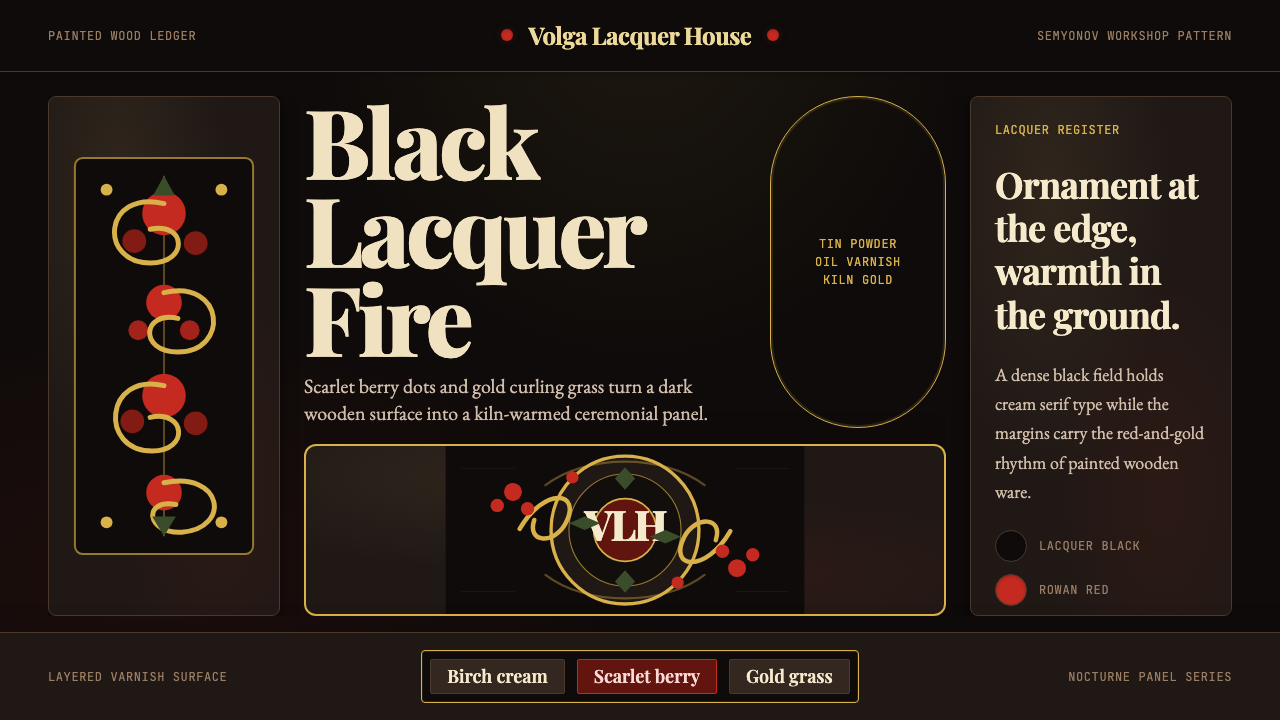 Russian Khokhloma Wood-Red LacquerKiln-fired ornament. Lacquer black, scarlet dots, and Playfair gold curls cro…
 Tibetan Butter SculptureDevotion made dense. Cinnabar, lapis, and gold relief glow from altar black.
 Batak GorgaCosmology cut into wood. Chalk-white lines and batu hula red hold a blackened…
 Central Asian IkatMaximal silk haze. Madder, gold, and indigo warp bands feather across aubergi…
 Lezgin Star WeaveKnot logic, made monumental. Madder stars lock into abrash indigo and ivory g…
 Mien Yao Cross-StitchDensity is the achievement. Carmine counted stitches saturate near-black indi…