What is Ndebele Geometric Mural?
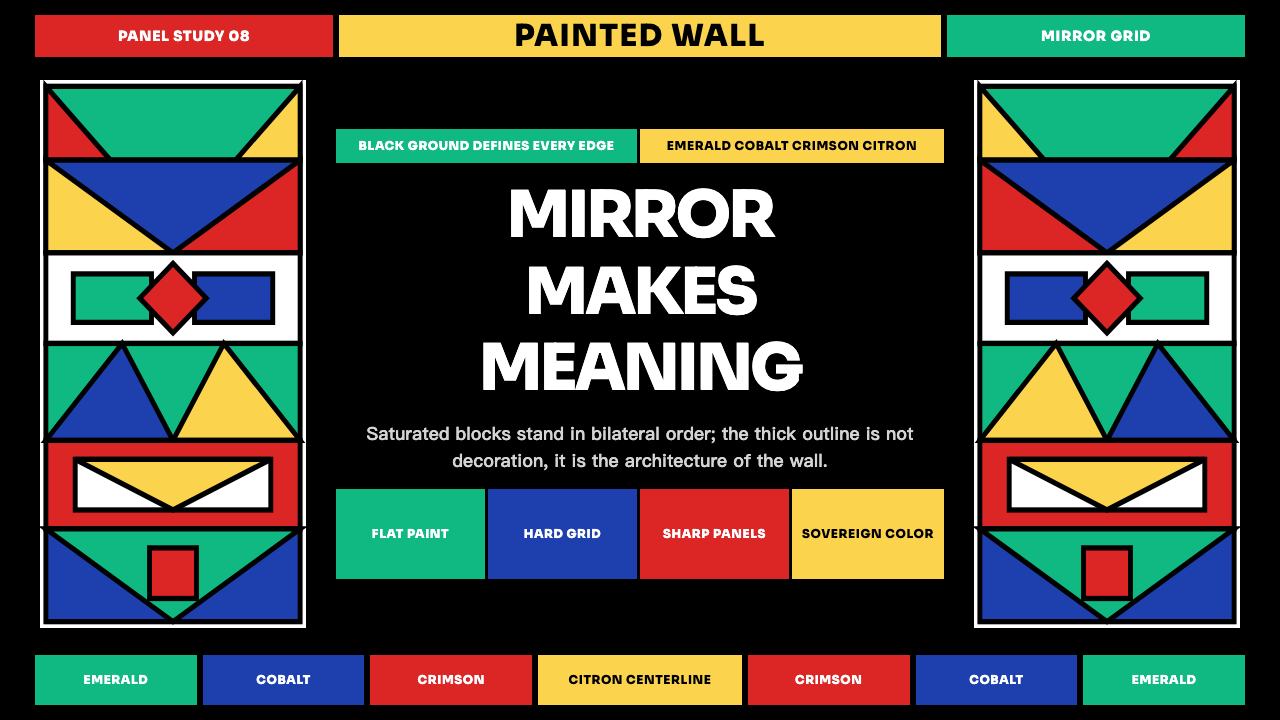
For two centuries, Ndebele women have declared identity in mirror-symmetric murals — pitch-black outlines enclosing saturated blocks of emerald, cobalt, crimson, and citron that announce sovereignty in color.
Ndebele Geometric Mural in brief
Ndebele Geometric Mural is a South African visual tradition in which women paint the exterior walls of their homes with bold, mirror-symmetric geometric patterns. Every composition is built from rectilinear and stepped forms — squares, crosses, chevrons, and interlocking panels — all bounded by thick black outlines and filled with flat, unmodulated color. The palette is high-saturation and deliberate: emerald greens, cobalt blues, deep crimsons, and sharp citron yellows appear against white or cream grounds, never blending, never fading, always assertive.
Unlike decorative art systems that serve primarily aesthetic ends, Ndebele murals carry social and communicative weight. The style of a mural signals the status, life stage, and identity of the household. The craft is passed from mother to daughter, making each painted wall simultaneously a personal statement, a social declaration, and an act of cultural transmission. The geometric vocabulary has evolved over generations, absorbing industrial paints and synthetic pigments while maintaining its essential formal logic: symmetry, flatness, outline, and bold color.
As a digital design system, Ndebele Geometric Mural translates these foundational principles — strict bilateral symmetry, assertive black outlines, flat saturated fills, rectilinear geometry — into a language suited to screens and print. The result is a style that is simultaneously ancient and visually contemporary: rigorously structured, immediately legible, and charged with a sense of cultural confidence that few other design traditions can match.

Where does Ndebele Geometric Mural come from?
The Ndebele people of South Africa, primarily the Southern Ndebele (also known as the Ndzundza Ndebele), have inhabited the Mpumalanga province and surrounding highveld regions for centuries. The practice of decorating home walls with geometric patterns is documented from at least the nineteenth century, though oral tradition places its roots earlier still. The murals were not merely decorative — they were a technology of identity in a context where the Ndebele people faced sustained pressure on their land, language, and cultural autonomy. Painting the home was a way of asserting presence and continuity.
The visual system evolved through a period of particular historical significance. Following the Mapoch Wars of the 1880s, the Ndzundza Ndebele were defeated by Boer forces and subjected to a form of indentured servitude that dispersed families across the Transvaal. During this period, the mural tradition intensified rather than diminished: women maintained and developed the painting practice as an act of cultural resistance and solidarity. The strict geometric vocabulary — unreadable to outsiders as a literal text but deeply legible within the community — functioned as a visual language that could persist without being suppressed.
Historically, the pigments used were earthen: ochres, clays, and ash provided the initial palette of reds, whites, and blacks. As industrial paints became available through the twentieth century, the palette expanded dramatically to include the vivid synthetic greens, blues, and yellows that are now most strongly associated with the style. This adoption of new materials was not a departure from tradition but a continuation of it — each generation adapted available technologies while maintaining the formal logic of outline, symmetry, and flat color.
The art form reached global audiences largely through the work of Esther Mahlangu, born in 1935 in Middelburg, Mpumalanga. Mahlangu learned the tradition from her mother and grandmother and became its most internationally visible practitioner. In 1991, she painted the BMW 525i Art Car — the first non-Western artist commissioned for the series — which toured internationally and introduced Ndebele geometric visual language to audiences far beyond South Africa. Subsequent commissions and exhibitions at institutions including the Centre Pompidou in Paris and the Museum of Modern Art in New York confirmed the style's standing as a major world art tradition. Francina Ndimande, another master practitioner, has similarly contributed to preserving and extending the tradition through her own painting and through teaching younger generations.
What defines the Ndebele Geometric Mural look?
Bilateral Symmetry
The defining structural principle of Ndebele murals is strict mirror symmetry along a vertical axis. Each composition reflects itself precisely — what appears on the left is mirrored on the right, creating a visual logic of balance and declaration. This symmetry is not accidental or approximate; it is the primary ordering device, more fundamental than color or pattern choice. In digital applications, this means interface elements, cards, and compositional panels are constructed from a centerline outward, with deliberate attention to bilateral equivalence.
Thick Black Outline
Every shape in Ndebele composition is bounded by a bold black outline. This outline is not a subtle stroke — it is a structural member, as visually dominant as the colored fills it encloses. The outlines create the composition's skeleton: they define each panel, separate adjacent colors, and give the whole design its graphic authority. Removing or softening the black outline collapses the system. In digital work, this means borders and dividers carry genuine visual weight, and colored panels are defined by boundary rather than shadow.
Saturated Flat Color
Color in Ndebele murals is applied as pure, unmodulated fill — no gradients, no shading, no blending at edges. The palette centers on high-saturation emerald greens, cobalt blues, deep crimsons, and bright citrons, deployed against white or near-white grounds. Each color occupies its panel completely and uniformly. The flatness is not a limitation but a principle: color is used as a symbol and an assertion, not as a simulation of light or material. The vibrancy of the result comes from the contrast between highly saturated panels placed in direct adjacency.
Rectilinear and Stepped Geometry
Ndebele patterns are built exclusively from right angles, straight lines, and stepped or staircase transitions between levels. Curves are essentially absent. The compositional vocabulary includes stepped chevrons, interlocking crosses, concentric rectangular frames, and T-shaped or L-shaped panels. This rectilinear discipline gives the style its architectural quality — it reads less like painting and more like a plan or elevation, which is appropriate given that it is literally applied to architecture. In screen design, this translates to grid-locked layouts with hard corners and no rounded elements.
Hierarchical Panel Structure
Ndebele murals organize space into distinct panels — framing bands, central fields, border registers, and accent zones — each carrying a different scale and visual weight. The composition reads as a nested system of frames within frames, with the outermost boundary establishing the overall scale and inner panels creating rhythm and hierarchy. This panel logic maps naturally to interface design: it provides a ready-made system for organizing headers, content areas, sidebars, and footers into a visually coherent whole without relying on typographic hierarchy alone.
White Ground as Active Space
The white or near-white ground in Ndebele composition is not empty space — it is a visual participant. Unpainted areas between and around colored panels function as a contrasting color in their own right, contributing to the overall rhythmic pattern. This means that in digital applications, background areas should be treated as considered elements rather than defaults. The proportion of white ground to colored panel, and the width of the black outline separating them, are significant compositional decisions that determine whether the result feels bold or dense, spacious or claustrophobic.
Color as Cultural Assertion
In Ndebele murals, color choice is expressive and intentional but not rigidly codified in the way of Bauhaus color theory. Specific combinations and proportions signal membership, status, and aesthetic sovereignty. The key principle for digital translation is that color should be used with confidence and commitment — large blocks of single hues rather than graduated tints, bold adjacencies rather than harmonious blends. The palette should feel chosen rather than calculated, vibrant rather than refined. Color in this system declares rather than suggests.

Who shaped Ndebele Geometric Mural?
Born in 1935 in Middelburg, Mpumalanga, Mahlangu learned the mural tradition from her mother and grandmother, beginning to paint at around ten years old. She is the most internationally recognized practitioner of the tradition, responsible more than any other individual for bringing Ndebele geometric painting to global audiences. Her 1991 BMW 525i Art Car — the first in the series to be created by a non-Western artist — toured internationally and was followed by exhibitions at the Centre Pompidou in Paris, the Museum of Modern Art in New York, and major institutions across Europe, the United States, Japan, and Australia. In South Africa, she has been awarded numerous honors and continues to paint and teach at her homestead in Middelburg, where the walls of her compound remain a living demonstration of the tradition at its most vital.
Ndimande is another master practitioner of the Ndebele mural tradition, recognized alongside Mahlangu as one of the foremost artists working in the form. Her work has been exhibited internationally and is held in significant public and private collections. Ndimande has been instrumental in the teaching and transmission of the tradition, working to ensure that younger generations of Ndebele women inherit both the technical skills and the cultural understanding that the murals carry. Her compositions are known for their particularly rigorous geometric discipline and their confident command of the saturated palette.
Unlike many canonical art traditions, Ndebele mural painting is not primarily a history of named individuals but of a collective female practice transmitted across generations. The innovation and evolution of the style — including the adoption of new colors, the development of new geometric motifs, and the expansion of the scale and complexity of compositions — happened through the ongoing dialogue between generations of painters. This collective authorship is integral to understanding the tradition: each mural is simultaneously an individual expression and a contribution to an evolving communal visual language. Recognizing this collective dimension prevents the tradition from being reduced to a single artist's biography.
The 1991 BMW Art Car commission, while not a person, functions as a pivotal institutional figure in the global reception of Ndebele design. The program, which had previously engaged artists including Andy Warhol, Roy Lichtenstein, and Alexander Calder, selected Esther Mahlangu to paint a BMW 525i — the first time the commission had gone to an African artist working in a traditional rather than fine-art-world context. The collaboration was significant not only for its reach but for its framing: it positioned Ndebele geometric painting as a major world design tradition deserving of the same institutional recognition as canonical Western modern art. The resulting car, and the documentation and touring exhibitions that followed, introduced the visual language to designers, curators, and audiences on multiple continents.
How do you use Ndebele Geometric Mural today?
Ndebele Geometric Mural is a high-confidence, high-presence style — it does not whisper. Applying it well requires committing to its core structural logic: bilateral symmetry, thick black outlines, flat saturated color, and rectilinear geometry at every scale. The most common failure mode is borrowing the color palette without adopting the structural principles, which produces layouts that feel festive or decorative rather than architecturally grounded. The style's power comes from its structure, not its hues.
For presentation slides, the style is exceptionally well-suited to cover pages that need to establish immediate visual authority. A Ndebele-derived cover works from a centered axis outward: a stepped geometric frame in bold outlines surrounds a central title zone, with saturated color panels occupying the frame registers. Supporting text sits cleanly within a white or near-white central field, legible against the surrounding structure. Content slides should carry the panel logic forward — section headers can occupy a colored band at the top, body content sits in a clean unlined field, and data visualizations such as bar charts or comparative tables are given hard borders and flat fills that echo the mural's geometric discipline. Accent colors drawn from the core palette differentiate categories without needing gradients or shadows.
For web interfaces, the style is particularly strong in contexts where the product needs to project confidence, cultural specificity, or institutional presence. Dashboard layouts benefit from the panel-within-panel structure: a dark-bordered sidebar, a header band in one saturated color, and content cards defined by bold outlines rather than soft shadows. Pricing pages work well with the style's natural hierarchy — plan tiers can be distinguished by which panel color they occupy, with the featured tier given the most saturated or high-contrast treatment. Navigation should be typographic and structured, with clear bordered zones rather than floating menus. The style is not well-suited to interfaces requiring softness, organic movement, or emotional warmth, such as wellness or social applications.
For editorial and marketing work, Ndebele Geometric Mural produces posters and feature layouts of exceptional graphic power. A poster composition uses the mural logic directly: a symmetrical frame of stepped colored panels surrounds a central text or image zone, with the black outline creating graphic separation between all elements. Marketing pages and banners benefit from the style's poster-like boldness — full-width feature blocks in alternating color registers create strong section separation, and calls to action sit within bordered panels that feel chosen rather than placed. Photography, when used, should be treated as a flat panel element: cropped to a rectangle, given a bold border, and placed within the compositional grid rather than allowed to bleed freely.
A common mistake when applying this style is assuming that more color means more authentic. Genuine Ndebele compositions are controlled: the number of colors in any single panel register is limited, and the palette is applied with consistency across the composition. Using every available hue simultaneously, or introducing gradients and soft transitions to make the palette feel more contemporary, undermines the system's formal logic. Similarly, rounding corners — even subtly — works against the rectilinear discipline that gives the style its architectural quality. Commit fully to hard edges, bold outlines, and bilateral symmetry, and the style rewards with rare graphic authority.

Ndebele Geometric Mural — FAQ
Is Ndebele Geometric Mural appropriate for digital products, or is it only suited to print?
The style translates to digital contexts with considerable success, particularly for interfaces where strong visual hierarchy and cultural distinctiveness are valued. The flat fills, hard outlines, and rectilinear geometry all render cleanly on screens at any resolution. The main consideration is scale: the style's panel structure works best when there is enough space to establish the nested frame logic — small components or dense mobile layouts may not give the geometry room to breathe. For dashboard applications, landing pages, and full-screen presentations, the style is especially effective.
How is this different from other African geometric design traditions?
Ndebele Geometric Mural is distinguished from other African geometric traditions by several specific characteristics: its strict bilateral symmetry along a vertical axis, its particularly bold black outline as a primary structural element, and its associated high-saturation synthetic color palette that developed from the twentieth century onward. Traditions such as Kente weaving from Ghana, Kuba textile patterns from the Democratic Republic of Congo, or Berber carpet weaving from North Africa each have their own geometric logic, color relationships, and structural principles. Ndebele is not a representative African style but a specific South African one with its own rigorous formal language.
Can this style work on dark backgrounds?
The traditional Ndebele mural uses a white or near-white ground, and this is the most direct application of the style. A dark-background inversion is possible but requires care. On a deep background, the black outline that is so central to the system loses its contrast and definition — one common solution is to reverse the outline to white or to a light neutral, which maintains the structural separation between colored panels. The saturated palette colors generally read well against dark grounds. The key risk is that without the visible black outline, the composition loses its defining graphic quality and begins to resemble other saturated geometric styles rather than Ndebele specifically.
Is there a risk of cultural appropriation when using this style commercially?
This is a question worth taking seriously. Ndebele mural painting is a living tradition practiced by an identifiable community of women in South Africa, not a historical style from a culture that no longer exists. Respectful application means: crediting the tradition explicitly in design documentation and public-facing materials; avoiding decontextualized or trivializing uses; not claiming the style as a novel innovation; and, where commercially viable, seeking collaboration with or compensation for Ndebele artists. The style's global presence is partly the result of Esther Mahlangu and other practitioners actively choosing to engage with international institutions — the tradition is not private, but it is not weightless either. Transparent attribution and genuine acknowledgment of the tradition's origins are the minimum baseline for responsible use.
What kinds of products or brands are a poor fit for this style?
The style is a poor fit for products that depend on organic warmth, soft transitions, or emotional intimacy. Healthcare applications, products aimed at young children, personal wellness brands, and services that rely on a sense of gentle approachability will struggle against the style's bold geometric assertiveness. The style is also demanding at small scales — complex nested panel structures require sufficient display area to read correctly, making it less suited to small-format mobile interfaces or dense information environments. Luxury goods that position themselves on subtlety, restraint, and understated refinement are also unlikely to benefit, as this style declares rather than whispers.
Related design styles
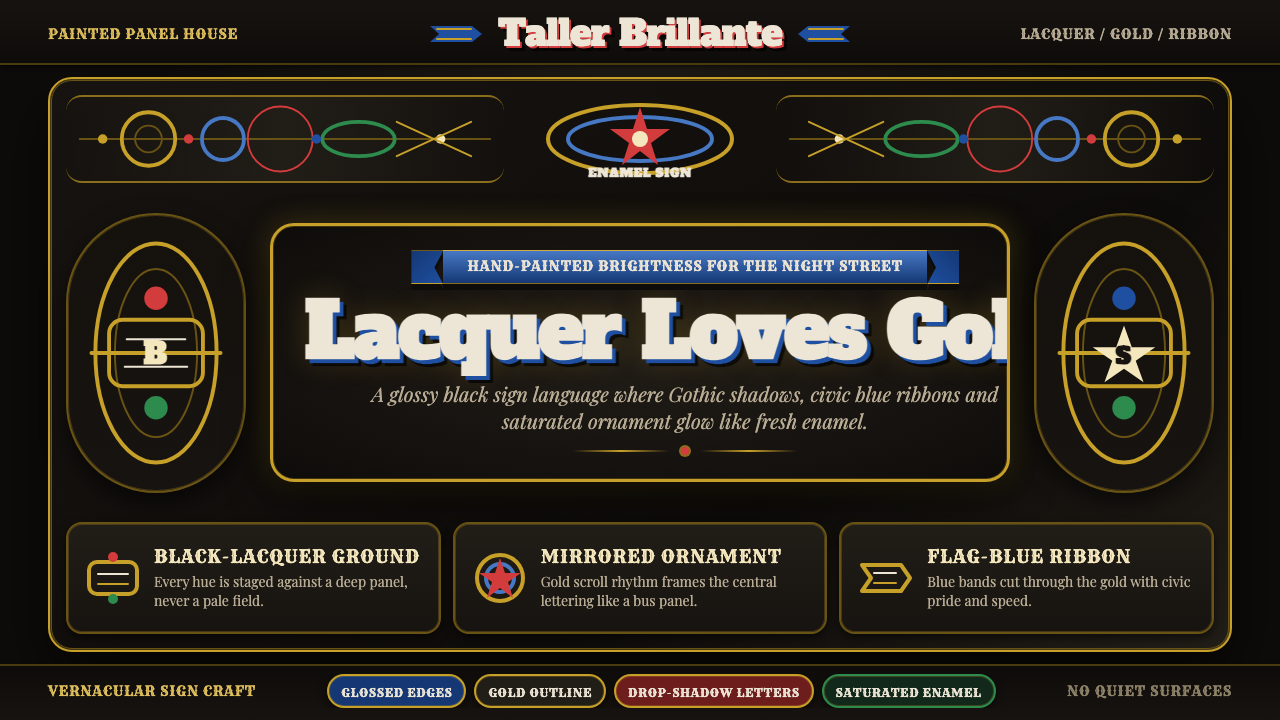 Fileteado Porteño Sign ArtBlack lacquer turns maximal. Gold scrolls, blue ribbons and Gothic shadows gl…
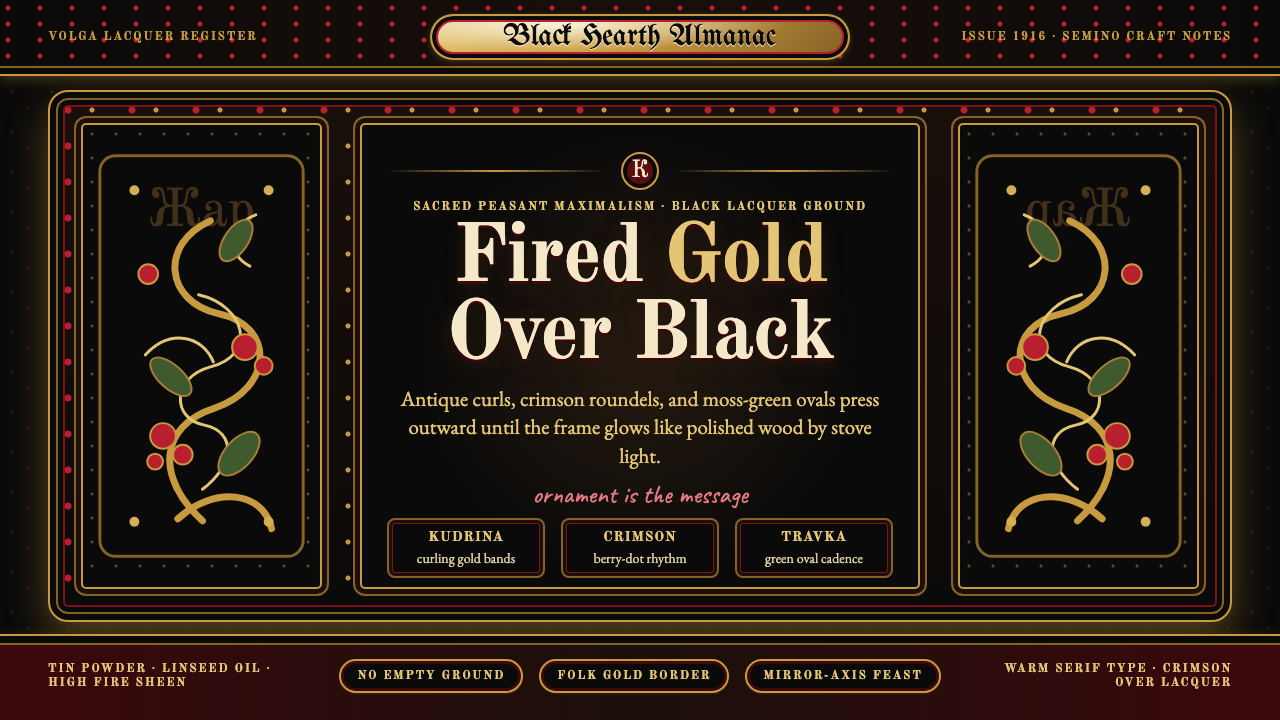 Russian KhokhlomaOrnament is the message. Antique gold curls and crimson dots crowd a black la…
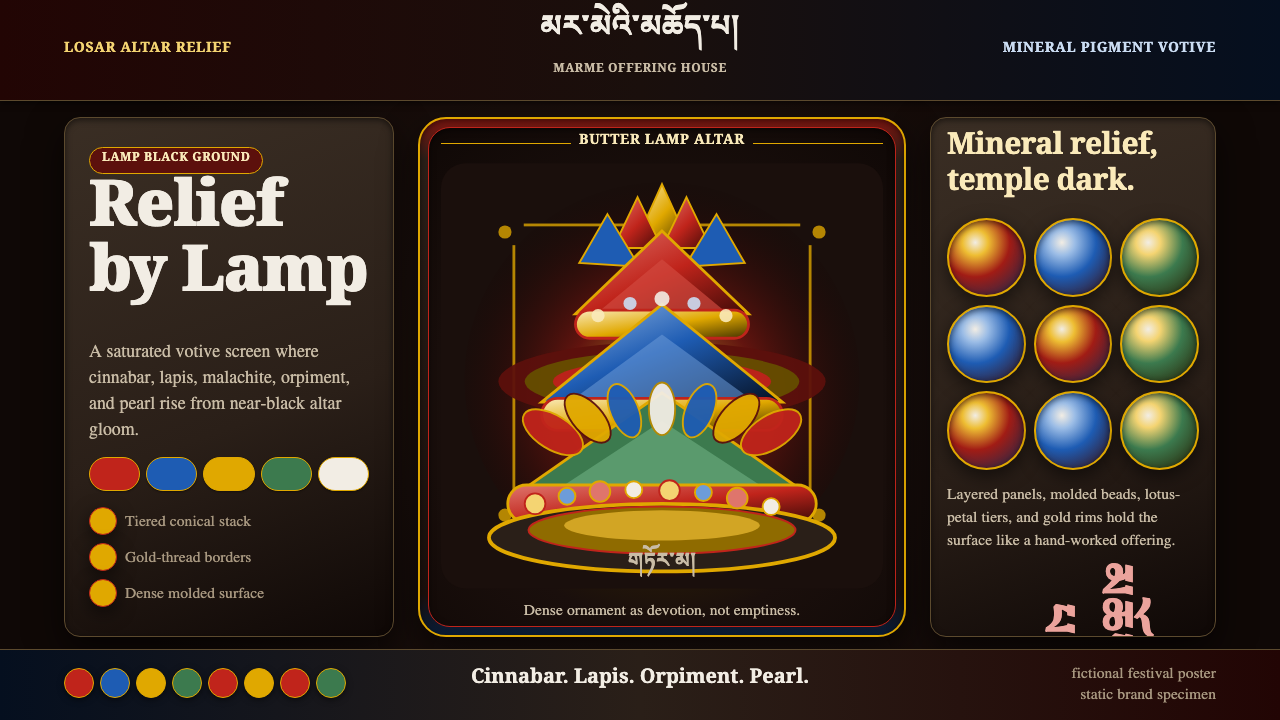 Tibetan Butter SculptureDevotion made dense. Cinnabar, lapis, and gold relief glow from altar black.
 Bamileke Elephant MaskRoyal density. Indigo bead fields lock white triangle rows into ceremonial po…
 Batak GorgaCosmology cut into wood. Chalk-white lines and batu hula red hold a blackened…
 Calçada PortuguesaA city drawn in stone. Stepped limestone courses cut across a basalt grid.