What is Lezgin Star Weave?
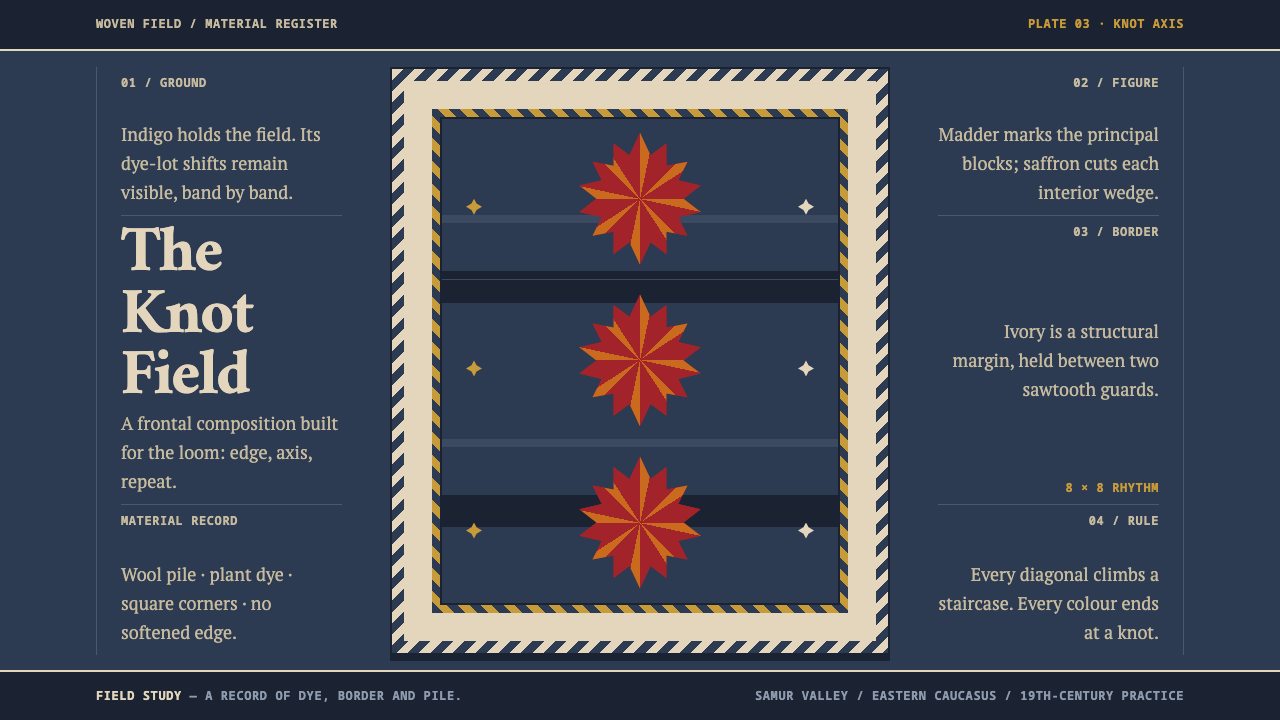
The Lezgin star rug is a grid made monumental: madder-red stars locked onto an indigo field, ivory guards that bite like sawteeth, and not a single curve anywhere.
Lezgin Star Weave in brief
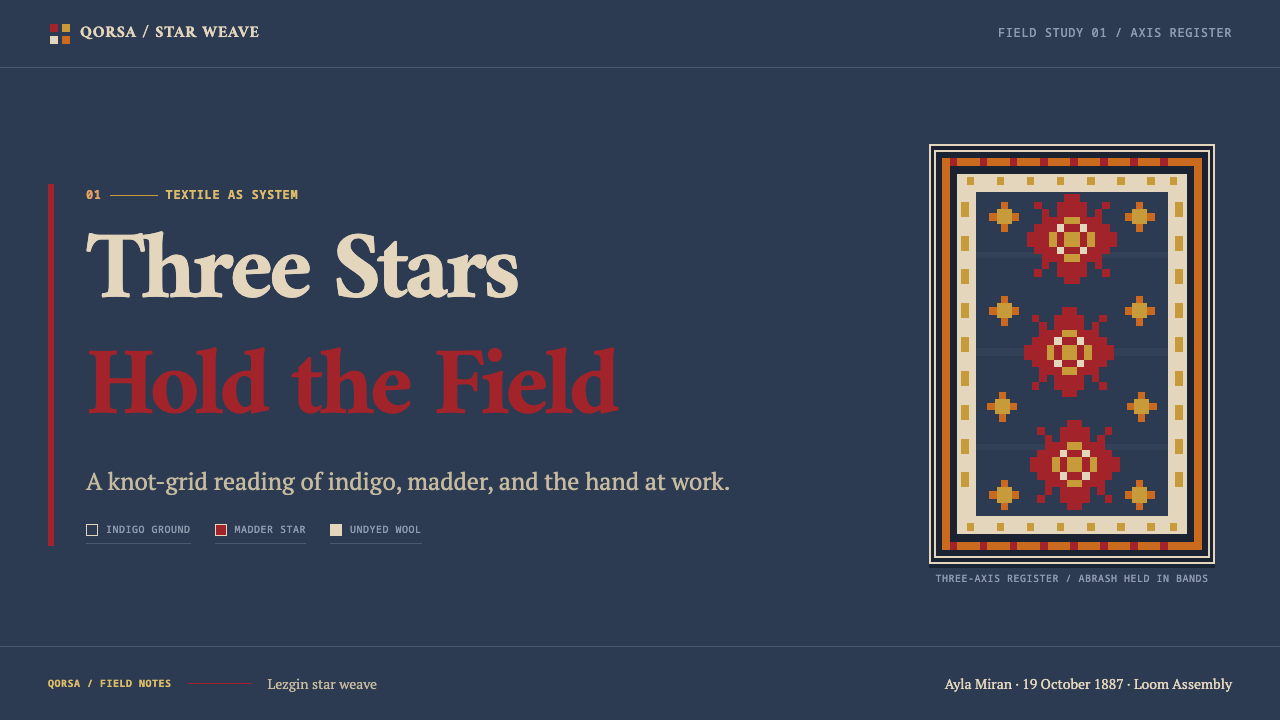
Lezgin Star Weave is a design style taken from a nineteenth-century Caucasian village rug. Its structure is simple and strict: a dark indigo wool field, three serrated eight-point stars stacked on the centre axis in madder red, small ivory rosettes scattered as filler, and a wide ivory border of leaf-and-calyx repeats held between sawtooth guard stripes. The composition reads as a tall rectangle with a clear centre, a clear frame and a very clear order of importance.
The governing idea is that the loom dictates everything. A knot grid cannot draw an arc, so every diagonal climbs as a staircase, every shape is built from small squares, and every colour stops dead at a knot line. Nothing blends, nothing blurs and no corner is rounded. The style turns that technical limit into an aesthetic rule, and the result is geometry with real weight, a pattern that looks constructed rather than drawn.
The palette is what a village dye vat produced: madder root, indigo, saffron-rust, gold and undyed camel wool. The slight horizontal drift in colour that results from dyeing in separate batches, called abrash, is left visible rather than corrected away. The mood is dark, rich and ceremonial, with a strong sense of handwork. It is a style for work that wants authority and pattern without any softness, and it rewards compositions with a single, unmistakable centre.
Where does Lezgin Star Weave come from?
The structure comes from pile weaving in the eastern Caucasus. The source places it in Dagestan and in the Kuba and Shirvan weaving belt, specifically among the Lezgin villages of the Samur valley, and dates the practice to the nineteenth century and earlier, before 1900. The wider tradition is Caucasian village pile weaving: rugs made in households and villages with local wool and local dyes, on looms whose geometry sets the limits of what can be drawn. The style takes one such rug as its blueprint.
The makers named in the record are the Lezgin village women weavers of the Samur valley, together with the local madder and indigo dyers of Kuba. The pairing is instructive, because the colours of the rug come from two crafts working in sequence: dyers produce the madder reds and indigo blues, and weavers decide where each colour begins and ends on the grid. The design system inherits that division, treating colour as a material supplied by the dye vat and structure as a decision made at the loom.
The record also names a movement, the Lezgi star design group across Kuba, Zeyve and Shirvan. It describes a family of rugs sharing the motif of the serrated star, set against dark fields and framed by borders with saw-tooth guards. The three-star centre axis of this system belongs to that family. The motif matters because it is both a pattern and an organising principle: a star placed on the axis, repeated down the length of the field, gives the rug its vertical rhythm and its sense of ceremonial order.
A further movement named in the record is natural-dye practice before aniline. Madder root, indigo, saffron-rust, gold and undyed camel wool are all drawn from plants and animals, and they carry the irregularity of those sources. When a weaver changed to a new indigo vat halfway through the work, a horizontal shift in depth appeared across the field. That shift is abrash, and the design system treats it as evidence of the hand to be kept. The ground is indigo and the star sits on it; the relationship cannot be turned upside down without losing the rug.
What defines the Lezgin Star Weave look?
Indigo Field
The ground is a deep indigo, a dark blue-black that reads as wool dyed in a vat rather than as a screen colour. It fills most of the composition and is the first thing established: the stars sit on the field, and the field does not sit behind the stars. This ordering is non-negotiable. The darkness gives the style its ceremonial weight, and every other colour is defined by how it stands out from this ground.
Madder-Red Stars
Three serrated eight-point stars are stacked down the centre axis in madder red, a deep and slightly brown red that comes from root dye. They are the hero of the composition: large, centred and repeated. The serrated edges are built from stepped edges, not points drawn with a straight ruler, so each star looks woven. Because there are only three, each carries weight, and the eye moves down the axis from one to the next.
Ivory Rosettes and Guards
Ivory is the light colour of the system. It appears in the small rosettes scattered as filler across the dark field and in the border and guard stripes that frame the composition. As filler, the rosettes keep the field from going empty without competing with the stars. As guards, the sawtooth stripes bite along both sides of the border and mark the transition from pattern to frame. The ivory is warm and woolly, never a clean white.
Wide Border of Leaf and Calyx
A wide ivory border of leaf-and-calyx repeats runs around the whole field, held between sawtooth guard stripes. The border is generous, roughly as visually important as the centre, and its repeating motif gives the composition a steady outer rhythm that contrasts with the large, slow stars inside. It turns the whole composition into a bounded object, something with an edge, which is a central part of the style's rugged formality.
Knot-Grid Geometry
A knot grid cannot draw an arc, so nothing in the style curves. Diagonals climb as staircases, shapes are built from small squares, and every colour stops dead at a knot line with no transition, no blur and no rounded corner. This is not a lack of sophistication; it is a rule that makes the geometry honest. In a layout, it means hard corners, stepped diagonals and edges that begin and end exactly where a colour changes.
Natural-Dye Palette
The palette is limited to what a village dye vat could produce: madder-root red, indigo, saffron-rust, gold and the undyed camel colour of raw wool. Together these five give a warm, earthy, saturated set in which no colour is synthetic or neon. Gold and saffron-rust are used sparingly as accents; camel and ivory carry the lighter areas. The restriction is the point, because a small fixed palette makes any composition coherent.
Abrash
When the weaver changed to a fresh indigo vat halfway through, a horizontal difference in depth appeared across the field. That drift is abrash. The style keeps it deliberately: large dark areas are allowed a faint horizontal change in tone rather than being flattened to a perfectly uniform fill. It reads as proof that a person worked on the surface in stages, and it prevents the dark ground from feeling like a digital rectangle.
Who shaped Lezgin Star Weave?
The weavers named in the source record, and the authors of the structure. Working on a knot grid, they decided where each colour started and stopped, and so produced the stepped diagonals, serrated stars and bordered fields that define the style. Their method has become the design rule: build everything from small squares, never draw an arc, and let the loom set the limits of the pattern.
The dyers who supplied the reds and blues. Madder-root red and indigo blue are the colours of the star and the field, and both came from vat processes that vary slightly from batch to batch. That variation is the source of abrash. The dyers represent the part of the style that cannot be controlled with precision, and the design system respects them by leaving horizontal drift visible instead of smoothing it away.
A grouping rather than a person: the family of Caucasian rugs, spread across Kuba, Zeyve and Shirvan, that share the serrated star motif. It is the design lineage the style belongs to. Naming the group matters because it makes clear that the three-star centre axis is not an isolated invention but a recognised arrangement within a regional tradition, repeated and varied across many villages and many looms.
The broader craft tradition named in the record, covering rugs made in villages of the eastern Caucasus before 1900. It supplies the physical logic for everything in the system: wool, knots, natural dye and the grid. When the style insists on hard corners, stepped lines and a limited palette, it is describing the working conditions of this tradition and treating them as the rules of a design language.
How do you use Lezgin Star Weave today?
Lezgin Star Weave is a dark, formal and strongly structured style, and it transfers best to work that benefits from authority, pattern and a single strong centre. It does not suit hesitation. Applying it correctly means thinking of the layout as a tall rectangular rug: a bounded field, a wide frame, a hero stacked on the central axis, and everything else left to the dark ground. The ground is the ground, and the stars are on it.
For presentation slides, a cover can place a bold central emblem or title on the axis of a dark indigo field, framed by a wide ivory border with sawtooth edges. Content slides keep the border and let a single stacked element anchor the centre, with supporting text confined to quiet blocks. Data slides suit charts built from stepped shapes: bars with square ends, line segments drawn as staircases, and a single madder-red element carrying the one point that matters.
For web interfaces, the style gives dark products a strong, ceremonial character. Components have hard corners and no radius; borders are drawn as stepped frames; focus and hover states change colour at a clear edge instead of fading. A narrow, centred column works like the rug face. On a pricing page, plan tiers can be stacked down the central axis like the stars, with the recommended tier in madder red and the others in quieter tones. Navigation stays plain and typographic.
For editorial and marketing work, the style suits heritage, craft, textile, travel and cultural storytelling, and any brand wanting a monumental pattern-based identity. A long article can use a bordered reading column with a guard stripe at each side, section breaks drawn as rows of small rosette marks and pull quotes set inside a framed block. Photography works best when it is warm and textured, showing wool, dye and hands, and it should be cropped with hard rectangular edges.
The most common mistake is to soften it. Rounded corners, gradients between colours, blurred shadows or curved ornaments all contradict the knot grid and turn the style into a generic dark theme with red accents. A second mistake is to correct abrash by filling the ground with a perfectly uniform tone, which removes the evidence of the hand. A third is to reverse the hierarchy, putting a red field behind indigo stars or letting the border colours bleed into the interior, which destroys the clear order of ground, star and frame.
Lezgin Star Weave — FAQ
What is the Lezgin Star Weave design style based on?
It is based on a nineteenth-century Caucasian village rug from the Lezgin villages of the Samur valley in Dagestan and the Kuba and Shirvan weaving belt. The rug has a dark indigo field, three serrated eight-point stars in madder red stacked on the central axis, ivory rosettes as filler, and a wide ivory border of leaf-and-calyx repeats held between sawtooth guard stripes.
Why does the style have no curves at all?
Because a knot grid cannot draw an arc. On the loom every diagonal climbs as a staircase and every colour stops at a knot line, so the pattern is built from small squares. The style turns this technical limit into a rule: hard corners, stepped diagonals, no rounded corners, no blur and no gradients between colours. Adding a curve would break the logic of the object.
What is abrash, and should I keep it?
Abrash is the horizontal drift in colour depth that appears when a weaver changes to a new dye vat partway through a piece. In this style it is kept on purpose as evidence of the hand. Large dark areas may carry a faint horizontal change in tone rather than a perfectly uniform fill. Keep it subtle and horizontal, and never let it turn into a gradient or a noisy texture.
Can I swap the indigo field for a light background?
The style is built as a dark one, and the order of ground, star and frame depends on it. The stars sit on an indigo field; the ivory appears in the border, guards and rosettes. A light field would invert that relationship and turn the stars into holes. If you need a lighter surface, confine ivory to the frame and to small blocks, and keep the main field indigo.
Where does the style fit, and where does it struggle?
It fits heritage, craft, textile, travel and cultural projects, dark-mode products wanting a ceremonial character, and any brand that benefits from a bounded, central, pattern-based composition. It struggles in soft, playful or minimal contexts, in interfaces that need many equal columns, and wherever smooth gradients and rounded components are part of the product's identity.
Related design styles
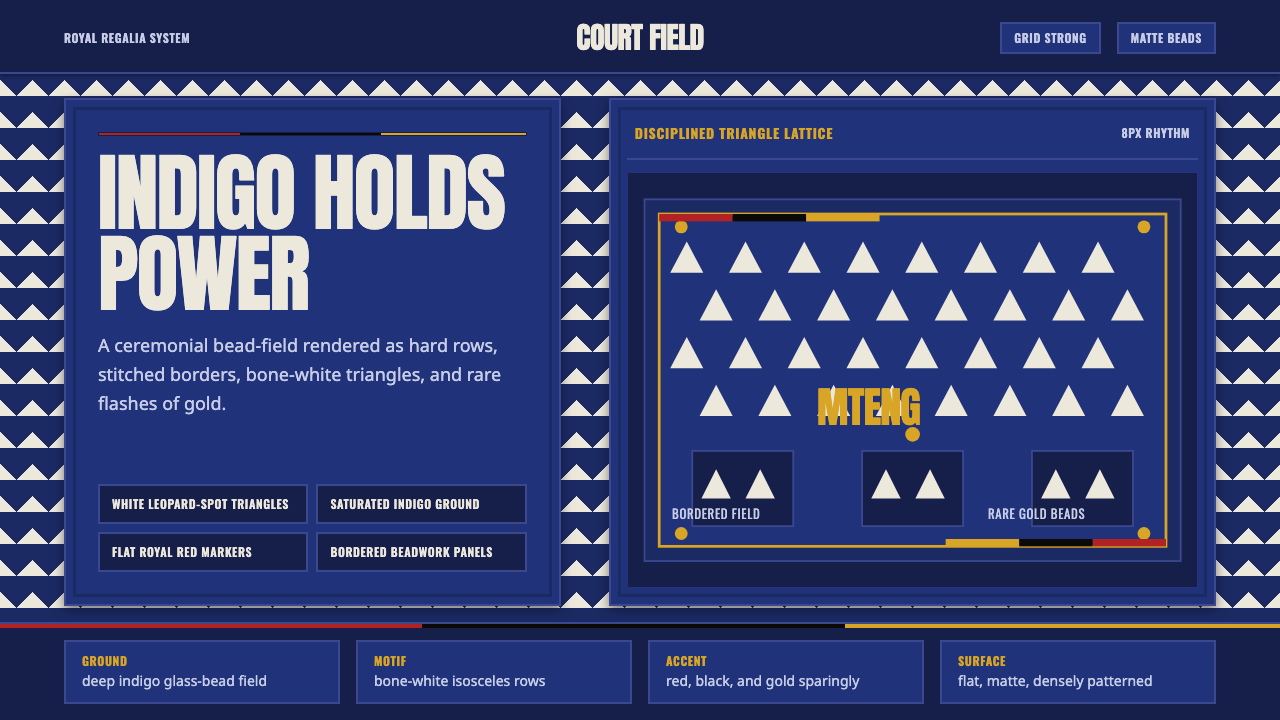 Bamileke Elephant MaskRoyal density. Indigo bead fields lock white triangle rows into ceremonial po…
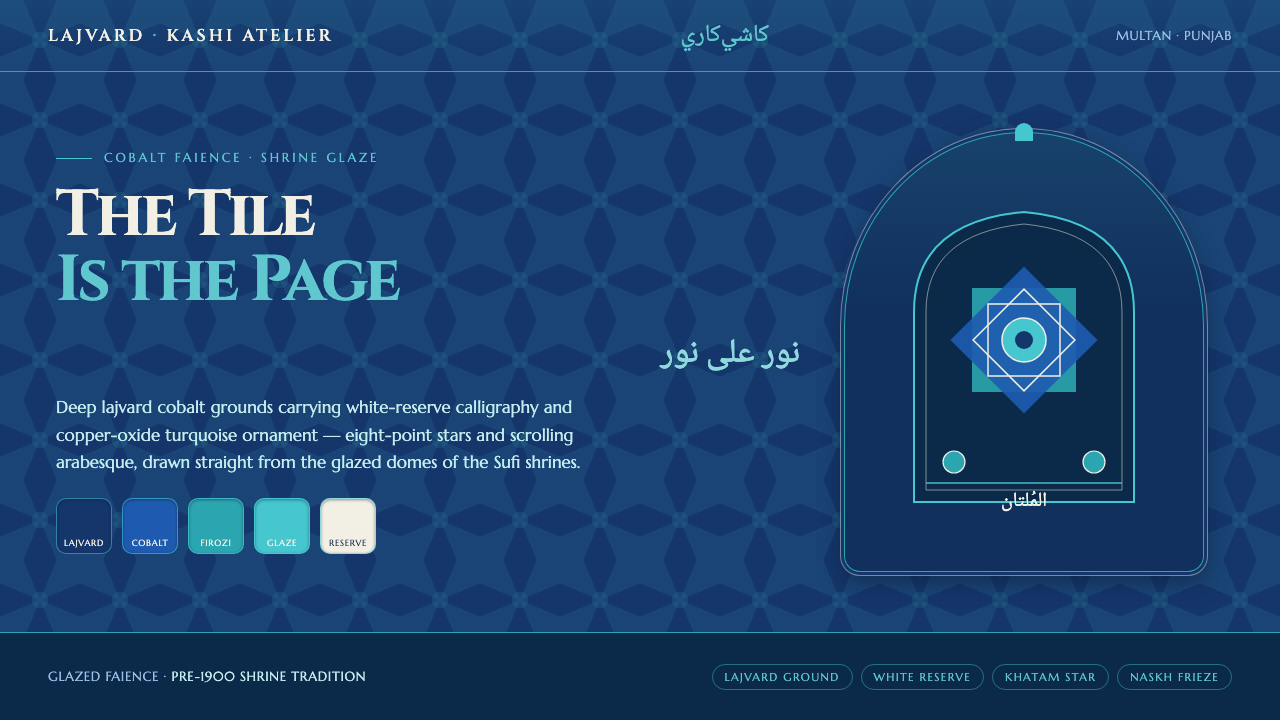 Multani Kashi TileworkThe cobalt tile is the page. Lajvard grounds carry white-reserve script and f…
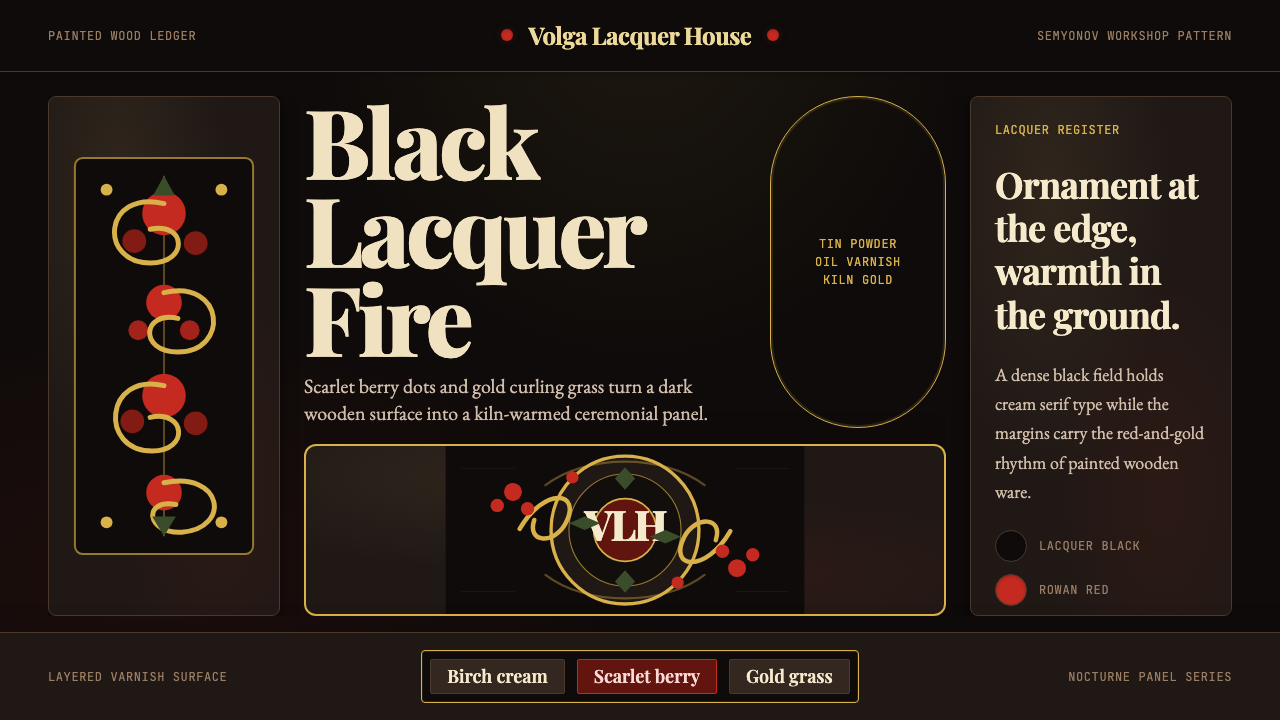 Russian Khokhloma Wood-Red LacquerKiln-fired ornament. Lacquer black, scarlet dots, and Playfair gold curls cro…
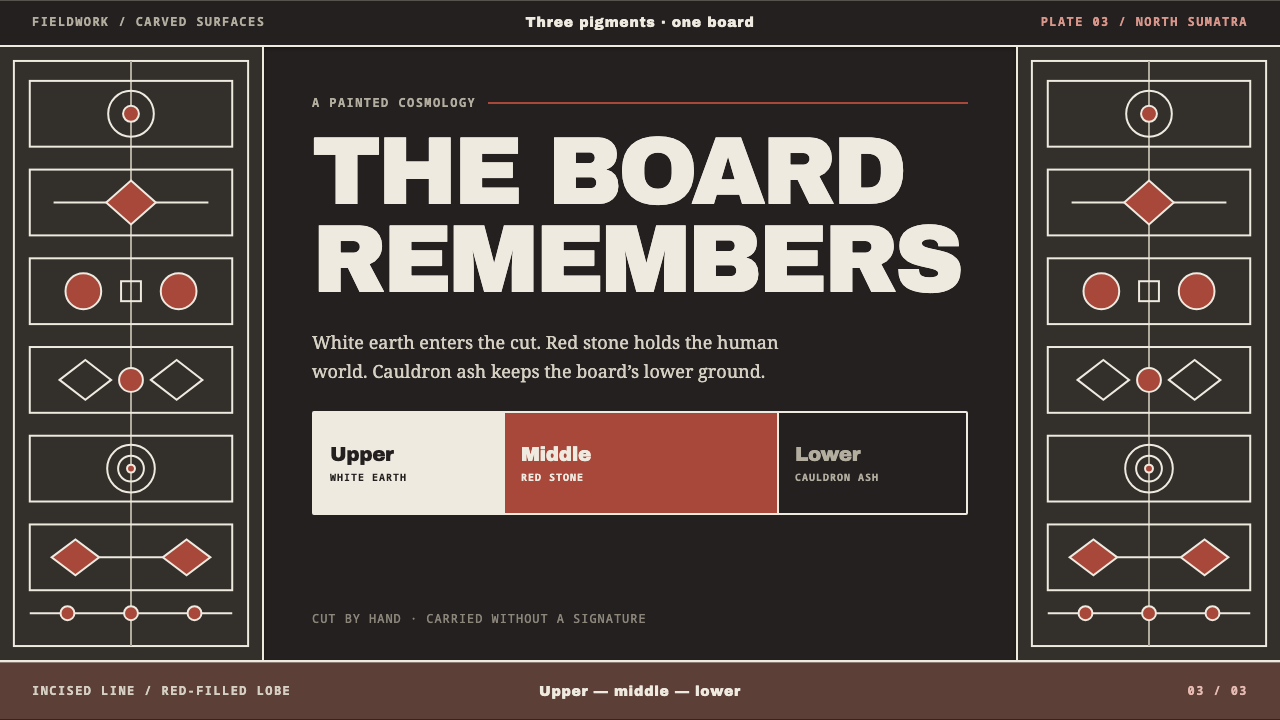 Batak GorgaCosmology cut into wood. Chalk-white lines and batu hula red hold a blackened…
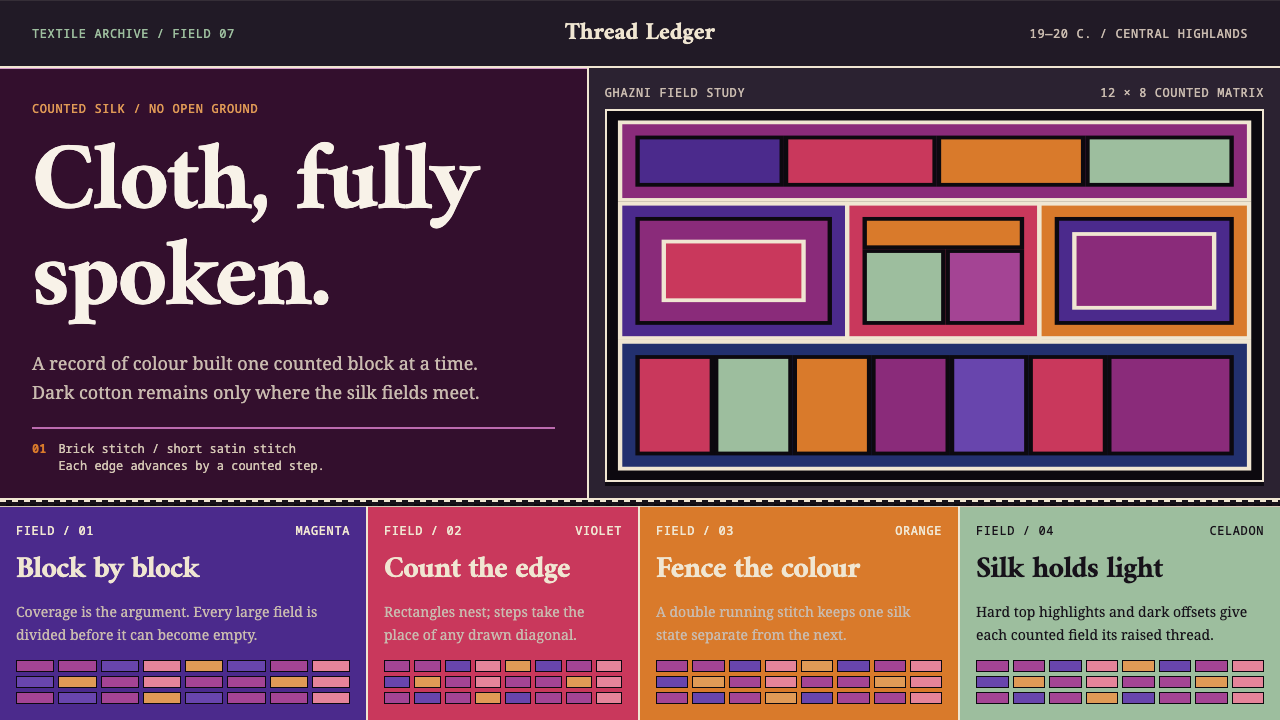 Hazara EmbroideryCoverage is the argument. Magenta silk blocks meet on a dark counted lattice.
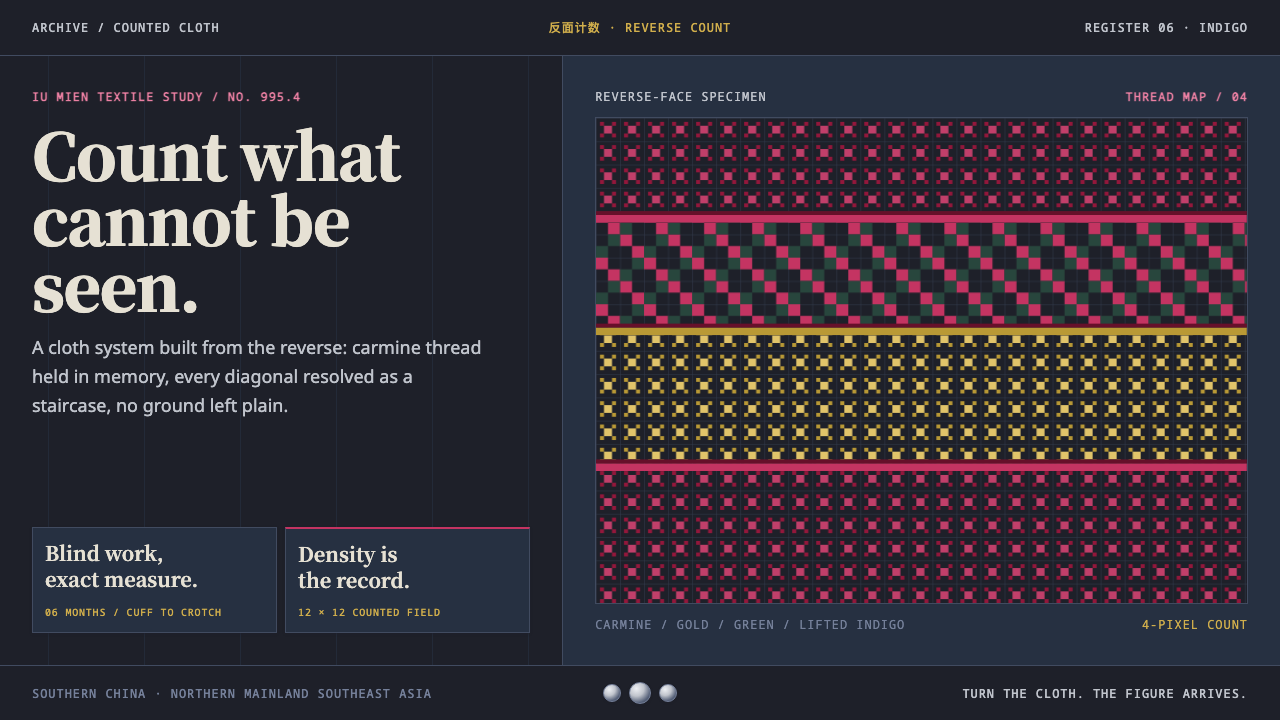 Mien Yao Cross-StitchDensity is the achievement. Carmine counted stitches saturate near-black indi…