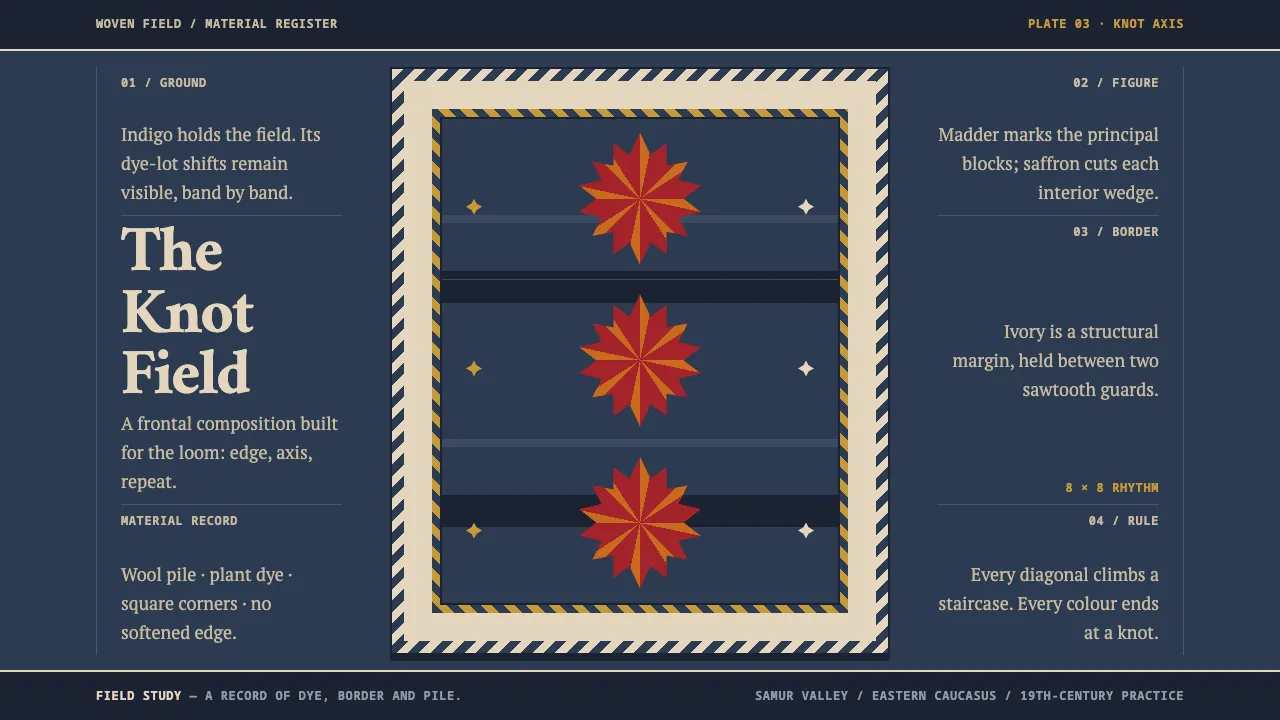
About Lezgin Star Weave
Lezgin Star Weave takes its structure from a 19th-century Caucasian village rug: a dark indigo wool field, three serrated eight-point stars stacked on the centre axis in madder red, ivory rosettes scattered as filler, and a wide ivory border of leaf-and-calyx repeats held between sawtooth guard stripes.
Nothing in it curves. A knot grid cannot draw an arc, so every diagonal climbs as a staircase and every colour stops dead at a knot line. The palette is what a village dye vat produced — madder root, indigo, saffron-rust, gold, undyed camel wool — and the horizontal drift of abrash is left visible rather than corrected away.
- Origin
- Dagestan and the Kuba/Shirvan weaving belt of the eastern Caucasus; Lezgin villages of the Samur valley
- Era
- pre-1900 — 19th-century and earlier Caucasian village pile weaving
- Key figures
- Lezgin village women weavers of the Samur valley · Local madder and indigo dyers of Kuba
- Movements
- Caucasian village pile weaving · Lezgi star design group across Kuba–Zeyve–Shirvan · Natural-dye practice before aniline
Lezgin Star Weave design spec
Colors
Typography
The other 11 sections — buttons, cards, spacing, motion, techniques and more — open once you unlock. Download the DESIGN.md or send it to your AI in one click. Unlock once, yours forever.
Sign up nowStyles similar to Lezgin Star Weave
Also inspired by crafts & folk art, with a close feel.
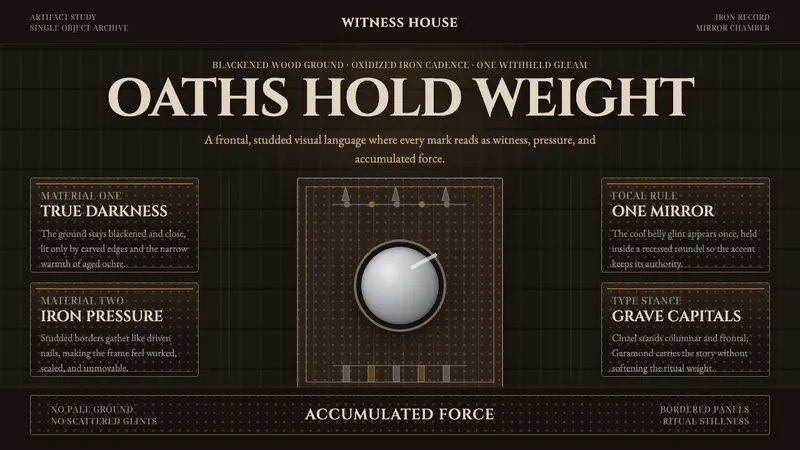 Kongo Nkisi Nkondi Power FigurePower accumulates in darkness. Black wood, iron studs, and one mirror glint hold the frame.
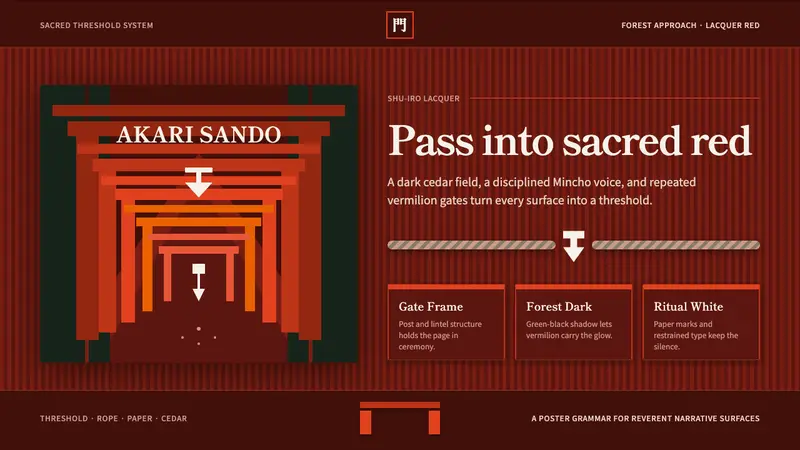 Shinto ToriiSacred red holds the dark. Vermilion gates, Mincho type, and shide white frame the threshold.
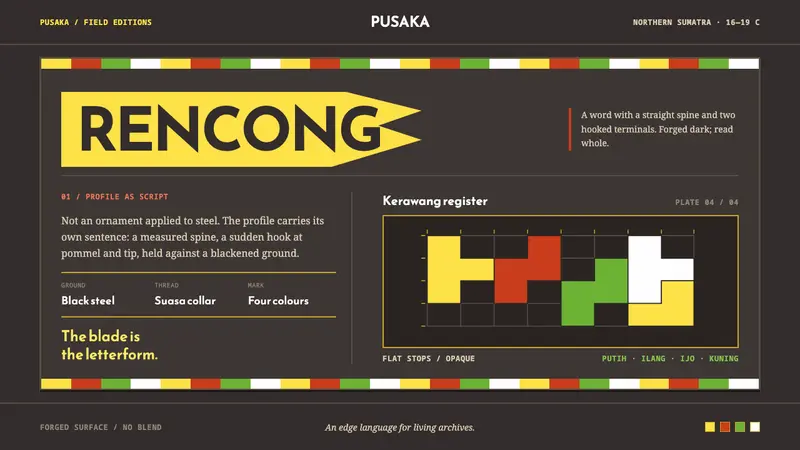 Acehnese Rencong MotifA blade that reads as a word. Flat kerawang red, white, green and yellow lock into black steel.
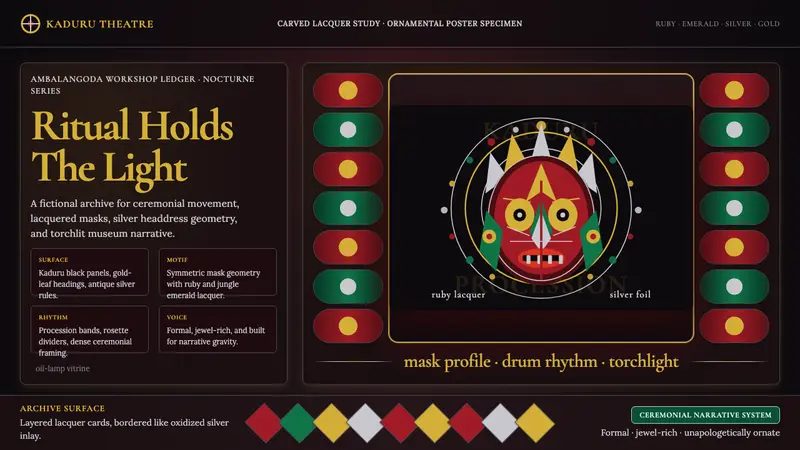 Sri Lankan Kandyan Mask & DanceRitual carries weight. Gold serif type and ruby-emerald filigree burn on black lacquer.