What is Hazara Embroidery?
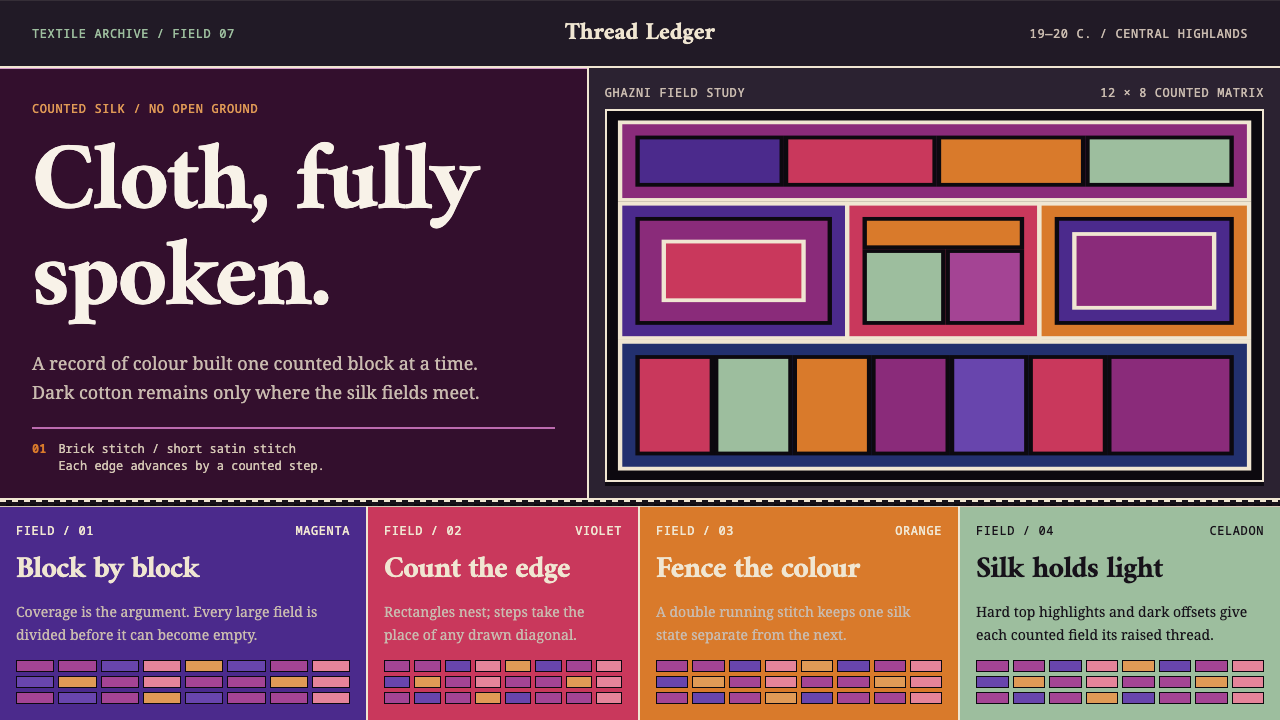
Hazara embroidery counts its way across the cloth until nothing of the ground is left bare — no empty field, no curve, only silk blocks meeting on a thin dark lattice.
Hazara Embroidery in brief
Hazara embroidery is a counted-thread silk tradition from the Hazarajat, the mountainous heartland of central Afghanistan. Hazara women work it on plain cotton cloth in brick stitch and short satin stitch, and they keep stitching until the cloth beneath has disappeared completely. What the eye reads is not fabric decorated with thread but thread that has become fabric: a dense mosaic of silk in which every unit is one counted block.
Its visual language is built from a handful of shapes: lozenges, chevrons, chequerboards and stepped triangles. None of them is drawn; each is counted. Because every shape is assembled block by block along the weave of the cloth, every edge is a staircase of threads and no line is ever allowed to curve. Colour is bright, saturated silk set against a dark ground, with magenta as the signature voice, and the narrow gaps between blocks let the dark ground show through as a fine lattice.
As a design system it is an unusual one, because it is dense where most contemporary styles are sparse. The governing principle is coverage: nothing is left as open field, large areas are divided into horizontal bands and filled, and a change of colour carries meaning, such as a change of state. The only restraint the style keeps is reserved for text, which stays calm so that the pattern can be loud around it.
Where does Hazara Embroidery come from?
Hazara embroidery comes from the Hazarajat, the highland region of central Afghanistan that includes Bamiyan, Ghazni and Daykundi. The library dates the tradition to the nineteenth and early twentieth centuries and treats it as a living practice rather than a closed chapter of history: women still make it. It belongs to the wider Central Asian family of dowry and festival textiles, the cloths made for weddings and celebrations, where hours of needlework are a way of putting skill and patience on public display.
Technically, the work belongs to counted-thread silk embroidery, the family the source tradition names through terms such as khamak and tarshoamar. The embroiderer does not trace a design onto the cloth. She counts the warp and weft of a plain cotton ground and lays each stitch in step with the weave. Brick stitch sets rows of stitches in staggered courses, like masonry; short satin stitch packs parallel stitches tightly side by side. Both are worked until no cloth shows. The geometry that results is not a stylistic choice imposed on the technique but the shape the technique naturally makes, since a grid can only produce a diagonal as a staircase.
Two regional schools are singled out. Ghazni work nests squares and long rectangles inside one another and divides one field from the next with a black-and-white double running stitch, a narrow two-tone seam that works like a ruled line. Bamiyan work runs on a dark ground in celadon green, pink, orange and red. The schools differ in palette and in how a field is subdivided, but they share the commitment to counted geometry and total coverage. The Curio system borrows from both: the dark ground and bright silk of the one, the divided fields and ruled seams of the other.
Scholarship has given the tradition a documentary record. Gillian Vogelsang-Eastwood, the Textile Research Centre in Leiden and SOAS University of London all appear in the lineage the library cites, and they matter for a practical reason: they treat these cloths as constructed objects with a technique, a grammar and a regional identity, not as anonymous folk decoration. For a designer that is both permission and obligation. The system borrows a discipline, and it deserves the same attention to counting and construction that the makers bring.
What defines the Hazara Embroidery look?
Coverage
The founding rule is that no cloth is left showing. Brick stitch and short satin stitch are worked until the plain cotton beneath disappears, so the finished surface is all thread. In interface terms, coverage means no region is merely empty: wide areas are divided into horizontal bands and filled, and what another style would leave as white space becomes either pattern or the thin dark lattice between blocks.
The Counted Lattice
The dark ground is never an open field. It survives only as the narrow channel between silk blocks, a lattice that is at once the grid of the weave and the structure of the layout. This inverts the usual relation between background and content: the ground is not a canvas waiting to be written on but the mortar that holds the blocks apart, and it is what makes the colour read as luminous.
Stepped Geometry
Lozenges, chevrons, chequerboards and stepped triangles are the entire repertoire. Because every shape is counted along the weave, a diagonal can only be a staircase and a circle cannot exist. The result is a hard-edged geometry that looks almost pixel-like, a thread-count constraint that anticipated the screen's pixel grid long before screens existed. Nothing curves: not corners, not icons, not charts.
Colour as State
Colour is information, not decoration. A change of silk colour marks a change of state: selected, active, finished, different. Bamiyan work runs celadon green, pink, orange and red on a dark ground, while the signature voice of this system is magenta silk. In both, a colour shift means that something has changed, not that something is being emphasised with a glow or an outline.
The Double Running Seam
Where one field ends and the next begins, the Ghazni tradition lays a black-and-white double running stitch, a thin two-tone ruled line. It is the style's one true divider: a narrow boundary that organises without adding weight. Sections are separated by this seam rather than by shadows, cards or extra spacing, which keeps the surface continuous and fully occupied.
Silk on Dark
Silk has a lustre that matt cotton does not, and the system keeps that relationship: saturated, slightly shining colour blocks against a deep, absorbent ground. Contrast is carried by hue and value between thread and ground rather than by outline or shadow, so glows, gradients and drop shadows are all unnecessary. They would also be foreign to a stitched surface, where nothing can blur.
Quiet Text
Pattern is the voice of this style and text is its silence. Reading matter sits in calm bands of its own, set in plain letterforms with room to breathe, framed by pattern but never printed over it. The abundance depends on that contrast. If text competes with pattern, the reader loses both, so the busiest surface in the library keeps the most orderly paragraph.
Who shaped Hazara Embroidery?
The tradition belongs to the Hazara women of the Hazarajat, who count, stitch and compose in the same act. There is no drawn pattern and no separate designer: the cloth is composed as it is stitched, and the schools of Ghazni and Bamiyan are the accumulated decisions of many hands. Any use of the style should begin by acknowledging that it is a living practice, not a finished archive.
A textile scholar named in this style's lineage. Her place in the account is as part of the documentary record, the careful study of cloth, technique and regional identity that makes it possible to treat these embroideries as constructed objects with a grammar rather than as anonymous folk ornament.
A research institution devoted to textiles and one of the reference points the library lists for this style. Institutions of this kind preserve the vocabulary the system depends on — which stitches, which regional schools, which structures — and are the right place to check any claim about how a motif is actually made.
A London university known for the study of Asia, Africa and the Middle East, listed alongside the Leiden centre among the scholarly reference points for the style. Its inclusion is a reminder that the tradition has a place in academic study of Asian material culture and not only in the marketplace or the museum shop.
How do you use Hazara Embroidery today?
Hazara embroidery is the most abundant style in the library, and the problem it solves is the opposite of the usual one. Most styles ask how to use less; this one asks how to organise a great deal without losing the reader. Using it well means taking its three rules seriously: nothing is empty, nothing curves, and colour means something.
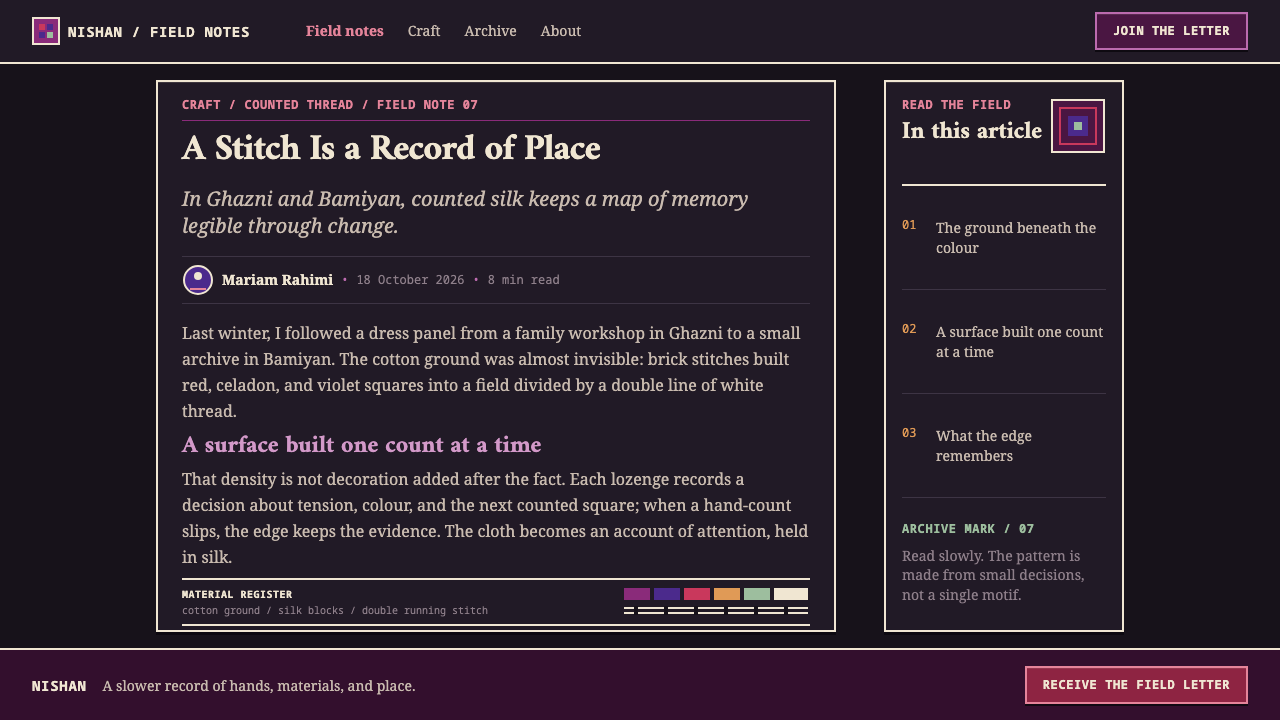
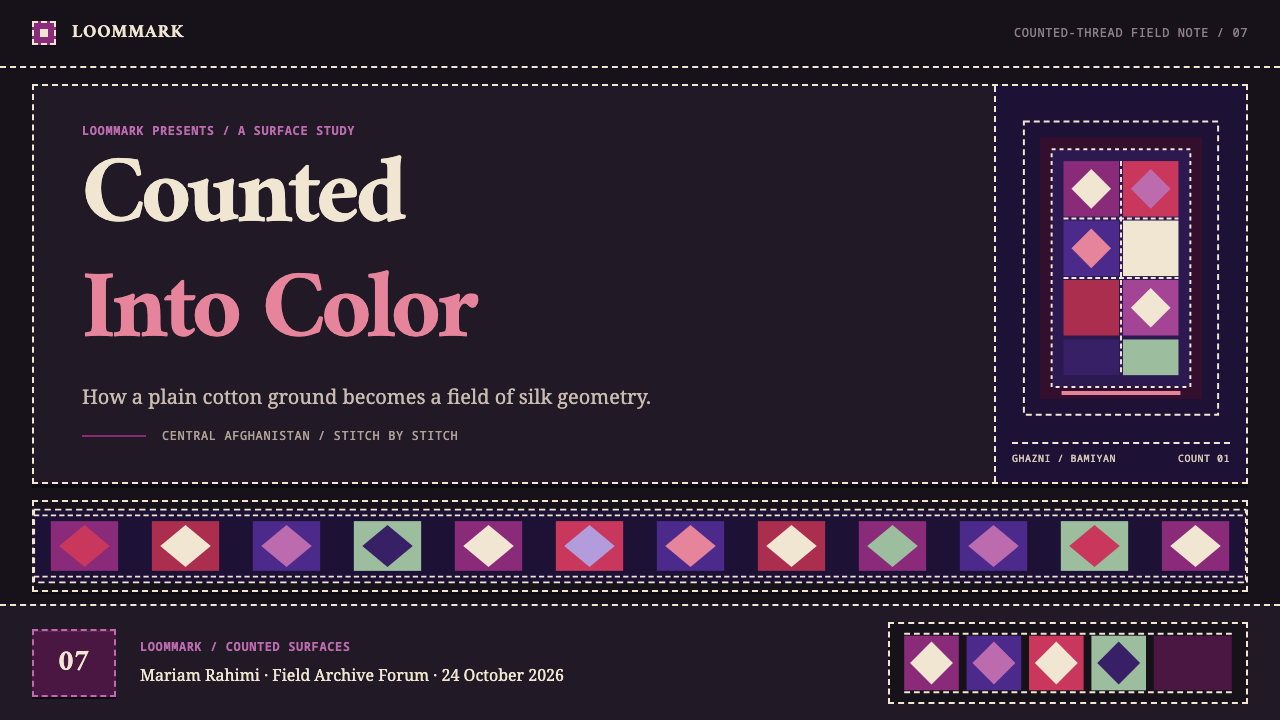
For slides, the cover works as a full-bleed field of silk-coloured blocks arranged in horizontal bands, with the title set in a single quiet band so that the dark ground shows only as a thin lattice between the blocks. Content slides follow the same logic: divide the slide into bands, give each idea one band, keep the text band calm, and use the black-and-white double seam to separate sections. Data slides are a natural fit because charts are already grids. A bar becomes a run of counted units rather than a smooth rectangle, and heat maps and tables simply inherit the lattice.
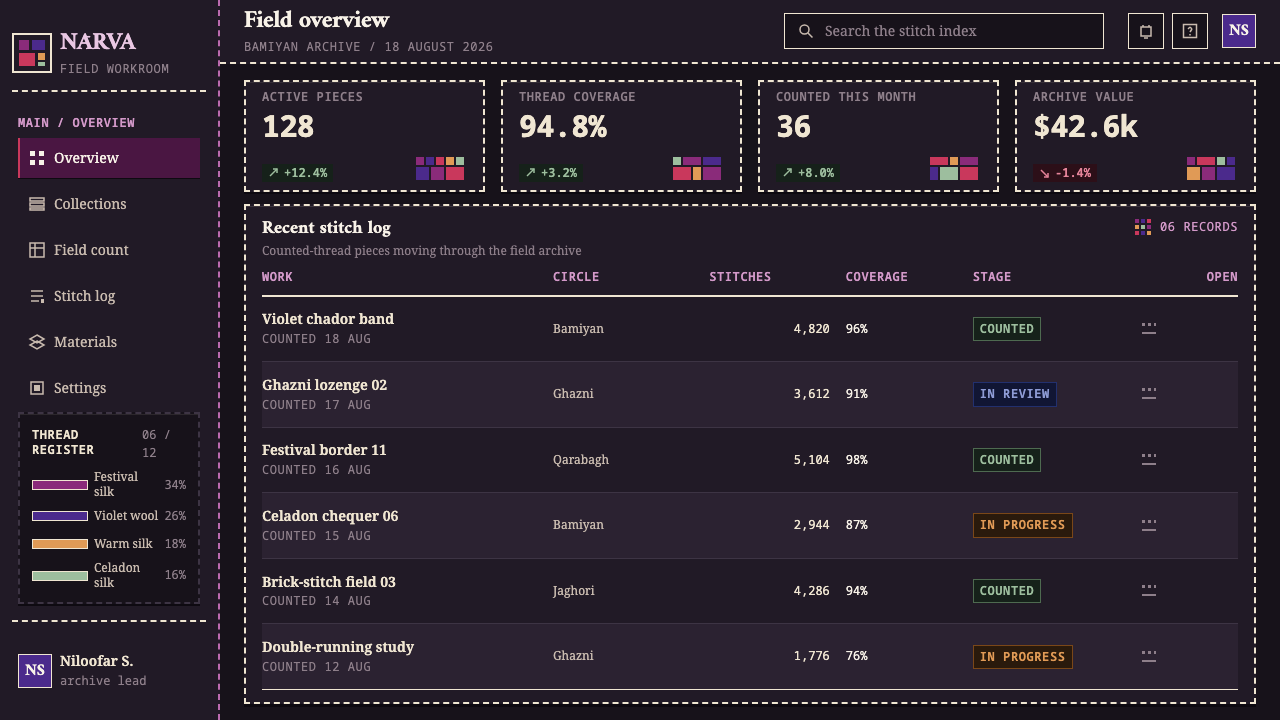
For web interfaces, dashboards and pricing pages can be built as blocks on a lattice, with the gutter playing the part of the dark ground. A selected state changes the colour of a block's thread instead of adding a glow or an outline, and tiers are told apart by colour band rather than by badge or shadow. Navigation and headers stay quiet so the pattern can carry the personality. The style suits products whose character is warmth and craft, such as handmade marketplaces, cultural platforms, games and creative tools, and it suits less well anything that needs to feel clinical, such as legal or banking surfaces.
For editorial and marketing work, section dividers can become patterned bands, and a pull quote can sit in a calm field between two bands of pattern. Photography of textiles, hands and thread pairs naturally with the system. Long reading text must never sit on top of the pattern: the pattern frames the words, it never lies behind them. A campaign page built this way reads like a woven panel, with each band a different message and the black-and-white seam acting as the paragraph break.
The common mistakes all keep the ornament and lose the discipline. Scattering a few motifs over an otherwise empty layout abandons coverage, which is the point of the style. Adding rounded corners, blur, glow or soft shadows breaks the counted-grid logic. Borrowing the colours without the counted structure produces a costume rather than a system. And treating the tradition as an exotic skin to be laid over any product ignores that it is a living craft; credit it, learn how it is constructed, and use the rules rather than only the look.
Hazara Embroidery — FAQ
What is the difference between brick stitch and short satin stitch, and why does it matter for design?
Brick stitch lays rows of stitches in staggered courses, the way bricks sit in a wall, while short satin stitch packs parallel stitches tightly side by side. Both fill the cloth completely. For design the practical lesson is that a surface can be covered in two different rhythms: offset rows, which suit masonry-style card layouts, and tight parallel runs, which suit solid bands and bars. In both cases the edges are stepped, never smooth.
Why does this style forbid curves?
Because the cloth is counted. Stitches follow the warp and weft, so a diagonal can only be built as a staircase and a true circle cannot be made at all. The prohibition is not a taste; it is the signature of the technique. In an interface it means no round avatars, no pill-shaped buttons and no smooth line charts. Corners are square, and anything that would normally be round is stepped or squared off.
Does the dark ground mean the style cannot work in a light layout?
It is conceived on a dark ground, and the ground matters: the bright silk reads as luminous precisely because it sits against something deep and absorbent. A light inversion is possible only if the ground still survives as a thin lattice between blocks and the colours keep enough contrast to separate. If you simply place the pattern on white, you lose the jewel-like quality and are left with something closer to a generic geometric border.
How is this different from other Afghan or Central Asian embroidery?
The library places Hazara work inside a wider family of counted-thread silk embroidery and of dowry and festival textiles, so it shares ancestry with neighbouring traditions. What this style isolates is the Hazara version: coverage until the ground vanishes, strict stepped geometry, and the two regional schools of Ghazni and Bamiyan. It should not be used as a generic stand-in for all Afghan or Central Asian needlework, which varies widely by region and community.
How can I use the style respectfully?
Start by treating it as a discipline instead of a decoration. Keep the rules that make it what it is: counted geometry, total coverage, colour that carries meaning and calm text. Name the tradition and its region where the work is public, and avoid pairing it with caricature or with clichés about the place it comes from. It is a living craft practised by Hazara women, and a design that honours its construction honours them better than one that borrows only its look.
Related design styles
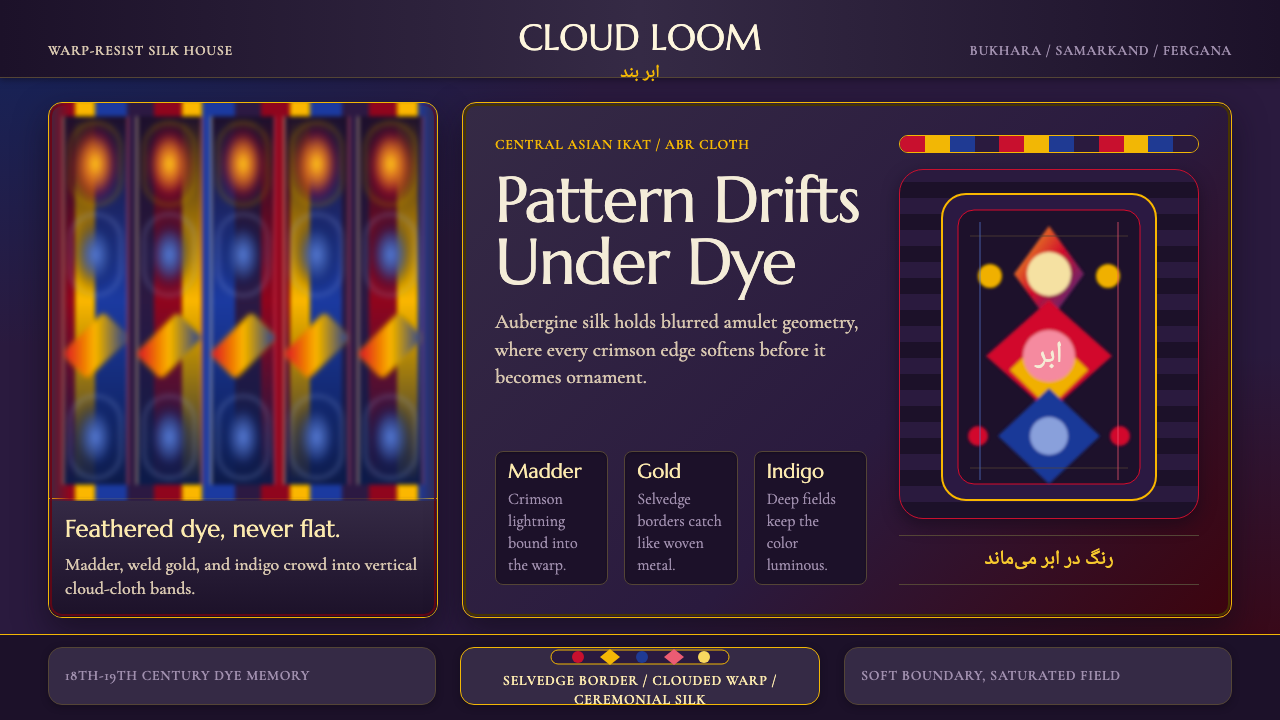 Central Asian IkatMaximal silk haze. Madder, gold, and indigo warp bands feather across aubergi…
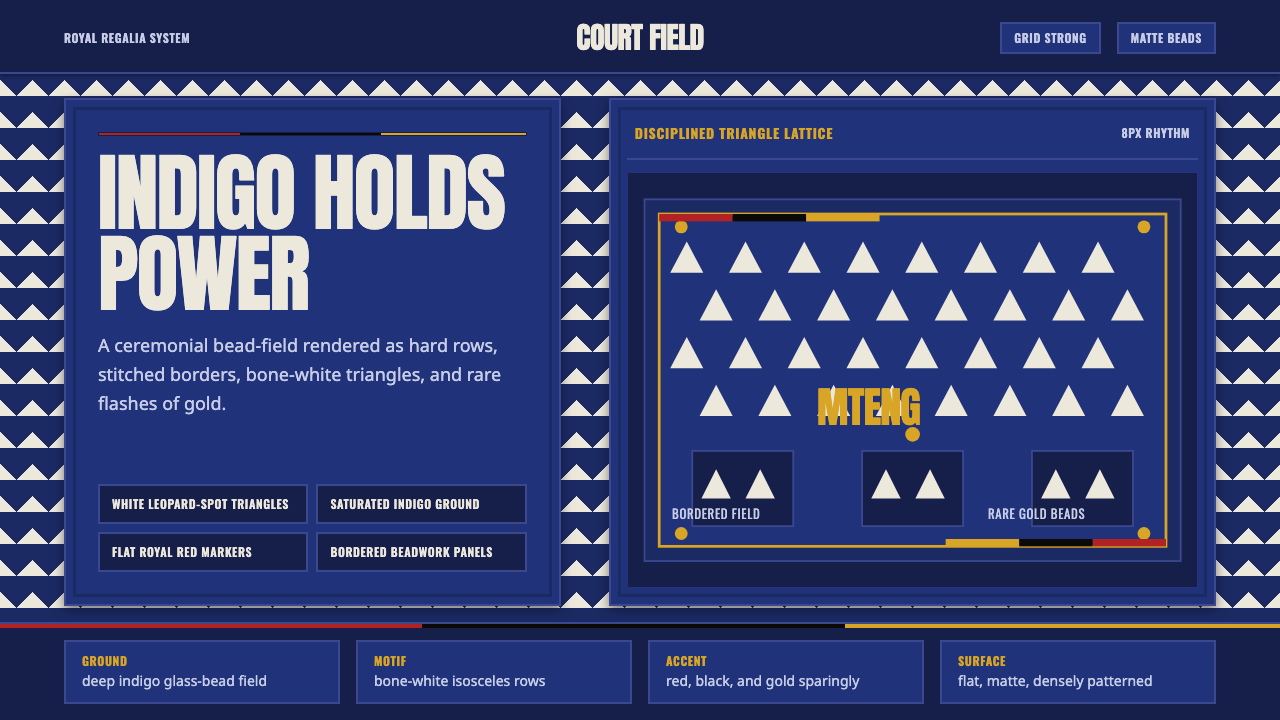 Bamileke Elephant MaskRoyal density. Indigo bead fields lock white triangle rows into ceremonial po…
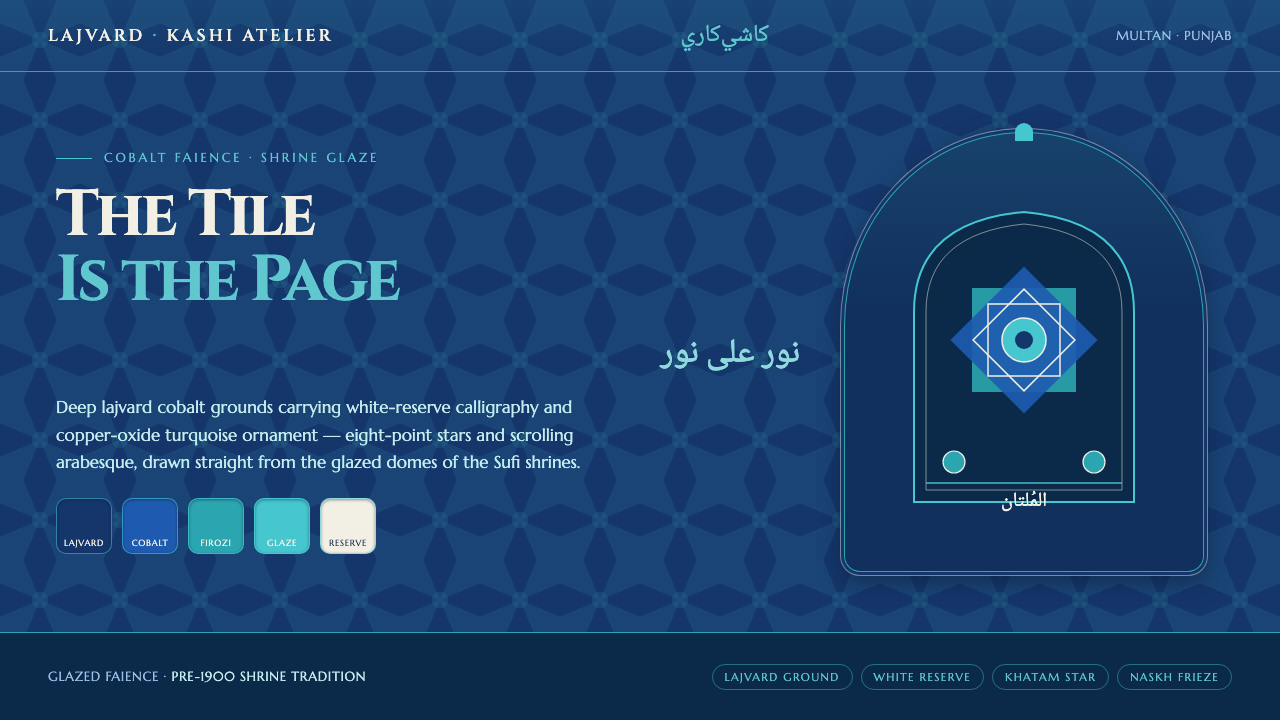 Multani Kashi TileworkThe cobalt tile is the page. Lajvard grounds carry white-reserve script and f…
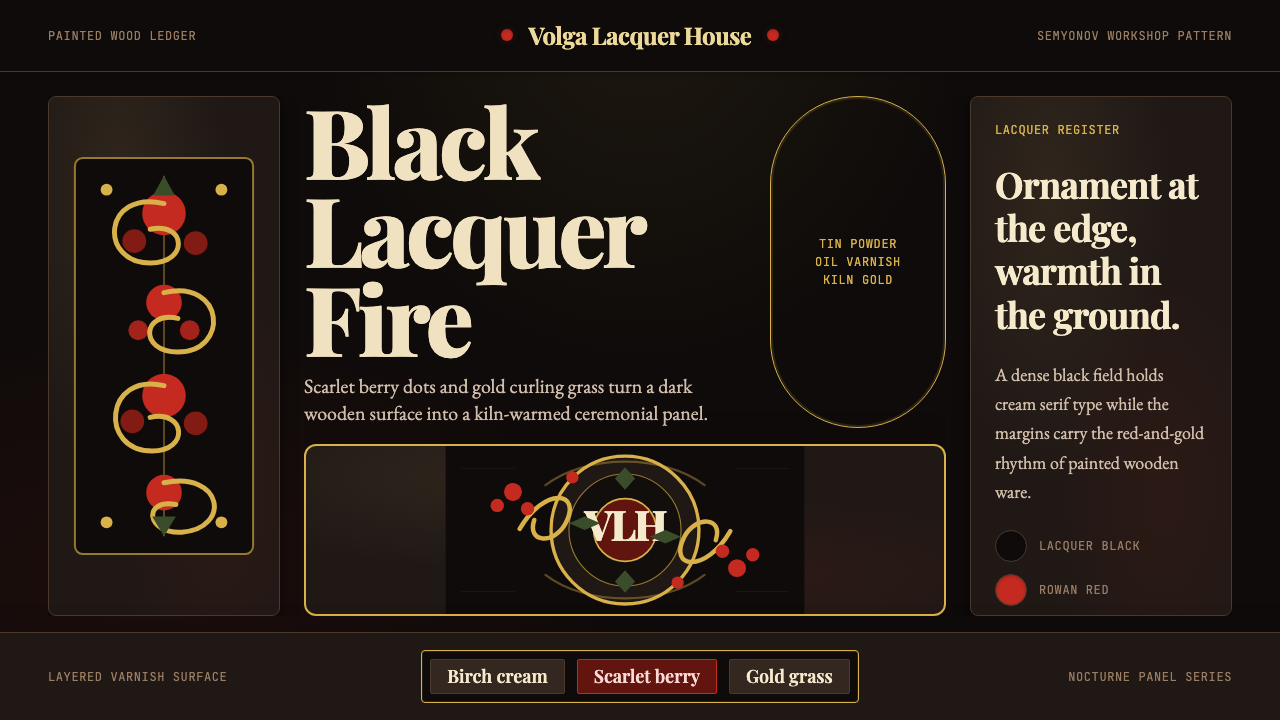 Russian Khokhloma Wood-Red LacquerKiln-fired ornament. Lacquer black, scarlet dots, and Playfair gold curls cro…
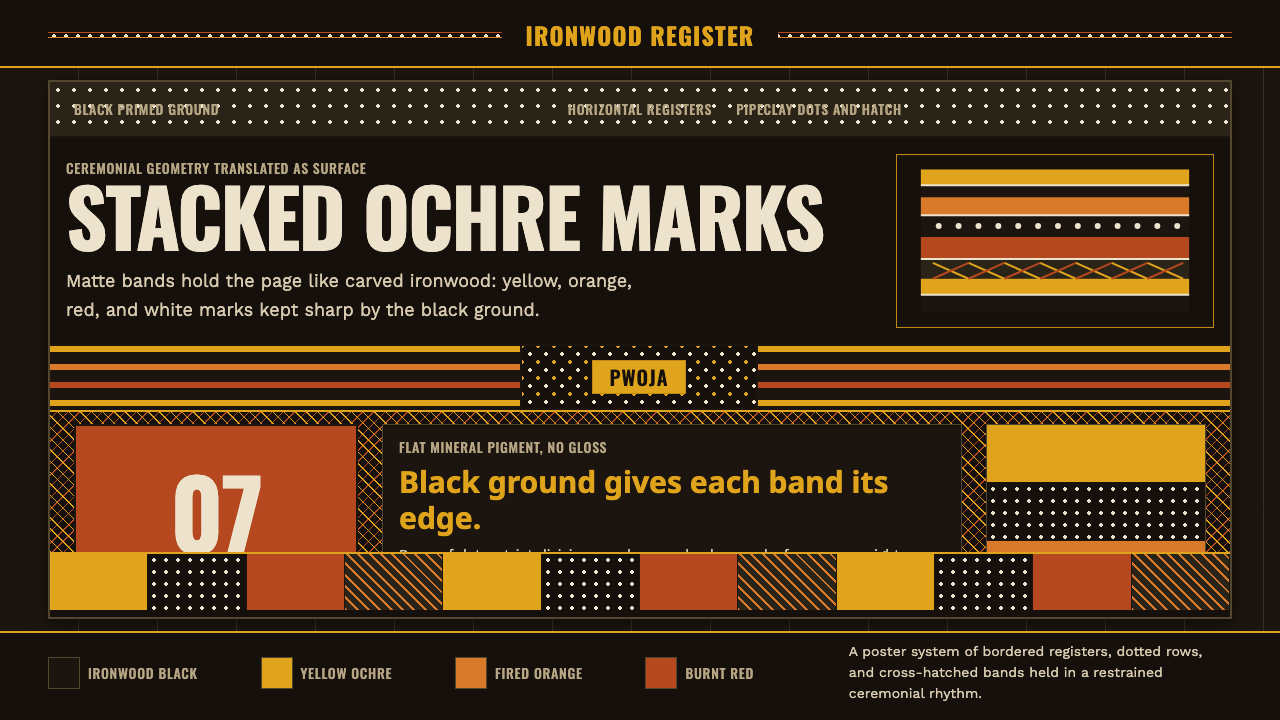 Tiwi Pukumani PoleBlack ground carries ceremony. Ochre bands, pipeclay dots, and hatch stack li…
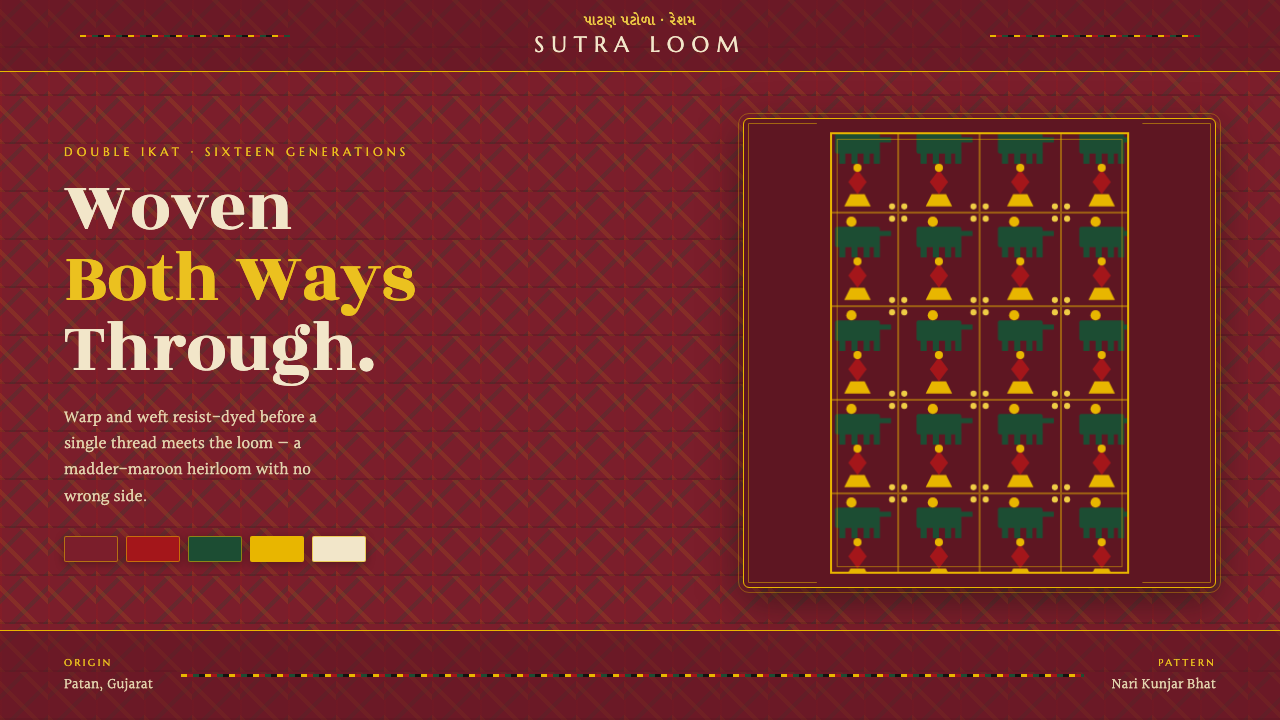 Patan Patola Double IkatReversible by design. Madder-maroon ground, a strict red-green-gold lattice,…