What is Mien Yao Cross-Stitch?
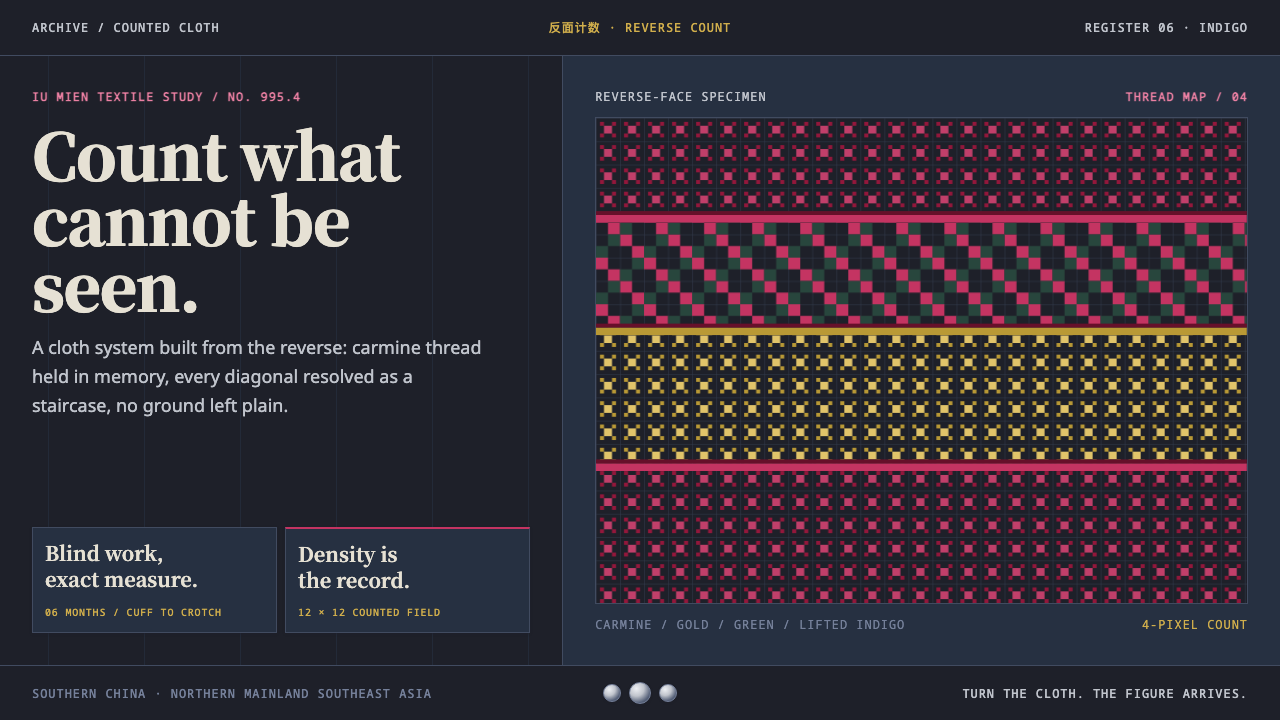
Mien Yao embroidery is worked blind from the back of the cloth — carmine counted stitches packed edge to edge across near-black indigo until no plain ground remains.
Mien Yao Cross-Stitch in brief
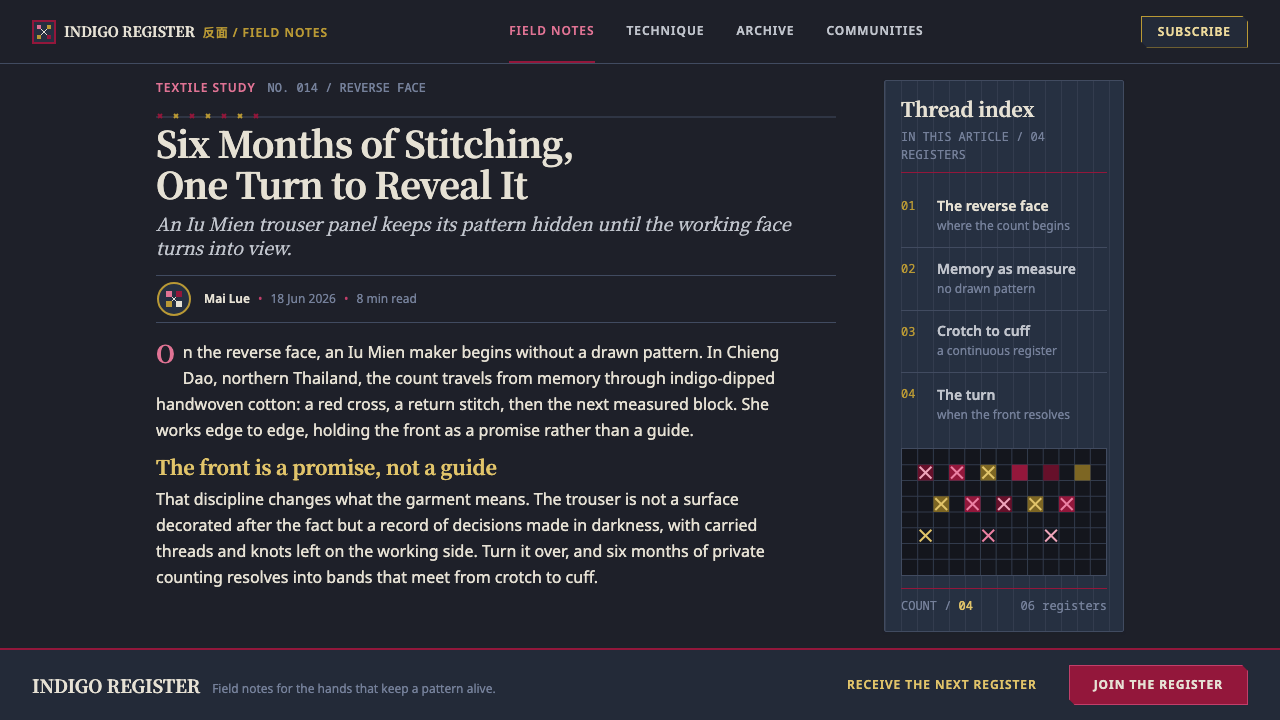
Mien Yao Cross-Stitch is a design style taken from the embroidered trousers of the Iu Mien, whose communities lie across southern China, northern Vietnam, Laos and northern Thailand. Iu Mien women embroider the trousers from the back of the cloth. No pattern is drawn, no glance is taken at the front, and the count is held entirely in memory, so the design only surfaces when the piece is turned over. A single pair takes six months or more and is worked from crotch to cuff with no ground left plain.
As a design system it takes the reverse face as its working surface: near-black indigo as the field, deep carmine floss as the figure, and a stitch grid that forbids curves. Diagonals follow the grid, curves become steps, and pattern blocks sit shoulder to shoulder in bands and columns with no gaps between them. Cold silver coins press against matte thread, and the bright rose of the neck ruff is allowed only as a small accent, never as the lead.
Density is not decoration here; it is the achievement. The style is the opposite of the airy minimalism that dominates contemporary interface design. It asks the designer to fill space deliberately and to earn the filling through order: every block counted, every band complete, every diagonal obeying the grid. At first glance it reads as dark, rich and almost overwhelming, and a second look rewards the viewer with the discovery of how strict its rules are.
Where does Mien Yao Cross-Stitch come from?
The Iu Mien are named in the source as communities of southern China, northern Vietnam, Laos and northern Thailand, and the places it cites include Lào Cai, Chieng Dao and Maechan. The source dates the tradition to before 1900 and into the twentieth century, and anchors it with a Lu Mien festival costume in The Metropolitan Museum of Art dated to around 1900. Because the communities live across several modern borders, the style belongs to no single nation; it belongs to a people and to a method.
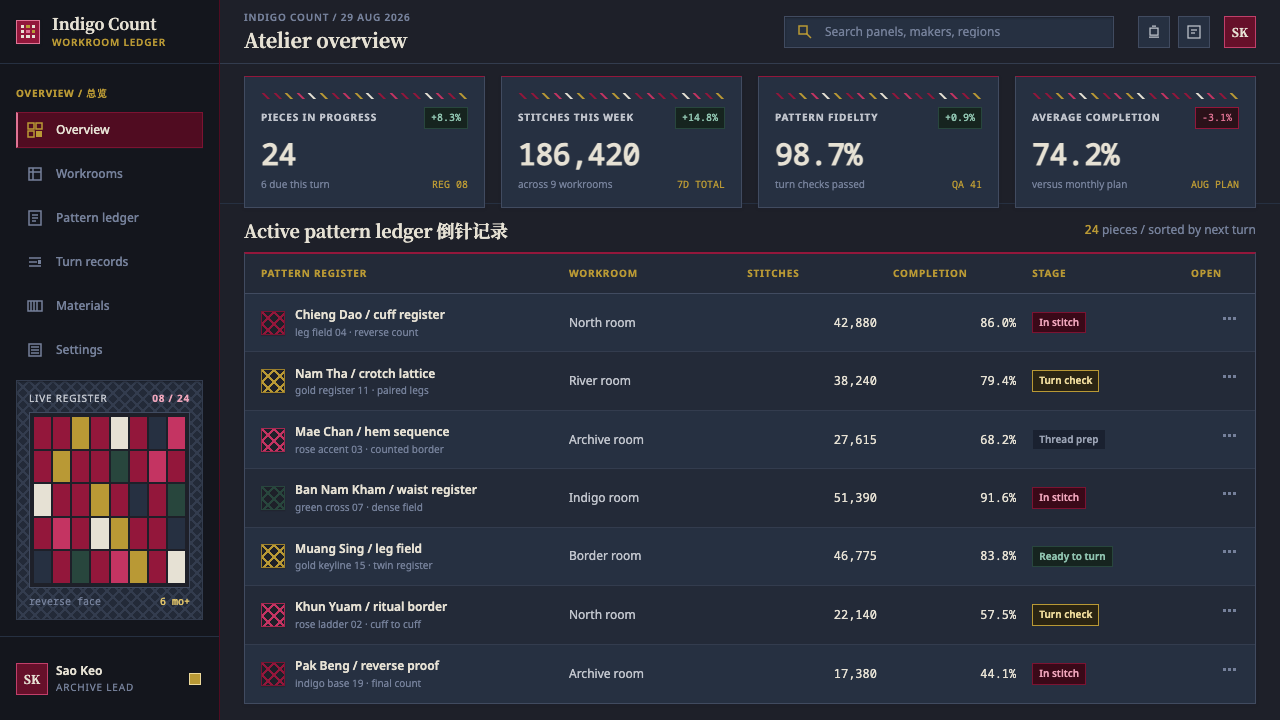
The technique is what gives the style its logic. Iu Mien women work the embroidery from the back of the cloth, stitch by stitch, over hand-woven cotton that has been dyed with indigo again and again until it is nearly black. Nothing is drawn on the fabric beforehand. The embroiderer counts and holds the pattern in her head, and the finished design is seen only when the piece is turned over. The source calls this counted reverse-face embroidery, and it is the reason the style is built from counted, stepped shapes rather than drawn curves.
The scale of labour is part of the meaning. A pair of trousers takes six months or more and is worked from crotch to cuff, with no area of ground left plain. Pattern blocks are packed against each other in bands and columns, so the garment reads as a continuous surface of red on dark blue. The source also names a narrative layer, the Pan Hu ancestral narrative as pattern, which suggests that the motifs are more than ornament. This article does not retell that story, but it is worth knowing that the density of the patterns is also a density of meaning.
Today the cloth is known largely through collections. The source names three institutions among its key references: Cornell University Anthropology Collections, the Traditional Arts and Ethnology Centre in Luang Prabang, and The Metropolitan Museum of Art. They are the places where a designer can see real work at full scale, with its actual stitch count and the way thread sits on cloth, and they are the right places to check any digital interpretation against.
What defines the Mien Yao Cross-Stitch look?
Indigo Ground
The field is a near-black indigo, the colour of hand-woven cotton dyed over and over until it is almost without light. Depth comes from repetition, not from a single coat, and the result is a ground with more blue in it than any plain black. In a design it works as an unbroken dark mass that makes the thread colour glow without any extra lighting effect.
Carmine Figure
The figure colour is a deep carmine, the red of embroidery floss rather than of paint. It is matte and saturated, sitting on the indigo with strong chroma but modest brightness, which gives a dark, jewel-like pairing. Carmine carries the figure, and variety comes from the arrangement of stitches, not from adding more colours.
Counted Grid, Stepped Curves
Every shape is built from counted cross-stitch and back-stitch, so the grid is the only drawing tool. Diagonals follow the grid's own diagonal, rounded forms are approximated as stepped outlines, and nothing is smooth. The effect is close to a pixel language: edges are exact, repeated and rhythmic, and the logic of the stitch determines every silhouette.
Density with No Gaps
Pattern blocks sit directly against each other, in bands and in columns running down the piece, with no gutters between them. No plain ground is left, and visual rest comes from the change of motif, not from empty space. The work reads as a woven surface rather than as motifs placed on a background.
Garment-Length Bands
The structure follows the garment: the pattern runs from crotch to cuff, organised in bands and vertical columns. In layout terms that means long, continuous strips, a page built as a series of full-width bands or tall columns, each filled and each finishing exactly where it meant to finish. The structure is sequential and vertical, more like a scroll than a poster.
Cold Silver and Rare Accent
Silver coins press cold and hard against the matte thread, adding a metallic point of contrast to a soft-surfaced palette, and the bright rose of the neck ruff is allowed only as a small accent. Accents are rare and sharply bounded. If they spread, the figure colour is no longer the figure and the density no longer reads as the main event.
Who shaped Mien Yao Cross-Stitch?
The embroiderers described in the source's own account of the work: they stitch from the back, hold the count in memory and spend six months or more on a single pair of trousers. The style's rules — no curves, no gaps, no preliminary drawing — are the rules of their working method, and the credit for the visual language belongs to them.
A collection named among the style's references. University anthropology collections keep objects like these as documented material, and they are a source of close-up evidence on stitch structure and thread colour for anyone building a digital translation of the style.
An institution in Laos named in the style's references. As a centre devoted to traditional arts and ethnology, it represents the part of the Iu Mien world that lies in Southeast Asia rather than in a Euro-American museum, which is a useful reminder that the tradition's home communities are in southern China and mainland Southeast Asia.
The museum holds a Lu Mien festival costume dated to around 1900, which the source cites as an anchor for the style. A dated piece from the turn of the twentieth century shows that the grammar of dense, counted, red-on-indigo embroidery was already settled by then.
How do you use Mien Yao Cross-Stitch today?
Mien Yao Cross-Stitch is a style for rich, dense, rule-bound surfaces. It fits cultural and craft projects, textile and fashion brands, data-heavy interfaces that can use a strict grid, creative tools and games with a pixel-like sensibility, and anything where the effort of making is the message. It is a poor fit for airy, whitespace-led design and for any project that needs a light or neutral emotional tone.
For slides, the cover is a near-black indigo field with a dense carmine band running down one edge or across the lower third, and the title set in pale, high-contrast type in the open indigo area. Content slides butt text blocks and image blocks against each other with no gutters, separated by thin bands of stepped pattern, and full-width bands mark the sections. Data slides are among the style's strongest uses: heat maps, waffle charts, calendar grids and bar charts built from unit squares are all native to a counted grid, and line charts can be drawn as stepped lines in carmine on indigo.
For web interfaces, dashboards are a natural fit, since dense data in a strict grid is exactly what the style is about. Tables, heat maps and status grids can sit in tightly packed square cells, pricing pages can arrange plans as tall columns filled with blocks, and navigation can be a band of stepped pattern across the top. Avoid rounded corners and smooth gradients; use square cells and stepped edges. For readability, put dense ornament in decorative bands and set the text in clear indigo areas in pale type at a comfortable size.
In editorial and marketing work, the style supports textile, craft and cultural features, ethnographic stories, fashion or hospitality campaigns with a handmade angle, and lookbooks. A long page can be structured as a scrolling series of pattern bands, each a section, with copy sitting in the indigo gaps between them. Photography of textiles fits the palette, and a carmine-and-indigo duotone keeps other imagery consistent.
The most common mistake is to treat the density as clutter and fix it with whitespace and rounded corners, which removes the achievement the style is about. The opposite mistake is density without rules: scattering the carmine freely so the grid disappears. Others are letting the bright rose take over from carmine, adding smooth gradients, and setting body text in carmine on indigo, where the contrast is too low for reading. Keep body copy pale and ornament crisp.
Mien Yao Cross-Stitch — FAQ
What is reverse-face embroidery?
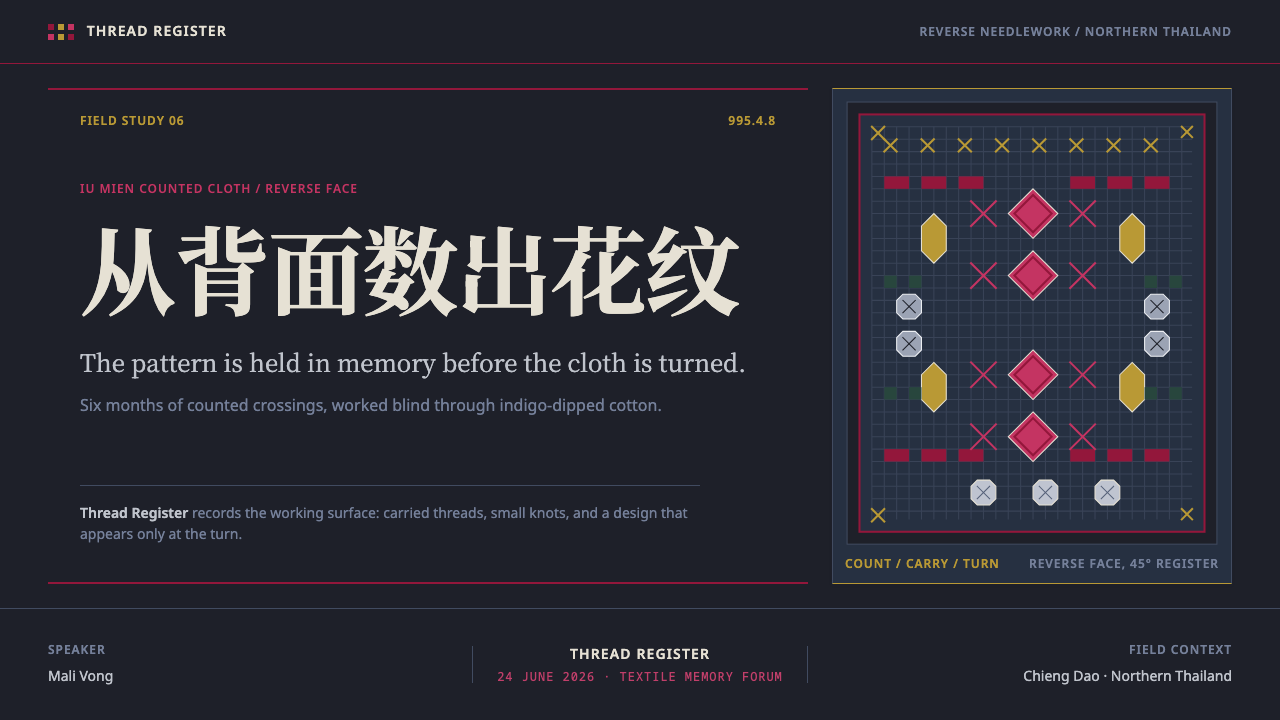
It is a technique in which the embroiderer works from the back of the cloth. Iu Mien women do this with no pattern drawn beforehand and no looking at the front, holding the count of stitches in memory, so the design appears only when the piece is turned over. The source calls it counted reverse-face embroidery. It explains why the visual language is made of counted, stepped shapes rather than freehand curves.
Why does the style forbid curves?
Because counted stitches live on a grid, and a grid cannot make a true curve. Diagonals follow the grid's own diagonal, and any rounded form is approximated by steps. Keeping to that rule is what makes the result look like the embroidery rather than a decoration that merely borrows its colours. In a layout, it means square cells, stepped edges and no rounded corners or smooth gradients.
Is this style just pixel art or cross-stitch?
It shares the logic of a counted grid with both, but it is more specific. The palette is indigo and carmine with rare silver and rose accents, the structure follows a garment in bands and columns, and the defining value is density with no plain ground. Generic pixel art or cross-stitch can be light, playful and sparse. Mien Yao work is dark, packed and worked to completion.
How do I keep the style readable when density is the point?
Separate decoration from reading. Put dense pattern in dedicated bands and columns, and set text in clear indigo areas in pale type at a comfortable size. Never set body text in carmine on indigo, because the contrast is too low. Treat the density as a property of the ornament and the data grid, not of the paragraphs, and let the text sit where the pattern deliberately stops.
Where do the Iu Mien live?
The source describes Iu Mien communities across southern China, northern Vietnam, Laos and northern Thailand, and cites places such as Lào Cai, Chieng Dao and Maechan. Because they live across several modern borders, the embroidery tradition is not tied to a single country, and the safest way to credit the style is to name the Iu Mien themselves as its makers.
Related design styles
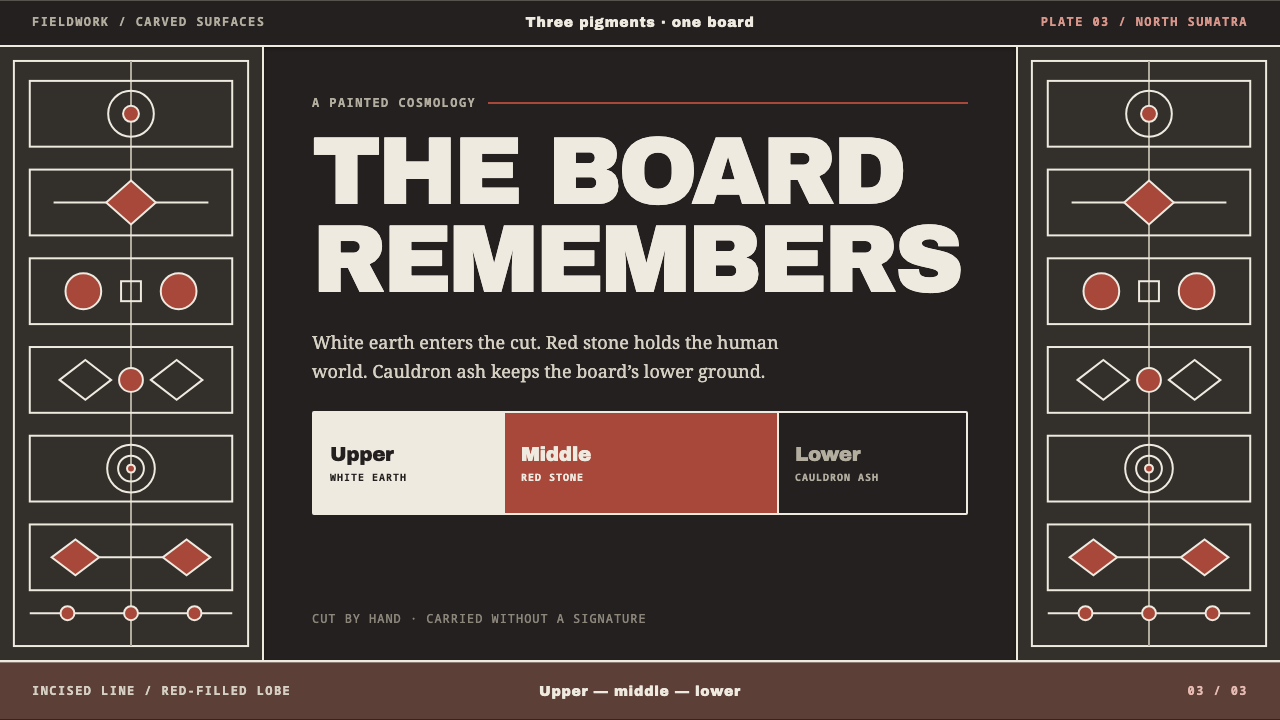 Batak GorgaCosmology cut into wood. Chalk-white lines and batu hula red hold a blackened…
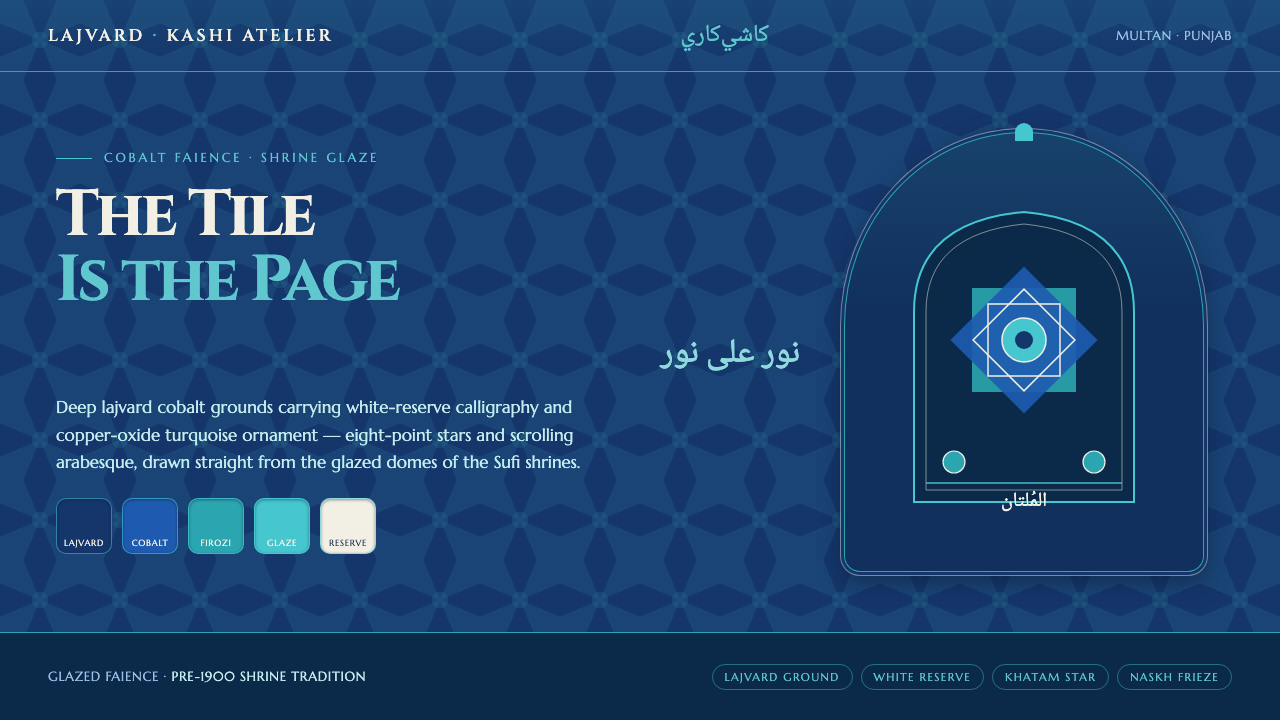 Multani Kashi TileworkThe cobalt tile is the page. Lajvard grounds carry white-reserve script and f…
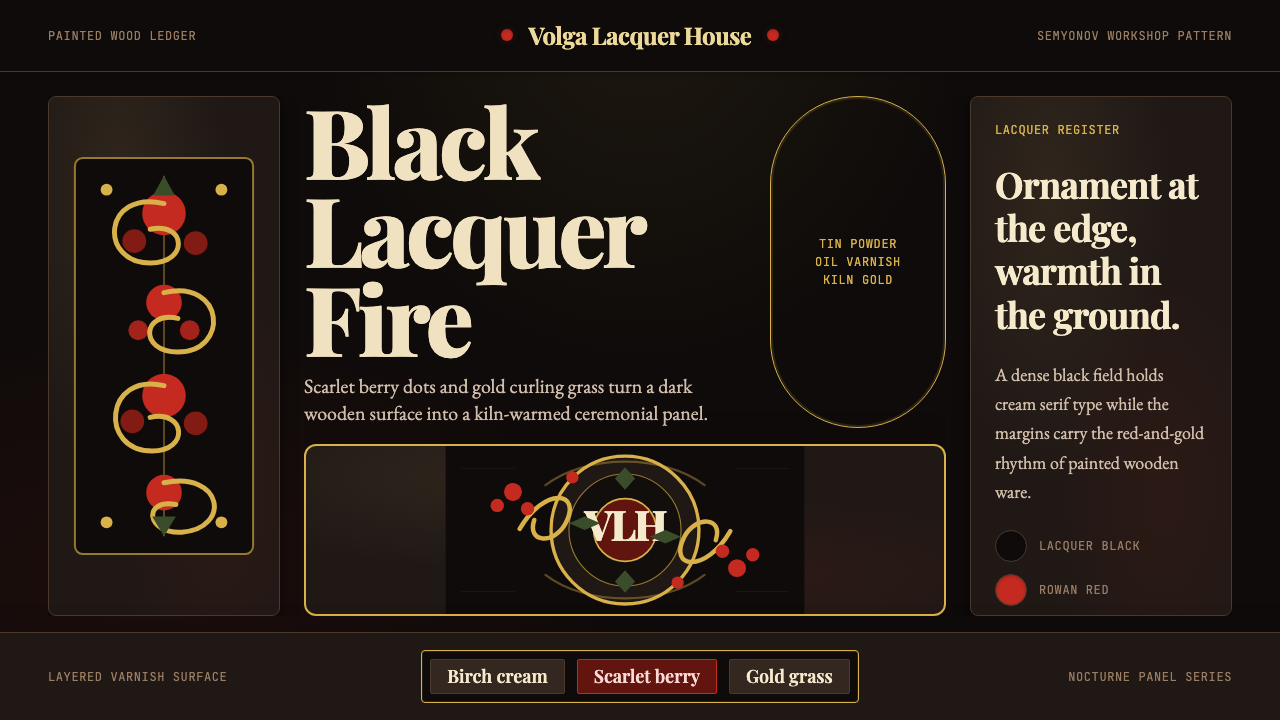 Russian Khokhloma Wood-Red LacquerKiln-fired ornament. Lacquer black, scarlet dots, and Playfair gold curls cro…
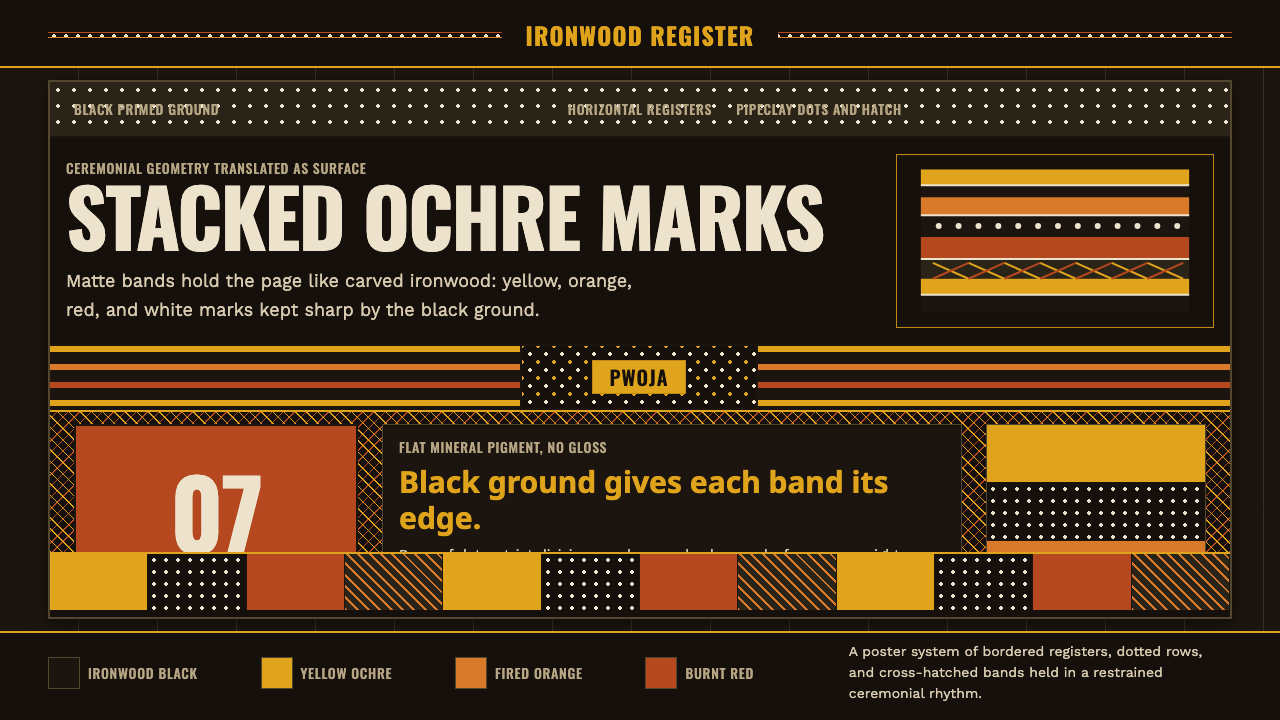 Tiwi Pukumani PoleBlack ground carries ceremony. Ochre bands, pipeclay dots, and hatch stack li…
 Bamileke Elephant MaskRoyal density. Indigo bead fields lock white triangle rows into ceremonial po…
 Hazara EmbroideryCoverage is the argument. Magenta silk blocks meet on a dark counted lattice.