What is Khevsur Cross Embroidery?
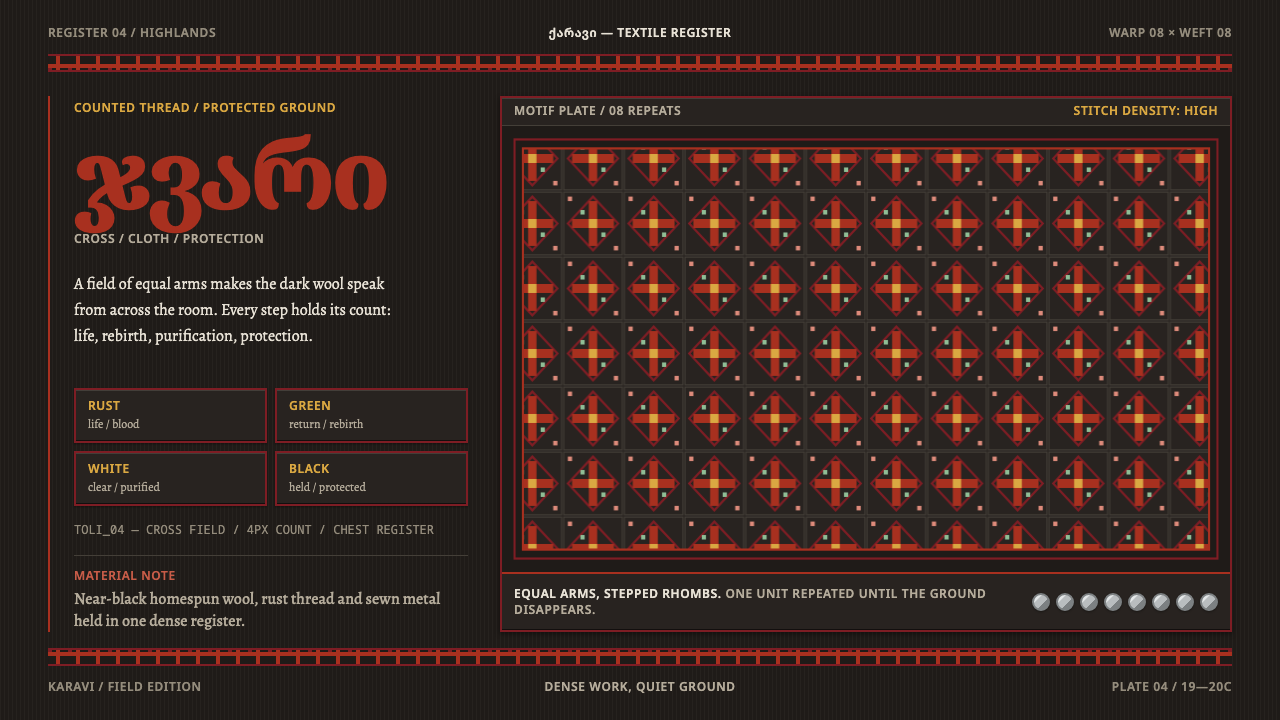
Khevsur Cross Embroidery is a style where density is the message: rust-red crosses tile near-black wool, and silver points punctuate a field with almost no empty cloth.
Khevsur Cross Embroidery in brief
Khevsur Cross Embroidery is a dark, dense, ornament-driven design style drawn from the traditional costume of Khevsureti, a highland region on Georgia's northern border. Women there spun and wove toli, a dark brown, near-black homespun wool, and then covered it edge to edge in counted-thread embroidery: equal-armed crosses, concentric rhombs, solar wheels and hooked border chains, stitched so closely that the cloth barely shows. Glass beads, pearl buttons and sewn-on silver coins gather at the chest and cuffs.
On screen, the same language becomes a near-black woollen ground, broad fields of rust-red embroidery, crosses and rhombs that follow a strict grid, and rows of silver discs that do the work of counters and status marks. An aged talavari front reads from across a room as a single warm red field with hard, bright points scattered through it, and the style aims for that same first impression: one saturated, textured mass, then, on approach, an ordered system of small repeated units.
What sets it apart from most pattern-based styles is that its density is not decoration laid over a layout. Density is the style's grammar. There is very little empty space in the original cloth, and the design system follows suit, using crowding, repetition and the careful placement of a few bright points to say what other styles say with margins and whitespace. For work that wants to feel rich, protective and deliberate, it offers a vocabulary that is both strongly folk and unusually systematic.

Where does Khevsur Cross Embroidery come from?
Khevsureti lies in the Greater Caucasus highlands of northeastern Georgia, on the country's northern border, and it is high enough that the passes close for half the year. The source locates the costume tradition in villages such as Shatili, Mutso and Ardoti, and dates it to the nineteenth century and earlier, with pieces worn well into the twentieth. With the passes closed for half the year, it is easy to see why the textiles were homespun: cloth was spun, woven and embroidered by hand, starting from wool.
The record is explicit about who did this work. The Khevsur highland women spun, wove and embroidered every piece. The foundation was toli, the dark homespun wool, and the embroidery was counted-thread work, in which each stitch is placed by counting the threads of the weave. That method matters for a design system, because it means the pattern is a grid by construction. Equal-armed crosses, concentric rhombs, solar wheels and hooked border chains are not drawn freehand and then fitted to a layout; they are generated by the cloth's own coordinates.
Colour carried meaning, and that meaning was written down: red for life and blood, green for rebirth, white for purification and black for protection. A wedding headcloth, the mandili, calls for white crosses. Glass beads, pearl buttons and sewn-on silver coins mass at the chest and cuffs, so the garment's richest zones are the chest and the cuffs. The source also adds a useful correction to legend: many of the coins are Soviet-era, which means the surviving objects are much younger than the stories told about them. A careful use of this style should carry the tradition, not the myth.
The motifs themselves have a layered history. The source describes the symbolism as pre-Christian solar imagery absorbed into Orthodox cross forms, which explains why solar wheels and equal-armed crosses sit side by side in the same border. Within the movements the record names, Caucasian highland dress and Georgian folk embroidery, Khevsur work is distinguished by its density and by its refusal to leave the cloth plain. Documented examples are kept in collections the source names, the TRC Leiden textile collection and the Georgian National Museum. The design system takes this evidence and translates it into screen terms: a near-black wool ground, broad rust-red embroidered fields, crosses and rhombs set on a grid, and rows of silver discs used for counting and status. Empty space is rare, and the density is the style.
What defines the Khevsur Cross Embroidery look?
Near-Black Wool Ground
The foundation is a very dark brown that reads as nearly black, the tone of toli homespun, never the flat, cold black of a switched-off display. A faint warmth and a suggestion of fibre keep the ground from feeling digital. Large areas of the page rest on this colour, and because it is so dark, the embroidered fields and silver points sitting on it appear to glow without any added effects.
Rust-Red Embroidery Field
The dominant colour is a warm, aged red, closer to rust and weathered cloth than to a bright signal red. At a distance, the dense stitching merges into one saturated field, which is exactly how an aged talavari front reads across a room. The red is a surface, not an accent: it is used in broad, textured areas and is allowed to carry the emotional weight of the whole composition.
Counted-Thread Grid
Because the embroidery is counted by thread, every motif is aligned to the weave. Equal-armed crosses, concentric rhombs and solar wheels are built from stepped, blocky units, and they sit on a strict underlying grid. This is a rigorous grid of small modules, not a flexible layout: elements snap to it, edges are stepped rather than smoothly curved, and diagonals are made of staircase units. Any curved or freehand shape would look foreign here.
Density as Meaning
Little cloth is left plain. The original garments are stitched so closely that the base barely shows, and the design system follows suit by treating whitespace as scarce. Hierarchy comes from the grade of density, with the most intricate zones carrying the most importance, rather than from isolating an element in empty space. The practical consequence is a style that feels full and protective, and one that requires care so that crowding never becomes noise.
Silver Points
Glass beads, pearl buttons and sewn-on silver coins mass at the chest and cuffs, and in the design system they become hard, bright, specular points scattered through the red. They are the only cool and reflective notes in an otherwise warm and matt composition. Rows of silver discs are used as counters and status marks, so a number, a step in a sequence or an on-off state can be told at a glance by how many discs are lit.
Written Colour Code
The palette is small and each colour has a recorded meaning: red for life and blood, green for rebirth, white for purification and black for protection. Black is the ground, red is the field, white appears in crosses and highlights, and green is a rare, deliberate accent. Treated as a semantic system, this gives the style a built-in logic for status and emphasis, but the meanings are cultural, so they should be used with respect and not as a generic traffic-light scheme.
Hooked Border Chains
Panels and edges are framed by hooked chains, continuous bands of repeated interlocking units that mark where one zone ends and another begins. They do the work that rules and dividers do in other systems. A border is never a thin line; it is a woven band with its own rhythm, and it can be thick or thin depending on how important the zone it encloses is. Corners are resolved by the pattern itself, not by rounded geometry.

Who shaped Khevsur Cross Embroidery?
The record credits the Khevsur highland women with spinning, weaving and embroidering every piece. They are the makers behind all of the visual language in this style: the choice of dark wool, the counting of threads, the placement of crosses, rhombs and solar wheels, and the building up of beads, buttons and coins at the chest and cuffs. The work was done by hand, in a region where the passes close for half the year.
The textile collection associated with TRC Leiden is named in the source among the key references for this style. Its role is that of a keeper of evidence: a body of preserved textiles from which patterns, colour relationships and construction can be studied directly instead of being reconstructed from legend. For a design system built on density and accuracy of motif, that kind of documentation is a necessary check.
The Georgian National Museum is the second institution named in the record, alongside the Leiden collection. Its inclusion places the Khevsur costume within Georgia's own cultural heritage rather than leaving it as an object of foreign curiosity. For anyone working with the style, it is a reminder that the patterns have a home and heritage institutions that look after them, and that treating them as free-floating ornament would miss the point.
How do you use Khevsur Cross Embroidery today?
Khevsur Cross Embroidery is among the more distinctive styles for projects that want to feel rich, protective, rooted and deliberate. It rewards a precise reading of what the style is doing: using density as emphasis, a small and meaningful palette, a strict underlying grid, and bright reflective points to mark counts and states. Used as wallpaper it fails; used as a system it is unusually coherent.
For presentation slides, a cover works well when it is dominated by a broad rust-red embroidered field on a near-black ground, with the title set in a calm, high-contrast light colour on a quiet panel cut into the pattern. Content slides can use the pattern as a border band at the edges, leaving a calm central panel for reading. Data slides are a natural home for the silver discs: a row of discs becomes a progress meter, a score or a stepper, and the grid underlying the pattern makes chart gridlines feel native rather than imposed.
For web interfaces, the style suits dashboards, loyalty and membership products, and heritage or cultural platforms, where a sense of protection and accumulation is a feature. Use the near-black ground for the whole page, the embroidered red for hero zones and key panels, and the border chains in place of ordinary dividers. Counters, badges, ratings and step indicators can be made of silver discs. Pricing pages can present tiers as panels whose pattern density increases with the tier, so that the richest option is also the most intricately stitched. Keep forms and reading text on calm, unpatterned panels so that the density never competes with the task.
For editorial and marketing work, the style offers strong visual identity for craft stories, textile and heritage content, cultural institutions and brands whose products involve ritual, protection or family. Use pattern bands to introduce sections, set body text on quiet panels, and let a few silver accents mark the points that matter. Photography of real textiles, handwork and mountain settings fits well. Cite the region and the makers when the motifs are shown, since the tradition belongs to specific communities in Khevsureti and not to a generic idea of folk art.
The common mistake is to treat the style as a repeating wallpaper and fill the whole interface with pattern at uniform density. That removes the one thing that makes the cloth readable: variation. The most intricate zones should be reserved for the most important areas, with calm panels around them for reading. A second mistake is to round the geometry or draw the motifs freehand, which breaks the counted-thread logic. A third is to use the red, green, white and black as an ordinary status scheme without regard to their cultural meaning.

Khevsur Cross Embroidery — FAQ
Why does this style leave so little empty space?
Because the cloth it comes from leaves none. Khevsur embroidery covers the toli wool edge to edge, and the meaning lies in that fullness. In the design system, density takes the role that margins and whitespace play elsewhere: the most important zones are the most intricate, and calm areas are used sparingly for reading. The skill is to vary density deliberately, so that the page still has a hierarchy even though it is crowded.
Can the red, green, white and black be used as status colours?
They can carry meaning, but with care. In the tradition, red stands for life and blood, green for rebirth, white for purification and black for protection, so the palette already has a semantic order. Mapping red to the main emphasis, green to renewal or completion, white to confirmation or clearing and black to the protective ground can work well. It should not be reduced to a plain success, warning and error scheme, which would ignore where the meanings come from.
How do I keep a dense layout readable?
Reserve the dense pattern for borders, hero zones, headers and decorative panels, and place text on calm, unpatterned surfaces within or beside it. Make the pattern's units large enough to see as a system and keep them on a consistent grid, so the eye can read rhythm instead of clutter. Text should be set in a clear light colour on the near-black ground. When in doubt, reduce density around the content and increase it around the frame.
Are the silver coins in the tradition as old as the legends suggest?
Not necessarily. The source notes that many of the sewn-on coins are Soviet-era, so the surviving objects are much younger than the stories sometimes told about them. That does not diminish the tradition: the embroidery, the weaving and the motif system are older and independent of any single coin. It does suggest that when you write about the style, you should describe the costume as worn into the twentieth century and avoid claiming ancient origins for specific objects.
Is this just a generic folk-pattern style?
No. Generic folk-pattern styles borrow a vague sense of tradition, usually with light grounds, decorative curves and arbitrary colours. This one is specific: a near-black homespun ground, counted-thread geometry, a recorded colour code, a particular set of motifs and a defined place in the Greater Caucasus. Those constraints are what make it usable as a system. Remove them and what remains is the wallpaper effect the style is meant to avoid.
Related design styles
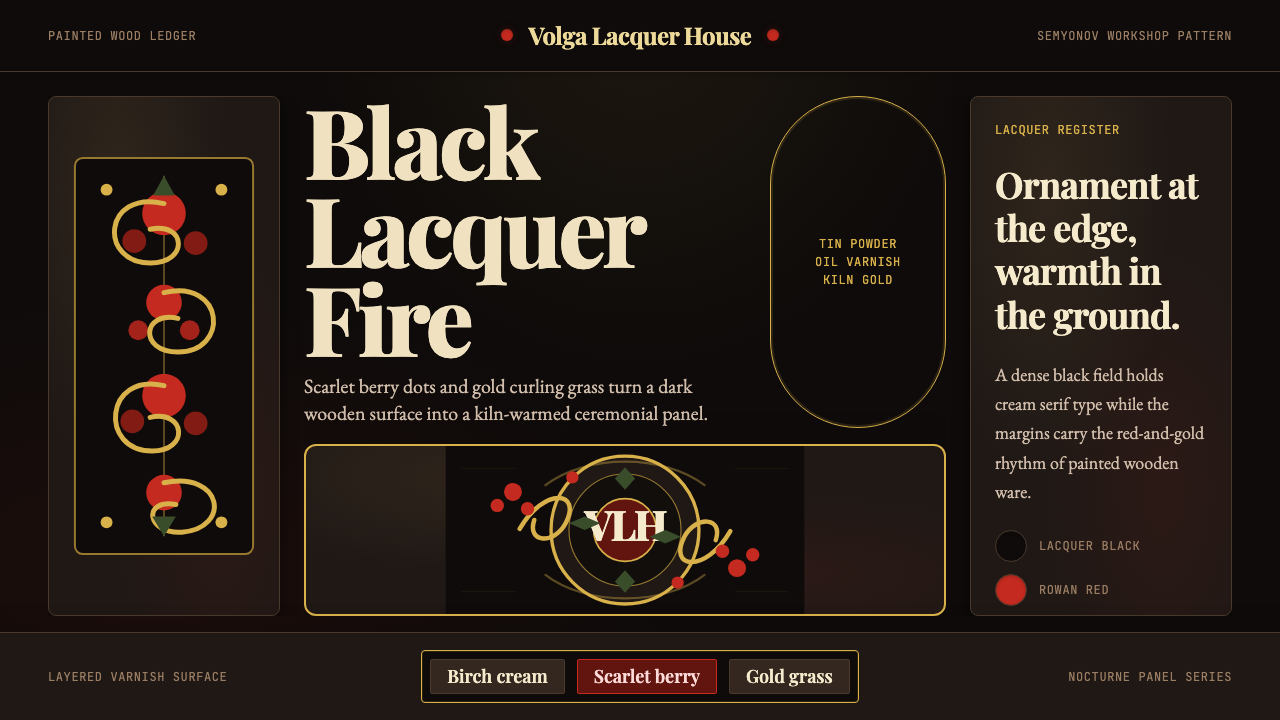 Russian Khokhloma Wood-Red LacquerKiln-fired ornament. Lacquer black, scarlet dots, and Playfair gold curls cro…
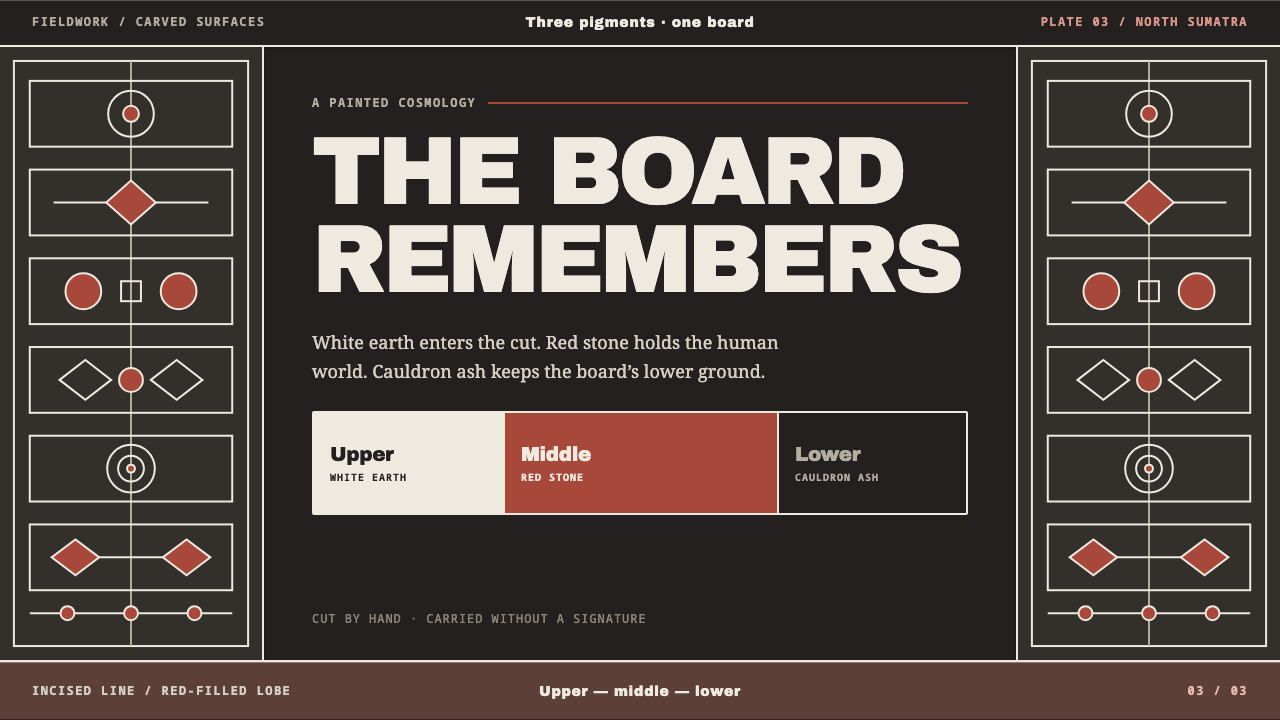 Batak GorgaCosmology cut into wood. Chalk-white lines and batu hula red hold a blackened…
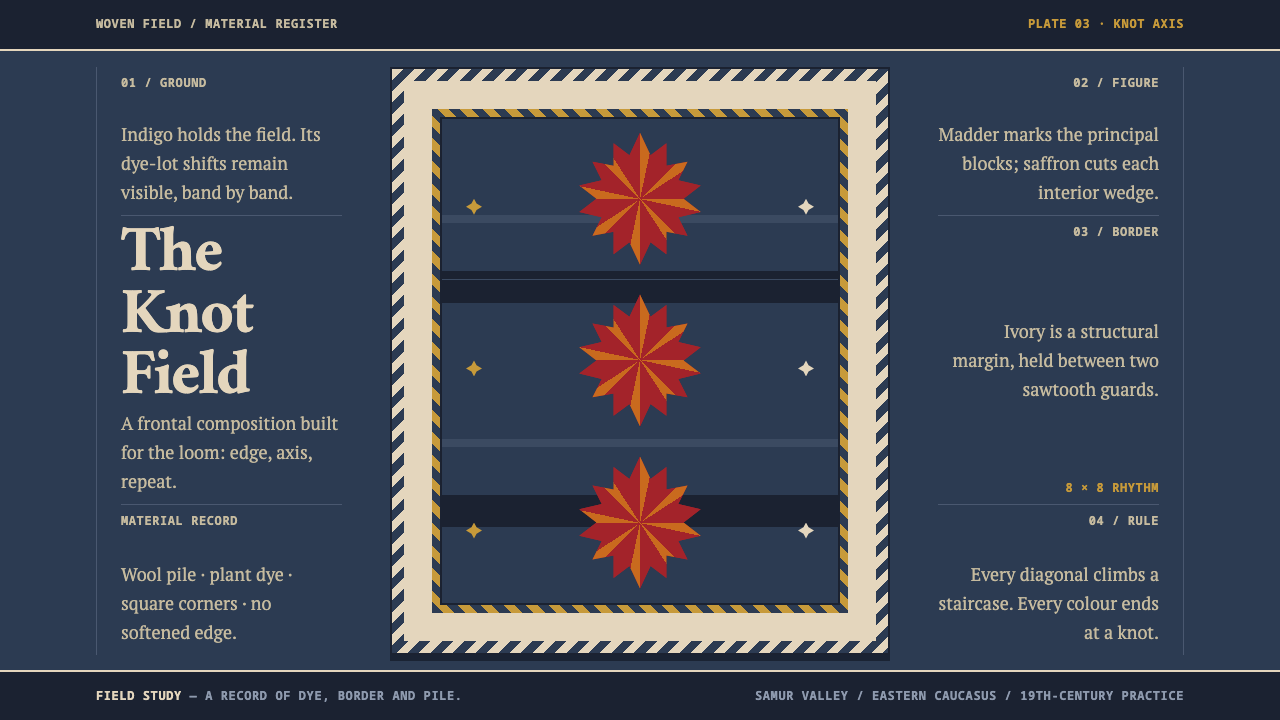 Lezgin Star WeaveKnot logic, made monumental. Madder stars lock into abrash indigo and ivory g…
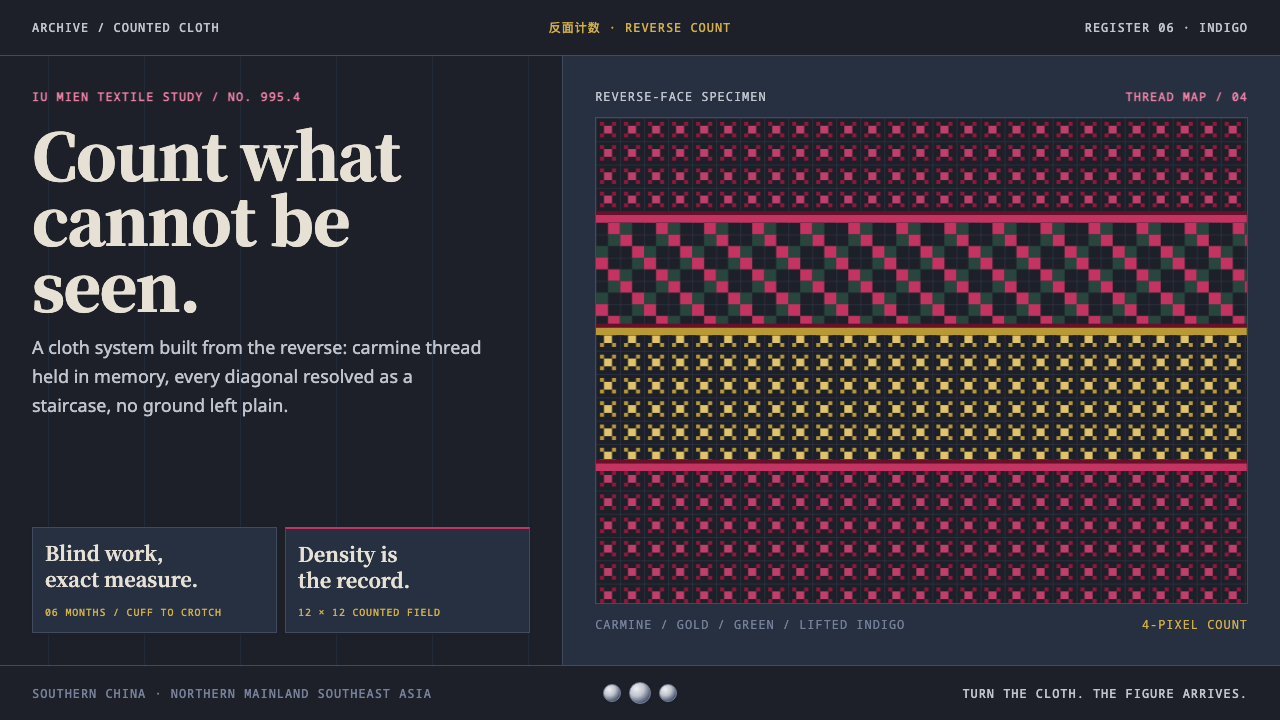 Mien Yao Cross-StitchDensity is the achievement. Carmine counted stitches saturate near-black indi…
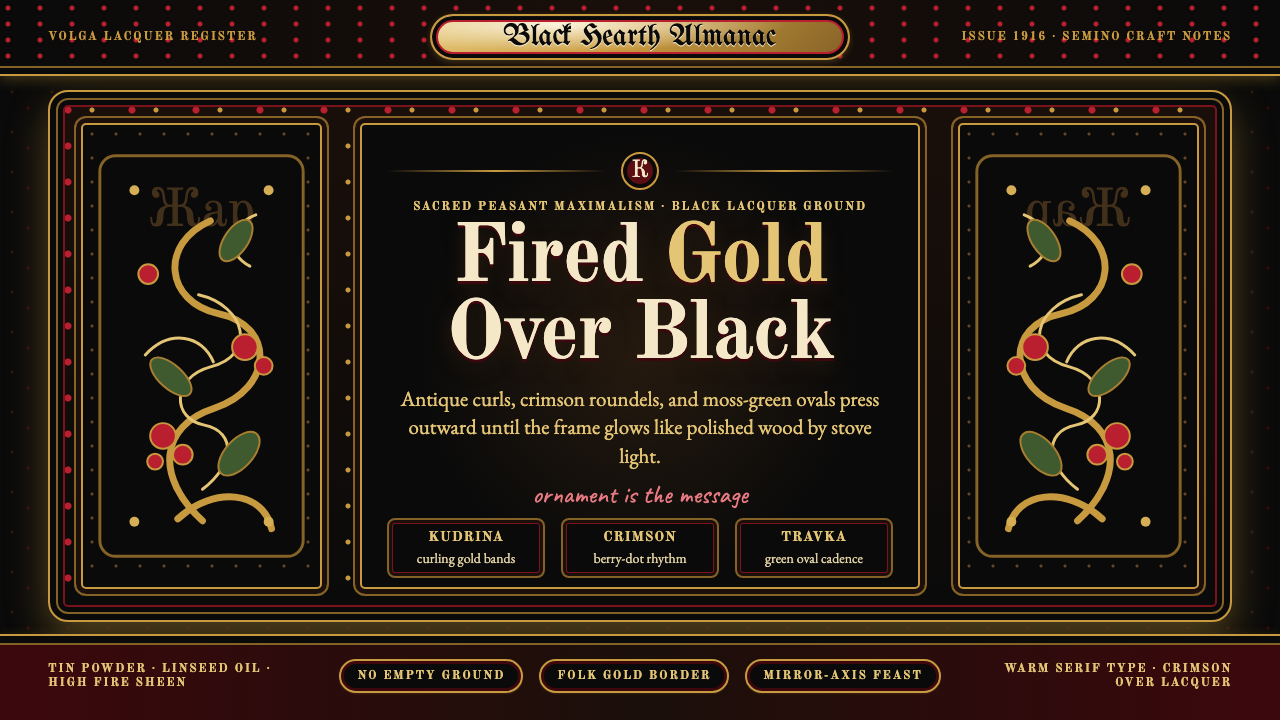 Russian KhokhlomaOrnament is the message. Antique gold curls and crimson dots crowd a black la…
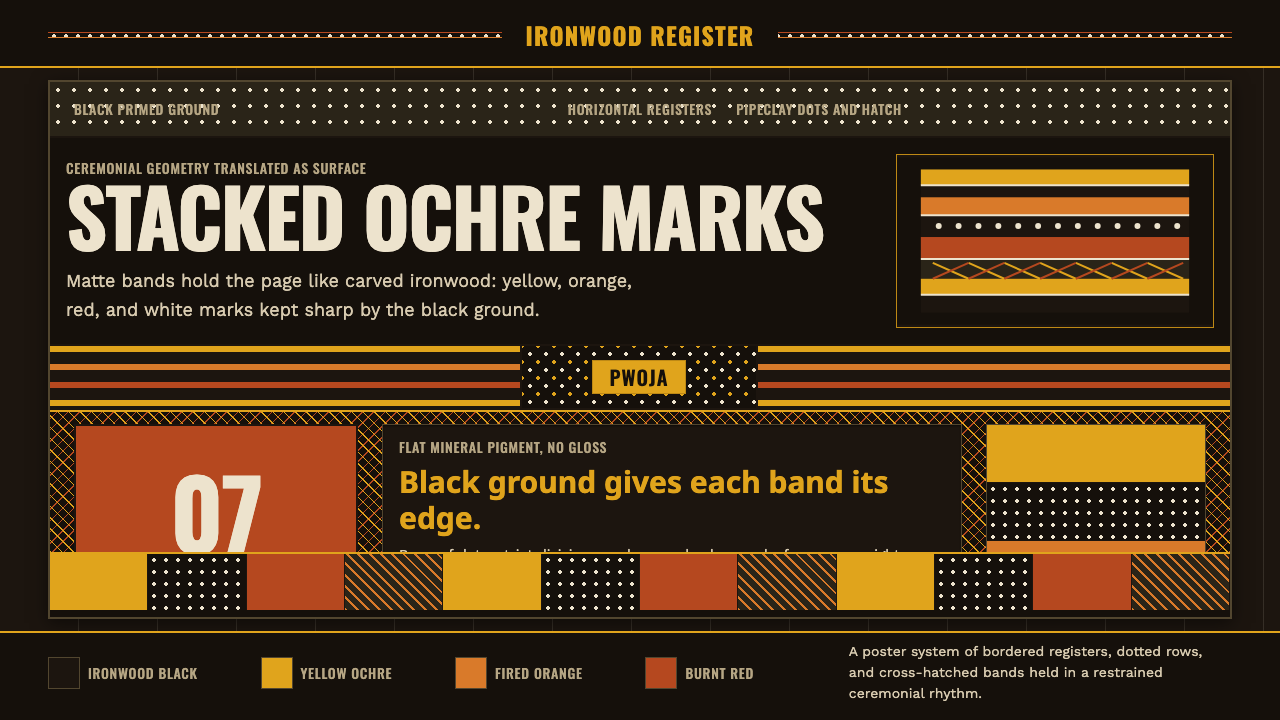 Tiwi Pukumani PoleBlack ground carries ceremony. Ochre bands, pipeclay dots, and hatch stack li…