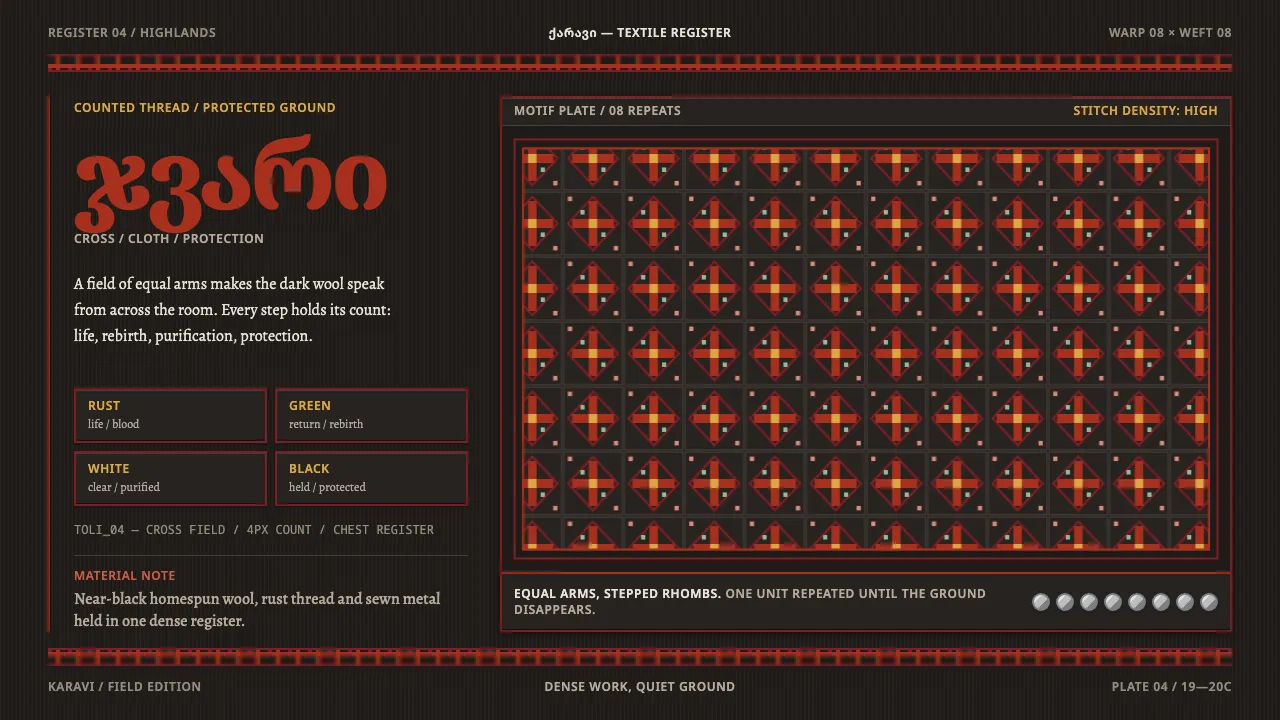
About Khevsur Cross Embroidery
Khevsureti sits on Georgia's northern border, high enough that the passes close for half the year. Its women spun and wove *toli* — dark brown, near-black homespun wool — then covered it edge to edge in counted-thread embroidery: equal-armed crosses, concentric rhombs, solar wheels, hooked border chains, stitched so densely that the cloth barely shows.
The colour carries meaning that was written down: red for life and blood, green for rebirth, white for purification, black for protection. Glass beads, pearl buttons and sewn-on silver coins mass at the chest and cuffs. An aged *talavari* front reads from across a room as one warm red field, hard specular points scattered through it.
- Origin
- Khevsureti, Greater Caucasus highlands, northeastern Georgia (Shatili, Mutso, Ardoti)
- Era
- 19th century and earlier, worn into the 20th century
- Key figures
- the Khevsur highland women who spun, wove and embroidered every piece · TRC Leiden textile collection · Georgian National Museum
- Movements
- Caucasian highland dress · Georgian folk embroidery · pre-Christian solar symbolism absorbed into Orthodox cross motifs
Khevsur Cross Embroidery design spec
Colors
Typography
The other 11 sections — buttons, cards, spacing, motion, techniques and more — open once you unlock. Download the DESIGN.md or send it to your AI in one click. Unlock once, yours forever.
Sign up nowStyles similar to Khevsur Cross Embroidery
Also inspired by crafts & folk art, with a close feel.
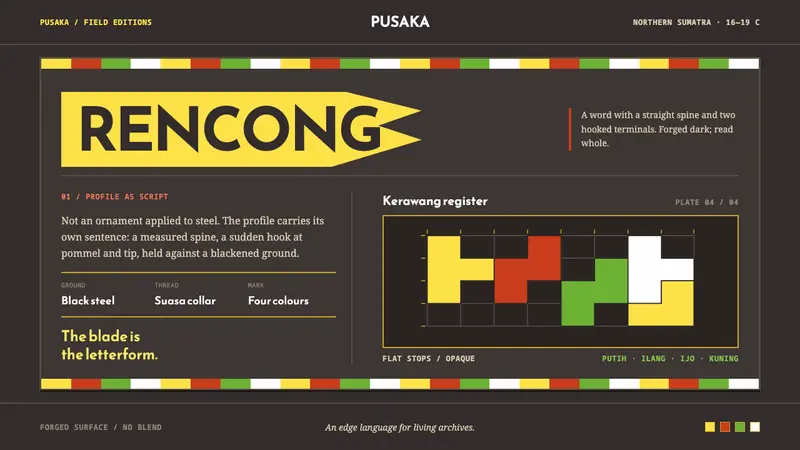 Acehnese Rencong MotifA blade that reads as a word. Flat kerawang red, white, green and yellow lock into black steel.
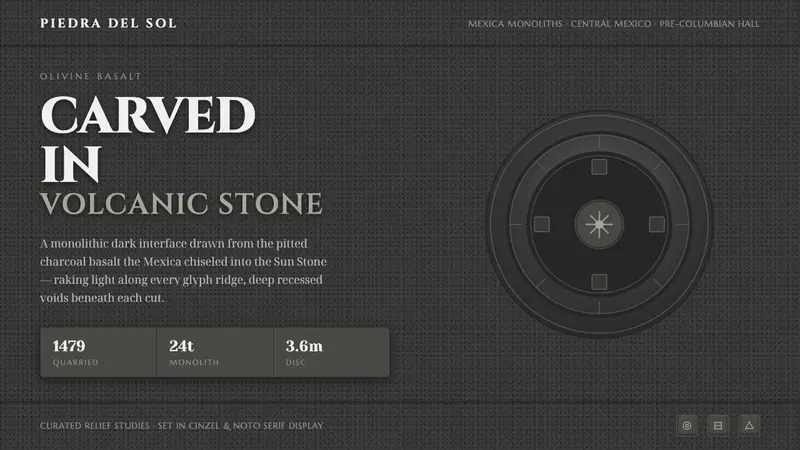 Mexican Volcanic StoneCarved, not floated. Pitted charcoal basalt, raking-light glyph relief, monumental Cinzel.
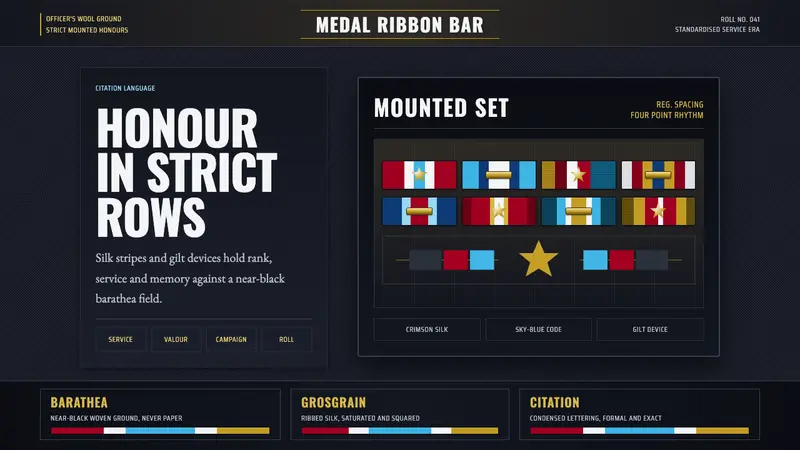 Medal Ribbon BarDiscipline worn as color. Crimson, sky-blue and gilt bars lock onto black wool.
 Sri Lankan Kandyan Mask & DanceRitual carries weight. Gold serif type and ruby-emerald filigree burn on black lacquer.