What is Danish Hedebo Cutwork?
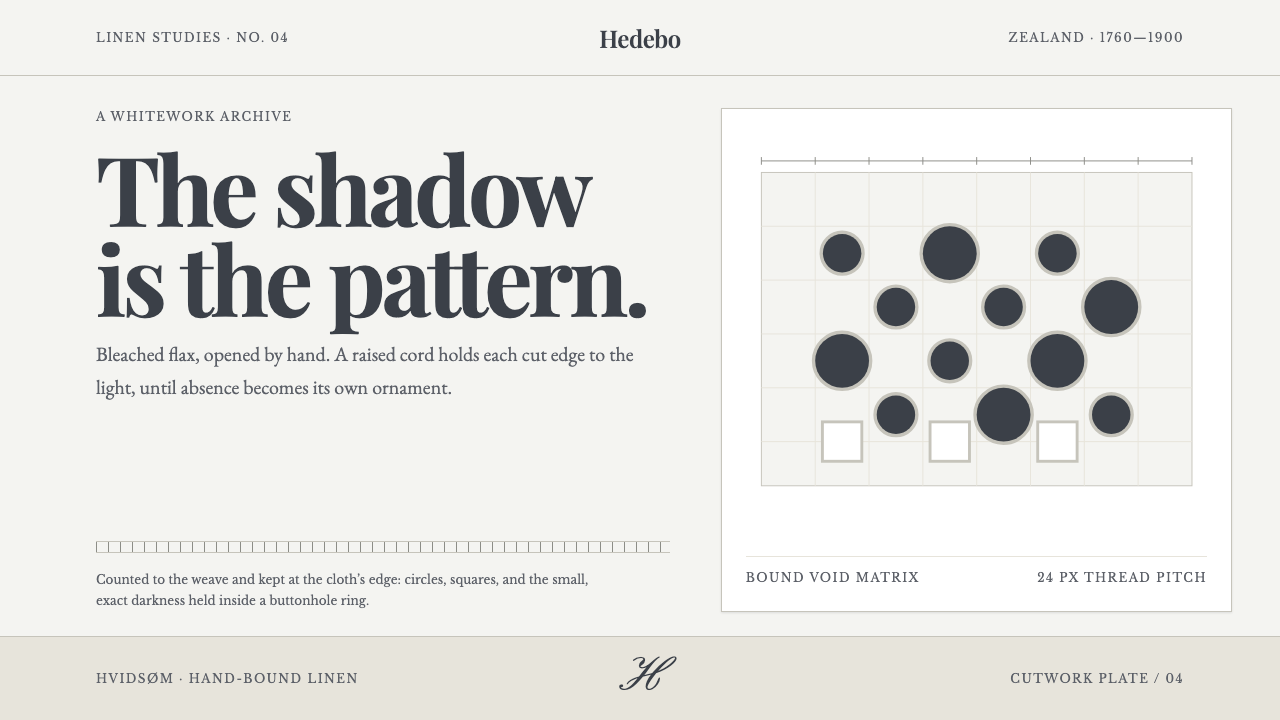
Hedebo whitework makes ornament by taking cloth away: white thread on white linen, with every pattern read as a bound hole and the small shadow around it.
Danish Hedebo Cutwork in brief
Hedebo is a tradition of Danish whitework, called hvidsøm, literally 'white sewing', worked on the heathland west of Copenhagen on the island of Zealand. It sits within the broader family of drawn thread work and cutwork, crafts in which a pattern is made not by laying colour onto cloth but by removing part of the cloth and then binding what remains. What sets Hedebo apart is its monochrome purity. The thread and the ground are the same bleached flax, so no dyed thread enters the craft at all.
With colour taken out of the equation, the pattern has to be read as light and shade. Circles and squares are cut out of plain linen with scissors, and every opening is bound around its rim by a raised ring of buttonhole stitch. That ring stands slightly proud of the cloth and throws a small shadow of its own, while the opening itself shows whatever dark lies behind the fabric. Ornament becomes a matter of presence and absence: a ridge of thread, a void, and the thin shade where the two meet.
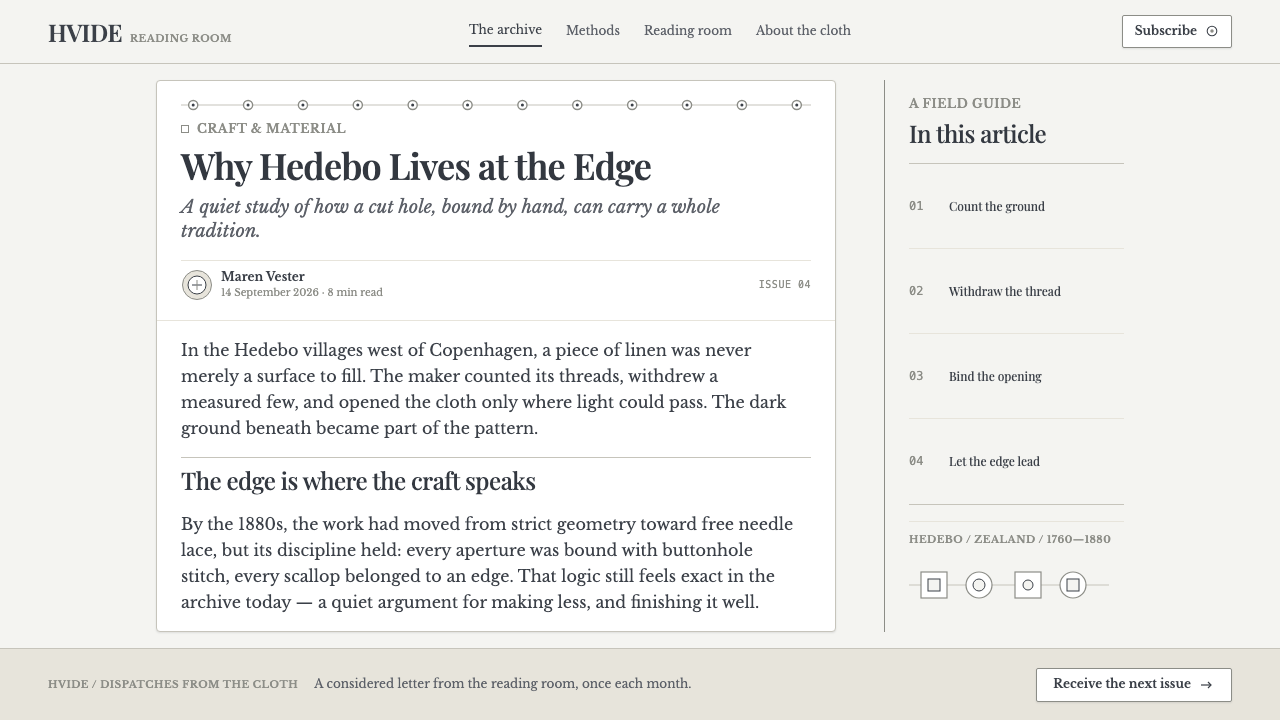
As a visual language, Hedebo translates into a page that behaves like linen: pale, matte and quietly textured. Dark is never applied as a pigment; it is only the darkness seen through a cut hole. Depth comes from a single hairline shadow rather than from stacks of floating cards. Ornament travels along edges, as a band on a collar, a cuff or a hem, and does not drift into the middle of a panel. The governing idea is that decoration is always attached to structure and never scattered over it.
Where does Danish Hedebo Cutwork come from?
Hedebo takes its name from the heathland where it was worked, the open country west of Copenhagen on Zealand (Sjælland), and the name still ties the craft to that landscape. Its makers were peasant needlewomen, and the technique grew up inside the household textile world of the heath, where flax was the raw material and linen the working cloth. Because the craft belongs to a community of needleworkers rather than to a studio or a school, its history is carried by the cloth itself and not by a roll of named masters.
The earliest phase that the record identifies is the counted-thread phase, which begins in the 1760s. In counted-thread work the needlewoman follows the weave of the linen, drawing out and counting threads so that every motif is dictated by the grid of the cloth. The result is square, orderly and tightly fitted to the fabric: geometry that comes from the loom rather than from the hand. Pattern and weave agree with each other, and the cloth is never asked to carry a shape it does not already suggest.
Later work loosened that discipline. In the late phase the craft turns to needle lace, and the pattern is no longer bound to the weave. Curves become free, edges become scalloped, and openings are bound and filled with stitches formed by the needle in open space rather than counted off the cloth. Hedebo therefore holds two temperaments inside one tradition: an early, rectilinear one that obeys the grid, and a late, flowing one that lets the needle draw. Neither replaced the other, and both remain part of what the name means.
In the 1870s the craft was declared a Danish national treasure, which places Hedebo inside the Danish national-romantic movement, the broad current in which rural crafts were recognised as expressions of a national character. After that recognition a revival took shape in Copenhagen, carried by needlewomen working in the city rather than on the heath. The revival matters to anyone reading Hedebo as a design language, because it describes how a peasant craft became a recognisable, teachable and collectable style. It also helps explain why the qualities now associated with Hedebo are so consistent: whiteness, restraint, and the visible logic of the stitch.
What defines the Danish Hedebo Cutwork look?
Linen Ground
The page is bleached linen: a pale, matte field with no tinted panels competing for attention. Because stitch and ground are the same material in the original craft, the palette is effectively tonal, and contrast is built from light against shade rather than one hue against another. Any dark that appears is read as depth, the dark seen through a cut hole, and never as a colour laid on top of the cloth.
Ornament by Subtraction
The defining move is the cut. Circles and squares are scissored out of the cloth, and the void itself becomes the motif. This reverses the usual logic of decoration: instead of adding a shape and then outlining it, the maker removes the shape and the outline arrives as a by-product. In a layout, this translates into openings, windows and negative shapes that carry meaning, rather than filled blocks that need a colour to be seen.
The Bound Edge
Every cut is finished. A raw hole would fray, so each opening is bound around its rim with buttonhole stitch, and the stitch accumulates into a raised ring that stands proud of the surface. That ring is the real ornament: it gives the void a clear boundary, a tactile edge and a shadow of its own. A design that borrows Hedebo should likewise finish its edges deliberately, with crisp rims and visible borders, not leave shapes soft or undefined.
A Single Hairline Shadow
Depth in Hedebo is modest and singular. The raised ring throws one small, thin shadow and that is the whole vocabulary of elevation. The design equivalent is one hairline shadow level used consistently, instead of a ladder of increasingly heavy drop shadows. Panels sit on the linen the way a stitched ridge sits on cloth: slightly lifted, clearly separate, never floating. Stacked cards, layered glows and heavy elevation all read as foreign to the material.
Ornament Runs Along the Edge
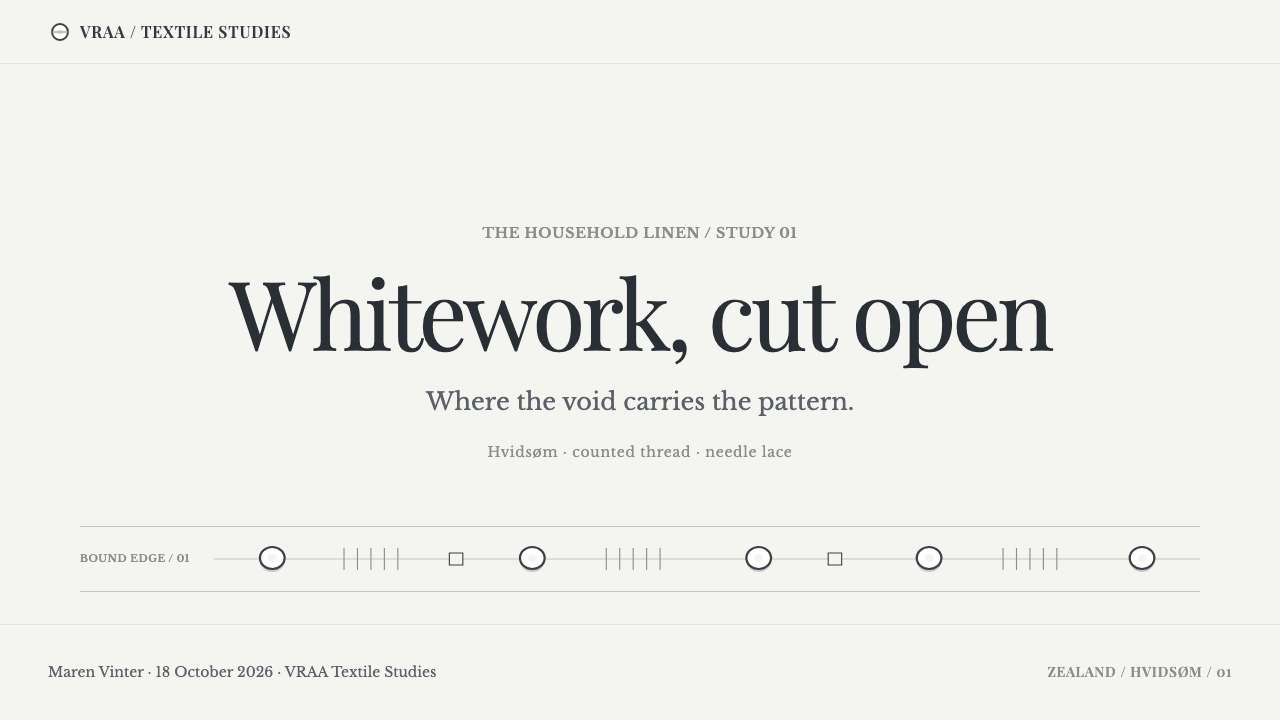
In the garment tradition, Hedebo work sits on collars, cuffs and hems, the places where cloth is structurally finished. It is a band, not a scatter. In layout terms the ornament belongs to the borders of a page, header and footer bands, section edges and card rims, while the middle of a panel stays plain and readable. This placement is a rule of the style: decoration is attached to a structural line, and it never wanders into the field where content lives.
Two Temperaments: Counted and Free
The style carries two moods. The counted-thread phase of the 1760s gives square, orderly forms that sit exactly on the weave, which suits rectilinear grids, tables and tight modular layouts. The later needle-lace phase gives free curves and scalloped borders, which suits soft section edges, ornamental rules and decorative headers. A coherent Hedebo-derived design chooses which temperament leads and lets the other appear only as an accent, rather than blending the two at equal strength.
Who shaped Danish Hedebo Cutwork?
The needlewomen of the Hedebo heathland are the makers from whom the whole tradition descends. They worked bleached flax with its own thread, cut circles and squares with scissors and bound each opening with a ring of buttonhole stitch. Their technical decisions, no dyed thread, ornament by cutting, depth by raised stitch, are exactly what this design system takes literally. They matter less as individuals than as the authors of a rule set: restraint in material, honesty in method, and pattern that earns its place through structure.
The counted-thread phase begins in the 1760s, and the workers of this phase established Hedebo's early grammar: squares and rectangles that follow the weave exactly, openings made by drawing out and counting threads, geometry set by the grid of the cloth. Their legacy to design is the principle that structure and ornament should be the same thing. When a layout lets its grid generate its decoration instead of adding decoration over the grid, it is working in their spirit.
As the craft moved from counted thread to Hedebo needle lace, its makers freed the pattern from the weave. They introduced free curves and scalloped edges, and filled bound openings with stitches formed in open space. This is the soft, flowing voice of the tradition. It shows that Hedebo is not only a rigid geometry: within the same white-on-white discipline it can also be graceful and curved, so long as the edge is still bound and the ornament still sits along a border.
After the 1870s, when the craft was declared a Danish national treasure, needlewomen in Copenhagen carried Hedebo into a second life. Their role was to preserve, teach and reinterpret a rural technique in an urban setting, which is how a heathland craft became a style with an identity beyond its place of origin. Their work is a reminder that a design system built on Hedebo is always a revival: it takes a craft's logic seriously while recognising that the setting around it has changed.
How do you use Danish Hedebo Cutwork today?
Hedebo is best matched to work where restraint signals care: heritage and craft brands, textile and homeware, stationery and invitations, hospitality, wellness, culinary and museum or archive publishing. It is a poor fit for loud, high-energy or data-dense products. Applying it well means using the logic of the craft, cut openings, bound edges, one hairline shadow, ornament on the border, rather than pasting lace clip-art over an ordinary layout.
For presentation slides, the cover works best as a pale linen field with a single band of ornament running along one edge, like a hem, and a title set in generous empty space. Content slides should lean on the hairline shadow to lift one panel at a time, with no stacked cards and no coloured fills. Data slides suit quiet outline charts on the linen ground: emphasis is made by an opening or a bound ring rather than by a saturated fill, and a single dark value, read as the dark seen through a hole, marks the one thing the audience must notice.
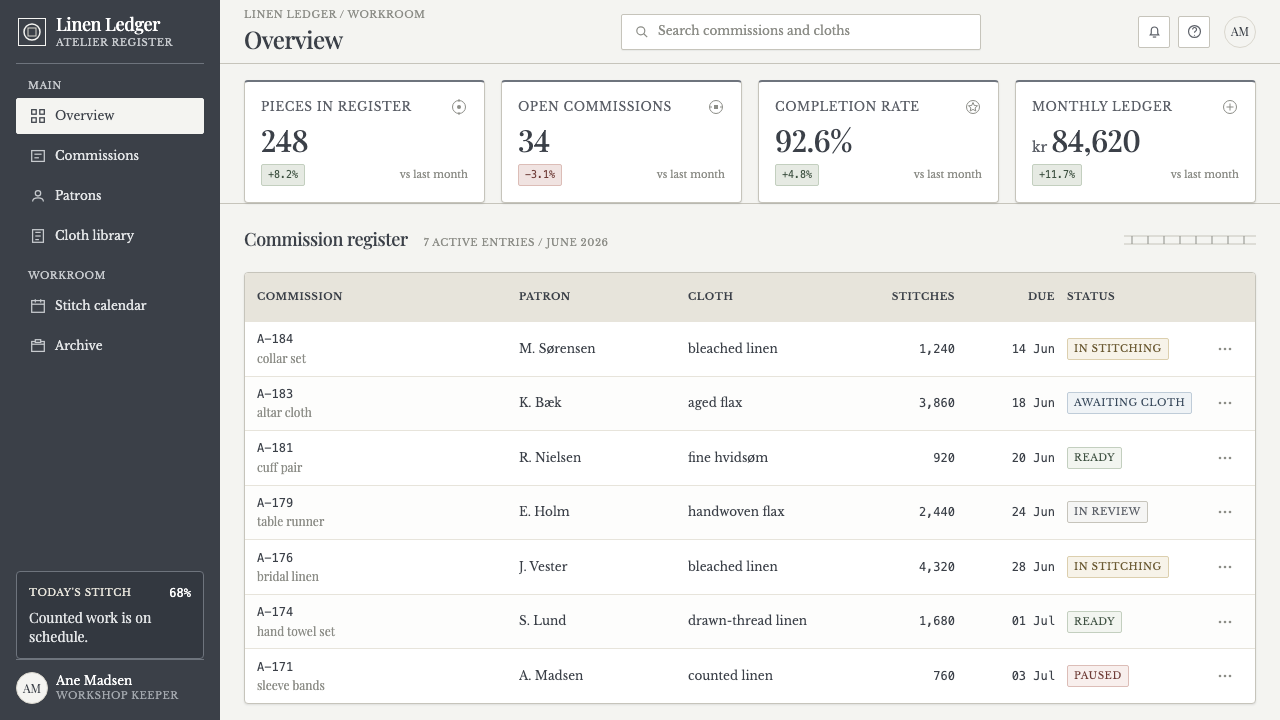
For web interfaces, Hedebo suits pricing pages, documentation, product galleries for craft or lifestyle goods, and calm account areas. Cards take the single hairline shadow or a plain bound outline. Header and footer carry the ornamental band, and section dividers can be drawn as a stitched, ridge-like rule. Forms use bordered fields rather than filled ones, and primary buttons use the dark of the cut hole. Dense dashboards are the stress case: keep ornament out of the data region and let the edges carry the character.
For editorial and marketing work, think in garment terms: put the ornament where a collar, cuff or hem would sit, at the head of a page, along a margin, or closing the footer. Lookbooks, invitations and packaging inserts benefit from pale, matte photography on white or linen grounds, with copy set quietly and generously. Calls to action should be the darkest element on the page, because that dark is the shade seen through the opening and the eye should go there first.
The most common mistake is to scatter motifs across the middle of a panel, which breaks the rule that ornament belongs to edges. Close behind are adding bright accent colours, which defeats the monochrome premise, stacking several shadow depths, which turns the single hairline into ordinary elevation, and tiling lace-like patterns as wallpaper, which treats the craft as texture rather than structure. If a Hedebo-derived layout feels busy, it is almost always because something that should be a border has crept into the field.
Danish Hedebo Cutwork — FAQ
What does hvidsøm mean, and how is Hedebo different from other whitework?
Hvidsøm is Danish for 'white sewing', the general name for whitework. Hedebo is the whitework tradition of the heathland west of Copenhagen. What distinguishes it is the combination of cutwork with a bound edge: circles and squares are scissored out of the linen and each opening is ringed by raised buttonhole stitch, so the pattern is read as shadow through voids rather than as stitched surface. The thread and the cloth are the same bleached flax, which keeps the whole work monochrome.
Is Hedebo the same thing as lace?
Not exactly. Hedebo begins as cutwork and drawn thread work on linen, where the pattern follows the weave in the counted-thread phase from the 1760s. Needle lace appears in the late phase, when openings are bound and filled with stitches made by the needle in open space and edges take free curves and scallops. Lace is therefore one chapter of Hedebo rather than the whole story. As a design reference, the earlier counted-thread geometry is just as important as the later lacy curves.
Can a Hedebo-style design use accent colours?
The craft itself uses no dyed thread, so colour is the least native part of the vocabulary. The safe approach is tonal: pale linen grounds, one dark for text and for the shade seen through openings, and depth made from a single hairline shadow. If a project needs an accent, keep it rare and small, tied to a single function such as a link or a status, and never let it fill panels. Once multiple bright hues share the page, the pattern stops being read as shadow and the style's logic breaks.
Can Hedebo work on a dark background?
The system is built on a pale linen ground, and its dark is the dark seen through a hole in the cloth. Inverting the page to a dark field flips that logic: the cloth would be dark and the voids light, and the bleached, matte character that defines the style would be lost. A dark variant is possible for specific moments, such as a closing slide or a footer band, but the default reading of Hedebo should stay light, with the dark kept as a controlled counterweight.
Why does the ornament sit only along edges?
Because that is where the craft puts it. Collars, cuffs and hems are the places where cloth is structurally finished, and Hedebo work decorates the finishing line rather than the field of the garment. Translating that to design means ornament belongs to borders, headers, footers and rims, while the interior of a panel stays plain so content can be read. Respecting the edge-only rule is the quickest way to make a design feel authentically Hedebo rather than merely lacy.
Related design styles
 Glagolitic ScriptCarved faith in limestone. Cinzel capitals and red rubrics sit in shadowed gr…
 Hardangersøm WhiteworkPrecision becomes relief. White satin and recessed cut squares make linen spe…
 Delft BlauwBrushwork remembers. Lavender cobalt washes follow blue-black lines across mi…
 Engraved Monochrome MapThe gravity of an old printed sheet. Warm carbon-black ink on foxed rag paper…
 Fern CyanotypeStillness turns scientific. Prussian blue field, white photograms, Victorian…
 Gregorian Chant NeumesNotation becomes scripture. Rubric red staff lines and square neumes sit on t…