What is Mizo Puanchei?
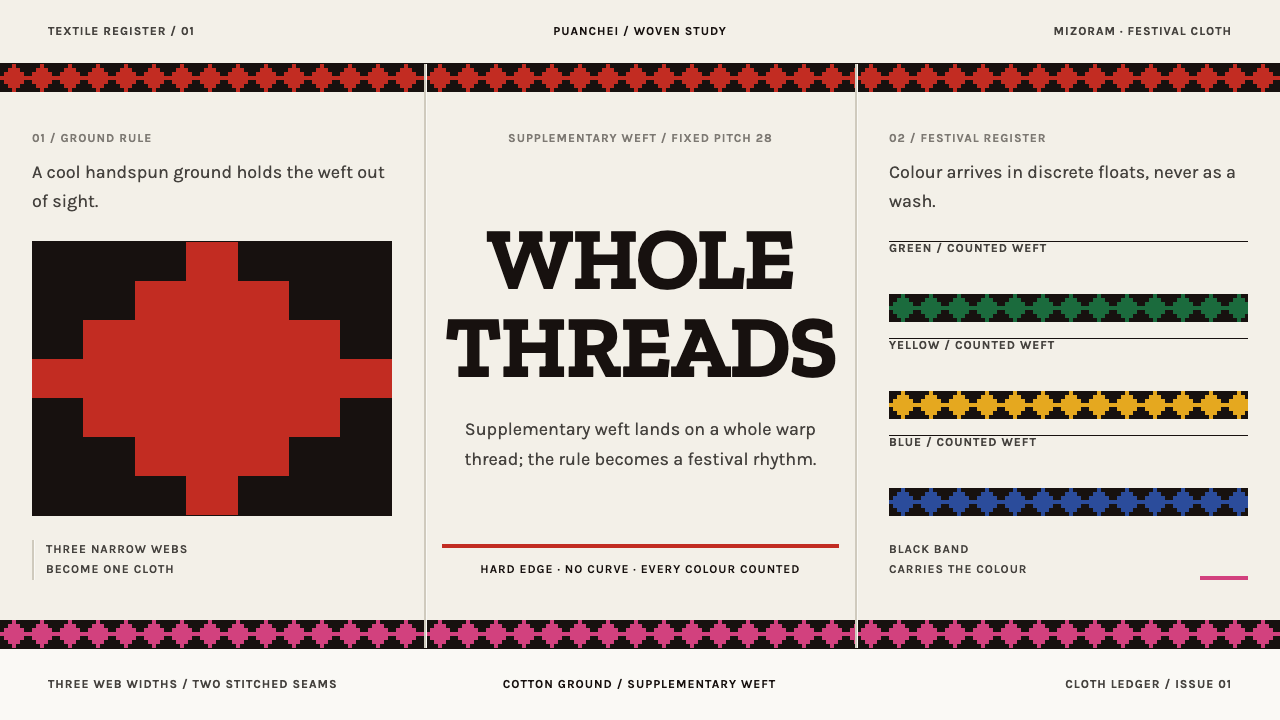
In the Mizo puanchei every pattern lands on a whole warp thread, so the cloth's rhythm is built from steps, black bands and bright festival wefts rather than from curves.
Mizo Puanchei in brief
The puanchei is the brightest of the Mizo puans, the woven cloths of Mizoram in northeast India. It is bridal cloth, festival cloth and the cloth worn for the Cheraw bamboo dance. As a visual style it is defined by a plain handspun white cotton ground, crossed at intervals by dense black bands, inside which small stepped motifs in red, green, yellow, magenta and blue march across the cloth.
Its logic comes from how it is made. The puanchei is woven on a backstrap loin loom, with one end tied around the weaver's waist and the other braced against her feet, in a warp-faced plain weave where the warp threads are packed so tightly that they cover the weft. A loom of this kind produces strips only as wide as one weaver can reach, so a full cloth is stitched from three narrow panels, and the two seams cut cleanly through the bands.
The result is a visual system with unusual consistency. Everything runs horizontally. Edges are hard, colour is flat and saturated rather than blended, and nothing curves. The motifs known as disul and halkha are built in steps, because a supplementary weft thread can only pass over or under whole warp threads and cannot land halfway between two. The style takes that constraint and treats it as its aesthetic: a cool, quiet ground, a few black rules, and bursts of festival colour counted out thread by thread.

Where does Mizo Puanchei come from?
Mizoram is a hill state in the far northeast of India, bordering Myanmar and Bangladesh, and the puanchei belongs to its capital Aizawl and the villages around it. The reference record dates the tradition to before 1900 and describes it as continuous, so the cloth is not a revival but a living practice carried from one generation of weavers to the next. Puan is the general word for a Mizo cloth, and there are many kinds, each with its own name and occasions. The puanchei is the most brilliant of them, the one kept for weddings and festivals.
Its construction explains almost everything about its look. Cotton is spun by hand, which gives the ground its slightly irregular, cool white quality, free of the cream tone of industrial cloth. On the backstrap loin loom the weaver controls tension with her own body, leaning back to tighten the warp and releasing it to open the shed. The patterning is done with supplementary wefts, extra coloured threads inserted by hand and counted across the warp, which means the pattern is worked out thread by thread rather than traced from a drawing. Strips come off the loom only as wide as an arm can reach, and joining three of them gives the finished cloth.
The cloth is tied to occasions. It is worn by brides, and it appears at Chapchar Kut, the spring festival, where it forms part of the festival dress. It is also what dancers wear for the Cheraw, the bamboo dance in which performers step in and out between pairs of bamboo poles clapped together in rhythm. The bright wefts and strict horizontal bands are therefore made to be seen in motion, flashing across a body as it moves, and the stepped motifs echo the stepping of the dance itself.
The reference record names two outside observers connected with the tradition, J. H. Lorrain and F. W. Savidge, who were among the early Christian missionaries to work in the Mizo hills in the late nineteenth century and who recorded the language and customs of the people there. Their writing helps place the puan in a documented past, though the craft itself was passed on by weavers rather than by books. In 2019 the puanchei received a Geographical Indication registration, which formally ties the cloth to its place of origin and acknowledges it as a regional product. For designers, that recognition is a reminder that this is a named, located and living tradition, not an anonymous pattern library.
What defines the Mizo Puanchei look?
Cool White Ground
The base is handspun white cotton, a plain, slightly cool white that carries no cream or yellow cast. The surface is matte and finely ribbed, with a faint irregularity that comes from hand spinning. This ground is the quiet half of the composition, and its restraint is what makes the black bands and bright wefts read so clearly against it.
Dense Black Bands
Wide, deep black bands cross the white ground at intervals and organise the cloth into zones. They act like heavy rules in a layout, dividing the field into clear horizontal sections and containing the coloured patterning inside them. Because the three panels are sewn together, the seams cut across these bands and make the structure of the garment part of the pattern.
Stepped Motifs
The disul and halkha motifs are built from small stair-shaped units that move sideways across the band. Nothing is curved, because a supplementary weft can only land on whole warp threads. The result is a geometry of diamonds, zigzags and stepped shapes with serrated outlines, a vocabulary that feels closer to a counted grid than to freehand drawing.
Festival Weft Colours
Red, green, yellow, magenta and blue appear as flat, fully saturated colours, each a separate thread. There is no blending between them and no gradient, so every colour keeps its own identity and sits next to its neighbour with a clean edge. The effect is joyful and high-energy, but because it is confined within the black bands, it remains orderly rather than chaotic.
Horizontal Rhythm
The whole composition runs sideways. Bands stack from top to bottom, patterns march left to right, and the width of the cloth is set by what one weaver can reach. The rhythm is regular but not mechanical, with alternating wide and narrow bands and varying density of colour. It is a layout that reads like a line of music, moving steadily from one end to the other.
Warp-Faced Texture
In a warp-faced weave the warp threads cover the weft, so the surface looks like a field of fine parallel lines. This gives the cloth a tight, ribbed grain that is visible up close and softly textured even from a distance. Colour and texture are inseparable: every hue is made of thread, and every edge is the edge of a thread.
Hard Edges, No Gradient
Because every shape is limited to whole threads, edges are always crisp and sit exactly on a thread boundary. There is no soft shading, no blur and no transparency. This hard-edged flatness is the strongest link between the cloth and screen design, since a grid of whole units is exactly how a pixel display works, and the cloth shows that this discipline can be warm, human and richly coloured.

Who shaped Mizo Puanchei?
J. H. Lorrain is one of the two outside observers named in the reference record for this style. He was among the early Christian missionaries in the Mizo hills in the late nineteenth century, and his work with the language and customs of the people places the Mizo textile world in a written record. The article does not credit him with the design of the cloth, which belongs to Mizo weavers, but treats him as a witness to the context in which the tradition was first documented.
F. W. Savidge is the second outside observer named in the record, and he worked alongside Lorrain in the same early missionary context. Together they stand for the first written attention paid to the Mizo language and way of life by outsiders. Their relevance to designers is chiefly historical: they remind us that this tradition is far older than its documentation, and that the people who made it were its authors long before anyone wrote it down.
The true makers of the puanchei are the Mizo weavers who spin the cotton, set up the backstrap loin loom and count each supplementary weft across the warp. Their craft is the source of every feature of the style, from the stepped motifs to the three-panel construction. A design system based on the cloth borrows the output of generations of skilled hands, and acknowledging them is part of using it well.
The dancers of the Cheraw, the bamboo dance, are the cloth's most visible audience and its living stage. Wearing the puanchei, they step between clapping bamboo poles in rhythmic patterns, and the cloth's bright bands flash with each movement. They stand for the idea that this is a design made to be seen in motion and in company, and that its rhythm is as much choreographic as it is textile.
How do you use Mizo Puanchei today?
The puanchei style is useful wherever a design needs strong rhythm and visible craft without ornament for its own sake. Its system is built from a few rules, a cool white field, black bands, stepped motifs and flat bright colour, and each of them translates easily to grids, tables and screens. Applying it well means keeping the discipline of the whole thread, so that every shape sits on a clear unit and nothing is blurred or rounded.
For presentation slides, a cover can use the cool white ground with a deep black band across the lower third, and a narrow row of stepped motifs in the five festival colours running along it. The title sits in the white area in a bold, plain type. Content slides can use black bands as section dividers, with generous white space between them. Data slides suit the style especially well: bar charts become stepped blocks, each series takes one flat festival colour, and gridlines are kept to a minimum so the structure reads like the weave.
For web interfaces, the style fits event pages, festival ticketing, calendars, craft marketplaces, cultural education sites and stories about regional products. Use hard-edged buttons and cards with no rounded corners, thick black rules as section dividers, and a limited set of flat colours for badges, tags and progress indicators. Stepped bars make good progress and loading indicators. Keep the background a clean cool white, avoid soft shadows entirely, and let colour appear in short bursts inside black-framed zones.
For editorial and marketing work, the cloth suits features on craft, textiles, regional heritage and festival culture. Layout can follow the weaver's logic: horizontal bands that stack down the page, a stepped motif as a repeating chapter marker, and colour used one accent at a time in each section. Captions and credits matter in this context, so name the tradition, the place and the community, and where possible refer to the makers themselves rather than to a generic 'tribal' category.
A common mistake is to soften the system with curves, gradients or drop shadows, which removes the whole-thread logic that makes it distinctive. Another is to spread all five colours evenly across large areas, instead of keeping them as bursts inside the black bands. The cloth should also not be treated as a generic ethnic pattern; mixing its motifs with those of unrelated textile traditions, or using them as wallpaper without credit, erases the specificity that gives the style its meaning.

Mizo Puanchei — FAQ
What is a puan, and how does the puanchei differ from other Mizo cloths?
Puan is the general Mizo word for a woven cloth, and there are many types, each with its own name and occasions. The puanchei is the brightest of them, associated with brides, festivals and the Cheraw bamboo dance. It is easy to recognise by its plain white ground, dense black bands and small stepped motifs in several bright colours. Other puans follow different colour and pattern conventions, so it helps to avoid treating all Mizo textiles as a single look.
Why are the patterns made of steps and never curves?
Because of the way the cloth is made. The patterning is done with supplementary weft threads, which can only pass over or under whole warp threads. A thread cannot land halfway between two, so every shape has to be built from whole units, which produces stepped diagonals, diamonds and zigzags. The style treats this limitation as its signature, and adding curves would break the logic of the weave.
Can the style work on a dark background?
It is built on a cool white ground and black bands, and the contrast between the two is central to how it reads. A dark inversion is technically possible, but it loses the quiet white field that lets the bright wefts stand out and changes the meaning of the black bands. If you need a dark version, keep the bands as the lightest or most neutral element and keep the colours flat, but for most uses the light version is more faithful.
Is it appropriate to use a traditional textile style in commercial design?
It can be, if it is done with care. The puanchei is a living tradition with named makers and a specific place of origin, so the respectful approach is to credit the tradition, avoid caricature, and not reduce it to a generic tribal pattern. Use the design principles, such as the whole-thread grid, the horizontal bands and the flat colour, rather than copying motifs verbatim, and where possible work with or support the community of makers.
What does the 2019 Geographical Indication registration mean?
A Geographical Indication generally recognises that a product's qualities and reputation come from a particular place and its makers, and it protects the use of the name for goods from that region. For the puanchei, the 2019 registration formally ties the cloth to Mizoram. It is not a copyright on patterns and does not stop designers from being inspired by the look, but it is a good reason to refer to the cloth by its proper name and to cite its origin.
Related design styles
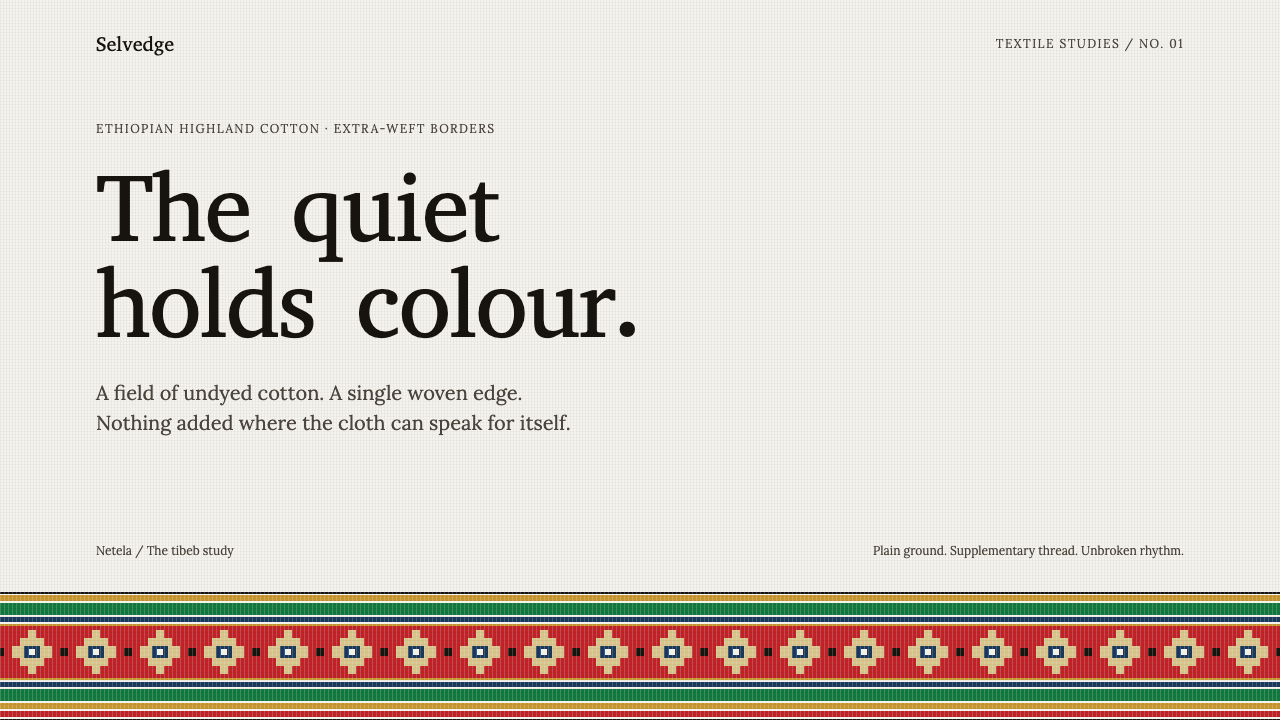 Ethiopian Tibeb BorderThe edge does all the talking. Undyed cotton white meets one dense red, green…
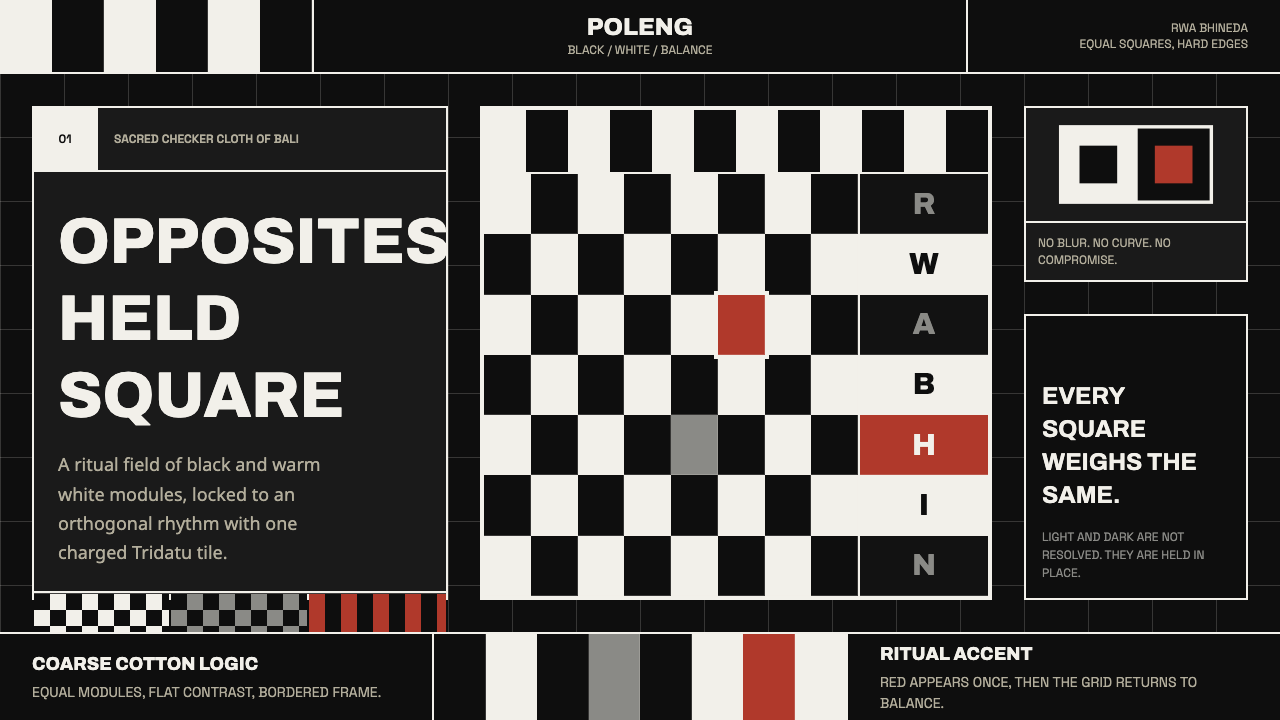 Balinese Poleng ClothSacred duality holds. Black-white squares lock the field; one red tile charge…
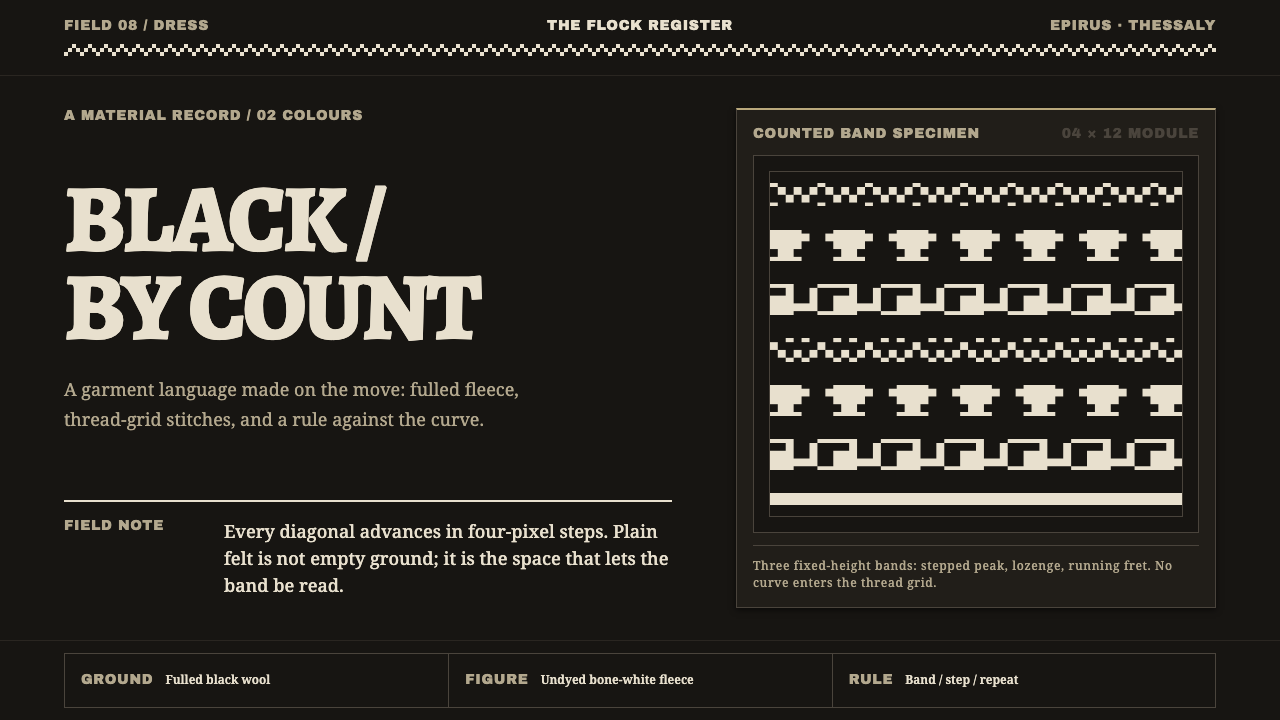 Sarakatsani ShepherdsDiscipline woven into darkness. Bone-white stepped bands count across matte b…
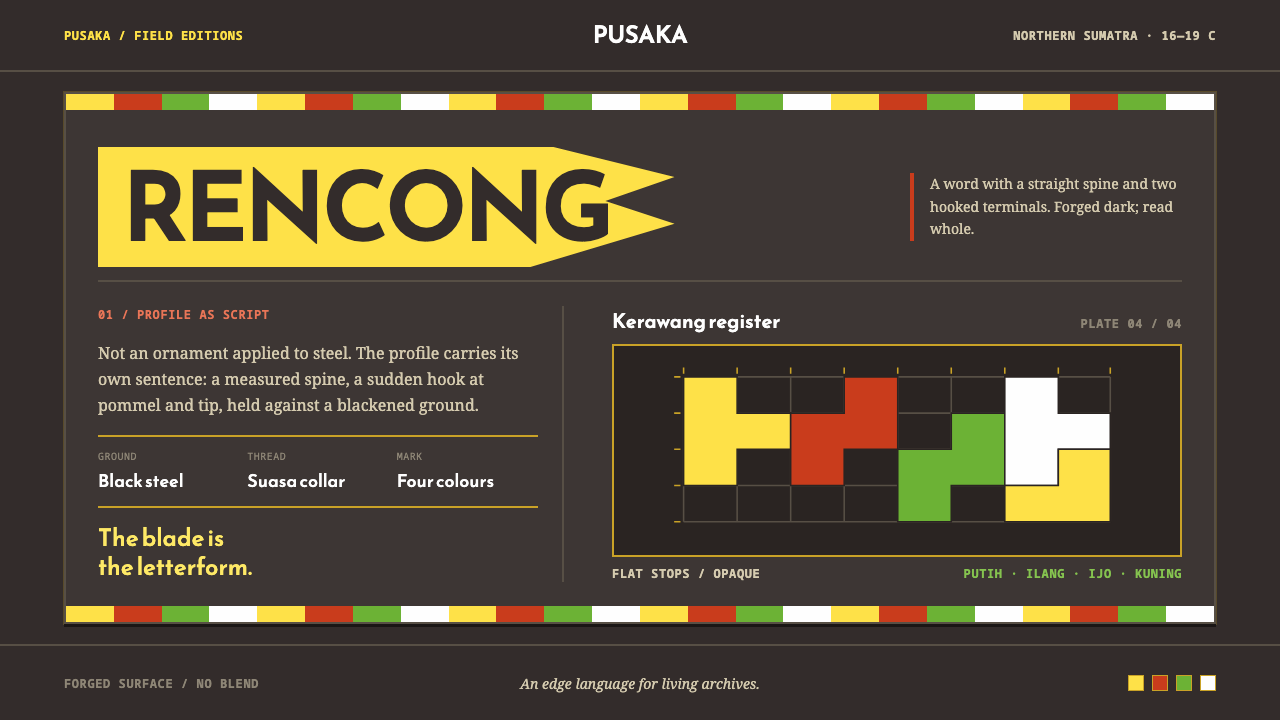 Acehnese Rencong MotifA blade that reads as a word. Flat kerawang red, white, green and yellow lock…
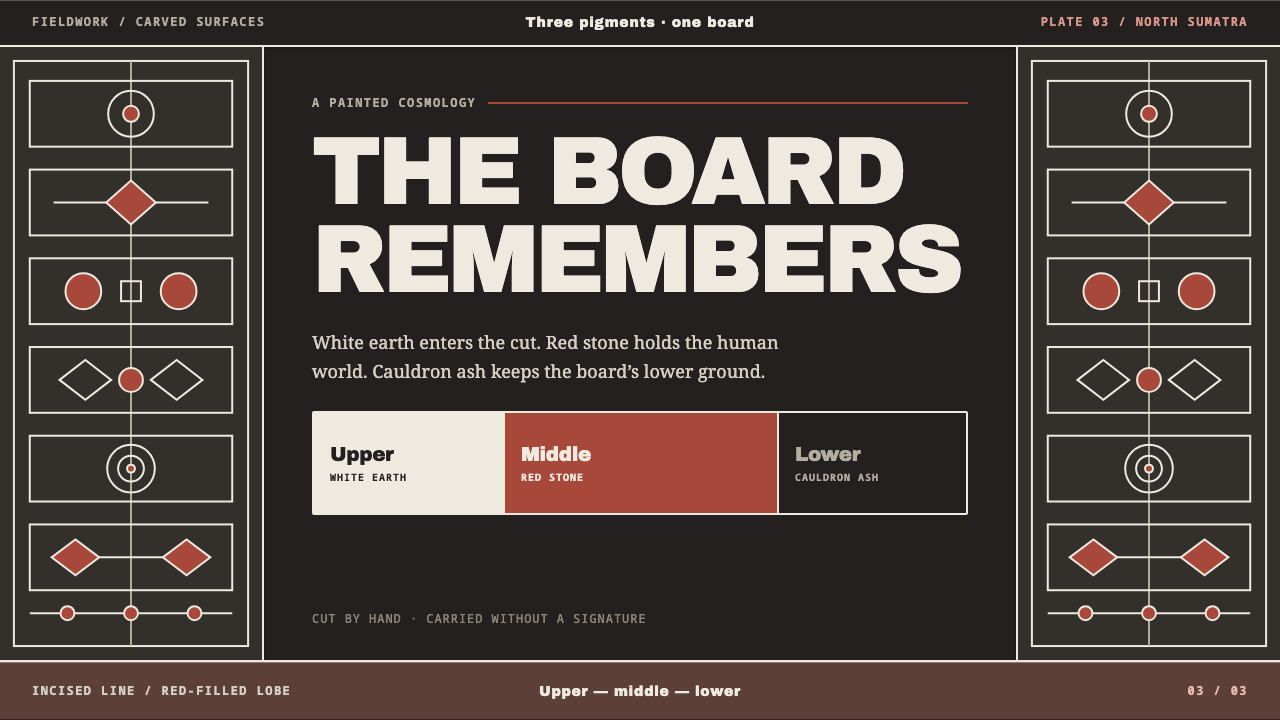 Batak GorgaCosmology cut into wood. Chalk-white lines and batu hula red hold a blackened…
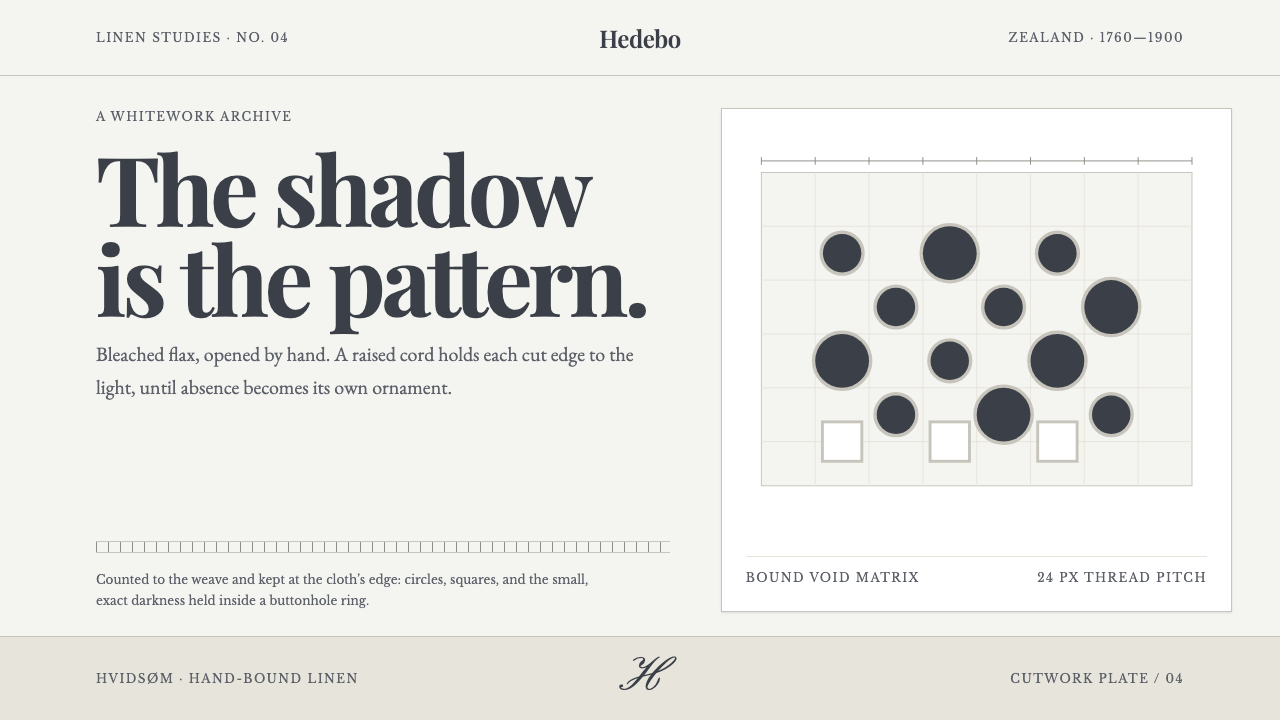 Danish Hedebo CutworkOrnament is cut, not applied. Bleached linen and bound shadow turn voids into…