What is Sakha Yakut Silver Breastplate?
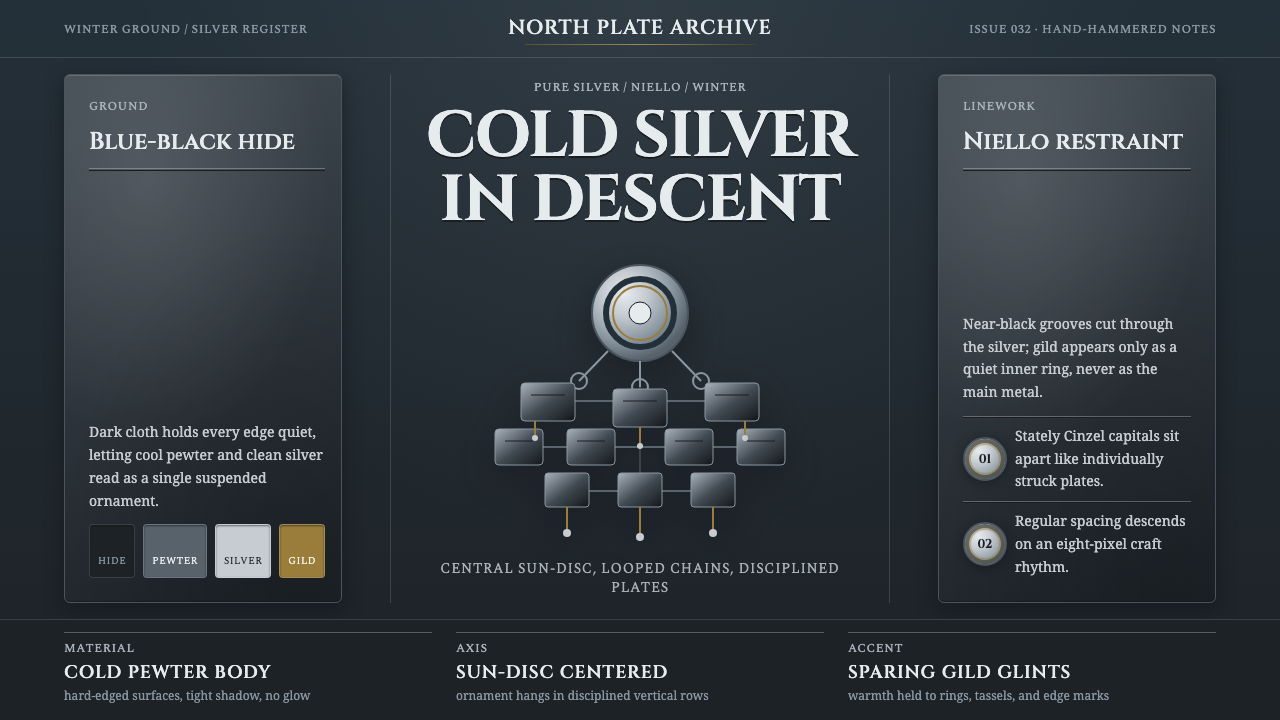
Cold silver hangs in ritual order: a dark Siberian field, disciplined vertical plates, Roman capitals, and near-black niello marks that make metal feel solemn rather than luxurious.
Sakha Yakut Silver Breastplate in brief
The Sakha Yakut Silver Breastplate style draws from the ilin kebiher, a heavy hand-hammered pure-silver chest adornment of the Sakha people of Yakutia in Siberia. Engraved and nielloed plates, linked chains, and a central sun-disc form a vertical structure worn against dark elk-hide and blue-black winter clothing. Its visual force comes from contrast: polished cool-grey metal appears almost luminous when suspended over a deep, cold ground.
Translated into digital design, the tradition becomes a page system built around dark hide-like fields, pewter-toned silver, sharp highlights, near-black engraved detail, and an extremely restrained trace of gilding. The goal is not to imitate a historical object as ornament. It is to preserve its visual logic: weight, suspension, repetition, measured spacing, and a central element that holds the composition together.
The style should feel cold, ceremonial, and exacting. It avoids warmth, softness, casual decoration, and visual abundance. Silver elements behave like hammered plates or linked components rather than glossy interface effects; dark linework acts like niello inlay rather than illustration. A successful composition feels hung, engraved, and deliberately ordered, as though every mark belongs to a ritual object.
Where does Sakha Yakut Silver Breastplate come from?
The visual source is the Sakha silver-adornment craft of Yakutia, Siberia, centered here on the ilin kebiher chest-plate tradition. The breastplate combines hand-hammered pure silver with engraving, niello treatment, plates, chains, and a sun-disc. These parts matter because the style is not merely metallic: its identity lies in the assembly of distinct pieces into a single worn field of order.
The garment context is equally important. The silver is understood against dark elk-hide and a blue-black winter garment, a contrast that establishes the palette and emotional temperature of the system. The dark field is not neutral empty space; it is the ground that lets polished metal read as cold, clean, and severe. Any digital adaptation should preserve that relationship between dark support and bright suspended detail.
Traditional Siberian silversmithing associated with this material is documented through P. A. Oyunsky in the early to mid twentieth century. Within the supplied record, Oyunsky functions as a documentary reference rather than a stylistic inventor. The design language should therefore avoid unsupported biographies or invented workshop narratives and remain attentive to the craft terms that are actually provided: Sakha silver adornment, ilin kebiher, niello, and champlevé enamel work.
Niello and champlevé enamel work point to a surface language of contained marks and material definition. In this digital system, that suggests engraved borders, dark inlaid-looking lines, controlled compartments, and highlights that follow form rather than dissolve into atmosphere. The result is a contemporary abstraction of a craft vocabulary: one that carries the gravity of metalwork without pretending that a screen can replace the original object.
What defines the Sakha Yakut Silver Breastplate look?
Cold Silver
Silver is the governing material impression, but it must remain cool-grey and clean rather than golden, creamy, or luxurious. Surfaces move from muted pewter to restrained highlights, suggesting polished hammered metal. Brightness should be selective, concentrated on edges, discs, borders, and suspended plates so that the dark ground continues to carry visual weight.
Dark Winter Ground
The background recalls dark hide and blue-black winter clothing. It should read as dense, quiet, and cold, never as theatrical blackness or empty void. This field is the garment behind the adornment: it gives silver its clarity, absorbs excess visual noise, and establishes the solemn environmental pressure of the composition.
Niello Linework
Near-black linework provides the system's finest detail. It behaves as engraved or inlaid marking, defining discs, plate edges, compartments, and small symbolic accents. Lines should be concise and intentional, with no decorative flourishes that compete with the metal structure. Their purpose is to articulate surface and order.
Vertical Suspension
Composition follows the logic of plates and tassels hanging in disciplined rows. Elements descend from a central axis or a closely controlled vertical rhythm, with intervals that feel measured rather than decorative. This creates gravity without heaviness: the page appears assembled, suspended, and wearable rather than simply stacked.
Sun-Disc Center
The central sun-disc offers a compositional model rather than a compulsory icon. A circular focal form can gather chains, rules, information groups, or interactive states into one stable point. It should be treated as an organizing force, with surrounding elements acknowledging its presence through alignment, spacing, or repeated metal detail.
Spare Gilding
A trace of gilding may appear, but only as a rare interruption within the silver-and-dark system. It is most effective when it signals a special point of attention, a ceremonial threshold, or a contained detail. If gild becomes a dominant field, the style loses the cold shaman-silver character that distinguishes it.

Who shaped Sakha Yakut Silver Breastplate?
Yakut niello silversmiths are the essential craft figures behind the supplied tradition. Their relevance is material and structural: hammered silver, engraving, nielloed treatment, linked components, and the disciplined organization of adornment all inform the digital system.
P. A. Oyunsky is identified in the source material as a documentary reference for traditional Siberian silversmithing in the early to mid twentieth century. His place in this article is archival: he anchors the documented context without being presented as the creator of the breastplate tradition.
The makers of ilin kebiher are represented through the object tradition itself. Their work establishes the key formal lesson: separate plates, chains, engraving, and a sun-disc can operate as one coherent ceremonial surface when their hierarchy and suspension are carefully controlled.
How do you use Sakha Yakut Silver Breastplate today?
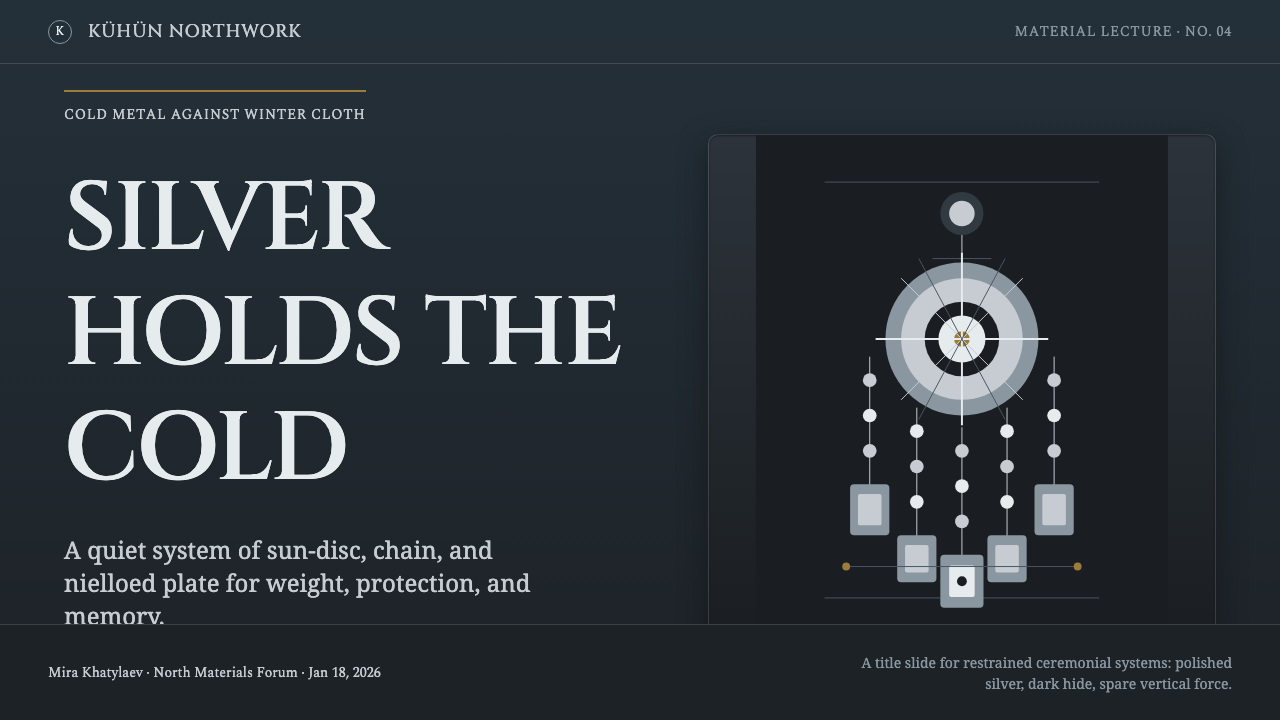
For presentation covers, use the style as a single ceremonial arrangement rather than a decorative theme. Place a title in Roman capitals within a calm dark field, then establish one dominant circular or plate-like form and a small number of vertically descending details. The title should feel engraved or inscribed, while the silver forms create hierarchy through placement and reflected edge rather than through a crowded collection of ornaments.
For content and data slides, translate chains and aligned plates into information structure. Use vertical rules, repeated labels, restrained silver containers, and a central divider to organize categories. Data graphics should stay sparse and legible: marks can resemble metal segments or engraved records, but their values must remain easier to read than the visual metaphor. Use the darkest field for context and reserve brighter silver for the active comparison.
For web interfaces, this system suits dashboards, records, collections, pricing pages, and other products that benefit from gravity and controlled hierarchy. Navigation can read like a band of inscriptions; panels can behave like linked plates; selected states can receive a narrow silver highlight or a contained dark inlay mark. The interface should remain practical, with clear labels and calm interaction cues instead of ornamental metallic effects.
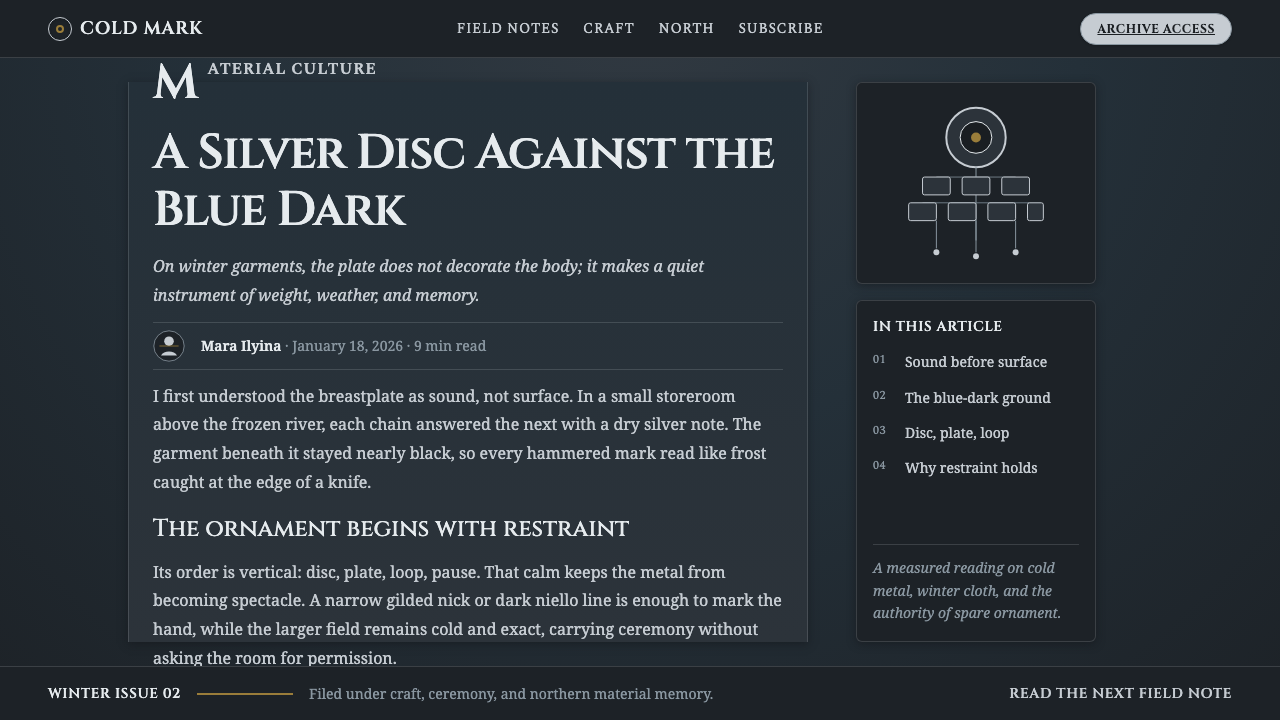
For editorial and marketing work, use the vertical rhythm to give long material a ceremonial pace. An article can open with a central disc motif, then let headings, pull quotes, metadata, and image captions hang in a measured column. Marketing pages can alternate dark garment-like fields with silver informational plates, allowing one rare gilded note to mark an invitation, release, or special edition without turning the whole page warm.
The common mistake is to equate the style with generic luxury metal. Warm gold, soft shine, abundant gloss, gem-like color, and elaborate filigree all weaken its character. Another mistake is adding every available engraved motif until the interface becomes costume. The stronger approach is colder and stricter: dark support, controlled silver, near-black detail, vertical order, and enough empty space for each element to feel physically suspended.
Sakha Yakut Silver Breastplate — FAQ
Is this style simply a dark luxury aesthetic?
No. Its visual basis is the Sakha ilin kebiher silver-adornment tradition, not a generalized idea of premium metallic design. The intended mood is cold, ceremonial, and materially disciplined. Silver, dark garment-like ground, niello linework, chains, plates, and vertical suspension should work as a system, not as unrelated luxury signals.
Why must the silver remain cool rather than warm?
The supplied material defines the signature as cool-grey polished silver against a dark blue-grey ground, explicitly not warm. That temperature is central to the style's identity: it evokes clean shaman-silver in a Siberian winter setting. Warming the metal shifts the composition toward gilded luxury and breaks the intended contrast between cold highlight and dark support.
How should niello be represented in a digital layout?
Treat it as near-black engraved or inlaid linework, not as texture spread across every surface. It works best around edges, discs, dividers, small marks, and contained details. Its role is to define and sharpen the silver structure. When too dense, it loses the precision that makes engraved detail feel deliberate.
Can the sun-disc be replaced in modern applications?
Yes, provided its compositional role remains. The sun-disc can become a circular control, emblem, focal image, section marker, or data point. What matters is that it gathers the surrounding structure and gives the vertical arrangement a center of gravity. Replacing the form is acceptable; losing the organizing principle is not.
Where does this style work less well?
It is less suitable when a product needs warmth, playfulness, visual abundance, or a light conversational mood. The system depends on dark space, cold metal, and disciplined restraint, so it can feel overly severe for cheerful entertainment, soft lifestyle communication, or interfaces that require dense casual browsing. Its strongest use is where focus, record, ceremony, or hierarchy are meaningful values.
Related design styles
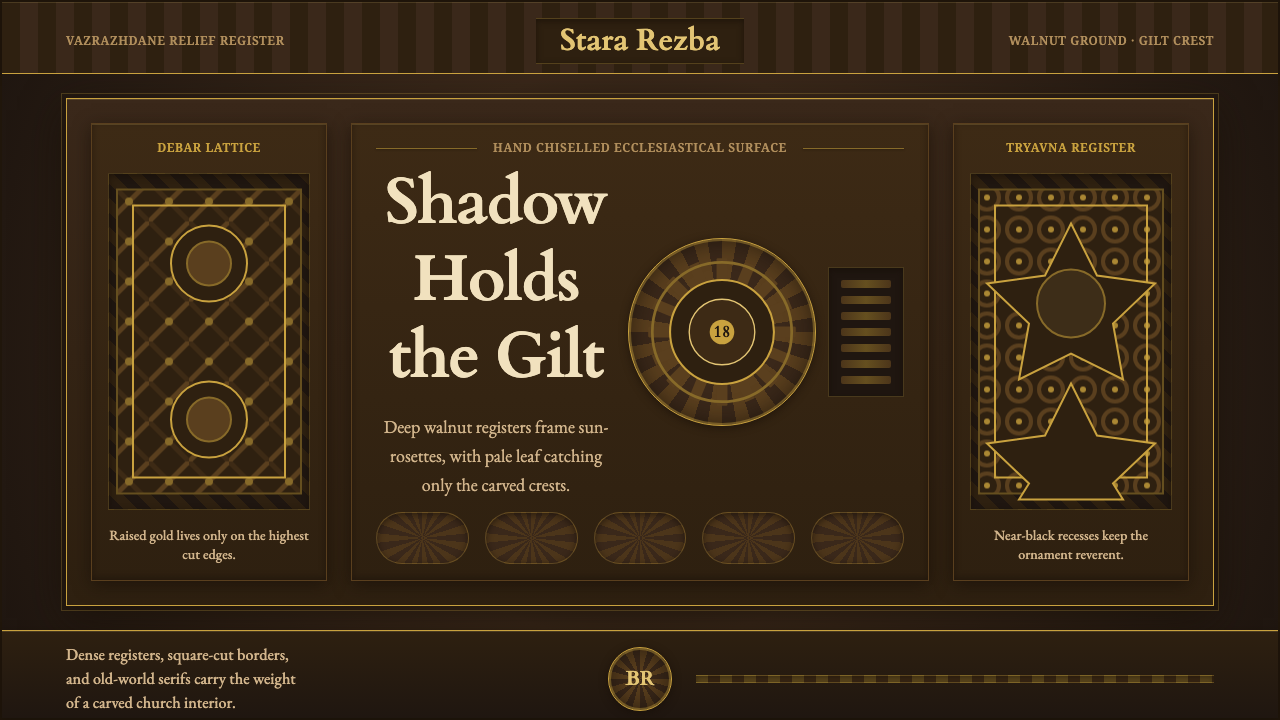 Bulgarian Revival WoodcarvingDark devotion in relief. Walnut panels, Cardo serifs, and gilt rosettes catch…
 Circassian Adyghe Gold BraidCourtly gold on dark wool. Raised braid edges coil over indigo-black panels.
 Orenburg Goat-Down Gossamer ShawlLuxury in thinness. Pale Cormorant type and down-lace lines breathe on Ural s…
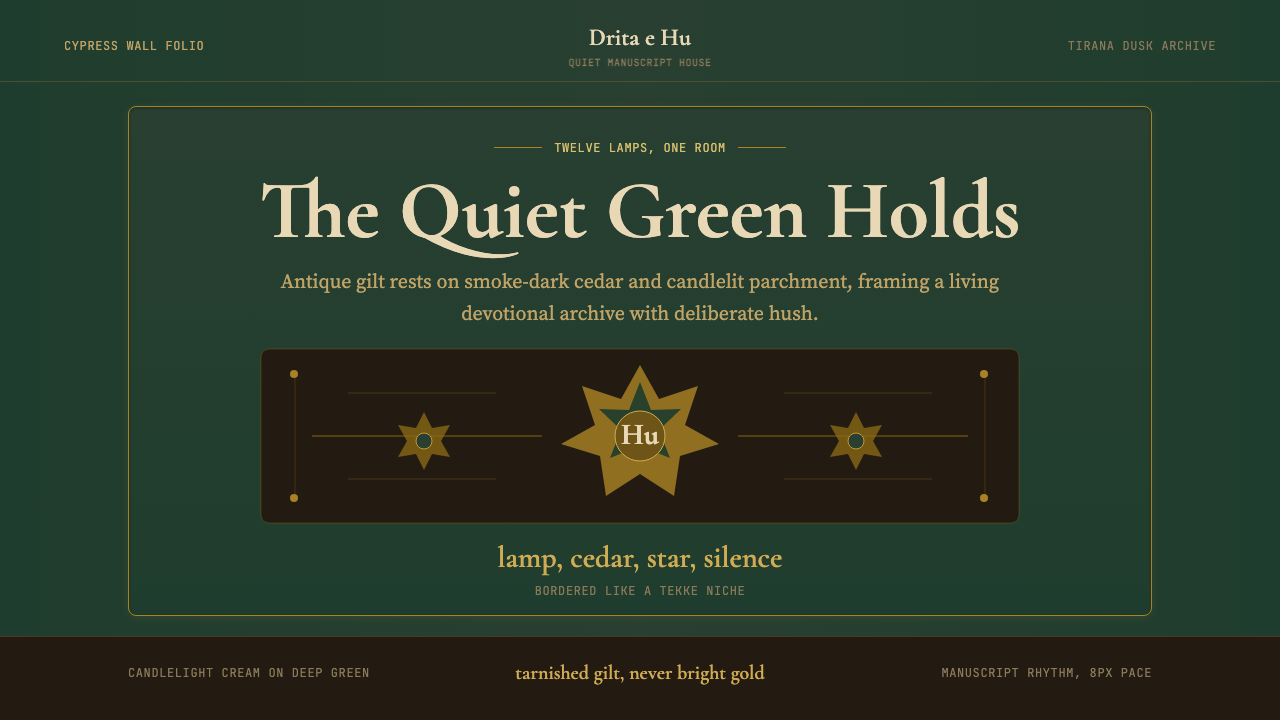 Albanian Bektashi Sufi (Tekke)Sacred quiet in cypress green. Gilt stars and Cormorant type frame a dusk tek…
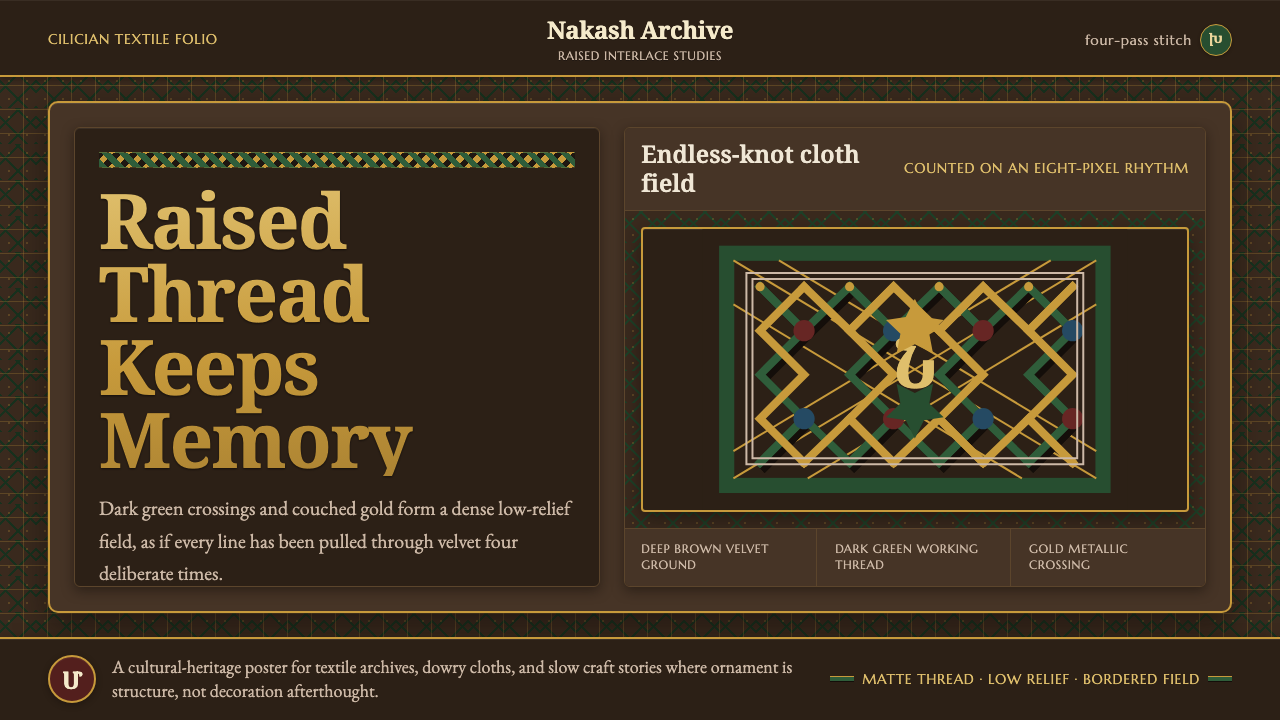 Armenian Marash Interlace EmbroideryDense memory in raised thread. Green-gold interlace locks over deep brown clo…
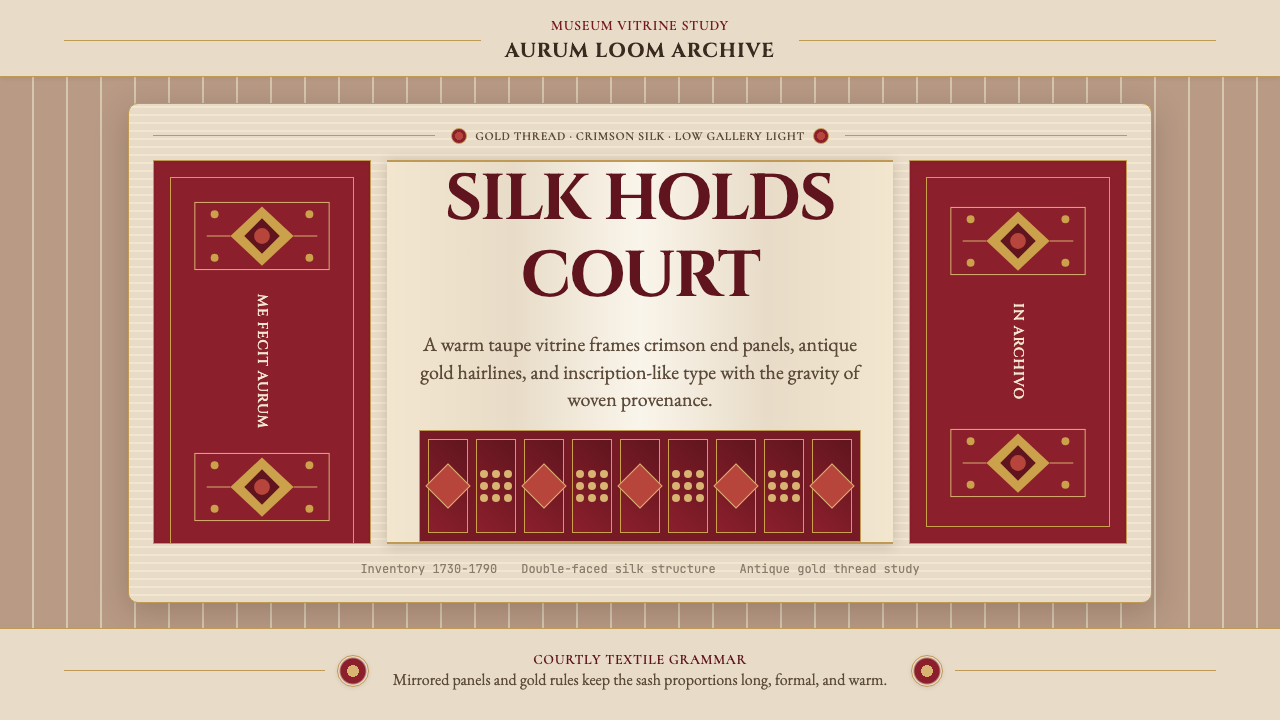 Belarusian Slutsk SashCourtly silk, vitrined. Taupe ground, crimson panels, Cinzel type, antique go…