What is Circassian Adyghe Gold Braid?
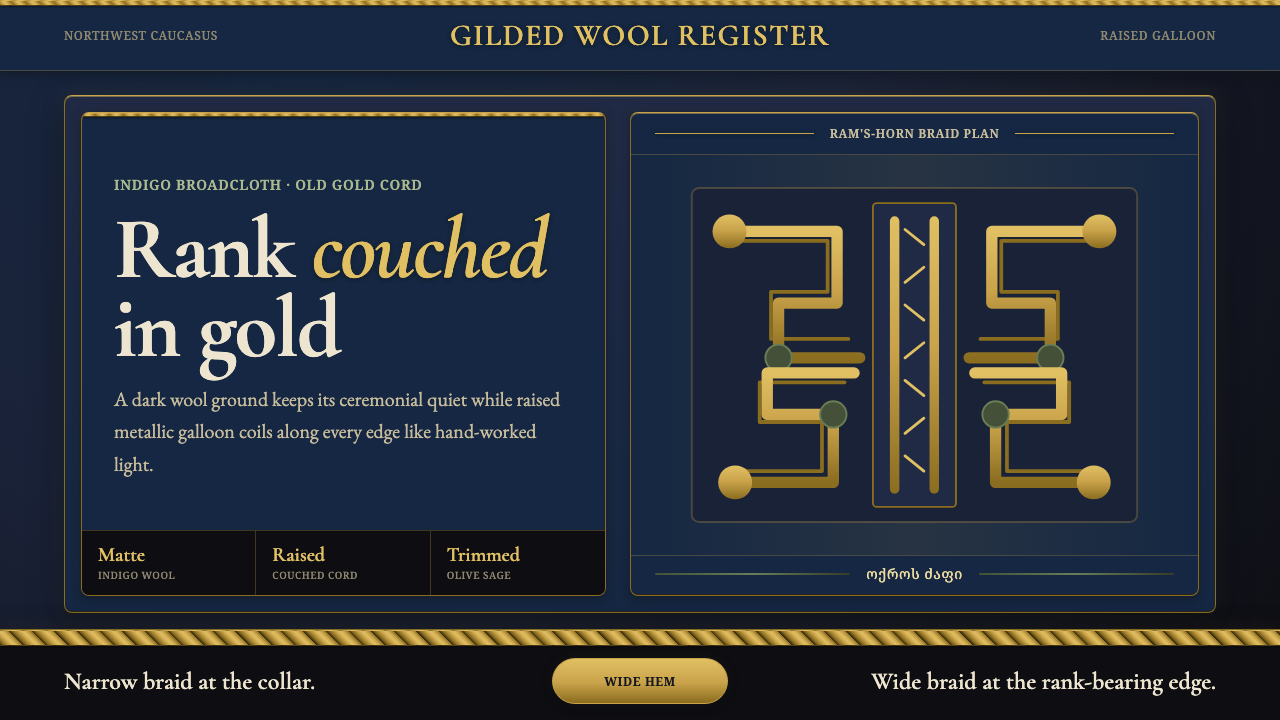
Circassian Adyghe Gold Braid brings courtly gold onto dark wool: raised braid, angular ram’s-horn coils, and a quiet indigo-black ground whose restraint makes every glint feel ceremonial.
Circassian Adyghe Gold Braid in brief
Circassian Adyghe Gold Braid is a design language drawn from the raised couched galloon soutache used along the edges of a nineteenth-century Caucasian noble’s chokha or caftan. Gold-thread cord coils into angular ram’s-horn motifs over dark indigo-and-black wool broadcloth, creating a visual tension between luminous ornament and a deep, matte ground.
Its authority comes from contrast rather than abundance. The metallic braid is not scattered across the surface as general decoration; it traces borders, hems, and structural edges. Because the wool remains visually quiet, the gold reads as dimensional, lace-like, and hand-worked. The garment appears formal without becoming brightly ornamental.
Translated to screen, the system becomes a dark indigo-black interface with galloon gold as its signature accent. Narrow braid establishes the upper edge, wider braid marks the hem, olive-sage trim provides a restrained secondary note, and calligraphic serifs carry the courtly temperament. The result should feel inherited, crafted, and ceremonial rather than glossy or opulent.

Where does Circassian Adyghe Gold Braid come from?
The source is the nineteenth-century Caucasus, specifically the traditional Adyghe noble costume associated with the Northwest Caucasus, Circassia, and the wider Eastern European setting named for the region. The chokha or caftan is treated here not as a generic historical garment but as the carrier of a particular edge vocabulary: dark broadcloth disciplined by metallic braid.
The defining technique is raised couched galloon soutache. A cord of gold thread is worked onto the cloth so that it sits above the ground rather than disappearing into it. The result is both linear and tactile: the braid behaves like drawn ornament, but its lifted profile gives the line physical presence. Angular ram’s-horn motifs emerge through the coiling of the cord, joining geometry with the rhythm of handwork.
The visual balance depends on the relationship between materials. Gold provides the active surface, catching light and outlining the garment’s formal boundaries. Indigo-and-black wool provides the recession, absorbing light and preventing the ornament from becoming noisy. This is why the historical impression is courtly but restrained: brilliance is concentrated at the edge, while the field remains deep, matte, and composed.
The screen translation preserves that hierarchy instead of copying the garment literally. A dark indigo-black page becomes the wool ground; galloon gold becomes the principal line of emphasis; a narrow upper braid and a broader lower braid establish a vertical sense of ceremony; olive-sage trim adds a muted companion; and calligraphic serifs translate the hand-worked, noble character into typography. The system is therefore an interpretation of costume structure, not a costume illustration.
What defines the Circassian Adyghe Gold Braid look?
Indigo-Black Ground
The background should feel like deep wool broadcloth: indigo-black, quiet, and matte rather than flatly neutral. Its role is to absorb attention so the braid can carry the light. Dark panels, surfaces, and containers should remain tonally related, creating depth through subtle distinction rather than bright contrast.
Galloon Gold
Gold is the single true signature of the system. It should appear as a raised, braided line that defines an edge, frames a title, or marks an important boundary. Gold is not a general-purpose highlight for every control; its scarcity is what makes it ceremonial. Its surface should feel luminous and worked, never synthetic or mirror-like.
Braid Hierarchy
Edge treatment has an intentional hierarchy. A narrow braid at the top establishes an entrance and a formal cap, while a wider braid at the hem provides weight and closure. Repeating the same treatment everywhere weakens the costume logic. The braid should guide the eye through the composition, not turn every boundary into an equally loud frame.
Angular Ram’s-Horn Motifs
The motif vocabulary joins coiling movement with angular geometry. Ram’s-horn forms can appear as corner turns, repeated border units, or compact ornaments near a title or emblem. They should remain legible as structured linework. Excessively fluid curves would lose the Adyghe character, while random geometric marks would lose the sense of braided construction.
Calligraphic Serif
Typography carries the courtly and hand-worked temperament. Calligraphic serifs should introduce grace without becoming theatrical, with letterforms that feel shaped rather than mechanically stamped. Display type can sit close to the gold braid, while supporting text should remain calm and readable. The contrast is between ceremonial titles and a dark, disciplined field.
Olive-Sage Restraint
Olive-sage trim is the secondary voice. It can distinguish supporting rules, quiet labels, or secondary framing, but it should never compete with the gold. Its muted character connects the luminous braid to the wool ground and prevents the palette from becoming a simple black-and-gold luxury formula.

Who shaped Circassian Adyghe Gold Braid?
The Adyghe noble class is the social context named by the source material. Their nineteenth-century chokha or caftan provides the courtly reference for the system: dark wool made formal through carefully placed gold braid. In the design translation, this becomes a visual language of restraint, rank, and controlled display rather than a generic invitation to decorate everything with metallic ornament.
The village galloon embroiderers of the Northwest Caucasus represent the hand-worked intelligence behind the ornament. The raised cord, repeated border rhythm, and angular coils should feel made through patient application rather than generated as anonymous decoration. Their presence in the source material keeps the system connected to labor, material, and local craft.
The chokha and caftan tradition supplies the garment structure that makes the braid meaningful. Gold is understood through the edges it follows: upper borders, hems, and formal divisions. On screen, the same principle suggests that ornament should clarify the architecture of a page or interface, not float independently as surface decoration.
Gold-galloon couched-braid ornament is the system’s central formal device. It combines a line, a raised profile, a repeating rhythm, and a material contrast between metal thread and wool. Every digital border, rule, or ornamental coil should preserve some part of that relationship so the result remains recognizably derived from the source.
How do you use Circassian Adyghe Gold Braid today?
For presentation covers, use the dark indigo-black field as a quiet stage and let a single sweep of galloon gold establish the ceremony. A narrow braid can enter along the upper edge while a title in calligraphic serif type sits with deliberate authority in the open field. The cover should feel like the front of a formal garment: contained, tactile, and marked by one confident border rather than crowded with ornament.
Content slides should use the braid as a structural guide. A gold rule can separate a title from its explanation, while olive-sage trim distinguishes supporting information. Data slides benefit from the same discipline: charts should remain dark and legible, with gold reserved for the principal series or decisive figure. The braid motif may frame a data block, but it should not compete with the information it is meant to dignify.
For web interfaces, the system suits dashboards, pricing pages, and tools that need to feel authoritative without becoming cold. Use the indigo-black ground for the application shell, gold for selected states and primary boundaries, and olive-sage for secondary navigation or quiet status information. Panels should feel like layered cloth rather than floating glass. Borders and edge treatments are more appropriate than diffuse glow, because the source language is built from raised lines and material contrast.
Editorial and marketing layouts can treat the page as a ceremonial textile. Headlines may sit within generous dark fields, with a gold braid marking the beginning or end of a section. Product stories, cultural essays, and premium launches can use the contrast between matte ground and luminous edge to create atmosphere without relying on abundant imagery. The strongest compositions allow the border to carry the sense of occasion while the text remains clear and composed.
The common mistake is turning the system into a generic black-and-gold luxury theme. Adding metallic accents everywhere, using several competing ornamental patterns, or making every edge equally bright destroys the hierarchy. Keep gold concentrated, preserve the dark wool-like ground, use olive-sage sparingly, and let the braid follow real structural boundaries. The style succeeds when the ornament appears to belong to the garment of the page.

Circassian Adyghe Gold Braid — FAQ
Is this meant to reproduce a historical garment exactly?
No. The source material defines it as a screen translation of the gold braid used on a nineteenth-century Caucasian noble’s chokha or caftan. The goal is to preserve the relationships that make the costume vocabulary distinctive: dark wool against luminous gold, raised line against matte ground, narrow upper braid against wider hem braid, and angular coils against disciplined structure. A literal costume illustration would be a different task.
Can the style work without gold?
It can be interpreted in a reduced form, but gold is the defining signature and should not be casually removed. Without it, the system loses the contrast between courtly luminosity and dark wool. If gold must be restrained, reduce its area and concentrate it on meaningful edges rather than replacing it with many unrelated accents. The important quality is not brightness everywhere; it is controlled radiance.
Why is the dark ground so important?
The dark indigo-and-black wool ground is what allows the raised braid to read as dimensional and luminous. If the background becomes bright, glossy, or visually busy, the gold loses its concentrated authority and the material contrast collapses. The ground is therefore not merely a backdrop. It is the quiet half of the system that gives the ornament its presence.
Does this style suit every product or interface?
It is best suited to experiences that value ceremony, authority, craft, and restrained luxury. Cultural publishing, formal portfolios, premium launches, dashboards, and pricing interfaces can benefit from its strong edge logic and dark contrast. It is less suitable when the product depends on bright informality, playful abundance, or a lightweight visual mood. Its success depends on whether the product can support the seriousness and material richness implied by the braid.
Related design styles
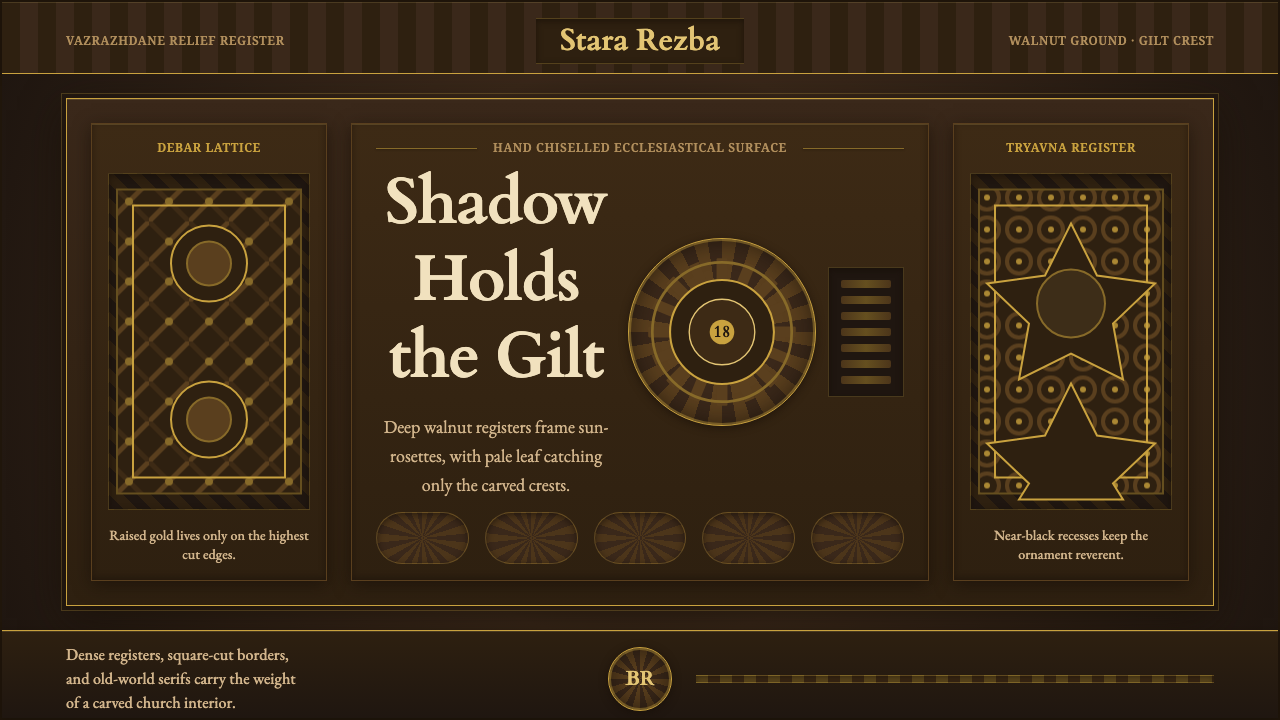 Bulgarian Revival WoodcarvingDark devotion in relief. Walnut panels, Cardo serifs, and gilt rosettes catch…
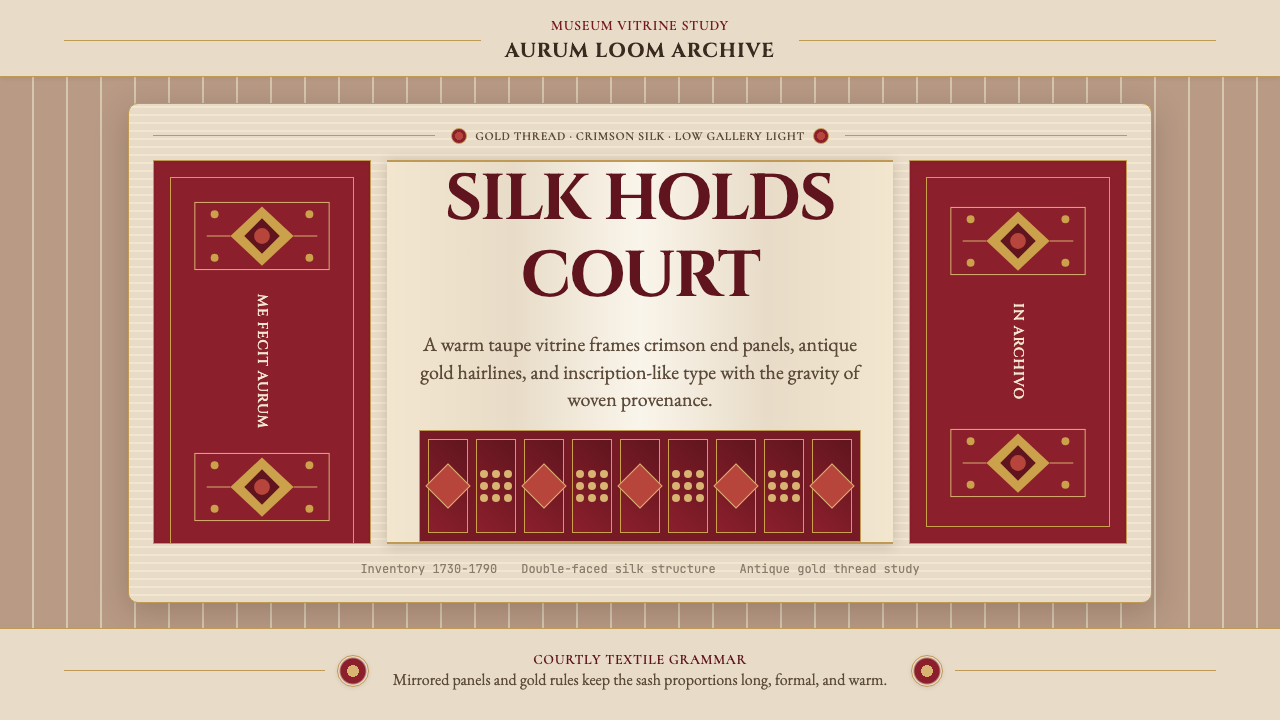 Belarusian Slutsk SashCourtly silk, vitrined. Taupe ground, crimson panels, Cinzel type, antique go…
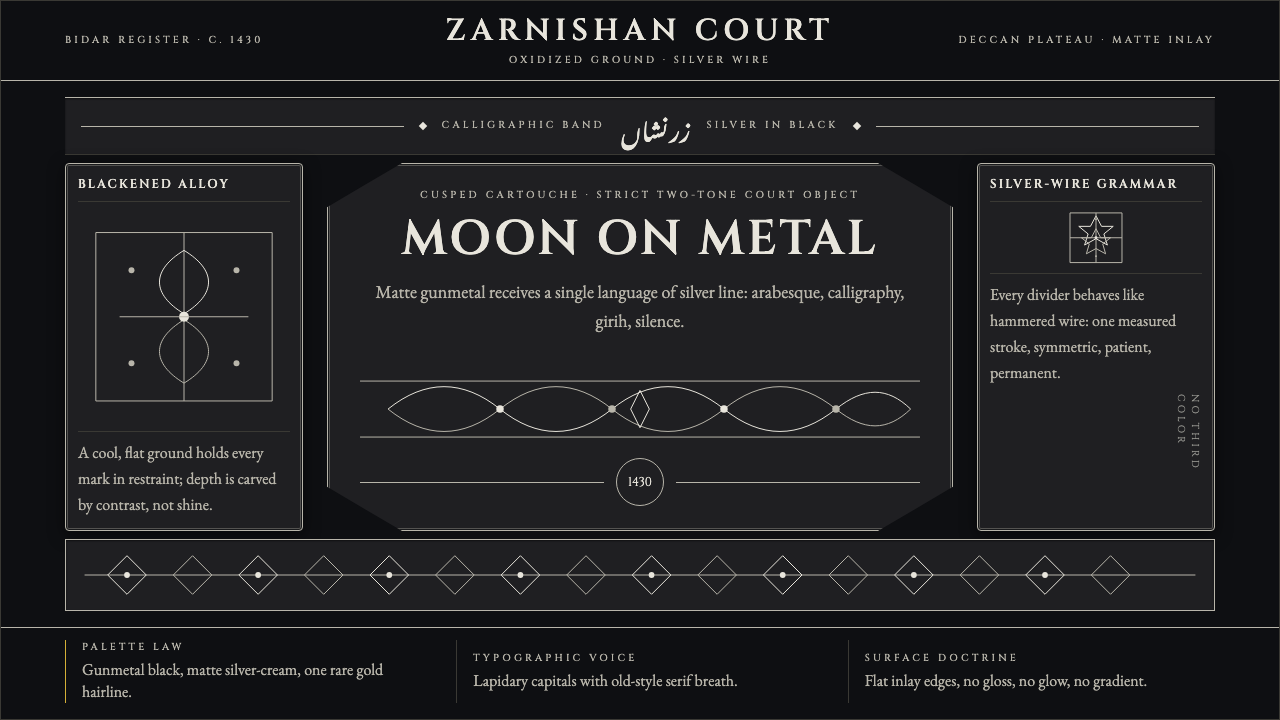 Bidri Deccan MetalworkCourtly darkness, tooled by silver. Cinzel caps and hairline arabesques cut g…
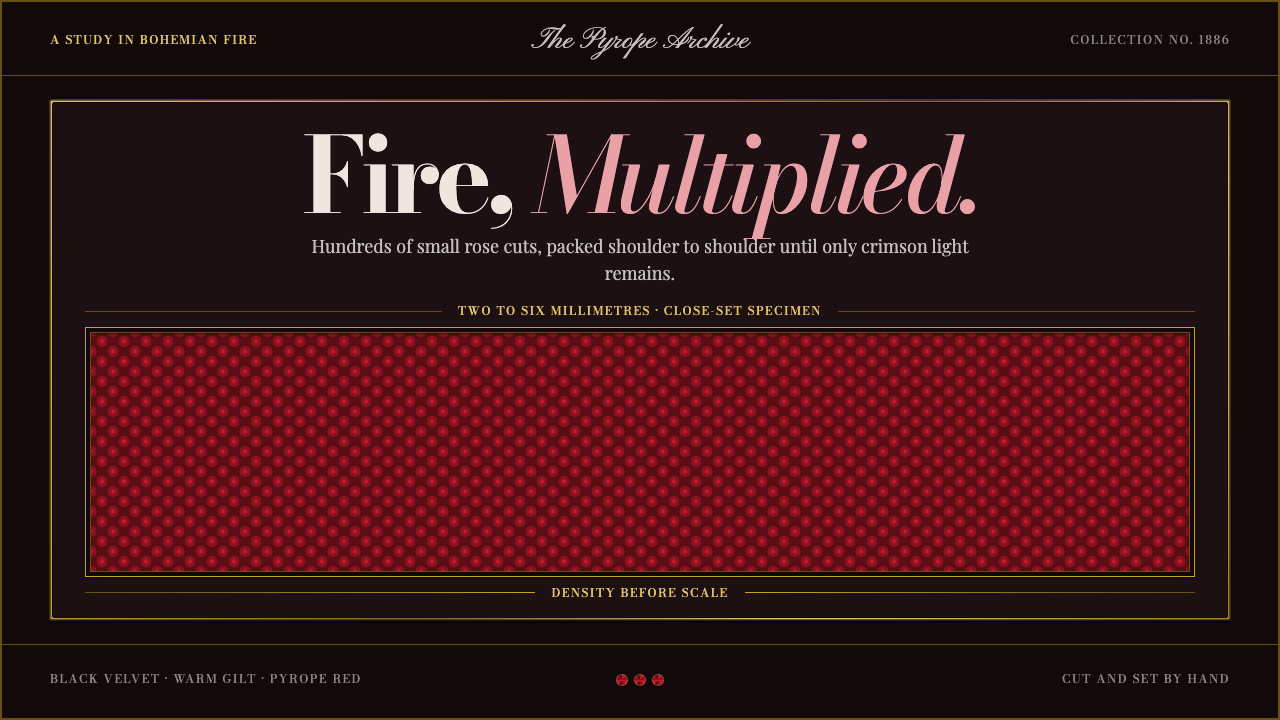 Bohemian GarnetFire thrives in density. Tiny pyrope facets pack tight against black velvet a…
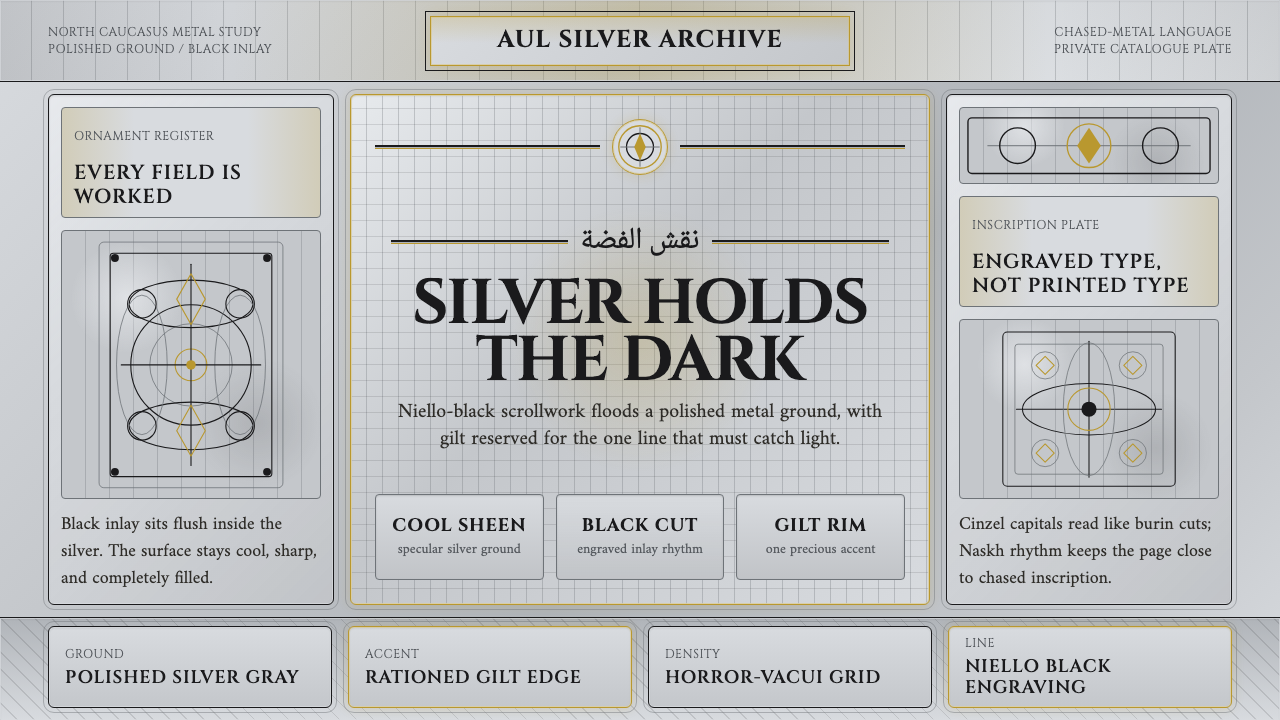 Dagestan Kubachi Silver NielloSilver made obsessive. Niello-black scrolls cover cool metal, with one ration…
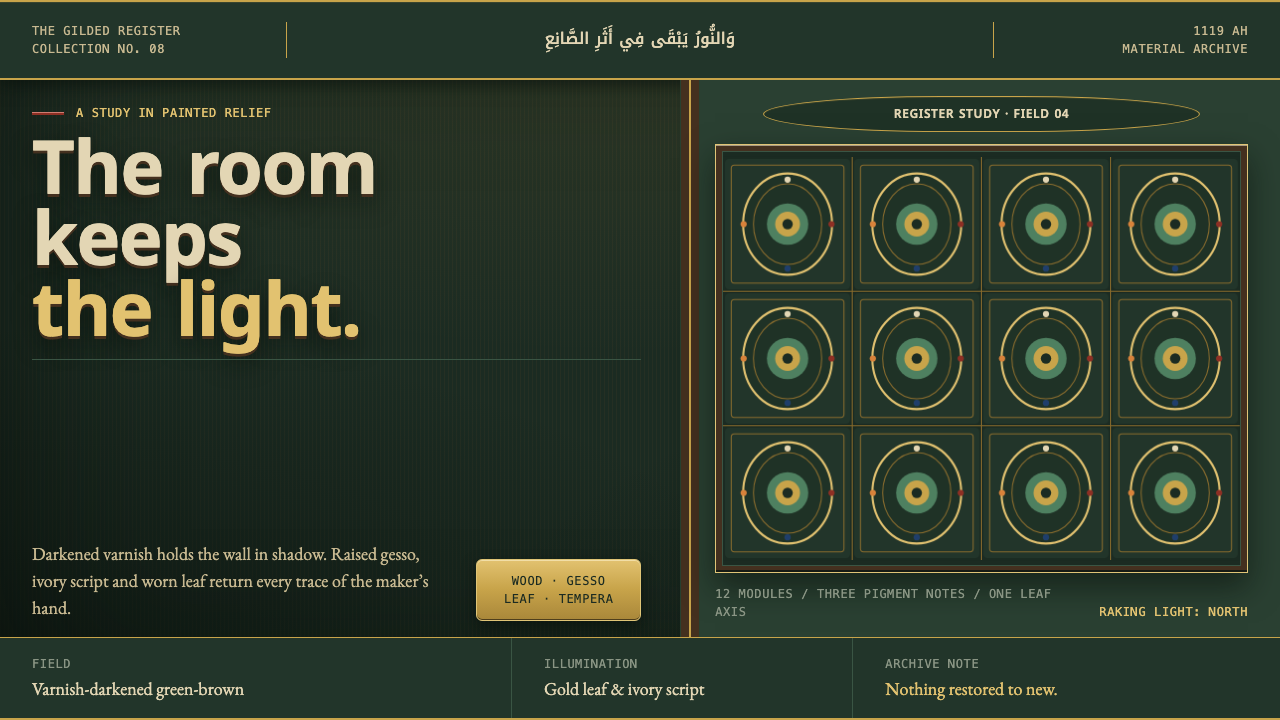 Damascus Ajami RoomDarkness makes the gilding glow. Ivory script and gold relief cross a varnish…