What is Bulgarian Revival Woodcarving?
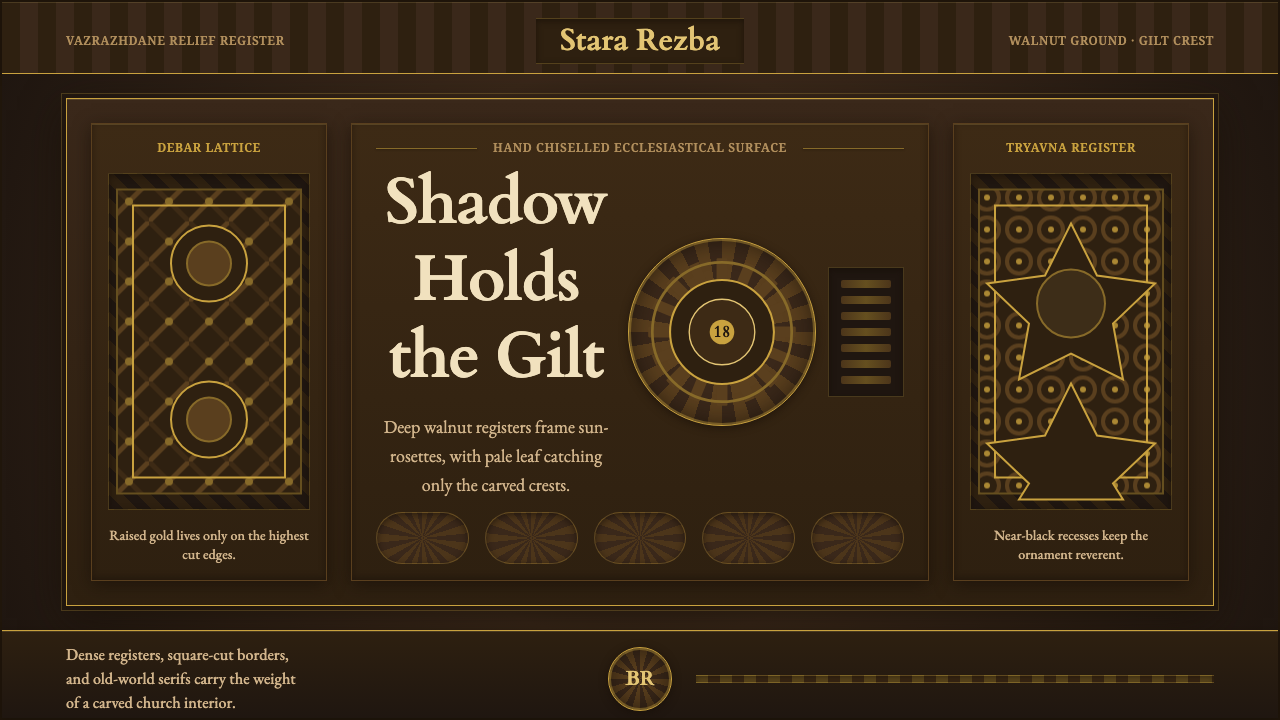
Bulgarian Revival woodcarving is devotion cut in relief: dark stained walnut, sun-rosettes and vine lattice chiseled deep into the wood, with gold leaf caught only on the raised crests above near-black shadowed hollows.
Bulgarian Revival Woodcarving in brief
Bulgarian Revival woodcarving refers to the dense relief carving produced by regional schools of church craftsmen for the iconostasis — the carved and painted screen that separates the nave from the altar in an Orthodox church — as well as for pulpits, bishop's thrones, and other ecclesiastical furniture. Craftsmen worked walnut and other dense woods into elaborate compositions of sun-rosettes, spiraling vine lattice, and stylized foliage, cutting the pattern deep enough that the surface reads as true sculptural relief rather than shallow decoration.
The wood itself is left dark — a deep, stained walnut brown, never lightened toward cream or honey tones — and gold leaf is applied sparingly, confined almost entirely to the raised crests and highest points of the relief where it catches available light. Everything below those high points falls into near-black shadow, so the carving reads less as a flat ornamented surface and more as a landscape of ridges and hollows, with gold marking only the peaks.
This produces an aesthetic of real, physical depth rather than illustrated depth: the shadow is not painted on, it is cast by the actual cut of the wood. The overall effect is heavy and monumental, built for the dim, incense-thick interior of a church rather than for bright daylight, and it stands apart from lighter folk-carving traditions elsewhere in Europe precisely because of this commitment to darkness and restraint in where the gold is allowed to appear.
Where does Bulgarian Revival Woodcarving come from?
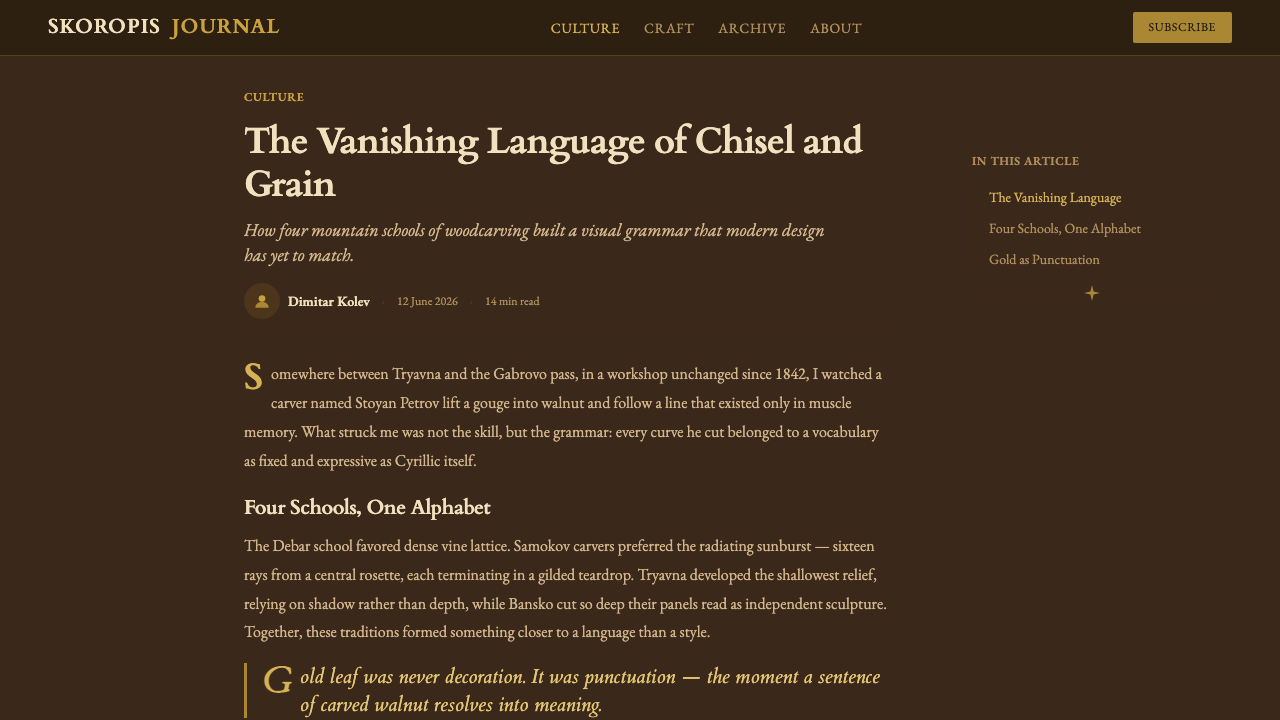
Bulgarian Revival woodcarving belongs to the Bulgarian National Revival (Vazrazhdane), an eighteenth- and nineteenth-century period of resurgent Bulgarian cultural, economic, and religious life under continued Ottoman rule. Ottoman-era restrictions limited the height and outward grandeur permitted to Christian church buildings, which meant that Bulgarian communities poured much of their artistic ambition and increasing merchant wealth into what could be built inside those modest exteriors — icon painting, wall painting, and above all the carved wooden iconostasis, which became the single most elaborate object a village or town congregation could commission.
Several regional schools of carvers, referred to in Bulgarian as reztabari (literally, 'cutters'), developed distinct local practices while sharing a broad common vocabulary of sun-rosettes, spiraling vine and grapevine lattice, and stylized foliage cut deep into the wood. The schools associated with Debar, Samokov, Tryavna, and Bansko are the most frequently cited centers of this craft, each supplying carved iconostases, pulpits, and bishop's thrones to churches and monasteries across the Bulgarian lands and, in the case of carvers trained in the Debar tradition, well beyond them.
Carvers typically worked in traveling teams, moving from commission to commission across a wide region rather than staying fixed to a single workshop town, and often collaborated directly with icon painters and gilders on the same iconostasis — the carved wooden structure providing the architectural framework into which painted icon panels were set, with gold leaf applied by hand to the highest points of the relief once the carving itself was complete. As with the icon-painting schools of the same period, individual carvers are far less documented by name than the schools and workshop lineages they belonged to; where specific attributions survive, they are often the subject of ongoing folklore and local record rather than settled academic consensus.
The surviving iconostases from this period — many still in place in active churches and monasteries — are considered today the high point of Bulgarian decorative woodcarving, studied alongside the icon-painting and wall-painting traditions of the same Revival period as evidence of the sophistication Bulgarian ecclesiastical art reached even under the material constraints of Ottoman rule.
What defines the Bulgarian Revival Woodcarving look?
Walnut Ground
The wood is left dark — a deep stained walnut brown rather than a lightened honey or cream tone — and that darkness is treated as the base state of the whole surface, not as a shadow effect layered over a paler wood. Anything that lightens the ground toward cream immediately reads as a different, gentler folk-carving tradition rather than this one.
Sun-Rosette Motif
A circular, radiating rosette — carved petals or rays fanning out from a central point — recurs across iconostasis panels as a solar and cosmological symbol. It functions as a focal medallion within the larger lattice, a single dense point of concentrated carving that anchors the eye the way a hub anchors spokes.
Vine Lattice
Spiraling grapevine and foliage lattice covers most of the remaining surface, interlocking in continuous, all-over coverage rather than isolated ornamental sprigs. The density is total: there is very little bare, uncarved ground left visible anywhere on a finished panel, which is part of what gives the work its monumental, almost overwhelming quality.
Gilding Restraint
Gold leaf is confined almost entirely to the raised crests and highest ridges of the relief, applied after the carving is finished. It is never washed across a whole panel or used to fill recessed areas, which keeps gold functioning as a highlight that describes the physical topography of the carving rather than as a flat area of color.
Relief Depth and Shadow
Because the pattern is cut deep rather than shallow, the shadow that defines each motif is physically real, cast by the wood itself, and shifts as the light source moves. This is fundamentally different from a flat surface with a painted or simulated shadow: the depth is structural, not illustrated, and it is what gives the carving its sculptural, almost architectural presence.
Inscriptional Lettering
Where lettering appears — dedications, saints' names, liturgical inscriptions — it follows an old-world, upright serif tradition suited to a carved or painted church surface rather than a casual hand. The letterforms carry weight and formality befitting the interior they belong to, treated as part of the church's overall gravity rather than as incidental labeling.

Who shaped Bulgarian Revival Woodcarving?
Carvers trained in the Debar tradition — reztabari, the Bulgarian term for master wood-cutters — were known for working across a wide territory, taking on major iconostasis commissions well beyond their home region and helping spread a shared vocabulary of deep relief carving across Bulgarian church art of the period.
The Samokov school worked alongside the town's well-documented icon-painting workshops, and its carvers are generally understood to have collaborated closely with painters and gilders on shared church commissions, contributing the structural, deep-cut wooden framework into which painted icon panels were set.
Tryavna produced both icon painters and woodcarvers during the National Revival, and its carving workshops are counted among the schools most frequently cited for the density and precision of their vine-lattice and rosette relief work on iconostases and church furniture.
Carvers associated with Bansko are cited among the major regional schools of the period, contributing to the same broad tradition of deep-relief iconostasis carving that defined Bulgarian ecclesiastical woodwork during the National Revival.
How do you use Bulgarian Revival Woodcarving today?
A presentation cover built on this style should commit fully to the dark walnut ground and let a single carved-looking mark — a wordmark, an emblem echoing the sun-rosette — catch the only gold accent on the page, the way a real iconostasis reserves gilding for its highest points. The effect reads as monumental and serious rather than energetic, well suited to decks about craftsmanship, heritage, legacy institutions, or long-term trust.
Content slides can borrow the lattice's density without losing legibility by keeping one clear organizing shape — a rosette-like circular emphasis, or a single strong vertical division — while letting supporting text sit in the surrounding 'carved' texture at lower visual weight. Gold should behave exactly as it does on the source material: reserved for the single most raised, most important number or word on a slide, never spread evenly, so a data slide's headline metric can be the one gilded 'crest' against otherwise dark, textured supporting figures.
In web interfaces, the aesthetic suits products built around craftsmanship, heritage, and permanence — bespoke furniture and goods, legal and estate services, cultural institutions, premium subscription tiers positioned as an heirloom rather than a commodity. A dashboard or pricing page should keep its ground dark and richly detailed rather than flat, use gold only for the recommended tier or the primary action, and let borders and dividers carry some sense of carved depth rather than being simple flat rules.
For editorial and marketing work, the style rewards long-form storytelling around craft, tradition, and material — artisan brand features, heritage-goods marketing, cultural travel writing. A dark, densely patterned background works well behind photography of physical objects, letting the texture of the design echo the texture of the product itself, with gold used only to mark calls to action or the single most important credential or claim.
The most common mistake is treating this as generic 'ornate dark' decoration: lightening the ground toward cream for legibility, spreading gold evenly instead of confining it to a few 'raised' focal points, or flattening the lattice into a repeating pattern with no sense of depth or shadow. The style depends on the illusion of real carved relief — light striking high points, shadow pooling in the recesses — and any treatment that removes that structural logic collapses it into generic wallpaper.
Bulgarian Revival Woodcarving — FAQ
Is this the same tradition as the gold-leaf icon painting also produced in Bulgaria at the time?
Related but distinct. Icon painting is a two-dimensional craft — tempera on a gessoed, gilded wooden panel — practiced by icon-painting workshops. This woodcarving tradition is a three-dimensional, structural craft: carvers cut the iconostasis itself, the wooden framework and screen into which painted icon panels are set. The two crafts were produced by different guild lineages but frequently collaborated on the same church commission, with carvers, painters, and gilders all contributing to a single finished iconostasis.
Why is the gold confined to raised areas instead of covering the whole carving?
Partly practical and partly aesthetic. Full gilding was expensive, so carvers and patrons reserved it for the parts of the relief that would actually be seen catching light. Just as important, gilding an entire surface would flatten the visual effect the deep carving is built to produce — gold reflects light evenly across a flat plane, which erases the shadow contrast between raised crest and cut recess. Confining gold to the highest points preserves exactly that contrast, so the relief keeps reading as physically deep rather than merely shiny.
How different are the Debar, Samokov, Tryavna, and Bansko carving schools from one another?
They shared a broad common vocabulary — sun-rosettes, vine lattice, deep-cut relief on dark walnut — while each developed its own regional hand and reputation within that shared language, much like regional dialects of a single craft rather than unrelated traditions. Because individual carvers within these schools are documented far less precisely than the icon painters of the same period, the finer distinctions between schools are still an active subject of folklore and craft-history research rather than a fully settled record.
Can this style be used without any religious content or imagery?
Yes. The structural principles — a dark, never-cream ground; gold confined to raised highlights; dense, all-over pattern coverage; shadow that behaves like real carved depth — carry the reference on their own, without literal crosses, saints, or church iconography. For secular products, it is generally better to keep the motifs abstract (rosettes, lattice, geometric relief) rather than borrowing explicitly religious imagery out of its liturgical context.
Screens are flat — does this style require literal 3D texture to work?
No, though the reference depends entirely on convincingly simulating relief rather than simply reusing the color palette. What matters most is directional, consistent shadow logic — as if one light source were striking raised areas from a fixed angle — and restraint in exactly where the gold highlight falls. A flat design that gets that shadow logic and gilding restraint right will read as genuinely carved; one that just applies dark brown and gold as flat colors without that logic will not.
Related design styles
 Circassian Adyghe Gold BraidCourtly gold on dark wool. Raised braid edges coil over indigo-black panels.
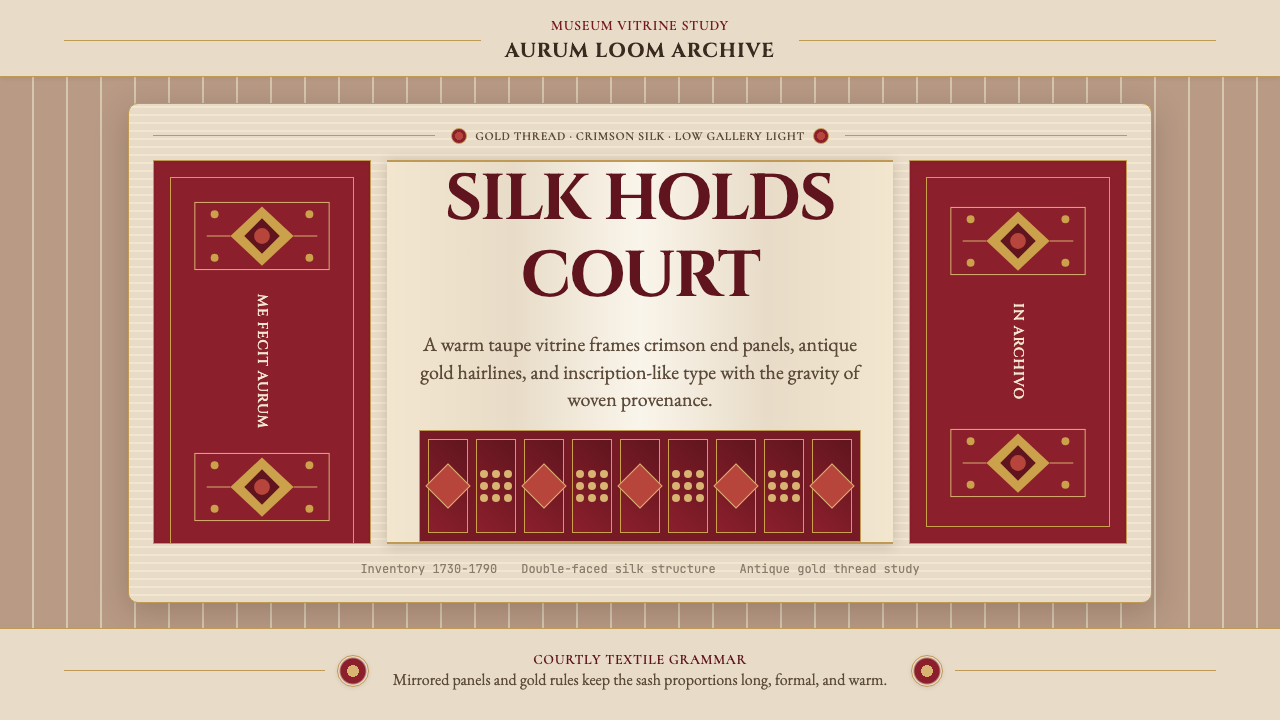 Belarusian Slutsk SashCourtly silk, vitrined. Taupe ground, crimson panels, Cinzel type, antique go…
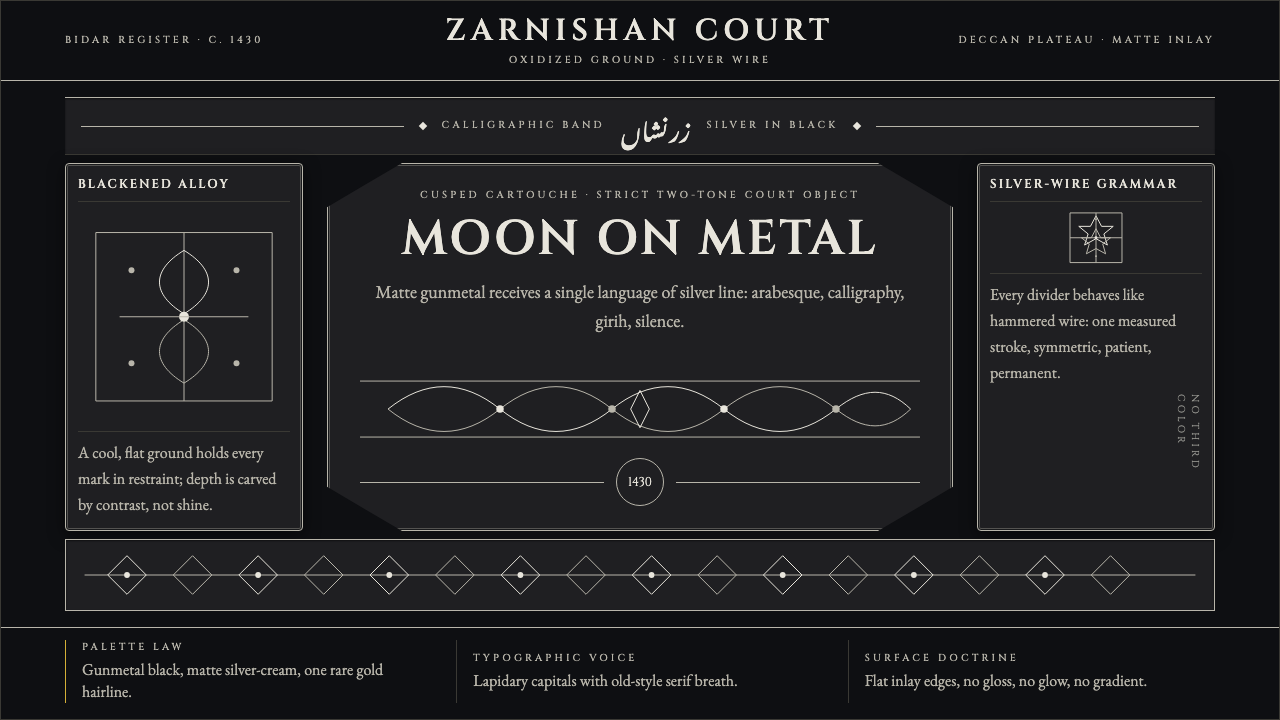 Bidri Deccan MetalworkCourtly darkness, tooled by silver. Cinzel caps and hairline arabesques cut g…
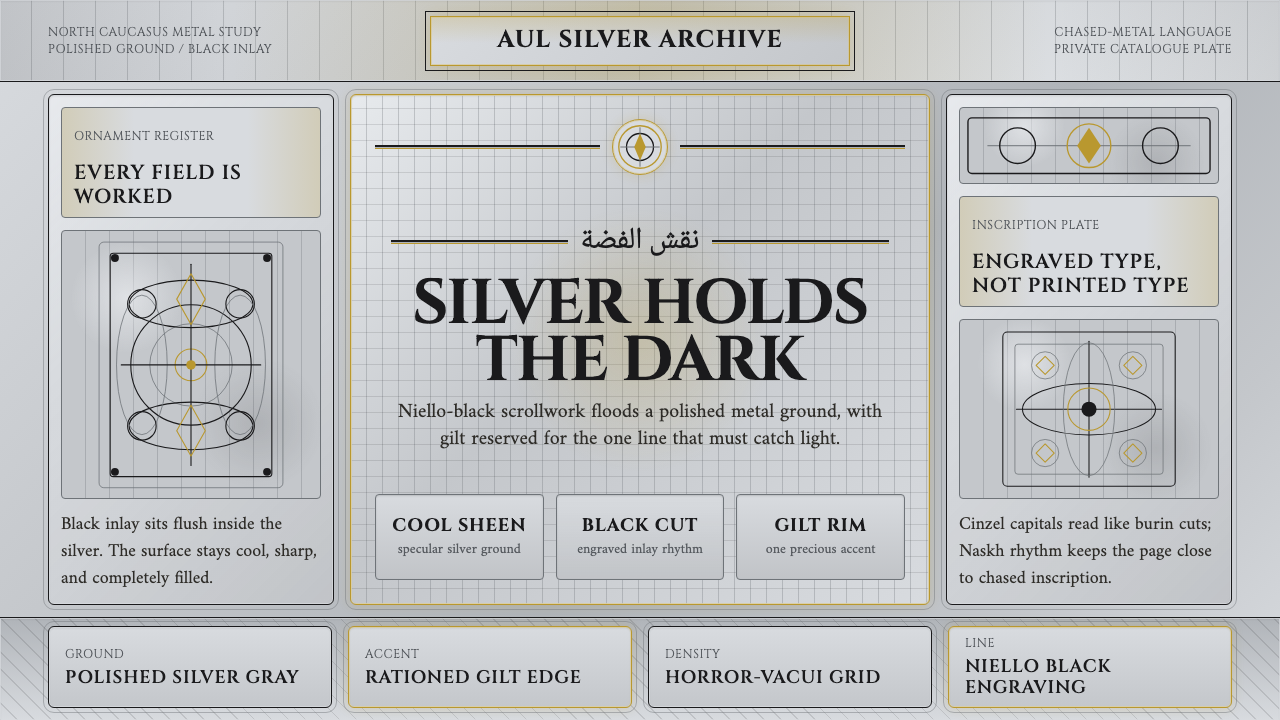 Dagestan Kubachi Silver NielloSilver made obsessive. Niello-black scrolls cover cool metal, with one ration…
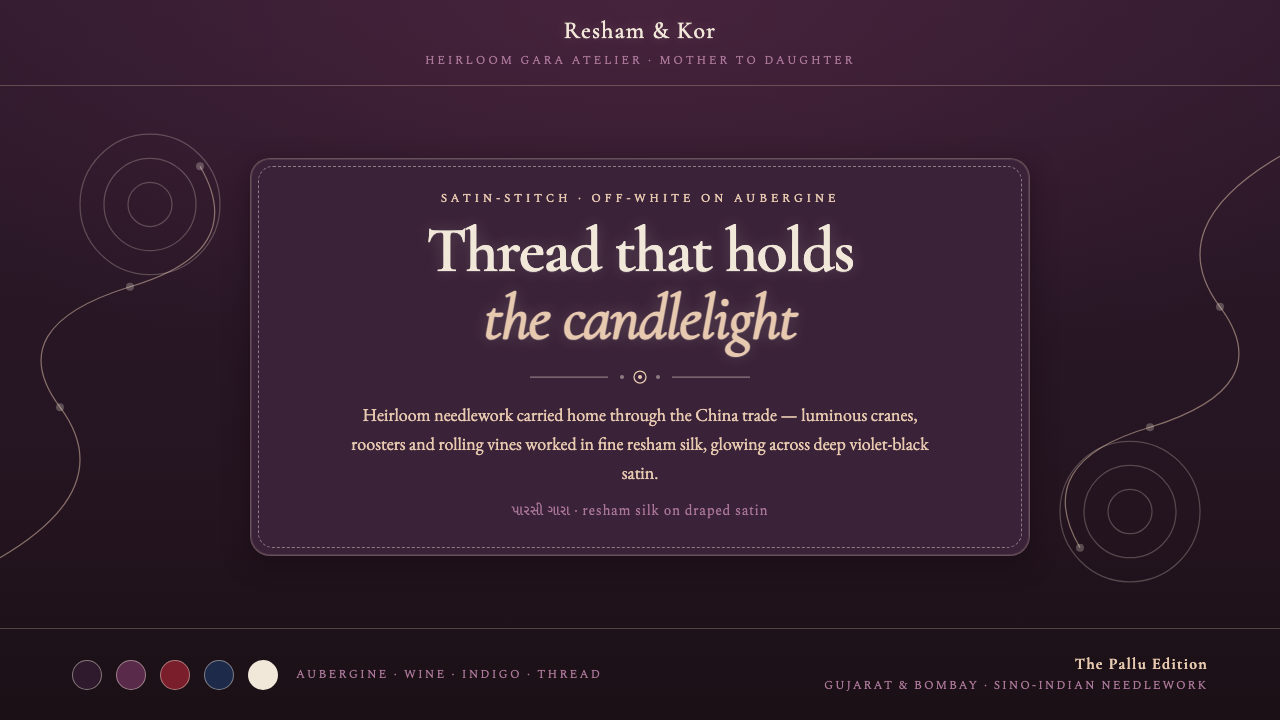 Parsi Gara EmbroideryHeirloom needlework, made digital. Off-white silk vines glow over deep auberg…
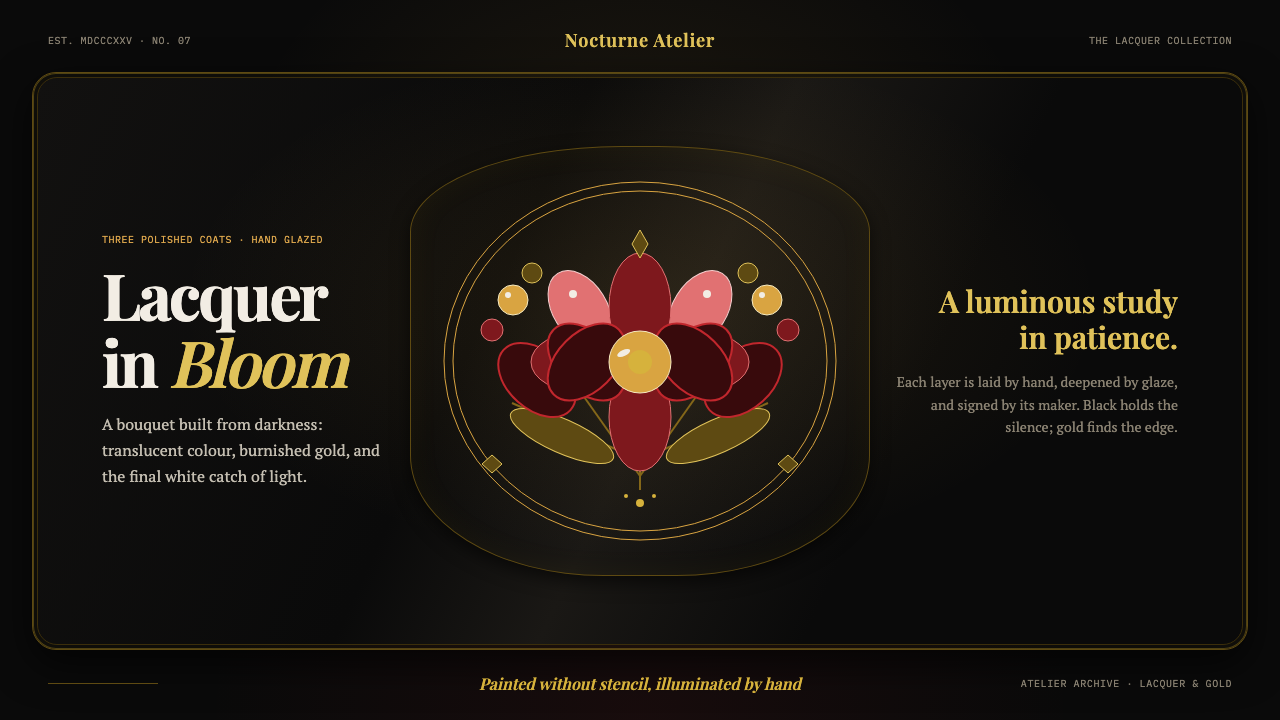 Zhostovo Lacquer Tray BouquetThe darker the ground, the brighter it blooms. Glazed petals, white catch-lig…