What is Damascus Ajami Room?
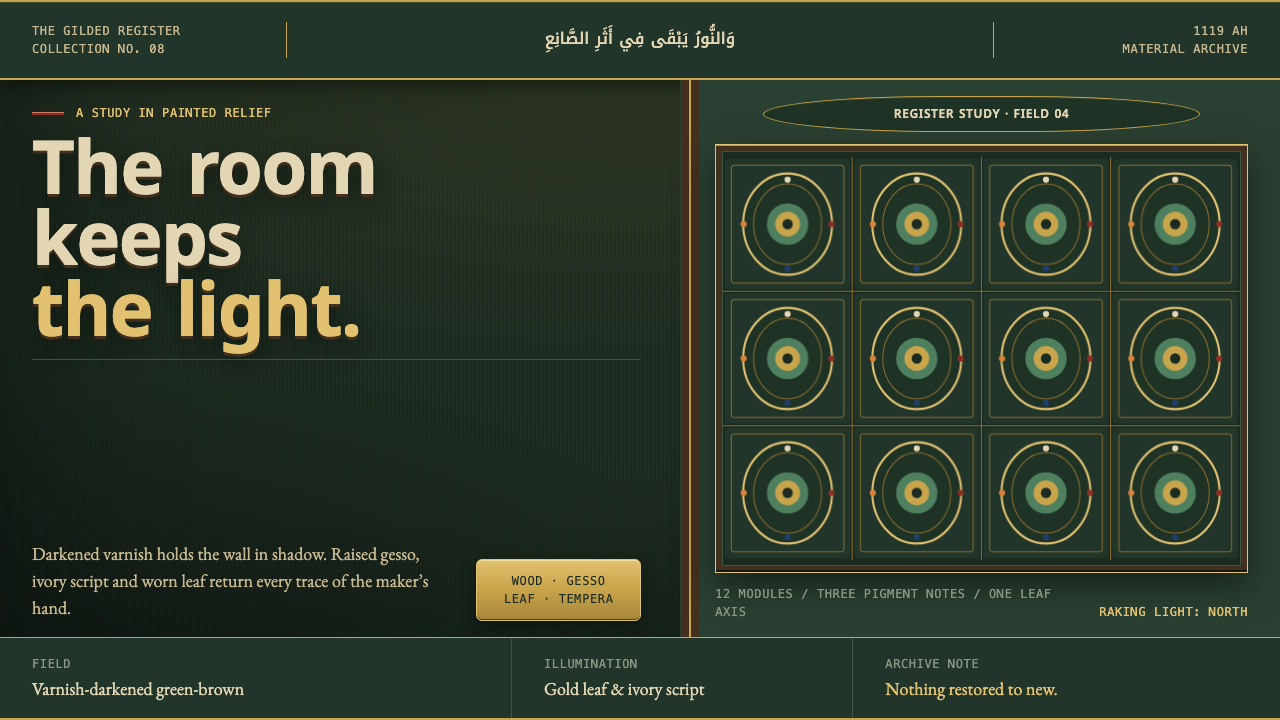
An ajami room turns a whole house interior into a painted jewel box — gilded relief and ivory script glowing out of a wall that three centuries of varnish have sunk to deep green-brown.
Damascus Ajami Room in brief
An ajami room is the panelled reception hall of an Ottoman-era courtyard house in Damascus: a chamber whose timber lining runs from floor to ceiling and is painted, gilded and modelled in low relief until almost no bare surface remains. In this context ajami names a technique and a style at once — gesso piped into raised lines and arabesques, metal leaf laid over it, tinted glaze brushed above the leaf, and flat passages of painting in egg tempera. The result is less a decorated room than a room made of decoration.
Its visual language is dense and horizontal. Flowers, fruit, cypress trees and curling vines fill the panels. Bands of Arabic poetry and Quranic verse run around the room at eye level, so that a visitor stands literally encircled by writing. Nothing is left blank as breathing space. Frames, cartouches and mouldings divide each wall into a mosaic of bordered fields, and every field is full.
What a modern visitor sees, however, is not what the painters finished. Restoration varnish applied and reapplied over roughly three centuries has darkened the whole surface, sinking the original ground into a deep, warm green-brown. In that condition the gilding and the ivory-coloured inscriptions are the only things that still catch the light. This is the state in which ajami rooms actually exist in museums today, and it is the state the Damascus Ajami Room style adopts as its truth: a dark panelled wall in which gold and script do the illuminating.
Where does Damascus Ajami Room come from?
Ajami rooms belong to the domestic architecture of Ottoman Damascus, and the surviving examples span roughly the seventeenth to the nineteenth century. Their setting was the courtyard house, whose principal reception room opened onto the central court and served as the place where a household received guests. It was therefore the room that received the most lavish treatment a family could afford. The craft belongs to what scholars of the period describe as Ottoman-Syrian interior painting: a tradition of covering timber wholesale in painted and gilded decoration, rather than reserving ornament for a few isolated panels.
The method was slow and layered. Craftsmen prepared the boards, then used animal glue and gesso to pipe raised lines, borders and floral forms directly onto the wood, which gave the ornament real physical relief that catches light from changing angles. Gold leaf or tin leaf was laid over the raised work, and transparent tinted glazes were brushed above the metal so that its shine warmed or deepened depending on the glaze. The flat areas between the relief were painted in egg tempera. Every stage depended on the one before it, which is why the finished surface reads as a single built object rather than as a painting hung on a wall.
Though fixed to their houses, these rooms proved remarkably portable. Whole rooms were dismantled and shipped to museums, panel by panel. The best-known example in this tradition is the room in the Metropolitan Museum of Art, which comes from a house in the Bahsa quarter of Damascus that was demolished in 1978, and which is dated 1119 AH, corresponding to 1707 CE. Rooms removed in this way have become the main route by which the wider world meets the genre, so any designer working from it inherits the museum encounter as much as the living interior.
Conservation has shaped the look as much as craft did. Layer upon layer of restoration varnish, built up over about three centuries, has darkened the field to a deep green-brown. Specialists who study and conserve these interiors — Anke Scharrahs is the name attached to the conservation and study of Damascene ajami rooms — must decide whether to present the artefact as it survives or to imagine it returned to its first brightness. The Damascus Ajami Room style declines the restoration fantasy. It works in the sunken, darkened state and treats brightness as something the gold and the script have to earn.
What defines the Damascus Ajami Room look?
The Varnished Dark Field
The ground is a deep green-brown rather than a clean black, with a warm, resinous undertone that comes from centuries of aged varnish. It reads as lacquered wood, not as an empty screen. Because the field is already dark and slightly translucent, everything laid on it gains weight, and the page never feels like a blank void waiting to be filled.
Gilded Relief
Gold is the main source of light. It lives on raised lines, borders and floral scrolls, as though the ornament stood slightly proud of the wall. The metal is warm and a little worn rather than mirror-bright, and it is used as an outline and highlight, never as a broad flat fill. Where gold appears, something is being marked as important.
The Ivory Inscription Band
Writing in a soft ivory tone runs in horizontal bands, echoing the verse bands that circle the original rooms. In an interface this band does the work of navigation and labelling: it tells you where you are and runs edge to edge. The ivory is warmer than pure white, so text feels inscribed on the surface rather than glowing from behind it.
Fullness and Density
Nothing is left empty. Panels sit close together, margins are tight, and decoration continues right up to the edge of each field. The density is the point: an ajami room reads as a surface completely worked by hand. Leaving generous empty space would turn it into a different style, and a thinner one.
Framed Panels
Content sits in bordered boards, like panels joined into a wall, each with a moulded frame. Cards are therefore framed objects with a visible edge rather than soft floating tiles. The frames repeat the logic of the room itself: the wall is a sequence of joined, bordered pieces, and so is the page.
Botanical and Calligraphic Ornament
Flowers, fruit, cypress trees and vines supply the pictorial vocabulary, and Arabic calligraphy supplies the textual one. The two interlock: a vine curls around a cartouche, a line of script is bounded by a garland. Ornament here is never random pattern-fill; it is drawn from a small family of motifs that repeat with variation.
Glazed Colour and Tempera
Colour comes in two textures. Tinted glazes over metal give translucent, jewel-like tones that seem lit from within, while egg tempera gives matte, slightly chalky flat areas. Together they keep the palette muted and layered, never glossy-saturated, and they explain why even the brightest accent sits quietly inside the dark field.
Who shaped Damascus Ajami Room?
Scharrahs is the specialist whose name is most attached to the conservation and study of Damascene ajami interiors. Her work illustrates the central dilemma of the genre: whether to show a room as it has survived, with its darkened varnish, or to reconstruct a lost original brightness. The Damascus Ajami Room style follows the first answer and takes the survived condition as the real artefact.
The painters, gesso workers and gilders who made these rooms are anonymous, and the work is signed by the room rather than by a person. Their layered process of glue-and-gesso relief, metal leaf, tinted glaze and tempera is the real source of the visual language. The design system borrows the discipline of that process: each layer has a job, and none is decorative by accident.
This is the best-known surviving ajami room in the tradition, and it is dated by its own inscription to 1119 AH, which is 1707 CE. For most people outside Syria it is the genre's reference point, and the dark green-brown, gilded, inscribed wall that the style describes is the state in which a visitor encounters it in the museum.
The Metropolitan Museum room originally belonged to a house in the Bahsa quarter of Damascus, which was demolished in 1978. Its story is a reminder that these interiors were once embedded in family homes and neighbourhoods, and that the museum room preserves a fragment of a domestic world that no longer stands in its original place.
How do you use Damascus Ajami Room today?
The Damascus Ajami Room is a dark, ornate, high-density style, and it works best when a project wants the feeling of a precious, enclosed interior rather than an open, airy one. Its logic is that darkness is the wall, gold is the light, and writing is the way you move through the space. Apply those three roles consistently and the style holds together; apply only its colours and it collapses into a generic dark theme with yellow highlights.
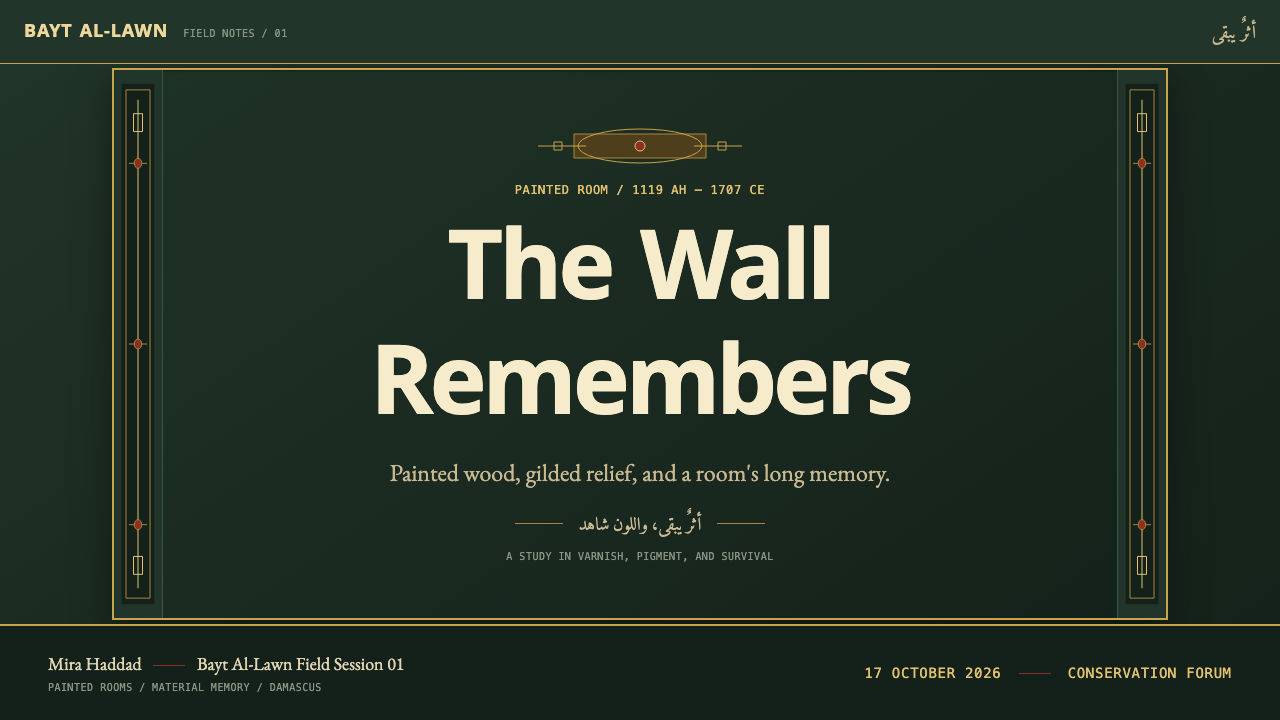
For presentation slides, the cover is the strongest page. Fill the slide edge to edge with the varnished dark field, set the title in a calm ivory serif band across the middle, and let a gilded border or a single relief-like motif frame it. Content slides should behave like panelled walls: two or three framed boards of different sizes, each with a clear gold edge, and a thin inscription band for the section title. Data slides suit this treatment well because a chart can sit inside a framed board, with gold reserved for the single series that matters.
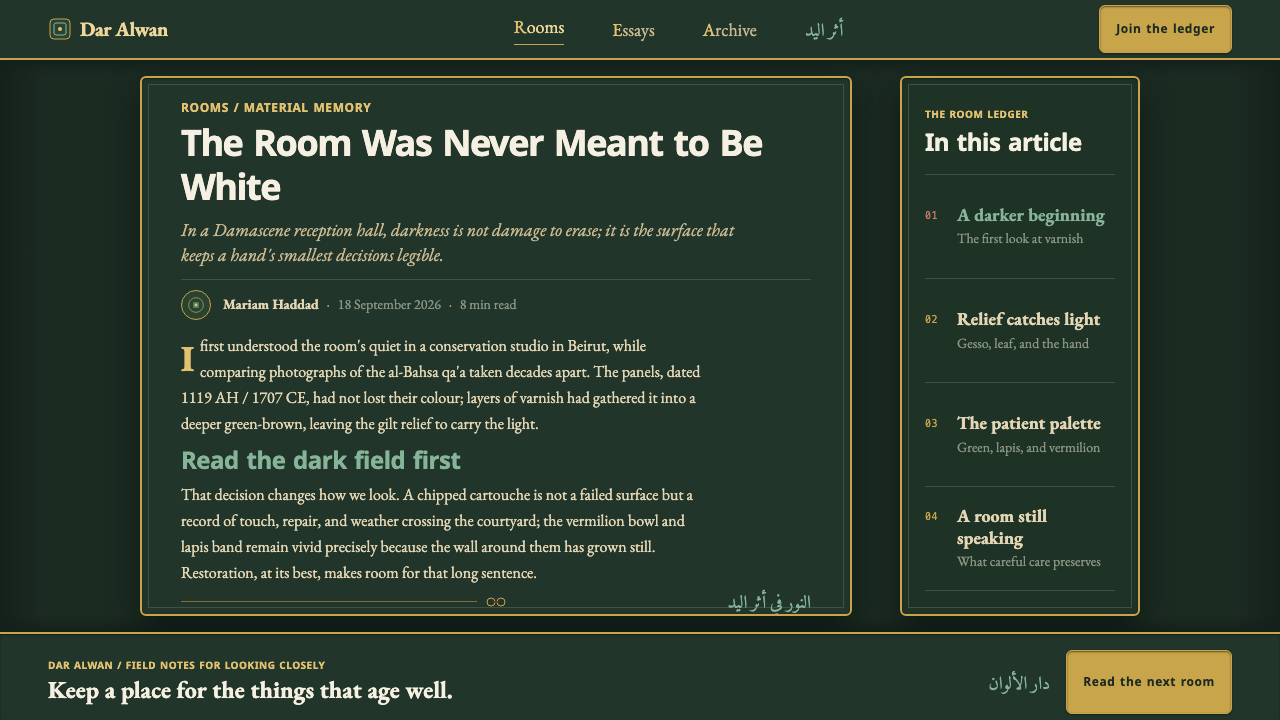
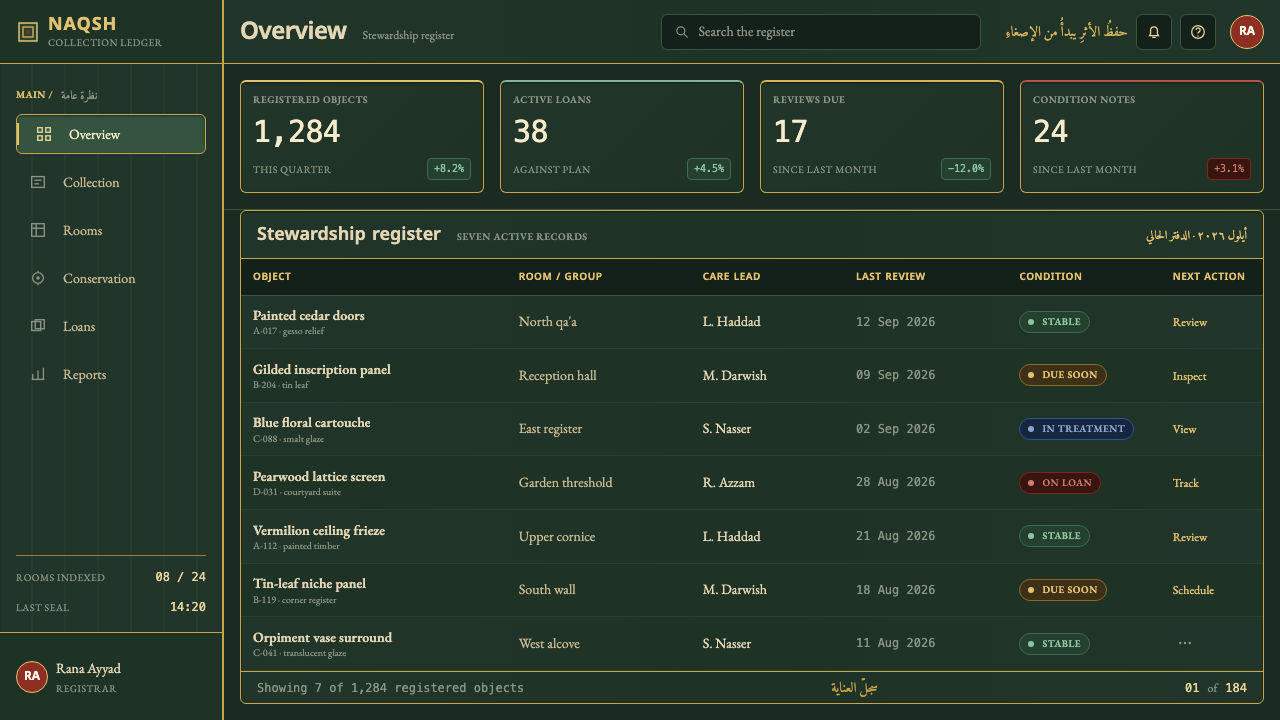
For web interfaces, the style suits cultural, hospitality, heritage and storytelling products, and any experience where dark, immersive browsing is welcome: museum collections, a restaurant or hotel site, a long-form editorial feature, a premium catalogue. Use bordered cards with a visible frame, a continuous horizontal band for navigation, and gold only on interactive and highlighted states. Keep spacing tight and avoid large empty hero sections; the page should feel furnished from the first scroll.
For editorial and marketing work, treat each article or campaign as one room. Use an ivory inscription band for headings and pull-quotes, framed panels for sidebars and captions, and repeat a small family of botanical or calligraphic motifs rather than inventing new ones for each page. Photography works best when it is placed inside a framed board and tonally warmed so that it belongs to the same wall. Generous gutters and large flat areas will weaken the effect.
The most common mistake is to read the style as a request for pure black and bright yellow. The ground is a deep green-brown, the metal is warm and slightly worn, and the text is ivory rather than white. A second mistake is to scatter Arabic script as decoration without meaning; where inscription is used, it should be genuine text, and sacred verse in particular should be handled with care rather than treated as texture.
Damascus Ajami Room — FAQ
What exactly is an ajami room?
It is a wood-panelled reception hall from an Ottoman-era Damascus courtyard house, decorated from floor to ceiling with raised gesso relief, metal leaf, tinted glaze and egg tempera. Flowers, fruit, cypress trees, vines and bands of Arabic verse cover almost every surface. The surviving examples date from roughly the seventeenth to the nineteenth century, and several have been moved into museums.
Why is this design system dark instead of bright and restored?
Because the real artefacts are dark. Roughly three centuries of restoration varnish have sunk the original ground into a deep green-brown, and only the gilded relief and the ivory inscriptions still reflect light. The style chooses to represent that actual surviving state rather than an imagined fresh one, which also gives gold and script a clear job as the sources of light.
Can I use it on a light background?
It is designed around a dark field, and the gilding and ivory only make sense against that darkness. A light-ground version would lose the effect of glowing metal and would feel like a different style. If a product needs a light page, borrow individual elements instead: the framed panel, the horizontal inscription band, the motif family. Keep the dark wall as the main surface where the brand should be felt.
How should I treat Arabic script and sacred text?
The original rooms carry verse and Quranic text because they are meant to be read. Use script only when it carries real meaning, and have it checked by a fluent reader. Do not use sacred text as pattern-fill, and do not mirror or crop it in ways that distort the words. For purely decorative needs, rely on the botanical motifs and framed borders, which give the same feeling without that risk.
How is it different from other ornate historical styles?
Many ornate styles show richness through depth, with sculpted volumes and deep shadow. The ajami room shows it through surface: relief is low, gold is thin, glazes are translucent, and the density comes from covering every field. It is also unusually writing-centred, since the inscription band is a structural element of the room. That combination of low relief, glazed metal and continuous text is what makes it recognisable.
Related design styles
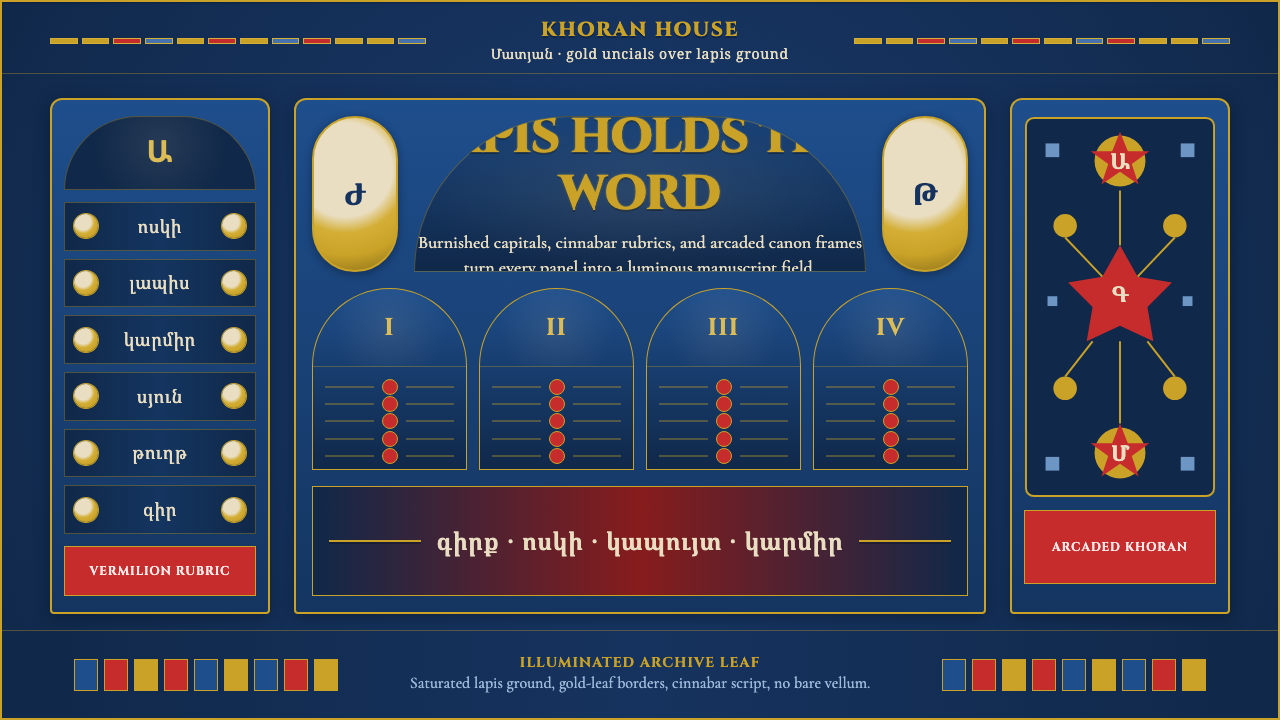 Armenian Manuscript FolkloreJewel-dense devotion. Lapis ground, gold uncials, and vermilion arcades fill…
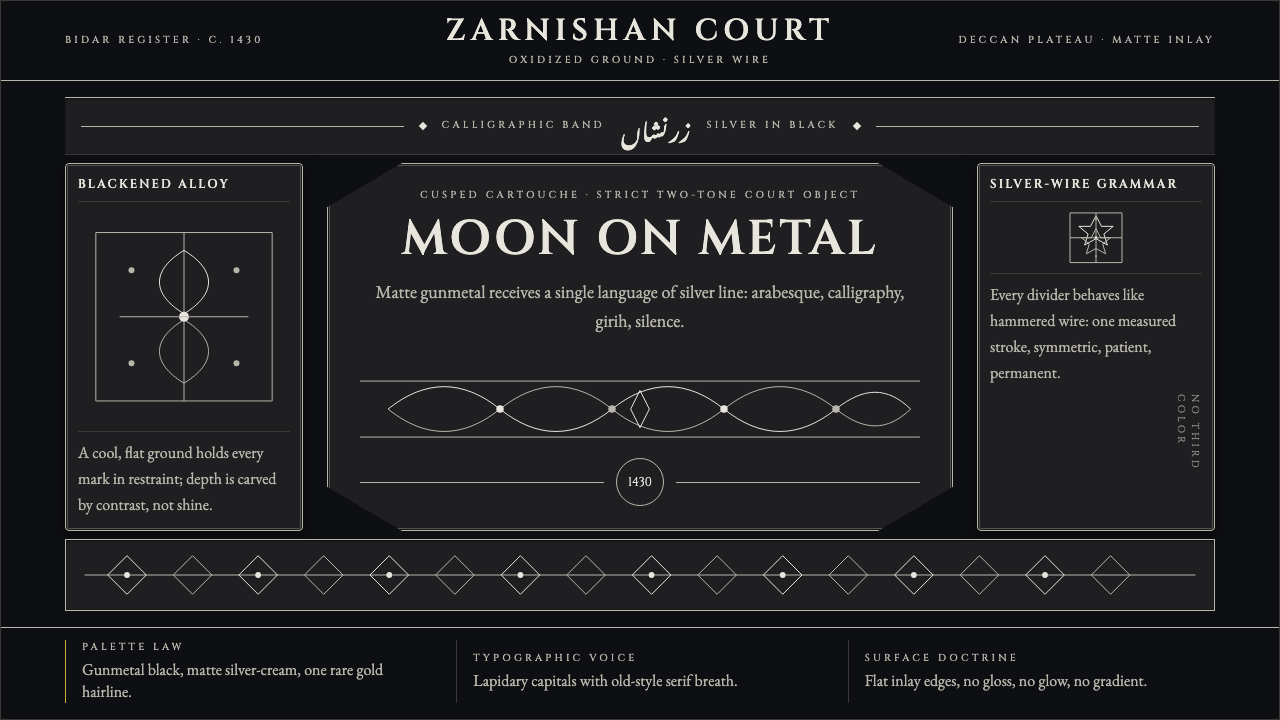 Bidri Deccan MetalworkCourtly darkness, tooled by silver. Cinzel caps and hairline arabesques cut g…
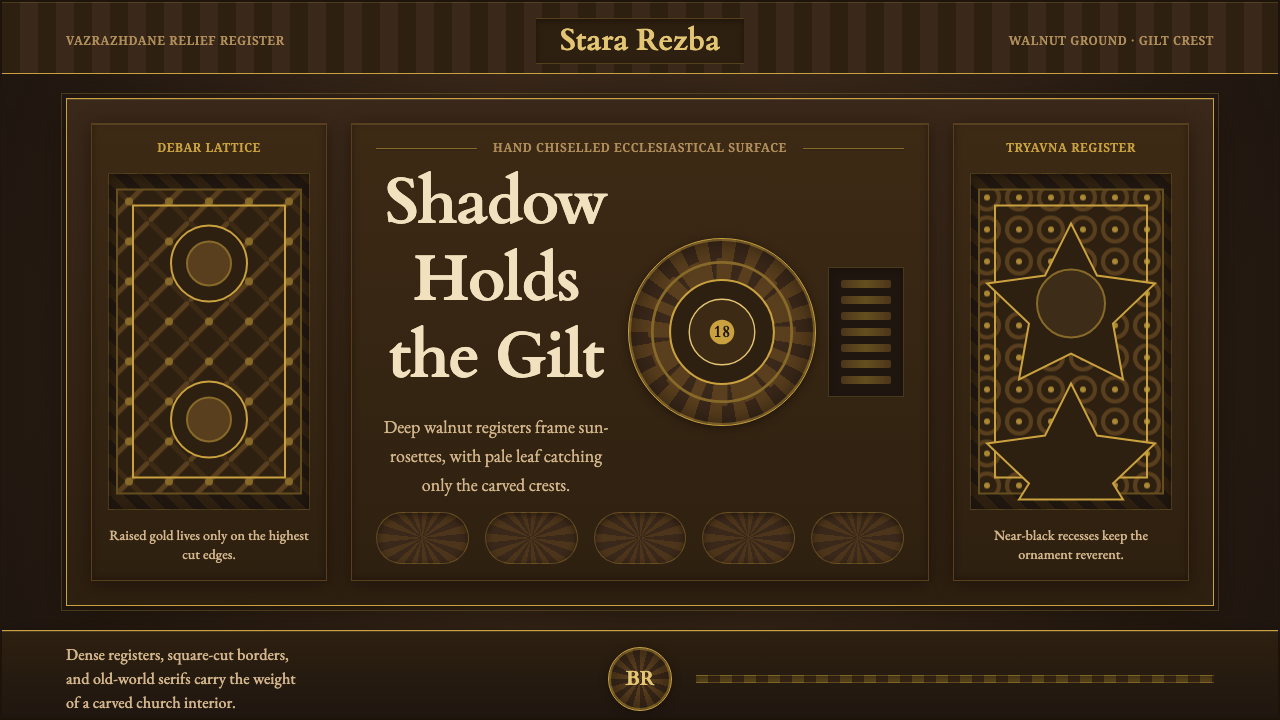 Bulgarian Revival WoodcarvingDark devotion in relief. Walnut panels, Cardo serifs, and gilt rosettes catch…
 Circassian Adyghe Gold BraidCourtly gold on dark wool. Raised braid edges coil over indigo-black panels.
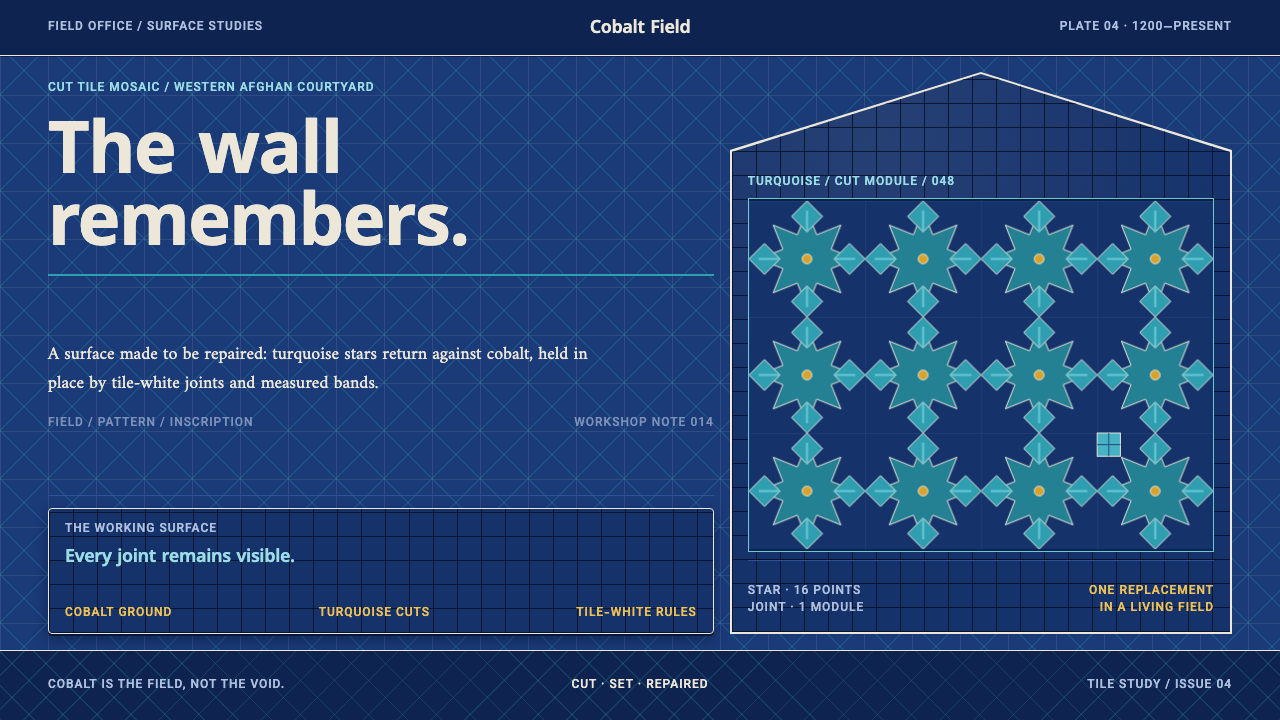 Herat Friday Mosque TileHistory is built to be repaired. Cobalt fields lock turquoise stars into tile…
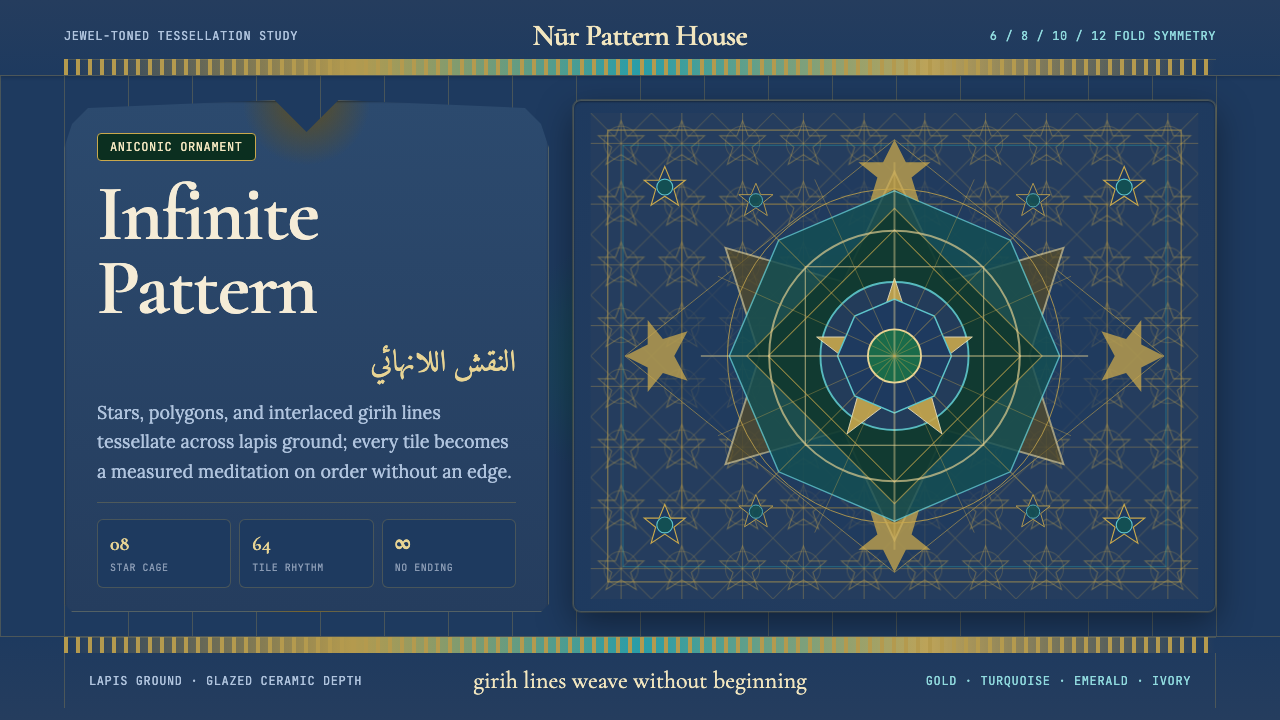 Islamic Geometric ArtInfinite order, fully tiled. Lapis ground with gold girih lines and turquoise…