What is Orenburg Goat-Down Gossamer Shawl?
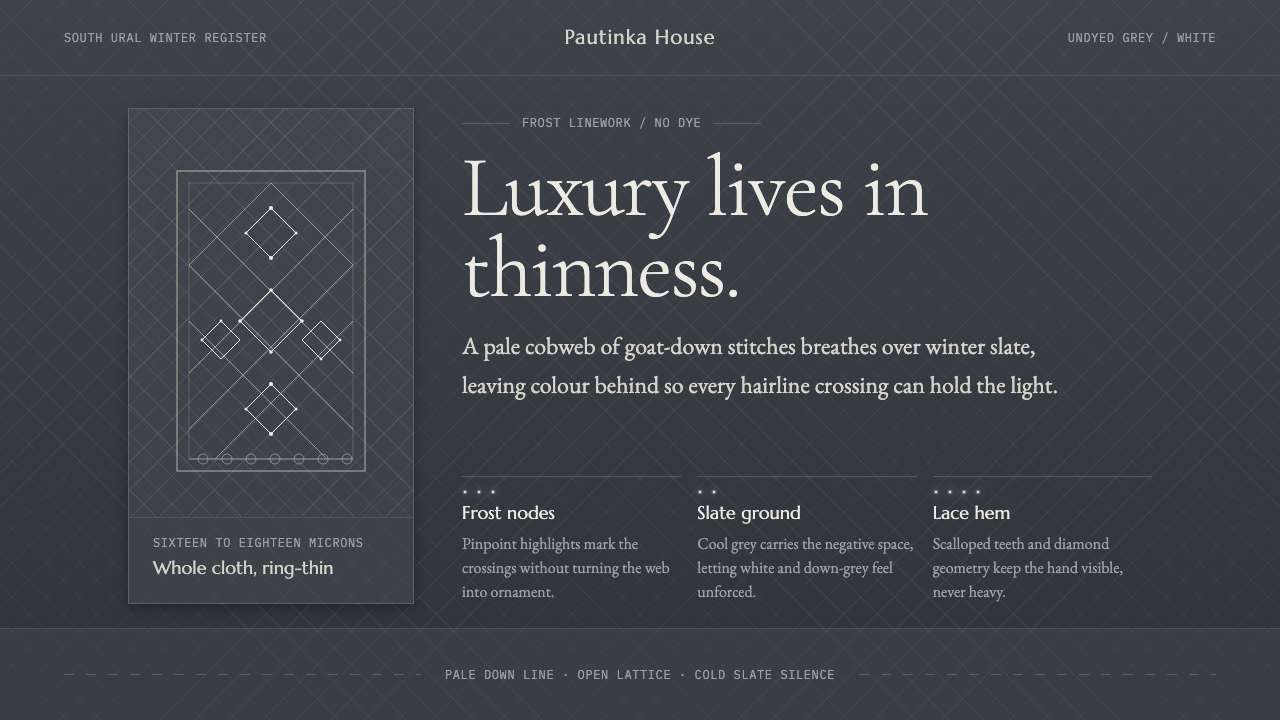
Luxury in thinness: pale type and down-lace lines breathe across the smoky slate of a Ural winter.
Orenburg Goat-Down Gossamer Shawl in brief
The Orenburg Goat-Down Gossamer Shawl takes its visual logic from the пуховый платок, a hand-knit lace textile of the South Ural steppe. It is made from exceptionally fine goat down and traditionally left undyed in the natural whites and greys carried by the animal. Its defining miracle is thinness: a complete shawl can pass through a wedding ring, while its openwork pattern still holds a dense, intricate presence.
As a design language, the shawl is not decorative abundance. It is a web of restrained means: hairline strokes, pale thread-like marks, immense dark breathing room, and repeated openings that make absence as important as material. The image is less a fabric placed on a surface than frost suspended against dusk.
The resulting mood is quiet, exacting, and almost weightless. Pale forms emerge from a cold slate ground without becoming loud or ornamental. Every line should appear hand-drawn by tension rather than mechanically imposed, and every empty field should preserve the sensation of air moving through lace. Luxury arrives through patience, delicacy, and the refusal of unnecessary color.
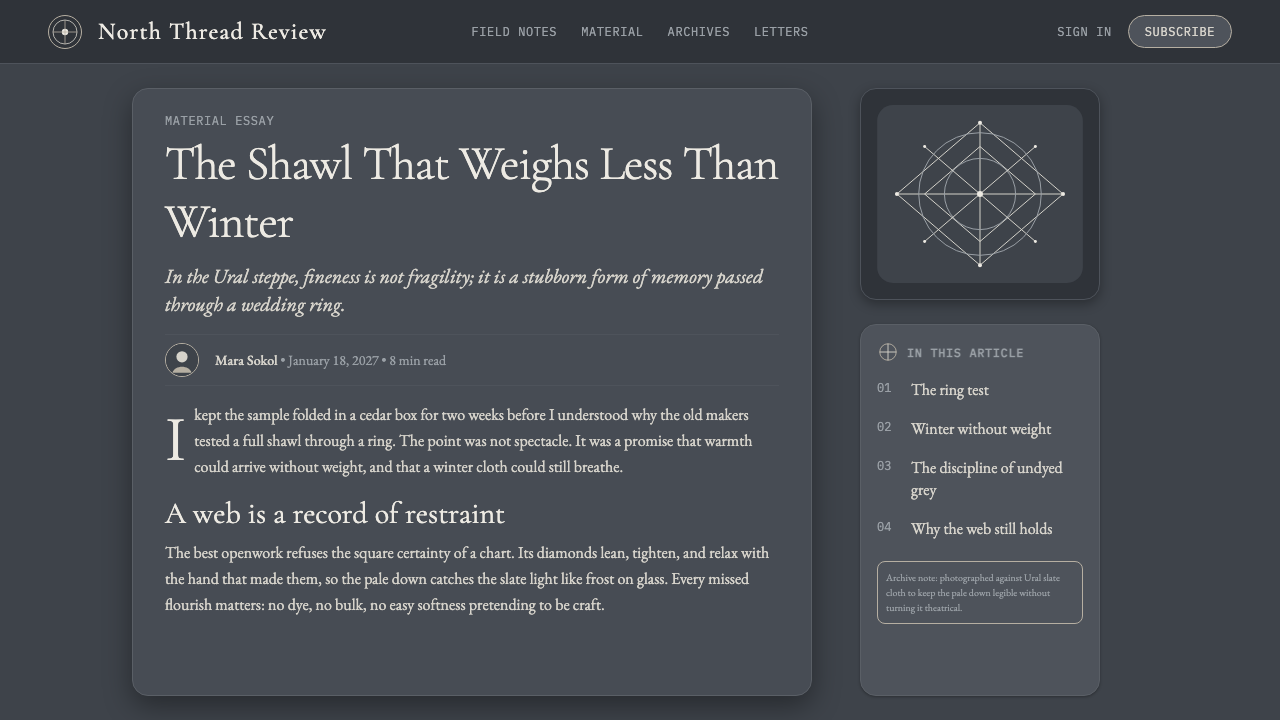
Where does Orenburg Goat-Down Gossamer Shawl come from?
The Orenburg gossamer shawl belongs to the folk textile culture of Orenburg and the South Ural steppe. From the eighteenth century onward, anonymous Cossack and peasant knitters developed a tradition of down-lace knitting whose achievement lay in joining warmth, fineness, and open structure. The shawl was not conceived as a display of applied color; its character came from the material itself and the labor required to turn down into a breathable lattice.
The landscape implied by the craft is central to its visual identity. The South Ural setting suggests winter light, smoke, slate, frost, and a horizon in which pale matter is most visible against dark air. Natural white and grey down becomes an aesthetic principle: color is inherited rather than added. That constraint gives the shawl its unusual authority, because variation comes from density, openness, and touch rather than pigment.
By the nineteenth century, Orenburg shawls were catalogued at trade exhibitions. Their presence in those settings made a local folk practice legible as an object of wider attention, while preserving the anonymous knowledge embedded in the knitting itself. The essential image remained the same: a fine down structure capable of appearing both substantial and nearly invisible.
The tradition later found influential interpreters in Galina Khmeleva and Carol Noble, whose names are associated with the craft alongside its many unnamed makers. Their place in this lineage matters because Orenburg lace is not a fixed graphic motif to be copied mechanically. It is a living discipline of material sensitivity, openwork rhythm, and respect for the natural character of down.
What defines the Orenburg Goat-Down Gossamer Shawl look?
Natural Pallor
The palette stays within the whites and greys implied by undyed goat down. Pale lettering and linework should feel lifted from the dark ground, not painted on it. Saturated accents disrupt the material honesty that gives the style its calm authority.
Slate Darkness
The ground is smoky, cold, and mineral rather than theatrical black. It functions like Ural winter twilight: a field that makes pale detail visible while retaining depth, silence, and a sense of weather.
Down-Lace Linework
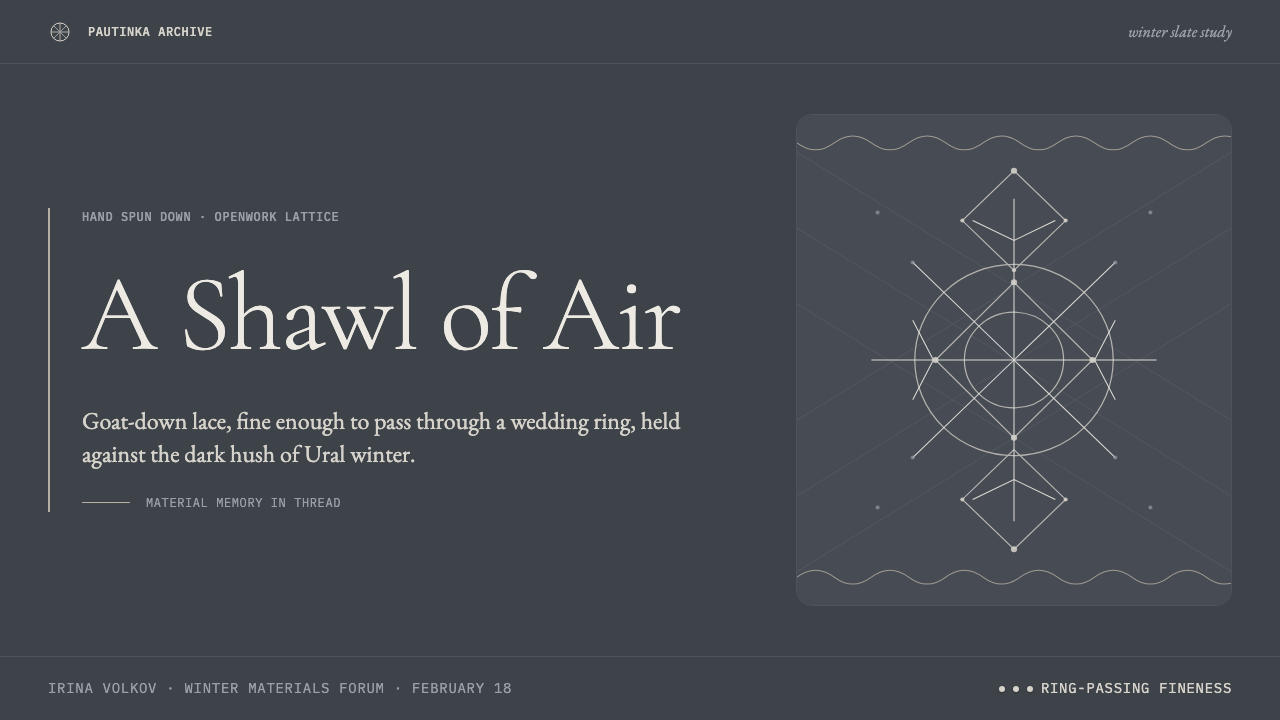
Lines are extremely fine and should seem knitted, tensioned, or breathed into being. They can gather into snowflake-like lattices, but their purpose is never illustration alone. Each thread describes both a form and the air passing through it.
Openwork and Absence
Negative space is an active material. Open areas interrupt pattern, prevent visual heaviness, and make the remaining marks appear more precious. A dense field should always be answered by a quieter field nearby.
Cormorant-Like Serif
Typography should be pale, refined, and gently literary, with the delicacy of a feathered serif rather than the force of a display face. It belongs beside lace as another fine structure, not as a heavy label stamped over it.
Quiet Contrast
Contrast comes from light against slate, fineness against emptiness, and intricate web against broad calm fields. There is no need for visual noise. The most successful compositions make the viewer lean closer rather than step back.

Who shaped Orenburg Goat-Down Gossamer Shawl?
The foundational makers of the Orenburg tradition were anonymous Cossack and peasant knitters of the South Ural steppe. Their accumulated practical knowledge established the down-lace language: exceptionally fine material, openwork structure, and an economy of natural color that remains inseparable from the shawl’s identity.
Galina Khmeleva is named among the key figures connected with the Orenburg gossamer shawl tradition. Her association with the craft places her within a lineage defined not by spectacle, but by close attention to fine down, knitted pattern, and the enduring expressive power of restrained materials.
Carol Noble is also identified as a key figure in the Orenburg shawl tradition. Her place beside the craft’s anonymous makers and later interpreters underscores that the shawl is sustained through attention, transmission, and a continuing commitment to the discipline of gossamer openwork.
How do you use Orenburg Goat-Down Gossamer Shawl today?
For presentation covers, use the dark slate field as an expanse of winter air rather than a decorative backdrop. Let a pale title sit with ample isolation, then introduce a single lace-like cluster near an edge or corner. The cover should feel discovered in the dark, not assembled from competing visual parts.
Content slides benefit from the style’s measured hierarchy. Keep headings pale and composed, use fine rules or openwork fragments to separate ideas, and allow broad empty regions around text. For data slides, let charts remain spare and legible; a restrained lattice can frame or accompany information, but should never make values harder to read.
In web interfaces, this language is strongest where calm scrutiny matters: dashboards, account views, research tools, and premium pricing pages. Dark surfaces can make sparse controls feel deliberate, while pale serif display type and fine structural lines provide identity. Interactive elements should remain unmistakable; softness in atmosphere must not become ambiguity in navigation.
For editorial and marketing work, the shawl language suits stories of craft, provenance, winter, material knowledge, or considered luxury. Use open space as pacing between passages, set quotations as quiet pale interruptions, and let images or illustrations carry a similarly reduced tonal world. A marketing page should communicate rarity through restraint, not through ornamental accumulation.
The common mistake is mistaking delicacy for low contrast or decoration. Faint text that cannot be read, repeated snowflake symbols, dense ornamental borders, or arbitrary bright accents flatten the idea into seasonal styling. The real system depends on legibility, natural restraint, and the tension between a fine web and the darkness that lets it breathe.
Orenburg Goat-Down Gossamer Shawl — FAQ
Is this style simply winter-themed design?
No. Winter imagery is useful because the Orenburg shawl comes from the South Ural setting and its pale lace resembles frost against dark air, but the deeper logic is material and structural. The style is about undyed down, fine openwork, restrained contrast, and the value of emptiness. Literal snow imagery can be used sparingly, yet it is not the system’s foundation.
Can the style use colors beyond white, grey, and slate?
The source material points firmly toward the natural colors carried by goat down: white and grey, read as pale light against a smoky slate ground. Additional color weakens the direct connection to undyed material. If variation is needed, create it through density, opacity, spacing, and the relationship between linework and empty space rather than through conspicuous accents.
Does fine linework make the interface difficult to use?
It can, if aesthetic thinness is allowed to override function. The shawl provides a visual metaphor, not permission to hide hierarchy or interaction. Use delicate lines for atmosphere, framing, and secondary structure, while keeping essential text, actions, data, and navigation clearly distinguishable against the dark ground.
What makes an Orenburg-inspired layout feel authentic rather than generic luxury?
Authenticity comes from preserving the shawl’s internal discipline. Let natural pallor, openwork, and negative space do the work; avoid gilded effects, dense flourishes, or loud contrast intended merely to signal expense. A convincing layout feels as though its pale detail could pass through a dark field of air, carrying precision and labor without needing to announce either.
Related design styles
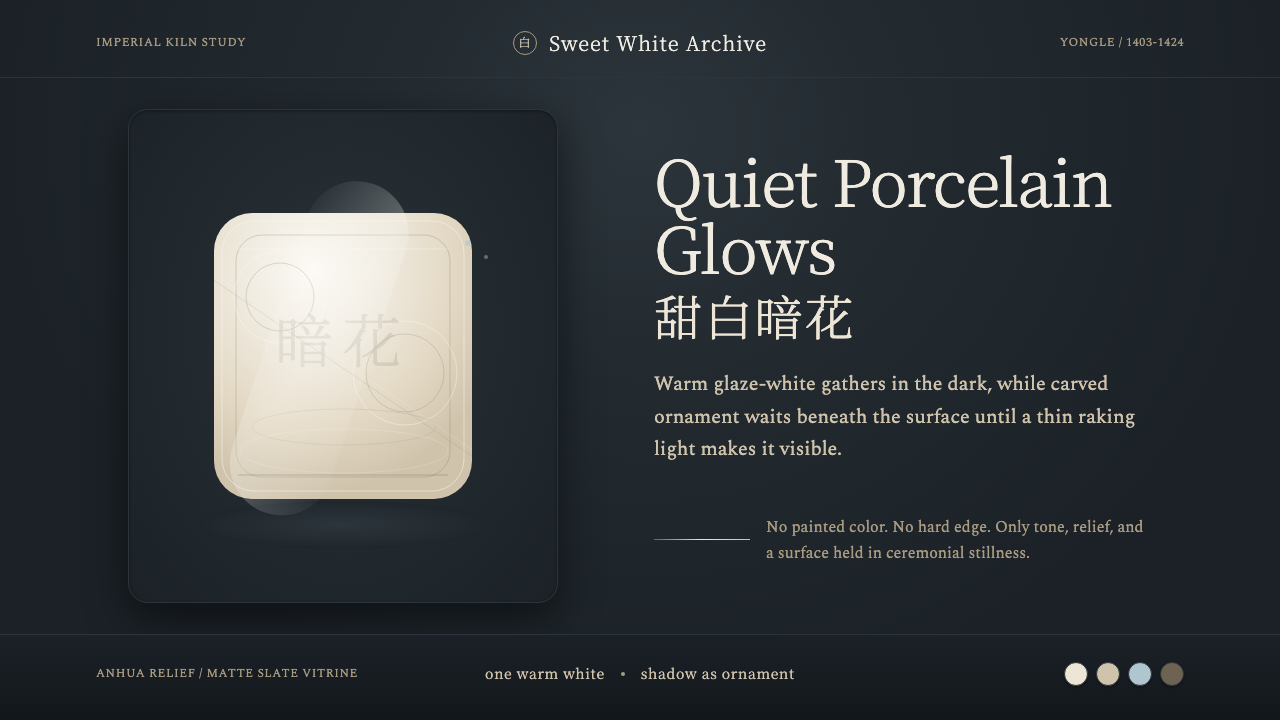 Jingdezhen BlancQuiet porcelain glows. Warm glaze-white on slate reveals hidden anhua incisio…
 Gabonese Fang Mask & ByeriStillness has weight. Mirror-black forms, brass hairlines, and museum shadow…
 Goryeo Celadon 高麗青瓷Stillness carries ornament. Bisaek jade ground holds white and black hairline…
 Sakha Yakut Silver BreastplateCold silver hangs in ritual order. Blue-black ground, Roman capitals, and nie…
 Venetian Plaster WhiteQuiet luxury in cool shadow. Bodoni type rests on clouded gray plaster planes.
 Joseon Moon JarQuiet imperfection glows. Milk-white porcelain floats on charcoal with a visi…