What is Samoan Siapo Mamanu?
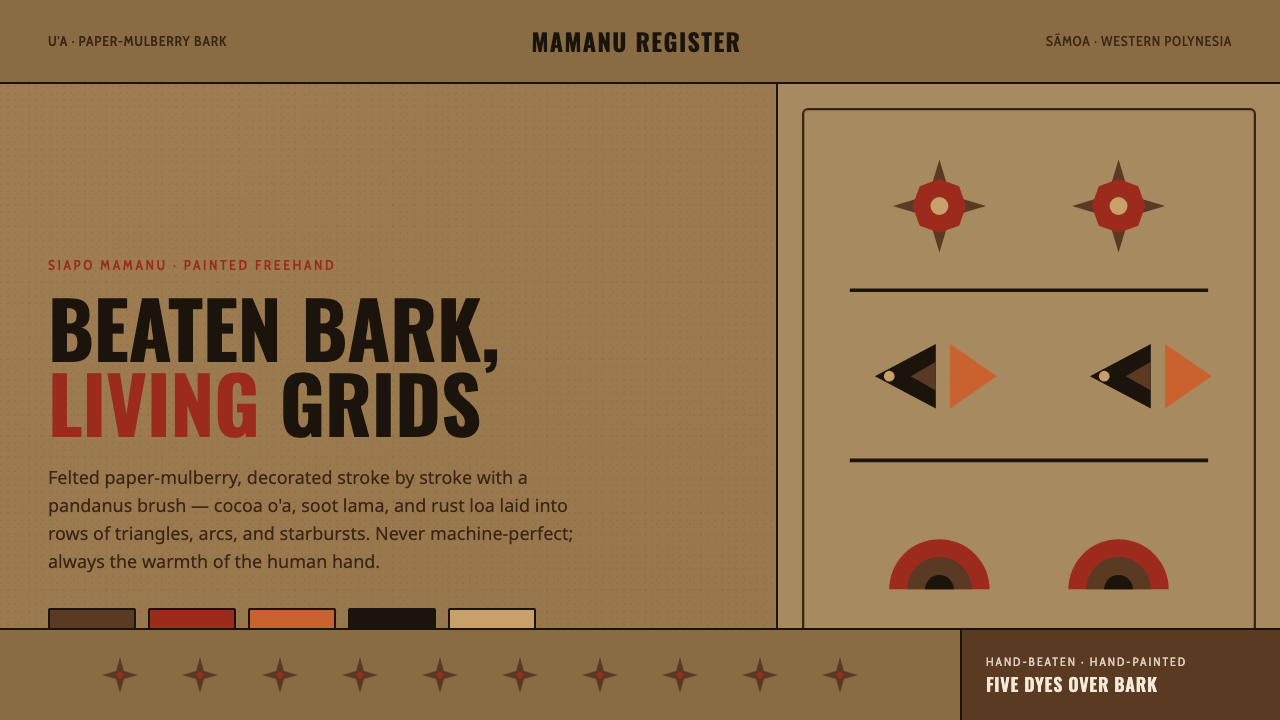
Samoan siapo mamanu keeps the memory of the tree in its surface: warm beaten bark, matte natural dyes, and freehand grids alive with fish, shells, and starbursts.
Samoan Siapo Mamanu in brief
Samoan siapo is barkcloth beaten from the inner bark of the paper-mulberry tree, known in Sāmoan as u'a. Repeated beating turns the bark into a warm tan, felted sheet whose grain remains perceptible beneath the decoration. The material is not a neutral backdrop. Its aged-bark color, softened surface, and quiet variation establish the visual identity before any painted motif appears.
In the mamanu method, makers use a paogo brush made from pandanus leaves to paint directly onto the barkcloth. Cocoa-brown o'a, soot-black lama, and rust-red loa form the most visible part of a vocabulary built from five natural dye tones. The hand remains present in every mark: lines are freehand, grids are slightly irregular, and repeated motifs feel made rather than mechanically stamped.
The resulting design system is matte, tactile, and pattern-led. Fish, shells, and starbursts occupy a loose grid that gives the surface order without suppressing its organic character. Dark brushwork sits firmly against warm beaten bark; edges carry the small variations of a hand-painted process. The aesthetic is neither polished minimalism nor rustic decoration. It is disciplined pattern-making whose authority comes from material, repetition, and touch.
Where does Samoan Siapo Mamanu come from?
Siapo mamanu belongs to the living Sāmoan tradition of barkcloth and is placed in Oceania, in Western Polynesia. The tradition predates 1900, with siapo mamanu established at least by the nineteenth century. Its historical identity is therefore inseparable from continuity: this is not a recently invented visual theme borrowing an old surface, but a design language carried through making and repeated use.
The foundation is the transformation of u'a into cloth. Paper-mulberry bark is beaten until its fibers form a cohesive, warm tan sheet with a felted character. That process determines the ground color and texture of the finished work. Rather than covering the bark with an artificial neutral, mamanu keeps the genuine aged-bark ground visible, allowing the material itself to remain an active part of the composition.
The makers named in this tradition are Sāmoan women makers and tufuga siapo, the barkcloth masters. Their roles point to two connected forms of knowledge: the sustained work of women who pass the practice through generations, and the authority of specialists recognized as masters of siapo. The hand-painted surface is consequently understood as embodied knowledge, not merely as a repeatable ornament library.
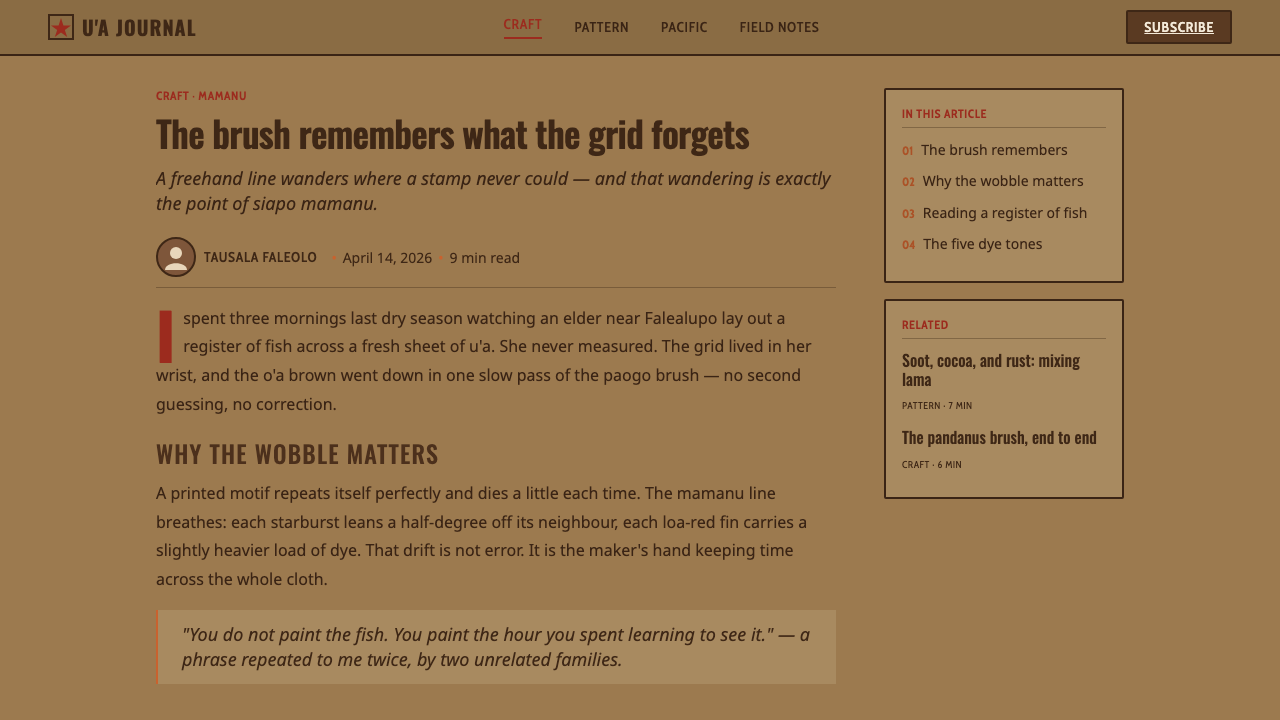
Within the broader source tradition, siapo mamanu is identified as freehand-painted, alongside siapo ʻelei, which is rubbed or relief-based, and the wider Polynesian tapa or barkcloth movement. The distinction matters visually. Mamanu makes the brush and the hand visible: its grids are drawn, its motifs are painted, and its irregularities are part of the form. Its modern design translation should preserve that relationship between structured pattern and living material.
What defines the Samoan Siapo Mamanu look?
Bark Ground
The ground is warm tan beaten bark, never a clean cream or white. Its felted, aged character should remain perceptible, giving the composition a material body before pattern begins. Background variation is welcome when it feels like the natural surface of u'a rather than an added paper texture.
Natural Dye
Color comes from five natural dye tones, with cocoa-brown o'a, soot-black lama, and rust-red loa forming the clearest named accents. The palette is earthy and matte rather than luminous. Tones should feel absorbed into the bark, allowing contrast to come from value and repetition instead of artificial brightness.
Freehand Line
Mamanu linework is controlled but not mechanically exact. Brush marks may vary in width, direction, and pressure, creating a quiet rhythm across the grid. The irregularity is not noise to be corrected; it is evidence that the pattern was made by a person using a simple pandanus brush.
Motif Grid
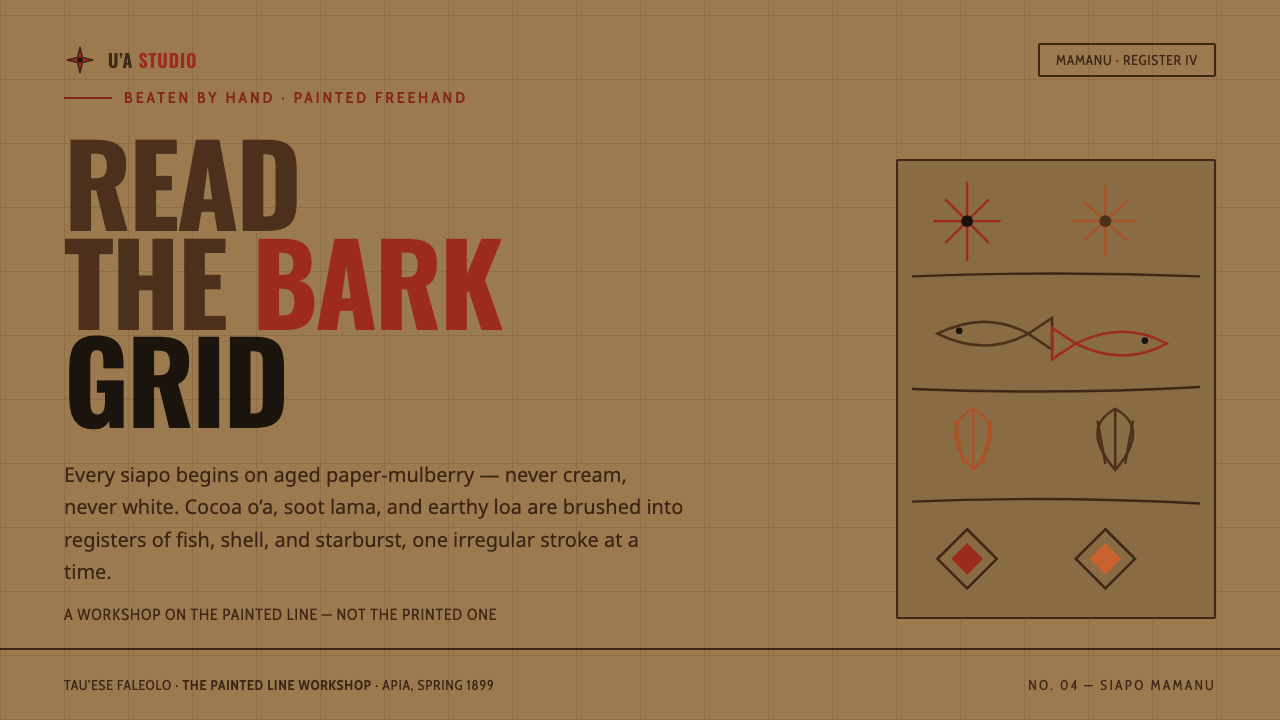
Fish, shells, and starbursts are organized into grids that feel hand-drawn rather than mathematically imposed. Repetition supplies structure, while small shifts keep the field alive. Motifs should read as a connected pattern system, not as isolated illustrations placed on an empty background.
Matte Depth
The surface has depth through fibers, dye absorption, and accumulated marks, not through gloss or simulated lighting. Flat areas remain visually substantial because the bark ground carries tactile weight. Any digital translation should suggest felted material without turning it into a shiny or photorealistic effect.
Patterned Restraint
The system is richly patterned but visually restrained. Warm bark carries the field, dark marks establish the principal structure, and the natural dyes provide measured variation. Ornament is therefore not added around the form; the form is built from the repetition and spacing of the ornament itself.
Who shaped Samoan Siapo Mamanu?
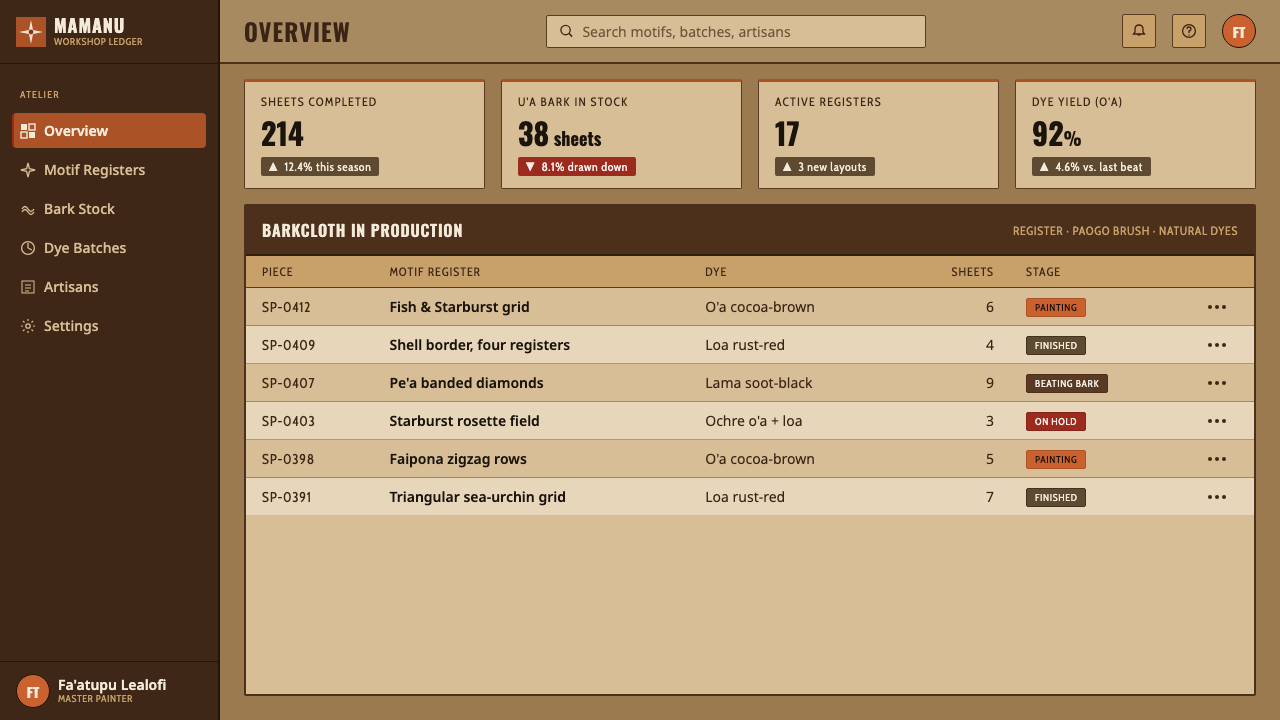
Sāmoan women makers are central carriers of the living siapo tradition. Their work joins material preparation, hand decoration, and generational continuity. In a design interpretation, their presence is best honored by keeping the surface visibly made: the bark should remain present, and the painted grid should retain the evidence of touch.
Tufuga siapo are barkcloth masters whose expertise gives the tradition its name, discipline, and authority. Their role represents knowledge that exceeds a decorative motif: it includes the behavior of beaten bark, the use of the paogo brush, and the balance between repeated structure and freehand variation.
Siapo mamanu is itself the defining practice of freehand-painted barkcloth. It provides the clearest bridge between physical making and the design system: a warm organic ground, natural dye marks, and a patterned field whose order is strong enough to guide the eye but loose enough to show the hand.
How do you use Samoan Siapo Mamanu today?
Samoan siapo mamanu transfers best when its material logic is treated as the organizing principle. Begin with a warm beaten-bark ground, then establish a dark patterned structure and introduce the natural dye tones selectively. The goal is not to imitate every physical fiber, but to preserve the relationship between tactile ground, freehand mark, and repeated motif. Any application should feel made, matte, and quietly irregular.
For presentation slides, the cover can use a broad field of bark color with a concentrated mamanu pattern framing or anchoring the title. Content slides should let the grid carry hierarchy: headings, notes, and diagrams can sit within the same patterned logic, while the natural dye tones distinguish emphasis without becoming a collection of bright decorative blocks. Data slides are strongest when charts are treated as woven or painted pattern structures, with repeated marks and organic edges rather than sterile diagram geometry.
For web interfaces, the style suits dashboards and pricing pages that need a distinctive visual surface without losing order. A bark-toned background can establish the page, while dark painted lines define cards, navigation, tables, or comparison bands. Fish, shell, and starburst motifs should be used as structural signals or quiet pattern fields, not as unrelated icons. Controls benefit from clear borders and tactile states that feel stamped or brushed into the material.
For editorial and marketing work, siapo mamanu creates a strong identity for covers, campaign panels, packaging stories, and feature sections. Use the bark ground as a continuous field, allow generous unpainted areas to preserve visual breathing room, and let a repeated grid connect headlines, captions, and imagery. Marketing language should sit inside the pattern system rather than compete with it; a restrained natural dye accent can mark a call to action or key statement.
The common mistake is to reproduce the motifs while replacing the bark ground with cream, white, or a smooth modern neutral. That substitution breaks the system immediately. Other failures include making every line perfectly uniform, using glossy effects to suggest depth, or scattering fish and shells as decorative stickers. Mamanu depends on the combined presence of material, hand, grid, and restraint; removing any one of these turns a living visual language into surface styling.
Samoan Siapo Mamanu — FAQ
What is Samoan siapo mamanu?
It is a Sāmoan barkcloth practice in which paper-mulberry bark is beaten into a warm tan, felted sheet and then decorated by hand. Mamanu specifically refers to the freehand-painted method, using a paogo pandanus brush and natural dye tones to create grids of fish, shells, and starbursts.
How is mamanu different from siapo ʻelei?
The source distinguishes mamanu as freehand-painted siapo and ʻelei as rubbed or relief-based siapo. Mamanu therefore makes brushwork, painted lines, and hand-drawn irregularity central to the visual language, while ʻelei belongs to a different surface-making approach within the broader barkcloth tradition.
Why must the ground remain warm bark rather than cream or white?
Because the beaten u'a is part of the design, not merely a support for the pattern. Its warm tan color and felted character establish the identity of siapo before the dyes are applied. Replacing it with a clean neutral removes the material history that makes mamanu distinct.
How can a digital design borrow this style without becoming a superficial pattern?
Keep the hierarchy of the source material intact: warm bark first, matte natural dye tones second, and freehand pattern as the organizing structure. Preserve variation in the lines and spacing, use motifs as a connected grid, and avoid glossy effects or isolated decorative icons. The design should communicate making and material, not only Polynesian-looking imagery.
Related design styles
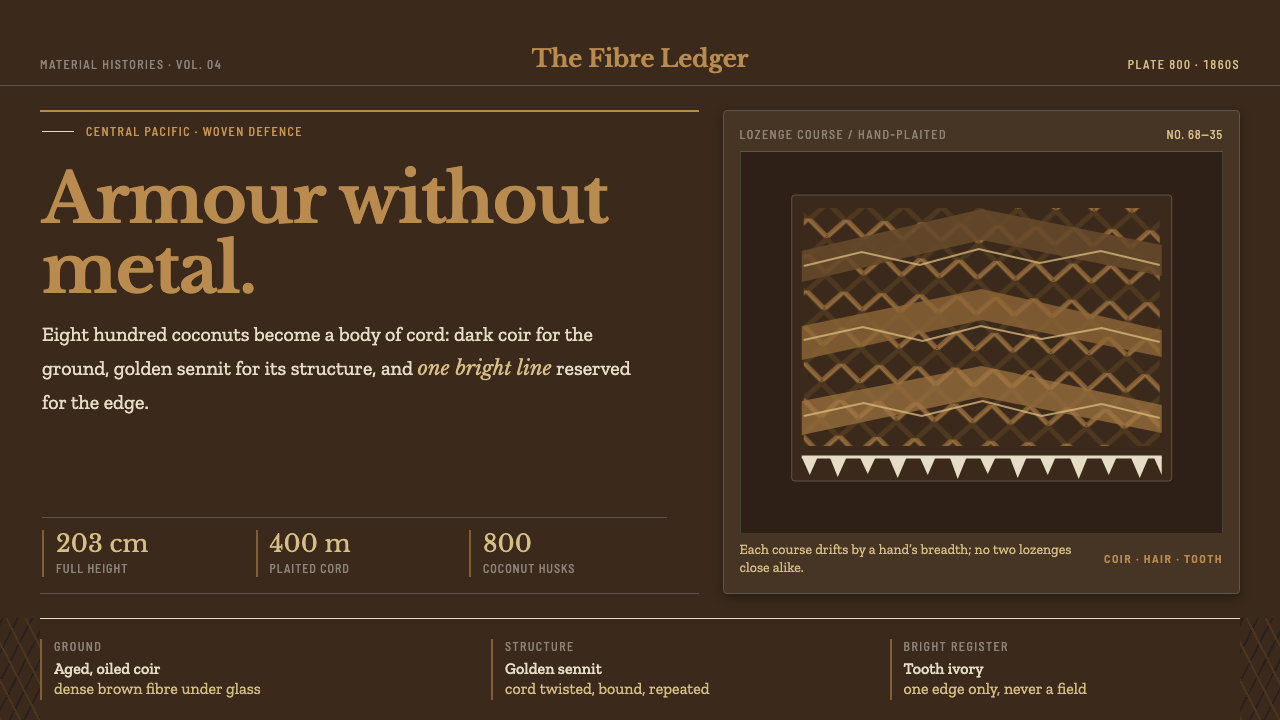 Kiribati Coconut ArmorArmour without metal. Dark coir, golden sennit and one disciplined tooth-ivor…
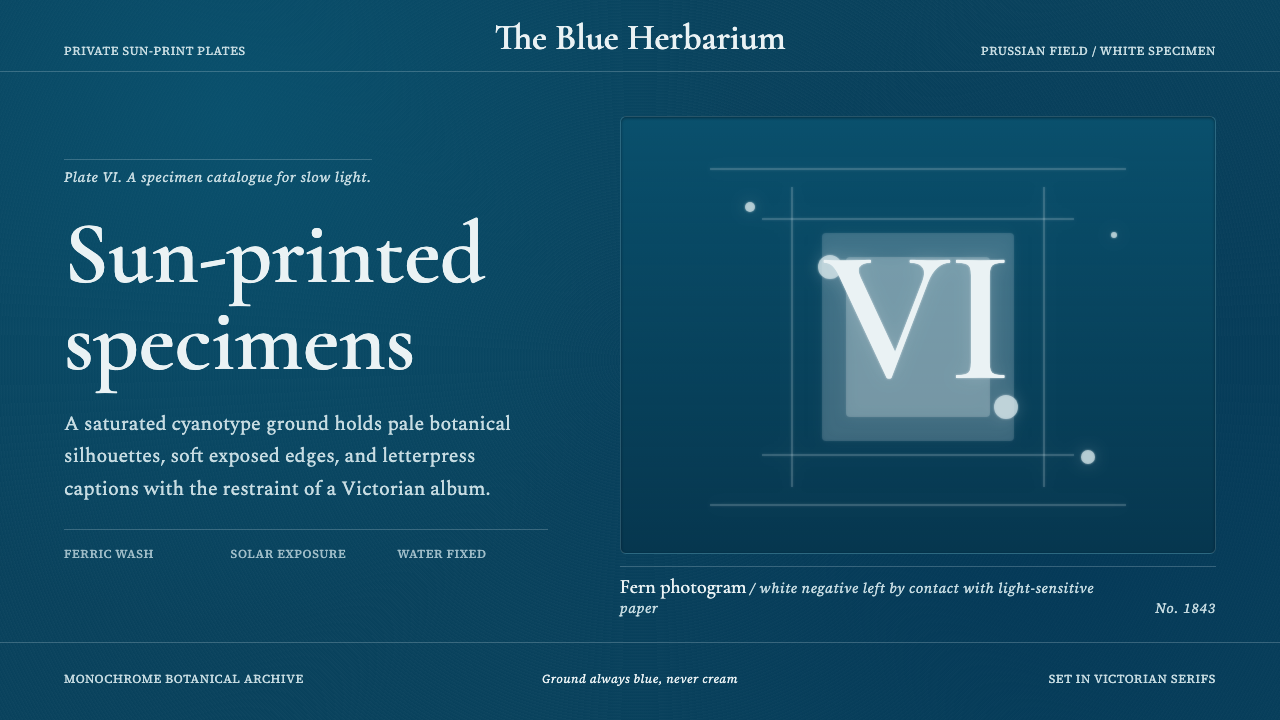 Fern CyanotypeStillness turns scientific. Prussian blue field, white photograms, Victorian…
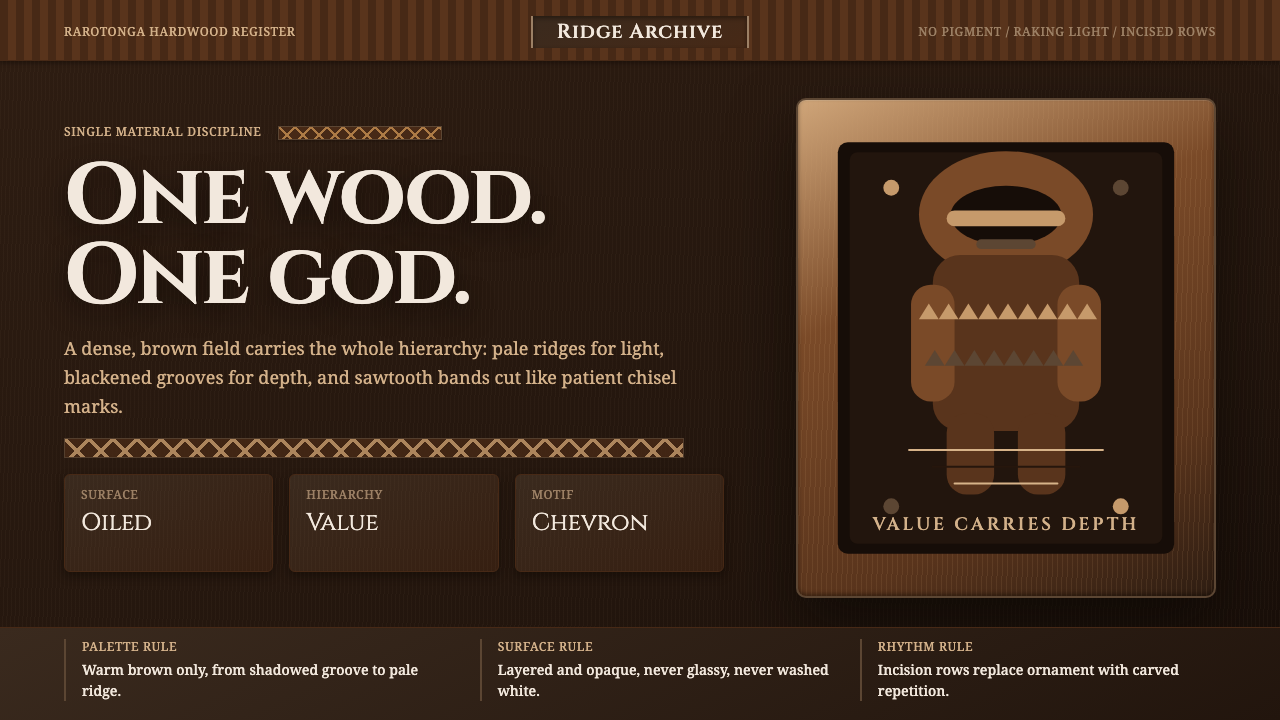 Cook Islands Tangaroa CarvingOne-material gravity. Warm browns, sawtooth rows, and raking light carve hier…
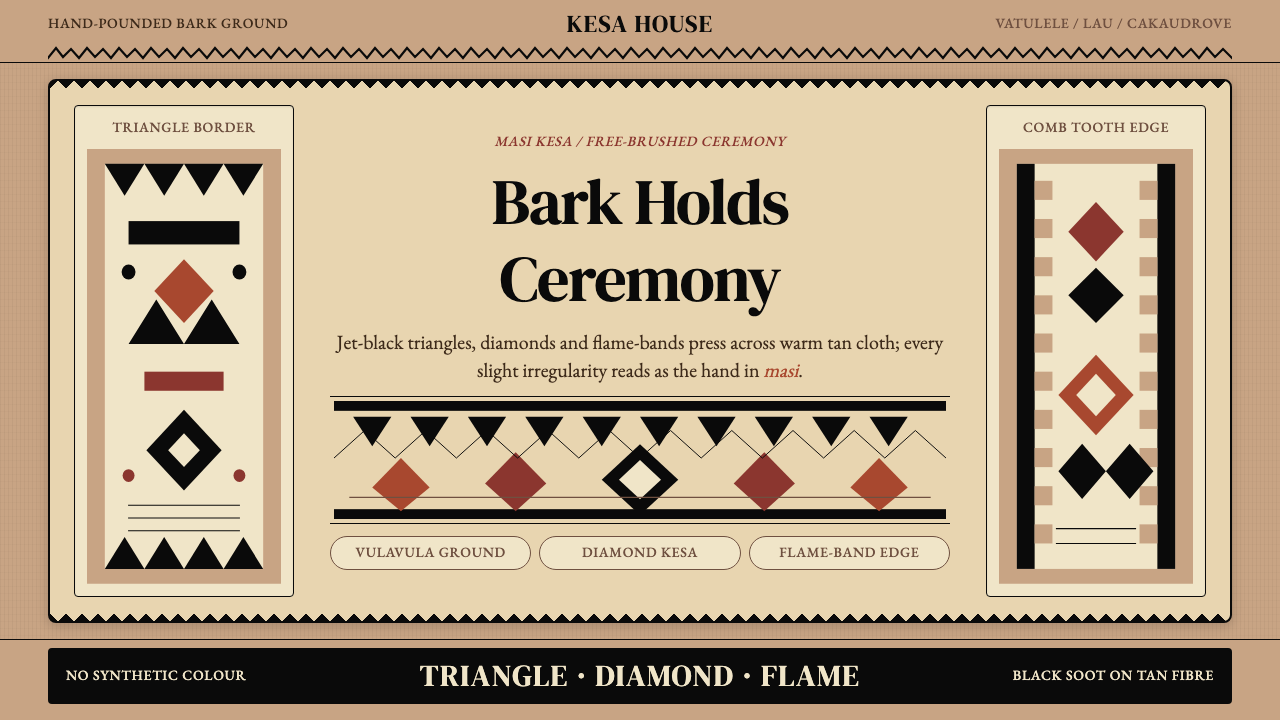 Fijian Masi (Tapa Cloth)Ceremony hits in black. Tan bark ground carries diamonds, zigzags and flame-b…
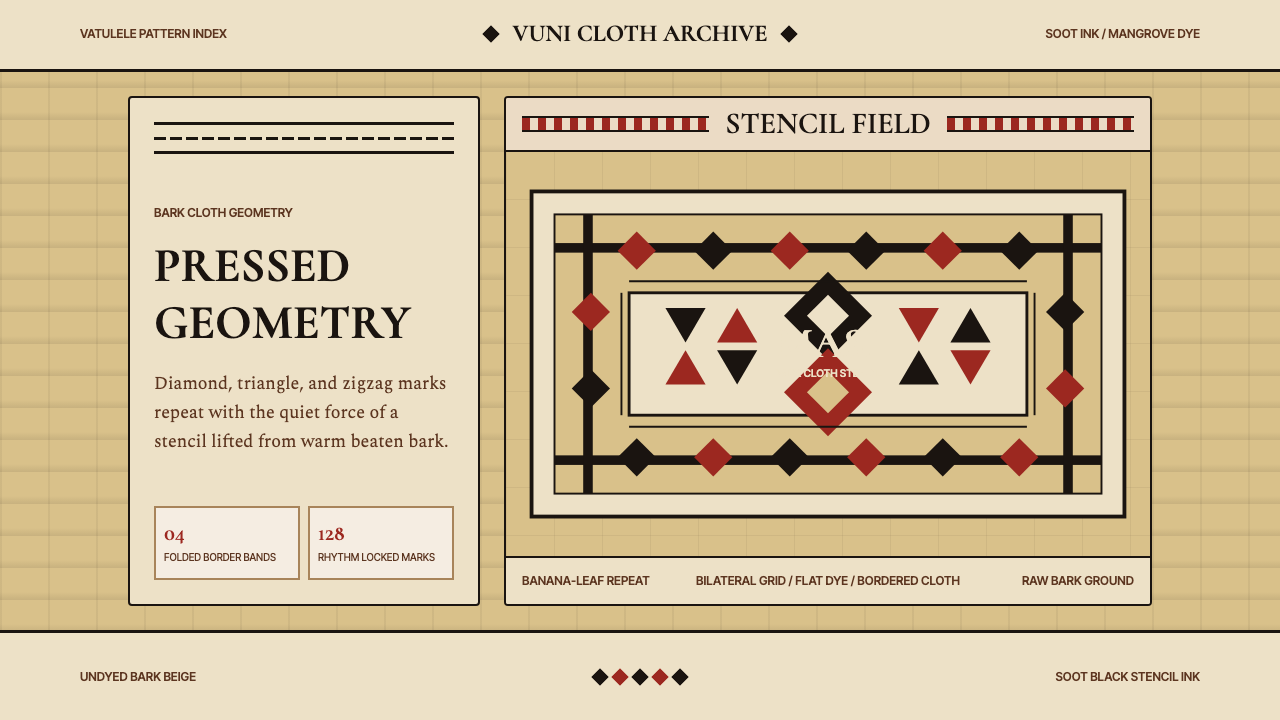 Fijian Masi Tapa StencilGeometry keeps ceremony. Soot-black diamonds repeat on bark beige with rust-r…
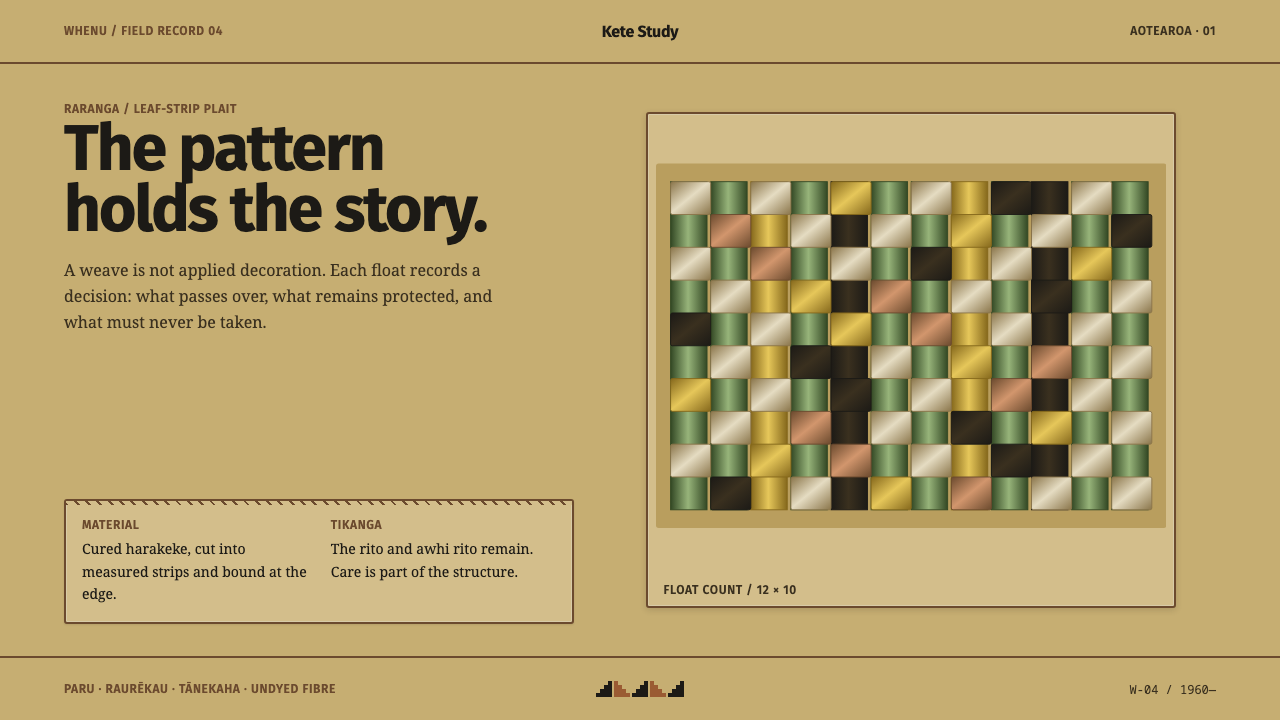 Harakeke Raranga WeavingStructure carries care. Honey-straw grids expose each green, bark and fibre s…