What is Kiribati Coconut Armor?
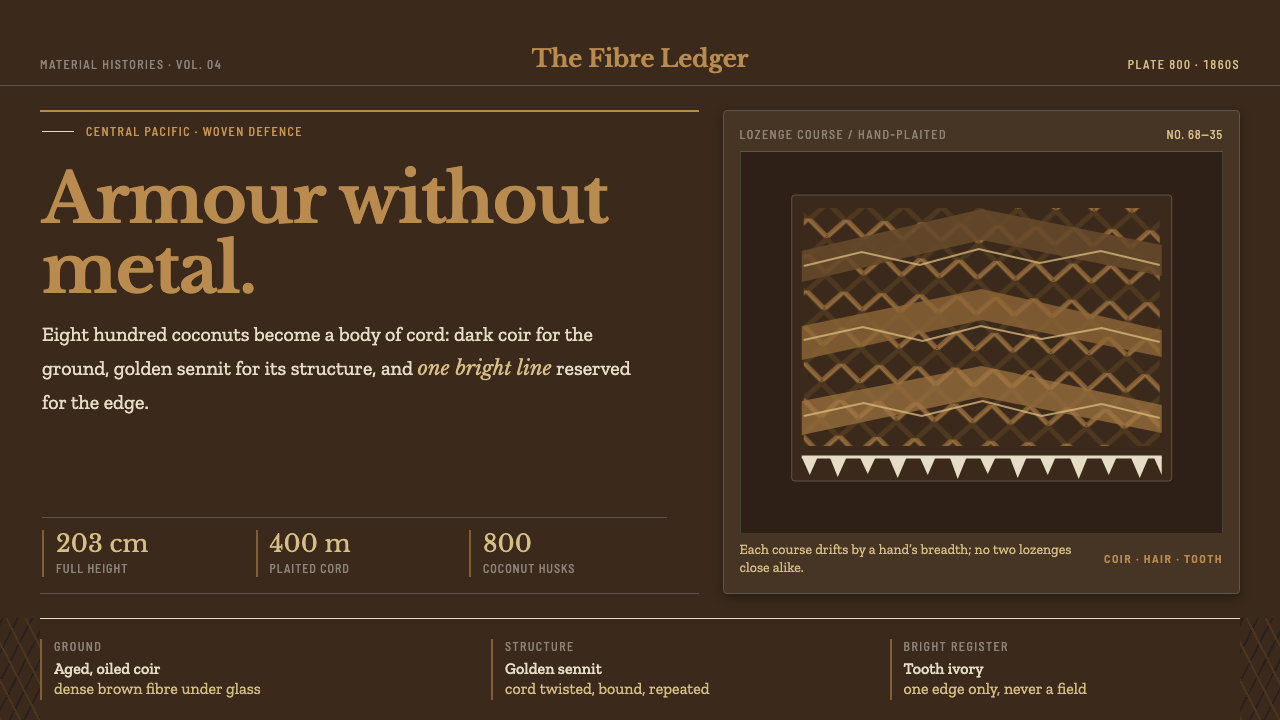
Kiribati armour is Oceania's only fully articulated body armour — and it is made almost entirely from coconut.
Kiribati Coconut Armor in brief
Kiribati armour stands apart from every other armor tradition in Oceania because it is the only example of fully articulated body armour the region produced — meaning it was built in jointed sections that allowed a warrior's limbs and torso to move rather than encasing the body in a single rigid shell. A mid-19th-century suit in museum collections measures roughly 203 by 68 by 35 centimeters and consumes more than 400 meters of plaited sennit cord, the equivalent of roughly eight hundred coconuts' worth of husk fiber, all of it bound together with human hair, palm leaf, ray skin, and shark teeth.
The design system built from this armour takes its structure directly from that material list rather than from any applied decorative pattern. Aged, oiled coir — coconut husk fiber that has darkened and been worn smooth by handling — forms the ground tone of the system. Fresh sennit, the plaited cord itself, supplies the primary mid-tone. Tooth-ivory white appears only as an edge treatment, tracing the line where shark teeth were once bound into the armor, and it is never allowed to spread into a full field.
Typography in this system draws on Victorian museum label convention rather than any invented 'tribal' lettering, because that is the honest historical register available: Gilbertese, the language of Kiribati, was first written in Latin letters only from the 1860s mission presses onward, meaning there was no indigenous script tradition for a typeface to imitate. Geometry, likewise, comes from the weaving process itself — diamond lattices, diagonal twill lines, and body-following band borders — rather than from a separately invented ornamental vocabulary, and it is deliberately kept slightly irregular, since hand-plaiting shifts and never produces machine-perfect precision. Even the helmet that accompanied this armour, the te barantauti made from a dried, inflated pufferfish, reinforces the same design lesson: appearance and structural protection were treated as two separate jobs within a single warrior's outfit, so a system built from this material should likewise separate a loud, striking accent detail from the quiet, load-bearing structure that carries most of the visual weight.
Where does Kiribati Coconut Armor come from?
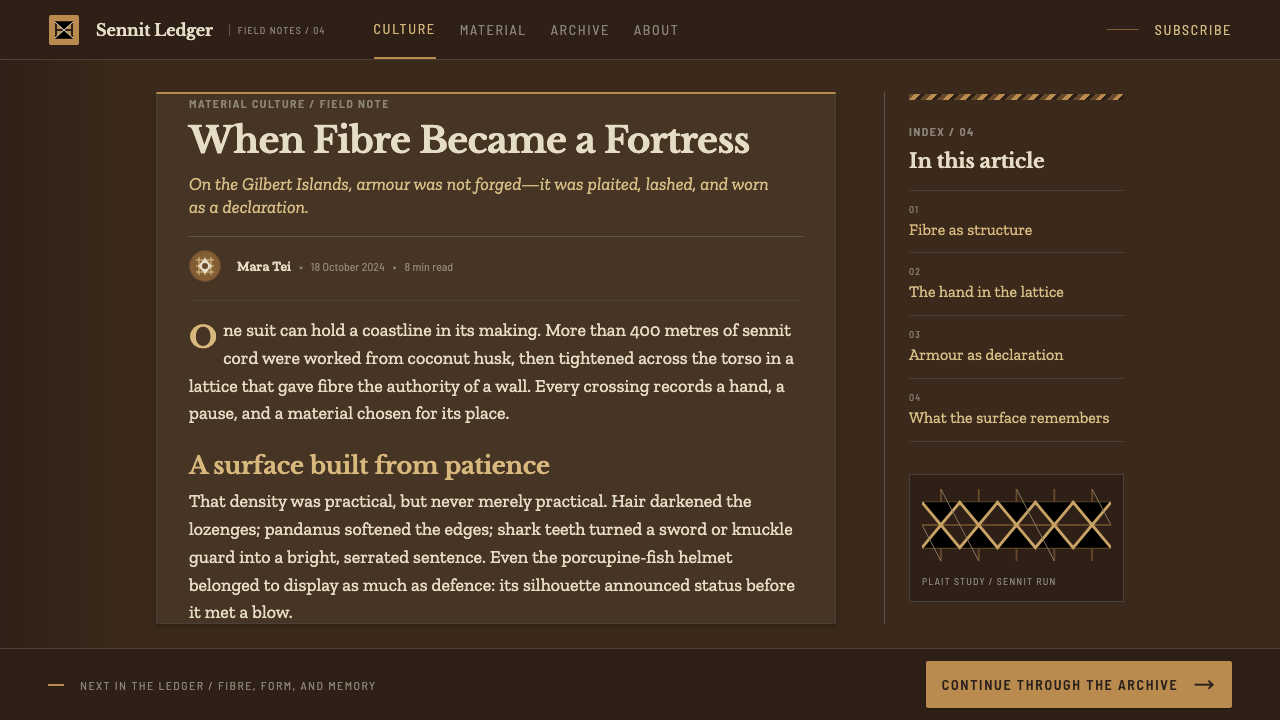
Kiribati armour, also known as Gilbertese armour after the islands' former name, belongs to the 19th century and was collected by Western institutions largely in the mid-1800s, placing it firmly within the pre-1900 tradition of Pacific fibre arts as well as within the broader wave of 19th-century ethnographic collecting that brought Pacific material culture into Western museum collections.
The armour was made by I-Kiribati plaiters and warriors themselves, produced within a fibre-arts tradition centered on coconut palm — a material chosen not for decorative reasons but because it was the most abundant and structurally workable resource available across the atolls of the Gilbert Islands. A helmet worn with this armour, known as te barantauti, was made from a dried, inflated pufferfish stretched over a woven cap, designed to look striking and intimidating rather than to withstand a direct blow — appearance and structural armour served different, deliberately separated purposes within the same warrior's outfit.
Surviving examples of this armour were preserved and are held today by major Western institutional collections, including the Royal Collection Trust, the Peabody Museum of Archaeology and Ethnology, and Världskulturmuseerna, whose holdings have allowed the specific construction — the sennit binding, the shark-tooth edging, the diamond and twill weave patterns — to be studied and documented in detail long after the armour's original active use had ended.
Because Gilbertese was set down in Latin script only through mission presses beginning in the 1860s, any typographic treatment of this material inevitably draws on the register in which the armour was first described and catalogued in the West — the plain, factual voice of the 19th-century museum label — rather than on an invented indigenous typeface, since no earlier written form existed to draw from.
What defines the Kiribati Coconut Armor look?
Aged Coir Ground
The dominant tone is a dark, oiled coconut-husk brown, aged and worn rather than fresh or bright. This is the ground on which everything else sits, evoking the handled, weathered surface of a real armour piece rather than a clean manufactured material.
Fresh Sennit Mid-Tone
A slightly lighter, golden-brown tone represents freshly plaited sennit cord, used as the system's primary color for structural lines, borders, and the visible cordage-like texture that runs through the design.
Tooth-Ivory Edge Only
Pale tooth-ivory white is rationed strictly to edges and outlines, echoing the line of shark teeth bound along an armor's border. It never becomes a large field or a background — its role is to mark a boundary, not to fill space.
Diamond and Twill Weave
Geometric pattern comes directly from plaiting technique — diamond lattices and diagonal twill lines — rather than from a separately invented decorative motif. These patterns should follow the logic of a woven structure, not a printed or drawn design.
Body-Following Band Borders
Borders and bands follow the logic of an articulated, body-fitted armor piece, curving and segmenting along implied joints rather than running as straight, flat-page rules — a reminder that the source object had to move with a human body.
Deliberate Irregularity
Lines and patterns carry slight, deliberate irregularity rather than machine-perfect precision, reflecting the reality that hand-plaited sennit shifts and varies. A too-precise, vector-perfect rendering misrepresents the handmade nature of the source material.

Who shaped Kiribati Coconut Armor?
The armour was made and worn by I-Kiribati plaiters and warriors themselves, working within a coconut-based fibre-arts tradition suited to the resources available across the atolls of the Gilbert Islands, producing the specific sennit-and-shark-tooth construction the design system is built from.
Among the major Western institutions holding surviving examples of Kiribati armour, the Royal Collection Trust's holdings have contributed to preserving and documenting the mid-19th-century construction details this design system draws its material logic from.
The Peabody Museum's collection of Kiribati armour has allowed the specific dimensions, sennit binding, and shark-tooth edging of surviving suits to be studied in detail long after the armour's original active use had ended.
Sweden's Världskulturmuseerna holds examples of this armour within its Pacific collections, part of the institutional record that keeps the 19th-century fibre-arts construction techniques of Kiribati armour documented and accessible for study.
How do you use Kiribati Coconut Armor today?
This system's strength comes from its restraint on color and its specificity of texture — a dark oiled-coir ground, a mid-tone sennit accent, and tooth-ivory used only as a thin edge. Applying it well means resisting the temptation to brighten the palette or introduce colors outside this narrow, material-derived set.
For presentation slides, the style suits a cover slide built around a dark coir-toned field with a woven-texture band running along one edge and a thin tooth-ivory outline marking the frame, title type set in a plain, museum-label register rather than a decorative display face. Content slides should use the sennit mid-tone sparingly for section headers, keeping most of the surface in the dark ground tone.
For web interfaces, this system fits a cultural archive, a museum-adjacent site, or a craft-focused product better than a bright consumer app — its whole visual logic is quiet, textured, and historically grounded rather than vivid or playful. Card borders and dividers work well rendered as thin woven-texture bands rather than flat plain lines, and tooth-ivory should be reserved for a single accent detail per view, such as an active-state outline, rather than distributed generally. Navigation and structural chrome should stay in the sennit mid-tone rather than the dark ground, echoing how the cord itself — not the darker aged coir — carries the armor's visible linear structure.
In editorial and marketing layouts, the style rewards long-form storytelling treatments: a dark coir-toned reading background, sennit-toned pull quotes, and section dividers styled as a diamond-lattice or twill band rather than a plain horizontal rule. Because the source material is fragile and historical, the overall feel should stay measured and documentary rather than bold or commercial.
The most common mistake is treating tooth-ivory as a general light background or a large accent field rather than a strict, thin edge treatment. In the source armour, ivory-white shark teeth trace a border line and nothing more; a version that expands that white into a dominant field loses the ratio between dark ground, mid-tone cord, and rationed edge-light that defines the system.
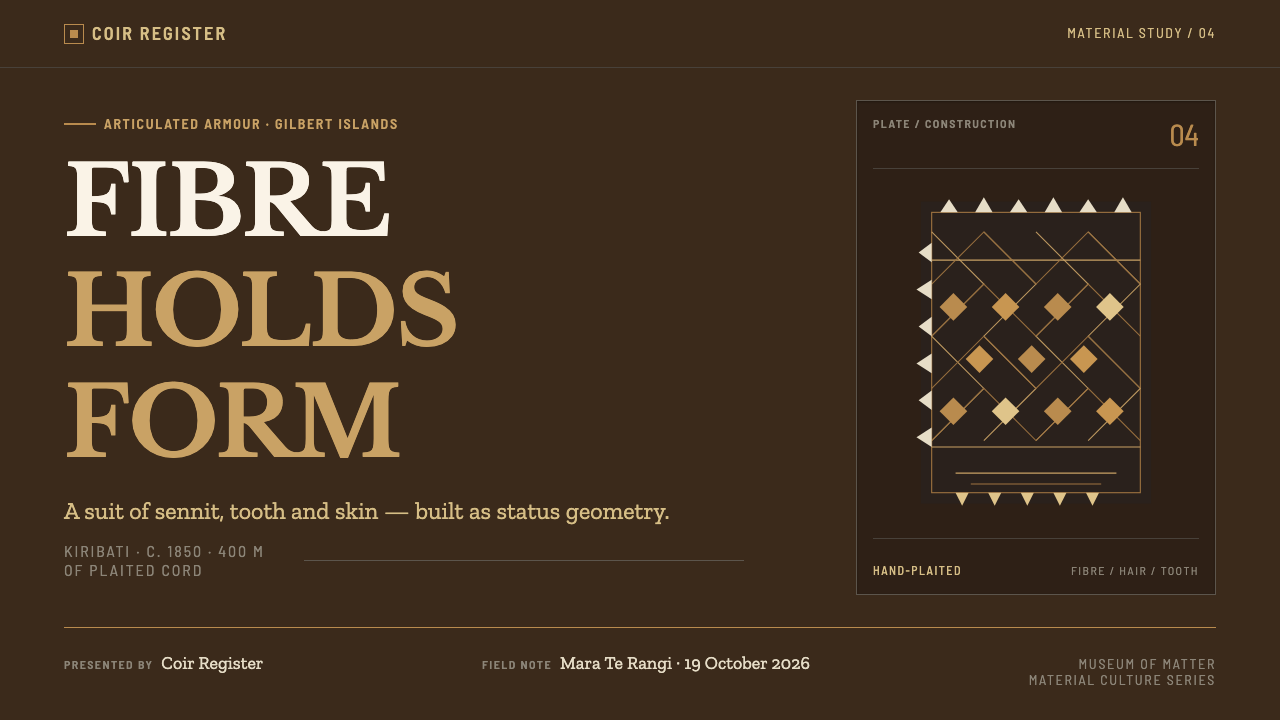
Kiribati Coconut Armor — FAQ
Why is white used only as a thin edge instead of a background color?
Because in the original armour, the pale tone comes specifically from shark teeth bound along an edge or border, not from any large surface. The design system preserves that exact ratio — a dark, textured ground with white rationed to a thin line — because expanding white into a background would misrepresent where that color actually appeared on the source object.
Why does the typography look like a 19th-century museum label rather than something more decorative?
Because Gilbertese was first written in Latin letters only from the 1860s mission presses onward, meaning there was no earlier indigenous script tradition to draw a decorative typeface from. Using the plain, factual register of the 19th-century museum label — the register in which this armour was actually first catalogued — is the honest choice rather than inventing an ornamental lettering style with no historical basis.
Is this armour typical of Pacific or Oceanic armor traditions generally?
It is notably exceptional rather than typical: the source material describes it as the only fully articulated body armour Oceania produced, meaning most other regional armor traditions did not achieve the same jointed, body-following construction. This makes it a distinct case rather than a representative sample of a broader regional style.
Should this style be applied with bright, high-saturation colors?
No — the palette is deliberately narrow and material-derived: dark aged coir, mid-tone fresh sennit, and rationed tooth-ivory. Introducing bright or high-saturation colors outside that set breaks the quiet, historical, handmade character that defines the style and makes it read as an invented decorative pattern rather than a faithful rendering of the source armour.
Why does the helmet, the te barantauti, look so different from the armor's restrained palette?
Because it served a different purpose. The source material notes the te barantauti — made from a dried, inflated pufferfish over a woven cap — was designed to look striking and intimidating rather than to provide structural protection, which is what the sennit-and-shark-tooth body armour was for. The two objects deliberately divided the jobs of visual impact and physical defense rather than trying to do both with one design.
Related design styles
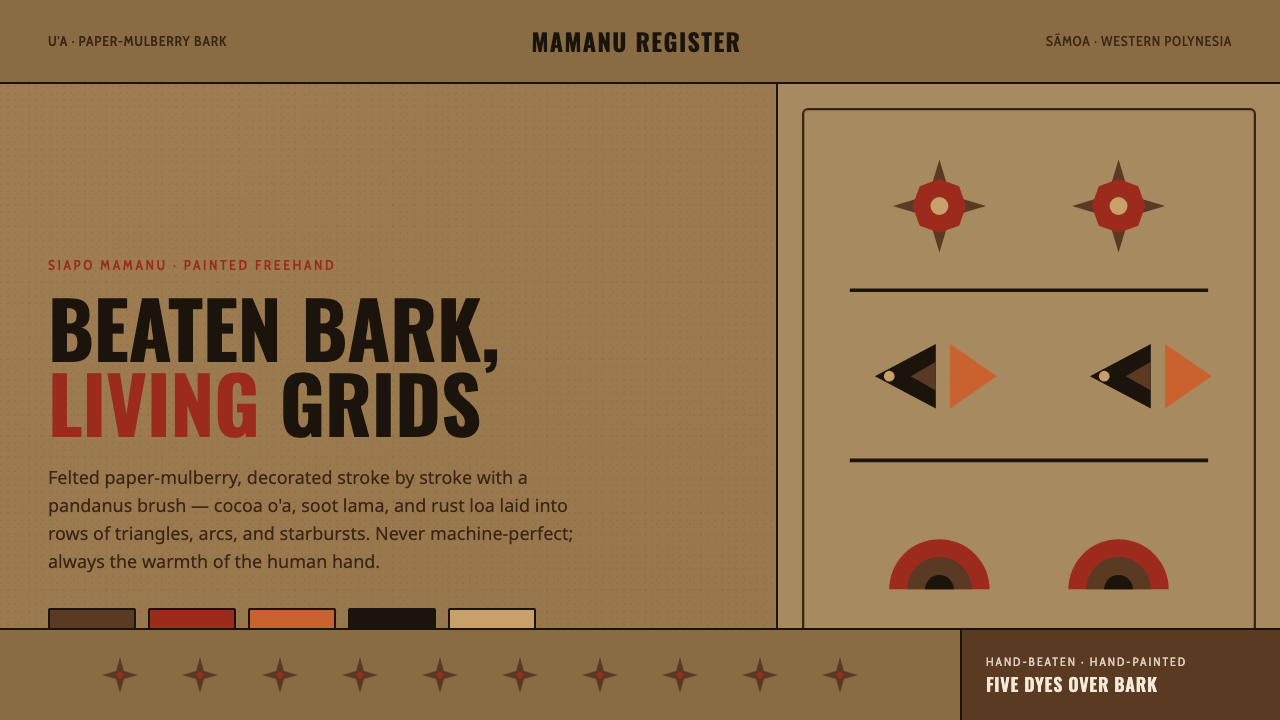 Samoan Siapo MamanuBeaten bark, never white. Five natural dyes paint freehand grids of fish, she…
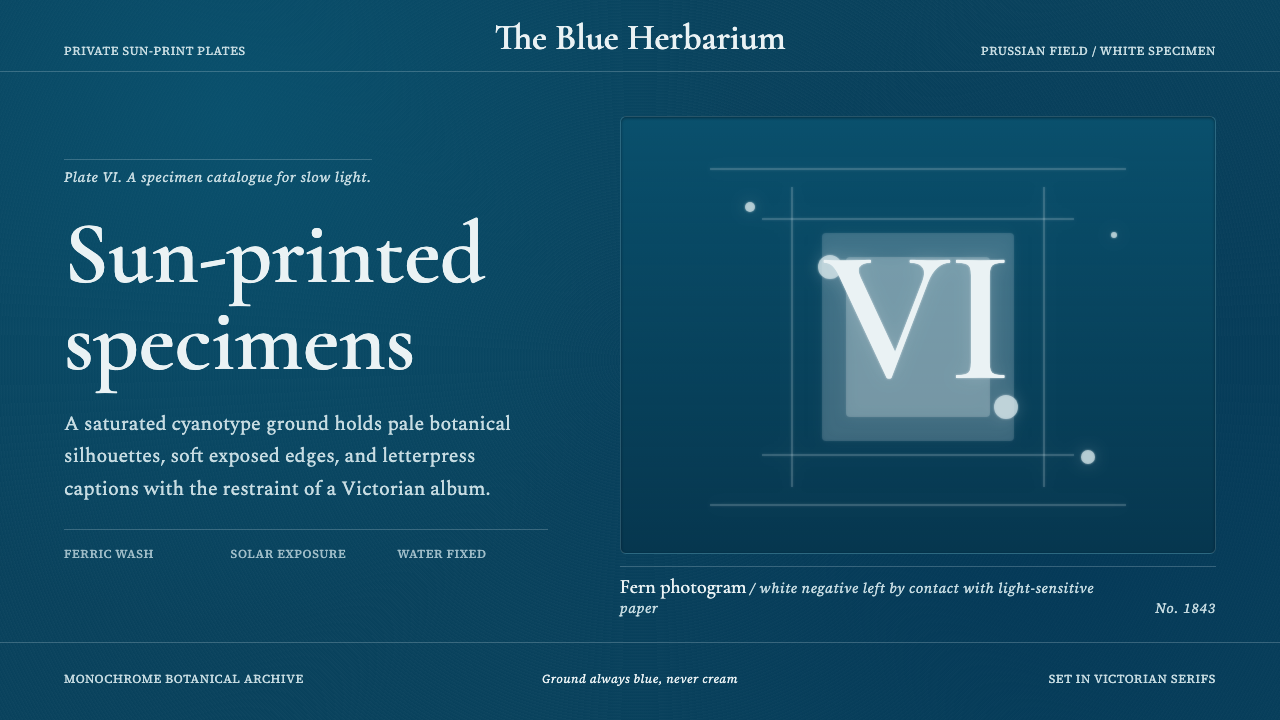 Fern CyanotypeStillness turns scientific. Prussian blue field, white photograms, Victorian…
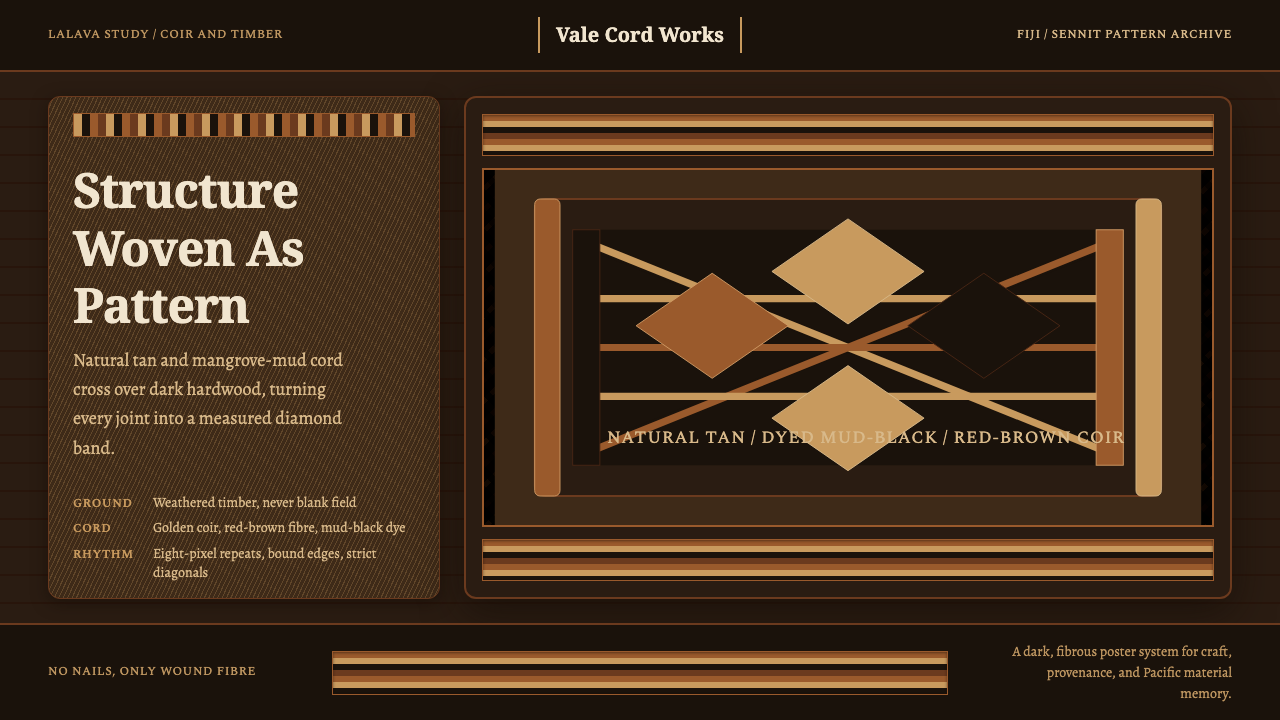 Fijian Magimagi LashingStructure becomes ornament. Tan coir diamonds bind mud-black timber in a stri…
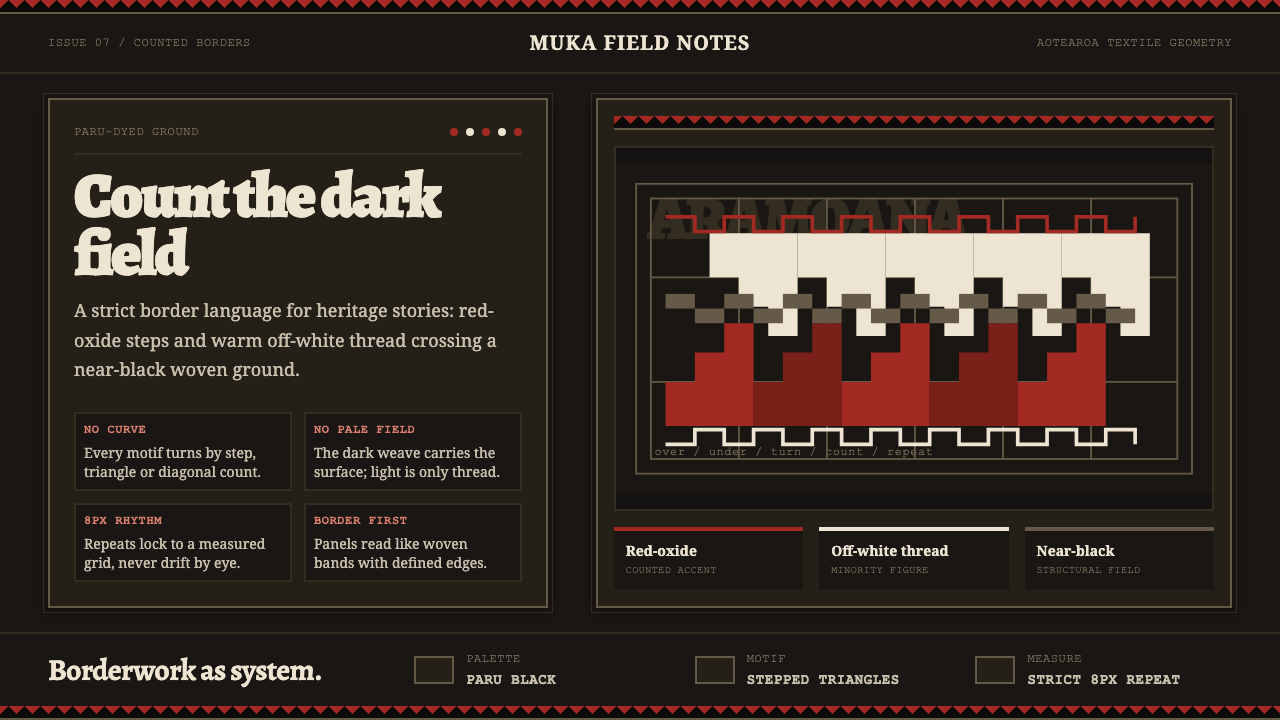 Māori Tāniko Border WeaveCounted darkness. Red-oxide steps and off-white thread cross a paru-black gri…
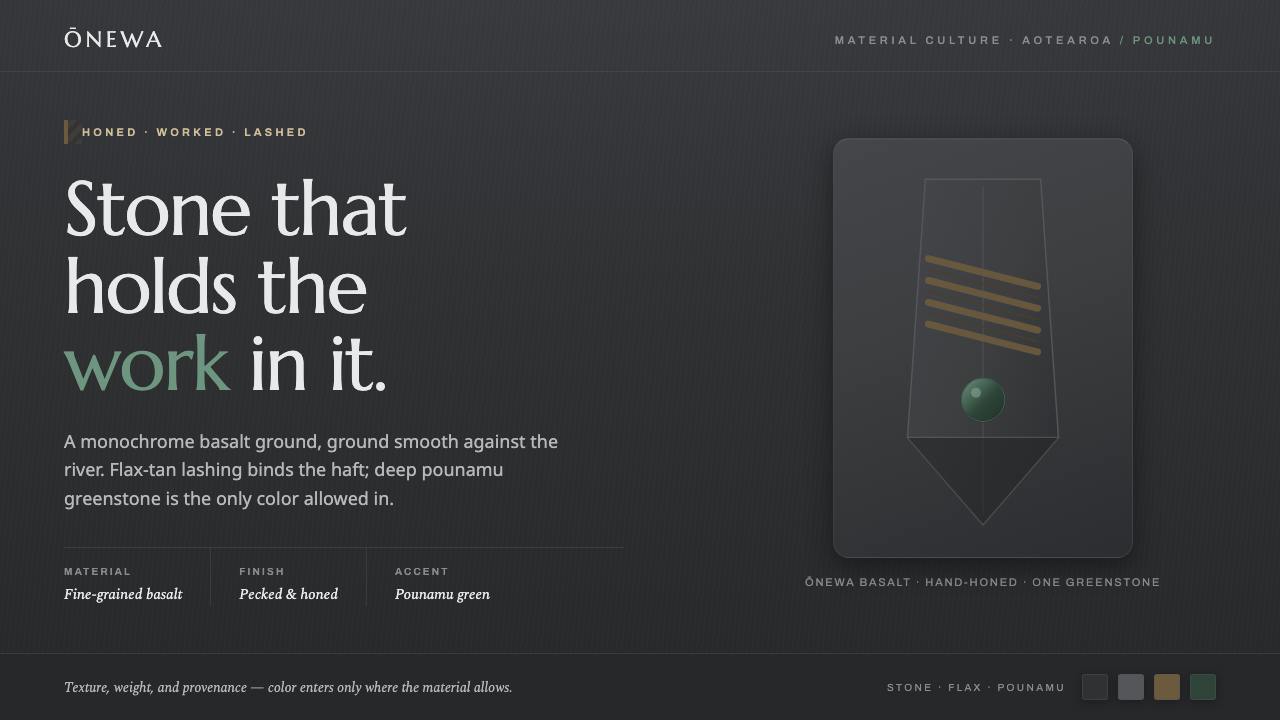 Māori Volcanic StoneColor enters only where the stone allows. Honed charcoal basalt, flax lashing…
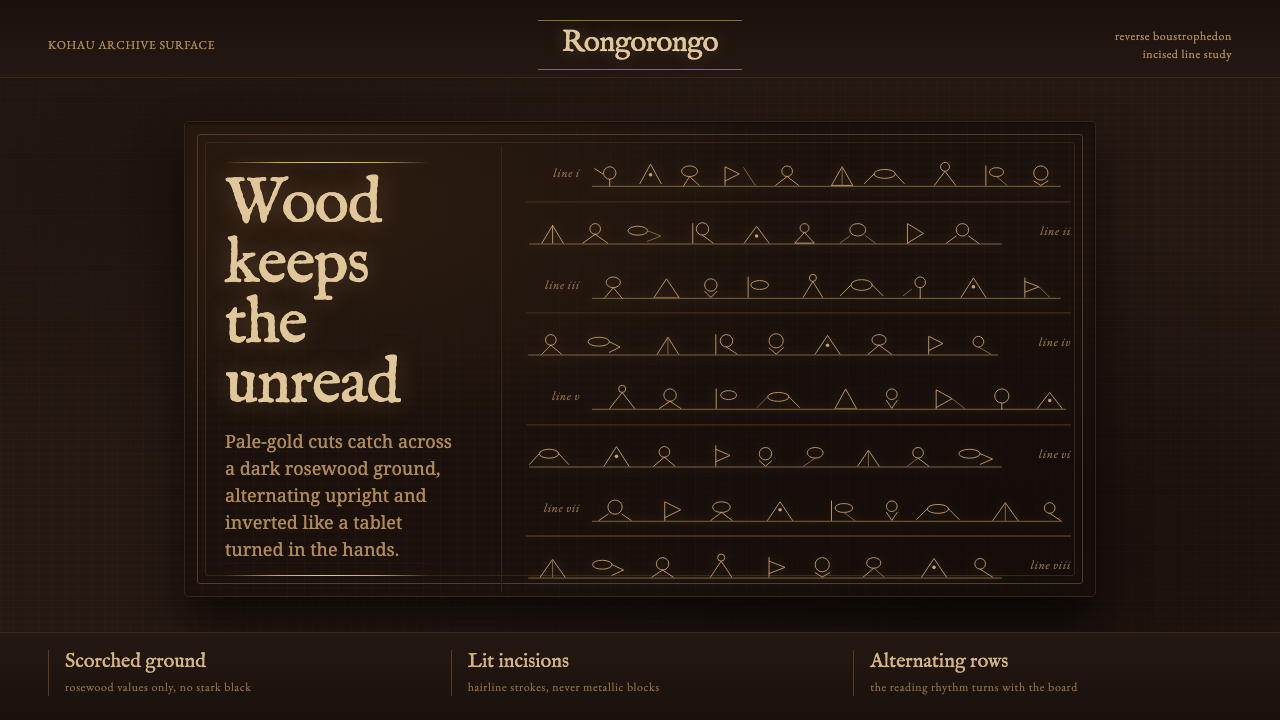 Rapa Nui Rongorongo GlyphThe unread glows. Pale-gold incisions alternate across scorched rosewood rows.