What is Māori Tāniko Border Weave?
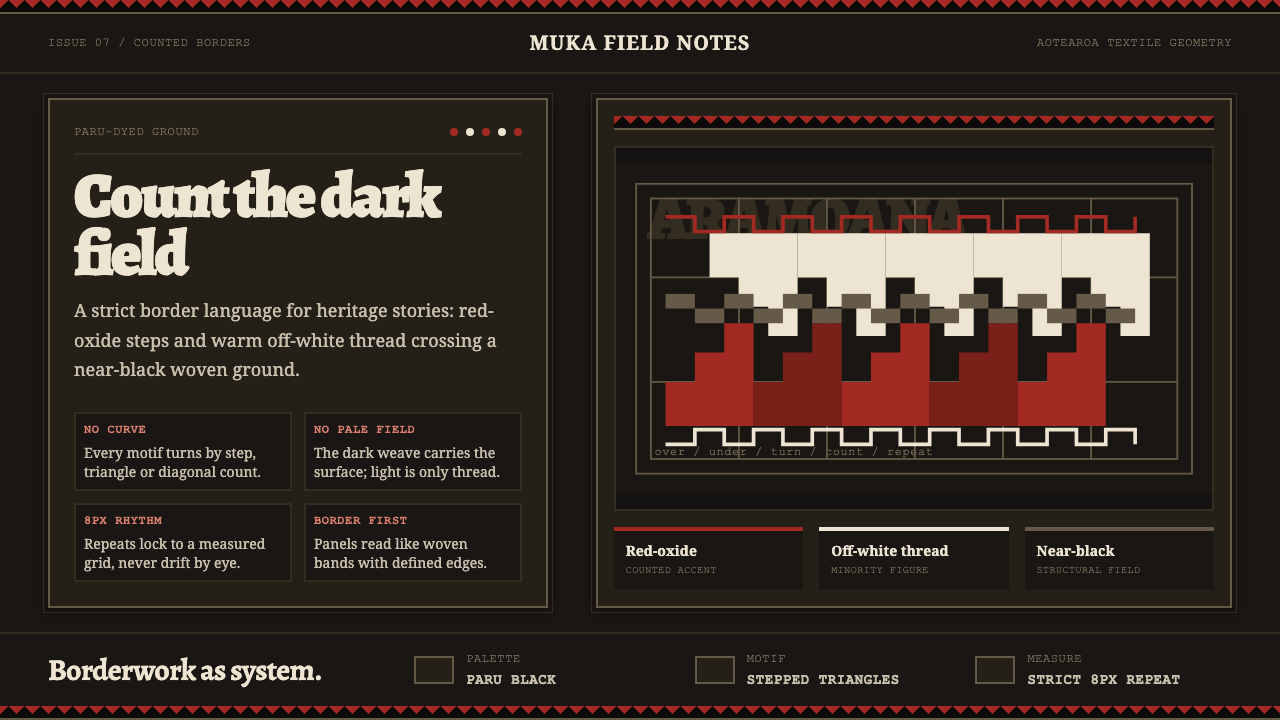
Māori Tāniko Border Weave turns darkness into a counted structure, where red-oxide steps and warm off-white thread travel across a paru-black field with the discipline of a pathway.
Māori Tāniko Border Weave in brief
Māori Tāniko Border Weave is the visual language of tāniko: a dense border of finger-twined muka flax fibre worked by hand into steps, triangles, and diamonds. It belongs to the border of a classic-period Māori cloak, where the textile is not a loose decoration but a tightly controlled band whose geometry records the movement of counted threads.
Its palette is deliberately narrow and materially specific. The ground is a near-black field dyed with iron-rich paru mud; red-oxide accents provide the visual pressure; warm off-white thread describes the pattern. The contrast is strong without becoming ornamental because the dark weave remains the field and never turns into the figure.
The defining motif is the aramoana zigzag, a pathway of the sea that crosses the ground through strict diagonals. There are no curves, no soft transitions, and no cream-colored substitute for the warm off-white thread. The style gains its authority from repetition, restraint, and the visible fact that every step has been counted.

Where does Māori Tāniko Border Weave come from?
Tāniko belongs to the Māori raranga and whatu textile tradition of Aotearoa, New Zealand. Its classic-period context is pre-1900, and its most visible architectural setting is the border of a cloak rather than an isolated surface pattern. The border concentrates craft, material, and geometry into a narrow zone that frames the larger garment.
The technique is defined by handwork. Muka flax fibre is finger-twined stitch by stitch, with no loom involved. This matters aesthetically because the pattern is not the result of a mechanically imposed image placed over cloth; it is produced through the repeated physical act of counting threads and controlling their crossings. The resulting geometry feels built from inside the textile.
The visual system grows from the relationship between a dark paru-dyed ground and a small group of contrasting threads. Red oxide establishes stepped accents, while warm off-white marks the pattern against the near-black field. The aramoana zigzag gives the border its directional energy, moving diagonally across the band while keeping the weave dense and ordered.
The principal makers named in this tradition are kairaranga master weavers and whatu twining practitioners. The work is also specifically associated with tāniko borderwork on kaitaka and korowai cloaks. These references keep the style connected to a textile practice and to its border function: it should be understood as a counted woven edge, not merely as a collection of fashionable geometric symbols.
What defines the Māori Tāniko Border Weave look?
Paru Ground
The ground is a near-black field associated with iron-rich paru mud. It is not an empty background but the dominant material presence of the border. Every lighter mark gains authority because it is cut into this darkness, and the darkness must remain visually larger, quieter, and structurally continuous than the pattern.
Restricted Palette
The palette stays close to near-black, red oxide, and warm off-white. Red is used as a stepped accent rather than a broad field, while off-white describes the thread pattern without becoming a creamy surface color. The restraint keeps the weave legible and prevents color from overpowering the counted structure.
Stepped Geometry
Steps, triangles, and diamonds form the primary vocabulary. Their edges are resolved through discrete turns rather than curves, giving the border a built, almost architectural quality. Shapes should feel assembled from repeated crossings and measured changes of direction, not drawn as smooth symbols.
Aramoana Direction
The aramoana zigzag moves across the border as a pathway of the sea. Its strict diagonals create travel and continuity without requiring a curved line. The motif works because each directional change is clear enough to count, yet close enough to its neighbors to read as one uninterrupted passage.
Counted Rhythm
Repetition is not incidental patterning; it is the organizing principle. The eye should sense a sequence of equivalent crossings, recurring steps, and controlled intervals. Variation may appear through the meeting of triangles and diamonds, but it should remain subordinate to the rhythm of the thread count.
Dense Border
Tāniko is experienced as a border: concentrated, directional, and capable of framing a larger field. Its density gives it authority, while its narrow role prevents it from becoming visual noise. The border should feel like a woven threshold between the garment and the surrounding space.

Who shaped Māori Tāniko Border Weave?
Kairaranga master weavers represent the expert hand behind the border. Their role is expressed through control of muka flax fibre, disciplined counting, and the ability to sustain steps, triangles, diamonds, and diagonal movement as one coherent woven field. The style should retain that sense of deliberate construction rather than imitating only its surface colors.
Whatu twining practitioners are associated with the finger-twined method that gives the pattern its structural character. Their practice clarifies why the geometry feels counted rather than illustrated: each motif is inseparable from the crossing, turning, and tightening of thread. The textile logic comes before the graphic appearance.
Tāniko borderwork on kaitaka and korowai cloaks defines the setting in which this visual language belongs. The border is a concentrated edge, not an all-over field. It frames the garment through a dark, dense band whose pattern carries movement while remaining subordinate to the larger woven body.
How do you use Māori Tāniko Border Weave today?
For presentation covers, use the border as a strong framing device rather than wallpaper. Let a near-black field establish the atmosphere, then place an aramoana-like stepped path along one edge or across a lower band. Keep the title quiet and legible against the dark ground, with red oxide reserved for one directional emphasis and warm off-white used for essential information.
For content and data slides, treat the weave as a system of counted modules. Repeat a narrow stepped band to separate sections, use triangles or diamonds as markers for categories, and let diagonal movement guide the reading path. Charts should remain sparse and structural: red oxide can distinguish a key series, while warm off-white supports labels and the dark ground carries the field.
For web dashboards and pricing interfaces, the style suits products that need a strong sense of order and a memorable dark identity. Use dense border bands to frame navigation or pricing tiers, keep cards visually flat and woven rather than glossy, and reserve the lighter thread color for readable labels. Interactive emphasis should feel like a counted interruption in the pattern, not a separate decorative color system.
For editorial and marketing work, the border can act as a recurring signature across covers, section openings, packaging-like panels, and campaign headers. Pair a restrained wordmark with a dense diagonal band, allowing the red-oxide accent to mark a transition or call to action. The composition should feel framed and tactile, with the pattern concentrated at the edge rather than scattered across every surface.
The common mistake is to turn the style into a generic tribal pattern by multiplying motifs, adding curves, or treating the near-black ground as an interchangeable dark background. Preserve the narrow palette, the strict diagonals, the dense border role, and the fact that the field remains the field. The logic of counting is more important than the number of symbols displayed.

Māori Tāniko Border Weave — FAQ
Is Māori Tāniko Border Weave simply a black, red, and white geometric pattern?
No. Its identity depends on the relationship between a paru-dyed near-black ground, red-oxide accents, and warm off-white thread, but color alone is not enough. The pattern is a dense finger-twined border made from muka flax fibre, organized through counted steps, triangles, diamonds, and strict diagonals. Removing the textile logic leaves only a superficial palette.
Why are curves absent from the style?
The supplied visual language is built from steps, triangles, diamonds, and the aramoana zigzag. Its directional force comes from discrete turns and strict diagonals rather than continuous arcs. Curves would change the counted character of the border and soften the geometric passage that makes the pattern read as a woven pathway.
Does the pattern come from drawing, printing, or weaving?
Its source is weaving. Tāniko is made by finger-twining muka flax fibre stitch by stitch, without a loom. That process explains the density and regularity of the visual language: the motif is inseparable from counted threads and controlled crossings. A drawn or printed adaptation should therefore preserve the sense of interlocked construction.
Can this style be used across an entire interface or page?
It can be extended, but its strongest role is still the border. Tāniko derives its visual authority from concentration: a dense edge framing a larger field. If every surface carries the same zigzag, the distinction between field and figure collapses and the counted rhythm becomes noise. Use the border to establish hierarchy, then let the dark field remain open enough to support reading.
What is the most important principle when adapting it for contemporary design?
Keep the structure ahead of the decoration. Preserve the narrow palette, the near-black field, the red-oxide and warm off-white contrast, the strict diagonals, and the dense border function. The adaptation becomes convincing when viewers can sense a counted system of crossings and steps, not merely a dark surface with geometric marks placed on top.
Related design styles
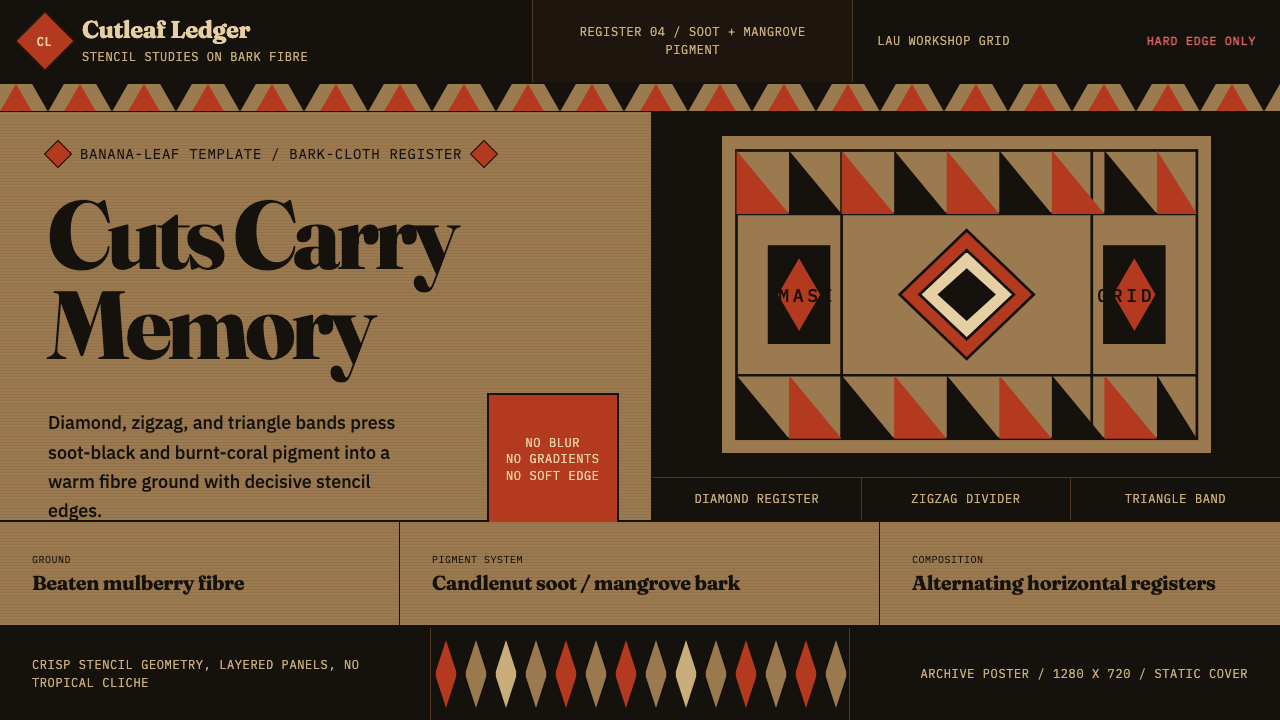 Fijian Masi (Bark Stencil)Stencil memory stays sharp. Soot black and burnt coral strike bark-fibre band…
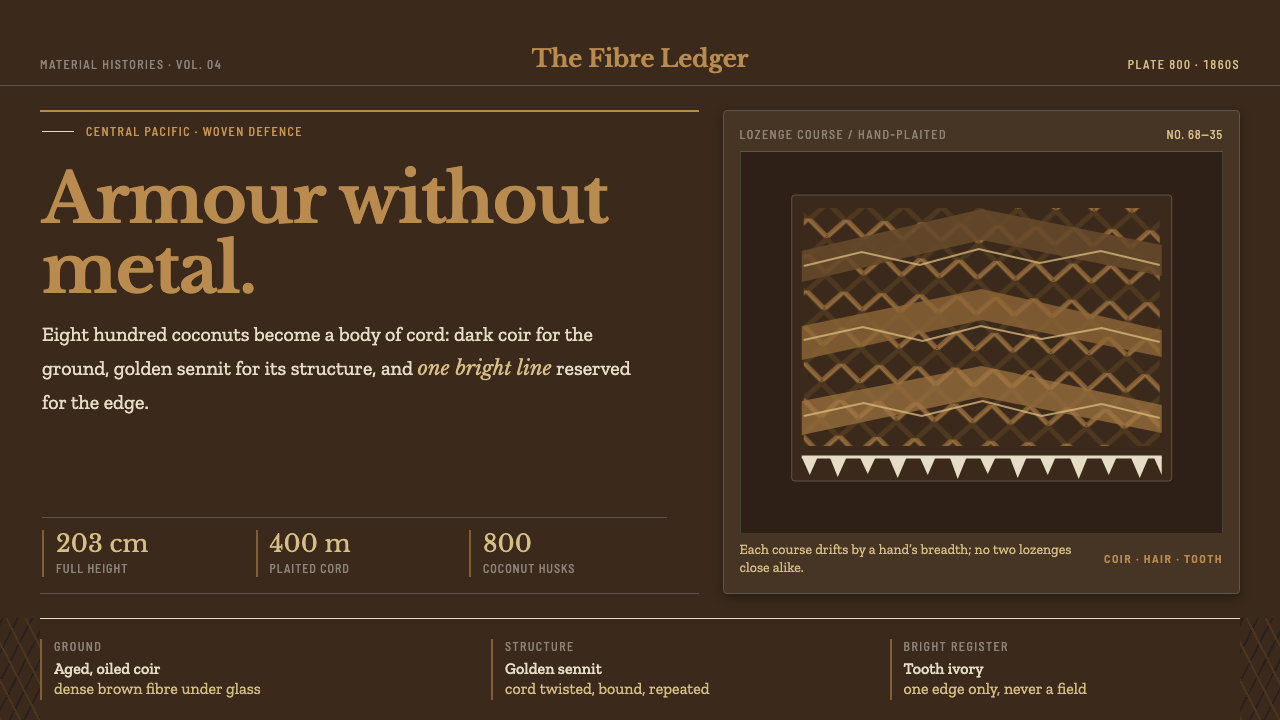 Kiribati Coconut ArmorArmour without metal. Dark coir, golden sennit and one disciplined tooth-ivor…
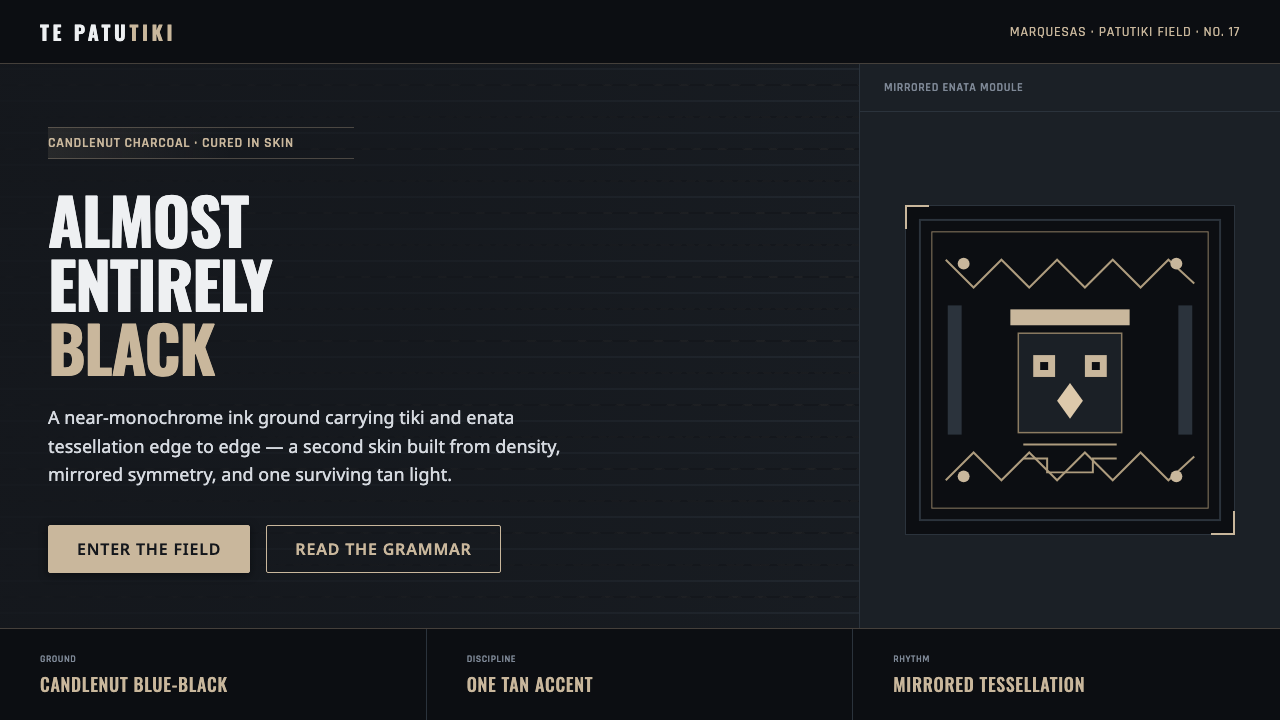 Marquesan Tatu PatternDensity as authority. Tiki and enata tessellation inked into blue-black, lit…
 Tiwi Pukumani PoleBlack ground carries ceremony. Ochre bands, pipeclay dots, and hatch stack li…
 Acehnese Rencong MotifA blade that reads as a word. Flat kerawang red, white, green and yellow lock…
 Batak GorgaCosmology cut into wood. Chalk-white lines and batu hula red hold a blackened…