What is Sámi Drum Symbols?
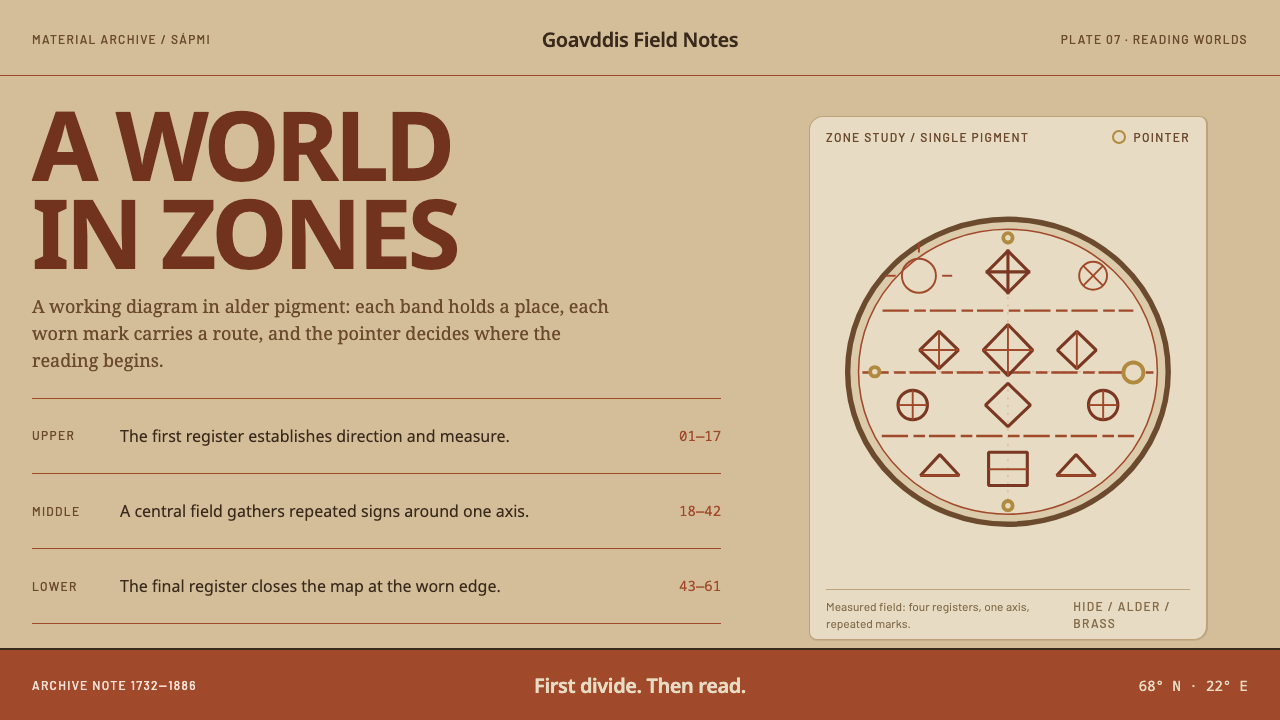
A Sámi goavddis drumhead is a diagram of the world drawn in red-brown on pale hide: zones first, then symbols, then the wear of use.
Sámi Drum Symbols in brief
The goavddis is the bowl drum of the northern Sámi. Its body is a shallow bowl hollowed from a burl of pine or birch, and its head is untanned reindeer rawhide. The drawing on the skin was made with chewed alder bark, whose extract dries to a red-brown on the greasy, pale surface. The visual logic follows directly from those materials: dark figures on a light ground, drawn with one pen on one skin.
The drumhead is not decoration. It is a working diagram. The membrane is divided into zones, and the zones are populated with reindeer, boats, lávvu tents, sun signs and beings of the spirit world. While the drum was struck, a brass or bone pointer travelled across the drawing, and where it came to rest was where the reading was taken.
That makes this a style about order. First comes the partition of space into bands or zones, then the placement of signs inside them. Strokes keep one even weight, are worn into broken lines by age and handling, and never aim for crisp corners. Curio's Sámi Drum Symbols system reads these traits as a rule set: legible marks, ordered world-bands, and a surface that shows its wear.

Where does Sámi Drum Symbols come from?
Sápmi, the Sámi homeland, spans the north of Norway, Sweden and Finland and reaches the Kola Peninsula in Russia. Within that area the goavddis is the bowl drum of North Sámi practice, and the South Sámi tradition has its own type, the gievrie, a frame drum. Both belong to Sámi shamanic practice, in which the ritual specialist known as the noaidi used the drum as the instrument of the work.
Drums are documented from the seventeenth century onward, and that documentation has a hard history. Most of the drums that survive were confiscated during the missions of the seventeenth and eighteenth centuries, when the mission church was working to suppress shamanic practice. This is why many now sit in museum collections, among them the drum collection of the Nordiska museet in Stockholm. The study of the form depends on objects taken from their makers, and on records written by outsiders.
The makers of goavddis drums are overwhelmingly anonymous. No individual craftspeople are recorded, only noaidi who owned drums and unnamed makers, and what remains is the objects themselves and the collections that preserve them. For design purposes that anonymity is part of the context: the drumhead drawings are the work of a community's visual system, handed down through use, not of named artists.
A final point of context is that this is a living identity as well as a historical one. The Sámi are an Indigenous people whose heritage is not archaeology. Anyone borrowing from the drumhead is borrowing from a sacred object with a political history, and that is good reason to approach it with care, to credit it correctly, and to avoid casual 'mystic' framing.
What defines the Sámi Drum Symbols look?
Dark Marks on Pale Hide
The only pigment is the red-brown extract of chewed alder bark, and the only ground is untanned reindeer hide. That gives the style a two-tone logic: dark marks on a warm, pale page. There is no second ink, no fill colour and no tint to rescue a weak composition. Everything depends on the clarity of the mark and the order of the space.
Zones and World-Bands
The membrane is partitioned before it is populated. Zones stack and divide the surface into bands, each holding its own kind of subject, so the drumhead reads as an ordered cosmos rather than a loose scatter of pictures. In layout terms the partition comes first and content comes second.
A Working Symbol Vocabulary
Reindeer, boats, lávvu tents and sun signs recur as a small, readable set of pictograms. Each is reduced to the minimum needed to be recognised, and each is reused across zones. This is closer to a diagram legend than to illustration: a mark earns its place by being legible, not by being ornamental.
An Even Stroke, Worn Line
Strokes keep a consistent weight, as if drawn with the same tool throughout, and age has worn them into broken, intermittent lines. Pigment is thin and uneven, and edges are never crisp. The wear is part of the style, and a drumhead that looked freshly printed would lose its authority.
The Pointer's Path
A brass pointer moves across the drawing while the drum is struck, and the reading depends on where it lands. The surface is therefore a field to be navigated, with a single moving marker. In interface terms this suggests one clear active state, a visible path through content, and navigation that behaves like a reading rather than a menu.
A Warm, Greasy Page
The hide is pale but never pure white. It carries a warm, slightly greasy, uneven tone where the pigment settles and fades. A page treated this way feels organic and handled, and it holds its dark marks with a natural softness that a clinical white background never offers.
Legibility Before Beauty
Because the drumhead was read, every mark has to be recognisable at a glance by someone who knows the system. The signs therefore avoid ambiguity: a reindeer reads as a reindeer, a boat as a boat, a sun sign as a sun sign. Legibility, rather than beauty, is the primary requirement, and the beauty is what accumulates when legibility is pursued with a consistent hand.

Who shaped Sámi Drum Symbols?
The noaidi were the ritual specialists of Sámi shamanic practice, and the drum was the instrument of their work. The reading of the drumhead, with the pointer travelling across its zones, belonged to them. Their relationship to the object is the source of everything the style stands for, and it is a spiritual and social role, not a decorative one.
The people who hollowed the burl, stretched the hide and drew the zones are not recorded by name. What survives of their skill is the objects. Treating the drumhead as the product of a collective visual tradition, handed on through use, is the honest way to describe its authorship.
A major museum collection of Sámi drums in Stockholm. Because most surviving drums were confiscated during the missions of the seventeenth and eighteenth centuries, collections like this are where the form can now be studied. They hold the evidence, along with the difficult history of how it came to be there.
Not a person but the southern counterpart of the bowl drum: a frame drum, with its own makers and its own manner of drawing. It is a useful reminder that the goavddis is one regional form within a wider family of Sámi drums, not a universal Sámi symbol.
How do you use Sámi Drum Symbols today?
The Sámi Drum Symbols style is a diagram language: ordered zones, a small set of legible signs, and a light page with dark marks. It fits wherever information has structure and should be read like a map. It works best when content can be sorted into a small number of named categories, because the whole system depends on every mark knowing which zone it belongs to.
For presentation slides, a cover can be a drumhead: a pale, slightly warm field divided into two or three horizontal bands, with the title in the central band and a small set of sign-like marks above and below. Content slides keep the pale field and use band dividers as section markers. Data slides benefit from diagram-like treatment, with grouped zones in place of a single chart, simple pictogram markers, dark single-weight lines and no fills, so that the chart reads like something drawn rather than rendered.
In interfaces, the style suits documentation, knowledge bases, maps, educational tools and anything where categories and relations matter. Pages are divided into clearly labelled bands, cards are outlined in a single even stroke, icons are drawn as simple unfilled pictograms, and the active item is marked like a pointer resting on a symbol. Dashboards should group metrics by zone and avoid decorative gradient charts. A pricing page can arrange its tiers as ordered zones on one surface rather than as floating cards.
For editorial and marketing work, the style supports long-form journalism, museum and cultural-heritage material, outdoor and northern-landscape brands, and explanatory content. Use band structure for article sections, keep the line quality worn rather than glossy, and let a small vocabulary of recurring symbols act as section markers. If the content concerns Sámi culture itself, involve Sámi voices and give credit, because the visual language comes from sacred objects and the subject deserves more than a theme.
The main mistake is making it crisp: sharp vector corners, perfectly clean circles and uniform fills destroy the worn, hand-drawn authority that gives the style its meaning. Another is covering the page with symbols; the drumhead works because every mark has a zone and a purpose. The third is using the style as shorthand for 'mystical' or 'tribal' in contexts with no connection to Sámi culture, which strips a sacred object of its meaning for the sake of atmosphere.

Sámi Drum Symbols — FAQ
What is a goavddis?
A goavddis is the bowl drum of the northern Sámi. Its body is a shallow bowl hollowed from a pine or birch burl, and its head is untanned reindeer rawhide drawn on with chewed alder bark. The drawing is a working diagram, divided into zones and populated with signs, and a pointer travelled across it while the drum was struck.
Why is the palette so limited?
Because the materials set the limits. The only pigment is the extract of chewed alder bark, which dries to red-brown on pale hide, and the only ground is the hide itself. The result is dark marks on a light page and nothing else. The restraint is not a stylistic pose but a direct consequence of one pen and one skin.
Can I use it on a dark background?
The system is built on dark figures on a light page. Inverting it to light marks on a dark ground turns the marks into glowing signs, which is a different idea from ink on hide. If a dark mode is required, keep the marks dark and set them on a muted pale panel inside the dark frame.
How should this style be used respectfully?
Remember that the drumhead was a ritual instrument in Sámi shamanic practice and that most surviving drums were taken during the missions of the seventeenth and eighteenth centuries. Use the visual logic of zones, legible marks and worn line where it suits the content, credit the source, and avoid using it as a generic 'mystical' skin. When the subject is Sámi culture itself, involve Sámi voices.
How is the goavddis different from the gievrie?
They are two regional drum types. The goavddis is the bowl drum of North Sámi practice, with a shallow bowl body and a hide head. The gievrie is the frame drum of the South Sámi tradition. Curio's system draws on the bowl drum, so it should not be presented as a picture of every Sámi drum.
Related design styles
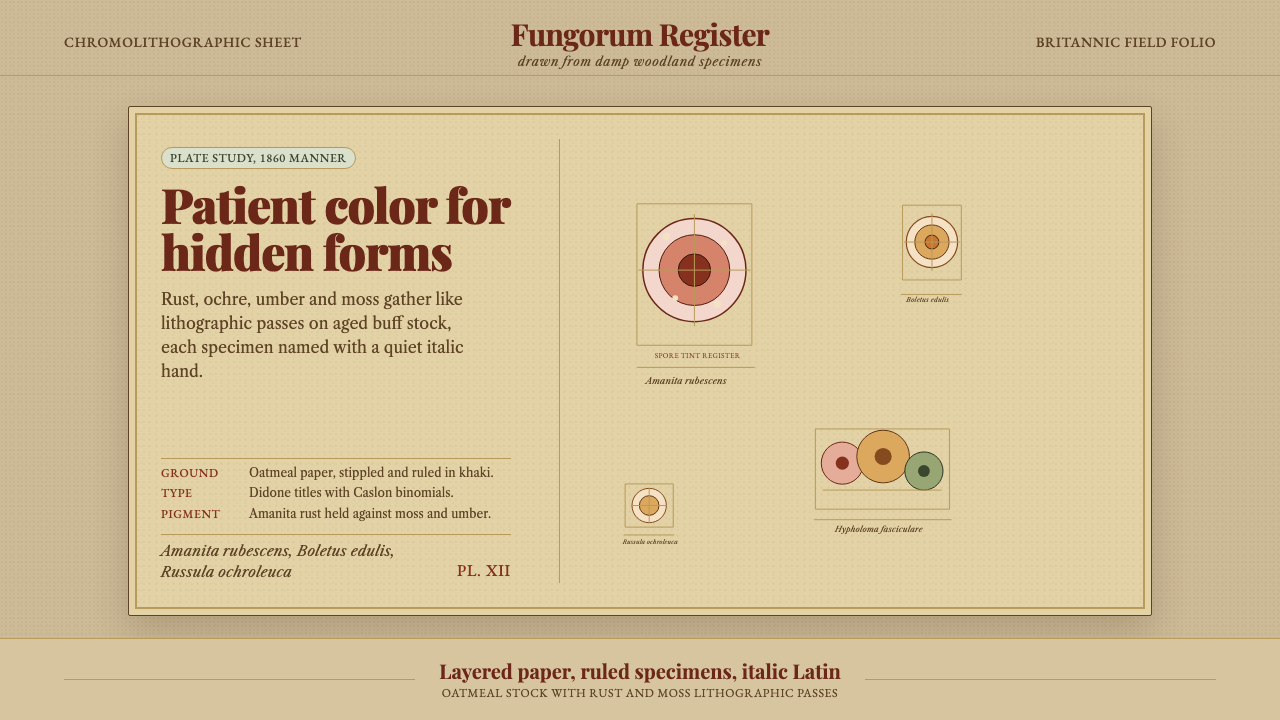 Victorian Mycology PlatePatient field science. Rust and moss specimens sit on stippled buff paper wit…
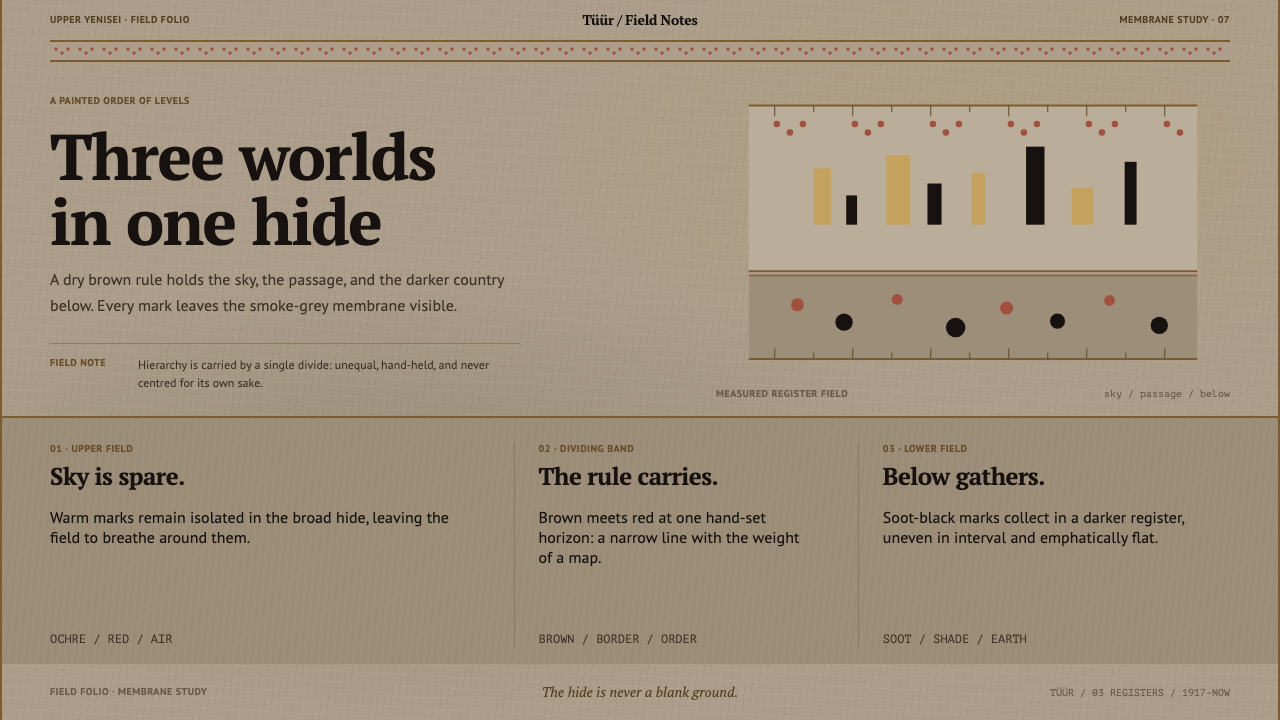 Khakas Shaman DrumA cosmology held by one rule. Smoke-tan hide, ochre marks, and a red-dotted M…
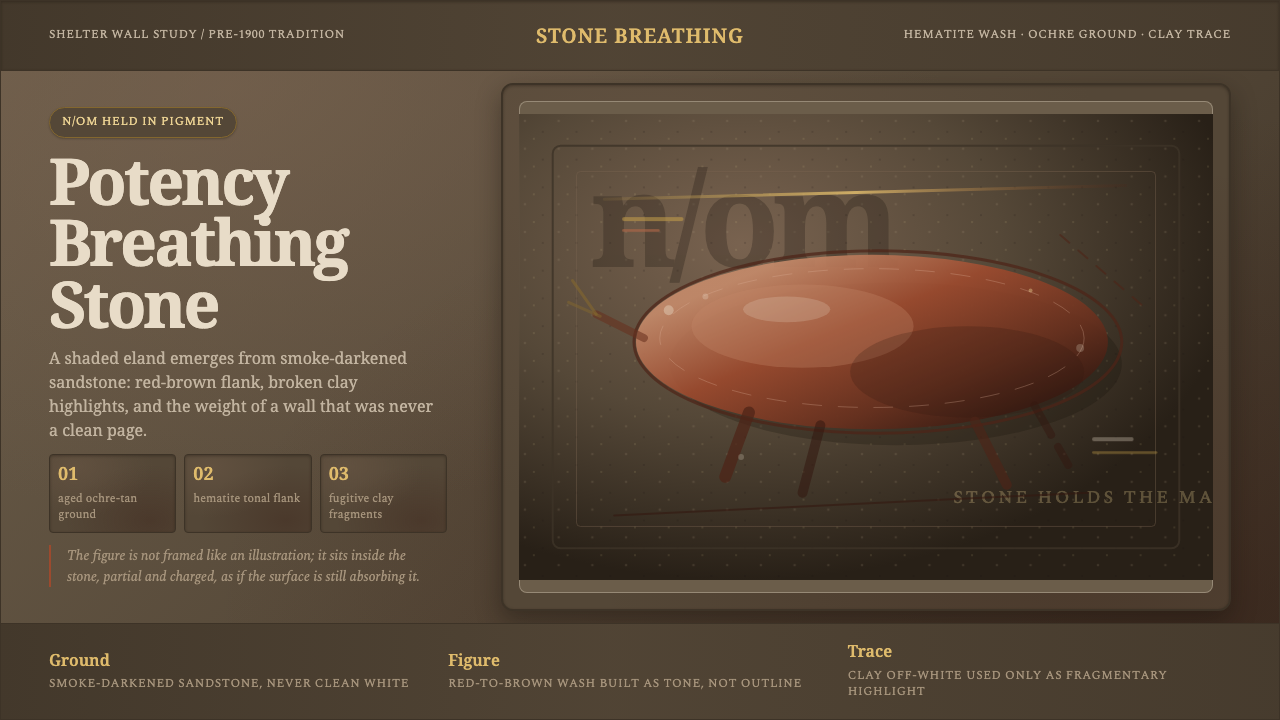 San Rock Art DrakensbergPotency stains the stone. Hematite gradients breathe over smoke-dark sandston…
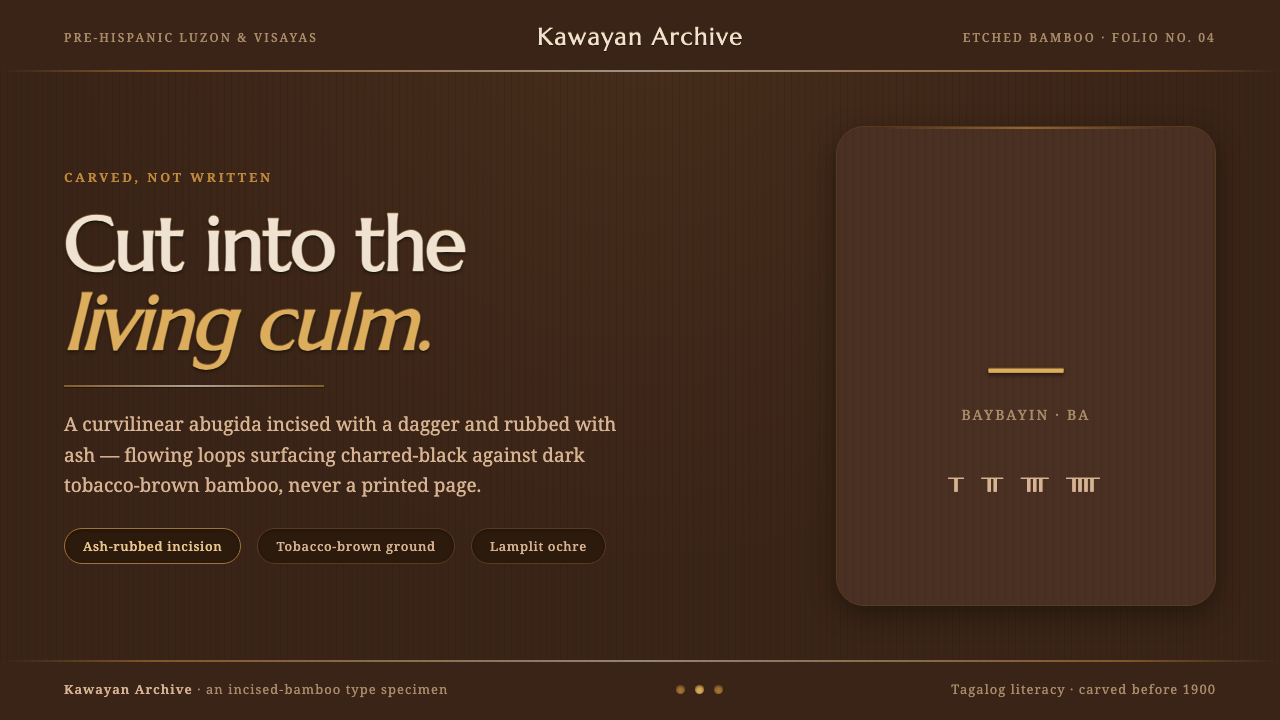 Baybayin ScriptCarved, not written. Curvilinear baybayin ash-rubbed into tobacco-brown bambo…
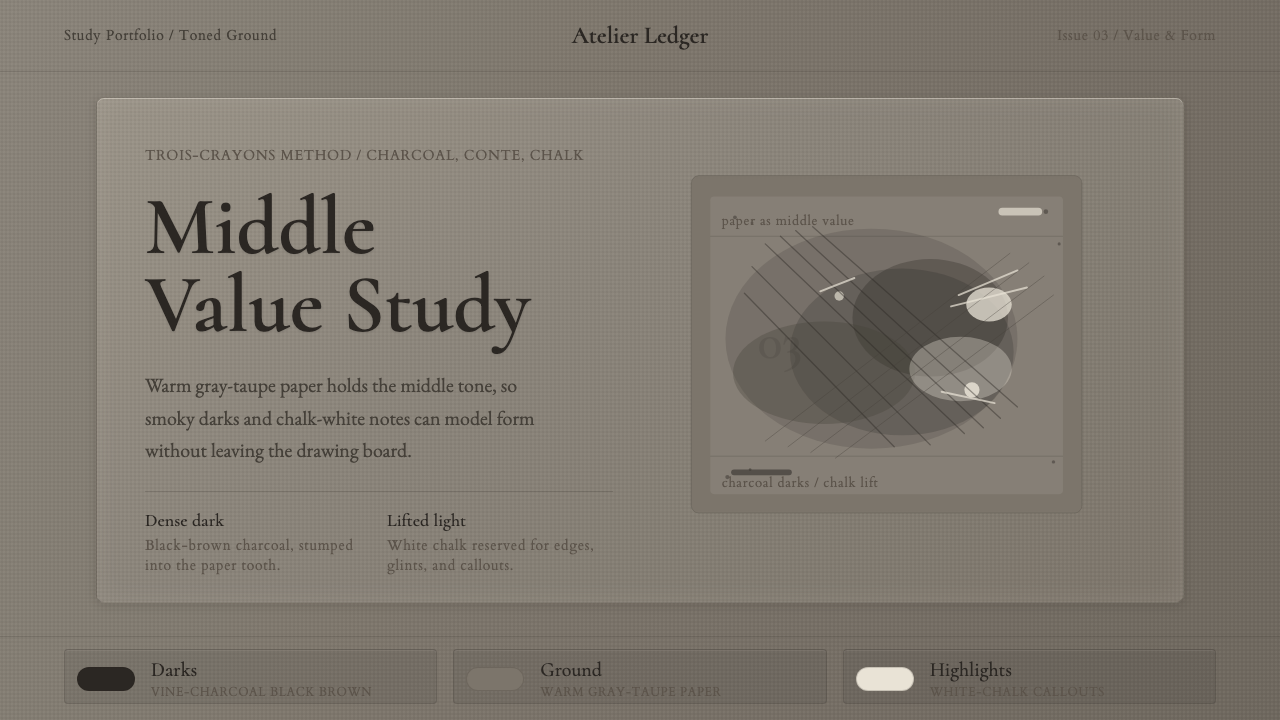 Charcoal & Conté DrawingAtelier calm, in middle value. Gray-taupe tooth, smoky charcoal, and chalk-wh…
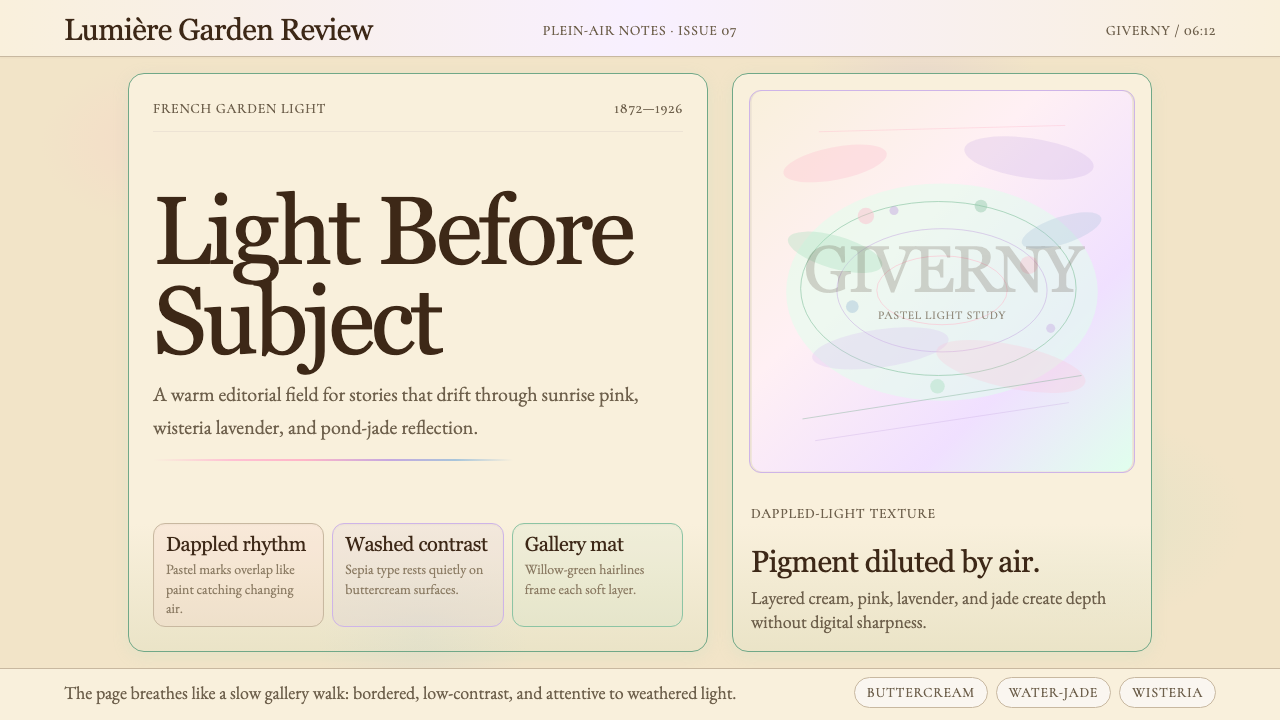 Claude Monet ImpressionistLight becomes the subject. Buttercream, pastel dapples, and Cormorant serif s…