What is Khakas Shaman Drum?
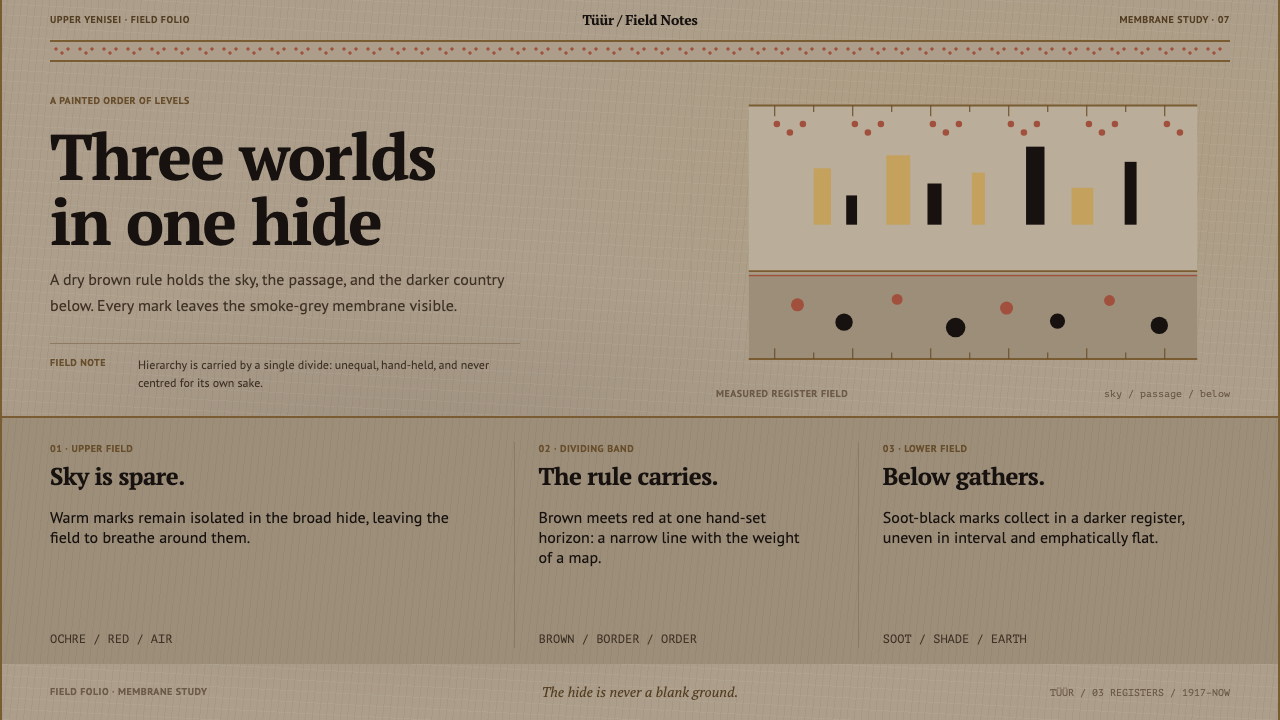
A Khakas shaman's tüür carries a whole cosmology on one smoke-tanned hide: a Milky Way border, a single line dividing sky, middle world and underworld, and hand-drawn figures leaning on either side of it.
Khakas Shaman Drum in brief
The tüür is the single-headed drum of the Khakas shamans of southern Siberia. Hide is laced onto an aspen frame, willow hoops brace the inside, a larch grip is cut behind the head, and an iron beam hung with pendants crosses the back. The membrane is smoke-greyed tan, and painted on it in black, red and brown is a cosmology: a border that reads as the Milky Way, and a line that cuts the head into sky, the middle world and the underworld.
The head of the drum works like a page. One horizontal band carries the entire hierarchy of the universe, and figures sit flat and frontal on either side of it: people, horses, deer, birches and black firs, leaning, unequal in size and unevenly spaced. They are drawn freehand rather than set out. The hide shows through everywhere, with its grain, its stretch marks, its smoke, and the wear where the beater strikes.
As a design reference, the style shows how a single dividing line can organise an entire composition, and how a surface that is visibly an object, not a screen, can carry meaning. Nothing is centred for the sake of being centred. The drum is also treated as a living thing: when its shaman dies, the hide is pierced. The style's materiality is therefore not nostalgia but something nearer to respect.
Where does Khakas Shaman Drum come from?
The tradition belongs to Khakassia and the Minusinsk basin in southern Siberia, and the reference record names it the Kača (Kachin) Khakas drum tradition. It places the tradition before 1900, and the sampled drum was collected in 1917. It sits within Siberian Turkic shamanism, in which the drum is the central instrument: not a decoration that accompanies ritual, but the means through which the shaman works.
The object is built from the surrounding landscape. Aspen supplies the frame, willow the hoops inside, larch the grip, and hide the membrane, with iron for the beam and pendants. Smoke has greyed the tan of the hide, which means the colour of the surface is partly a record of use. When the style asks for a smoke-tan ground, it is asking for a material that has been in the presence of fire, not a flat beige.
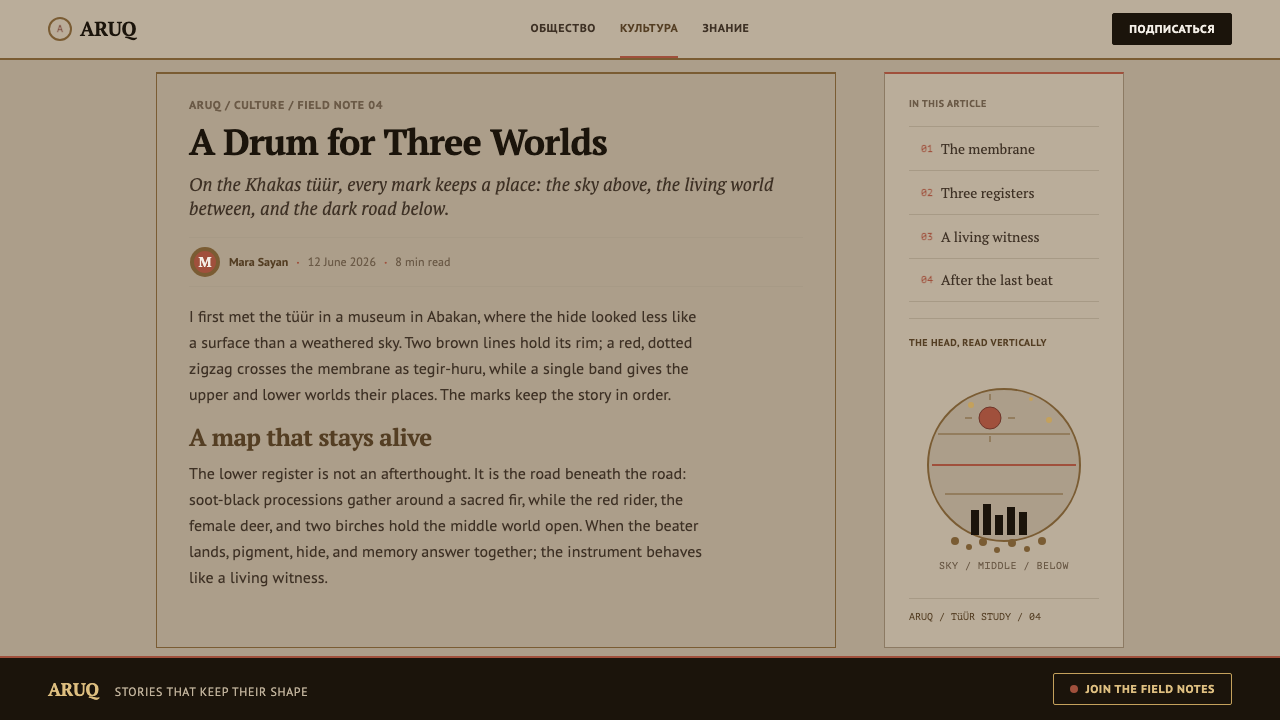
What is painted on the head is a map of the universe. A border of two brown lines flanks three strings of red dots in a saw-tooth edge, and this reads as the Milky Way, with the dots and crosses standing for stars. A dividing line of brown-red cuts the head into three unequal zones for the upper world, the human world and the lower world. Black, red and brown are the only pigments, and the figures beside the line, people, horses, deer, birch and black fir, are small, flat and drawn by hand.
The record also treats the drum through the lens of early-twentieth-century ethnographic collecting, and it lists three key names: J. J. Sederholm, Victoria Peemot and the Khakassia National Museum. That layer of documentation is why the painted head can be described closely today. It carries a responsibility with it. The drum was made as a working instrument, treated as alive, and its hide is pierced when the shaman dies, so any design that borrows its structure should do so with attention to where it comes from.
What defines the Khakas Shaman Drum look?
Smoke-Tanned Hide
The ground is hide that smoke has greyed into a warm, muted tan. It is not a flat colour: the surface carries grain, uneven absorption and slight variations in tone from soot and handling. Everything else sits on or in this ground, so it behaves as a material rather than a background. A faithful interpretation keeps a warm, slightly smoky neutral with visible subtle texture, and avoids clean, saturated beige.
The Milky Way Border
Two brown lines flank three strings of red dots with a saw-tooth edge, and the whole reads as the Milky Way, with dots and crosses as stars. This border is the style's signature ornament and its main framing device. It separates the painted cosmos from the rim of the drum, and it can be reused as a header strip, a divider or a progress marker made of small red dots and crosses.
One Line, Three Worlds
A single brown-red line cuts the head into sky, the middle world and the underworld, and the three zones are unequal. This one band carries the entire hierarchy. There is no tower of nested boxes, no stack of headings; a single decisive divider says what is above, what is between and what is below. Used in a layout, it is a powerful way to organise a screen with minimal structure.
Flat, Frontal Figures
People, horses, deer, birches and black firs stand flat and frontal on either side of the dividing line. They lean, they differ in size, and they are spaced unevenly, because they are drawn freehand rather than placed on a grid. There is no perspective and no shading. Each figure is a simple, readable silhouette, which makes the style a good match for flat illustration and icon sets with an intentionally hand-made feel.
Three-Pigment Restraint
Only black, red and brown are painted onto the tan hide. That is the entire palette. The restraint does a lot of work: it ties the figures, the border and the dividing line into one system, and it keeps the surface calm enough for the hide itself to remain the main texture. Resist adding a fourth or fifth hue, because the style depends on how few colours it has.
The Hide Always Shows Through
Nothing is opaque enough to hide the surface. Grain, stretch marks, smoke and the wear where the beater strikes all remain visible beneath and between the painted marks. The drum is an object that has been used, and the style keeps that evidence. In practice this means semi-transparent, material-aware layering of marks over a textured ground, and wear placed where it would honestly occur rather than scattered at random.
Not Centred for Its Own Sake
Composition follows meaning, not symmetry. The dividing line sits where it divides the worlds, figures lean toward and away from it, and the spacing responds to what is being depicted. The overall effect is balanced but not mirrored. For layouts, this means resisting the reflex to centre headings and blocks, and letting emphasis and weight settle where the content wants them.
Who shaped Khakas Shaman Drum?
Sederholm is the name the reference record attaches to the early-twentieth-century collecting through which the sampled drum, collected in 1917, entered documentation. His significance for a designer is indirect but real: the painted head and its wear survive as something that can be examined closely, and that is what allows a style to be built from it.
Peemot is listed among the key figures behind the reference. Her presence in the record points toward the interpretive side of the material, the reading of the painted head as a layered cosmology of sky, middle world and underworld rather than as a set of pictures. It is a reminder that the structure the style borrows is a way of understanding the world.
The Khakassia National Museum is the regional institution named in the record, which ties the reference to the place the tradition belongs to instead of leaving it to the collecting world alone. For designers, it is a pointer to where the object can be studied in its own context, and a prompt to credit the Khakas tradition when adapting its structure.
How do you use Khakas Shaman Drum today?
Khakas Shaman Drum is a style about one decisive divider and a surface that shows its material. Its structure is simple to apply: a smoke-tan ground, a single horizontal band that carries the hierarchy, a border of red dots and crosses, and a few flat, hand-drawn figures leaning on either side. The craft is in resisting the urge to tidy it up.
On slides, a cover can sit on the smoke-tan ground with a Milky Way strip of red dots along the top edge and one horizontal brown-red line across the slide, with the title above it and a small hand-drawn figure beneath. Content slides can use the divider to split the page into three unequal zones for context, main point and footnote. Data slides place the chart in the middle zone with annotations above and below, and keep icons flat and frontal, spaced by hand rather than snapped to a grid.
For web interfaces, the single band becomes a structural device. A page might hold a header zone, a main zone and a footer zone split by one visible rule rather than by nested cards. The dot-and-cross border can serve as a section header, a loading indicator or a progress strip. Buttons are solid brown-red or black blocks without gradients or floating shadows. Keep a subtle grain on large surfaces, but make sure text contrast remains comfortable, since the texture is a quality of the surface and not a reason to reduce legibility.
In editorial and marketing work, the style suits stories about folklore, cosmology, ethnography and museum collections, and brands that want to feel handmade and rooted. Hero compositions can use a few hand-drawn silhouettes on either side of a single line, with generous empty hide between them. Section breaks use the dotted border. Because the source is a ritual instrument, copy should be factual and respectful, and credit the Khakas tradition rather than describing the style with generic mystic language.
The most common mistake is cleaning the hide into a flat beige and the figures into an evenly spaced icon row, which erases the whole point. A second is adding colours beyond black, red and brown, which breaks the restraint that holds the system together. A third is multiplying dividers: the strength of the composition comes from a single decisive line, and a dozen rules dilute it. Finally, avoid using the imagery as costume or novelty. The drum is treated as alive, and a design borrowing its structure should show a similar seriousness.
Khakas Shaman Drum — FAQ
What is a tüür?
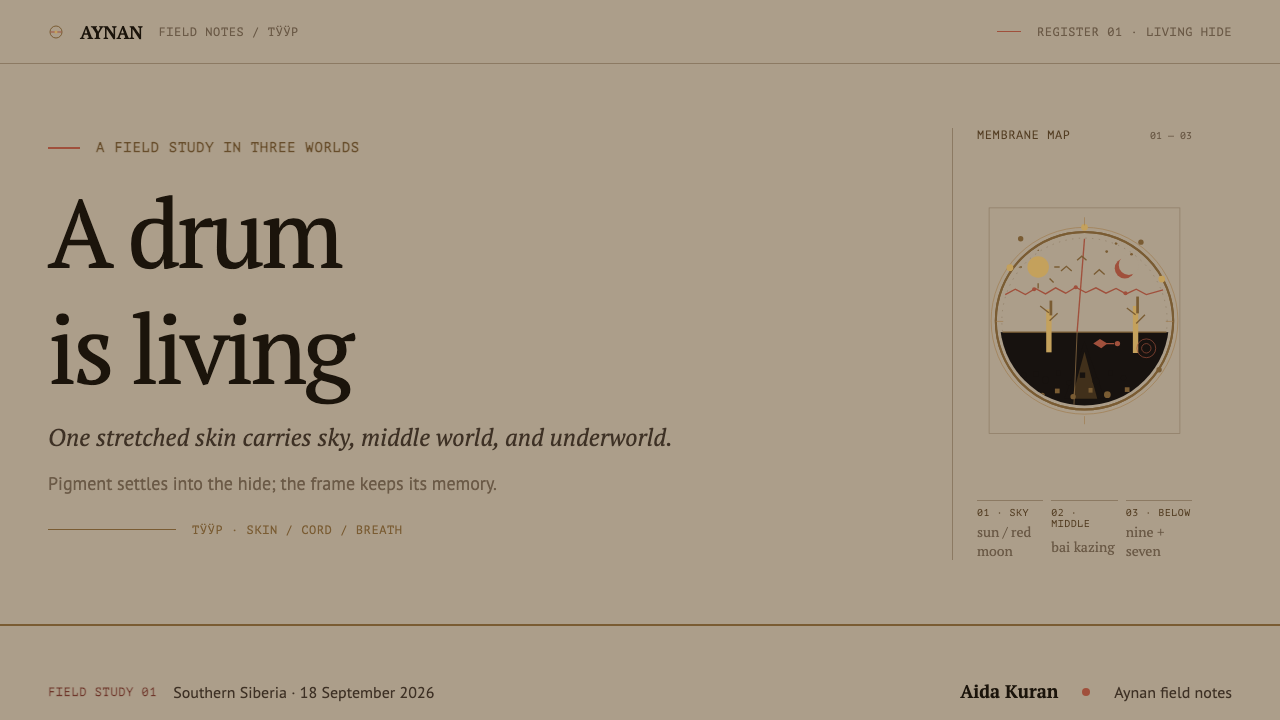
A tüür is the single-headed drum of Khakas shamans in southern Siberia. Hide is laced onto an aspen frame, with willow hoops inside, a larch grip behind the head and an iron beam hung with pendants. The smoke-greyed membrane is painted in black, red and brown with a cosmology: a Milky Way border and a line dividing sky, middle world and underworld.
What do the painted border and dividing line represent?
The border of two brown lines flanking three strings of red dots reads as the Milky Way, with the dots and crosses as stars. The brown-red dividing line cuts the head into three unequal zones for the upper world, the human world and the lower world. In design terms, one border frames the whole composition and one line carries the entire hierarchy.
Why must the hide show through everywhere?
Because the hide is not a background. It is the body of the drum, with grain, stretch marks, smoke and wear where the beater strikes, and the painted marks live on it rather than hiding it. Keeping the material visible is how the style conveys that it is an object that has been used. If the surface is cleaned into a flat fill, the cosmology loses its physical context.
Is it appropriate to use a shaman's drum as a design reference?
It can be, with care. The drum is a ritual instrument treated as alive, and its hide is pierced when the shaman dies, so it should not be treated as a costume or novelty. The respectful approach is to borrow structure, a single dividing line, a restrained palette and a visible material, to credit the Khakas tradition, and to avoid generic mystical language or frivolous use.
What colours does it use, and can it go dark?
The palette is smoke-greyed tan for the ground, with black, red and brown for everything painted on it. The reference is a light, warm, material surface, so a dark version departs from it. If you need one, keep the three painted colours and the single dividing line, make the ground a deep, smoky neutral that still shows grain and wear, and take care that the red dots remain legible.
Related design styles
 San Rock Art DrakensbergPotency stains the stone. Hematite gradients breathe over smoke-dark sandston…
 Victorian Mycology PlatePatient field science. Rust and moss specimens sit on stippled buff paper wit…
 Baybayin ScriptCarved, not written. Curvilinear baybayin ash-rubbed into tobacco-brown bambo…
 Adobe Pueblo SouthwestFeels made by hand. Earthen tan, turquoise trim, and viga rhythm shape the fr…
 Audubon Birds of AmericaAged natural history breathes. Buff rag paper, sepia rules, and italic binomi…
 Botswana Coiled BasketThe pattern keeps travelling. Bark-brown stepped bands wind across a straw co…