What is Robinhood 2023?
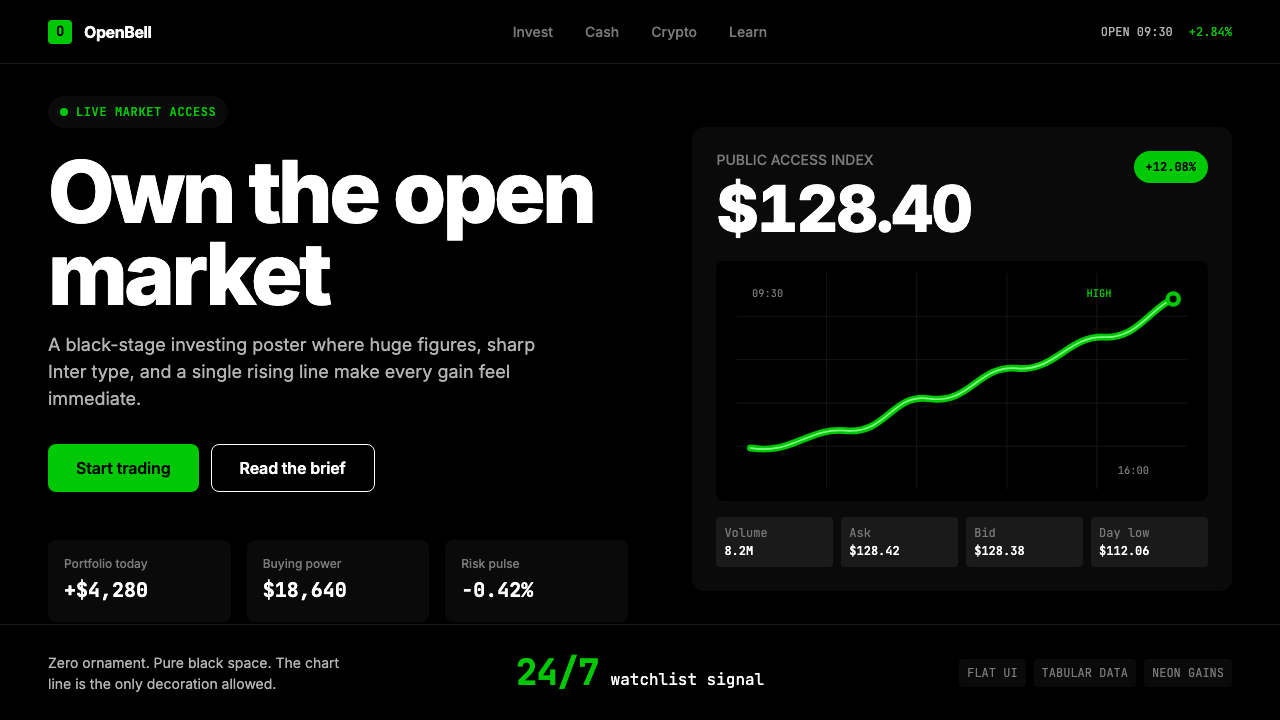
Robinhood 2023 proves that a pitch-black canvas, one neon-mint accent, and numbers set at billboard scale can make a retail brokerage feel as inevitable as the market itself.
Robinhood 2023 in brief
Robinhood 2023 is the visual identity language adopted by the American commission-free brokerage Robinhood during its post-meme-stock-era brand maturation. It is defined by a small number of decisions held with absolute conviction: a near-total black field, a single signature green used exclusively for upward momentum and calls to action, Inter set at extreme scale, and an almost total removal of decoration. The result is a fintech aesthetic that reads less like a bank and more like a flagship consumer-technology launch.
At its core, the system is built around legibility under pressure. Financial data — prices, percentages, portfolio values — is the primary content, and every typographic and chromatic choice is made to serve that data rather than compete with it. The black background eliminates ambient distraction. The neon-mint green communicates gain, movement, and possibility without requiring any explanatory copy. Numbers do not need to be explained when the environment is designed to make them impossible to ignore.
The aesthetic descends from the broader wave of consumer-fintech design that swept Silicon Valley in the 2010s — the conviction that personal finance could be made as immediate and emotionally resonant as a social media feed. But where earlier fintech brands often softened this premise with gradients, friendly illustration, and warm color palettes, Robinhood 2023 strips the premise to its hardest edge: confidence as a visual fact, delivered through darkness and light.

Where does Robinhood 2023 come from?
Robinhood was founded in 2013 in Menlo Park, California, by Stanford roommates Vlad Tenev and Baiju Bhatt, both children of immigrants who wanted to democratize access to financial markets. The founding product — a mobile-first, commission-free stock trading app — launched publicly in 2015 and grew explosively, reaching millions of accounts within its first few years. The original visual identity was deliberately approachable: softer greens, rounded forms, and a consumer-friendly affect that positioned the app as the antithesis of Wall Street's imposing architecture.
The visual identity underwent significant pressure testing between 2020 and 2022. The meme-stock episode of early 2021 — in which Robinhood halted trading in GameStop and other heavily shorted securities during a retail-investor short squeeze — brought the company intense public scrutiny and exposed a tension at the heart of its brand promise. The democratic, populist identity suddenly had to coexist with regulatory realities and institutional scrutiny. The brand needed to mature without abandoning its core claim of access.
The 2022–2024 visual refresh, developed by Robinhood's internal brand team, answered that tension by doubling down on confidence rather than charm. The softer, more approachable early palette was replaced by a system built on absolute black. The green signature color — always present in the brand's history as the color of a rising chart line — was pushed to its most saturated, most neon expression. Inter, a typeface engineered for screen clarity at a wide range of sizes, was adopted as the system typeface and deployed at sizes that turned financial data into visual statements.
The movements informing the 2023 identity are clearly legible: retail trading apps competing for attention on home screens, the gamification conventions of fintech broadly, and the post-Reddit-WSB reality that retail investors had demonstrated they could move markets. The design responded not by softening that reality but by embodying it — making the interface feel as serious and immediate as the consequences it represented. The Menlo Park origin matters too: the aesthetic has more in common with how Apple, Stripe, and Linear present software than with how JPMorgan or Fidelity present finance.
What defines the Robinhood 2023 look?
The Black Field
The dominant surface in Robinhood 2023 is an uncompromising, flat black — not charcoal, not near-black, but a pitch-black ground that absorbs all ambient distraction and makes every element placed upon it feel like a statement. This is not darkness for mood or luxury signaling; it is darkness as a functional decision. Against a black field, neon green reads at maximum intensity without needing increased saturation, and white type achieves the highest possible contrast ratio. The black is the silence from which numbers speak.
Neon-Mint Green as the System Accent
The signature green in Robinhood 2023 is unlike the conventional financial-green of stock tickers — it reads as neon, electric, alive. It is used with strict discipline: applied to chart lines representing upward movement, to calls to action, and to moments where the design needs to say something is happening now. It never diffuses or gradients; it appears as a flat, fully-saturated stroke or fill, then stops. Outside of this accent, the palette is entirely achromatic — only black, white, and the greens and grays that fall between them. The restraint makes every appearance of the accent color feel like an event.
Type at Extreme Scale
Robinhood 2023 deploys its system typeface at sizes that feel almost confrontational — portfolio totals and price figures that span most of the screen width, headlines that crowd into the frame like billboard copy. The size hierarchy is steep: the largest numbers are many times the scale of supporting labels, which themselves are tightly set and small. This extreme contrast in scale communicates priority without requiring any decorative framing — the size is the hierarchy. It also signals that the information is the product, not the chrome around it.
The Stock-Chart Line as Sole Ornament
In a system that otherwise eliminates all decoration, the single permitted ornament is the stock-chart line — a continuous stroke rendered in the signature green, sweeping upward through the composition. It functions simultaneously as data visualization and brand signature: it carries the informational message of a portfolio gaining value while also serving as the visual centerpiece of the identity. The line is never used ironically or downward; its role is exclusively aspirational. This limitation gives it unusual potency — every appearance reinforces the brand's fundamental promise.
Radical Subtraction of Decoration
No gradients, no shadows, no illustrations, no ambient textures, no iconographic ornament. The negative space in Robinhood 2023 is not empty; it is load-bearing. Every element that is absent creates room for the elements that are present to carry maximum weight. The absence of gradients means edges are decisions — a boundary between black and white is sharp and absolute. The absence of illustration means photography and data visualization carry the full representational burden, with nothing decorative mediating between the user and the content. The style's severity is its argument: this is what serious looks like.
Achromatic Supporting Palette
Beyond the signature green and the black field, the system's supporting palette is entirely achromatic — a range of grays and whites used for secondary text, card backgrounds, dividers, and inactive states. These intermediate tones never compete with the green accent and never suggest warmth or decoration on their own. They are structural — their job is to define depth and hierarchy within the monochromatic ground before the accent color arrives. This restraint is deliberate: a second color accent would dilute the neon green's signal value and introduce visual noise into a system designed around signal clarity.
Consumer-Technology Confidence, Not Financial Caution
Traditional financial design signals stability through restraint, heritage through serif type, and trustworthiness through institutional blue and gold. Robinhood 2023 rejects all three conventions. Its confidence is not institutional — it is the confidence of a company that believes it has already disrupted its category and is now daring the user to keep up. The visual language borrows from product launches, keynote presentations, and premium consumer hardware more than from any financial predecessor. This is a deliberate positioning signal: Robinhood is not a brokerage that learned to look like a tech company; it is a tech company that trades stocks.

Who shaped Robinhood 2023?
Co-founder and CEO of Robinhood, Tenev is the primary public voice of the company's mission to democratize finance. His communications and product decisions have consistently pushed the brand toward the conviction that financial markets are not inherently complex — they have been made to appear so by incumbents with an interest in keeping retail investors at arm's length. This premise is inseparable from the visual language Robinhood adopted: if markets belong to everyone, the interface should look like it knows that.
Co-founder of Robinhood and architect of its original product vision alongside Tenev, Bhatt represented the engineering and systems thinking that made zero-commission trading technically viable at scale. The clean, precise aesthetic of Robinhood 2023 — its refusal of excess, its confidence in reduction — carries the DNA of that original engineering philosophy: remove what is unnecessary and what remains will be powerful.
The 2022–2024 visual identity was developed internally, a notable choice in an era when brand transformations of this scale typically involved large external agencies. The in-house nature of the work meant the visual language was built by people who understood the product deeply — who knew where numbers appeared, at what scale, under what conditions of user stress or excitement. That intimacy is legible in the result: the system does not look designed for a pitch deck; it looks designed for real screens at real moments.
Though a typeface is not a person, Inter — the open-source typeface designed by Rasmus Andersson and released in 2017 — functions as a key creative collaborator in the Robinhood 2023 system. Designed specifically for screen readability across a wide range of sizes, Inter performs equally well at the microscale of a trading label and the macro-scale of a portfolio total displayed as a headline. Its neutral, precise letterforms carry numbers without competing with them — a design virtue that makes it particularly suited to a system where numerical content is the primary communication.
Not a designer but an event: Robinhood's decision to halt trading in GameStop and other volatile securities in January 2021 during the Reddit-driven short squeeze became the most significant pressure test in the company's brand history. The backlash forced a reckoning with what democratic finance actually meant under institutional constraint. The subsequent visual identity refresh can be read in part as a design response to that crisis — a choice to lean into confidence and directness rather than institutional softness, as if the brand itself was daring critics to misread its intentions again.
How do you use Robinhood 2023 today?
Robinhood 2023 is most naturally at home in presentation contexts that need to project confidence and urgency simultaneously — product pitches, investor decks, and executive briefings where being taken seriously is a precondition of the conversation. A cover slide in this style leads with darkness: the full slide field is black, a single line of neon-mint green or white type sets the thesis at maximum scale, and nothing else competes. The title is the slide. For content slides, the approach is equally spare — one key number or claim displayed at headline scale, supporting detail set tightly below in a smaller weight, and a horizontal divider rendered as a fine white or green rule rather than a decorative graphic.
Data visualization is where the style earns its keep most distinctly. Line charts become brand statements when rendered in the signature green against a black field — the visual vocabulary of a rising portfolio directly applied to whatever data is being presented. Bar charts and area charts should follow the same logic: use the neon accent for the primary series and an achromatic tone for comparison series. Avoid introducing additional accent colors for secondary data; the system's power comes from the green being singular. When negative trends must be shown, white or light gray serves as the contrast color — the system deliberately avoids red, which would introduce a competing emotional register.
For web interfaces and dashboards, the Robinhood 2023 approach requires disciplined application of the dark-field logic. A full-black background works at the product or marketing level but may create accessibility and readability challenges in dense information environments. The practical adaptation is to carry the spirit rather than the letter: use very dark near-black surfaces for primary panels, reserve the neon accent for interactive states and key metrics, and let secondary panels lift slightly toward dark gray to create depth without introducing color. Navigation should be typographic and unadorned — labels only, no icon decoration except where a geometric indicator is genuinely functional.
For editorial and marketing content, the style has strong poster energy that suits campaign headers, social cards, and out-of-home advertising. A full-bleed black background with a single data point — a return figure, a percentage, a date — set in maximum-scale white or green type communicates with the visual grammar of a financial headline. Supporting copy should be set small and secondary; competing with the hero number at any scale breaks the system's logic. For longer editorial formats, consider a light-on-dark treatment for hero sections and a conventional light-background treatment for body-text sections — the contrast between the two registers reinforces the primacy of the data display panels.
A common mistake when applying this style is treating the neon-mint green as a general accent that can appear anywhere emphasis is needed. In authentic Robinhood 2023, green carries one specific meaning — gain, momentum, the thing that is happening in the user's favor — and diluting that by using it for headers, decorative elements, or secondary labels destroys the system's signal clarity. A second common mistake is warming the black field toward dark gray or dark navy in the belief that softening will improve reception; this typically just produces an undistinguished dark-mode aesthetic without the stark force of a true black ground. The style requires commitment to its most extreme positions to function as intended.

Robinhood 2023 — FAQ
Is Robinhood 2023 a dark mode, or is darkness its default and only mode?
It is the latter. Robinhood 2023 was not conceived as a dark-mode variant of a light-mode system — the black field is the primary and canonical surface, not an inversion. This distinction matters when applying the style: a true dark-mode system is designed to function equivalently in light and dark contexts, with the same hierarchy and the same weight of accent. Robinhood 2023 functions only in darkness — the neon-mint green's intensity is calibrated specifically for a black ground, and the removal of all supporting color means there is no light-mode equivalent that preserves the system's logic. If you need a light-mode version for accessibility or context reasons, you are effectively designing a related-but-distinct system.
How does Robinhood 2023 handle negative data — losses, downward trends, warnings?
This is one of the more interesting constraints of the system. Conventional financial interfaces use red for losses and green for gains — the red-green binary is deeply embedded in trading culture. Robinhood 2023 leans heavily into green as its sole chromatic accent, which means the system must find other strategies for communicating negative states. In practice, the brand uses red sparingly and only where functional necessity clearly outweighs the system's chromatic restraint. For many downward or negative states, the approach is achromatic — white or gray text, a downward-sloping chart line in a muted tone — rather than introducing red as a systematic accent. This keeps the visual field clean but requires careful calibration to avoid making losses feel visually insignificant.
Can this style work for a brand that is not in fintech or investing?
Yes, but the translation requires understanding what the style is actually communicating beyond its surface vocabulary. Robinhood 2023 projects conviction, immediacy, and the claim that data speaks for itself. Those are values that transfer well to any domain where expertise and directness are the primary brand virtues: enterprise software, professional tools, data analytics platforms, performance hardware, and high-stakes consumer products like premium audio or gaming peripherals. The style struggles in contexts that call for warmth, approachability, or organic quality — food and wellness brands, children's products, community platforms, and any context where the user experience depends on the brand feeling human rather than precise. The test is whether the brand's core promise benefits from severity or is undermined by it.
What is the relationship between Robinhood 2023 and other high-contrast dark-field fintech aesthetics?
High-contrast dark interfaces proliferated across consumer fintech in the early 2020s, particularly after OLED screens made true-black backgrounds technically practical and visually striking on mobile hardware. Robinhood 2023 sits within this broader wave but distinguishes itself by its degree of chromatic reduction — most dark-mode fintech interfaces use multiple accent colors for category coding, status signaling, and decorative hierarchy. Robinhood 2023's commitment to a single accent color is the more extreme position, closer to the monochromatic discipline of luxury fashion branding than to the multi-accent logic of most trading apps. The nearest aesthetic relatives are not competing brokerages but product-launch presentation decks from Apple and the identity systems of brands like Linear and Vercel — software-native companies that treat restraint as a form of confidence.
Does the style age well, or is it tied to a particular moment in fintech culture?
Robinhood 2023 carries the mark of its moment — the post-meme-stock, post-zero-interest-rate maturation of retail fintech, when the industry needed to project seriousness after a period of criticism that it had gamified investing. That cultural specificity means the style may date as the cultural context shifts. However, its formal choices — high contrast, typographic hierarchy, chromatic restraint — have deeper roots in the principles of effective data display that are not trend-dependent. The elements most likely to date are the specific neon character of the green accent and the extreme display type sizing, which carry the energy of a particular moment in consumer technology marketing. The underlying structure — darkness, data at scale, one color to signal what matters — is resilient and will continue to read as disciplined and serious as long as those remain desirable values in the relevant context.
Related design styles
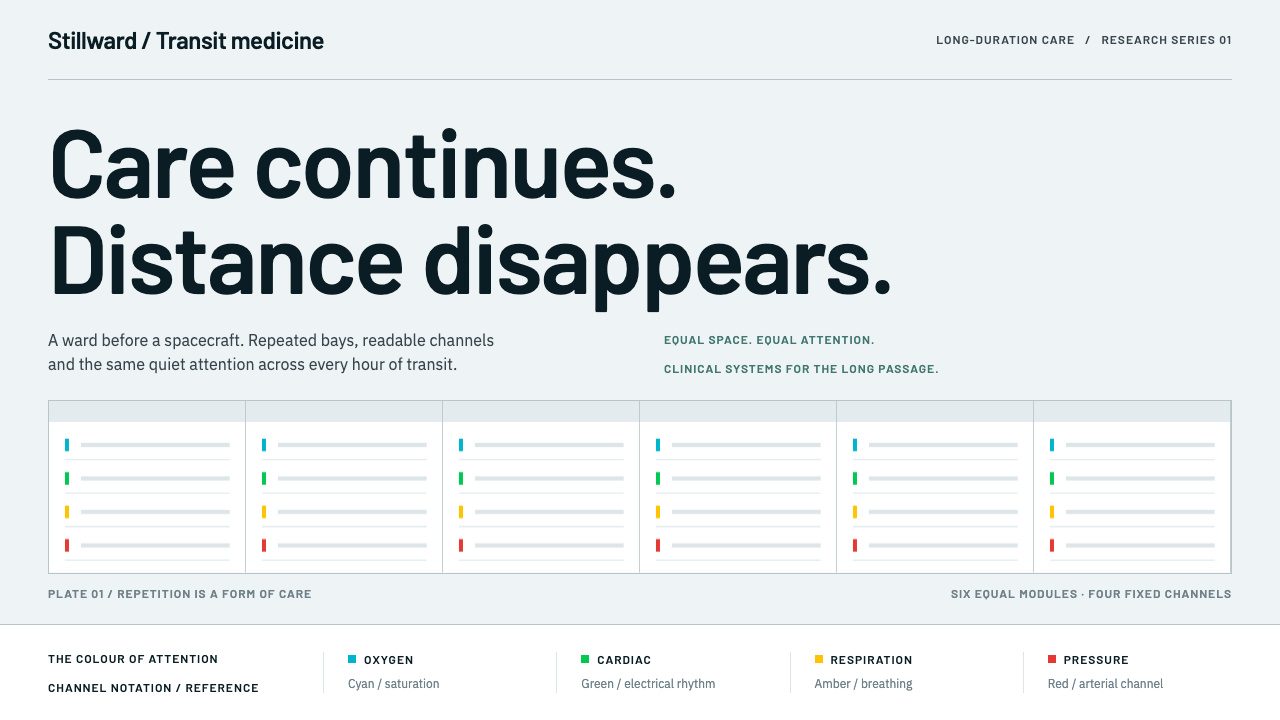 Cryosleep Transit WardCare without spectacle. Clinical white, equal bay grids and the fixed colours…
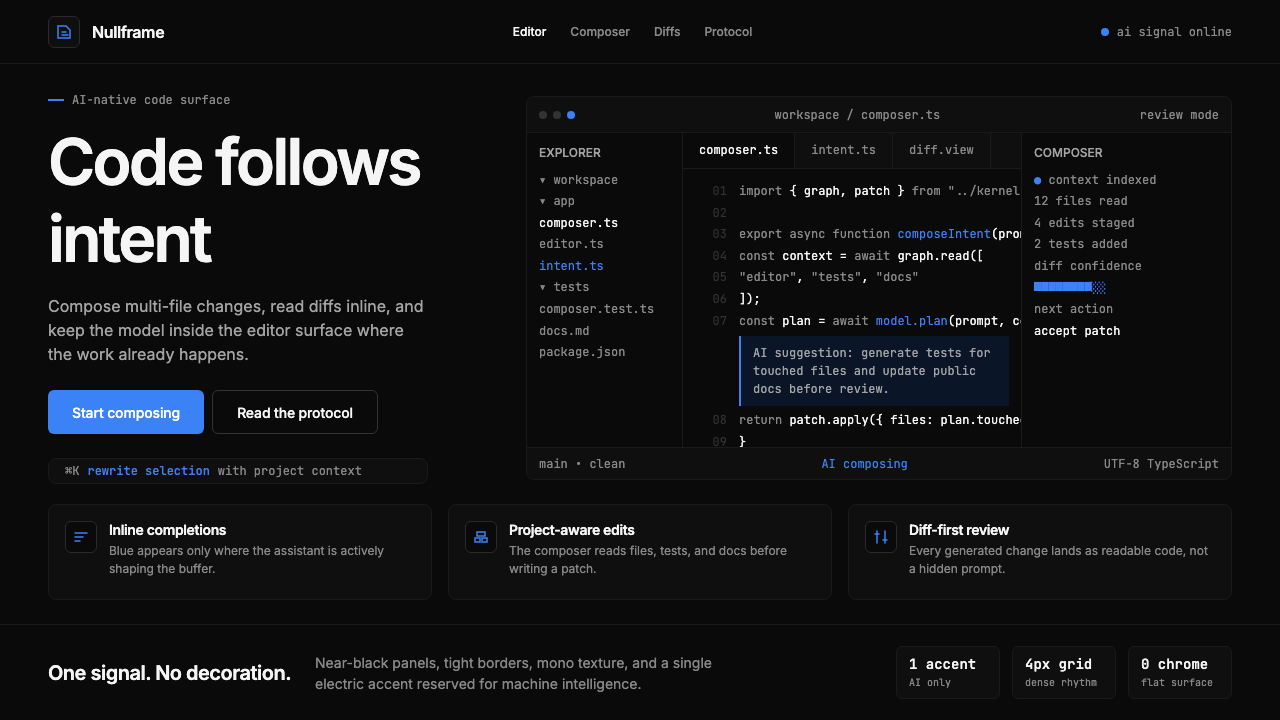 Cursor IDEAI-first code editor. Pure dark surfaces, off-white text, electric blue reser…
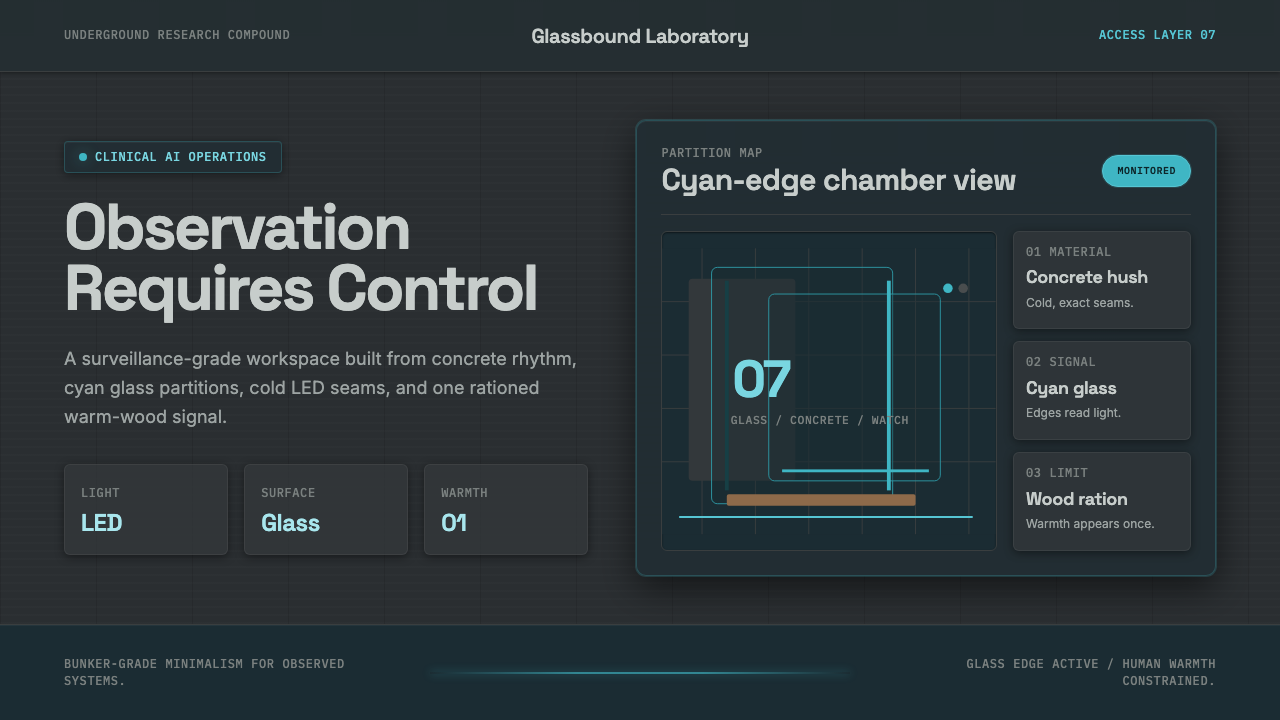 Ex MachinaClinical control, made visible. Concrete gray, cyan glass, LED seams, one woo…
 Feather MicroscopyPhysics glows in the dark. Cyan filaments and mono scale bars cut a black ima…
 Microsoft Fluent 2Disciplined translucency. Warm Mica neutrals, acrylic blur, and muted blue cr…
 Raycast Spotlight Launcher (2023)Obsidian confidence. Sharp red cuts through Inter rows and mono shortcut chip…