What is Rarámuri Running?
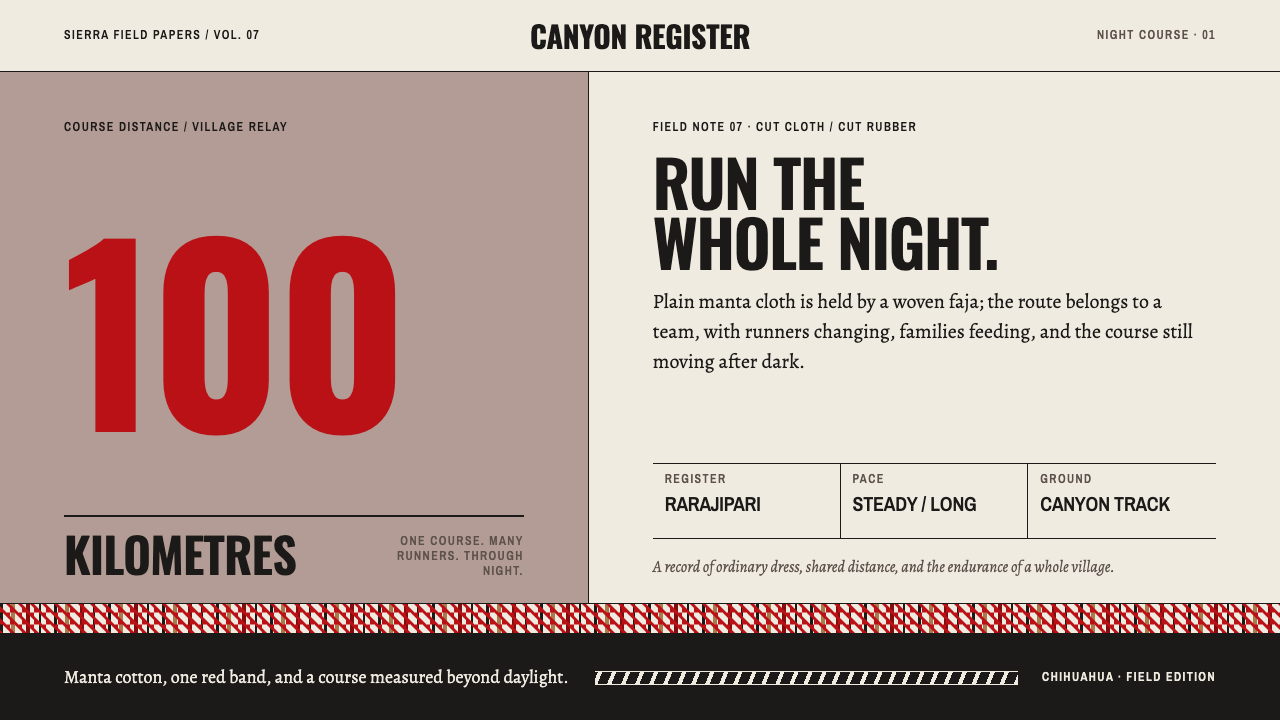
Rarámuri Running takes the running dress literally — plain cotton planes, one red band, and a woven belt whose stripes wander because a loom is not a machine.
Rarámuri Running in brief
Rarámuri Running is a design language built from the dress and the long-distance team racing of the Rarámuri, the people of the Sierra Tarahumara and the Barrancas del Cobre in Chihuahua, northern Mexico. Their name, in their own language, means something close to 'those who run on foot'. The system takes the structure of the running outfit literally: wide, flat planes of undyed hand-loomed cotton, a single saturated red band, and a woven belt of stripes, stepped diamonds and zigzags.
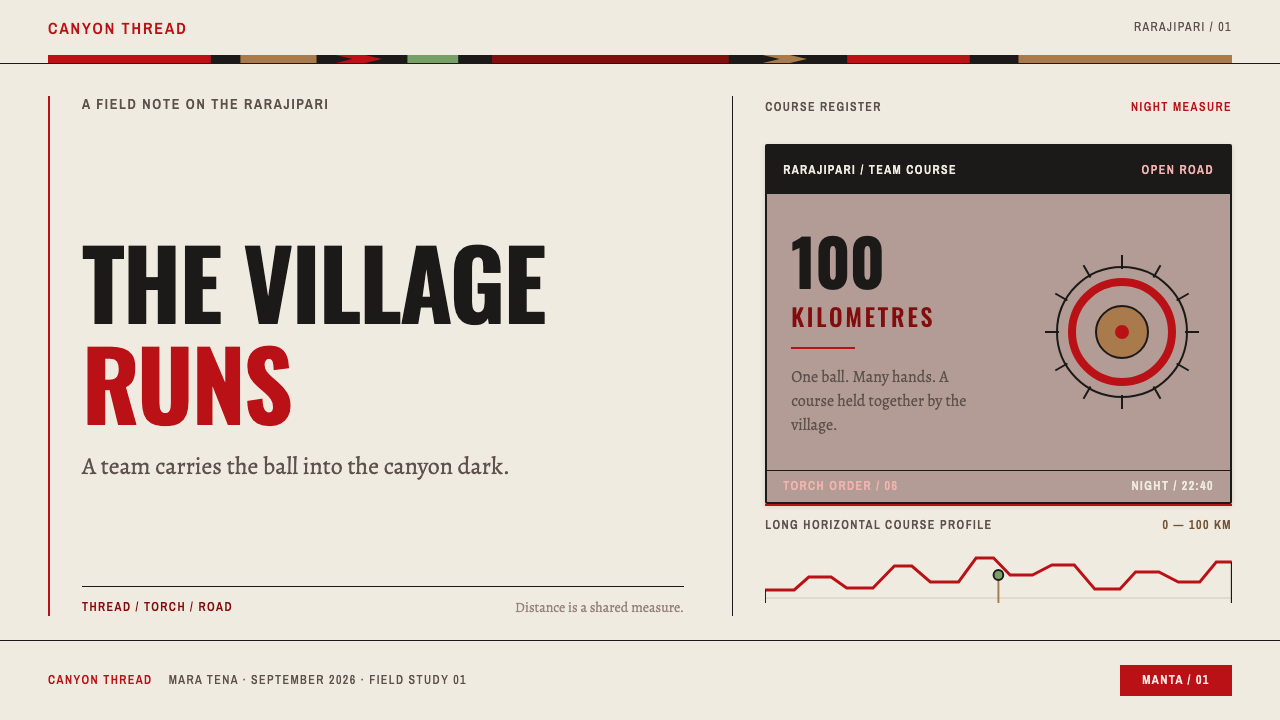
What makes it distinctive is how it treats distance. Numbers are set large, because the rarajipari, the village team race, can cross a hundred kilometres of canyon and carry on through the night. The race is collective: two teams, a wooden ball kicked along the trail, runners handing over to fresh legs, onlookers and bets. It is the opposite of the lone runner at sunset that most running design reaches for.
Visually the style is calm, warm and cloth-like. Backgrounds are off-white, the red is used as one decisive band rather than a general accent, and every divider is a piece of weaving rather than a thin hairline. Hand-woven patterns drift in width, since a backstrap loom is not a machine, so the system is regular without ever becoming mechanical.
Where does Rarámuri Running come from?
The Rarámuri live in the Sierra Tarahumara and the canyon country of the Barrancas del Cobre in Chihuahua, in northern Mexico. Tarahumara is the Spanish-language rendering of the name, and Rarámuri is how they name themselves. In rugged canyon terrain where travel is on foot, running is part of community life, and that fact is the root of everything in this system: the dress, the race and the way distance is spoken about.
The running dress is plain on purpose. It is hand-loomed manta cotton, an off-white zapeta (a loincloth) and a blousy shirt, held in by a densely patterned woven faja. A red koyera headband sits across the forehead. On the feet go akaka, huaraches whose soles are cut from worn car tyres, with the tread still plainly visible, laced on with hide. The sandal shows the material intelligence of the whole system: a discarded industrial object recut to a shape that suits the canyon.
The faja is made on a backstrap loom, which is why its stripes, stepped diamonds and zigzags never come out perfectly even. The weaver's body tension and hand set the width, so the pattern drifts. This is the design language's most important lesson in texture: regularity with a human tolerance. Cloth, weaving and sandal-making are the three crafts the source names alongside the culture itself, and they supply the three material textures that the system uses.
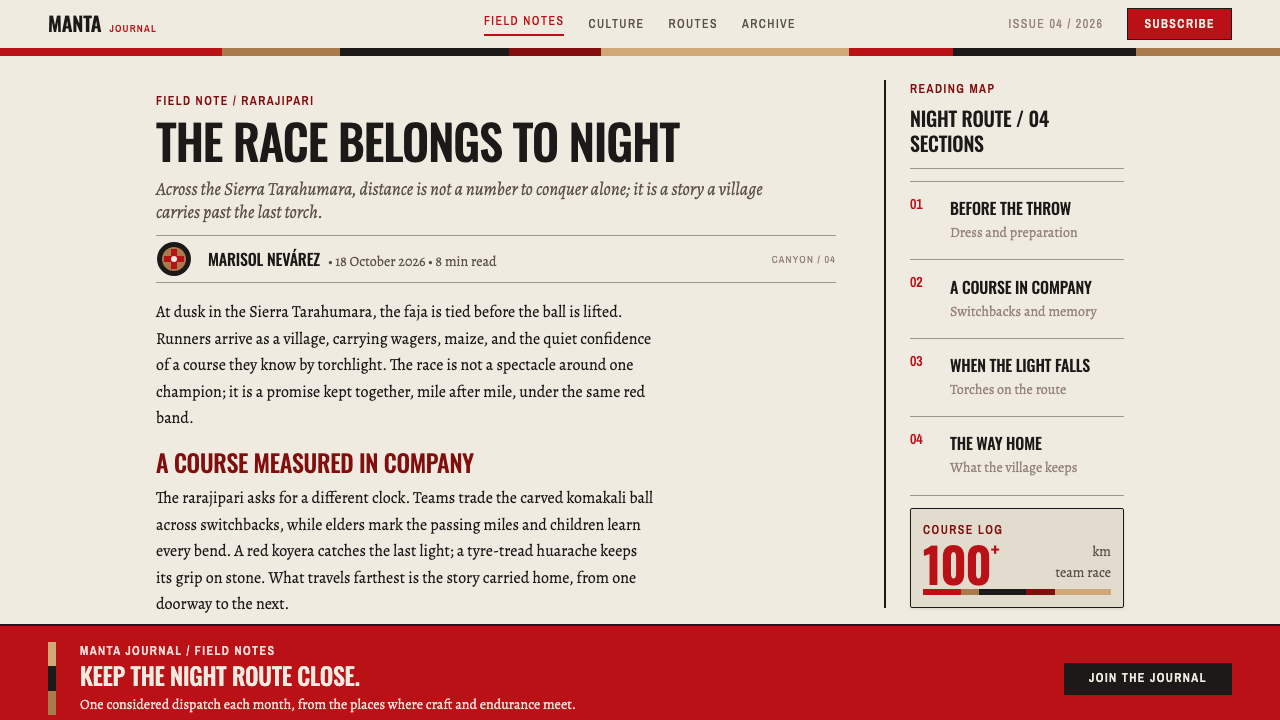
The documented period runs from 1900 to 1950, when both the dress and the race are most clearly recorded, and both are still run and worn today, so the system treats them as living culture rather than history. Carl Lumholtz, an early outside observer, appears among the key figures, as do two Rarámuri runners, Arnulfo Quimare and Silvino Cubesare Quimare. The rarajipari itself is a team race that can cross a hundred kilometres of canyon and run through the night with torches. It has bets, changeovers and spectators. It is a community event, not a solitary feat.
What defines the Rarámuri Running look?
Undyed Manta Ground
The ground is wide, flat planes of off-white cotton cloth: matte, slightly textured, warm and never glossy. There is a lot of it. Large areas of calm cloth let the few other elements, the red band and the woven stripes, read with real force, and they give the system the quiet of a long horizon rather than the crowding of a busy interface.
One Red Band
A single saturated red, taken from the koyera headband, cuts the cloth. It is used once per composition as a decisive stroke, not scattered as a general accent. The restraint is what gives it meaning: when red appears, it marks the one place the eye should go, in the way a headband marks a runner in a crowd.
Woven-Band Dividers
Instead of thin hairlines, sections are separated by a strip of faja pattern: stripes, stepped diamonds and zigzags. These are dense, geometric and rhythmic, and they contrast with the plain cloth around them. A divider here is something made, not something drawn, and it brings a sense of craft to every transition.
Drifting Widths
Because a backstrap loom is not a machine, the stripes in a woven band are slightly different from one another. The system keeps that tolerance: lines are regular enough to read as pattern but never snap to a perfect mathematical rhythm. The slight drift is what tells the viewer that a person made this, and it is the main defence against the look going sterile.
Large Numerals
Numbers run large, because distance is the subject. A race that can cover a hundred kilometres and carry on into the night is best told through its figures: kilometres, hours, changeovers. Numerals become structural elements of the layout, set big and plain on the cloth ground, not small data tucked into a corner.
Tyre Tread and Hide Lacing
The akaka huarache contributes a rougher, heavier texture: a visible tread pattern and cord-like lacing. In design terms these are accents of grit, used sparingly, such as a line that behaves like a lace or a textured band that echoes a sole. They keep the cloth-and-weaving softness grounded in a hard, practical object.
Collective, Not Heroic
The race is a village event with teams, handovers, bets and spectators, so the system favours groups, relays and many small parts over a single hero. Compositions are shared across several elements, and imagery shows people together. This is a deliberate rejection of the lone figure at sunset, and it is as much part of the visual language as the colour.
Who shaped Rarámuri Running?
Lumholtz was an explorer and early outside observer of the Sierra Tarahumara region, and his name stands for the first generation of written, external documentation of Rarámuri life. His account is part of the record that lets later designers know what the dress and the race looked like in the period from 1900 to 1950, while reminding us that the record was made by a visitor.
Quimare is named in the source material as one of the Rarámuri runners of the documented period. Including a runner by name matters: it keeps the style attached to a person and a community rather than turning it into an anonymous backdrop. Any design that borrows this look should remember that its subject is people who run, not a pattern that looks athletic.
Cubesare Quimare is the second Rarámuri runner named among the key figures. Together with Arnulfo Quimare, the name signals that the endurance culture behind this system belongs to named individuals inside a village tradition, and that the team race, the dress and the craft of making them are all carried by people, not abstractions.
How do you use Rarámuri Running today?
Rarámuri Running suits subjects built around endurance, community and slow, patient craft: charity runs, outdoor events, community organisations, textile and handmade brands, and any project whose real story is that a group got somewhere together. It is a calm system, so it rewards content that has something large and steady to say.
For presentation slides, let the cover be a wide, off-white cloth plane crossed by one red band, with a large number, such as a distance or a count of people, as the title element. Content slides can use a strip of woven pattern as the divider between sections and large numerals for key metrics. Data slides suit long horizontal bars and relay-style timelines in which distance reads as a band; keep red for the one value that matters.
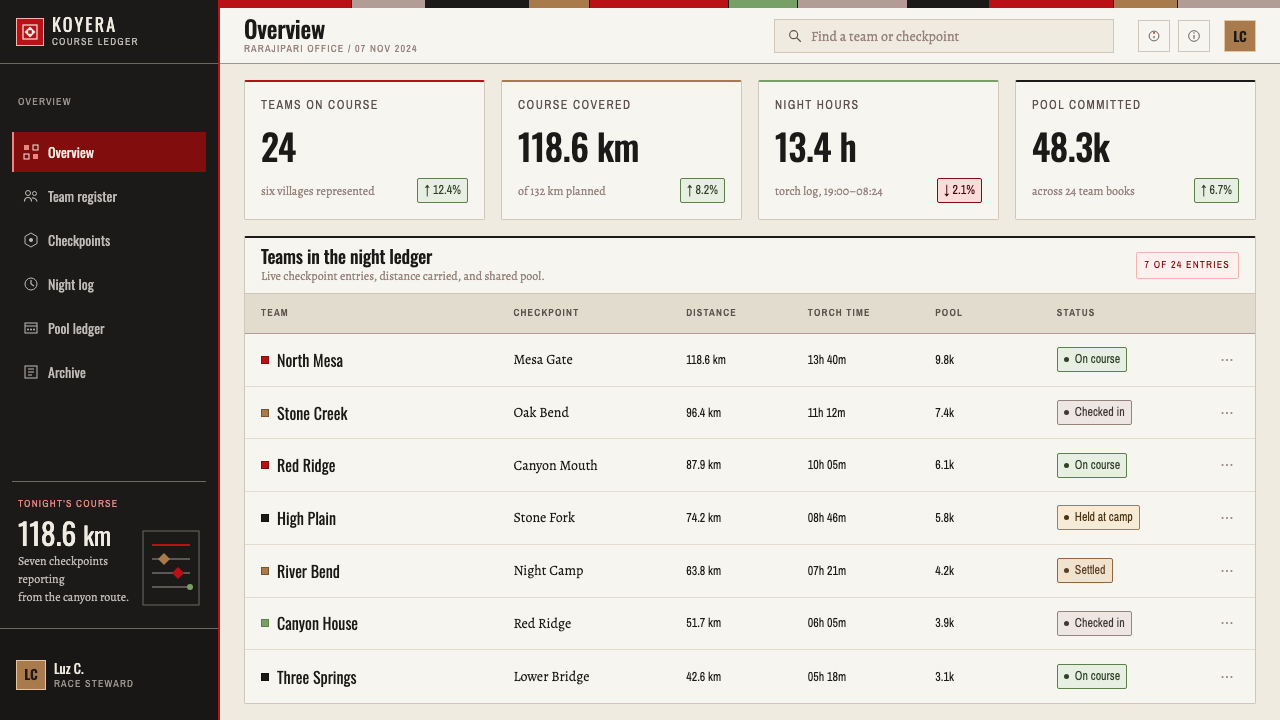
On the web it fits event and race pages, community fitness products and team-oriented dashboards. Use the red band as a header or footer, build progress indicators as woven strips rather than thin bars, and keep navigation minimal. Pricing pages with team plans sit well here, because the system favours groups. A product that tracks individual personal bests and leaderboards runs against its grain.
In editorial and marketing work it supports race reports, outdoor-brand stories and features on cloth, weaving and footwear. Photograph groups, handovers and spectators rather than a lone figure, and let the weave pattern act as a section marker. Credit the Rarámuri tradition where it is the source, and name garments and objects accurately, for example faja, koyera and huarache.
The common mistakes are to reach for the lone runner at sunset, to add neon sports colours beside the red, or to make the woven pattern perfectly machine-regular so that the human tolerance disappears. A subtler error is to treat the patterns as generic tribal wallpaper. They are specific woven forms from a specific community, so use them as dividers with purpose, not as filler.
Rarámuri Running — FAQ
What do Rarámuri and Tarahumara mean?
Rarámuri is the people's own name for themselves, and it means something close to 'those who run on foot'. Tarahumara is the Spanish-language rendering of that name, and it survives in place names such as the Sierra Tarahumara. In writing about the design, Rarámuri is the more respectful and accurate choice for the people, while Sierra Tarahumara remains the proper name of the mountain region.
What is the rarajipari?
The rarajipari is a village team race in which two teams run a wooden ball along the trail, kicking it as they go. It can cross a hundred kilometres of canyon and continue through the night with torches. There are bets, changeovers between runners and spectators. It is a collective event, which is why this design language favours groups and large numbers over a single heroic figure.
Why is there only one red band?
Because the red comes from a single object, the koyera headband, and the system uses it the same way: once, decisively, against a large calm plane. If red is repeated everywhere it stops marking anything. Keeping it to one band per composition preserves its meaning and keeps the cloth planes quiet.
Can I use the woven patterns purely as decoration?
It is better not to. The stripes, stepped diamonds and zigzags are specific woven forms from a specific community, and in this system they do a job: they divide sections and bring craft into transitions. Use them as dividers or bands with a purpose, keep their hand-woven drift, and avoid tiling them across backgrounds as generic pattern.
Does it suit fitness and sports apps?
It suits team-based and community-based ones, such as club events, charity runs and group challenges, where the story is shared effort over distance. It suits personal-best trackers and competitive leaderboards much less, because the system celebrates relays, handovers and collective endurance. Think of the village race rather than the stadium sprint.
Related design styles
 Bugis PinisiSailcloth made resolute. Vermilion, chrome and cobalt bands cut a warm white…
 Amauta MagazinePrint with conviction. Vermilion blocks and heavy slate-navy type bite into b…
 Nepali Dhaka TopiPattern becomes structure. White diamonds and madder-red hits advance row by…
 Palauan Dilukai Gable FigureGuardian symmetry on old wood. Ochre red, yellow and soot black lock each fla…
 Puerto Rican Bomba & PlenaNight festival dignity. Drum-red stripes and cream Playfair type on deep trop…
 Aboriginal Wandjina KimberleyAncestral presence in stone. Chalk white haloes and red ochre outlines sit on…