What is Nepali Dhaka Topi?
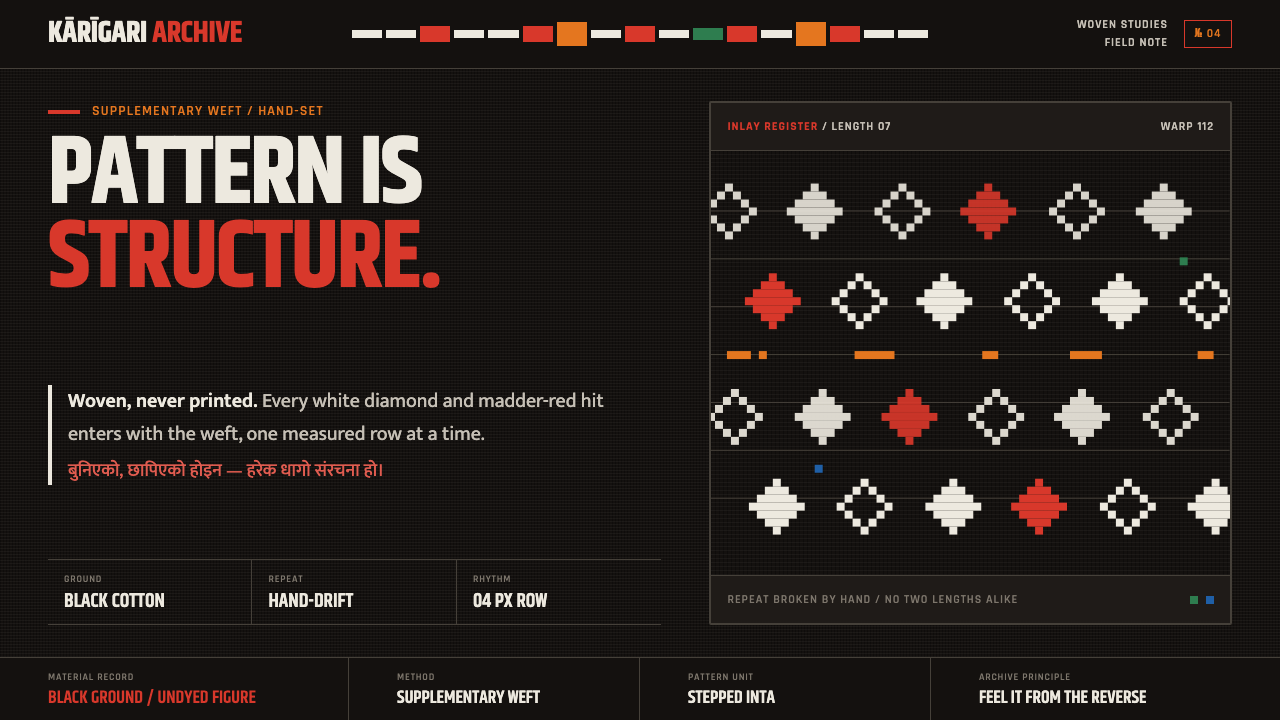
Dhaka cloth doesn't print its pattern — it weaves it, one extra weft thread at a time, until every white diamond is something you can feel from the back of the cloth.
Nepali Dhaka Topi in brief
Dhaka cloth is woven, not printed. A weaver works a second, coloured weft thread alongside the plain ground weft, but only through certain selected sheds — the openings a loom creates in the warp for a weft thread to pass through. Because the coloured thread is only ever introduced at those chosen points, the resulting pattern is not a surface applied to the cloth after the fact; it is the cloth's own structure. Turn the fabric over, and the same white diamonds and red accents are visible from the back exactly as they are from the front.
The brimless cap cut from this cloth — the Dhaka topi — became Nepal's national headwear, worn across the country regardless of whether a given wearer's own family ever wove Dhaka cloth themselves. That national adoption fixed the cloth's pattern vocabulary in the public eye: stepped white diamonds advancing in orderly rows, punctuated by hits of red, against a dark ground.
This design system follows the loom's own rules rather than treating the pattern as free-floating decoration. Black cotton is the base page. Pattern arrives strictly in weft rows, quantised to a steady vertical rhythm — nothing drifts or floats independent of that row structure. Red and white carry almost the entire visual load; orange appears as occasional punctuation; green and blue show up rarely enough that each appearance registers as a distinct event rather than a routine color choice. And because a weaver restarts each new pattern from memory rather than a fixed template, no two lengths of cloth are ever perfectly identical — a small, deliberate irregularity that a faithful system should leave room for rather than eliminate.
Where does Nepali Dhaka Topi come from?
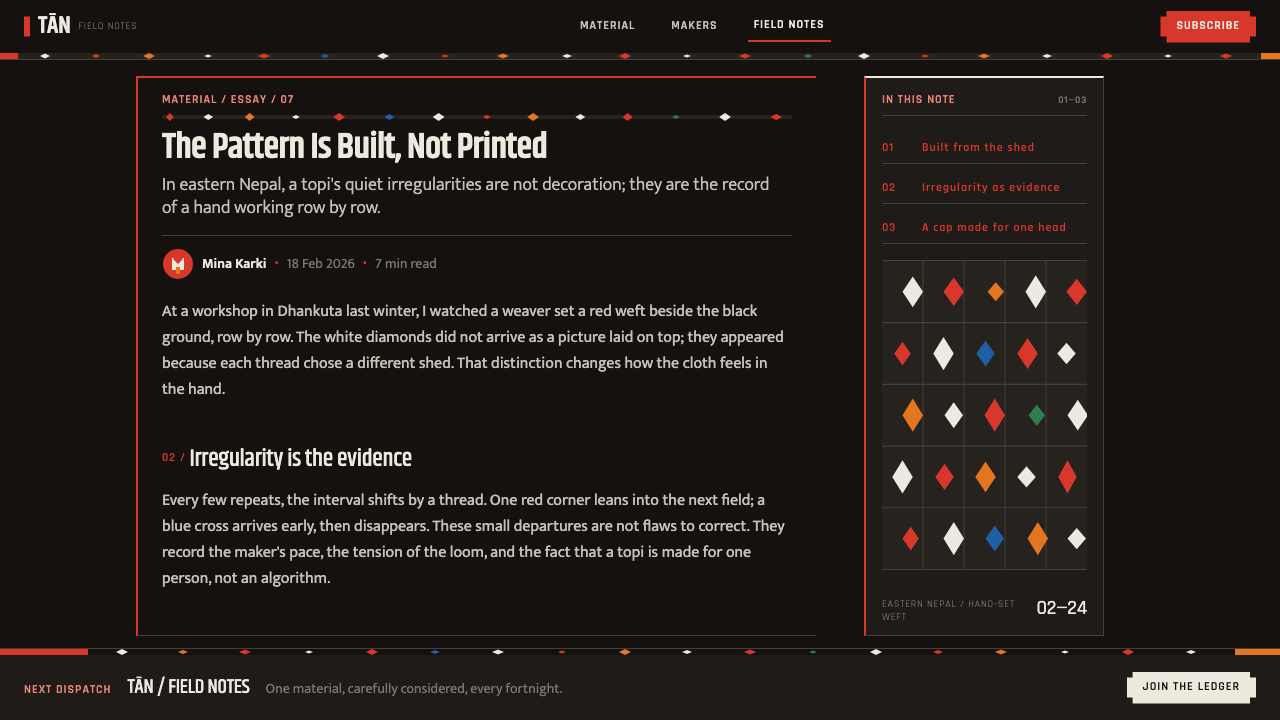
Dhaka weaving is centered in eastern Nepal, particularly the districts of Terhathum, Palpa and Tansen, and Dhankuta. The technique belongs to a wider South Asian family of supplementary-weft inlay weaving, in which a second thread is added to a base cloth's structure rather than printed or embroidered onto its surface afterward. The pattern vocabulary most closely associated with Dhaka cloth today, and the cap's rise to national status, both date to roughly 1900 to 1950.
The weaving process itself explains why the pattern reads as structural rather than decorative. As the weaver works the ground weft across the loom, they introduce a second, coloured weft only through specific sheds chosen to build up the diamond and accent motifs row by row. This is skilled, memory-based work rather than something copied from a fixed written pattern book — a weaver carries the sequence of sheds needed for a given motif in their own hands and memory, restarting it at the beginning of each new length of cloth. That reliance on memory rather than a template is exactly why no two pieces of Dhaka cloth turn out perfectly identical, even when they are meant to repeat the same design.
As the Dhaka topi rose to national prominence in the first half of the twentieth century, a distinction settled into how it was worn: a plain, unpatterned black cap for formal and official occasions, and a patterned cloth cap — carrying the woven diamonds and red accents — for everyday wear. That split meant the decorative weaving tradition and its plainer counterpart both remained current at once, each suited to a different register of daily life rather than one replacing the other.
The palette itself shifted again later in the century: acrylic yarns, which brightened the available color range, entered common use only after 1980, sharpening the contrast of the white diamonds and red and orange accents against the black ground beyond what the earlier materials could achieve. The weaving itself has continued to be carried by Limbu women weavers and household weavers in districts such as Terhathum, as well as by cooperative weavers organized in Dhankuta — a shift, over time, from purely individual household production toward some collectively organized weaving as well.
What defines the Nepali Dhaka Topi look?
Color
Red and white carry almost the entire visual weight, set against a black ground. Orange appears only as occasional punctuation, and green or blue are rare enough that each appearance reads as a distinct event rather than a default part of the palette.
Woven Structure
Pattern is structural, not surface decoration. A motif built from supplementary weft is visible and legible from both sides of the cloth, because the coloured thread runs through the fabric itself rather than sitting printed on top of it. A system drawn from this logic treats pattern as load-bearing — part of what a surface is built from, not an overlay applied afterward.
Vertical Row Rhythm
Pattern is quantised to a steady vertical rhythm defined by weft rows — nothing drifts free of that row structure. Motifs advance row by row up or down a surface rather than floating at arbitrary positions.
Stepped Diamond Geometry
The primary motif is a stepped diamond — a shape built from small horizontal steps rather than a smooth continuous outline, a direct consequence of being constructed one weft row at a time. Curves are approximated in steps rather than rendered smoothly.
Deliberate Irregularity
Because each new length of cloth is started from memory rather than copied from a fixed template, repeated motifs are never perfectly identical from one repetition to the next. A faithful system leaves room for small, human variation within a repeating pattern rather than enforcing pixel-perfect uniformity.
Ground
The base surface is black cotton — a genuine dark ground rather than a neutral gray or off-white — against which the white diamonds and red accents achieve their full contrast.
Formal and Everyday Register
The tradition carries two distinct registers at once: a plain, unpatterned black surface for formal or official contexts, and the full patterned version — diamonds, red hits, occasional orange — for everyday use. A system can borrow either register depending on whether the context calls for restraint or for its full decorative vocabulary.

Who shaped Nepali Dhaka Topi?
Limbu women weavers are central to the Dhaka weaving tradition, carrying the supplementary-weft technique and its memory-based pattern sequences through direct practice rather than written instruction. Their work sustains the specific combination of stepped diamond motifs and rationed red, orange, green, and blue accents that defines the cloth's visual vocabulary.
Household weavers in Terhathum represent the tradition's home-based production model, in which weaving skill and pattern knowledge are typically passed down within a family rather than taught through formal institutions. This household model has long been one of the primary ways the technique and its motif vocabulary have been maintained across generations.
Cooperative weavers organized in Dhankuta represent a more collectively structured approach to Dhaka production, sitting alongside the household model rather than replacing it. Their organized production reflects how the craft has adapted, in more recent decades, to operate at a somewhat larger and more coordinated scale.
How do you use Nepali Dhaka Topi today?
This system transfers well anywhere a pattern needs to feel load-bearing and structural rather than like a decorative overlay — anywhere the underlying content is already organized into rows, and the visual style can grow directly out of that structure rather than being applied on top of it.
On presentation slides, a cover works well with a border or frame built from the stepped diamond motif in white and red against black, treating the pattern the way a woven edge would function on real cloth. Content slides benefit from organizing information in discrete horizontal bands, echoing weft rows, rather than a free-floating layout. Data is best shown with stepped, blocky charts — bar charts and step charts rather than smooth curves — since the whole visual system is built from discrete rows rather than continuous lines.
For web interfaces, the palette suits dark-mode products that want a confident red-and-white accent system against black rather than a soft neutral one. Row-based components — tables, lists, step trackers — are a natural fit for the underlying row-quantized logic, and small variation between otherwise repeating elements, such as slightly different accent placement across cards in a grid, can echo the handwoven original's memory-based irregularity without looking like an error.
In editorial and marketing contexts, the style supports heritage and national-identity storytelling particularly well — packaging, cultural campaigns, or event branding that wants a specific, structural pattern rather than a generic border. A stepped diamond band works as a strong, recognizable framing device around a headline or a product image.
The most common mistake is smoothing the stepped diamond motif into a perfectly curved shape, which erases the exact quality that marks it as woven rather than drawn. A second mistake is treating red, white, orange, green, and blue as an equally weighted color set instead of a ranked one — the system depends on red and white doing almost all of the work, with orange as occasional punctuation and green or blue appearing rarely enough to still feel like an event.
Nepali Dhaka Topi — FAQ
Is the Dhaka pattern woven into the cloth, or printed onto it?
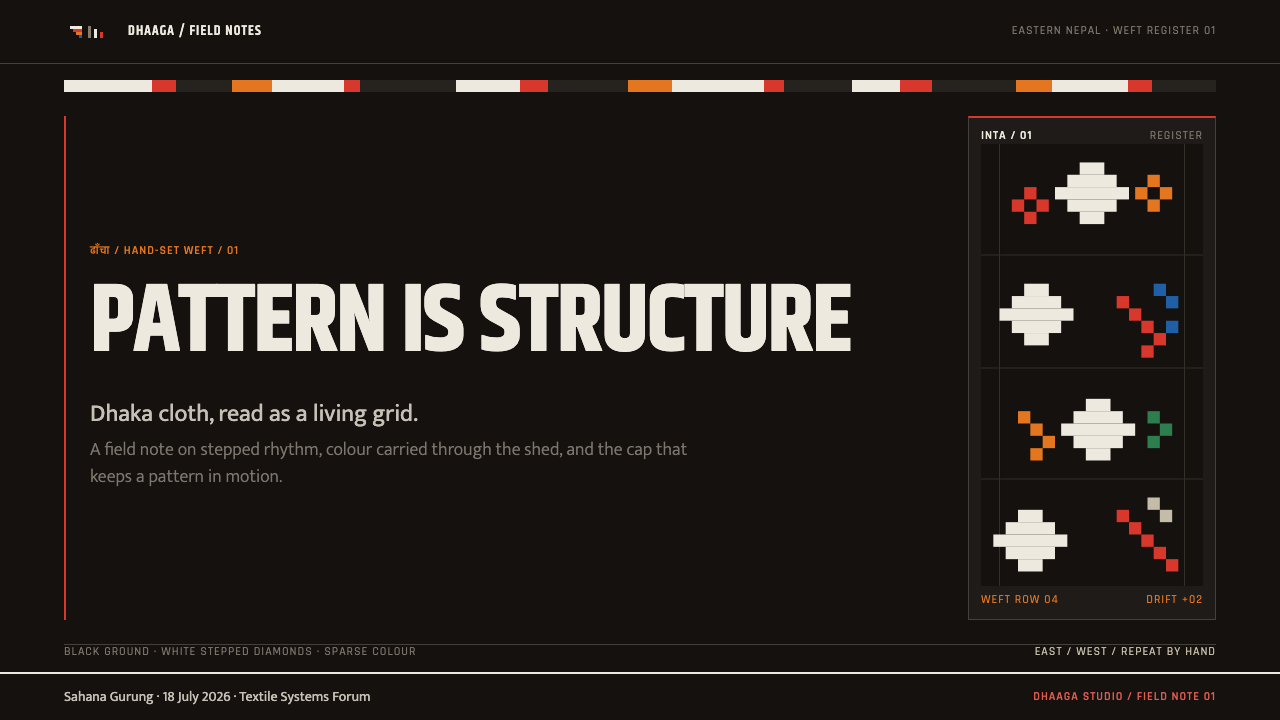
It is woven, not printed. A second, coloured weft thread is introduced alongside the plain ground weft only at specific points in the weaving — selected sheds chosen to build up each diamond and accent — so the pattern becomes part of the cloth's own structure rather than a layer added afterward. That is why the same motif is visible from both the front and the back of the fabric, which would not be true of a printed pattern.
Why does the same cap exist in both a plain black version and a patterned version?
Because the cap serves two different registers of daily life. As the Dhaka topi rose to national prominence, a plain, unpatterned black cap became the expected choice for formal and official occasions, while the fully patterned version — with its woven diamonds and red accents — remained the everyday choice. Both versions are authentic parts of the same tradition; they simply answer different social contexts rather than representing an earlier and a later stage of the style.
Why is no two pieces of Dhaka cloth ever exactly identical?
Because the pattern sequence lives in the weaver's memory rather than in a fixed, written template. Each time a weaver starts a new length of cloth, they rebuild the sequence of sheds needed for a given motif from memory, and small variations naturally creep in from one repetition to the next. This is not considered a flaw in the tradition; it is simply how handwoven, memory-based production works, and a system honoring the style should leave room for the same kind of small variation rather than demanding pixel-perfect repetition.
Can this style work on a light background instead of black?
It works against the grain of the tradition, but not impossibly. The system depends on red and white achieving strong contrast against a genuinely dark ground, and the black cotton base is treated as a deliberate, load-bearing part of the design rather than an incidental choice. Moved onto a light background, the same red and white accents lose the sharp, high-contrast quality they have on black, and the pattern reads as merely colorful rather than structurally bold. A closer adaptation would keep at least the pattern band itself on a dark surface even within an otherwise light layout.
Where does this style struggle?
It struggles in contexts that call for soft, continuous curves or a pastel, muted palette — wellness products, baby or children's brands, or anything wanting a gentle, rounded visual language. The stepped diamond geometry and the confident red-and-white contrast against black are built for boldness and structural clarity, not softness, and forcing smooth curves or muted colors onto the system removes the exact qualities that make it recognizable.
Related design styles
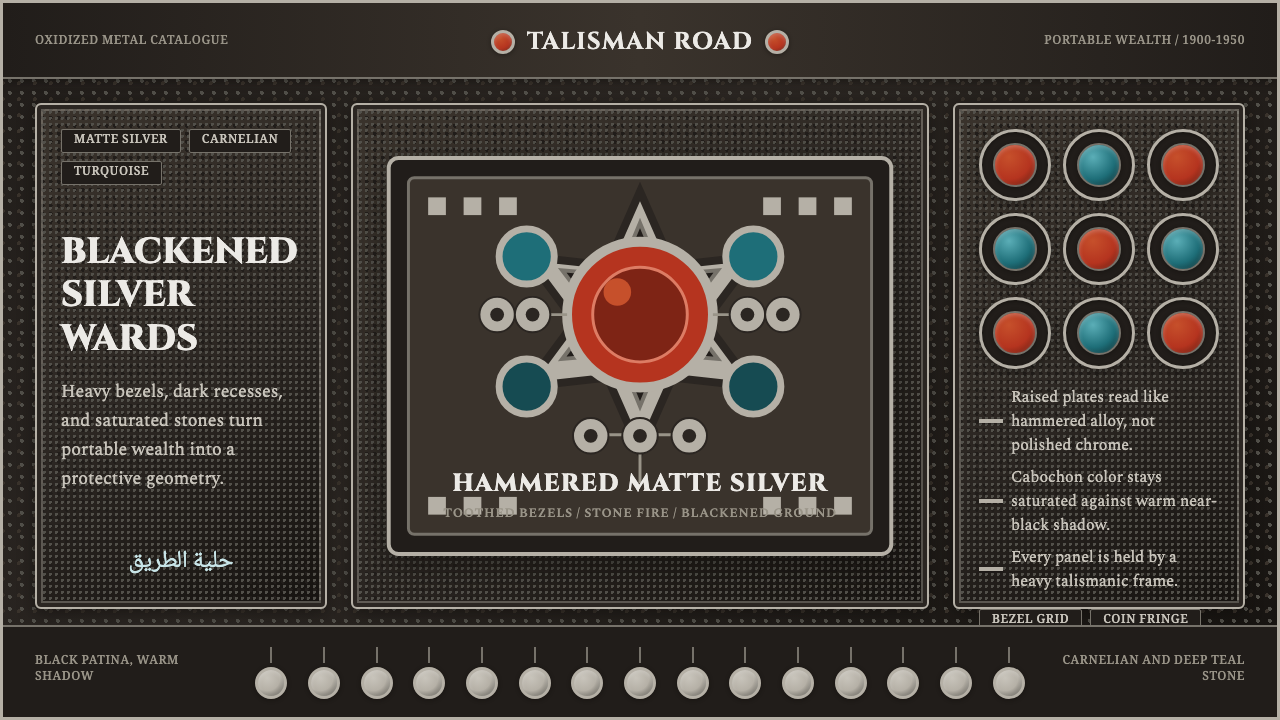 Kuchi Nomad Silver JewelryWeight becomes protection. Matte silver frames carnelian and teal stones on b…
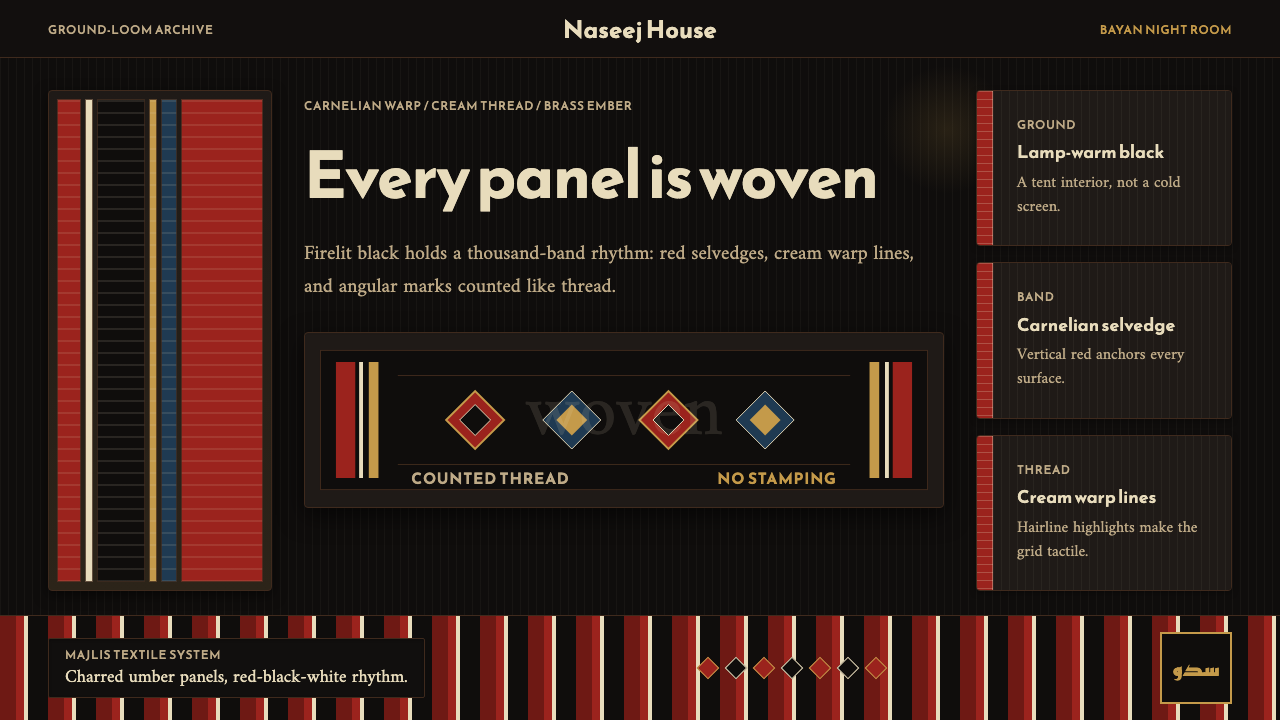 Kuwaiti Sadu Bedouin WeaveFirelit craft, not dark mode. Carnelian bands and cream warp lines make each…
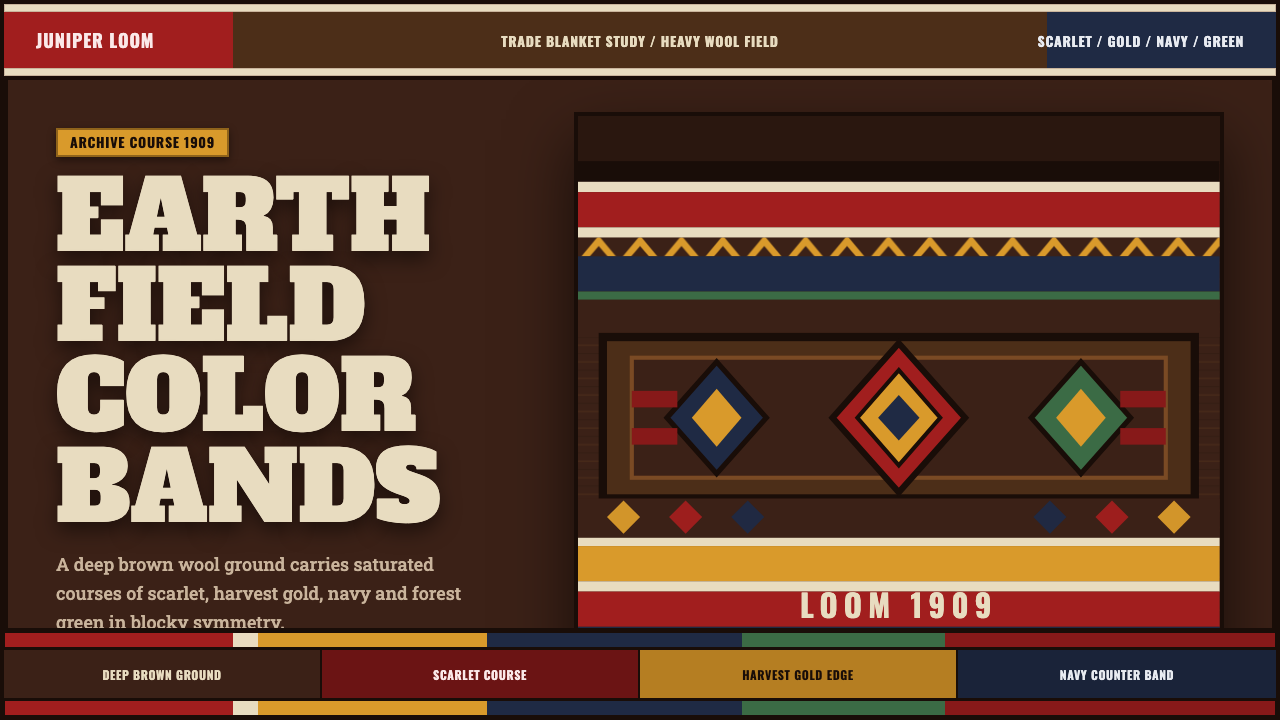 Pendleton Wool BlanketWoven authority. Scarlet-gold-navy bands lock into diamonds on dark brown woo…
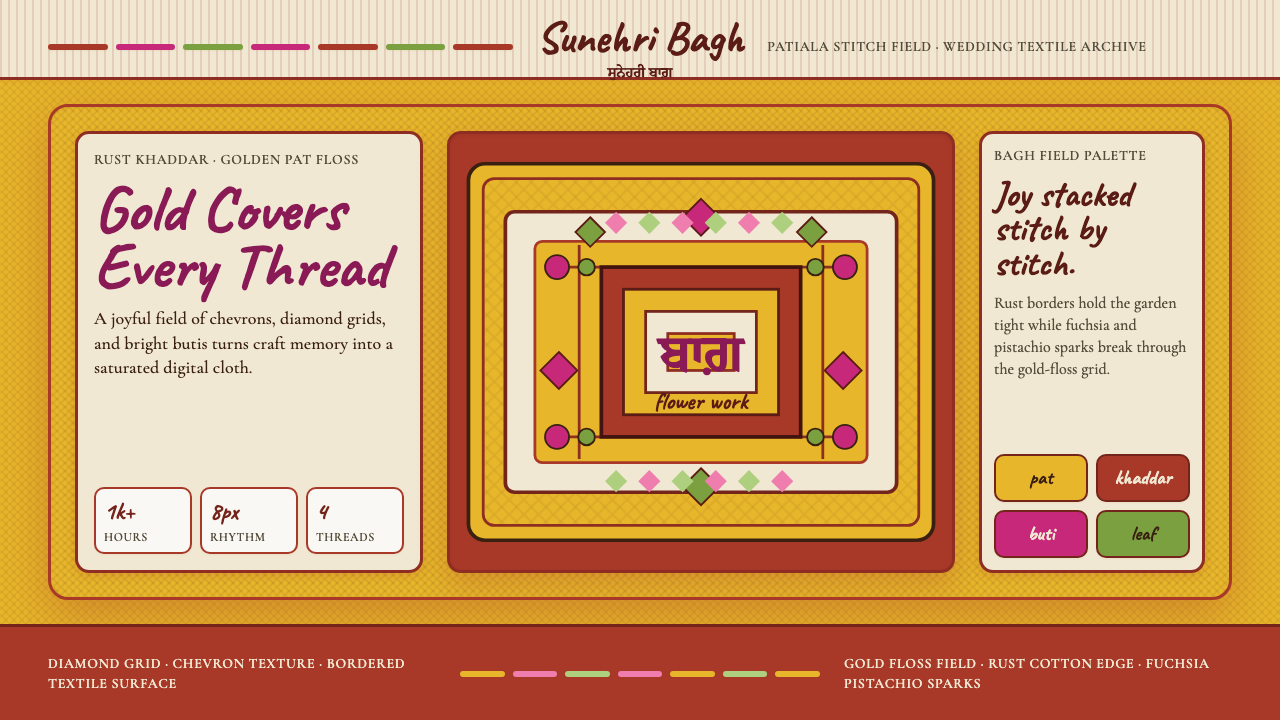 Punjabi Phulkari (Floral Bagh)Joyful density wins. Gold chevrons, rust borders, fuchsia-pistachio butis fil…
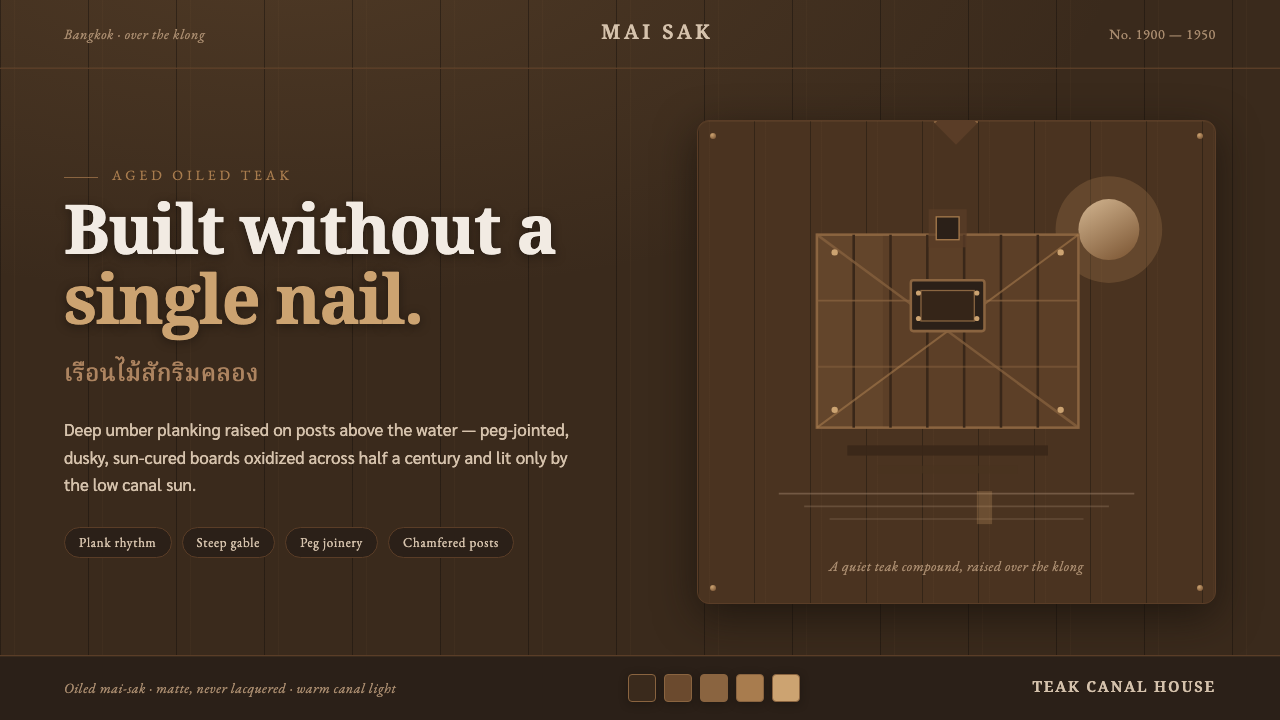 Thai Teak Canal HouseAged oiled teak, never fresh-sawn. Deep umber planks raised over the klong, l…
 Tobacco Curing BarnSlow heat turns leaf to gold. Amber and sienna glowing on dark timber, label-…