What is Wandjina Kimberley Rock Art?

Wandjina Kimberley Rock Art turns a page into weathered stone: ancestral rain-and-cloud presence emerging in chalk white and red ochre.
Wandjina Kimberley Rock Art in brief
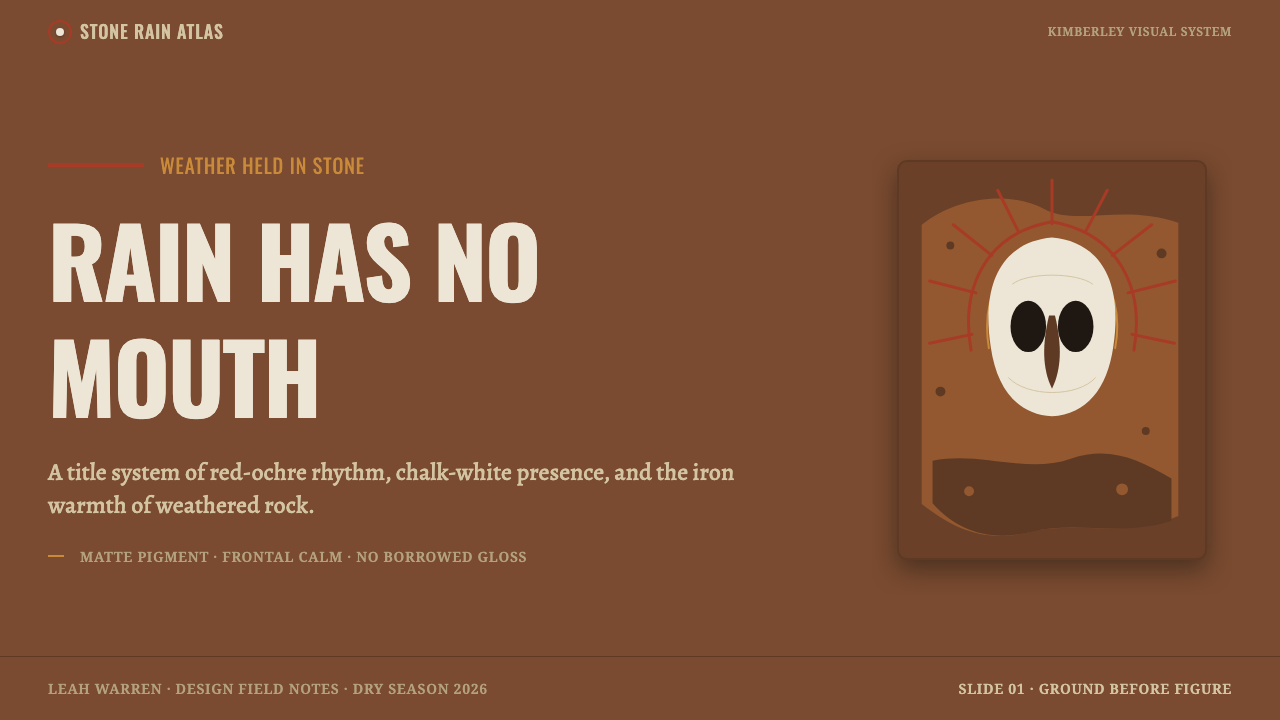
Wandjina Kimberley Rock Art draws from the living cave-painting tradition of the Kimberley in Western Australia. The Wandjina are ancestral rain-and-cloud spirits painted in rock shelters across Worrorra, Ngarinyin, and Wunambal Country. Their defining image is a chalk-white face without a mouth, enclosed by a radiating halo associated with cloud and lightning.
This is not an illustration style detached from its setting. Custodians repaint the figures across generations, renewing huntite-clay white and red-ochre outlines directly on sandstone. The rock is not a backdrop behind the image; it is the ground through which the image exists. That relationship is essential when translating the visual language into a contemporary design system.
The resulting aesthetic is dark, mineral, and concentrated. A deep ochre-brown field carries the weight of weathered rock. Chalky off-white establishes the face and halo, while red ochre gives the figure its defining contour. Surfaces should feel deposited, rubbed, and held by the ground rather than polished, luminous, or digitally weightless.

Where does Wandjina Kimberley Rock Art come from?
The tradition belongs to the Kimberley region of Western Australia, on the Country of the Worrorra, Ngarinyin, and Wunambal peoples. It is identified in the approved record as a pre-1900 living rock-art tradition, continuously repainted across generations. Its history is therefore not best understood as a closed historical period with a finished archive, but as an ongoing custodial practice.
At its center are the Wandjina: ancestral rain-and-cloud spirits. Their mouthless faces and surrounding radiating marks make presence visible without relying on scenic narrative or naturalistic portraiture. The halo is inseparable from the figure, carrying the visual association of cloud and lightning around the face.
Senior Wandjina custodians and Worrorra, Ngarinyin, and Wunambal clan elders are the key human custodians named for this tradition. Their role matters because repainting is not merely restoration of an old image. It refreshes the white clay and red ochre on the living sandstone, sustaining an ancestral image in its proper material setting.
For design interpretation, this origin sets a firm boundary. The style should not be reduced to an exotic palette or a generic cave-wall texture. Its visual authority comes from the relation among ancestral presence, mineral pigment, rock shelter, and continued custodianship. A useful adaptation preserves that gravity: image, ground, and outline must remain interdependent.
What defines the Wandjina Kimberley Rock Art look?
Rock as Ground
The dominant field is a deep ochre-brown rock plane, not a neutral canvas. It should feel weathered, absorbent, and materially present, so that every lighter mark appears to have been worked into it rather than placed above it.
Chalk-White Presence
Chalky off-white belongs to the face and halo. It should read as huntite-clay pigment: matte, dense, and softly irregular in character, never as a glossy highlight or a clean digital white.
Red-Ochre Contour
Red ochre carries the outline weight. Around a mouthless face, contour does more than separate shapes: it defines identity, holds the halo together, and gives the composition its visual gravity.
Radiating Halo
The halo is a field of radiating marks associated with cloud and lightning. It should expand from the face as an active perimeter, not behave like a decorative sunburst, badge, or ornamental frame.
Mouthless Face
The absence of a mouth is a defining visual fact, not empty space awaiting embellishment. Preserve the face's stillness and directness; added expressive features would change the image's governing logic.
Pigment, Not Gradient
No surface should rely on decorative fading. Transitions are better understood as differences in deposited pigment, worn stone, and the meeting of chalk white, red ochre, and brown ground.

Who shaped Wandjina Kimberley Rock Art?
Senior Wandjina custodians are named as key figures because the tradition remains living through repainting. Their custodianship keeps the image connected to sandstone, mineral pigment, and ancestral rain-and-cloud presence rather than treating it as an isolated historical motif.
Worrorra clan elders are among the named custodians of Wandjina imagery in the Kimberley. Their place in the tradition underscores that the visual language belongs to Country and to continued cultural responsibility, not to a free-floating style category.
Ngarinyin clan elders are identified as custodians within the same living tradition. Their inclusion makes clear that the system's visual cues—white face, red outline, brown rock, and radiating halo—are held within an intergenerational cultural practice.
Wunambal clan elders are likewise named among the tradition's key custodians. In a design context, that attribution should encourage restraint: the aim is to learn from the material relationships of the imagery, not to claim or replicate ceremonial authority.
How do you use Wandjina Kimberley Rock Art today?
For presentation covers, let the brown rock field establish the entire atmosphere. A single chalk-white face-like focal form or radiating halo can carry the title area, while red ochre supplies only the contour or a directional accent. Keep the composition quiet and frontal; it should feel encountered, not advertised.
For content and data slides, use the palette as a hierarchy of material roles. Brown holds the background and large containers, off-white carries essential reading content, and red ochre identifies boundaries, key categories, or selected marks. Charts should remain restrained and legible, with the halo logic reserved for focal relationships rather than repeated decoration.
In web interfaces, this language is strongest in immersive landing sections, cultural or editorial dashboards, and focused data views that benefit from a dark grounded atmosphere. Use generous open areas in the rock field, clear off-white text, and red-ochre outlines for active controls or divisions. Treat the interface as layered pigment on a ground, not as glossy panels floating in space.
For editorial and marketing work, foreground provenance and material presence. A story page can alternate broad rock fields with chalk-white reading areas, using red-ochre rules to connect captions, source notes, or feature statements. Imagery and typography should leave the central figure or halo enough silence to retain its force.
The common mistake is to turn the system into a generic earthy theme: scattered sunbursts, distressed filters, decorative gradients, or invented facial features. Those choices erase the disciplined relation among mouthless face, radiating halo, mineral pigment, and sandstone. Use fewer motifs, preserve their roles, and avoid implying authority that belongs to custodians.
Wandjina Kimberley Rock Art — FAQ
Is this simply a cave-art or earthy visual style?
No. The source is a living Wandjina cave-painting tradition of the Kimberley, sustained through custodianship and repainting. Brown rock, chalk white, red ochre, mouthless face, and radiating halo are not interchangeable rustic motifs; together they describe a specific ancestral rain-and-cloud image system.
Why should the background remain dark ochre-brown?
Because the image is painted directly onto sandstone rather than onto paper or a neutral ground. The brown plane gives the white figure and red outline their material context. Replacing it with an unrelated bright or neutral field weakens the central idea that pigment and rock belong to the same encounter.
Can the radiating halo be used as a general decorative device?
It should be used sparingly and only where a focal presence is needed. In the source material, the radiating halo is associated with cloud and lightning around the Wandjina face. Repeating it as a generic badge, burst, or background pattern disconnects it from that visual function.
What should contemporary designers avoid when adapting this system?
Avoid decorative gradients, glossy synthetic surfaces, invented facial expression, and claims that the adaptation carries custodial or ceremonial authority. Work from the approved material relationships instead: weathered brown ground, chalk-white figure, red-ochre contour, radiating halo, and careful acknowledgment of the living Kimberley tradition.
Related design styles
 Palauan Dilukai Gable FigureGuardian symmetry on old wood. Ochre red, yellow and soot black lock each fla…
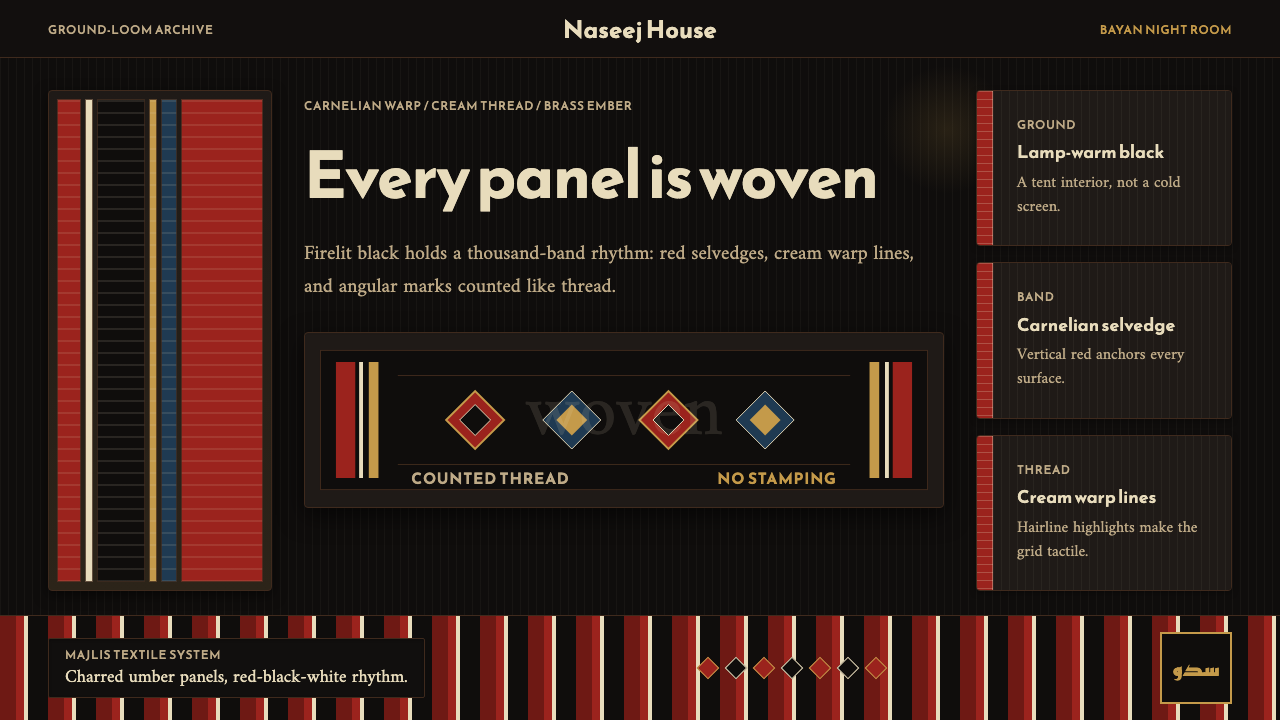 Kuwaiti Sadu Bedouin WeaveFirelit craft, not dark mode. Carnelian bands and cream warp lines make each…
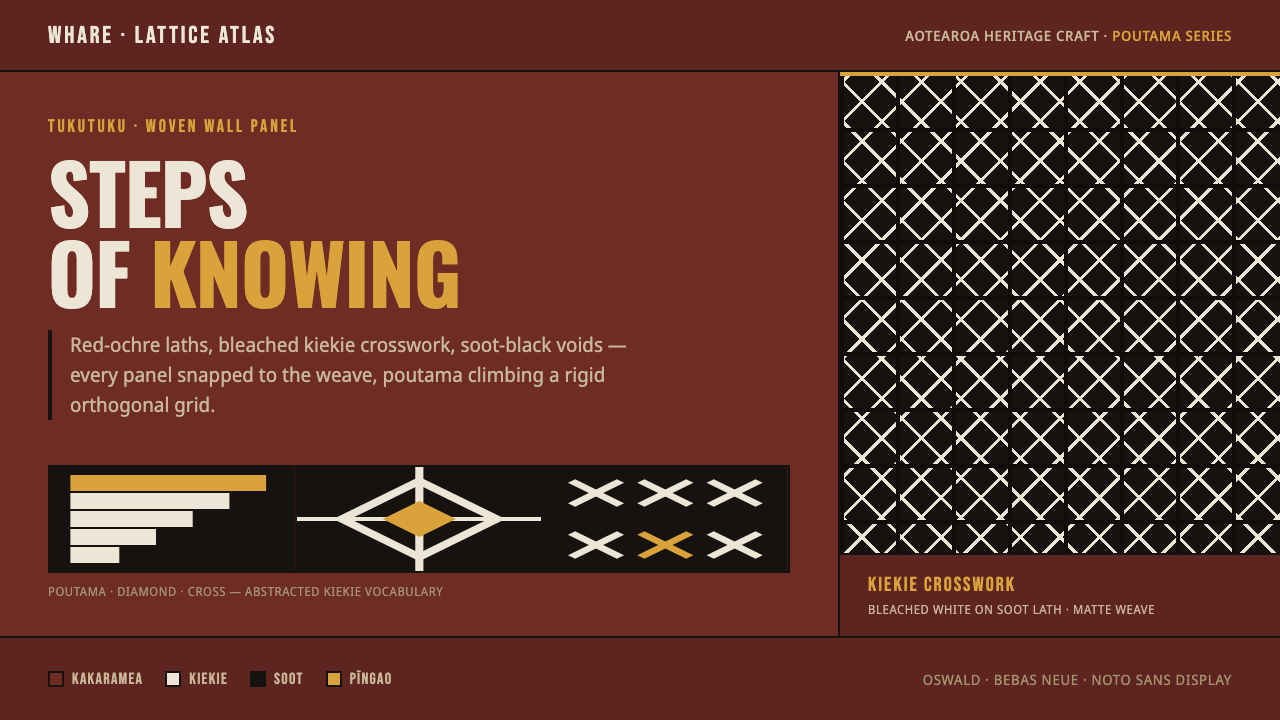 Māori Tukutuku PanelTukutuku weave, rendered strict. Bleached kiekie crosswork laces poutama step…
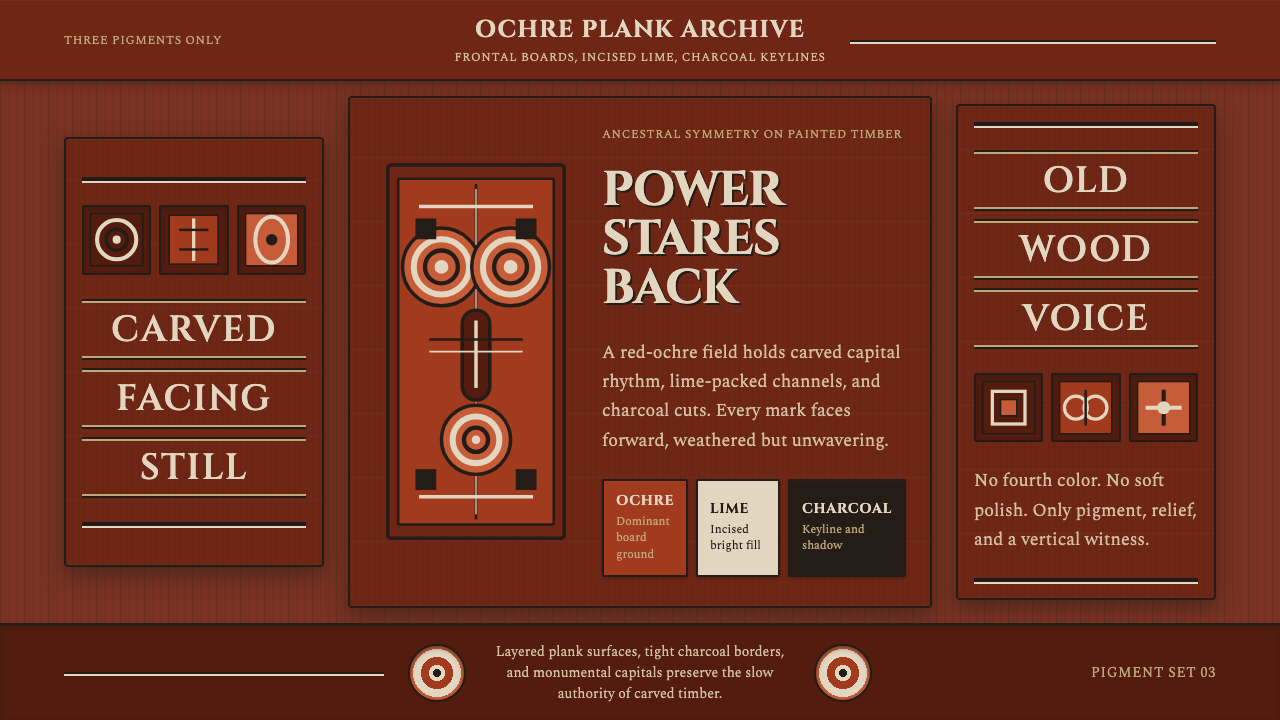 Sepik Spirit BoardThree-pigment power. Ochre, lime, and charcoal lock into frontal carved symme…
 Trobriand Yam House PaintPainted wealth speaks loud. Vermilion bands and black stamp silhouettes hit t…
 Akan Adinkra (Ghana)Proverbs become cloth. Russet grids, lampblack serif marks, and gold-edge ban…