What is Sepik Spirit Board?
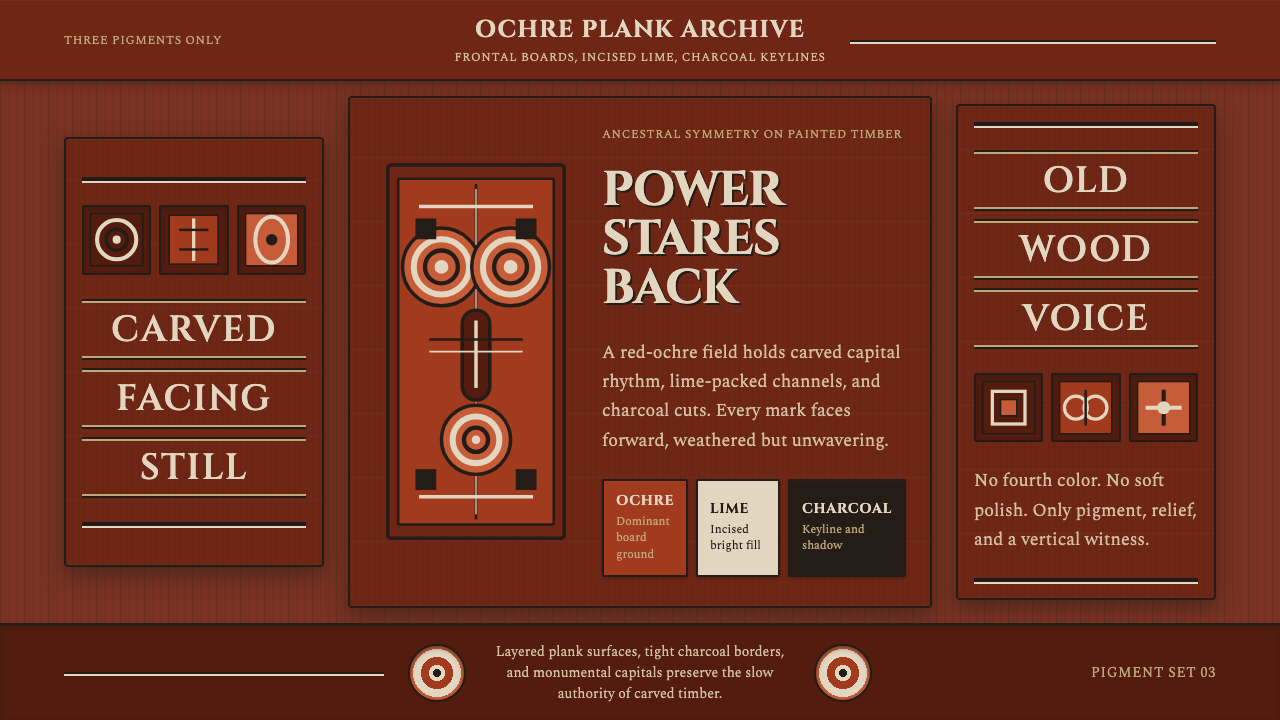
A red-ochre ancestral face rendered in exactly three earth pigments, its carved spirals holding eyes, nose, and navel in perfect bilateral symmetry.
Sepik Spirit Board in brief
Sepik Spirit Board takes its visual grammar from the gope and kwoi ancestral boards carved along Papua New Guinea's Papuan Gulf and Sepik River, where a single frontal face is carved directly into a salvaged plank of house or canoe timber. The features are not naturalistic portraiture but an assembly of low-relief spirals and ridges — a spiral for each eye, a ridge for the nose, a further spiral marking the navel below — held together in unwavering bilateral symmetry, so the face reads as a fixed, watching presence rather than a captured expression.
The color discipline is where the system becomes most visible. A dominant field of red ochre covers most of the board's surface, and against that red, white lime and charcoal pick out the incised lines: the rim of a spiral, the ridge of a brow, the edge of a carved lip. No fourth pigment enters the system anywhere, and no hue blends into another — each color sits inside its own carved channel, bounded sharply by the cut of the tool rather than by a soft edge.
Carried into graphic use, this becomes a system built on scarcity and repetition rather than novelty: a strict three-color world, carved relief standing in for flat illustration, a weathered wood-grain texture instead of a clean gloss finish, and titling set in blocky, monumental capital letterforms that echo the board's own gravity and its refusal of ornament.
Where does Sepik Spirit Board come from?
The boards behind this system belong to a pre-1900 tradition of Melanesian carving practiced along the Papuan Gulf and the lower and middle Sepik River, in the part of Papua New Guinea that sits within the broader cultural world of Oceania. In these riverine and coastal societies, a carved board was never a decorative object hung for its own sake. It was understood as a vessel for an ancestor's continuing presence, made to be installed inside a men's ceremonial house and consulted, fed, or invoked as part of the community's ongoing relationship with its dead.
Carvers rarely worked timber chosen fresh for the purpose. Boards were commonly cut from planks already carrying meaning — the retired hull of a canoe that had served the community for years, or a post pulled from a house being rebuilt — so the new ancestral face inherited the weathering, grain, and history of the wood beneath it. This practice of reuse reinforced the sense that the ancestor being carved was continuous with the material life of the community, not a separate or purely symbolic figure standing apart from it.
The gope and kwoi board traditions are associated with several distinct carving lineages across the region — Kerewa carvers working the Gulf's river systems, Elema carvers along the Gulf coast, and Iatmul carvers of the middle Sepik — each holding its own conventions for how tightly a spiral should coil or how deep a nose ridge should be cut, while sharing the same core grammar of frontal face, three pigments, and mirrored symmetry. None of the carvers behind surviving boards are individually named in the historical record; the work belonged to a craft lineage and a ceremonial role, not to a personal signature.
These boards entered Western attention through the colonial administrators, missionaries, and early ethnographers who collected them from the Papuan Gulf and Sepik regions across the late nineteenth and early twentieth centuries, placing them in the ethnographic museum collections of Europe, Australia, and North America. There, in the opening decades of the twentieth century, they came to the notice of modernist artists and collectors newly attentive to carving traditions outside the European canon — a moment of cross-cultural attention that, even as it too often stripped the boards of their original ceremonial context, helped fix Sepik and Papuan Gulf carving within the wider twentieth-century history of art appreciation.
What defines the Sepik Spirit Board look?
Pigment Discipline
The palette is locked to exactly three natural pigments — iron-oxide red as the dominant field, white lime and charcoal black reserved for the incised linework. No fourth color is ever introduced, and hues never blend into one another; each stays inside its own carved boundary.
Carved Relief
Every mark is cut into the wood rather than painted flat on top of it. Lines carry real depth — a groove catches shadow, a raised spiral catches light — so the surface reads as sculpture even in a flat, two-dimensional reproduction.
Bilateral Symmetry
The composition mirrors exactly around a central vertical axis, feature for feature and spiral for spiral. This gives the face a fixed, ceremonial stillness, closer to an emblem than to the asymmetry of a captured expression.
Eye, Nose, and Navel Spirals
The face is built from a small vocabulary of spirals and ridges rather than naturalistic features: a tight spiral for each eye, a raised ridge for the nose, and a further spiral marking the navel below, treating the whole figure as one continuous carved field.
Monumental Capitals
Titling favors blocky, weighty capital letterforms with none of the delicacy of a script face — a typographic echo of the board's own carved gravity, meant to be read as struck into a surface rather than printed on it.
Weathered Surface
Because so many boards were cut from reused canoe or house timber, the surface carries the grain, cracks, and discoloration of wood that had already lived a working life before a face was ever carved into it.
Frontal Composition
The face confronts the viewer directly, straight ahead, occupying the full height of the board with no three-quarter turn or profile view — a stance that reads as a presence meeting you rather than a portrait observed from the side.

Who shaped Sepik Spirit Board?
Working the river systems of the Papuan Gulf, Kerewa carvers produced boards tied to the region's kwoi tradition, their spirals and ridges following conventions passed down within a craft lineage rather than credited to an individual hand — consistent with a culture that understood carving as inherited communal knowledge.
Elema carvers of the Papuan Gulf coast are among the makers most closely associated with the gope board tradition, producing boards meant for installation inside a community's ceremonial house as part of an ongoing relationship with ancestral presence, rather than as freestanding art objects.
Iatmul carvers of the middle Sepik River worked within the same broad grammar of frontal face, three-pigment color, and mirrored symmetry, while developing their own regional conventions for the depth of relief and the proportion between spiral and ridge.
Taken together, the gope and kwoi boards represent a shared regional tradition rather than a single workshop or school — a body of carving practiced across the Papuan Gulf and Sepik River that Western art history did not encounter, name, and begin to study closely until well into the twentieth century.
How do you use Sepik Spirit Board today?
Sepik Spirit Board transfers well to any layout that can commit to restraint, because its logic is aesthetic discipline rather than literal imagery. Applying it respectfully means carrying over the structural rules — the fixed three-pigment world, the carved-relief texture, the strict bilateral symmetry — rather than borrowing a red field or a spiral as generic decoration disconnected from what they represent.
On presentation slides, the style suits a cover built around a single centered, symmetrical motif rather than an off-center hero image: a bold red field anchoring the frame, with white-and-charcoal linework doing the work a photograph would do elsewhere. Content slides should hold to the same three tones throughout a deck, using the carved-line motif sparingly as a section marker rather than a repeated background texture.
In web interfaces, the palette suits dashboards or landing pages that want to feel grounded and deliberate rather than bright and playful: a red-ochre field for primary emphasis, near-white for body content, and a near-black tone for text and rule lines, with any iconography kept graphic and spiral-based rather than photographic.
For editorial and marketing work, the board's frontal stillness translates into strong, static hero compositions — a single centered mark rather than a scattered collage — paired with heavy, capitalized headline type that carries the same weight as a carved line, and body copy set plainly against the red or near-white ground.
The most common mistake is treating the palette as merely three warm colors to sample rather than as a closed system: adding a fourth accent color, softening the carved relief into flat vector shapes with a drop shadow, or scattering the spiral motif decoratively instead of using it to mark specific features. Each of those choices erases the discipline that gives the style its authority and turns a serious carving tradition into surface pattern.
Sepik Spirit Board — FAQ
Is it respectful to use an ancestral spirit-board tradition as a graphic design style?
The respectful path is to treat the tradition as a serious art-historical and ethnographic subject rather than as an exotic prop — engaging with its actual visual discipline (the three-pigment restriction, the carved relief, the bilateral symmetry) rather than caricaturing it with generic tribal-mask clichés, painted-on faces, or invented symbols. Used this way, the system honors the carving tradition's rigor instead of flattening it into decoration disconnected from its origin.
Why exactly three pigments, and can a fourth ever be added?
The three-pigment limit — iron-oxide red, white lime, and charcoal black — comes directly from the natural materials available to the original carvers: an earth pigment, a mineral pigment, and a burnt one. Adding a fourth color breaks the closed logic that gives the system its authority; if a project genuinely needs another hue for functional reasons such as an error state, it is better handled as a rare, clearly secondary exception than folded into the core palette.
Does the style require actual carved or textured surfaces, or can it work as flat digital graphics?
It can work in flat digital form, but the relief quality should still be implied rather than erased — subtle shading that suggests a groove or a raised edge, rather than a fully flat vector shape with a hard outline and no texture. A version that removes all trace of carved depth loses the quality that separates this system from a simple red-white-black icon set.
How strict does the bilateral symmetry need to be in an applied layout?
As strict as the layout can bear. The historic boards mirror exactly around a central axis, and a design that honors the system should center its key mark or motif rather than pushing it off to one side. Supporting content — captions, secondary text — can sit asymmetrically around that centered anchor, but the anchor itself should not be treated as a free-floating, off-axis element.
What is the difference between the gope tradition and the kwoi tradition referenced in this system?
Both are ancestral board traditions from the same general Papuan Gulf and Sepik region and share the core visual grammar this style draws on — frontal face, three pigments, carved relief, mirrored symmetry — but they arose among different carving communities within that world. The system treats them as a shared family of practice rather than collapsing them into one workshop, since the historical record itself preserves them as related but distinct lineages.
Related design styles
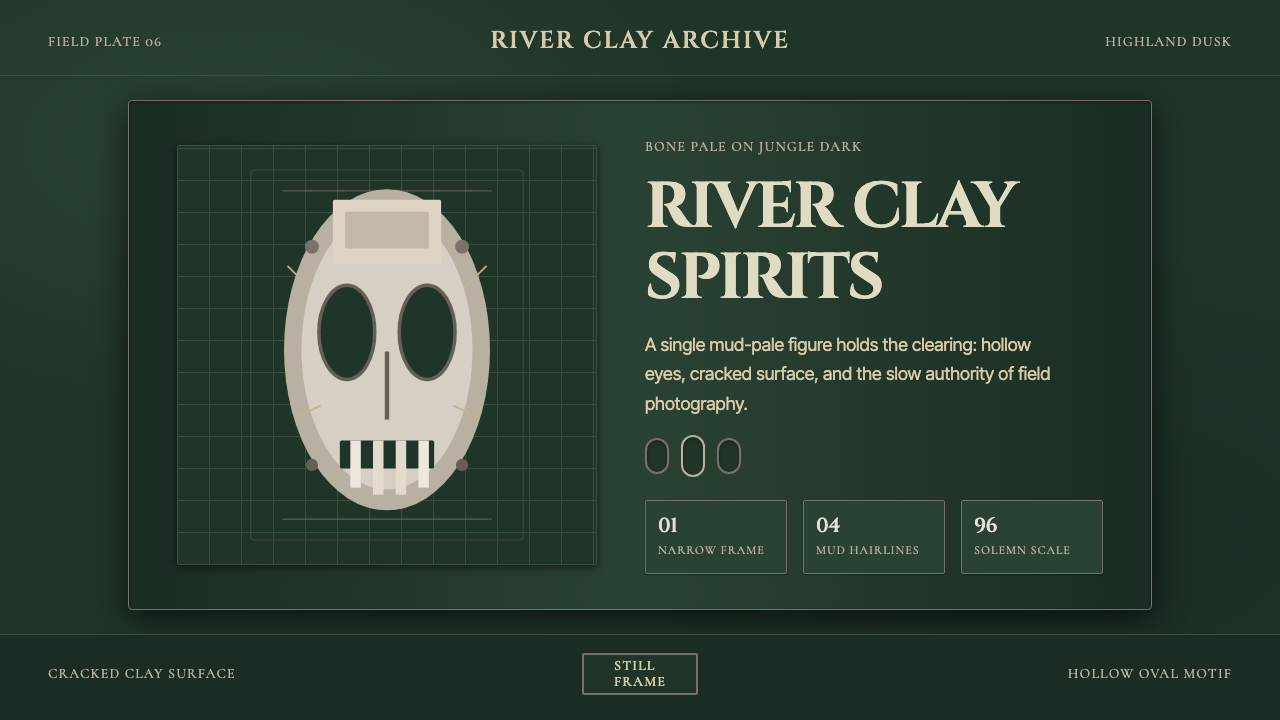 Papuan Asaro MudmenRitual stillness commands the frame. Bone-pale Cinzel rises against jungle-da…
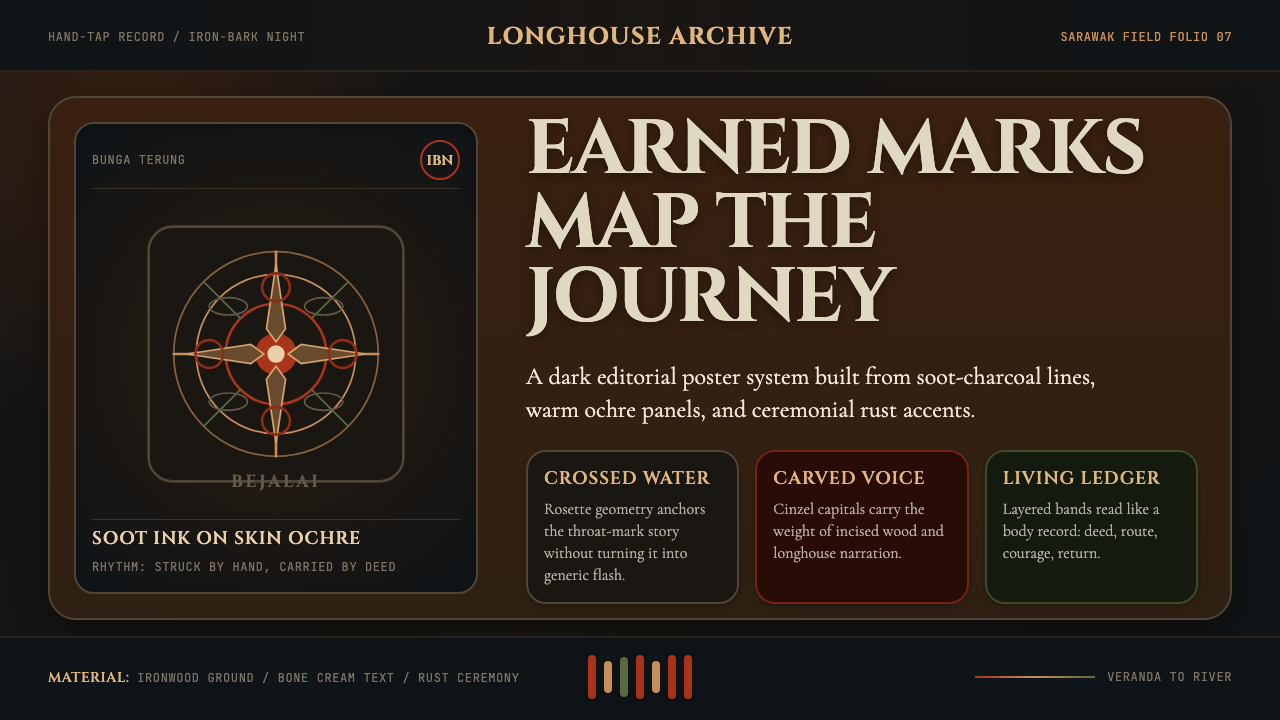 Dayak Borneo Tattoo (Iban)A living journey ledger. Soot lines, ochre panels, and rust rosettes feel han…
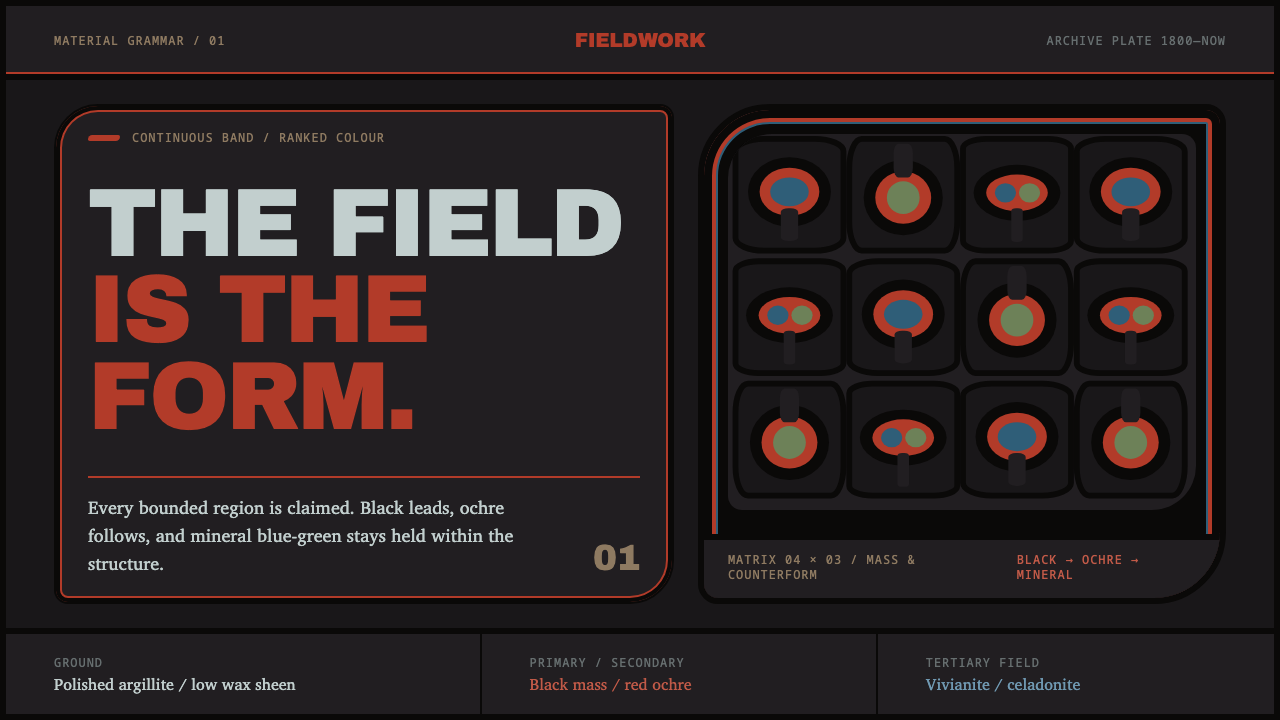 Haida FormlineEvery field is claimed. Black bands lead ochre and mineral blue-green through…
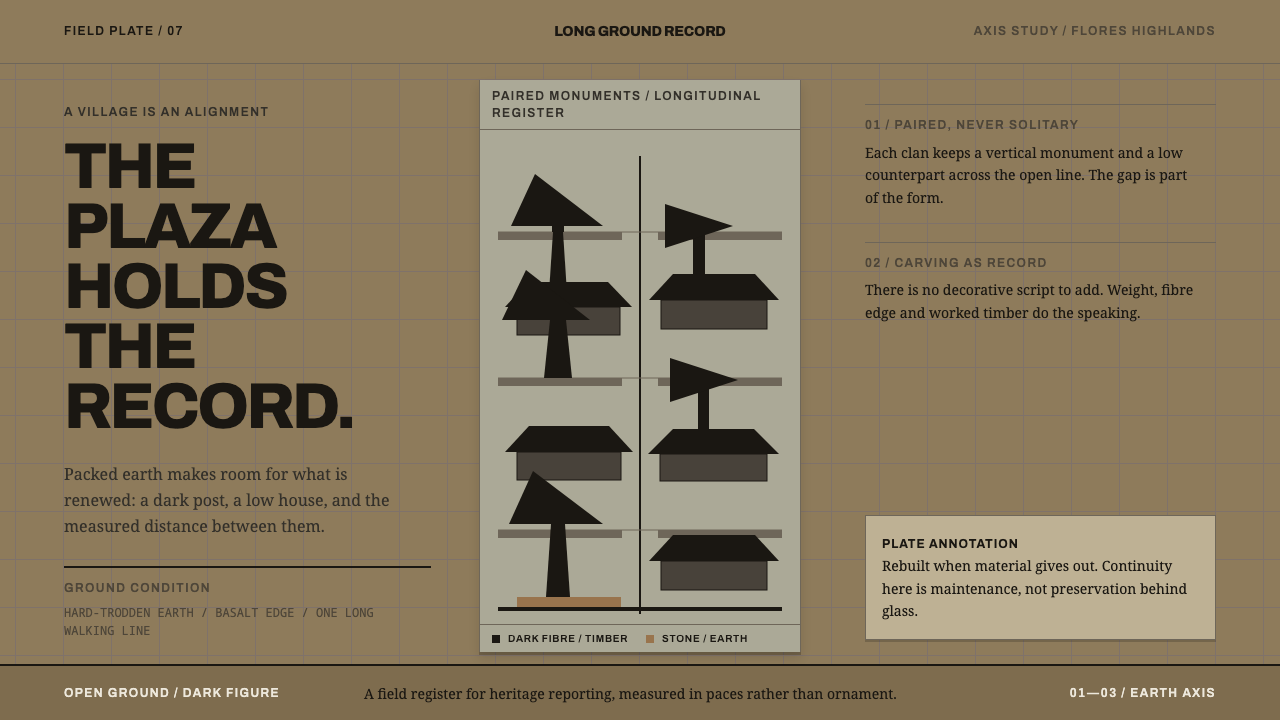 Ngada Ancestor PostsThe plaza is the record. Ijuk-black pairs stand on packed earth along one mea…
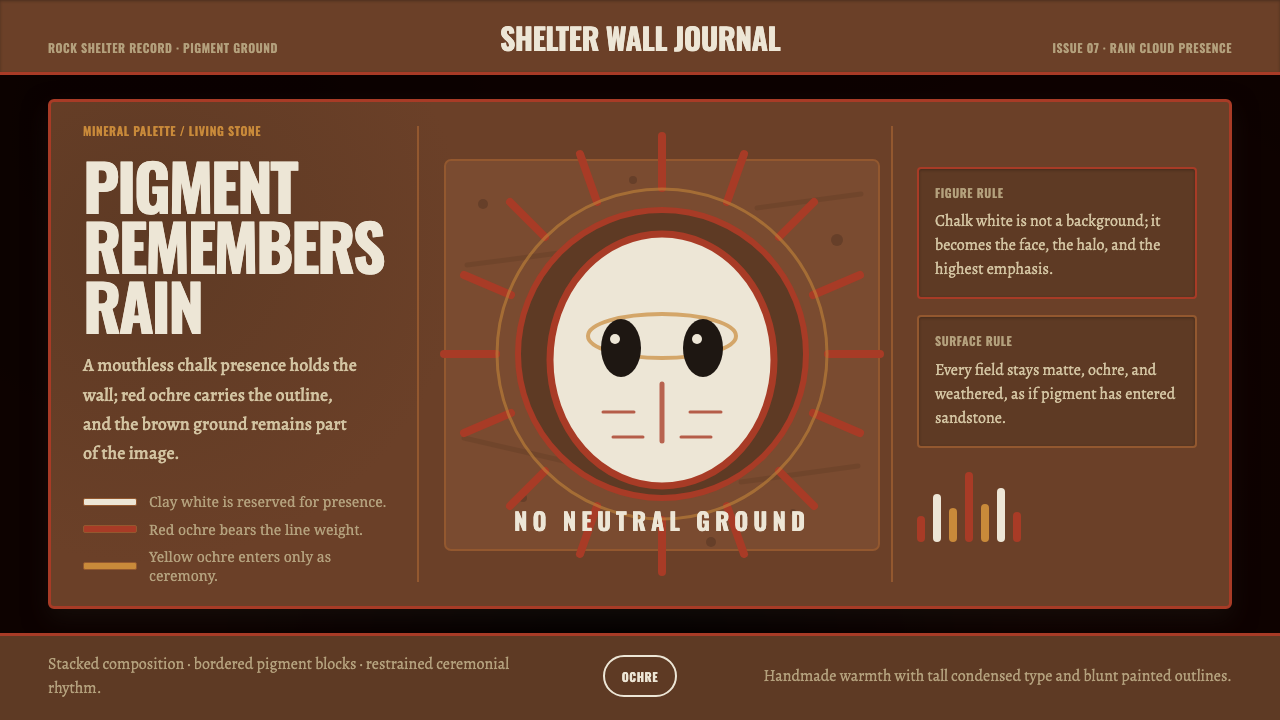 Aboriginal Wandjina KimberleyAncestral presence in stone. Chalk white haloes and red ochre outlines sit on…
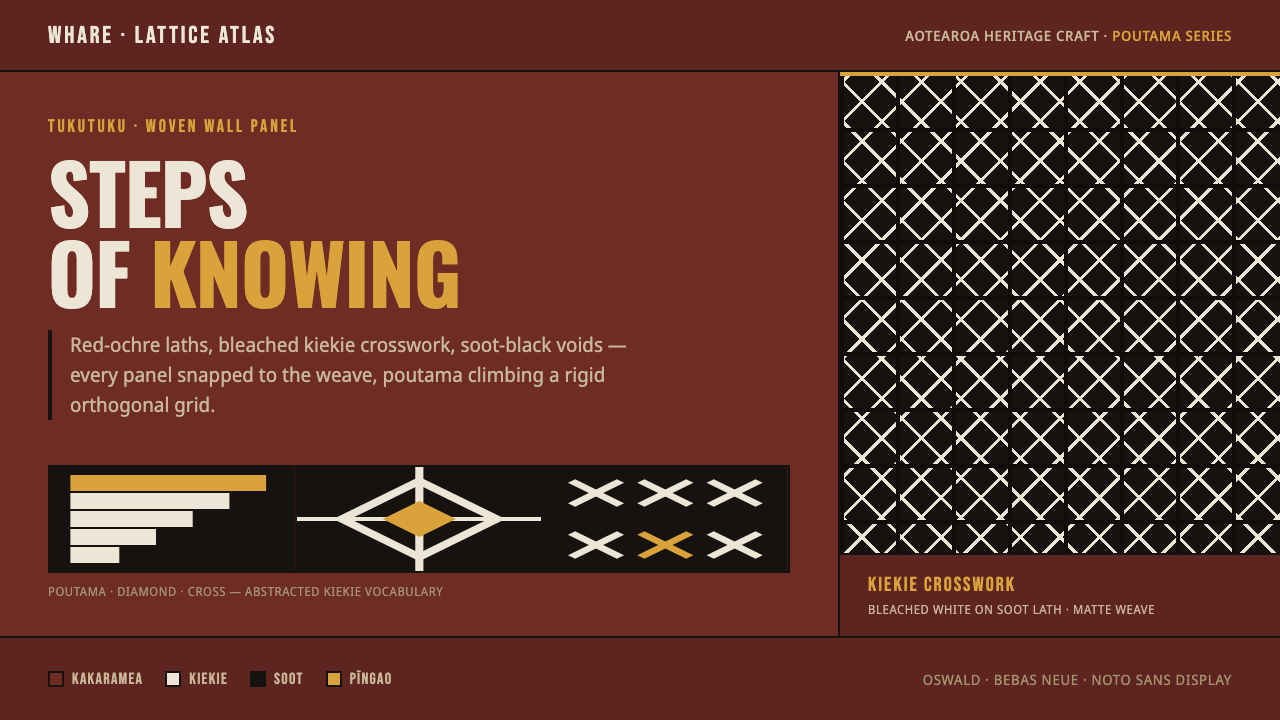 Māori Tukutuku PanelTukutuku weave, rendered strict. Bleached kiekie crosswork laces poutama step…