What is Ranakpur Jain Temple?
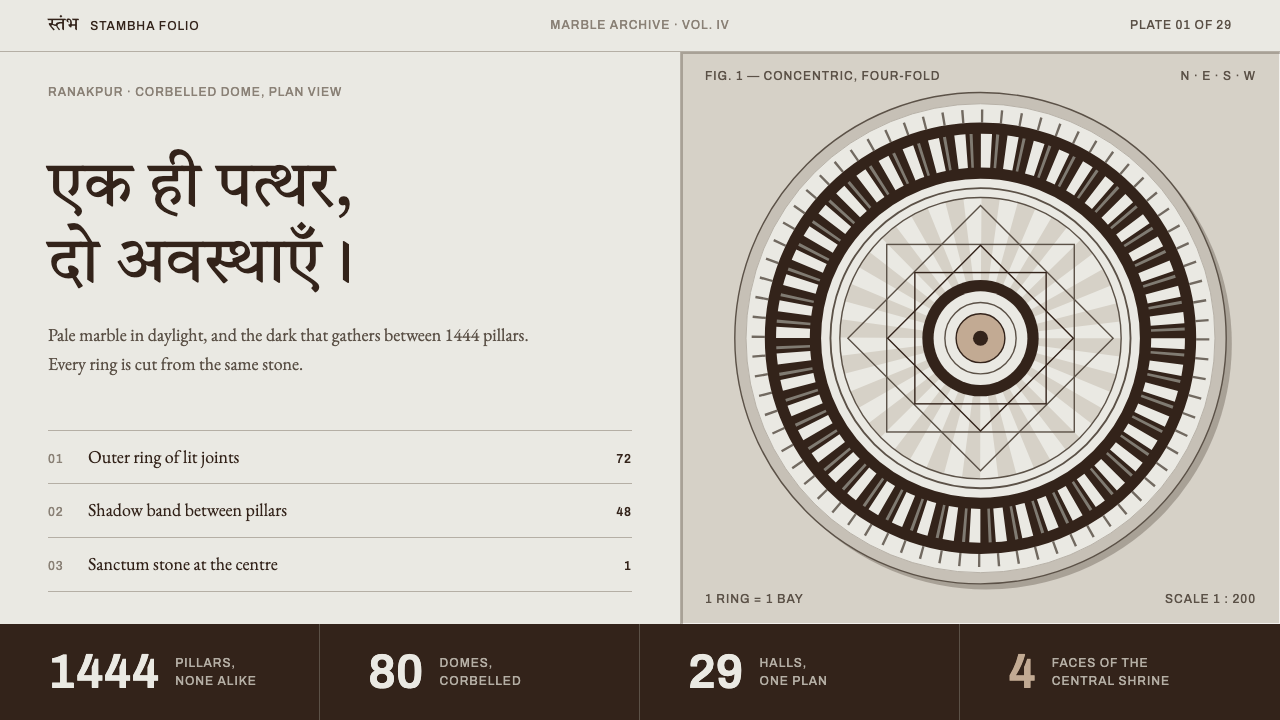
Ranakpur turns a single stone into a design system: pale marble lit and shadowed, laid out in concentric rings, and carved rather than drawn.
Ranakpur Jain Temple in brief
The Ranakpur Jain Temple style is cut from one material. The Chaumukha temple at Ranakpur in Rajasthan is pale grey-white marble from floor to dome, and this theme puts every surface on that same marble. Because the stone does not change from one part of the building to the next, the style builds its contrast not from different colours but from two states of one stone: the lit surface, and the dark between the pillars.
The structure is concentric and four-fold rather than columnar. Layouts follow the logic of a dome and of a temple that faces four directions, so content arranges itself in rings and symmetrical quadrants, not in the rows and columns of a Western grid. Panels are not floating cards. They are cut into the surface like recessed niches, with hard bevelled edges instead of soft shadows.
Typography carries the inscriptional weight. Devanagari headings set in Tiro Devanagari Hindi do the work of carved lettering, body text is set in EB Garamond, and numerals are given to Archivo. The numerals count the building: 1444 pillars, 80 domes and 29 halls, a reminder that repetition and variation are the central ideas of the style.

Where does Ranakpur Jain Temple come from?
The temple stands at Ranakpur in the Pali district of Rajasthan, India, in what was then the Mewar kingdom. Construction ran from the 1430s to 1458 CE, and the building has been in continuous worship ever since. That last fact matters for the style. This is not a ruin studied from a distance but a living place, which gives the system a quiet gravity: its marble is polished by use, and its density has a devotional purpose.
Three architectural and craft traditions meet in it. The first is Māru-Gurjara architecture, also called Solaṅkī temple architecture, the western Indian temple style known for its elaborate, layered stonework. The second is Jain Śvetāmbara temple building, in which large temple complexes were created as acts of religious merit and carried a high level of ornament in the service of devotion. The third is the Western Indian marble carving tradition, in which craftsmen cut stone so finely that it seems to be lace. Taken together they explain why the building feels both ordered and astonishingly rich.
The source names three figures in connection with the temple: Dharna Shah, Deepaka and Rana Kumbha. The record does not detail each person's role, so it is better to avoid claiming more than it says. What can be said is that the building belongs to the Mewar world of Rana Kumbha's time, that Dharna Shah and Deepaka are the names remembered in its making, and that the temple is the work of a community of patrons and carvers, not of a single hand.
The design lesson is in the repetition. The temple has 1444 pillars, and none of them is identical to another. A visitor moving among them sees a forest of columns where pattern repeats but never quite exactly, and where light enters from above to make some surfaces glow while others recede into shade. The theme translates this experience directly: density is the rule, but each element is allowed to differ. Marble carries the light, the pillars supply the shadow, and the page is made of both.
What defines the Ranakpur Jain Temple look?
Color
The palette is the stone itself: a pale grey-white marble ground in every surface, with warm and cool notes as it catches light. Contrast does not come from a second hue. It comes from the dark of the pillar forest, which appears as deeper, shadowed tones of the same stone. The system therefore has two states, lit and shaded, and everything is built from them.
Typography
Headings are set in Devanagari, using Tiro Devanagari Hindi, so they read like inscription cut into the wall. Body text uses EB Garamond for a calm, humanist reading voice, and Archivo handles numerals. The combination gives the page an inscriptional head, a literary body and a precise counting hand.
Concentric layout
Layouts follow the dome and the four-sided plan: rings around a centre and symmetry across four directions. Content gathers around a focal point and radiates outward, instead of descending column by column. The effect is of looking up into a carved ceiling rather than down a page.
Recessed panels
Panels are inset into the surface with hard bevelled edges, like niches cut from marble. They do not float on soft shadows. The bevel carries the whole sense of depth: a thin lit edge on one side and a shaded edge on the other, so that the panel looks carved rather than placed.
Density with variation
The temple has 1444 pillars and none matches another. The style takes the lesson that density is a duty: surfaces are rich and carefully filled, but repeated elements carry small differences so that repetition never becomes mechanical. A grid of similar items should feel handmade rather than stamped.
Counting numerals
Numbers are treated as content in their own right. Figures such as 1444 pillars, 80 domes and 29 halls are set in Archivo and given prominence, because counting is part of how the building is understood. Statistics and metrics in a layout can adopt the same posture: state the count plainly and let it carry awe.

Who shaped Ranakpur Jain Temple?
A name remembered in connection with the making of the Ranakpur temple in the source record.
A name remembered in connection with the making of the Ranakpur temple in the source record.
A name tied to the Mewar kingdom and the period in which the temple was built.
How do you use Ranakpur Jain Temple today?
For slides, the style is strong on covers and section pages for cultural, heritage, architecture, travel and luxury material. A cover can place a single Devanagari or serif title at the centre of a marble ground, with concentric ring motifs around it. Content slides can be organised around a centre point or into four symmetrical quadrants. Data slides can present key numbers in large Archivo figures inside bevelled recessed panels.
For web interfaces, it suits museum and heritage sites, cultural platforms, architecture portfolios, hospitality and premium travel pages. Cards should be inset panels with hard bevels, not floating shadows. Navigation can be arranged around a central hub when the content allows it. Keep contrast to the two stone states, lit and shaded, and avoid adding a third accent colour.
For editorial and marketing work, the style gives long-form features a stately, carved quality. Photography of stone, light and repeating architecture sits naturally within it. Captions and pull quotes can use the inscriptional heading type. The tone should be reverent and exact, with detail that rewards close reading.
A frequent mistake is to treat the style as generic stone texture or as a decorative border around ordinary content. It is a system of light and shade, not a wallpaper. Another is to replace the hard bevels with soft drop shadows, which turns carved panels into floating cards and removes the architectural logic. Finally, do not add bright accent colours to mark emphasis; use the contrast between lit and shaded stone instead.

Ranakpur Jain Temple — FAQ
What is the Ranakpur Jain Temple design style?
It is a design system based on the Chaumukha Jain temple at Ranakpur in Rajasthan. Every surface is pale marble, contrast comes from lit stone against the dark between pillars, layouts are concentric, panels are bevelled recesses, and headings are set in Devanagari.
When and where was the temple built?
At Ranakpur in the Pali district of Rajasthan, India, within the Mewar kingdom. Construction ran from the 1430s to 1458 CE, and the temple has been in continuous worship since.
Why does the style avoid soft shadows?
Because the building is carved, not layered. Panels are cut into the surface with hard bevels, which gives depth through a lit edge and a shaded edge. Soft drop shadows would make elements float and lose the sense of stone.
What fonts does it use?
Tiro Devanagari Hindi for headings, EB Garamond for body text and Archivo for numerals. Together they give an inscriptional heading voice, a calm reading voice and precise counting figures.
Which projects suit it?
Heritage and museum sites, architecture and travel features, cultural platforms, premium hospitality pages and decks that need a stately, carved feel. It is a poor match for playful, bright or fast-moving interfaces.
Related design styles
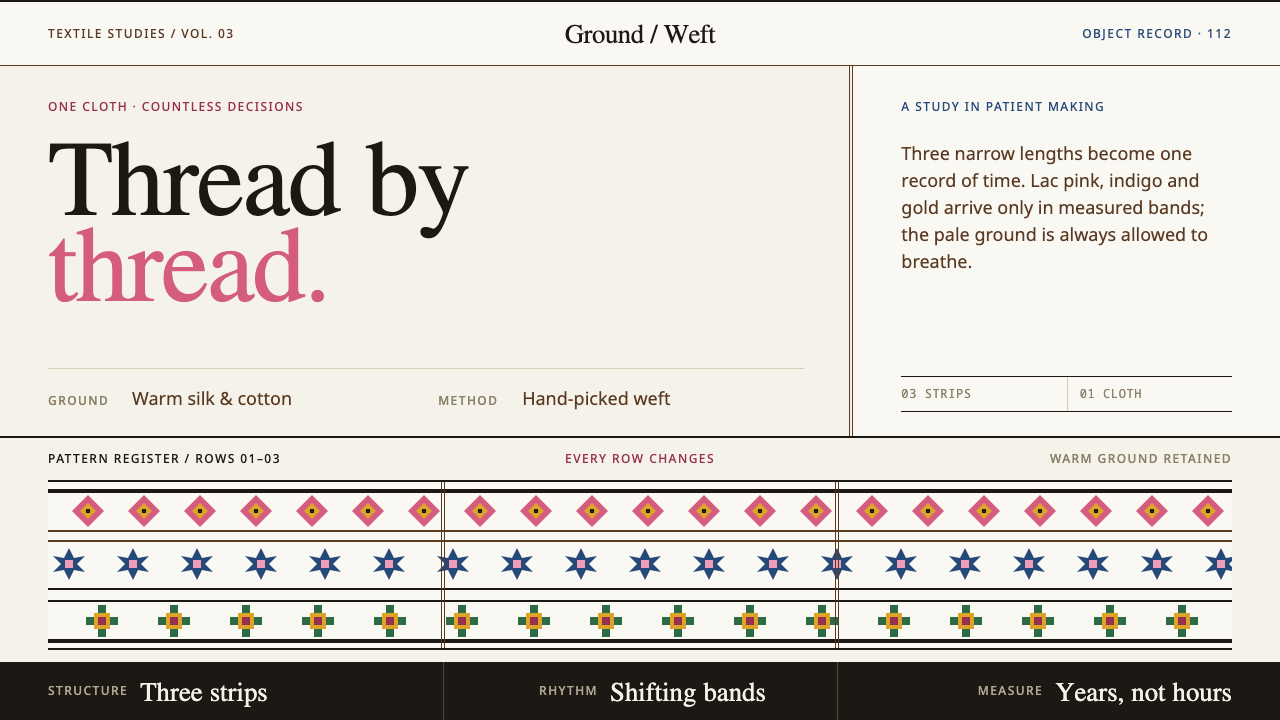 Bhutanese KushutharaPatience made visible. Lac pink and indigo bands shift across a warm silk gro…
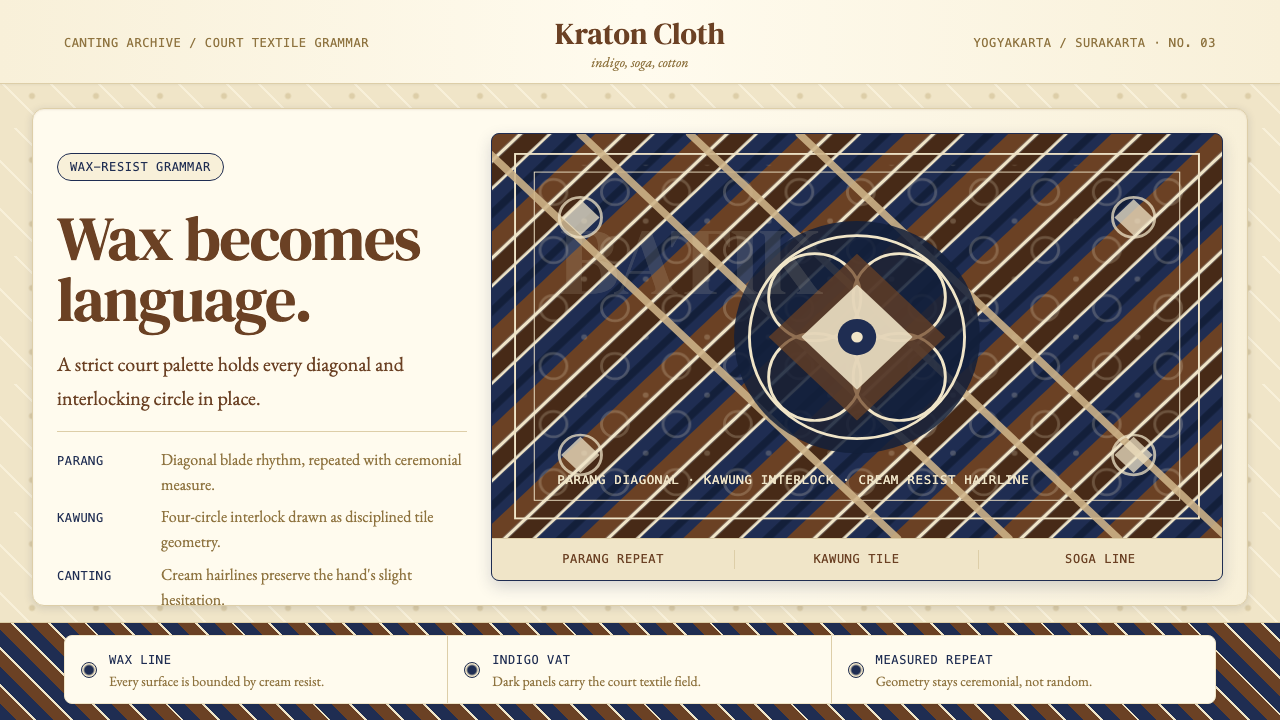 Javanese BatikCeremonial repetition. Indigo, soga, and cream frame a tiled canting motif.
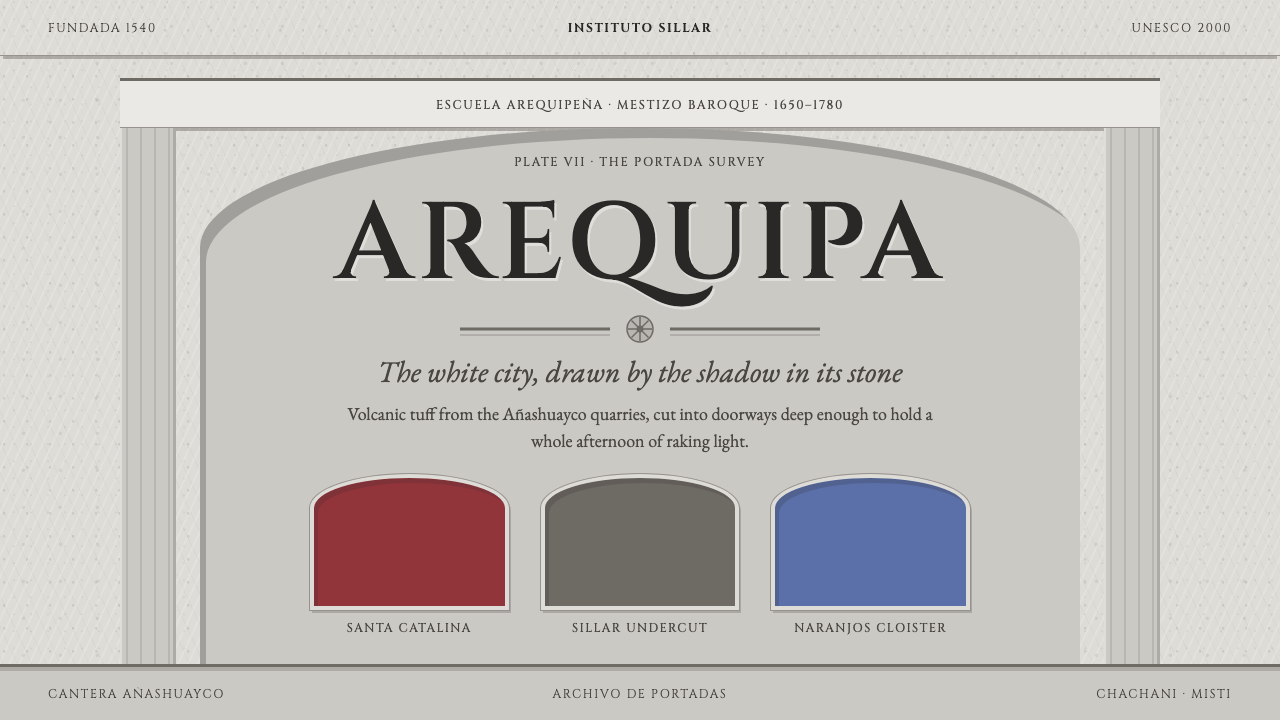 Arequipa White CityShadow is the only ink. Chalk-grey stone in a portada frame, Cinzel capitals,…
 Batak GorgaCosmology cut into wood. Chalk-white lines and batu hula red hold a blackened…
 Belarusian Slutsk SashCourtly silk, vitrined. Taupe ground, crimson panels, Cinzel type, antique go…
 Bhutanese Yathra Wool WeaveHighland wool made digital. Brown-maroon bands carry cyan diamonds and spare…