What is Pomak Rhodope Dress?
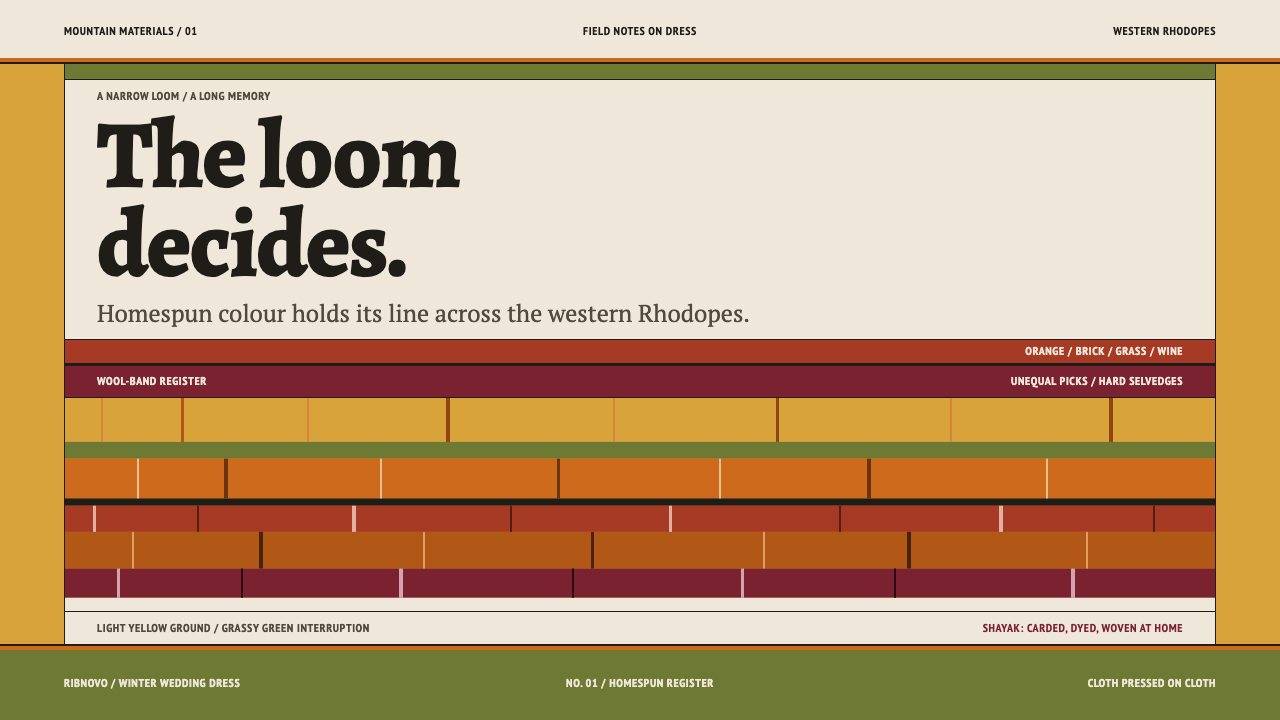
The loom decides: unequal bands of orange, brick red, grass green and wine stack in the rhythm of homespun cloth, and nothing floats.
Pomak Rhodope Dress in brief
Pomak Rhodope Dress is a design system drawn from the festive clothing of Pomak women in the western Rhodope mountains of Bulgaria. Its core is the saya, a long, open overdress worn over wide shalvari trousers, together with a white veil topped by a wine-red towel bound across the forehead and hair. This is a different costume from the dark, sleeveless sukman worn by the Pomaks' Christian neighbours, and the difference is the point: the clothing marks who is wearing it.
Visually, everything is horizontal banding. The cloth was woven on a narrow home loom, and the pattern follows the loom: wide bands on light yellow and orange grounds, cut across by grassy green and brick red, with narrow warp stripes sitting inside the wide bands. The bands are never equal. Their widths are decided by the weaver's hands and the length of thread, not by a designer's grid. Folklorists recognise this band grammar as specifically Rhodope.
The design system turns that grammar into layout rules. Elements stack downward, cloth on cloth; edges are cut and sewn hard, not rounded; nothing floats above the surface like a card or a shadow. It is warm, saturated, rhythmic and unmistakably handmade — closer to a wedding textile than to a luxury brand.

Where does Pomak Rhodope Dress come from?
The Pomaks are Bulgarian-speaking Muslims whose villages lie across the Rhodope range, mainly on the Bulgarian side of the border, with communities also in Turkish Thrace. Their material culture sits at a meeting point. It belongs to Bulgarian folk-costume tradition in its techniques and vocabulary, and to the wider world of Balkan Muslim material culture in its cut, its trousers, its head covering and its sense of modesty. Researchers who document Bulgarian folk dress treat the Rhodopes as a distinct costume region, and Pomak dress as a distinct variant within it.
The costume described here is a nineteenth-century tradition that persisted into the middle of the twentieth, and it has not entirely become a museum object. In Ribnovo, a village in the western Rhodopes, brides are still dressed in it for the winter weddings held there each year. Bridal dressers — women who prepare the gelina, as the bride is called, and paint and ornament her for the occasion — are the living keepers of the look. Other places named in the lineage are Gotse Delchev and Smolyan, and the Pomak communities of Turkish Thrace show how a costume can follow a population across a border.
The cloth itself is the substance of the style. The fabric is shayak, a coarse homespun wool woven by mountain families who dyed and wove it themselves, and it has nothing to do with court silk or urban fashion. Its structure comes from the loom: a narrow loom can only make a narrow length of cloth, so the garment is assembled from cut and sewn pieces with seams and hard edges. A related Balkan textile form, the futa or striped apron, repeats the same logic of bands, and the dowry chest — made by local craftsmen — was where a household kept the woven cloths a girl had prepared for her marriage.
Three groups of makers stand behind the look: the weavers of Ribnovo who produced the cloth, the bridal dressers who put the garments together on the body, and the craftsmen who built the dowry chests. That is a different kind of authorship from the designer-and-brand model. The look has no author and no logo; it has a practice, repeated across generations, with the loom setting the rules. Folklorists who record Bulgarian costume gave the horizontal band grammar its place in the record, and the design system treats that grammar as a discipline.
What defines the Pomak Rhodope Dress look?
Horizontal banding
The organising device is the stripe. Bands run the full width of a surface, stack downward, and vary in height in an unpredictable but balanced way, like the courses of woven cloth. Page sections, cards and panels all become bands. Because the unequal widths are the design, a designer working in this language should resist regularising them into an even grid.
Rhythm from unequal widths
Wide and narrow bands alternate in a pattern that feels repeated but never quite repeats. This is the loom's rhythm: a weaver changes colour when the work requires, not when a ruler says so. The effect is a steady, lived-in cadence, like footsteps rather than a metronome, and it gives pages the pace of a hand-made object.
Warm, earthy palette
Light yellow and orange grounds carry the warmth; grassy green and brick red cut across them; a wine red marks the head towel and anchors the whole composition. White appears as the veil, a clean and quiet counterweight. All of it is earthy, saturated and slightly warm, the colour of dyed wool rather than light emitted by a screen. Colours always meet as neighbours in bands; they never blend.
Narrow warp stripes
Inside the wide bands sit narrow lines, the warp stripes, which act as the cloth's equivalent of fine print. Rules, dividers and secondary detail are drawn as thin stripes of contrasting colour within a band, not as separate hairlines on a blank ground. Fine detail therefore belongs to the band it sits in, the way thread belongs to the cloth.
Hard, cut-and-sewn edges
Edges are cut and sewn, so corners are square. There are no rounded containers, circles or pills, no floating cards and no soft shadows. Where depth is needed it comes from one band overlapping another, like fabric laid on fabric. Seams are visible and honest; they are not hidden behind blur or glow.
Stacked, not floating
The costume is layered from head to hem: a white veil, a wine-red towel bound across the forehead and hair, an open saya over wide trousers. The layout inherits that order. Elements are placed against one another with seams between them rather than gaps, and a vertical column reads from top to bottom like a garment worn from veil to hem. Everything has something under it.
Homespun plainness in type
Type should behave like thread, not jewellery: sturdy, simple and horizontal, set on band grounds with firm contrast and no flourish. The ornament has already been spent on the stripes, and lettering that tries to decorate as well would compete with the cloth. Plain, strong text makes the bands feel richer by comparison.

Who shaped Pomak Rhodope Dress?
The women of Ribnovo wove the shayak and the striped cloths on narrow home looms, dyeing and weaving for their own families. They are the real authors of the band grammar: unequal widths, warm grounds, grass-green and brick-red cuts. Their practice, not any designer's decision, is what this system tries to translate onto a screen.
The bridal dressers prepare the gelina for her wedding, assembling the layers of costume on her body and decorating her face. They hold the knowledge of how the pieces go together: veil first, then the wine-red towel, then the open saya over the trousers. Their work is why the design system treats layering order as a rule, not a taste.
The craftsmen who built the dowry chests made the containers in which a household kept the woven cloths prepared for a daughter's marriage. Their chests tie the textile to the family and to the passing of cloth from one generation to the next. In the system, storage and stacking are therefore motifs, not afterthoughts: bands are laid one upon the next, like folded cloth in a chest.
The folklorists and ethnographers who recorded Bulgarian regional dress are the reason the Rhodope band grammar has a name and a place in the literature. They distinguished the saya of the Pomaks from the sukman of their Christian neighbours and treated the banded cloth as a regional signature. This design system relies on their documentation to stay specific instead of becoming generic folk pattern.
How do you use Pomak Rhodope Dress today?
Pomak Rhodope Dress is a warm, rhythmic and unmistakably cultural style. It works best when the content is itself structured as a sequence of sections — itineraries, timelines, programmes, recipes — and when the product wants to feel handmade and communal rather than high-tech.
A presentation cover can be a stack of wide bands in orange, brick and green, with the title set on a light yellow band and a narrow wine stripe along the base. Content slides can alternate band backgrounds to mark sections, so that a deck feels woven rather than paginated, with each slide's content sitting on a band. Data slides handle stacked horizontal bars especially well: a bar chart whose bars are the bands themselves, in unequal lengths, is almost native to the system.
In interfaces, full-width sections become bands with hard seams; navigation sits on a wine-red strip; cards become stacked rows rather than floating tiles. The style fits cultural, craft, travel, heritage and food products, community platforms and event pages. For dashboards, use it for summary strips and timelines rather than dense data grids. For pricing, tiers laid out as stacked bands from the lightest ground to the deepest read naturally.
In editorial work it suits ethnographic and travel features, museum and heritage materials, wedding and celebration publications, craft brands and cultural-tourism marketing. Long articles can use band changes to mark chapters, with a narrow stripe motif as the divider. Photography of textiles should be flat-lit and close, letting the loom's rhythm show. Credit sources and communities by name rather than leaving the look anonymous.
The usual failure is treating it as generic 'ethnic pattern'. Mixing in motifs from other regions, adding flowers, diamonds or arbitrary geometric borders, or laying a pattern as a decorative overlay on an otherwise conventional layout all lose the specific band grammar. Equally, regularising the bands into equal-height stripes removes the loom's rhythm, and rounded cards sitting on top of the bands contradict the cut-and-sewn logic. Finally, because this is the living dress of a particular community, avoid using it as costume or exoticism: name its origin and keep the representation respectful.

Pomak Rhodope Dress — FAQ
What is a saya, and why does the system mention it?
The saya is the long, open overdress at the centre of Pomak women's festive costume in the western Rhodopes, worn over wide shalvari trousers. It is the garment on which the banded cloth appears most clearly, and it is what separates this costume from the dark sleeveless sukman of Christian neighbours. The system mentions it because the identity of the look depends on it: the design is built on the saya's banded logic, not on a generic folk dress.
Why are the bands deliberately uneven?
Because the loom decided. In the original cloth the widths of the bands come from a weaver's choices and the available thread, not from a ruler. Folklorists treat that irregular but balanced rhythm as part of what makes the grammar Rhodope. An even grid of equal stripes would be easier to build, but it would read as a generic striped pattern, not as this cloth.
Can this style be used for any folk or ethnic brand?
It should not be. The system is specific: it describes one regional costume tradition and one band grammar. Applying it to unrelated cultural contexts blurs that specificity and risks turning a living community's dress into a decorative filter. It fits best where the subject genuinely connects to Rhodope, Pomak or Balkan textile culture, or where handmade, communal warmth is the real aim and the source is credited.
Does it work for modern, minimal or technical products?
Rarely. Its strengths are warmth, rhythm and a handmade feeling, which pull against the neutral precision most technical products want. It can work in small doses, such as a timeline strip or a section header band inside an otherwise plain interface, but a fully banded, saturated page will fight against dense data and fine controls. Use it where sections and stories matter more than throughput.
How should the white veil and the wine-red towel be handled in a layout?
Treat them as the head of the page. White is the quiet, clean top layer, a place for a title or a pause; wine red is the binding strip that sits across it, as the towel is bound across forehead and hair, and it anchors the composition. Below them, the warm banded cloth takes over. Keeping that order from top to bottom preserves the garment's logic and gives the page a clear beginning.
Related design styles
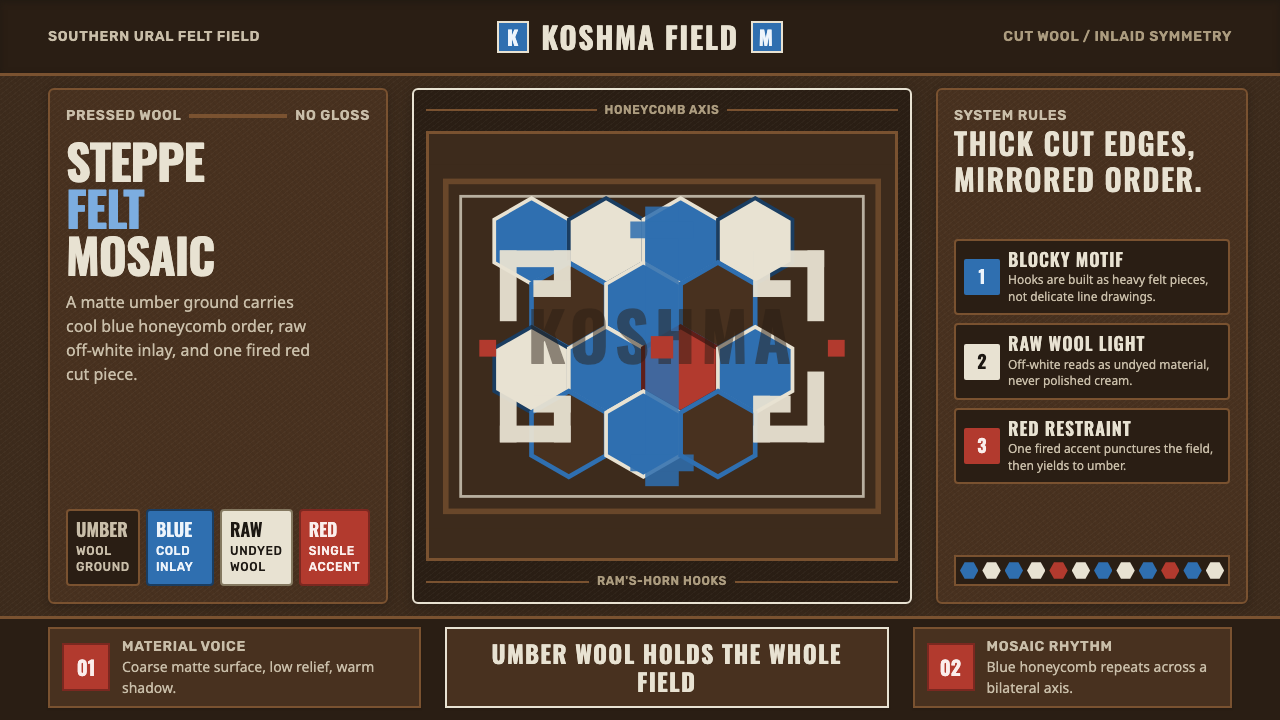 Bashkir Honeycomb Felt OrnamentSteppe craft feels weighty. Umber felt holds blue honeycomb and raw-wool hook…
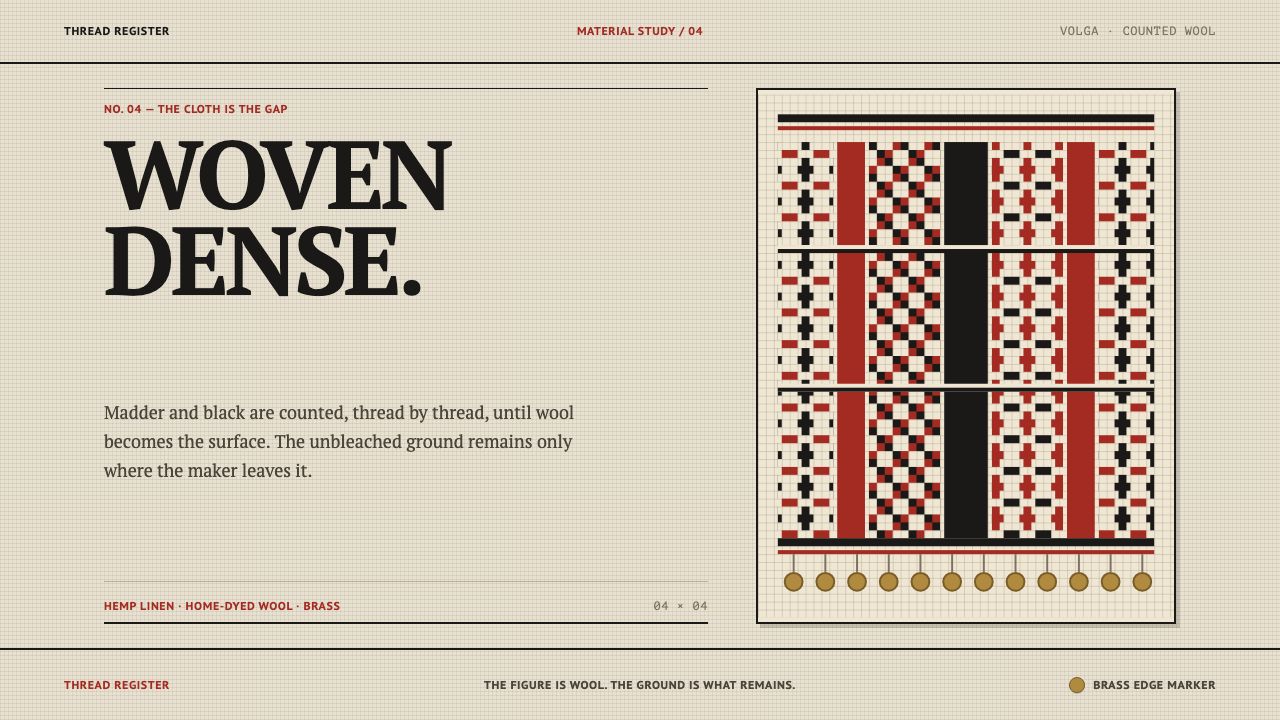 Erzya PangaDensity is the ornament. Madder and black stepped stitches crowd unbleached l…
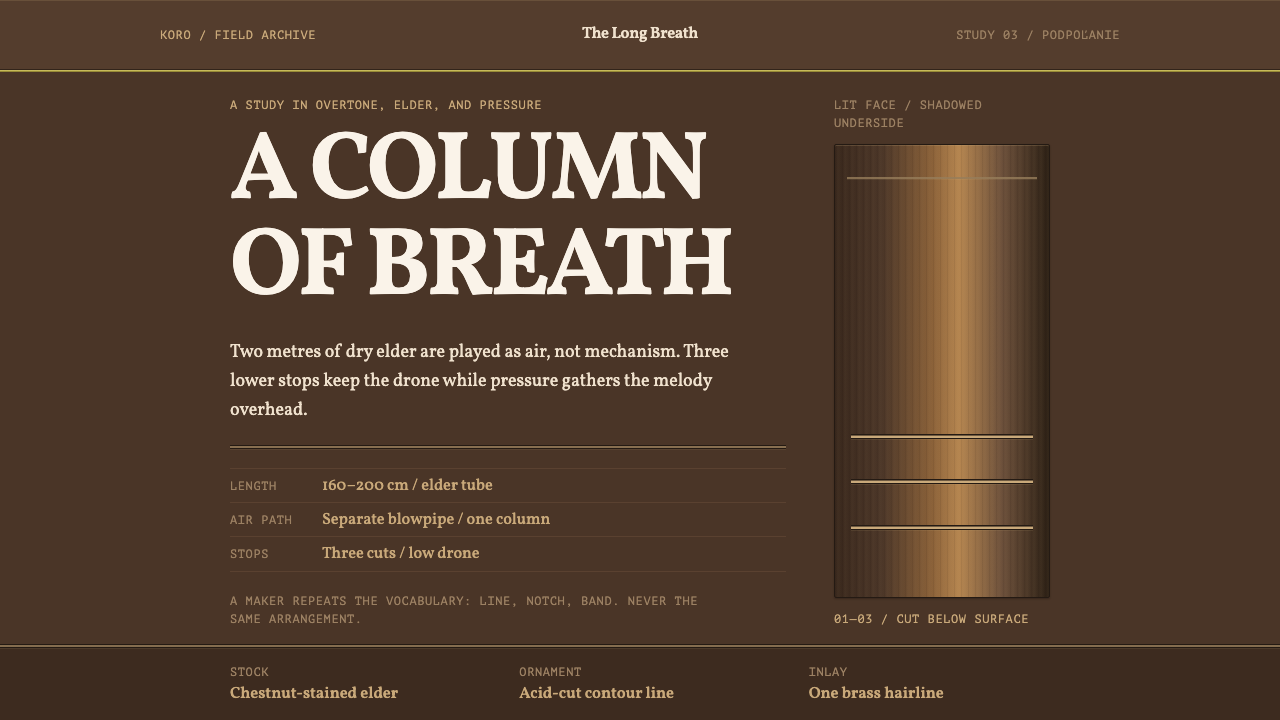 Fujara FluteBreath becomes architecture. Chestnut gradients and incised double rules hold…
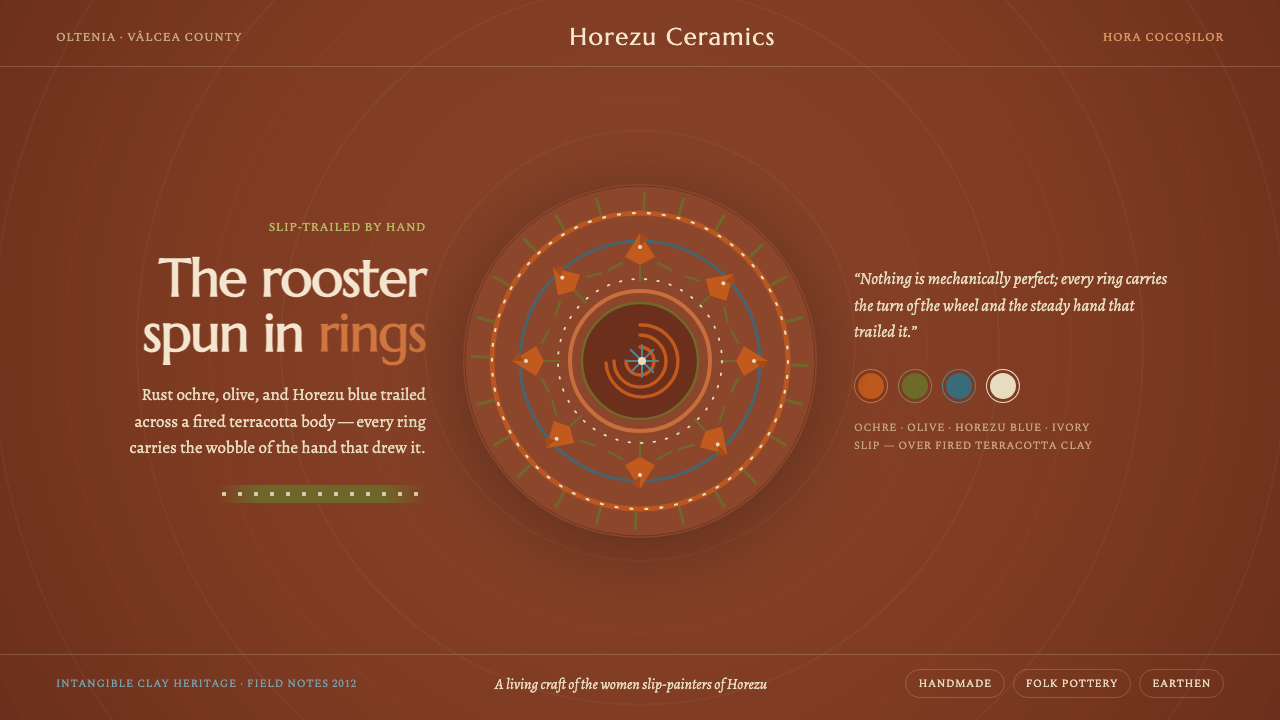 Horezu CeramicsWarm earth, steady hand. The Horezu rooster spun in ochre and olive slip acro…
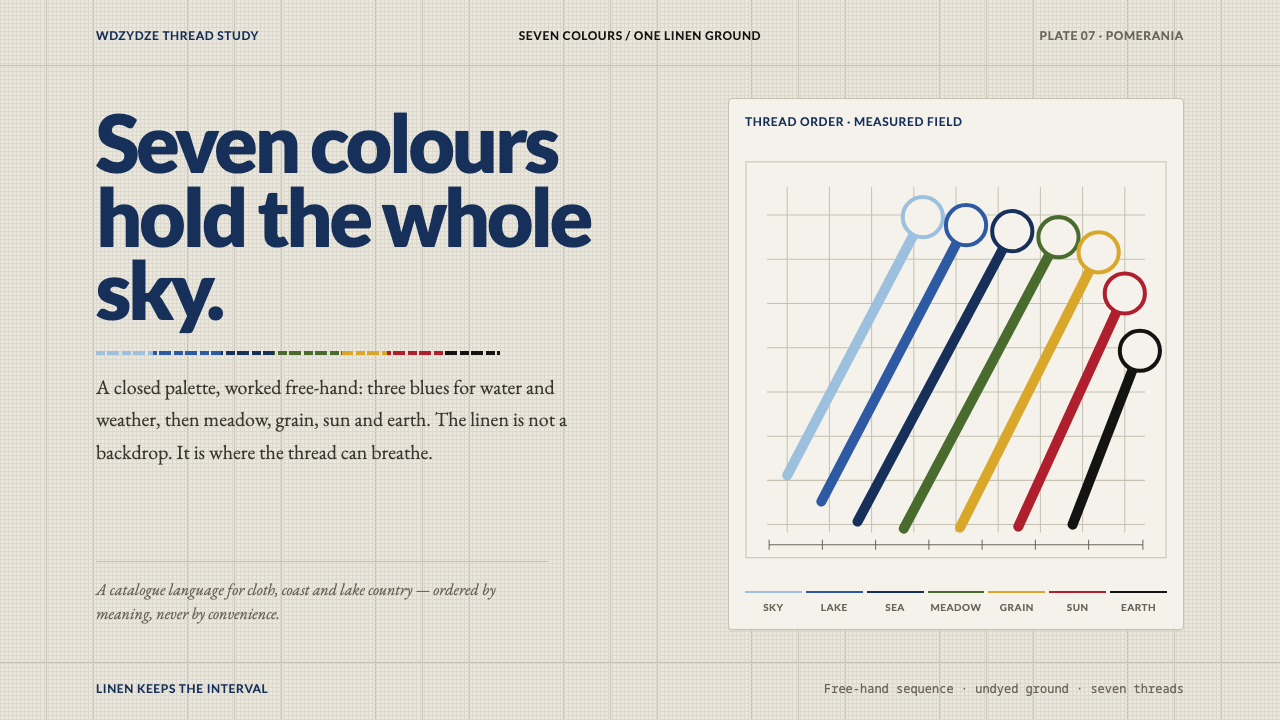 Kashubian Seven ColoursMeaning is stitched into the palette. Seven threads cross undyed linen in a m…
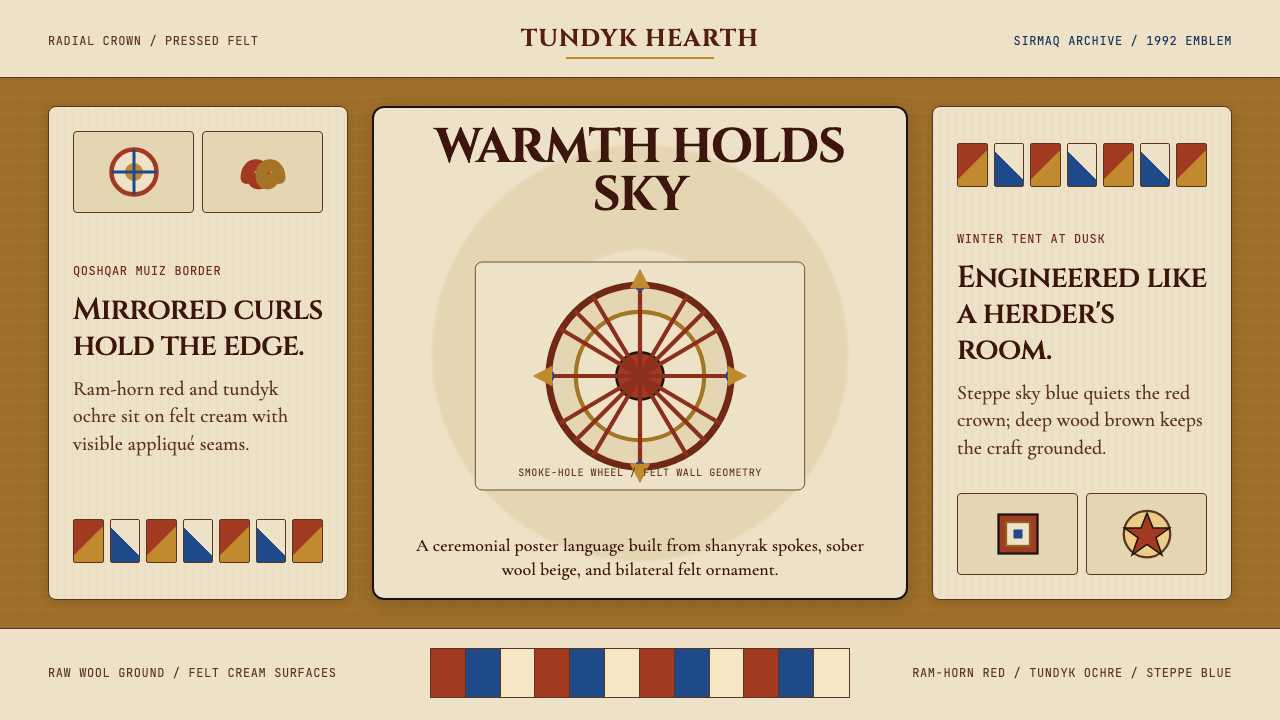 Kazakh Shanyrak Yurt FeltDomestic warmth, engineered. Ram-horn red felt curls around a radial shanyrak…