What is Malagan Carving?
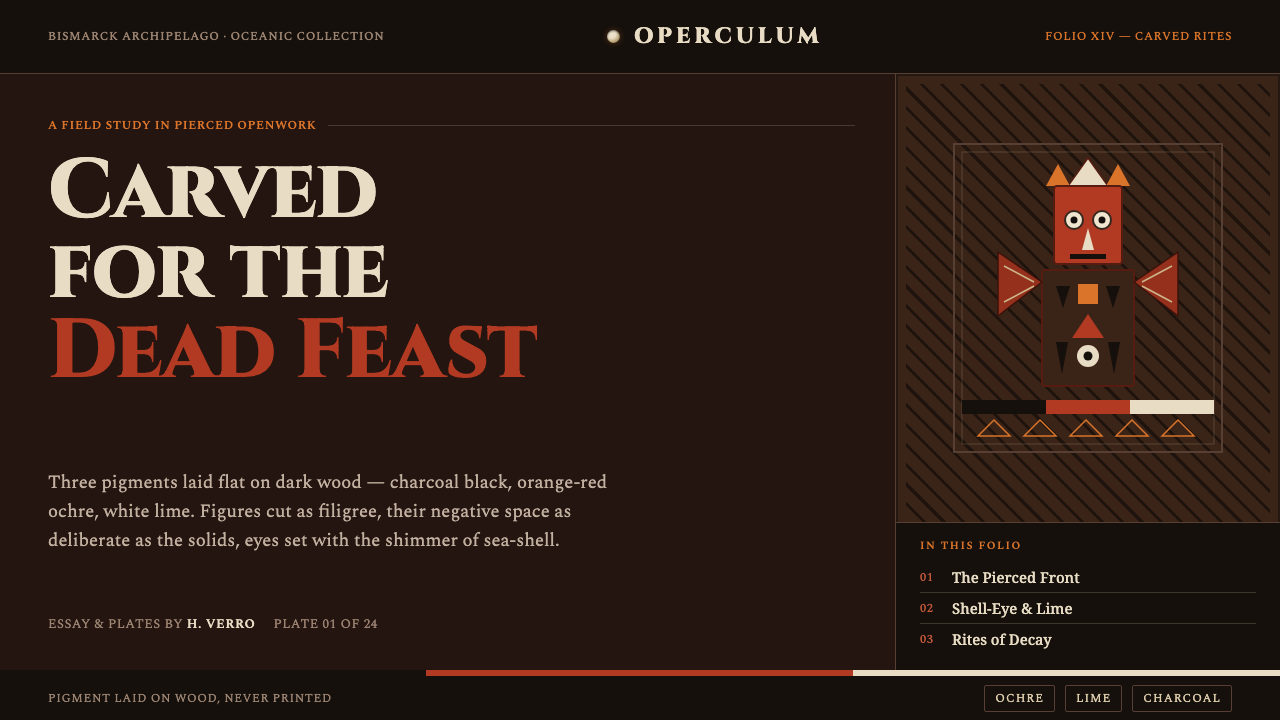
Malagan carving turns remembrance into dense openwork: ochre, lime, charcoal, and shell light held within dark wood for the mortuary feast.
Malagan Carving in brief
Malagan funerary carvings are polychrome sculptures and friezes from northern New Ireland in Papua New Guinea’s Bismarck Archipelago. Made for mortuary feasts, they are cut from dark wood as pierced openwork: interlocking figures and motifs are carved through the material until the object reads less as a solid block than as a dense filigree of connected forms. The visual force comes from this tension between mass and absence. Dark wood establishes depth, while openings make the surface feel active, layered, and difficult to take in at a glance.
Their fronts use a tightly controlled painted vocabulary of black, orange-red ochre, and white lime. These are not atmospheric washes or decorative gradients. They read as deliberate, matte areas laid across carved structure, making selected forms emerge from the dark ground. Turbo-shell opercula are inset as eyes, introducing a small reflective interruption into an otherwise absorbent material world. The shell does not soften the carving’s severity; it gives the object a watchful, glinting point of presence.
As a contemporary design language, Malagan carving is best understood as an interface system built from dark ground, pierced density, restrained painted accents, and rare luminous highlights. It is not a generic tropical decoration style. Its character depends on the relationship between carved complexity and ceremonial gravity: visual richness is earned through interlocking structure, while color and shine remain selective. A successful adaptation should feel hand-cut, attentive, and solemn rather than merely exotic or ornate.
Where does Malagan Carving come from?
Malagan belongs to a funerary carving tradition of northern New Ireland, in the Bismarck Archipelago of Papua New Guinea. The tradition predates the modern collecting era and was widely collected through the nineteenth century; carving continues today. Its central setting is the mortuary feast, which gives the work a ceremonial purpose from the outset. These objects were not conceived as detached décor. Their formal density, material care, and colored surfaces are inseparable from a context of remembrance and ritual display.
The works are associated with New Ireland malagan master carvers and with clan ritual specialists. That relationship matters for the style’s visual logic. The carving is neither casual pattern-making nor an individual signature detached from use: it belongs to a ritual tradition requiring highly developed making knowledge and ceremonial stewardship. The resulting surfaces convey accumulated attention. Forms overlap, cut through one another, and remain structurally connected even when the openwork becomes extremely intricate.
Dark wood supplies the physical field from which the forms are released. Instead of treating the wood as a neutral support for paint, the tradition lets it remain visually present as the deep body of the object. Openings are therefore not empty background. They are part of the sculpture’s composition, allowing darkness to travel through the design and separating one carved element from another without requiring broad blank areas.
The painted front and the shell eyes complete this interplay of material states. Black joins the dark carved field, orange-red ochre supplies warmth and emphasis, and white lime clarifies chosen surfaces. The inset Turbo-shell opercula catch light differently from paint or wood, making the eyes especially vivid. Together, carving, matte color, void, and shell create an object that can hold dense information without becoming visually shapeless. This is the key historical lesson for a design adaptation: complexity needs a disciplined material hierarchy.
What defines the Malagan Carving look?
Dark Carved Ground
The ground should feel like dark hard wood rather than an empty black screen. It carries weight, absorbs visual noise, and gives every lighter element a material context. Keep large areas quiet enough for the interface to breathe, but allow the darkness to suggest depth beneath the visible surface. The goal is not gloom; it is the sense that the page has been cut from a substantial, resistant material.
Pierced Openwork
Malagan density is made through connected cut-through forms, not through indiscriminate texture. In an interface, use interlocking frames, openings, dividers, and layered silhouettes to suggest a carved lattice. Negative space must remain legible as an active structural element. If every region is filled with detail, the openwork loses its meaning; darkness needs to pass through the composition.
Matte Ochre and Lime
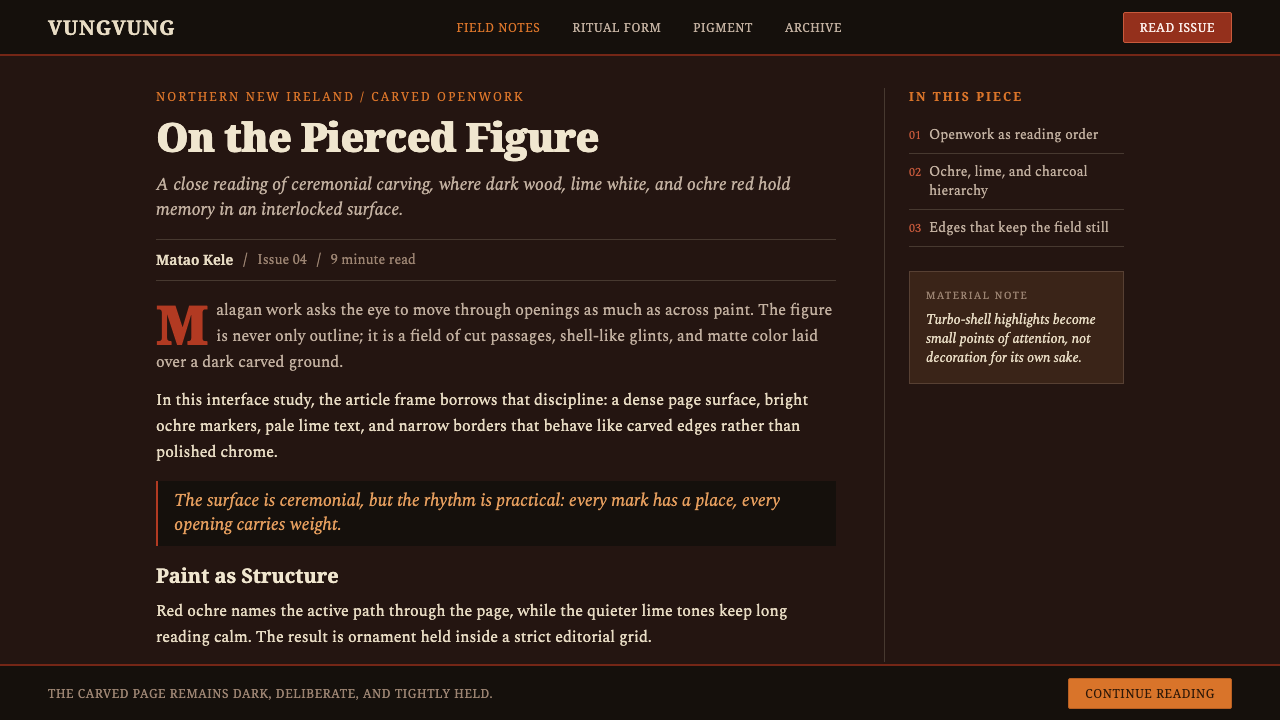
Orange-red ochre and white lime work as flat, opaque marks over the dark field. They should identify hierarchy, selected edges, active states, or ritual-like focal areas rather than decorate every component. Their effect is strongest when the paint appears to sit on the surface while the dark ground continues to imply depth behind it. Avoid glossy rendering, atmospheric blending, and color abundance.
Shell-Eye Highlights
Turbo-shell opercula create the tradition’s most concentrated points of reflected light. Translate this sparingly: a shell-eye highlight should be a rare marker for a decisive control, a current state, a key metric, or an important alert. It should feel inset and discovered, not sprayed across the page as sparkle. The contrast works because matte paint and dark wood make the small bright point consequential.
Interlocking Structure
Forms should appear related through contact, overlap, and shared boundaries. A panel can grow from a frame, a heading can align with a carved-like rule, and a data region can be held within a nested contour. This creates the sense of a continuous object rather than a collection of floating cards. Connections must remain purposeful and readable; the style gains authority from disciplined attachment, not visual entanglement for its own sake.
Ceremonial Restraint
The mood is grave, attentive, and materially warm. It supports density without becoming playful, and ornament without becoming casual. Reserve the strongest contrasts for information that deserves ceremony: an opening statement, a major transition, an important record, or a closing action. Decorative motifs that have no structural role weaken the translation, because Malagan’s richness comes from carved purpose and ritual context rather than from surface excess.
Who shaped Malagan Carving?
The master carvers of northern New Ireland are the tradition’s essential makers. Their work joins dark wood, pierced openwork, painted fronts, and inset shell eyes into a single ceremonial object. For designers, their importance lies in the example of integrated making: structure, color, and highlight are not separate styling passes but mutually dependent parts of the form.
Clan ritual specialists connect Malagan carving to the mortuary feast and its ceremonial meaning. Their presence reminds contemporary users that the tradition cannot be reduced to a visual resource alone. Any respectful adaptation should preserve the work’s seriousness, avoid empty spectacle, and describe its source plainly rather than presenting the language as anonymous ornament.
The mortuary feast is the setting for which these carvings are made, making the participating community a crucial bearer of the tradition’s meaning. The feast frames the carvings as objects of remembrance rather than as autonomous art effects. This context is why a Malagan-derived interface should privilege focus, hierarchy, and deliberate reveal over entertainment-oriented visual abundance.
How do you use Malagan Carving today?
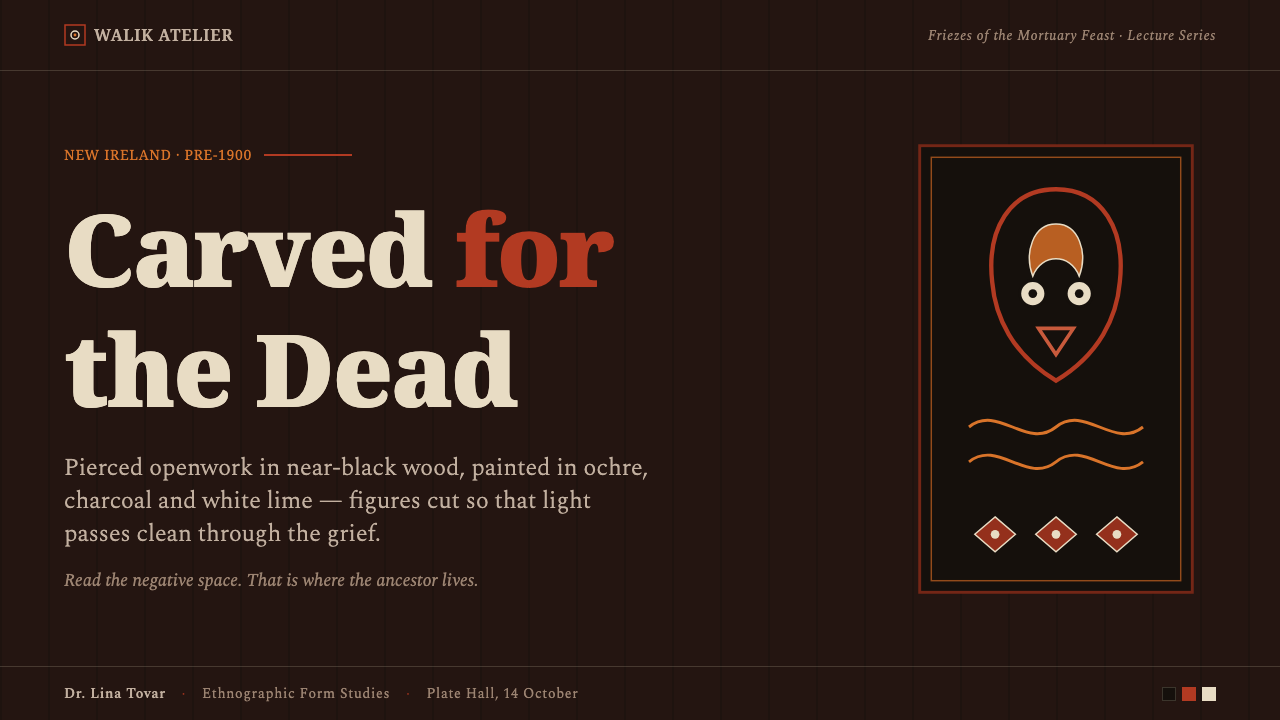
For presentation covers, use the dark carved ground as a field of ceremonial concentration. A title can sit beside or within a large open contour, with one ochre or lime intervention marking the focal region and a rare shell-like highlight indicating the central subject. Avoid treating the slide as a wallpapered artifact. The cover should have one clear visual entrance, with carved density gathered around it rather than distributed uniformly across the whole surface.
Content and data slides benefit from the style’s ability to make hierarchy feel embedded. Use nested openwork-like boundaries to contain sections, let the dark ground separate content groups, and reserve ochre and lime for meaningful distinctions. Charts should remain plain and interpretable, but their bars, segments, labels, and legends can be organized as connected carved forms rather than generic floating modules. A small reflective accent may identify the current value or decisive comparison, provided it remains exceptional.
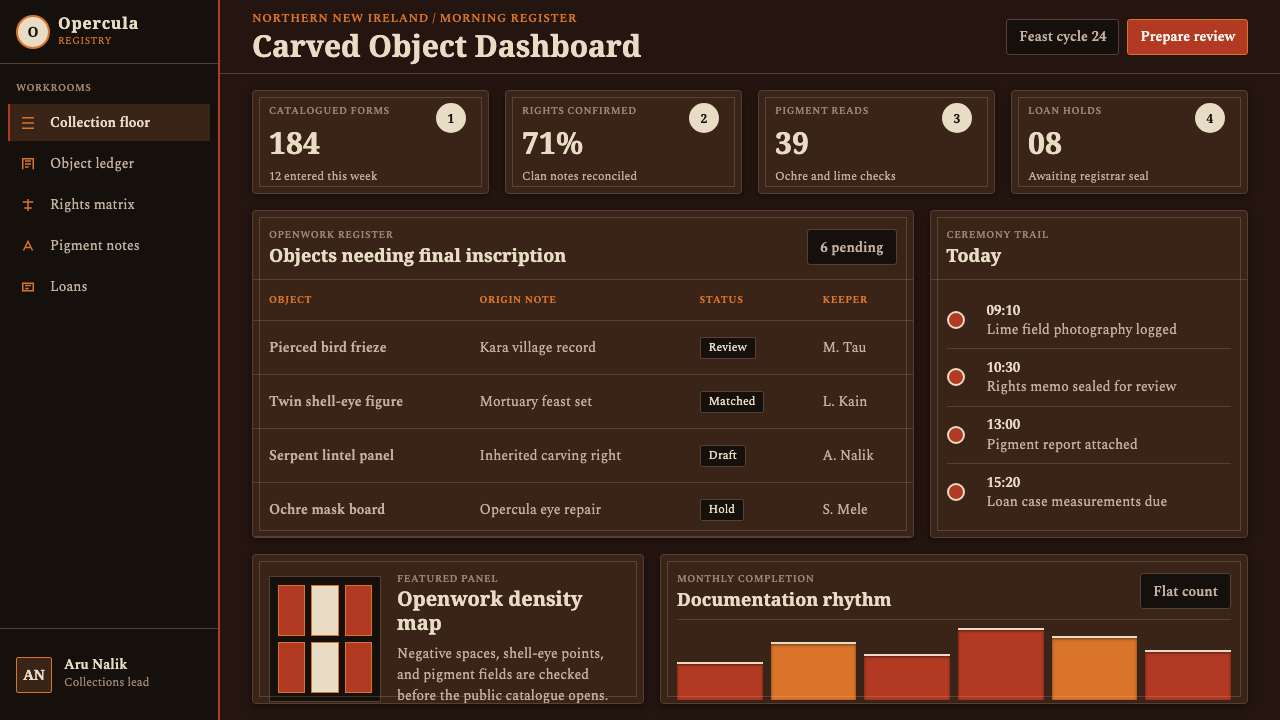
For web interfaces, Malagan is especially suitable for dashboards, archival tools, collections, and pricing or membership pages that need a sense of depth and authored value. Build navigation as part of a continuous frame rather than an isolated strip. Panels should seem seated within the dark field, connected by rules, apertures, or shared contours. Interactive states can use matte ochre or lime, while the brightest shell-like cue should be reserved for the most consequential action, status, or selected record.
In editorial and marketing work, the style can frame a long-form story with density without sacrificing readability. Keep reading areas calm within the dark composition, then use pierced borders or clustered motifs to mark transitions, pull quotations, media entries, or calls to action. For campaigns, a single strong carved silhouette can carry more authority than a field of decorative motifs. Credit the source tradition directly and ensure that the language explains its funerary and regional context rather than using its visual qualities as a vague global pattern.
The common mistake is to copy the palette and add indiscriminate tribal-looking decoration. That approach loses the specific qualities that make Malagan coherent: dark wood as substance, openwork as structural absence, paint as selective emphasis, shell as a rare optical event, and mortuary ceremony as the source of its gravity. Do not fill every gap with pattern, scatter bright highlights, or make the style cheerful by default. The strongest adaptation is sparse where it needs to be sparse, intricate where the structure can support intricacy, and explicit about its cultural source.
Malagan Carving — FAQ
Is Malagan carving simply a dark tropical decorative style?
No. Malagan is a funerary carving tradition from northern New Ireland, made for mortuary feasts. Its dark wood, openwork, painted surfaces, and shell eyes belong to a ceremonial object with a specific regional source. A design adaptation should retain that context in its description and should not present the style as anonymous tropical ornament.
How should ochre, lime, and black be balanced in an interface?
Let the dark carved ground do most of the spatial work. Use black as the deep field and let ochre and lime identify selected structural, interactive, or informational moments. Their power comes from restraint and matte clarity. If every surface receives both accents, the hierarchy collapses and the relationship to painted carving is lost.
What makes openwork different from adding a busy texture?
Openwork is structured absence. Forms are connected, but material is deliberately removed so darkness and air can move through the composition. A busy texture merely adds marks. In a Malagan-derived layout, every opening should help separate, connect, frame, or direct attention; it should not exist only to make the page look intricate.
When should shell-eye highlights be used?
Use them only where a small bright point changes the reading of the whole composition: a selected record, a key status, a major action, or a defining detail on a cover. Shell eyes are effective because they are materially and visually different from the surrounding wood and paint. Repeating that effect everywhere turns a meaningful glint into ordinary interface chrome.
Which products are a good fit for a Malagan-derived visual system?
It is strongest where depth, memory, collection, ceremony, or authored craft are meaningful values: archives, cultural collections, editorial experiences, research dashboards, membership spaces, and focused presentations. It is less suitable for products that need effortless cheerfulness or visual lightness at every moment. The fit depends on whether the product can support a dark, dense, respectful atmosphere without turning that atmosphere into spectacle.
Related design styles
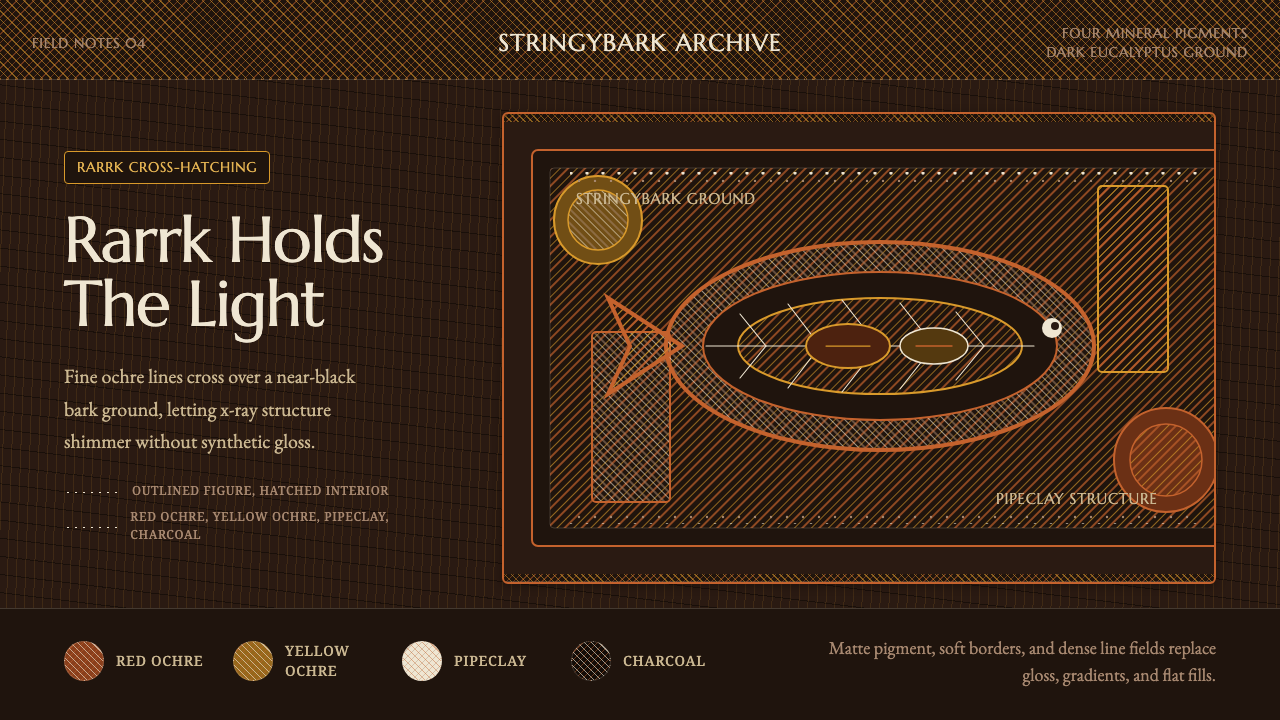 Arnhem X-Ray Bark PaintingShimmers without gloss. Ochre rarrk lines vibrate on dark stringybark.
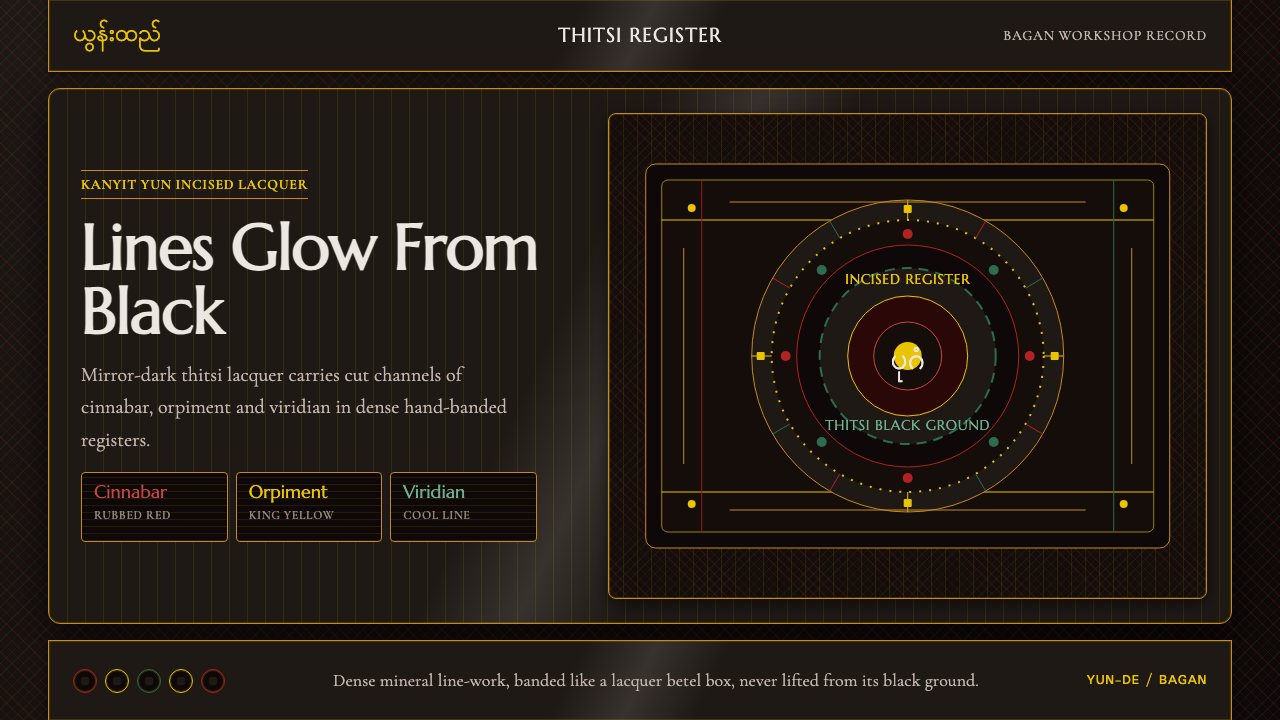 Burmese Yun LacquerwareLacquer glows in cut lines. Cinnabar, orpiment and viridian band a mirror-bla…
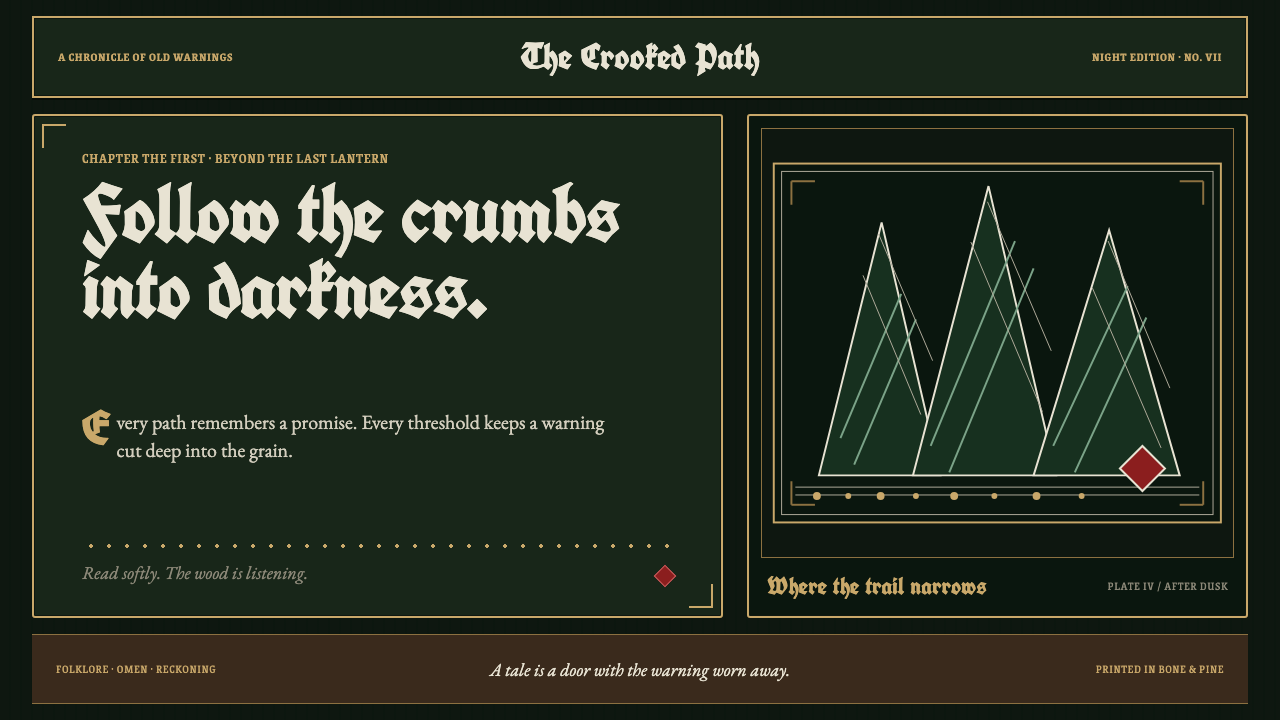 Grimm Fairy Tales (Black Forest Woodcut)The dark wood closes in. Bone-white cuts and aged-gold frames score a pine-bl…
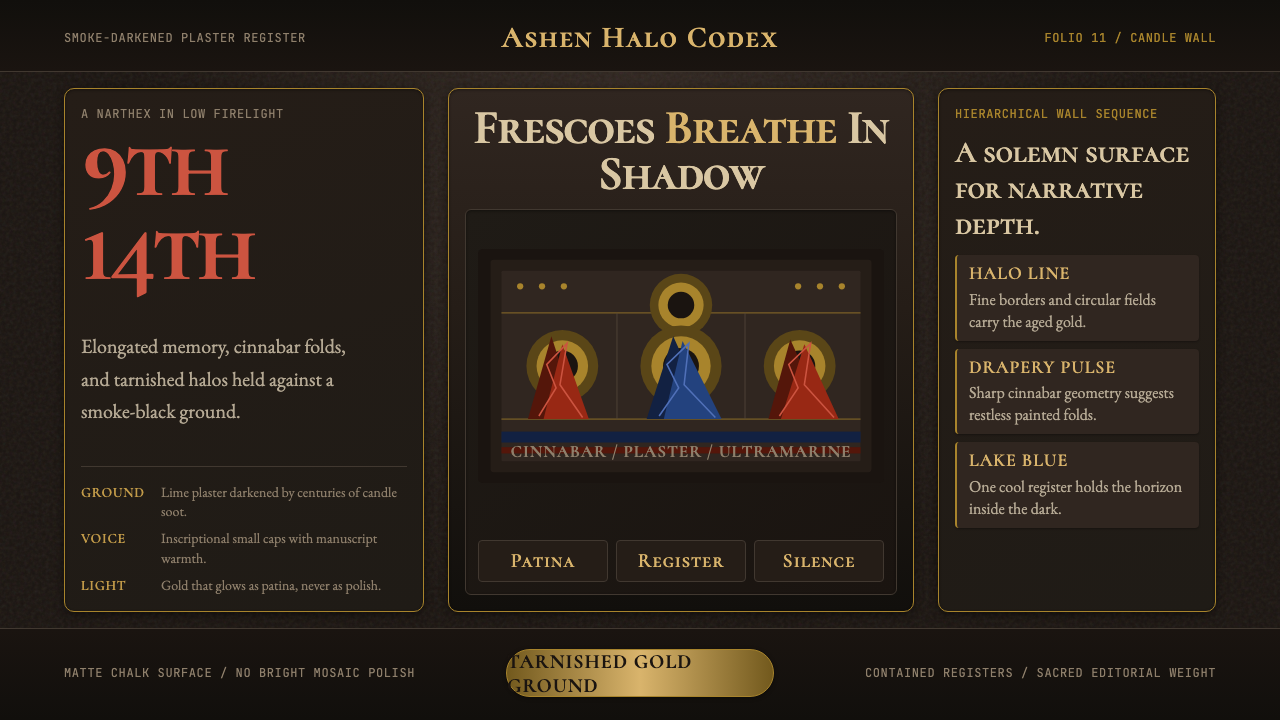 Macedonian Ohrid Fresco (Byzantine)Sacred darkness breathes. Tarnished gold rings, cinnabar folds, and plaster g…
 Newar Tundal Strut CarvingCenturies-darkened sal-wood. Carved deities and pierced lattice in mid-brown…
 Norse Runic StaveCarved memory, painted to last. Ochre-red futhark runes incised into iron-col…