What is PlayStation (1994 Original)?
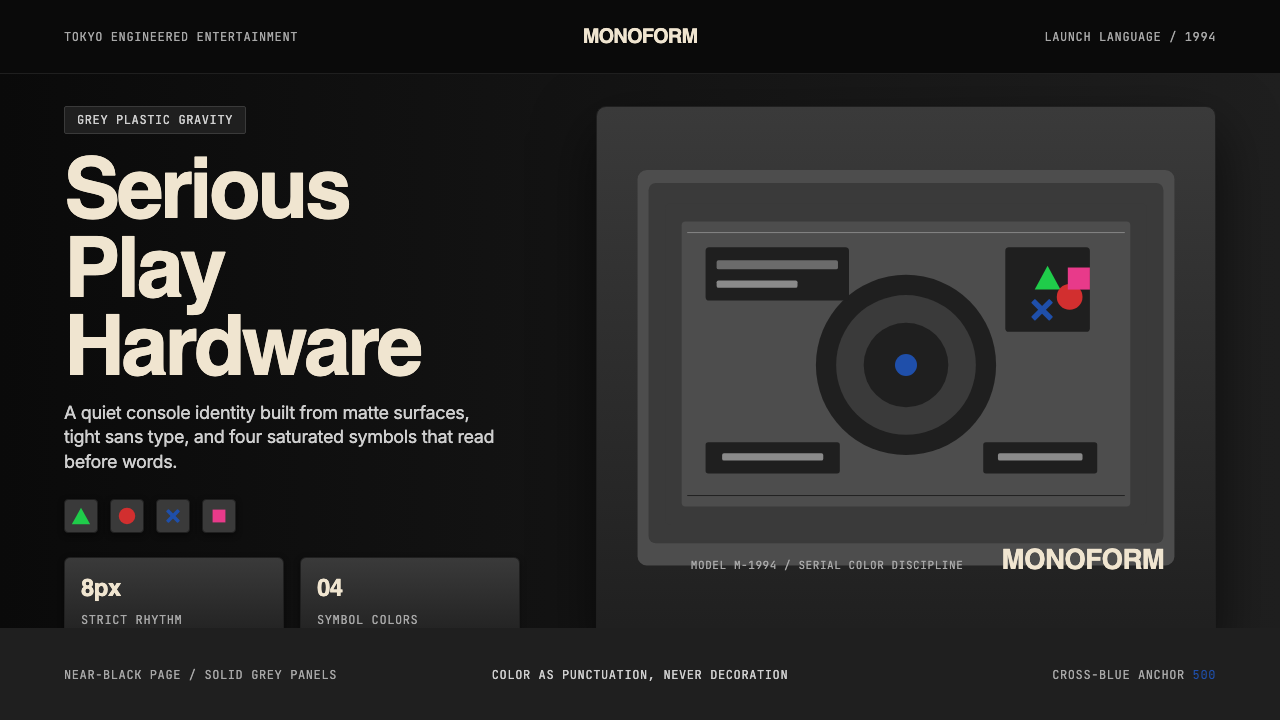
PlayStation's 1994 identity proved that a game console could be sold like industrial equipment — grey plastic, four saturated symbols, and Helvetica set tight.
PlayStation (1994 Original) in brief
PlayStation (1994 Original) is the visual identity system launched by Sony Interactive Entertainment in December 1994 alongside the first PlayStation console. Its grammar is austere: a dark or neutral grey chassis treated as a consumer-electronics product, a quartet of saturated geometric symbols — green triangle, red circle, blue cross, pink square — used as the controller's face buttons and as a wordless logo, and sans-serif typography set with unusually tight letter-spacing. Together these elements formed a brand language that refused every convention of 1990s gaming.
Where rival consoles leaned on speed lines, cartoon mascots, and aggressive chromatic contrast, Sony positioned PlayStation as a serious machine for adults. The photography in launch campaigns treated the hardware the way industrial catalogues treat precision instruments — straight-on, lit without drama, on plain backgrounds. Color appeared not as atmosphere but as labeling: each of the four symbols was assigned a distinct saturated hue, creating a pictographic system that communicated across language barriers without requiring a single word.
Thirty years on, the system is essentially unchanged. The four-symbol mark remains one of the most recognized logos on earth, and the restrained grey-dark-color vocabulary has influenced a generation of consumer-electronics and gaming brands that aspire to confident, tool-like authority. PlayStation did not borrow this seriousness from the world of professional equipment — it engineered it from scratch, using color, form, and type as precision components.

Where does PlayStation (1994 Original) come from?
The first PlayStation launched in Japan on December 3, 1994, the product of a development program led by Ken Kutaragi, a Sony engineer who had championed digital audio technology inside the company since the late 1980s. Kutaragi's original vision — hatched from a famously troubled collaboration with Nintendo on a CD-ROM add-on that was ultimately cancelled — was to build a machine powerful enough to render three-dimensional polygon graphics in real time, a capability that no home console had yet delivered convincingly. The technical ambition shaped the identity: a product this serious required a visual register to match.
The design of the console's physical form was handled internally at Sony, with art director Manabu Sakamoto credited as a key figure in the identity work. The team's decision to photograph the hardware in a style borrowed from Sony's professional audio and video equipment catalogues — stark, precise, product-forward — was deliberate. Sony's corporate design language at the time was already one of the most disciplined in consumer electronics, characterized by neutral greys, minimal surface texture, and type used as engineering annotation rather than as marketing decoration. PlayStation extended that language into gaming rather than inventing something new.
The four controller symbols — triangle, circle, cross, and square — were assigned color by Sakamoto's team using a logic that was both pragmatic and symbolic. Each shape needed a distinct hue for button identification, but the hues also carried intended associations: the green triangle pointed toward a viewpoint or perspective, the red circle represented a confirmation or 'yes' (in the Japanese cultural context where a circle denotes correctness), the blue cross suggested a directional or cursor function, and the pink square implied a document or surface. Whether players consciously registered these associations mattered less than the system's visual coherence: four shapes, four colors, one palette that never felt arbitrary.
The original PlayStation identity launched at a moment when Japanese consumer-electronics brands — Sony, Panasonic, Sharp — were at the apex of their global cultural authority. The aesthetic choices made in 1994 drew from that context: the confidence to use restraint when competitors were shouting, the trust that adult consumers would read seriousness as an asset rather than a liability, and the industrial-design tradition of treating a product's physical form as its primary communication. The identity has outlasted two subsequent decades of gaming-console visual inflation — the aggressive chrome treatments, the glowing LED accents, the motion-blur logotypes — because it was never playing that game.
What defines the PlayStation (1994 Original) look?
Symbol System
The four geometric symbols — triangle, circle, cross, square — are the identity's load-bearing structure. Each is rendered at a consistent weight and scale relative to one another, and each is assigned a single saturated color that appears nowhere else in the palette. The symbols function simultaneously as button labels, as a wordless brand mark, and as a pictographic globe — four languages collapsed into four shapes. No text is required for recognition.
Restrained Color Logic
Outside the four symbol colors, the palette is deliberately narrow: neutral and dark greys dominate the hardware and most branded surfaces, with the saturated symbol hues reserved for use as punctuation — present only where they carry meaning, absent everywhere else. Color is not mood; it is information. This economy makes each appearance of the four colors load-bearing and instantly significant, rather than decorative or atmospheric.
Industrial Neutrality
The console's physical form and its photographic presentation borrow the aesthetic vocabulary of professional electronics: neutral grey over black, smooth matte surfaces without decorative texture, and an absence of visual styling that would date the object to a particular cultural moment. The hardware reads as tool before it reads as toy — a deliberate inversion of every gaming-console visual convention of its era.
Tight, Functional Typography
The identity uses a single clean sans-serif typeface set with notably compressed letter-spacing, particularly in the wordmark and product labeling. Type is treated as engineering annotation — marking, identifying, specifying — rather than as expressive or decorative material. Scale contrast does the organizational work: product names are large and spare, technical specifications are small and dense, and nothing in between serves as decoration.
Dark Surface Confidence
Where most gaming brands of the 1990s defaulted to white or bright backgrounds to signal energy and accessibility, PlayStation adopted dark grounds as its primary canvas — both in hardware and in marketing. Dark surfaces connote seriousness, premium positioning, and nocturnal focus. They make the four saturated symbol colors simultaneously more vivid and more controlled, because saturation reads differently against darkness than against light.
Pictographic Global Reach
The symbol system was engineered for language-agnostic communication from the start. A player who cannot read Japanese, English, or any other language can still learn and recall which button is which because the shapes and colors are distinct and consistent across every market, every product generation, and every communication touchpoint. This pictographic universality is not accidental — it reflects a deliberate decision to treat the symbols as a visual language rather than a labeling convention.
Restraint as Brand Authority
Every element in the 1994 PlayStation identity system does exactly one thing and nothing more. The grey is not styled; the symbols are not shadowed or beveled; the type is not stretched or decorated; the photography is not retouched into drama. This total restraint functions as a brand argument: we did not need to shout because the product speaks for itself. In markets saturated with visual noise, restraint is a form of confidence, and confidence is a form of authority.

Who shaped PlayStation (1994 Original)?
Kutaragi is the engineer most responsible for PlayStation's existence. He championed digital sound chip technology inside Sony in the late 1980s, negotiated the original SNES sound chip deal with Nintendo, and then — after that partnership collapsed — led the internal effort to build a standalone console. His insistence on three-dimensional polygon rendering as the machine's core capability set the technical ambition that the identity's seriousness had to match. He remained the driving force behind PlayStation hardware through the PS3 era and holds the informal title 'Father of PlayStation'.
Sakamoto is the art director credited with designing the four-symbol color assignment — triangle in green, circle in red, cross in blue, square in pink — and with establishing the visual language that placed the symbols at the center of the brand. His decisions about which hue to assign to which shape, and the logic behind those assignments (each color carrying an intended associative meaning), gave the identity its most durable and most-copied element. The symbol system he designed in 1994 remains unchanged on PlayStation hardware released thirty years later.
SIE is the corporate entity that has stewarded the PlayStation identity for three decades without substantively altering its foundational elements. The four-symbol logo, the grey-and-dark palette, and the sans-serif tight-set wordmark have survived five hardware generations, multiple corporate reorganizations, and the rise and fall of several competing visual trends in consumer electronics. SIE's institutional commitment to the 1994 identity is itself a design statement — it demonstrates that a visual system built on structural rather than stylistic logic can remain coherent and contemporary across an unusually long lifespan.
As Sony's president and later chairman during the PlayStation era, Ohga was the executive who gave Kutaragi the organizational cover to pursue the PlayStation project after the Nintendo CD-ROM collaboration collapsed. A trained musician with unusually strong aesthetic sensibility for a corporate executive, Ohga's support for product design that took itself seriously — that positioned Sony hardware as precision instruments rather than mass-market toys — created the cultural conditions inside Sony that made the PlayStation's restrained identity possible.
How do you use PlayStation (1994 Original) today?
PlayStation (1994 Original) translates well into contemporary design work because its principles are structural: dark grounds, saturated symbol-colors used as punctuation, neutral grey as the primary surface, and sans-serif type at tight spacing. Applying it correctly requires understanding that this is a system of restraint — every choice is a reduction, not an addition. Adding texture, gradients, or decorative elements does not make the style richer; it destroys the logic that makes it work.
For presentation slides, the style excels at establishing authority on cover pages and maintaining clarity on content pages. A cover built in this language typically anchors on a dark or near-black ground, with a single large geometric symbol or symbol-derived shape in one of the four saturated colors holding a corner or center. The title sits in tight sans-serif type at large scale against the dark ground, with a wordmark or session identifier in small type at the opposite corner. Content slides treat the grid strictly: one organizing visual per slide, type hierarchies established by scale alone, and color used only where it signals a specific piece of information — a data point, a call to action, a category marker. Data visualizations in this style are clean and diagrammatic: bars and segments take the four symbol colors as their categorical palette, and chart furniture is minimal.
For web interfaces, the vocabulary maps directly onto dashboards, admin panels, and pricing pages where scannability and authority matter more than warmth. The approach begins with a dark or deeply neutral ground, a single sans-serif typeface at multiple weights, and color reserved for interactive states and status indicators. Card components should have hard or no shadows — the soft-shadow convention of contemporary UI does not belong here. Navigation should be typographic rather than icon-driven, and the four symbol colors can serve as a tier-differentiation system on pricing pages, where their natural distinctiveness does exactly the work that category color is supposed to do.
For editorial and marketing work, the style's most direct analogue is the product-launch announcement: a full-field dark background, a large product image treated without styling or glow, tight sans-serif type for the headline, and one of the four colors used as the sole accent — on a date, a product name, or a call to action. The absence of supporting imagery or atmospheric gradients is intentional. The style also works for long-form editorial when the dark ground is exchanged for a neutral grey field, with the four colors appearing only in pull quotes, section markers, or data labels.
A common mistake when working in this vocabulary is treating the four symbol colors as a general palette available for broad decorative use. In the original system, each color appears once — on its assigned symbol — and is largely absent from everything else. Applying two or more of the symbol colors simultaneously to non-symbol elements dissolves the punctuation logic and produces a palette that looks festive rather than serious. The correct restraint is to select one of the four colors as the single accent for a given piece of work, use it exclusively for load-bearing information, and leave the rest of the surface to the dark or grey ground and black-or-white type.

PlayStation (1994 Original) — FAQ
Is the PlayStation style minimalism?
It shares minimalism's preference for reduction and its rejection of decoration, but it is not minimalism in the contemporary sense — which tends toward warmth, soft neutrals, and organic imperfection. The PlayStation identity is closer to industrial modernism: reduction in service of function and authority rather than in service of calm or approachability. The four saturated symbol colors, in particular, are not minimalist — they are precise and bold. The style's restraint comes from discipline, not from aesthetic diffidence.
Can the four symbol colors be used freely in work inspired by this style?
No — the most important structural rule is that the four colors function as a set of distinct signals, not as a general palette. In the original system, each color appears once and carries one meaning. Applying multiple symbol colors simultaneously to decorative or atmospheric elements destroys the punctuation logic and produces work that reads as PlayStation-themed rather than PlayStation-principled. The correct approach is to select one color as the sole accent for a given piece and reserve the others entirely.
How does this style differ from generic dark-mode UI design?
Generic dark-mode UI typically softens darkness with subtle gradients, layered card surfaces at multiple grey values, and soft ambient shadows — it creates depth through visual layering. The PlayStation vocabulary does the opposite: surfaces are flat, shadows are absent or hard, and the dark ground is a decision rather than an atmospheric effect. The four saturated colors appear as deliberate, load-bearing punctuation rather than as accent tones that could be swapped out for any other saturated hue. The result reads as engineered and authoritative rather than as comfortable and immersive.
Does the style work for products aimed at warmth or playfulness?
It does not. The PlayStation identity was engineered to position a gaming product as serious adult equipment, and its visual grammar encodes that seriousness at every level — dark grounds, neutral greys, tight type, color used as information rather than mood. Applying it to products where warmth, organic texture, or emotional approachability are design goals produces a mismatch between visual language and product intent. The style is best understood as a tool for authority and confidence, not for hospitality or charm.
Why has the PlayStation identity remained unchanged for thirty years when most brands refresh regularly?
Because the identity was built on structural logic rather than on stylistic trends. Most brand identities that age poorly are anchored in the visual conventions of their launch era — gradients, bevels, type trends, color fashions that pass. The PlayStation symbols are geometric primitives that predate any particular style movement, and the four-color system is a communication logic rather than an aesthetic preference. A system built to communicate meaning rather than to signal contemporaneity does not need to be updated when tastes change — it only needs to be executed with the same discipline that produced it.
Related design styles
 Back to the Future (1985)Cold steel, live current. Cyan circuits and orange trails turn the dashboard…
 Akira Neo-TokyoNight moves fast. Firebrick trails cut crushed black, teal grids, and condens…
 Children of MenHope drains out. Soot-green fields, smoke-silver type, and checkpoint rules h…
 Cowboy Bebop Jazz-NoirCool at 3 AM. Bungee type, jazz yellow, red cuts, and cyan rules hit deep bla…
 Dance Dance Revolution ArrowsPure arcade voltage. Magenta, cyan, and acid-green arrows climb a black CRT g…
 Pac-Man (Namco 1980)Arcade joy burns bright. Yellow disc, cobalt maze, and four ghost hues snap o…