What is Pixel Art / 8-bit Retro?
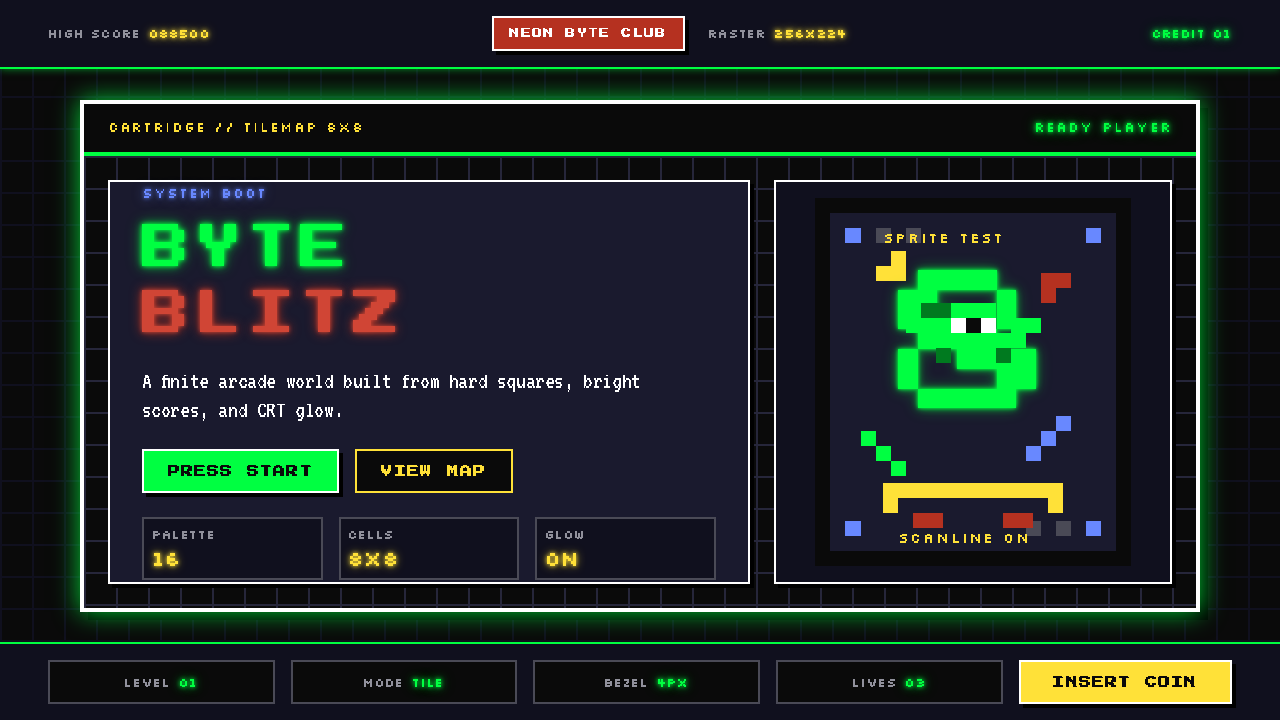
Born in smoky arcades and phosphor-lit living rooms, 8-bit pixel art transformed hardware poverty into a visual language that still feels electric fifty years later.
Pixel Art / 8-bit Retro in brief
Pixel art is a form of digital imagery in which individual square picture elements — pixels — are placed deliberately, one by one, on a strict grid. In the 8-bit era, this constraint was absolute: hardware could address only a small, fixed number of colors simultaneously, and sprites were assembled from tiles no larger than eight pixels on each side. The aesthetic that emerged from these limits is characterized by hard, staircase-like edges on every diagonal line, flat areas of pure color, and a luminous intensity that comes from rendering saturated hues against deep black backgrounds.
The term 'pixel art' today encompasses both authentic period work from the late 1970s and 1980s and contemporary work that deliberately embraces the same constraints — limited palettes, no anti-aliasing, grid-locked composition — as an expressive choice rather than a technical necessity. The 8-bit retro style draws specifically on the arcade and home-console visual vocabulary: chunky character sprites, high-contrast color blocking, and an overall sense of designed simplicity that communicates information legibly even at very small sizes.
What makes the style visually distinctive is not merely its technical origin but its emotional register. Pixel art carries the encoded memory of a particular cultural moment — the first mass encounter with interactive digital imagery — and that association gives it a warmth and nostalgia that newer, more technically sophisticated styles cannot easily replicate. Used intentionally, it does not read as low-resolution; it reads as handmade, precise, and full of personality.

Where does Pixel Art / 8-bit Retro come from?
The story of 8-bit pixel art begins in the Japanese and American arcades of 1978. Tomohiro Nishikado designed Space Invaders for Taito that year, composing the alien sprites on graph paper before transferring them into ROM — a design process that was, in its essential character, illustration adapted to a grid. Each creature was a small puzzle in how to make a recognizable silhouette from fewer than sixty lit pixels. Toru Iwatani's Pac-Man followed in 1980, introducing a maze environment built from equal-width tiles and a central character whose shape — defined almost entirely by a missing wedge — demonstrated how much expression a minimal pixel count could carry. These were not merely technical exercises; they were acts of visual invention operating under extreme constraint.
The hardware architecture of the era was the direct cause of the aesthetic. Processors in the late 1970s and early 1980s could address a color palette of sixteen or fewer simultaneous hues, drawn from a larger fixed set. Background tile maps were limited to grids of eight-by-eight or sixteen-by-sixteen pixel cells. Sprite layers sat above backgrounds and were subject to their own count limits — some systems allowed only eight sprites on a single horizontal scanline before hardware artifacts appeared. Designers at companies like Nintendo, Atari, Namco, and Capcom learned to work within and around these ceilings, and the problem-solving process itself became a craft tradition. Shigeru Miyamoto's team at Nintendo built the visual vocabulary of Donkey Kong, Mario, and The Legend of Zelda entirely inside these limits, producing characters recognizable worldwide.
The domestic counterpart to the arcade was the home console and home computer, which brought the aesthetic into living rooms. The Nintendo Entertainment System, the Commodore 64, and the ZX Spectrum each had distinct hardware personalities that shaped their visual output: the NES favored a bold, jewel-like palette; the Commodore 64's color set leaned toward earthier, more muted tones; the Spectrum worked in stark primaries with a characteristic color-clash artifact that became an identifying signature. Players and designers alike learned to read these hardware fingerprints, and the differences between them gave 8-bit visual culture a degree of variety and regional character it is easy to overlook in retrospect.
By the early 1990s, hardware had advanced far enough that the constraints of 8-bit design were no longer mandatory. The industry moved toward sixteen-bit and eventually three-dimensional rendering. But the pixel aesthetic did not disappear — it migrated. Independent game developers in the 2000s adopted it deliberately as a statement of identity and craft, producing games like Cave Story and Spelunky that treated pixel art not as a budget compromise but as an aesthetic argument. Simultaneously, the broader design world began to recognize the style's communicative power: its legibility at small sizes, its emotional warmth, and its capacity to signal authenticity, nostalgia, or playfulness in contexts far removed from gaming. The aesthetic moved from arcade cabinets to album covers, sneaker drops, fashion runways, and brand identity systems.
What defines the Pixel Art / 8-bit Retro look?
Grid-Locked Composition
Every element in pixel art exists on an explicit square grid, and that grid is never hidden or softened. The grid is the structural argument of the style — it imposes a rhythm on spacing, sizing, and alignment that makes even complex compositions feel ordered and intentional. In contemporary applications, the grid needn't be literally eight-by-eight pixels, but the principle holds: all spacing and sizing decisions should snap to a consistent module rather than existing on a continuous scale.
Hard Edges and No Anti-Aliasing
Diagonal lines in pixel art are rendered as staircase sequences of square blocks — there is no gradient blending at the edge of a form to create the illusion of smoothness. This hard-edge quality is the style's most immediately recognizable feature, and it is not a defect to be apologized for but a design choice to be embraced. The clarity of a hard pixel boundary reads with unusual confidence at small sizes, making the style well-suited to contexts where elements must remain legible when scaled down.
Limited, High-Contrast Palette
Authentic 8-bit work was constrained to palettes of sixteen colors or fewer, and the best designers treated this restriction as a compositional tool rather than a limitation. Colors in pixel art tend toward high saturation and are placed in sharp contrast against one another — often a luminous foreground against a near-black background. The result is an almost electric visual intensity. In contemporary use, a restricted palette of four to eight colors (including background and neutral tones) will produce more cohesive results than a full-spectrum approach.
Flat Color with No Shading Gradient
Volume and depth in pixel art are suggested not through continuous shading gradients but through deliberate placement of a small number of distinct tones — typically a highlight tone, a base tone, and a shadow tone drawn from the same hue. Each tone occupies a clearly defined pixel area with a hard border; there is no blending between them. This approach gives pixel art figures a simplified, almost diagrammatic solidity that is visually efficient and immediately readable even at thumbnail size.
Silhouette Legibility
The most important design constraint in 8-bit sprite work was that a character had to be recognizable by silhouette alone, at a size rarely larger than a postage stamp. This forced designers to reduce figures to their most essential shape — Pac-Man is a circle with a wedge removed; Space Invaders aliens are bilaterally symmetric creatures built from just a handful of pixel differences per row. The silhouette-first discipline carries directly into contemporary applications: any icon, character, or UI element designed in this aesthetic should read as a clear, unambiguous shape when reduced to a single flat tone.
CRT Glow and Scanline Texture
The original context for pixel art was the cathode ray tube display, whose phosphor coating produced a characteristic warm luminescence, and whose electron beam refreshed the screen line by line, leaving visible horizontal bands at close range. These scanlines, along with the slight bleed of phosphor glow between adjacent pixels, gave early digital imagery a physical, almost tactile quality distinct from modern flat-panel rendering. In contemporary design, this texture is evoked through subtle horizontal banding, a slight softening of brightness between pixel rows, or a warm tinted background rather than pure white — it is a reference to the original display environment rather than a technical requirement.
Dithering as Tonal Transition
When a limited palette cannot represent the full range of tones needed for a scene, pixel artists use dithering — alternating two colors in a checkerboard or irregular pattern to create the optical impression of a third, intermediate tone. Dithering is a technique unique to pixel art and gives experienced work a characteristic texture in transitional areas. In contemporary applications, dithering patterns can be used decoratively to create visual interest in areas that would otherwise be flat, functioning as a kind of pixel-native hatching or crosshatching.

Who shaped Pixel Art / 8-bit Retro?
Nishikado designed Space Invaders in 1978, serving simultaneously as programmer, artist, and hardware engineer — he custom-built the arcade circuit because no existing chip was fast enough to move all the invaders at once. His alien designs, drawn on graph paper and derived from H.G. Wells's War of the Worlds, established the foundational convention of 8-bit creature design: bilateral symmetry, layered detail within a tiny bounding box, and silhouettes that remain recognizable from across a dim arcade floor. Space Invaders was the first video game to achieve widespread cultural impact, and its visual approach set the template for an entire industry.
Iwatani created Pac-Man for Namco in 1980 with a conscious goal that almost no arcade game had previously attempted: to make a game appealing to women and couples, not just competitive young men. This intention shaped every visual decision. The main character was designed to be friendly and non-threatening — inspired, according to Iwatani, by a pizza with one slice removed. The maze was clean, tile-based, and navigable at a glance. The ghost enemies had distinct color identities but identical body silhouettes, a design strategy that compressed variety into a minimal pixel budget. Pac-Man demonstrated that pixel art could encode personality and emotion, not merely action.
Miyamoto's contribution to pixel art aesthetics spans more than a decade of Nintendo output: from the original Donkey Kong arcade cabinet in 1981 through the Super Mario series on the NES and the first Legend of Zelda. His teams developed conventions that became industry standards — the fixed-color character outline to ensure legibility against any background, the distinctive walking and jumping animations that communicated character weight through frame timing alone, and the environmental tile grammar that allowed enormous worlds to be built from a small set of repeating graphic modules. Miyamoto never treated hardware limits as obstacles; he treated them as the rules of the game.
Bushnell co-founded Atari in 1972 and was the architect of the commercial arcade industry that gave pixel art its original stage. While Atari's in-house designers — most famously the creators of Breakout and Asteroids — produced some of the earliest distinct pixel-art visual languages, Bushnell's larger contribution was infrastructural: he created the business model and distribution network that put CRT displays running pixel-graphic software into public spaces across North America, establishing the viewing context in which the aesthetic developed. Without the arcade as a physical venue, 8-bit pixel art would have had no audience and no urgency.
From the mid-2000s onward, independent game developers — most visible through platforms like itch.io and Steam — collectively rehabilitated pixel art as a serious contemporary medium. Developers including Daisuke Amaya (Cave Story), Derek Yu (Spelunky), and Toby Fox (Undertale) produced games in which the pixel aesthetic was not a budget constraint but a carefully considered visual argument: legible characters, expressive animation within tight pixel budgets, and a visual economy that forced every design decision to be purposeful. This community also developed and shared a sophisticated critical vocabulary for the form — distinguishing authentic low-resolution work from upscaled approximations — and their output demonstrated that the style was not nostalgia alone but a technically demanding discipline with its own standards of excellence.
How do you use Pixel Art / 8-bit Retro today?
Pixel art and 8-bit retro aesthetics are among the most versatile retro styles in the contemporary design toolkit, but they work differently from most historical styles because their emotional core — nostalgia, playfulness, and a reference to the first mass encounter with digital culture — is inseparable from the visual execution. Applying them correctly requires understanding that every design decision should reinforce the style's internal logic: deliberate grid alignment, hard edges, restrained color, and an overall commitment to simplicity that reads as intentional rather than incomplete.
For presentation decks, the 8-bit aesthetic delivers its strongest impact on cover slides treated as full-bleed game screens. A deep, near-black background anchors large pixel-art letterforms or a central character illustration, with a restricted palette of two or three accent colors providing all the visual energy. Content slides benefit from the grid discipline inherent to the style: information arranged in clear horizontal bands, section markers that resemble score counters or progress bars, and data visualizations built from chunky bar elements that echo sprite graphics. The style is particularly effective for technology, gaming, and entertainment-sector presentations where the audience will read the visual reference fluently.
For web interfaces, the pixel aesthetic is most coherent when applied to complete visual systems rather than used as surface decoration. Dashboards designed in this mode use a dark background with high-saturation accent colors for interactive states and status indicators, sharp-cornered card components with no shadow blur, and iconography built from grid-locked pixel shapes rather than smooth vectors. Pricing pages take on the character of a game's item-select screen: tiers rendered as distinct cards with pixel-border frames, feature lists using pixel-scale checkmarks, and a single accent color used consistently for the recommended or featured tier. Navigation should be typographic and minimal — pixel-influenced typefaces with a single weight — with no decorative flourishes.
For editorial and marketing work, the style supports strong information hierarchy through visual contrast rather than spatial complexity. A pixel-art editorial spread uses a dark or vivid background field, headline type set in a blocky, pixel-influenced face, and body text in a clean readable face that contrasts deliberately with the retro character of the display type. Marketing pages work well with alternating full-width blocks — dark-on-light and light-on-dark — each focused on a single message, with small pixel-art character or object illustrations serving as visual anchors rather than decorative filler. The key marketing strength of the style is that it signals both authenticity (craft, precision, deliberateness) and approachability (warmth, nostalgia, play).
The most common mistake when applying this aesthetic is using it as a texture or filter rather than as a structural design language. Overlaying a scanline effect on an otherwise conventional design, or inserting one pixel-art illustration into a layout that follows no grid logic, produces a result that reads as pastiche. The style works when the grid, the palette restriction, and the hard-edge principle govern the entire composition — not just the decorative elements. A second common error is palette overreach: using twelve or sixteen saturated colors simultaneously destroys the high-contrast legibility that makes the style effective. A disciplined palette of four to six colors, with one serving as the dominant background tone and one as the primary accent, will almost always outperform a larger set.

Pixel Art / 8-bit Retro — FAQ
Is pixel art the same as low-resolution design, or is there a meaningful distinction?
There is a meaningful distinction. Low-resolution design is simply design produced at or for a screen resolution that makes individual pixels visible — it may be accidental or a technical constraint. Pixel art is intentional: every pixel is placed deliberately, and the grid structure, color choices, and hard-edge rendering are conscious aesthetic decisions rather than side effects of limited hardware. A design can be low-resolution without being pixel art (blurry upscaling is the clearest example), and contemporary pixel art can be produced at display resolutions that make the individual pixels invisible to the naked eye but preserve the visual grammar of the form.
Can pixel art work in professional or corporate contexts, or does it always read as casual or gaming-adjacent?
The association with gaming and casual culture is real but not fixed. The determining factors are palette discipline, typographic execution, and the overall density of pixel-art elements relative to the rest of the design. A presentation that uses a controlled two-color palette, clean grid alignment, and pixel-art iconography as the only retro reference reads as technically confident and distinctive — not juvenile. A presentation that saturates every slide with character sprites, flashy colors, and retro sound-effect references will read as costume rather than design. The style has been deployed successfully in technology company rebrands, cultural institution campaigns, and financial-sector investor materials — the context adapts when the execution is disciplined.
How should color be approached differently in pixel art versus other retro design styles?
Pixel art's relationship to color is defined by scarcity and contrast rather than harmony in the traditional sense. Where a style like Art Deco or Bauhaus selects colors for their symbolic or compositional relationships, pixel art selects colors primarily for their ability to distinguish one element from adjacent elements at a very small scale. This means high saturation, sharp contrast between adjacent tones, and a premium on legibility over mood. The historical hardware palettes — NES, Game Boy, Commodore 64 — each had fixed color sets that artists learned to use expressively, and contemporary pixel work tends to honor this tradition by working with constrained, intentional sets rather than picking freely from a full spectrum.
What is the difference between using pixel art as a theme versus using it as a design system?
Using pixel art as a theme means applying its surface signatures — a pixelated typeface, a sprite-style illustration, a scanline overlay — to a design that is otherwise built on different structural principles. The result is decorative rather than coherent; the pixel elements sit on top of the design rather than arising from it. Using pixel art as a design system means letting its structural principles govern everything: the grid module determines all spacing; the palette restriction constrains every color decision; hard edges replace rounded corners and soft shadows throughout. The second approach requires more discipline but produces results that feel complete and intentional rather than accessorized.
Are there contexts where pixel art and 8-bit retro styling consistently underperform or should be avoided?
The style struggles in contexts that depend on warmth, organic texture, or premium sensory richness. Luxury brand materials, wellness and health products, fine dining, and anything where the communication goal is sophistication or natural authenticity will be undermined rather than enhanced by the hard-edged, synthetic quality of 8-bit aesthetics. The style also presents challenges in dense text environments — long-form editorial work where extended reading is required — because pixel-influenced typography is optimized for impact at display sizes, not for extended reading at body-text sizes. Finally, the style is associated strongly enough with youth culture and gaming that it can create an audience-mismatch problem in sectors that need to signal institutional authority, such as legal services, healthcare, or traditional financial services.
Related design styles
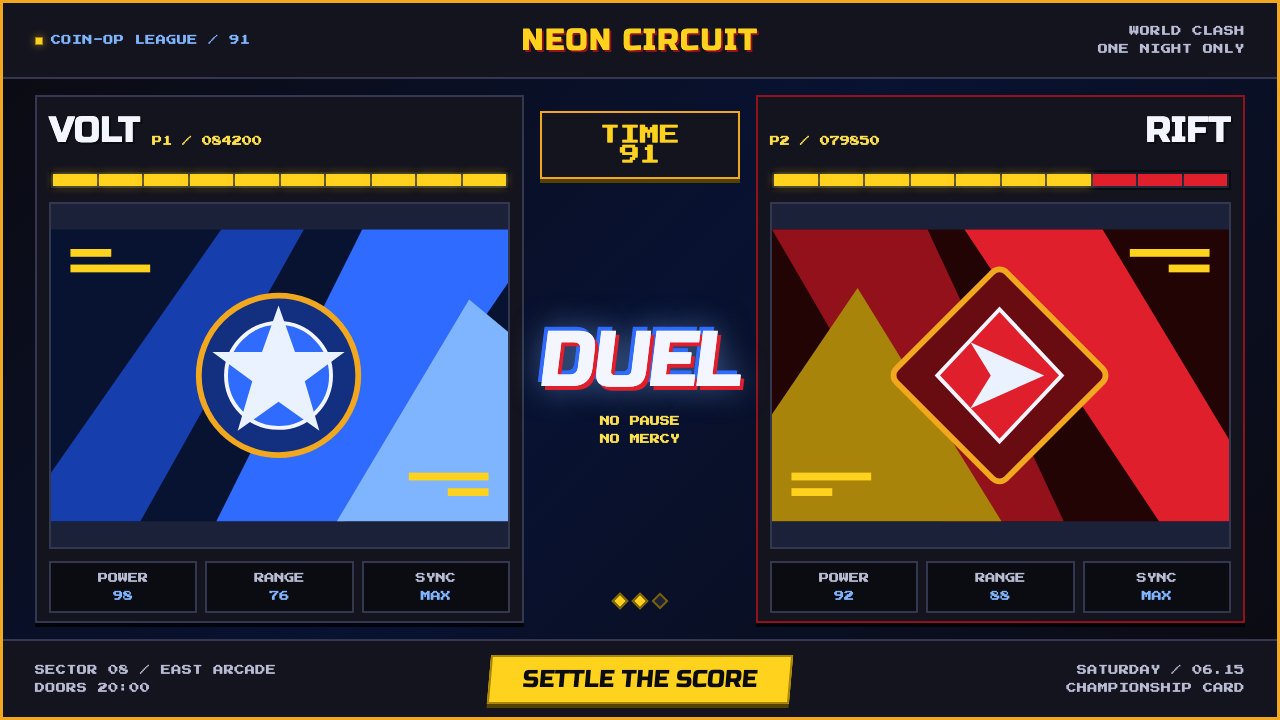 Street Fighter II (1991 Arcade)Pixel muscle hits hard. Hadouken blue, gold HUD bars, and outlined type blaze…
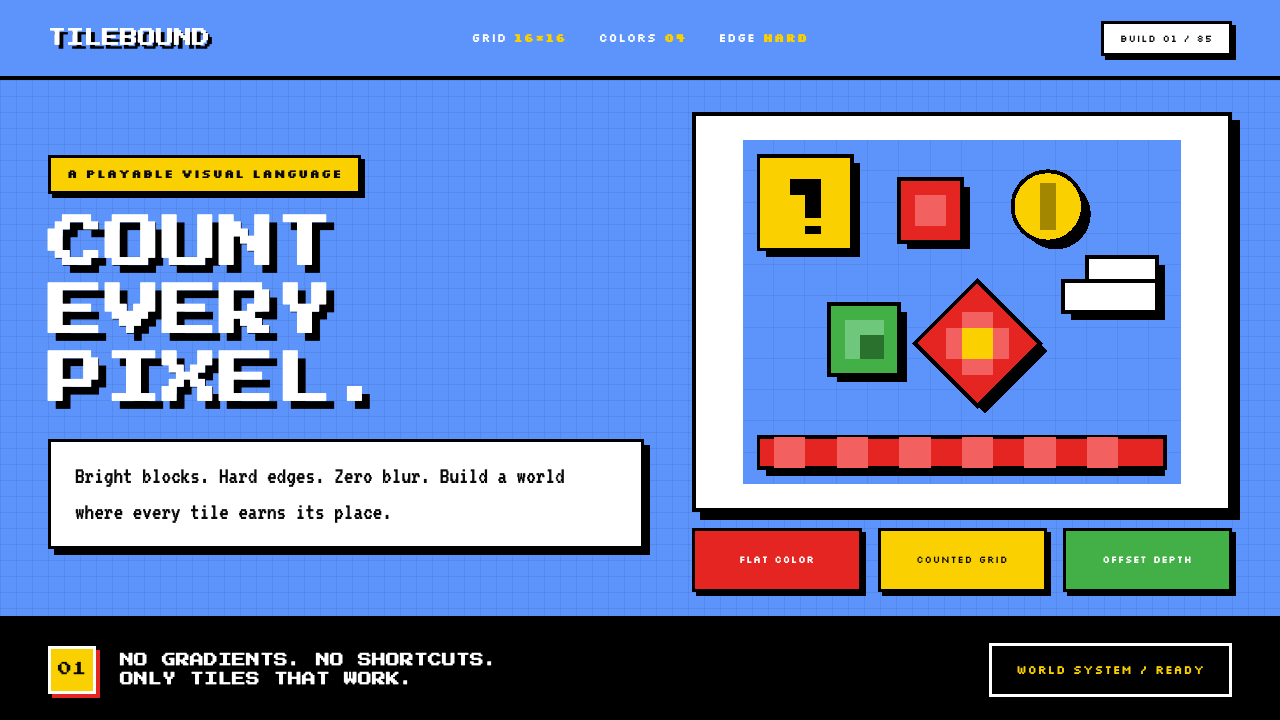 Super Mario Bros (1985)Every pixel earns its place. Sky blue, four-color tiles, and hard black outli…
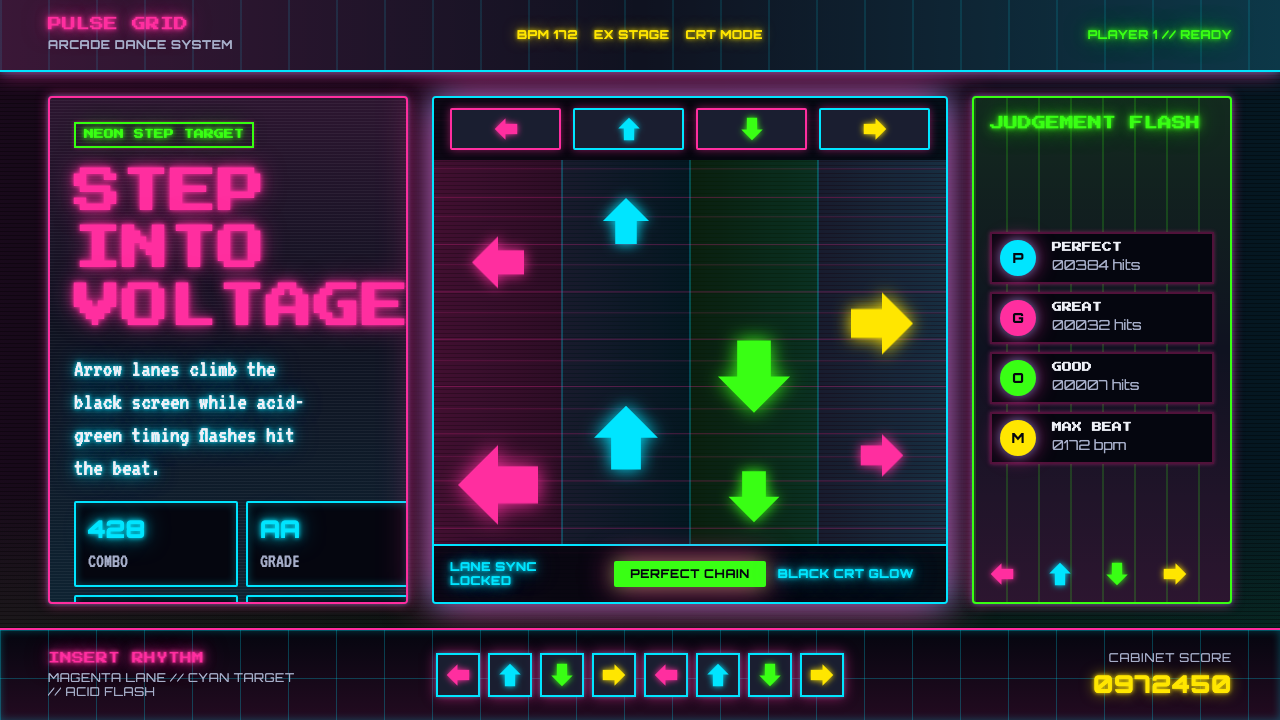 Dance Dance Revolution ArrowsPure arcade voltage. Magenta, cyan, and acid-green arrows climb a black CRT g…
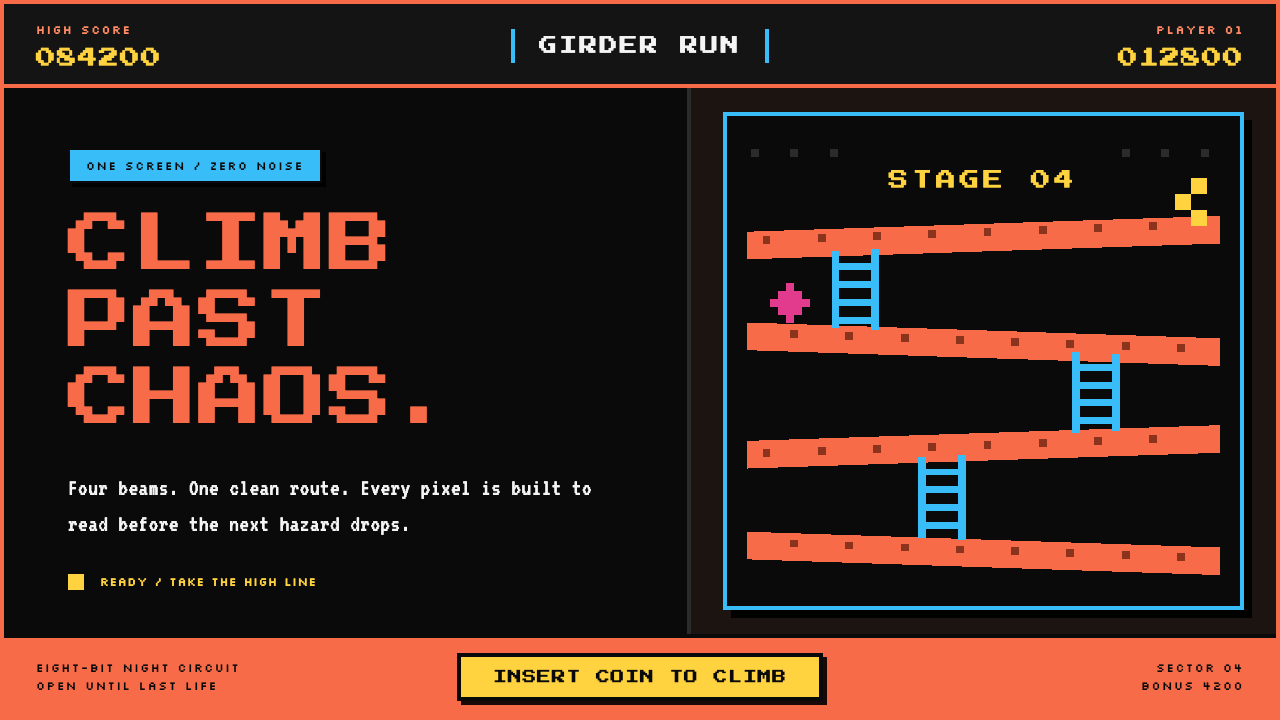 Donkey Kong (1981 Arcade)Built to read through the smoke. Coral girders and cyan ladders cut across a…
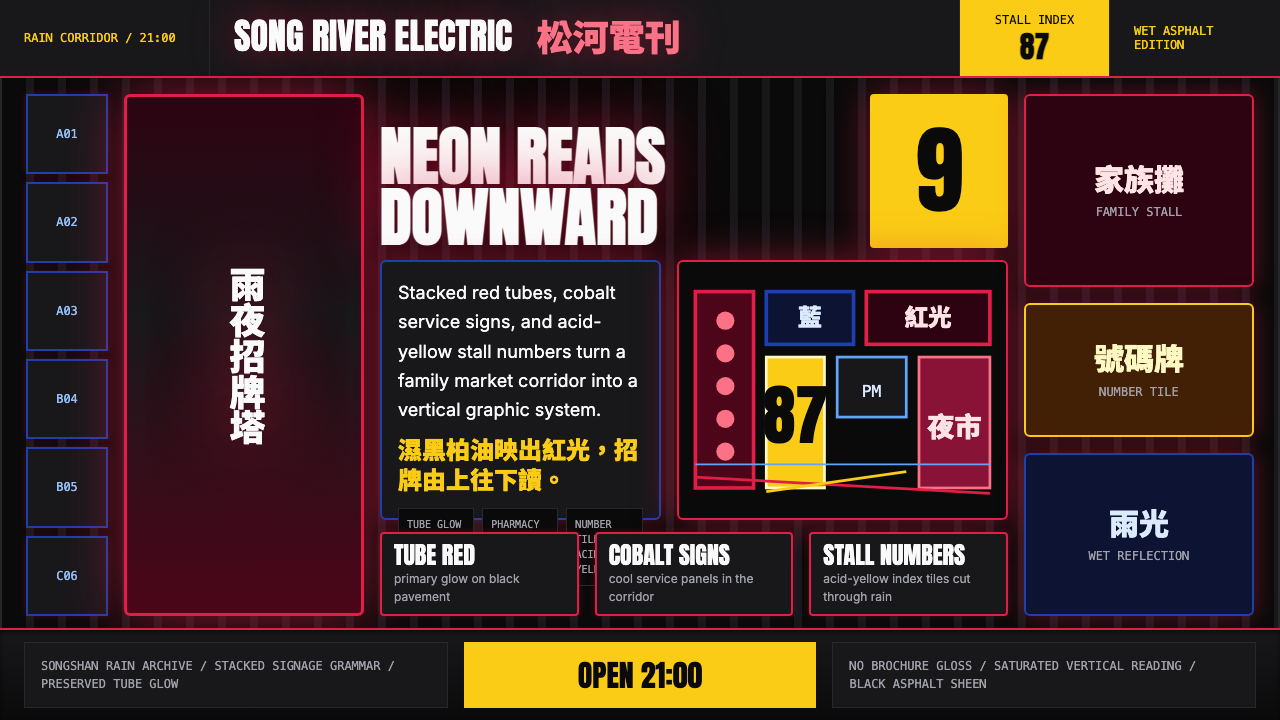 Taiwanese Raohe Night Market NeonTaipei night reads vertically. Neon red, cobalt panels, and acid-yellow numbe…
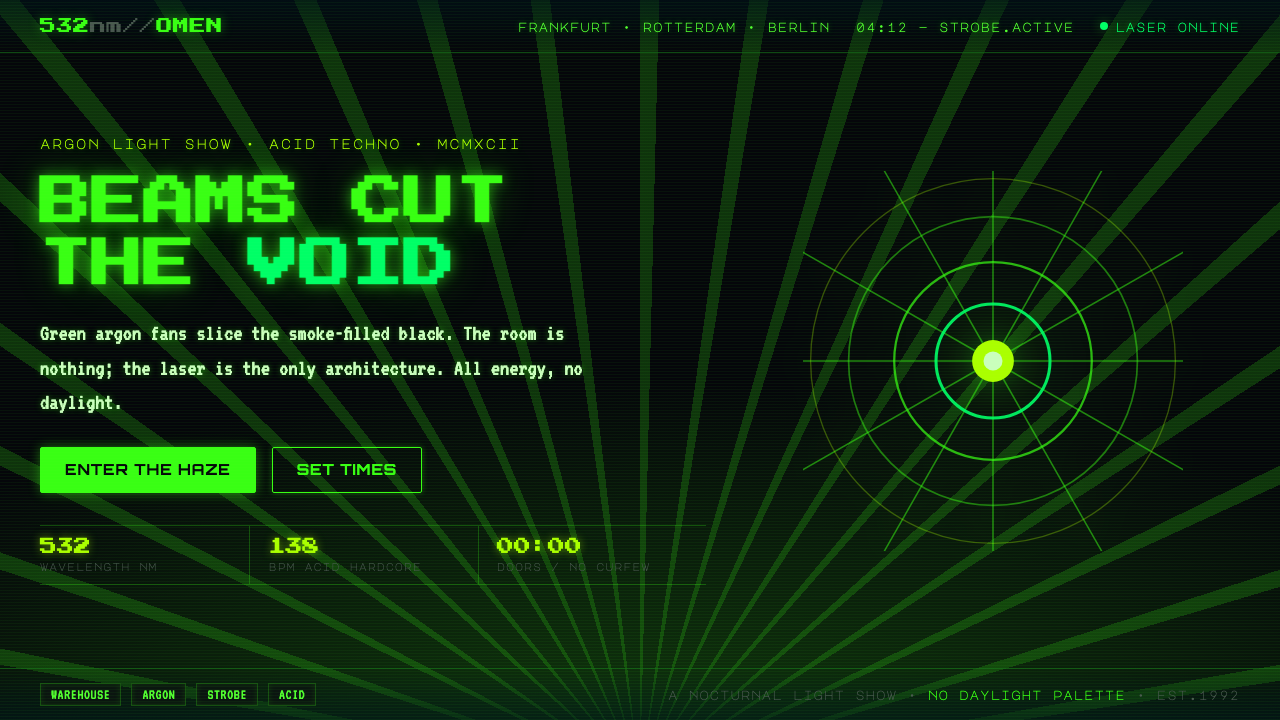 Acid Rave Laser Show 1992Beams cut the void. Argon green on pitch-black smoke, pixel marquee type, add…