What is Tetris (1984)?
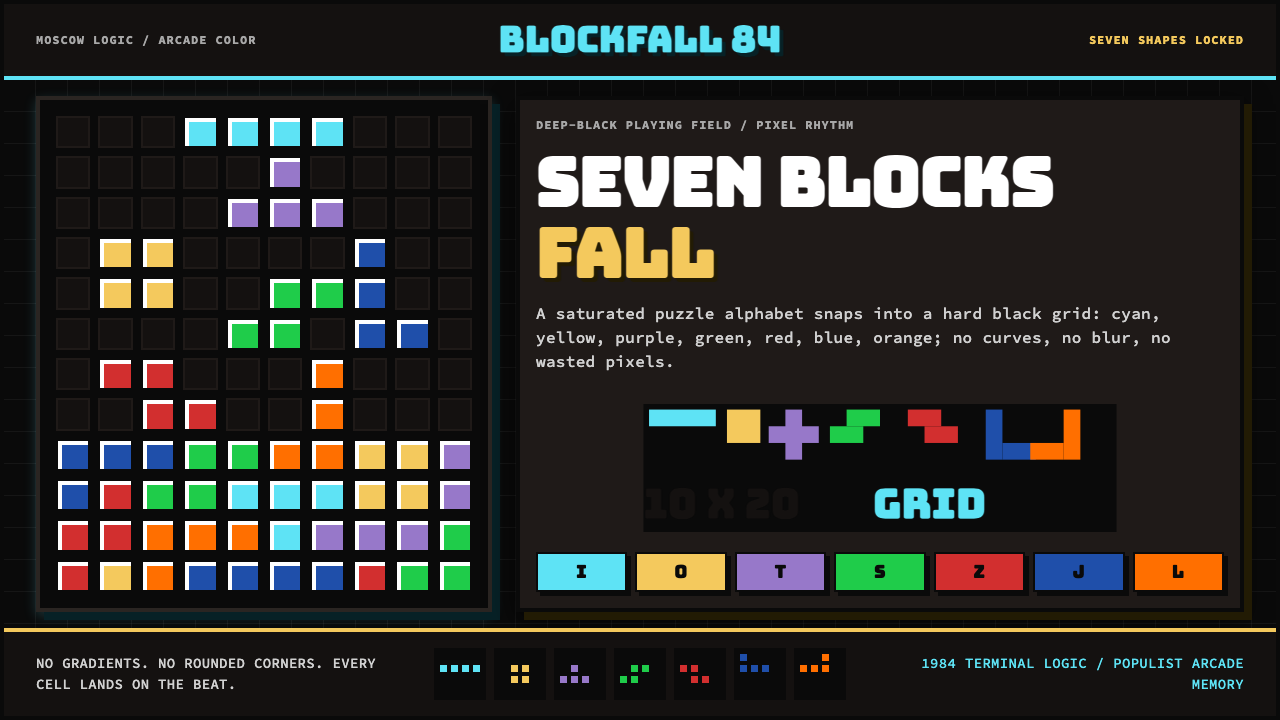
From a Soviet research lab in 1984, seven falling shapes and a black grid became the most recognizable visual system in the history of games.
Tetris (1984) in brief
Tetris (1984) is a design system that most people have played before they could name a typeface. Its visual identity is built from exactly four elements: a deep-black playing field, seven saturated tetromino colors, a precise pixel grid, and sharp corners that never soften. The aesthetic is at once utilitarian and iconic — designed for the constraints of early Soviet hardware yet globally legible across four decades of display technology.
Each of the seven tetromino shapes carries a distinct, saturated color: cyan for the I-piece, yellow for the O, purple for the T, green for the S, red for the Z, blue for the J, and orange for the L. These hues are not decorative — they are the primary communication layer, allowing the eye to instantly track piece type and position against the black field. There is no gradation, no blending, no ambient glow. Every color block is a flat, fully saturated cell.
The aesthetic can be described as populist arcade: bold enough to read across a dim CRT screen, simple enough for players of any age or background to parse instantly, and rigorous enough that no visual element exists without a functional reason. Tetris is probably the most widely experienced example of a design language where constraint is the creative engine — nothing curves, nothing washes out, every block snaps to the pixel.

Where does Tetris (1984) come from?
Tetris was created in June 1984 by Alexey Pajitnov, a software engineer at the Dorodnitsyn Computing Centre of the Soviet Academy of Sciences in Moscow. Pajitnov had been experimenting with a puzzle called Pentominos — a game using twelve five-square shapes — and was struck by the challenge of fitting falling pieces into a confined space. He adapted the concept to four-square pieces (tetrominoes, from the Greek prefix for four) because they produced exactly seven distinct shapes, a set small enough to learn and varied enough to sustain endless play. The name Tetris fuses the Greek prefix tetri with tennis, Pajitnov's favorite sport.
The original version ran on an Elektronika 60 terminal — a Soviet machine with no graphics capability, only text characters. Pajitnov rendered the tetrominoes using bracket characters on a monochrome screen. A colleague, Vadim Gerasimov, ported the game to the IBM PC in 1985 and added the first color graphics, establishing the saturated-block-on-black visual that would become canonical. The game spread rapidly through Soviet research institutions and government offices, distributed on floppy disks, before Western developers became aware of it.
The global licensing story is nearly as complex as the game itself. Hungarian software company Andromeda Software contacted Pajitnov in 1986, beginning a years-long tangle of competing rights claims involving the Soviet government's software export agency ELORG, Mirrorsoft, Spectrum HoloByte, Atari, Sega, and Nintendo. Henk Rogers, a Dutch game developer, traveled to Moscow in January 1989 and negotiated directly with ELORG officials to secure Nintendo's handheld rights — a deal that led to Tetris being bundled with the original Nintendo Game Boy at launch in June 1989. That pairing sold approximately thirty-five million units and transformed Tetris from a Soviet curiosity into a global cultural artifact.
Vladimir Pokhilko, a psychologist and colleague of Pajitnov who contributed to the game's early development, later co-founded The Tetris Company with Pajitnov and Rogers after the Soviet Union's collapse allowed Pajitnov to reclaim rights he had originally been unable to hold under Soviet law. The Tetris Company has since standardized the visual identity of official Tetris releases — specifying the seven tetromino colors and the black playing field — ensuring that the 1984 visual system remains the legal and aesthetic standard for the game worldwide.
What defines the Tetris (1984) look?
Deep-Black Ground
The playing field is pure, unmodulated black — not near-black, not dark grey, not a textured surface. This absolute ground is what makes the seven saturated tetromino colors legible at a glance. The contrast is not a stylistic preference but a functional requirement: pieces must be instantly distinguishable, and the void between falling blocks must read as empty space, not as visual noise. Every Tetris-derived design that dilutes this ground loses a measurable degree of immediacy.
Seven Saturated Tetromino Colors
The official color set — cyan, yellow, purple, green, red, blue, orange — is not a decorative palette; it is a functional coding system. Each color maps to exactly one piece shape, and the mapping is now so deeply established that experienced players recognize shapes by color before consciously reading their geometry. The colors are deployed at full saturation, with no tinting, shading, or mixing. They do not harmonize in the conventional sense — they coexist at maximum intensity, unified by the black ground rather than by any relationship to each other.
Pixel-Precise Grid
Every element in Tetris snaps to a consistent cell grid. There is no sub-pixel rendering, no anti-aliasing, no soft edges. The grid is the compositional foundation of the entire system: pieces are defined by which cells they occupy, cleared lines are defined by which rows are full, and the playing field itself is a fixed rectangular grid of cells. This absolute alignment means the visual system works at any display resolution — from a Game Boy's original low-resolution screen to a contemporary 4K display — without requiring any rethinking of the design.
Hard Corners and Zero Curves
Tetromino cells are squares with perfectly hard corners — no border radius, no chamfer, no rounding at any scale. This is not a limitation of early hardware that was corrected in later versions; it is the defining geometric character of the system. Rounded blocks look categorically different and read as a different game. The hardness of the corners emphasizes the grid's precision and reinforces the mechanical, interlocking quality that gives Tetris its visual tension. When the style is applied to interface design, this principle translates directly: rectangular components, right-angle joints, no softening of borders.
Flat Color, No Decoration
Each tetromino cell is a single flat color fill. There are no gradients, no specular highlights, no inner glows, no drop shadows on individual pieces, no texturing of any kind. The only visual differentiation between cells is color. This radical flatness is not a retro affectation in contemporary applications — it is the logical expression of a system where information is carried entirely by shape, color, and position, and where any additional visual layer would be competing noise rather than signal.
Arcade Legibility
The entire visual system was engineered for immediate readability under adverse conditions: low-resolution screens, dim arcade lighting, peripheral vision, rapid eye movement tracking a falling piece. This origin gives the style a quality that is rare in designed systems — it communicates under pressure. The high-contrast, high-saturation, zero-ambiguity approach means that information is never buried in subtlety. Applied to contemporary design, this translates into a bias toward high-contrast type, saturated accent colors, and spatial layouts that can be parsed at a glance.
Functional Color Coding
Unlike decorative palettes, the Tetris color system is semantic: each color means one specific thing. This model — where color carries exclusive categorical meaning rather than ambient mood — is one of the style's most transferable design principles. In any data visualization or dashboard application of the aesthetic, color should be reserved for categorical distinction rather than used for visual richness. When every color in a system refers to a specific entity, the visual language becomes a grammar. This is what separates the Tetris approach from mere colorfulness.

Who shaped Tetris (1984)?
Pajitnov designed Tetris in 1984 at the Soviet Academy of Sciences in Moscow, drawing on his interest in combinatorial puzzles and his experience with the Pentominos puzzle game. His insight — that exactly seven four-square tetrominoes created the ideal balance of learnable simplicity and infinite variability — was both mathematical and aesthetic. Because Soviet law at the time did not permit individual software ownership, Pajitnov did not receive royalties for Tetris during the Soviet era. After emigrating to the United States and following the Soviet Union's collapse, he co-founded The Tetris Company and finally began receiving royalties in 1996, twelve years after the game's creation.
Rogers was a Dutch-born game developer based in Japan who first encountered Tetris at the Consumer Electronics Show in Las Vegas in January 1988. Recognizing immediately that the game was suited for a handheld platform, he traveled to Moscow in January 1989 — at a time when Western business travel to the Soviet Union was still unusual and required significant bureaucratic navigation — and negotiated directly with the Soviet software export agency ELORG to secure the rights for Nintendo's Game Boy. The bundling deal he helped engineer between Tetris and the Game Boy is widely credited as one of the most consequential partnerships in gaming history. Rogers later became a close friend and business partner of Pajitnov.
Gerasimov was a sixteen-year-old student when he ported Tetris from the Elektronika 60 terminal to the IBM PC in 1985, adding color graphics for the first time. The PC version was responsible for spreading Tetris across Soviet research institutions and — once floppy disks began moving westward through academic networks — introducing the game to Western developers. Gerasimov's addition of color to the tetromino blocks established the visual convention that would persist through every subsequent platform version, making him an inadvertent author of the game's defining aesthetic even though his contribution has often been overshadowed by the licensing controversies that followed.
Pokhilko was a psychologist and researcher at the Moscow Medical Institute who collaborated with Pajitnov on the early development of Tetris, contributing insight into the game's psychological mechanisms — particularly its capacity to produce a state of absorptive, repetitive engagement that later researchers would term the 'Tetris effect.' He co-founded Bullet-Proof Software with Pajitnov and Rogers to manage the game's North American publishing, and later The Tetris Company. His background in psychology gave the founding team an unusual perspective on why the game's minimal, precise visual system was so effective at sustaining attention.
How do you use Tetris (1984) today?
Tetris (1984) is one of the most structurally pure visual references available to contemporary designers — a system where every element exists for a documented functional reason and nothing is ornamental. Applying it correctly means understanding the logic beneath the surface: color as exclusive category coding, hard geometry as spatial structure, black ground as the signal-from-noise separator. It should not be reduced to 'put colored blocks on a dark background.' The discipline is in the functional justification for every decision.
For presentation slides, the Tetris visual system works most powerfully on cover and section-break pages. A cover built on this aesthetic uses deep black as the full-bleed ground, arranges large flat-color rectangular blocks in a grid-aligned composition without border radius, and sets the title in a bold, geometric typeface at high contrast against the dark field. The seven tetromino colors provide a ready-made tier or category system for content slides: assign one color to each major topic or data series and use it consistently throughout. Data slides benefit from the style's native precision — bar charts become stacked tetromino-like columns, and the absence of chart decorations (gridlines in muted tones only, no background fill, no shadows on bars) keeps the data primary. The system works less well on slides that require photographic warmth or narrative subtlety.
For web interfaces and dashboards, the aesthetic is directly suited to environments where information density is high and scanning speed matters. The approach: pure black or very deep background, a strict rectangular grid for all layout components, and the tetromino color set reserved exclusively for categorical or status encoding — never for decoration. Card components should have sharp corners and, where depth is needed, a hard-edged offset shadow rather than a soft diffuse one. Navigation and headings in a bold geometric typeface; body text in a clean, undecorated face at a weight that reads clearly against the dark ground. Pricing pages and tier comparisons are especially natural fits: each tier receives one tetromino color, and the visual logic is immediately legible without any additional explanation.
For editorial and marketing contexts, the style supports a poster-like boldness that stops attention without relying on photographic imagery or illustration. A marketing hero section in this aesthetic uses a full-bleed black panel, one or two large flat-color blocks positioned on a grid to frame or counterweight the headline, and a call-to-action in a strongly contrasting accent color. Editorial article layouts can use a narrower version of the approach: black or near-black body text on white, with section breaks marked by a full-width flat-color rule in one tetromino color, and data callouts or pull quotes set in the same accent color. Social cards and motion graphics in this style have strong immediate recognition — the combination of black ground and saturated flat color is distinctive and inherently memorable.
The most common mistake when applying the Tetris aesthetic is decorative block-stacking: arranging colored rectangles as visual interest rather than as a categorical or compositional system. Authentic application requires that every colored shape refers to something — a category, a hierarchy, a state — rather than existing purely for visual texture. A second common error is treating the dark background as optional: diluting it to a medium grey or adding subtle gradients destroys the contrast that makes the color coding legible. Finally, mixing soft-radius components with the hard-corner geometry of the system creates an immediate tonal inconsistency. The style demands commitment to its geometric logic; half-measures produce a muddled pastiche rather than a coherent visual language.

Tetris (1984) — FAQ
Does Tetris style only work on dark backgrounds?
The canonical Tetris visual language is dark-ground: the black playing field is the foundational element that makes the saturated tetromino colors pop. A light-ground inversion is possible but requires significant adjustment. On a white or near-white background, the same seven tetromino colors appear less urgent and less functionally distinct from one another. If a light background is necessary, the best approach is to reduce the palette to two or three of the most distinct hues — typically cyan, yellow, and red — and use them at full saturation against the white ground rather than attempting the full seven-color set. The hard corners and flat-fill geometry translate well to light backgrounds; the deep contrast is what is hardest to replicate.
Is this aesthetic the same as pixel art or retro gaming style?
They are related but distinct. Pixel art as a style celebrates the individual pixel as a visible compositional unit — the jagged diagonal, the deliberate stair-step, the limited palette born of hardware constraints. Tetris (1984) style uses a pixel-precise grid but does not foreground the pixel itself; the grid cell is the unit, not the individual pixel. Additionally, Tetris is not a nostalgic style in the way that pixel art often is — it is a functional system whose aesthetic constraints serve information architecture rather than evoking a historical era. The distinction matters practically: pixel art implies pixelated letterforms, dithered gradients, and limited-color palettes, while Tetris style implies hard-corner rectangular geometry, full-saturation flat color, and high-contrast black grounds, without necessarily limiting the color count.
How do you apply the Tetris color system to data visualization without it looking like a game?
The key is to apply the underlying logic — one distinct saturated color per category, black or near-black ground, no decorative elements — while using professional typographic and compositional conventions that signal information design rather than entertainment. This means: clean, readable type in a geometric sans-serif at an appropriate scale for data labels; precise axis lines and gridlines in very low-contrast tones against the dark background; chart components (bars, cells, dots) built from the tetromino color set but sized and spaced according to data values rather than game-grid logic. The result reads as a high-contrast, systematic data dashboard rather than as a game interface. The most common failure is adding game-specific visual elements — brick textures, falling-block animations, score-counter typography — which anchor the aesthetic to entertainment context rather than information context.
Why does Tetris have exactly seven tetromino colors, and does that number matter for design?
The number seven is not arbitrary — it corresponds directly to the seven distinct free tetrominoes that exist in mathematics. There is no eighth four-square shape that tiles differently; seven is the complete set. For design applications, seven is also at the upper edge of what the human visual system can hold as a categorical coding system in working memory: cognitive research consistently finds that people can reliably distinguish five to seven distinct color categories at a glance before performance degrades. The Tetris palette is therefore at maximum practical capacity as a categorical system. When applying fewer than seven categories, select colors from the tetromino set that are maximally distinct from one another — cyan, yellow, and red are the most perceptually separated — rather than using all seven at reduced opacity or density.
Are there contexts where the Tetris aesthetic is a poor fit?
Several. The style is poorly suited to contexts that require warmth, organic texture, or emotional intimacy — healthcare interfaces focused on patient comfort, food and hospitality brands, children's educational products, wellness and mental health applications, or any context where the user experience depends on softness and approachability. The deep-black ground and maximum-saturation colors read as intense and demanding; in contexts where users are already stressed or vulnerable, this visual pressure is counterproductive. The style also struggles where brand identity requires differentiation from technology: a luxury goods brand, a heritage craft company, or a fine arts institution will find that the Tetris aesthetic positions them as a tech product regardless of how faithfully it is executed. The system is built for efficiency and precision; where those values conflict with the product's emotional positioning, a different reference will serve better.
Related design styles
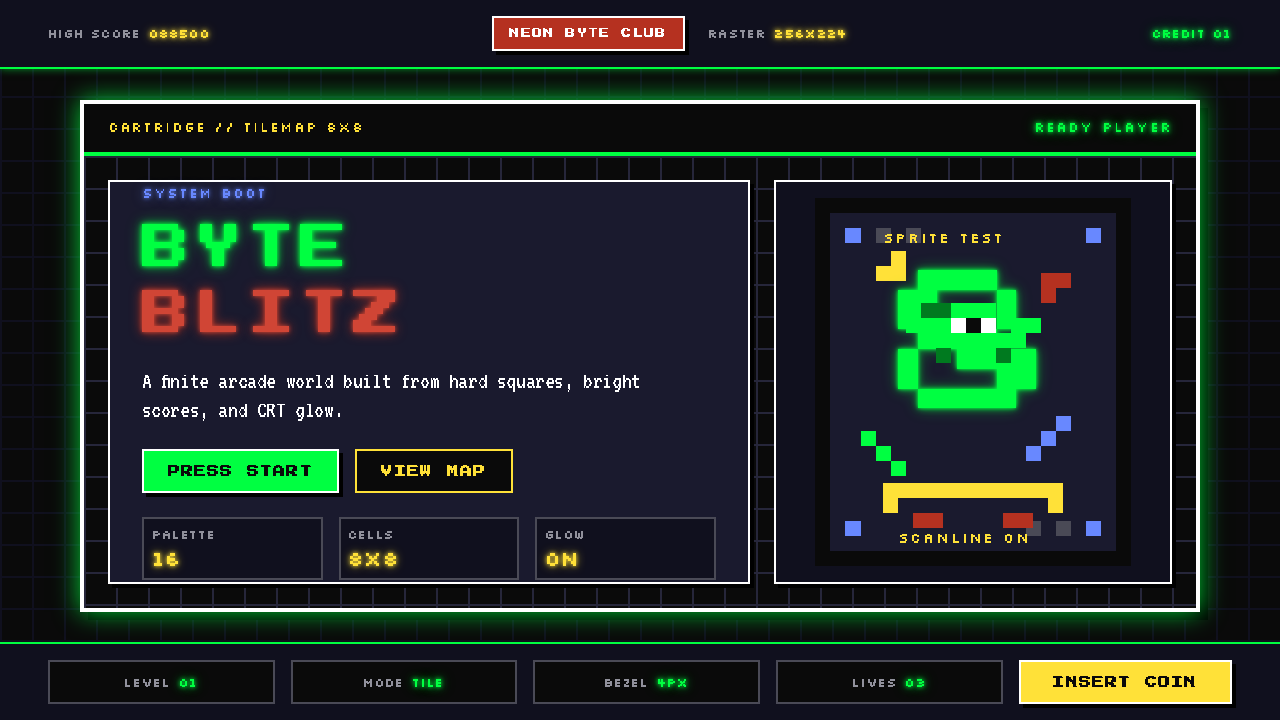 Pixel Art / 8-bit RetroHard-edged digital joy. CRT black, phosphor green, and 8x8 grids snap every p…
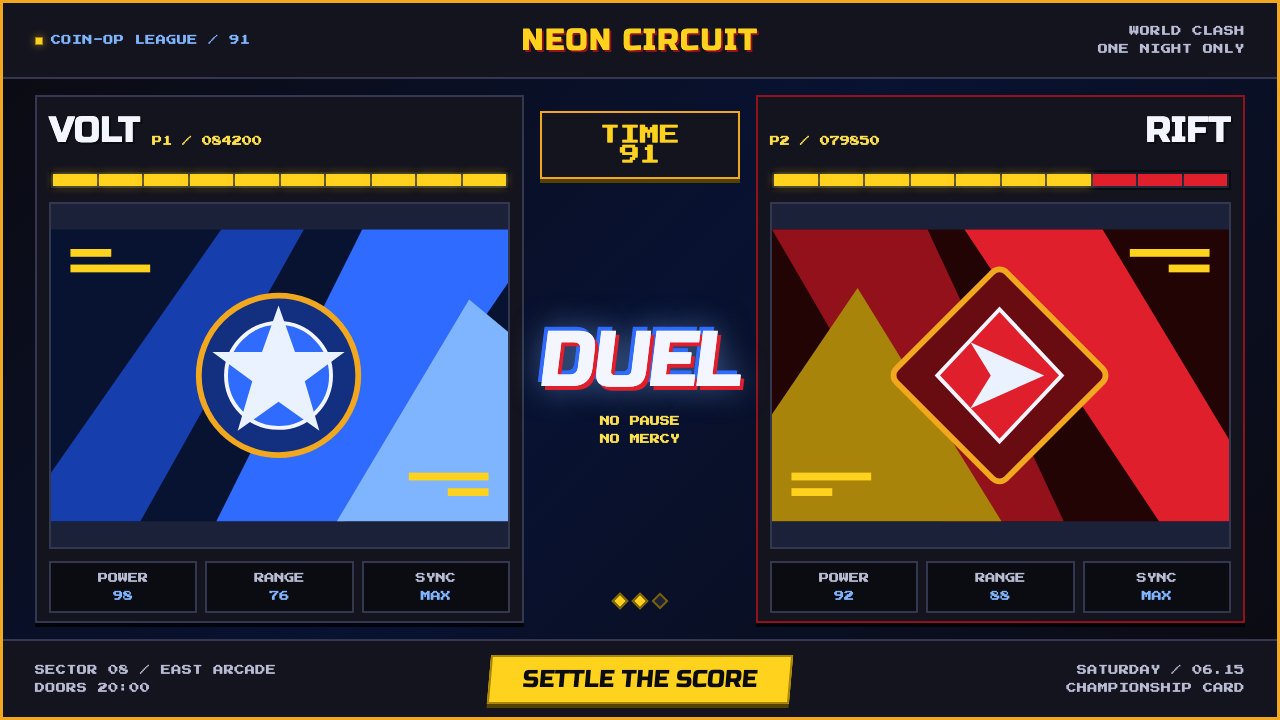 Street Fighter II (1991 Arcade)Pixel muscle hits hard. Hadouken blue, gold HUD bars, and outlined type blaze…
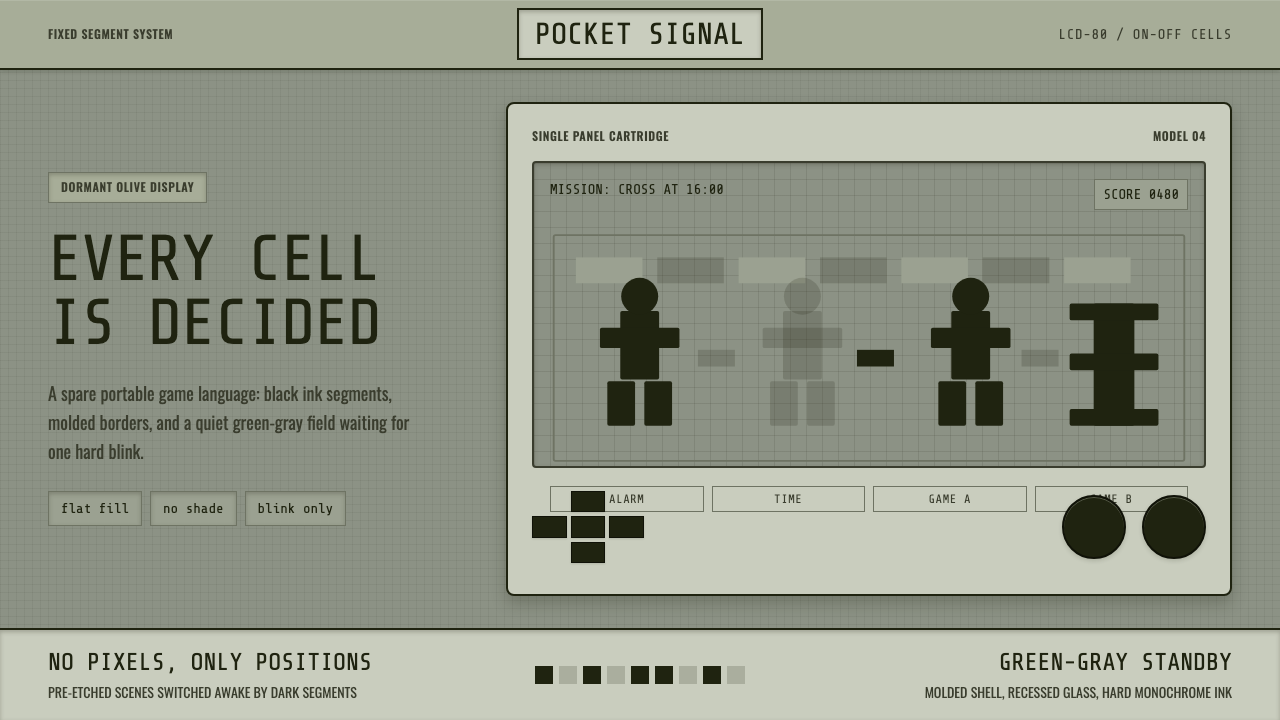 Handheld LCD GameConstraint is the charm. Olive LCD grid, black segment ink, tight molded beze…
 Super Mario Bros (1985)Every pixel earns its place. Sky blue, four-color tiles, and hard black outli…
 Space Invaders (1978)Constraint becomes menace. Phosphor green pixel ranks descend through a dead-…
 2 Tone SkaContrast as manifesto. White Anton type locks into a near-black checkerboard…