What is Nintendo Game Boy?
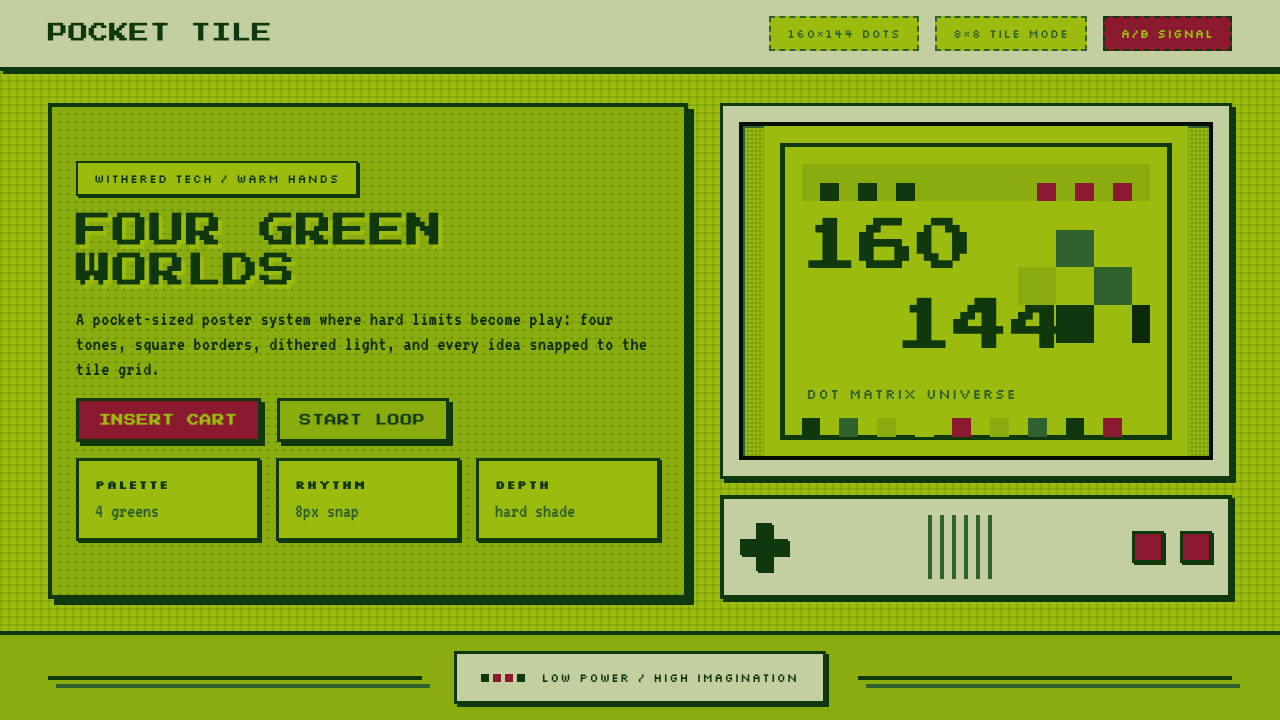
Four shades of swampy green, a pixel grid, and a pocket-sized screen proved that constraint is not limitation — it is a design language.
Nintendo Game Boy in brief
The Nintendo Game Boy aesthetic is a visual language born from hardware limitation. Launched in 1989 as Nintendo's first mass-market handheld console, the DMG-01 — 'Dot Matrix Game' — was engineered around a monochrome dot-matrix LCD capable of rendering only four gradations of the same murky olive-green hue. Instead of disguising this constraint, Nintendo's designers and the generations of artists who worked within it embraced it as an identity. The result is one of the most instantly recognizable visual systems in the history of portable media.
At its core, the Game Boy palette runs from the deepest possible dark green — so dark it reads as near-black — through two intermediate mid-tones, to a pale, almost yellowed green at the lightest extreme. Every image, every character sprite, every screen of text was rendered within this four-tone band. Transitions between tones were achieved not with true gradients but through dithering: a checkerboard or dot pattern that optically blends two adjacent tones into the illusion of a fifth. This pixel-level craft became the style's most characteristic texture.
Typography in the Game Boy world is equally governed by constraint. Characters are drawn on an eight-by-eight pixel grid — each letter a tiny bitmap constructed from individual lit or unlit dots. This grid-native letterform has its own rhythm: chunky, squarish, highly legible at small sizes, and utterly distinct from any smooth-edged digital typeface. The aesthetic has been revived and celebrated in retro game culture, in independent pixel-art communities, and now as a deliberate design choice for brands, presentations, and interfaces that want to evoke nostalgia, authenticity, and a certain quiet playfulness.

Where does Nintendo Game Boy come from?
The Game Boy was the creation of Gunpei Yokoi, a Nintendo engineer whose career had begun assembling mechanical toys on the factory floor. Yokoi developed a design philosophy he called 'lateral thinking with withered technology' — the idea that mature, inexpensive, well-understood technology, used imaginatively, could outperform expensive cutting-edge hardware. By 1989, reflective LCD technology was cheap, robust, and power-efficient. The Sega Game Gear and Atari Lynx would launch later the same year with full-color backlit screens; both drained their batteries in hours. The Game Boy, with its unlit monochrome display, ran for roughly thirty hours on four AA batteries. Yokoi chose longevity and affordability over visual spectacle.
The DMG-01 launched in Japan on April 21, 1989, and in North America that summer, bundled with Alexey Pajitnov's Tetris — a pairing that may be the most consequential in gaming history. Tetris required no color: its falling geometric blocks mapped perfectly onto the four-tone palette, and the game's meditative, compulsive logic proved that hardware limits were irrelevant to player engagement. Over the following decade, the Game Boy's library expanded to include the original Pokémon Red and Green (1996), The Legend of Zelda: Link's Awakening (1993), and Metroid II (1991) — titles whose artists developed sophisticated visual techniques within the four-shade constraint, using dithering to simulate terrain depth, weather, and atmospheric shadow.
The sound design of the Game Boy, handled primarily by composer Hirokazu Tanaka, contributed equally to the aesthetic identity. The console's audio processor produced four channels of waveform synthesis — two square waves, a programmable wave channel, and a noise channel — and the music composed for it became known as chiptune: a genre defined by the timbral constraints of limited-channel synthesis. Chiptune's relationship to the Game Boy's visual aesthetic mirrors the relationship between the pixel grid and the LCD palette: both are constraint-born languages that developed their own internal richness.
The original Game Boy was replaced by the Game Boy Pocket in 1996, which refined the form factor, and the Game Boy Color in 1998, which added a full-color display and effectively ended the monochrome era. But the four-tone green palette had already embedded itself in cultural memory. The demoscene, homebrew development community, and retro game preservation movement kept the aesthetic alive through the 1990s and 2000s. By the 2010s, pixel art had re-emerged as a mainstream creative choice — in independent games, in graphic design, in fashion — and the Game Boy's specific palette became a touchstone for anyone working in the retro-digital mode.
What defines the Nintendo Game Boy look?
Four-Tone Palette
The defining feature of the aesthetic is an absolute restriction to four gradations of olive-green: deepest shadow, dark mid-tone, light mid-tone, and near-white highlight. No other hues enter the system. The palette reads simultaneously as technological artifact and as a kind of natural restraint — the greens feel organic, slightly warm, and period-specific in a way that no synthetic color system quite replicates. When the style is applied beyond its original hardware context, fidelity to the four-tone structure (rather than simply 'green') is what makes the reference legible.
Dithered Gradients
Because true gradients are impossible within a four-tone palette, Game Boy artists developed dithering as the primary tool for creating tonal transitions. A dithered region alternates pixels of two adjacent tones in a regular pattern — checkerboard, diagonal stripe, or dot clusters — to create the perceptual impression of an intermediate tone. Dithering is simultaneously a technical workaround and an aesthetic signature: applied well, it gives surfaces a woven, tactile quality absent from smooth digital gradients. Overused, it reads as noise. The discipline of knowing when to dither and when to commit to a solid tone is central to the style.
Eight-by-Eight Pixel Grid
The DMG-01 hardware processed graphics in tiles of eight-by-eight pixels — the fundamental unit of the console's rendering engine. Every sprite, every background element, every character of text was built from these tiles. This grid is not merely a technical detail: it imposes a modular logic on all composition. Elements snap, align, and repeat at multiples of the base unit. The grid is legible in finished artwork as a kind of underlying architecture, giving the style a structural regularity that feels both rigid and rhythmically alive.
Hard Pixel Edges
Edges in the Game Boy aesthetic are never soft. Anti-aliasing — the technique of blurring pixel edges to create the illusion of smooth curves — did not exist at the hardware level. Every curve is an approximation constructed from stairstepping pixels, and every boundary between two tones is a crisp, hard line. This quality gives Game Boy-derived work a boldness and graphic density that smooth-edge digital work rarely achieves. In contemporary application, preserving hard edges is among the most important rules: introducing anti-aliasing or soft blurs immediately reads as anachronistic.
Pixel-Native Typography
Text in the Game Boy visual world is constructed from the same eight-by-eight grid as every other element. Bitmap fonts designed at this scale have their own character: letterforms are squarish, strokes are one or two pixels wide, and each character has a fixed width that gives text blocks an even, monospaced rhythm. The typefaces built for or in the tradition of this hardware — and the independent pixel fonts designed in their spirit — carry the aesthetic's identity into typographic choices. Using smooth vector fonts in an otherwise pixel-authentic layout undermines the coherence of the system.
Constrained Composition
The small screen area of the original hardware — a roughly postage-stamp-sized display — demanded extreme economy in composition. Designers learned to communicate character, environment, and action with minimal pixels, using negative space aggressively and relying on silhouette and shape over detail. This compositional economy carries into contemporary applications: Game Boy-derived layouts tend toward bold, simple shapes; large areas of a single tone; and careful placement of a few high-contrast elements rather than dense informational layering.
Nostalgia as Texture
Unlike many historical styles that are appreciated purely for formal qualities, the Game Boy aesthetic carries an unusually direct emotional charge: anyone who held a Game Boy as a child experiences an immediate, almost physical response to the palette and pixel grid. This nostalgia is not incidental — it is part of the aesthetic's communicative power, and deploying it is a deliberate rhetorical act. The style signals authenticity, craft, and a certain rejection of slick digital polish. It works best when that signal is intentional and honest rather than ironic or purely decorative.

Who shaped Nintendo Game Boy?
Yokoi joined Nintendo in 1965 as a maintenance engineer and rose to become the company's most influential hardware designer. His philosophy of lateral thinking with withered technology — using mature, cost-effective components imaginatively rather than chasing the technological frontier — shaped not only the Game Boy but the entire trajectory of Nintendo's hardware strategy. The Game Boy's four-tone palette, long battery life, and indestructible construction were all direct expressions of Yokoi's conviction that gameplay experience mattered more than specification. After leaving Nintendo in 1996, Yokoi founded Koto Laboratory; he died in a road accident in 1997, a year before the Game Boy Color launched.
Iwata joined Nintendo as president in 2002, but his connection to the Game Boy era runs deeper: as a programmer at HAL Laboratory in the early 1990s, he performed the technical optimization that made Pokémon Red and Green fit onto Game Boy cartridges simultaneously — compressing the dual-game package without sacrificing content. This contribution was invisible to players but essential to the commercial success of the franchise that would come to define the Game Boy's cultural legacy. Iwata's career exemplified the culture of creative constraint that the Game Boy aesthetic represents.
Tanaka served as Nintendo's primary sound designer through the Game Boy era, composing music and sound effects for Metroid, Tetris, and the original Pokémon games, among many others. Working within the four-channel audio limitations of the DMG-01's sound processor, Tanaka developed compositional techniques that became foundational to chiptune as a genre. His work demonstrated that the sonic constraints of early handheld hardware, like the visual constraints of the LCD palette, were generative rather than merely limiting — they forced a kind of formal discipline that gave the music its lasting identity.
Sugimori served as the lead artist for the original Pokémon Red and Green, designing the first 151 Pokémon characters and their pixel representations for the Game Boy. The challenge of making each creature distinctly readable as a character within the four-tone palette — using silhouette, proportion, and the placement of key details within a tiny sprite — made Sugimori's work a masterclass in pixel economy. His designs established the visual grammar of a franchise that would span multiple console generations, and his approach to character design under constraint influenced an entire generation of independent pixel artists.
Miyamoto's direct contribution to the Game Boy's visual language came through his supervision of titles like The Legend of Zelda: Link's Awakening, which pushed the four-tone palette to its expressive limits. As Nintendo's most senior creative director, Miyamoto championed the philosophy that game design was fundamentally about creating engaging experiences within whatever constraints the hardware imposed — a philosophy fully aligned with Yokoi's hardware approach. His presence over the Game Boy library helped ensure that constraint was treated as a creative opportunity rather than an obstacle.
How do you use Nintendo Game Boy today?
The Game Boy aesthetic is among the most context-specific historical styles available to contemporary designers: its nostalgic charge is precise, its formal rules are strict, and its audience associations are strong. Applying it correctly requires understanding both what the visual system does formally and what it signals culturally — then making deliberate choices about which of those signals are appropriate for the work at hand.
For presentation slides, the style works particularly well on covers and section dividers. A cover built in the Game Boy mode uses the four greens as the entire color vocabulary: the deepest tone as a background field or bold typographic anchor, the lightest tone for headline text, with the two mid-tones used for supporting graphic elements. Pixel-native lettering in a large, blocky scale immediately signals the aesthetic. Content slides should be treated with more restraint: a light near-white ground with dark-green type and a single illustrative pixel element maintains the reference without overwhelming the information. Data slides translate naturally — bar charts rendered in the four-tone palette, with dithered fills distinguishing categories, have an almost diagrammatic quality that reads as both retro and crisp.
For web interfaces, the Game Boy aesthetic is best suited to contexts where the retro-gaming cultural signal is intentional: portfolio sites for game developers, landing pages for indie game releases, developer tool interfaces positioned as playful and authentic, or brand campaigns targeting audiences with a direct relationship to early gaming culture. Dashboard and pricing layouts can adopt the palette and grid vocabulary without full pixel commitment — using the four greens as the color system, hard-edge card components, and monospaced or pixel-style typography — while remaining legible at web resolutions. The key discipline is consistency: mixing the palette with unrelated color accents or smooth-gradient UI elements immediately breaks the system.
For editorial and marketing work, the style supports strong visual hierarchy and poster-like boldness. An editorial layout using the Game Boy palette works with the deepest green as a structural anchor — a full-width header band, a bold rule, a large typographic element — and the lightest green as the body field. Dithered texture can serve as a section background, evoking pixel surfaces without reducing every element to literal pixel art. Marketing campaigns benefit from the nostalgia signal: the four-tone palette combined with pixel illustration and chiptune-inspired visual rhythms (repeating tile motifs, grid-aligned layouts) creates an immediate and specific cultural reference that resonates with audiences aged roughly thirty to fifty.
A common mistake when applying the Game Boy aesthetic is confusing 'pixel art' with 'Game Boy.' Pixel art encompasses a much broader range of palettes, styles, and resolutions — many pixel art traditions use full color, isometric perspective, or fine-detail work that has nothing to do with the four-tone monochrome palette. The Game Boy reference is specific: four greens, eight-by-eight grid logic, dithering as the transition tool, and hard pixel edges throughout. A second common error is applying the four-green palette to smooth-edge, anti-aliased design elements — a rounded button in swamp green is not Game Boy, it is merely green. The pixel grid and hard edge are not optional; they are what makes the reference legible.

Nintendo Game Boy — FAQ
Can the Game Boy palette be adapted for dark-mode interfaces?
Yes, with a specific inversion strategy. The standard palette runs from near-black at one end to near-white at the other, so a dark-mode variant simply treats the darkest tone as the background field and the lightest tone as the primary text and foreground color, with the two mid-tones serving as supporting elements. This preserves the four-tone structure and the tonal relationships between shades while reversing the ground-figure relationship. The result feels like looking at a Game Boy screen in a dark room rather than in daylight — which is itself a period-accurate reference. Introducing colors outside the four-tone palette to compensate for the inversion breaks the system.
How do you handle photography or imagery in Game Boy-style layouts?
Photography is incompatible with authentic Game Boy aesthetic unless it is processed into the four-tone system. The canonical approach is to convert any photographic image to the four-tone palette through a combination of posterization and ordered dithering — reducing the image to four tonal levels, then applying a pixel-grid dither pattern to simulate tonal transitions. The result looks like a Game Boy rendering of the photograph rather than a photograph. Vector illustrations fare better: simplified, flat vector shapes can be re-colored in the four-tone palette and rendered at pixel resolution to read as native. Realistic photography used without processing immediately reads as anachronistic and breaks the coherence of the aesthetic.
Is the Game Boy style appropriate for professional or enterprise contexts?
In most enterprise and professional contexts, the style is a poor fit and should be avoided. Its nostalgic charge is specific to gaming culture, and most enterprise audiences will read it as playful rather than authoritative — a significant liability for financial services, healthcare, legal, or industrial clients. The exceptions are narrow: a developer tool company, a gaming platform, or a technology brand deliberately positioning itself as culturally connected to gaming communities might deploy the aesthetic intentionally. Even then, the decision should be explicit and researched rather than assumed. The question to ask is not whether the palette is attractive, but whether the cultural signal it sends aligns with what the organization needs to communicate.
How is the Game Boy aesthetic different from general retro or lo-fi pixel art?
The Game Boy aesthetic is a specific subset of retro pixel art defined by the four-tone olive-green palette, the eight-by-eight pixel grid, and the dithering conventions of the DMG-01 hardware. General retro pixel art is a much broader category that includes NES-style work with a fifty-four color palette, Commodore 64 work with its characteristic warm tones, CGA graphics with their high-contrast primary palette, and many other platform-specific traditions. Lo-fi pixel art may use any palette at any resolution. A Game Boy reference is legible only when the four greens are present and the grid logic is respected. Using other warm tones, adding a fifth color, or working at a resolution inconsistent with the hardware shifts the reference to generic retro pixel art — which may be intentional, but is a different aesthetic.
What makes a Game Boy-styled design feel authentic versus derivative?
Authenticity in Game Boy-derived work comes from understanding the internal logic of the constraints rather than copying surface features. A designer who understands why dithering exists — as a solution to the impossibility of true gradients within a four-tone palette — will use it purposefully and knowingly, applying it where tonal transition is genuinely needed and committing to solid tones where it is not. A designer who treats dithering as decoration will overuse it. Similarly, understanding that the eight-by-eight grid was a rendering unit, not just a visual style, leads to compositions where elements genuinely align and snap to the grid at all scales. Derivative work borrows the look without the logic; authentic work obeys the logic and lets the look follow.
Related design styles
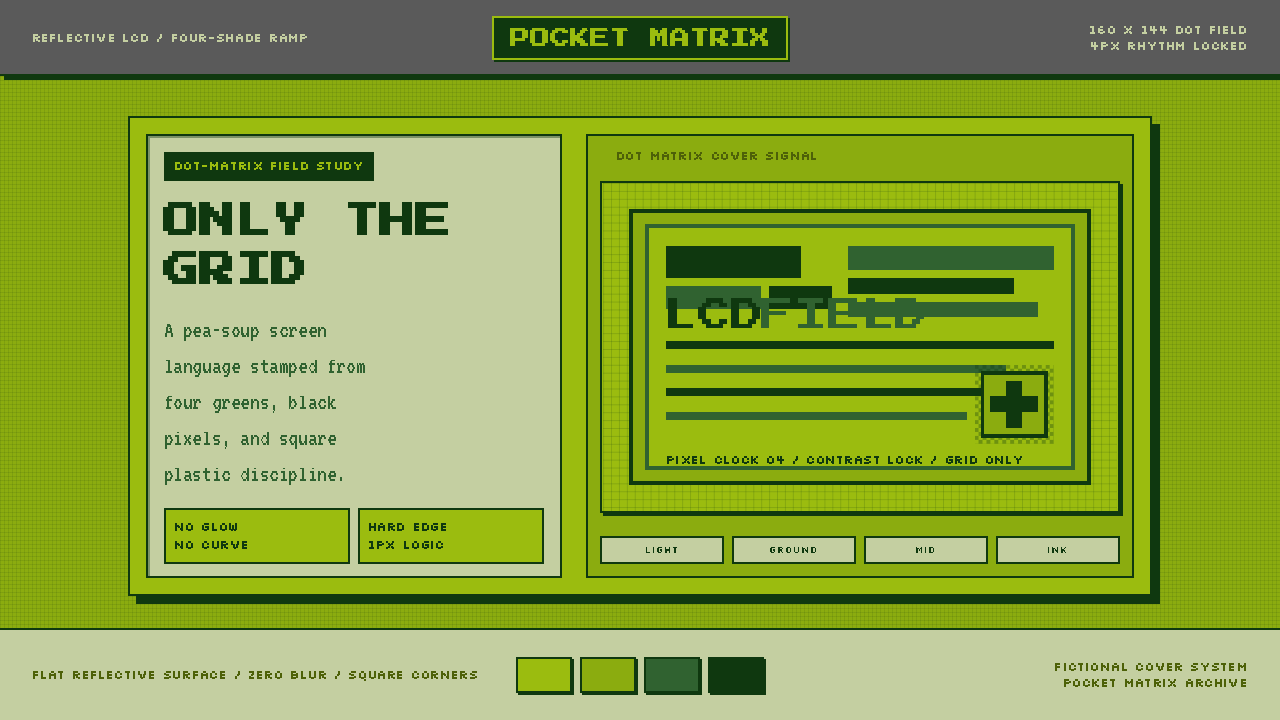 Game Boy DMG Green ScreenOnly the grid remains. Olive LCD tones, pixel type, and hard black borders.
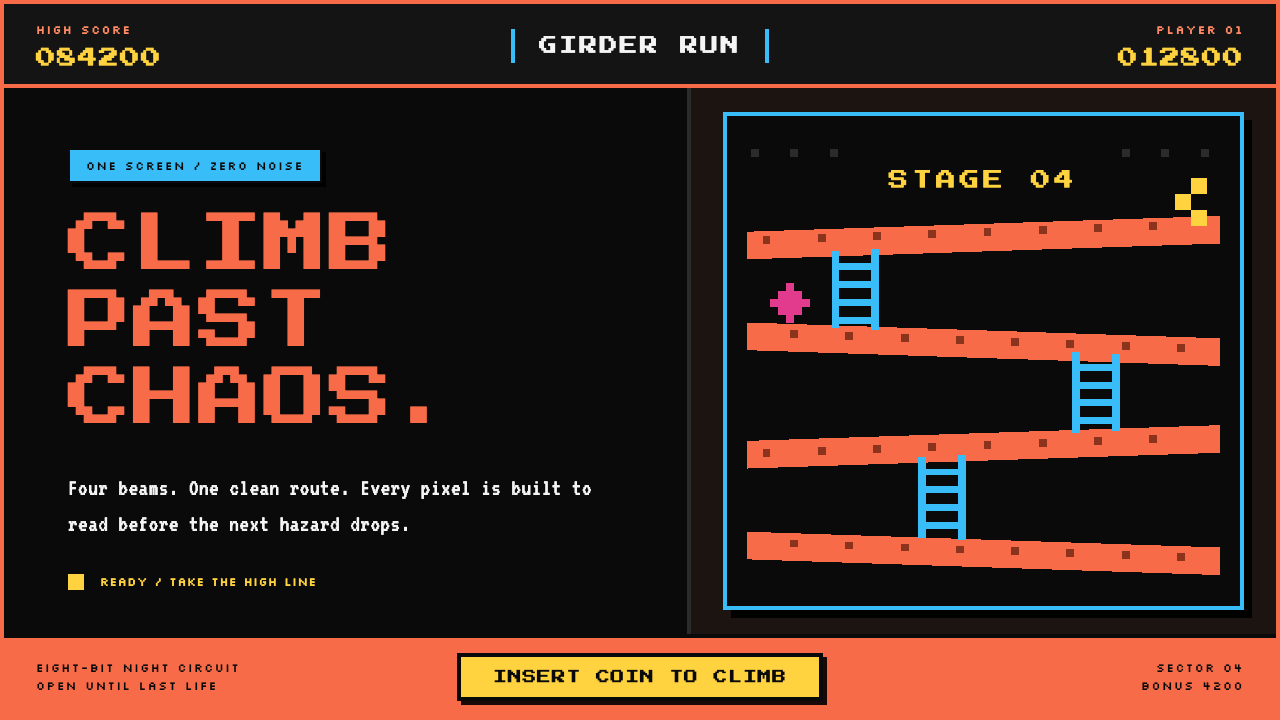 Donkey Kong (1981 Arcade)Built to read through the smoke. Coral girders and cyan ladders cut across a…
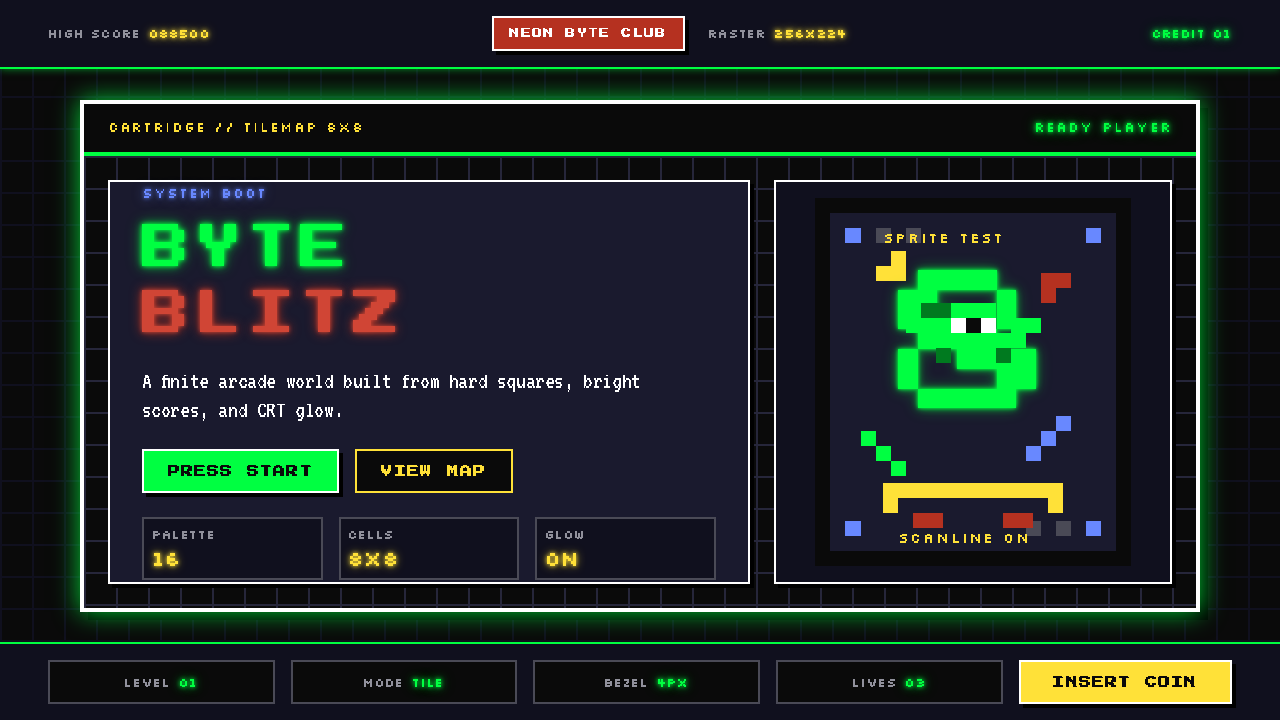 Pixel Art / 8-bit RetroHard-edged digital joy. CRT black, phosphor green, and 8x8 grids snap every p…
 Street Fighter II (1991 Arcade)Pixel muscle hits hard. Hadouken blue, gold HUD bars, and outlined type blaze…
 Super Mario Bros (1985)Every pixel earns its place. Sky blue, four-color tiles, and hard black outli…
 Rubik's Cube (1974)One twist from order. Six pure colors snap into a black-guttered 3×3 grid.