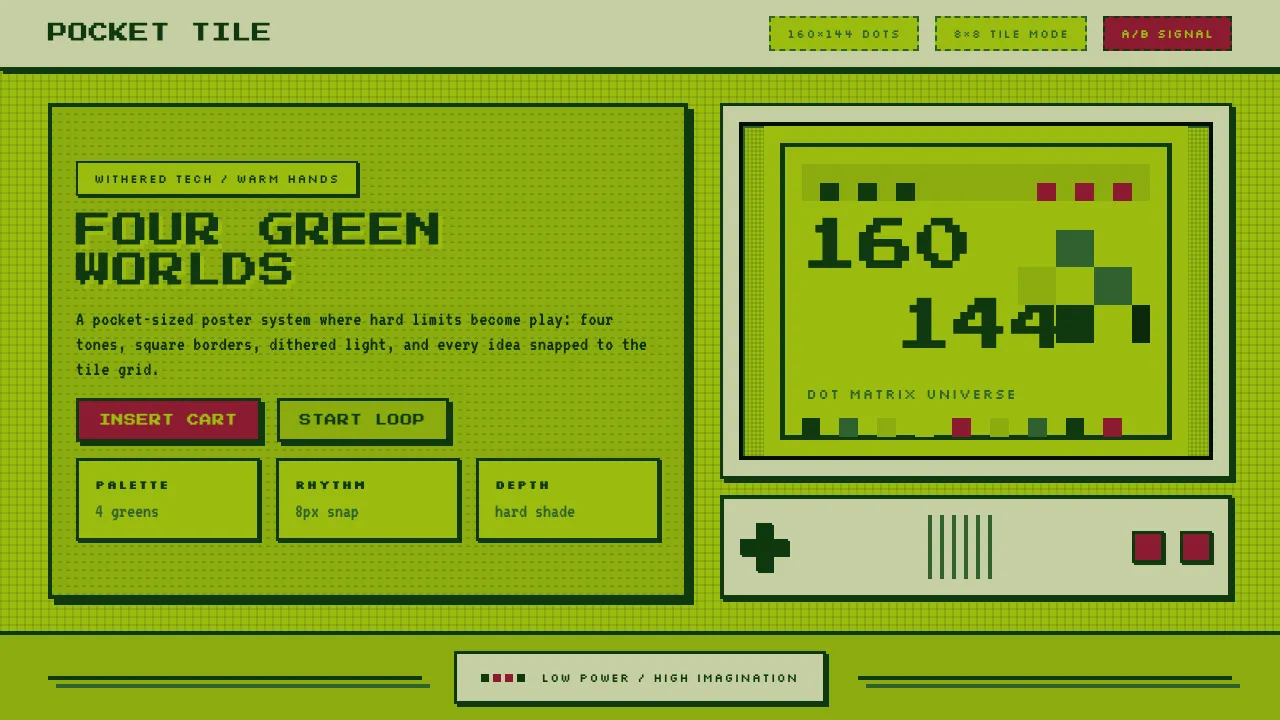
About Nintendo Game Boy
The Nintendo Game Boy (1989) was engineered around a deliberate limitation: a 160×144 dot-matrix LCD that could render only four shades of swampy green. Gunpei Yokoi's philosophy of "lateral thinking with withered technology" turned that constraint into a visual language, and Tetris, Pokémon, and Link's Awakening proved that whole worlds fit inside `#0F380F`–`#9BBC0F`.
This system treats those four greens as non-negotiable canvas, with a maroon `#8B1A30` accent lifted from the DMG-01's A/B buttons. Everything snaps to an 8×8 pixel grid, corners are hard, gradients are dithered, and type is pixel-native. The mood is constraint, craft, and cartridge-era optimism.
- Origin
- Kyoto, Japan
- Era
- 1989 launch; peak cultural impact 1989–1998 (pre-Game Boy Color)
- Key figures
- Gunpei Yokoi · Satoru Iwata · Shigeru Miyamoto · Hirokazu Tanaka
- Movements
- Handheld gaming · Dot-matrix pixel art · Chiptune
Nintendo Game Boy design spec
Colors
Typography
The other 11 sections — buttons, cards, spacing, motion, techniques and more — open once you unlock. Download the DESIGN.md or send it to your AI in one click. Unlock once, yours forever.
Sign up nowStyles similar to Nintendo Game Boy
Also inspired by brands & products, with a close feel.
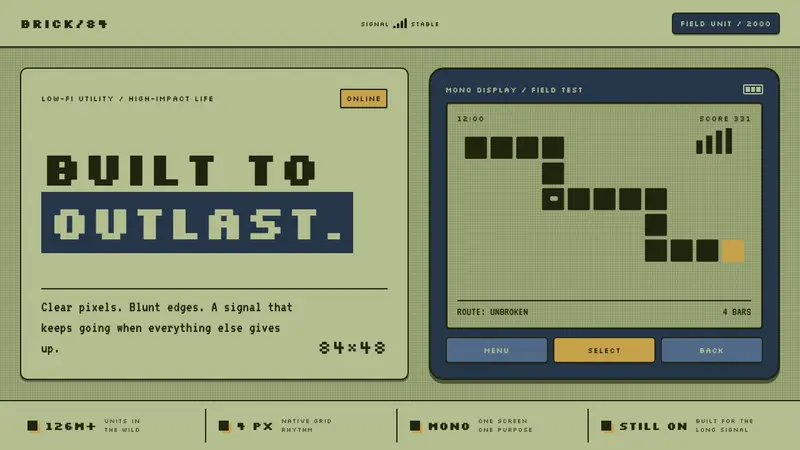 Nokia 3310 (2000)Built to outlast. Dark pixels march across olive glass inside a matte navy frame.
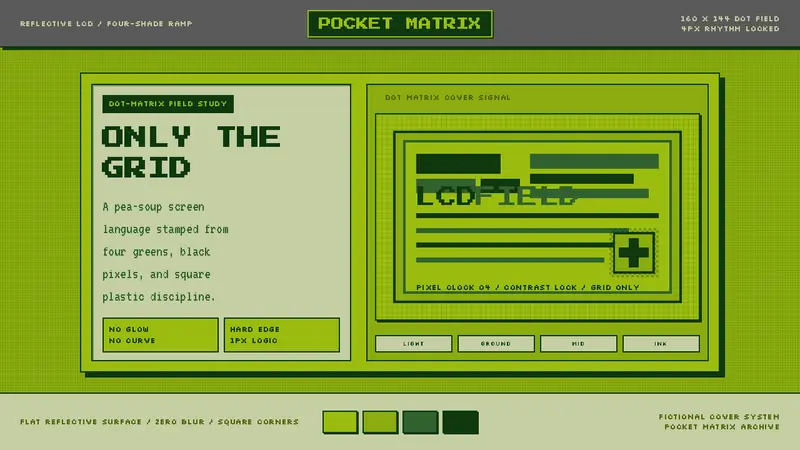 Game Boy DMG Green ScreenOnly the grid remains. Olive LCD tones, pixel type, and hard black borders.
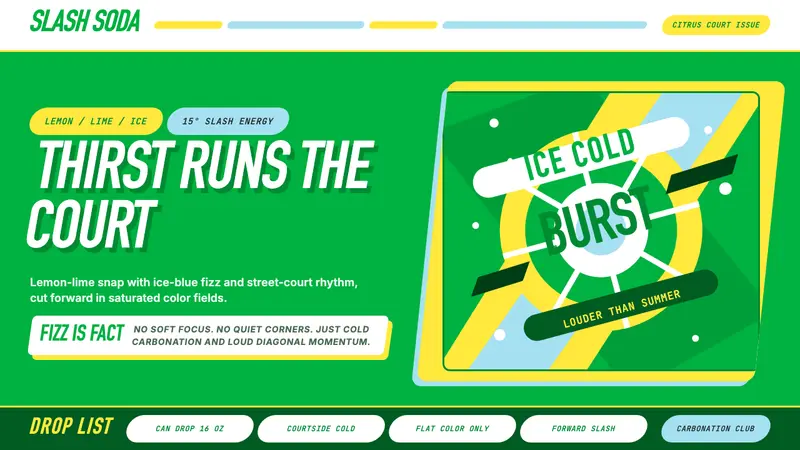 Sprite — Obey Your ThirstCitrus hits like asphalt heat. Saturated green, lemon yellow, and 15° slashes drive the poster.
 MSN Messenger (2001)Dial-up optimism, online. Luna-blue chrome and bright status dots keep every chat buzzing.