What is Persian Isfahan Carpet?
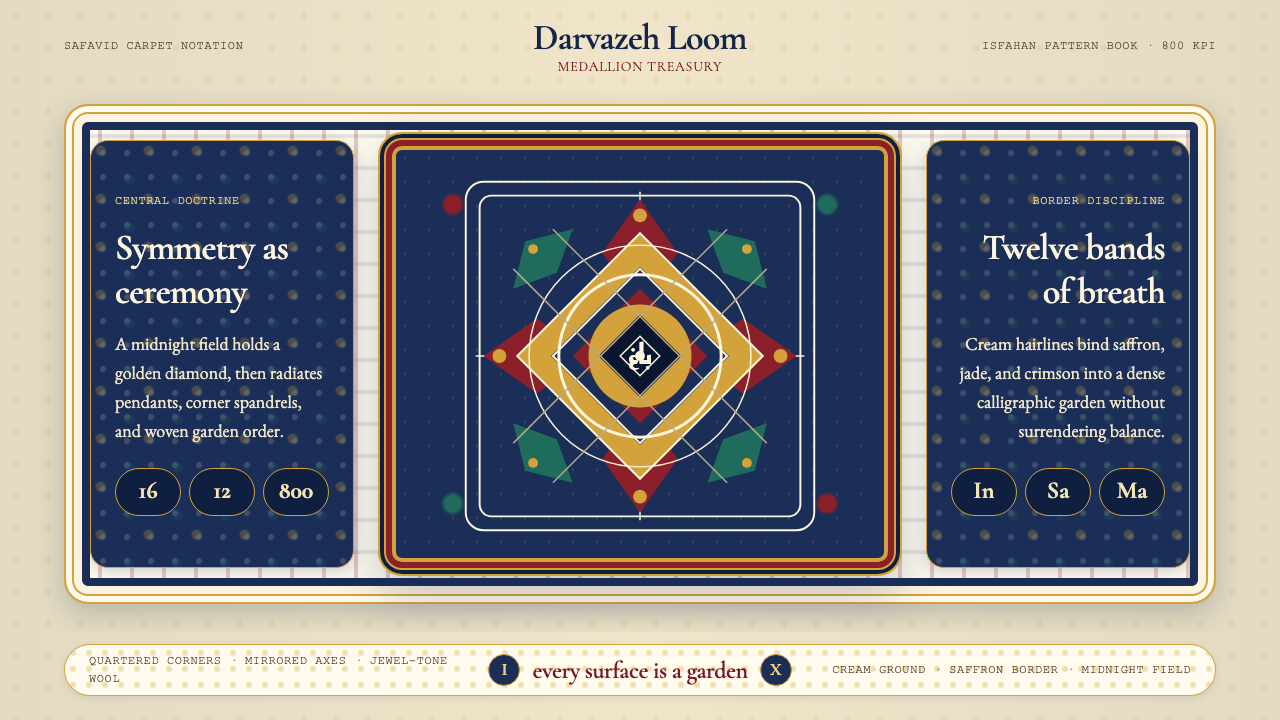
Every knot a ceremony — Isfahan's royal looms wove a universe of jewel-toned symmetry into wool and silk.
Persian Isfahan Carpet in brief
Persian Isfahan Carpet is a design language rooted in the peak of Safavid royal weaving — a system built on a central diamond medallion radiating outward through mirrored pendants, quartered corner spandrels, and layer upon layer of palmette-arabesque scrollwork borders. At densities reaching eight hundred knots per inch, the original carpets achieved a painted quality in fiber, where every surface was a calligraphic garden refusing to leave any ground uncovered.
The visual vocabulary is one of saturated natural-dye jewel tones — deep midnight blue as the dominant ground, golden saffron as the central medallion, emerald jade as the scrollwork vine, and crimson as the cartouche accent — all bounded by cream-ivory hairline arabesques that trace palmette flowers, cloud-bands, and interlocking spirals across every available plane. Symmetry is absolute: any half of a composition mirrors the other across both axes, and the geometry of the medallion is repeated, at diminishing scale, in the corner spandrels.
As a design system, Isfahan Carpet speaks to ceremony, scholarship, and material richness. It is appropriate when the work needs the weight of history — museum publications, luxury brand identities, heritage collections, archival catalogs — and when the designer is willing to commit to density and ornamental complexity as a form of respect for the audience rather than a lapse in discipline.

Where does Persian Isfahan Carpet come from?
The Isfahan carpet tradition reaches its canonical form during the reign of Shah Abbas I (1588–1629), who moved the Safavid capital to Isfahan and established royal court workshops — the so-called karkhanehs — staffed by the finest weavers, dyers, and designers in the Persian world. Under Abbas, carpet-making was elevated from a craft of nomadic and village origin into an imperial art form, with the court dictating designs, controlling the supply of natural dyes, and commissioning works of unprecedented scale and technical ambition. The political motive was clear: carpets were diplomatic gifts, throne-room furnishings, and visual statements of Safavid power that traveled across the Islamic world and into the courts of Europe.
The most celebrated surviving work of this tradition is the Ardabil Carpet, completed around 1540 and now held at the Victoria and Albert Museum in London. Measuring roughly eleven by five meters and containing more than thirty million knots, it bears a central sun medallion surrounded by sixteen oval pendants and a field of continuous arabesque scrollwork, with a cartouche inscription attributing the work to Maqsud of Kashan — one of the few surviving attributions of a named designer to a Safavid-era carpet. The Ardabil is the canonical reference point: every aspect of what designers call the Isfahan system — the medallion hierarchy, the horror-vacui field, the layered border structure — is present in it at its highest pitch.
The visual language of the Isfahan carpet synthesizes three distinct streams of Islamic visual culture: geometric ornament derived from mathematical tiling and architectural surface decoration; biomorphic arabesque that traces the growth logic of vines and flowers through endlessly branching spirals; and figural or narrative cartouches borrowed from manuscript illumination and bookbinding. The synthesis was made possible by the court workshops, which employed both master geometers and trained painters working from prepared cartoons — full-scale drawings transferred to the loom — allowing a design precision impossible in village weaving.
The Isfahan tradition continued through the Qajar dynasty (1789–1925) and into the Pahlavi era, adapting the Safavid vocabulary to new commercial markets as European and American demand for Oriental carpets surged during the nineteenth century. Workshops in Isfahan, Tabriz, Kashan, Kerman, and Qom each developed regional variations while preserving the medallion-field-border schema. Western scholars including Sheila Canby, who has written extensively on Safavid art, and Jon Thompson, whose research on carpet structure and provenance has been foundational, helped establish the academic framework through which contemporary designers understand the Isfahan visual system as a documented and attributable historical canon rather than an anonymous folk tradition.
What defines the Persian Isfahan Carpet look?
Medallion Hierarchy
The composition is organized around a central medallion — typically diamond or stellate in outline — from which a fixed number of oval pendants radiate symmetrically. The medallion is the brightest element on the ground, rendered in golden saffron or ivory against the deep blue field, and its geometry is echoed at smaller scale in the quarter-medallion spandrels occupying each corner. This center-to-edge hierarchy creates an immediate focal axis and gives every composition a throne-like gravity.
Jewel-Tone Palette
The palette is drawn from saturated natural-dye tones: a deep midnight blue as the primary ground, golden saffron as the medallion accent, emerald jade threading through the scrollwork, and crimson anchoring cartouche borders. Cream or ivory appears as the hairline detail color that separates and defines every motif. The combination is simultaneously rich and legible — each hue occupies a distinct zone of luminosity, preventing the density from collapsing into visual noise.
Horror-Vacui Field
The ground between and around the medallion is never left plain. Continuous arabesque scrollwork — branching palmette vines that spiral and fork without interruption — covers the entire field at a density that, at carpet scale, makes the ground feel woven rather than flat. This horror-vacui (fear of empty space) principle is not decorative excess but a structural commitment: each unit of scrollwork interlocks with its neighbors, so the field reads as a single breathing organism rather than a collection of discrete motifs.
Layered Border System
The composition is contained within a sequence of border bands — typically between eight and twelve — that step inward from the outermost edge to the central field. Each band carries a distinct pattern: a guard stripe of small reciprocal motifs, a wider main border of continuous cartouche-and-medallion chains, and inner guard stripes transitioning back to the field. The borders are not frames but structural membranes that modulate the transition from edge to center and back, giving the composition a sense of spatial depth without perspective.
Strict Bilateral Symmetry
Every element in the composition obeys a strict fourfold symmetry: the design can be divided along both the vertical and horizontal axes and each quadrant is a mirror of the others. This is not approximate balance but mathematical precision — a consequence of the cartoon-transfer method used in court workshops, where a quarter of the design was drawn and then mirrored into the full composition. The symmetry gives Isfahan-derived work an immediate sense of authority and completeness, as if the design could not logically be otherwise.
Palmette and Cloud-Band Motifs
The two signature motifs of the Isfahan vocabulary are the palmette — a fan-shaped flower head derived from the lotus and acanthus traditions via Central Asian transmission — and the cloud-band, a Chinese-influenced wisp-form that floats through the arabesque field in contrasting ivory or pale tone. The palmette serves as the terminal anchor of every scrollwork branch, while the cloud-band introduces a calligraphic softness that prevents the geometric structure from reading as mechanical. Together they create the sense that the field is alive rather than tiled.
Cartouche and Inscription Frames
Formal Isfahan carpets include cartouche panels — elongated oval or rectangular frames — placed along the main border or within the field, often containing calligraphic inscriptions in Persian poetry or dedicatory text. Even when the cartouche contains no legible text, its outline functions as a visual punctuation mark: a change of pace in the scrollwork rhythm that anchors the eye. In contemporary design applications, the cartouche form is adapted as an accent element — a label, badge, or pull-quote container — that carries the period's associative richness.

Who shaped Persian Isfahan Carpet?
Shah Abbas I is the pivotal political figure behind the Isfahan carpet tradition as a documented court art. By relocating the Safavid capital to Isfahan and establishing centralized royal workshops, he transformed carpet production from a decentralized craft into a state enterprise with design control, quality standards, and diplomatic purpose. The carpets produced under his patronage were sent as gifts to the Ottoman court, to the Doge of Venice, and to Philip III of Spain — an early and highly effective instance of what would now be called cultural diplomacy. His reign is the biographical anchor for every claim that the Isfahan visual system is a product of intentional design rather than organic tradition.
Maqsud of Kashan is the named designer attributed in the cartouche inscription of the Ardabil Carpet — the most studied single carpet in the tradition. His attribution is exceptional: the vast majority of Safavid carpets carry no designer's name, making Maqsud one of the few individuals around whom a discussion of intentional authorship in the carpet tradition can be organized. Whether he designed the pattern, supervised the workshop, or managed the commission is debated, but his name in the inscription establishes that the Ardabil was understood by its makers as an authored work rather than an anonymous artifact.
Sheila Canby, a leading scholar of Safavid and Persian art who has held curatorial positions at the British Museum and the Metropolitan Museum of Art, has produced some of the most authoritative scholarship on the visual culture from which the Isfahan carpet tradition emerges. Her work on Safavid painting, manuscript illumination, and decorative arts establishes the connective tissue between court patronage, artistic convention, and visual output that designers need to understand the Isfahan system as coherent rather than arbitrary. Her exhibitions and catalogs are primary resources for anyone building an academically grounded application of this aesthetic.
Jon Thompson's scholarship on carpet structure, weaving technology, and provenance has been foundational to the academic study of Oriental carpets as designed objects rather than ethnographic artifacts. His research establishes the technical vocabulary — pile height, knot density, warp depression, cartoon-transfer methods — that allows art historians and designers alike to understand how the visual effects of the Isfahan system were achieved and why they cannot be replicated through purely surface-level aesthetic mimicry. His work is essential reading for anyone seeking to apply Isfahan design with technical credibility rather than superficial period pastiche.
The Victoria and Albert Museum holds the Ardabil Carpet — the canonical masterwork of the Isfahan tradition — and has built around it one of the most significant scholarly and conservation records for any single textile object. The museum's documentation, exhibitions, and digital resources have made the Ardabil's visual system accessible to designers worldwide, establishing it as the primary public-domain reference for the Isfahan medallion schema. Any serious engagement with the Isfahan design language begins with the V&A's Ardabil holdings as the authoritative source object.
How do you use Persian Isfahan Carpet today?
Persian Isfahan Carpet is a design language of ceremony and density. Applying it correctly means committing to its core structural logic — the medallion hierarchy, the layered border, the jewel-tone palette, and the horror-vacui field — rather than treating it as a collection of decorative motifs to be scattered over a modern layout. The style demands that the designer understand what each element is doing structurally before reaching for it as ornament.
For presentation slides, Isfahan works most powerfully on cover and chapter-divider pages where ceremony and gravitas are the primary communication goals. A cover in this system places the medallion form — adapted as a framing device for a title or logo — at center against a deep midnight-blue ground, with an ivory scrollwork border receding toward the edges. The saffron and crimson accents are reserved for the title typography and subhead, creating the same luminosity hierarchy that the original carpets achieved between their medallion and field. Content slides should be more restrained: one or two border elements used as section dividers, the deep blue reduced to an accent bar, and the body text set in a neutral weight to keep the scrollwork from competing with information. Data slides in this system work best as single-chart pages where the chart itself is framed by a simplified cartouche border — the data becomes a form of inscription within the visual tradition of the style.
For web interfaces, Isfahan is best deployed in contexts where richness and historical authority are explicit brand values: museum collection pages, luxury e-commerce product detail views, heritage brand landing pages, and cultural institution homepages. The approach differs fundamentally from a stripped utilitarian UI: navigation and header elements can carry a simplified border treatment; the background alternates between a near-black midnight tone and a cream ground depending on section; primary calls to action are rendered in saffron against deep blue, borrowing the medallion's luminosity logic. Pricing pages in this system use the cartouche form for tier containers — each plan presented inside an outlined oval or rectangular frame — which transforms what is conventionally a grid into a hierarchical panel structure that implies that some choices carry more ceremony than others.
For editorial and marketing work, Isfahan design delivers an immediate sense of cultural weight and scholarly seriousness. A magazine spread or catalog page in this system uses a drop-capital initial letter framed by a miniature medallion ornament, a running border on the outer margin in a restrained palmette repeat, and pull-quotes housed in cartouche-derived frames. The palette in editorial contexts is typically reduced to two of the jewel tones — midnight blue and saffron, or crimson and ivory — with the full four-color palette reserved for feature openers. Marketing pages for heritage or luxury brands use the full-border treatment on hero sections, the medallion form as a seal or certification badge, and the scrollwork adapted as a background texture in a very low-contrast iteration of the main ground color.
A common mistake when applying Isfahan design is treating the ornamental density as wallpaper — tiling the scrollwork pattern uniformly across backgrounds without establishing the medallion hierarchy that gives the system its internal logic. Without the center-to-edge organization, the style collapses into visual noise regardless of how accurate the individual motifs are. A related mistake is using the jewel-tone palette at full saturation simultaneously across all elements: the original carpets achieved their luminosity by modulating tone — the ground blue is deep and recessive, the medallion gold is bright and advancing — and replicating this tonal range, rather than flattening it, is what separates a disciplined Isfahan application from a costume.
The Isfahan system also does not translate well to contexts requiring lightness, speed, or casual accessibility. It is a formal register, and forcing it onto products that depend on approachability — consumer social applications, casual retail, children's products — typically produces a result that feels either pretentious or oppressively heavy. The most successful applications are those where the audience is predisposed to read density and ornament as quality signals rather than as noise.

Persian Isfahan Carpet — FAQ
Is Isfahan the same as all Persian carpet design, or does it refer to something specific?
Isfahan refers specifically to the court-workshop tradition centered in the Safavid capital during the sixteenth and seventeenth centuries, characterized by the medallion-field-border schema, strict bilateral symmetry, and natural-dye jewel tones. Persian carpet design encompasses dozens of distinct regional traditions — Tabriz, Kashan, Kerman, Qashqai, Turkmen — each with its own compositional schemas, color preferences, and motif vocabularies. The Isfahan system is the most formal and architecturally organized of these traditions, the one most directly shaped by court patronage and design cartoons. Treating all Persian carpet aesthetics as interchangeable will produce work that reads as generic Orientalism rather than as a rigorous application of a specific visual system.
Can the Isfahan system work in a light or white-background layout?
The canonical Isfahan palette is dark-ground — deep midnight blue or deep crimson — because the system's luminosity hierarchy depends on the medallion and scrollwork being brighter than the field. A light-ground inversion is possible, but it requires rethinking the tonal relationships entirely. On a cream or ivory ground, the medallion becomes a deep blue or crimson form with saffron interior detailing, and the scrollwork reads as dark against light. This reversal works in contexts where a lighter, more editorial feeling is appropriate — a museum catalog page, a heritage-brand editorial spread — but it weakens the ceremonial gravity that makes the dark-ground version so distinctive. The border structure and medallion hierarchy remain essential regardless of ground color.
How does Isfahan design differ from other Islamic geometric traditions like Moroccan zellige or Ottoman Iznik?
The three traditions share a common origin in Islamic geometric and biomorphic ornament but diverge sharply in compositional logic and visual mood. Moroccan zellige is a tiling tradition — repeating geometric interlace patterns without a focal hierarchy, producing a mesmerizing all-over texture. Iznik ceramic design uses a centered radial symmetry like Isfahan, but its ground is typically brilliant white, its palette is dominated by cobalt blue and tomato red with bright emerald, and its motifs are more naturalistically rendered — recognizable tulips, carnations, and hyacinths rather than abstracted palmettes. Isfahan is the most architecturally hierarchical of the three: the medallion creates a center that radiates authority, the borders create depth, and the horror-vacui field is the most tightly controlled. Applying them interchangeably treats three centuries of distinct cultural production as costume.
Does using this style risk cultural appropriation?
Any design system derived from a living cultural tradition carries this responsibility, and Isfahan design — drawn from Iranian court art that continues to have meaning in contemporary Iranian cultural identity — is no exception. The relevant distinction is between informed application and surface extraction. Informed application means engaging with the tradition's documented history and visual logic, crediting the sources, and using the system in contexts where its ceremonial and scholarly associations are honored rather than flattened into novelty. Surface extraction — borrowing the color palette or a few scrollwork elements without understanding the system's structure or origin — produces work that is both aesthetically weaker and culturally disrespectful. Using Isfahan design for a luxury heritage brand catalog is a different act from using it as a novelty skin on a casual game. Context, credit, and understanding are the relevant variables.
What is the single most important principle to get right when applying Isfahan design?
Hierarchy. The Isfahan system is not a pattern — it is a spatial argument. The medallion is the loudest statement; the field is the sustained development; the borders are the structured containment. If these three zones are not clearly distinguished in luminosity, scale, and density, the entire composition loses its organizing logic and becomes indistinguishable from generic ornamental wallpaper. Every other decision — palette, motif selection, border count — is secondary to establishing this center-to-edge hierarchy clearly before adding complexity. Designers who begin with the border and work inward typically produce more coherent Isfahan-derived compositions than those who begin with individual motifs and attempt to assemble the hierarchy afterward.
Related design styles
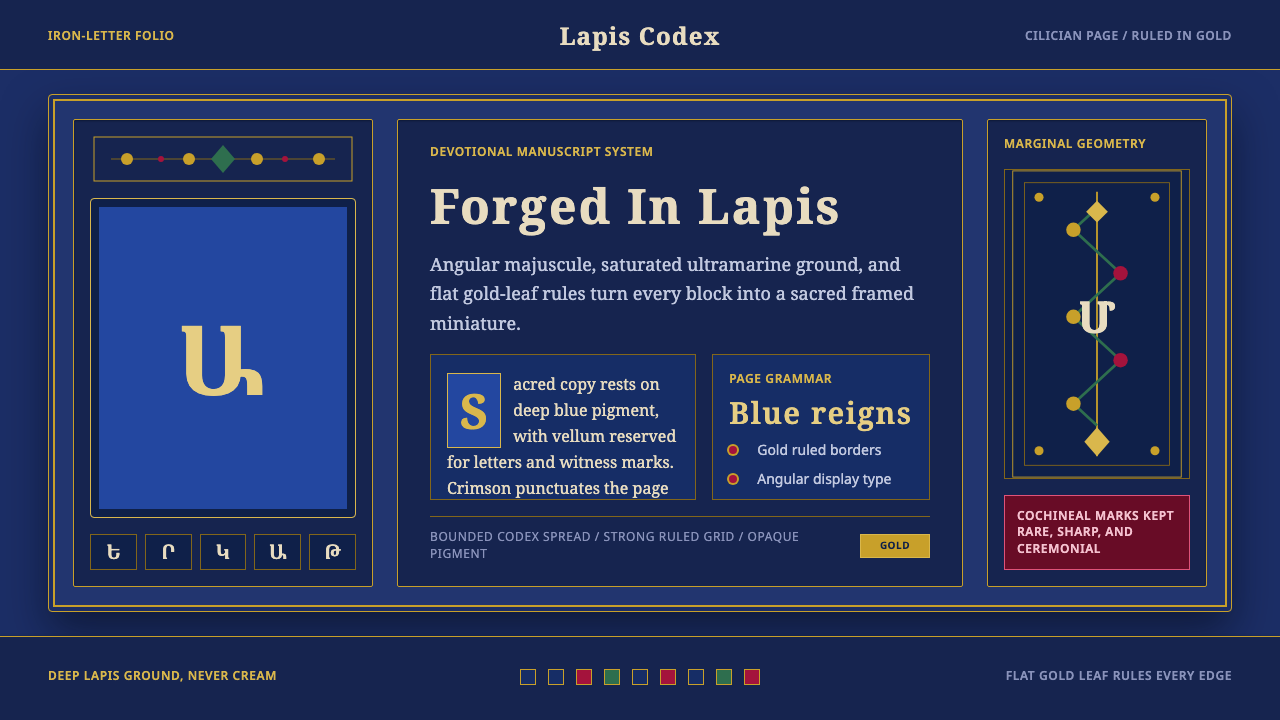 Armenian ErkatʿagirDevotional lapis reigns. Gold rules and angular serif glyphs frame a sacred g…
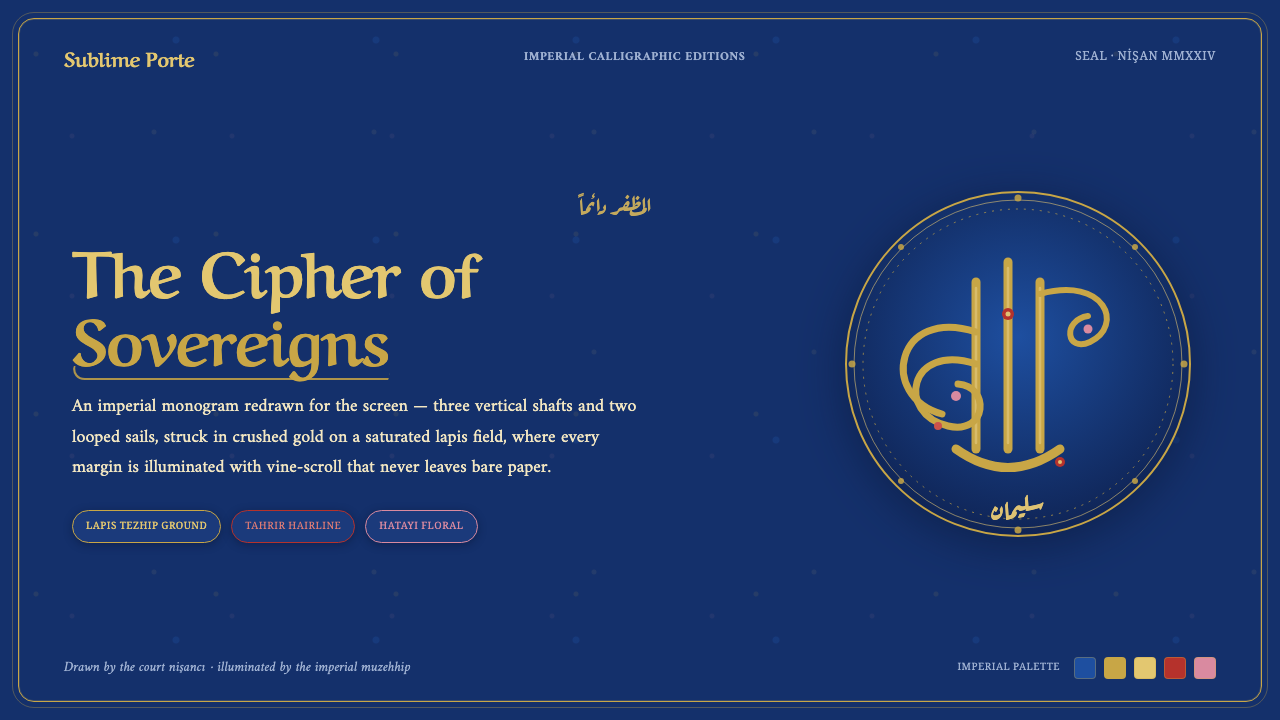 Ottoman Tughra SealEvery surface is a state seal. Gold tughra cipher on lapis, Aref Ruqaa script…
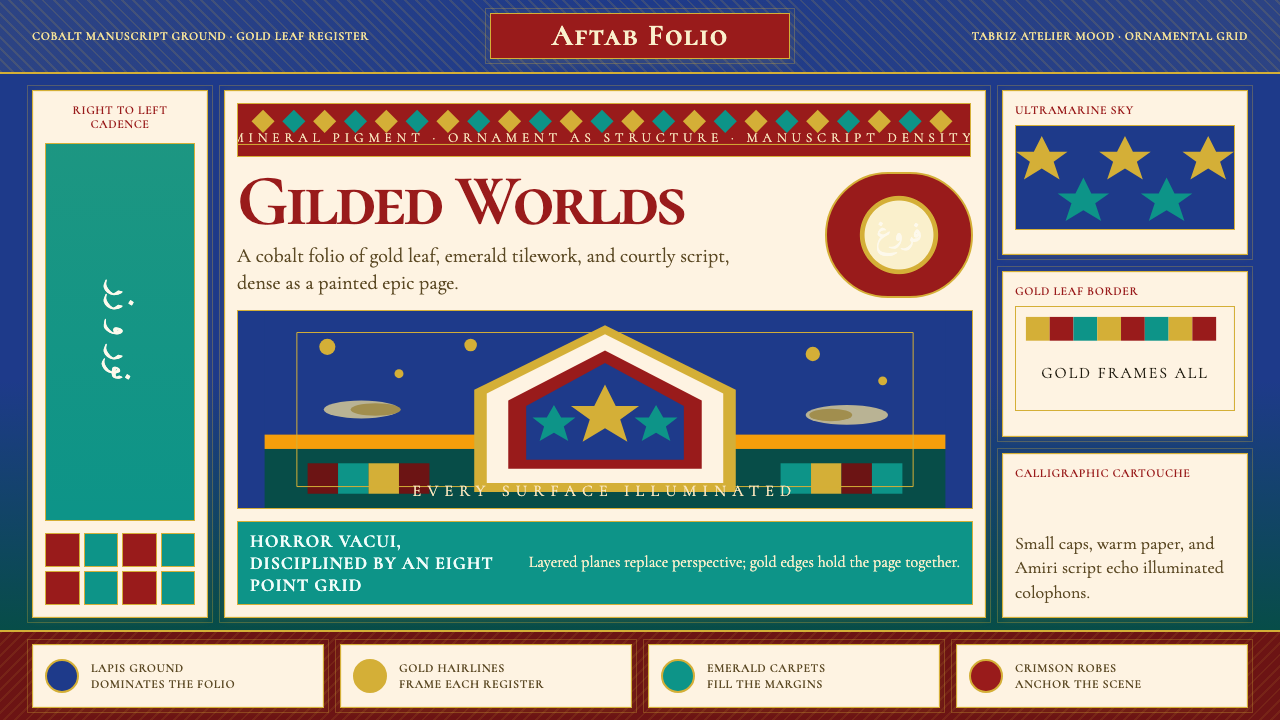 Persian Miniature (Shahnameh era)Manuscript luxury turns maximal. Cobalt ground, gold borders, and Cormorant S…
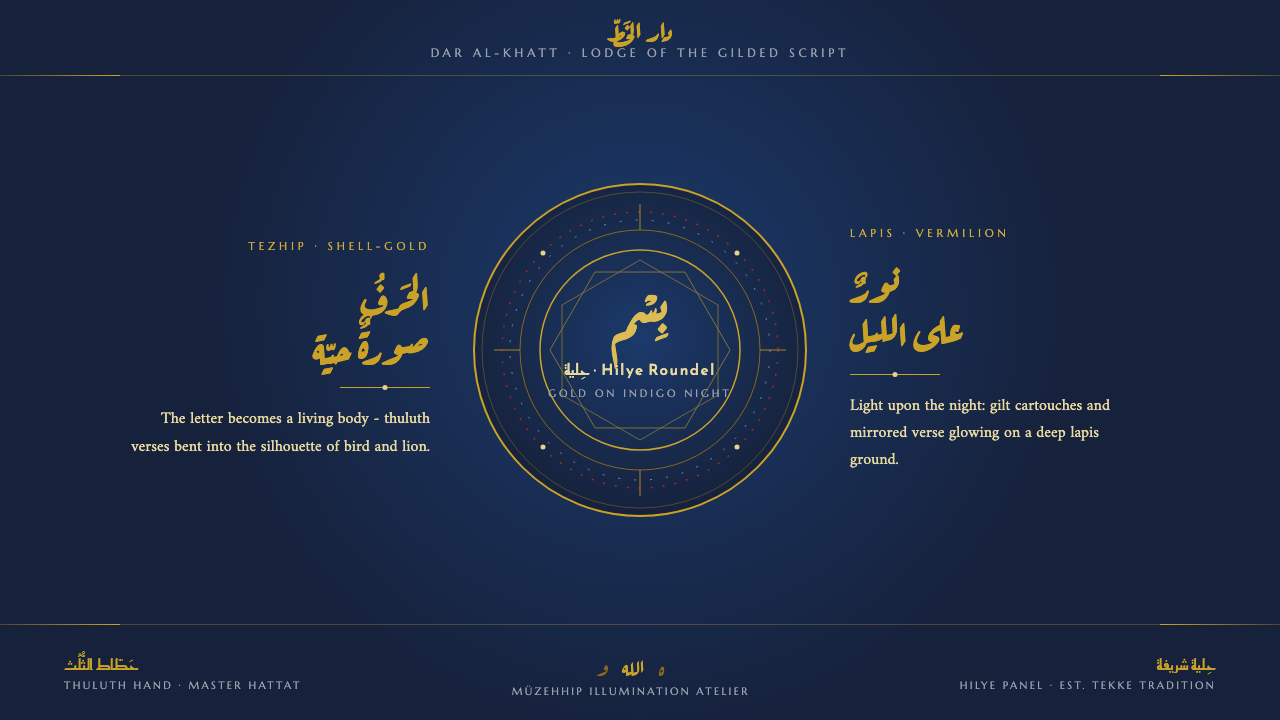 Sufi Zoomorphic CalligraphySacred script made flesh. Shell-gold thuluth on indigo-night grounds, framed…
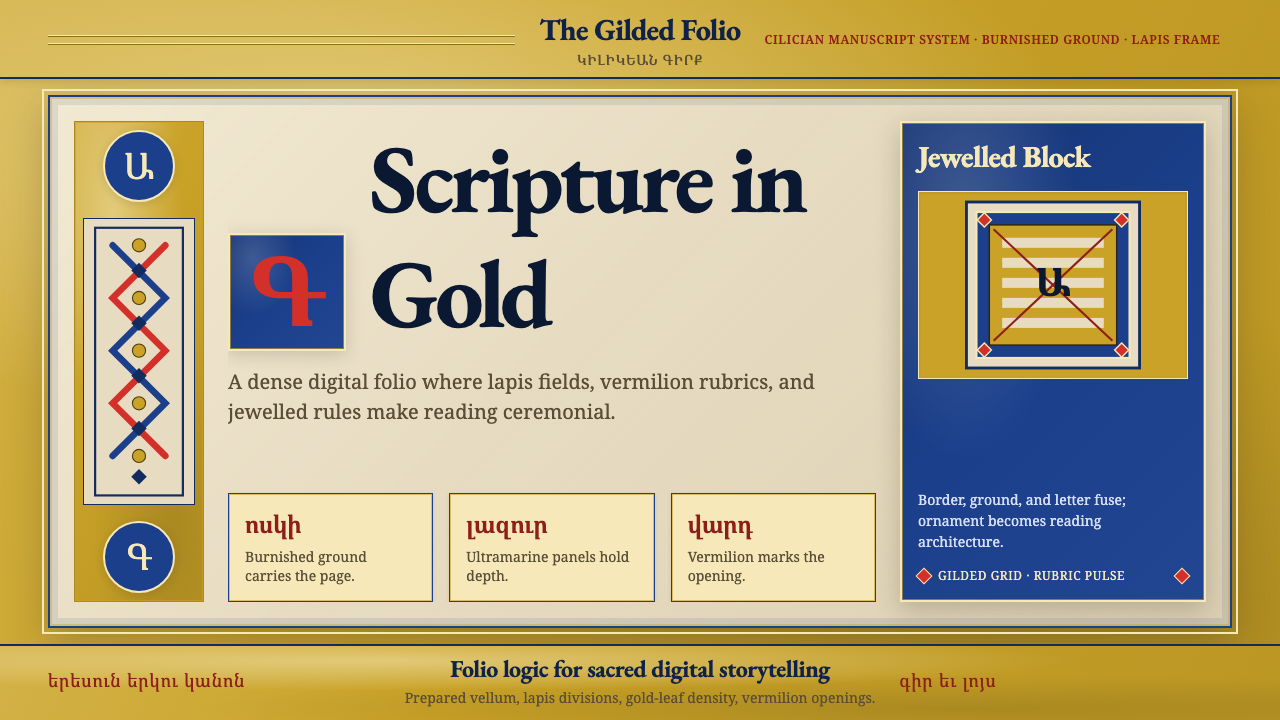 Armenian Illuminated ManuscriptGilded maximalism. Burnished gold, lapis frames, and vermilion initials build…
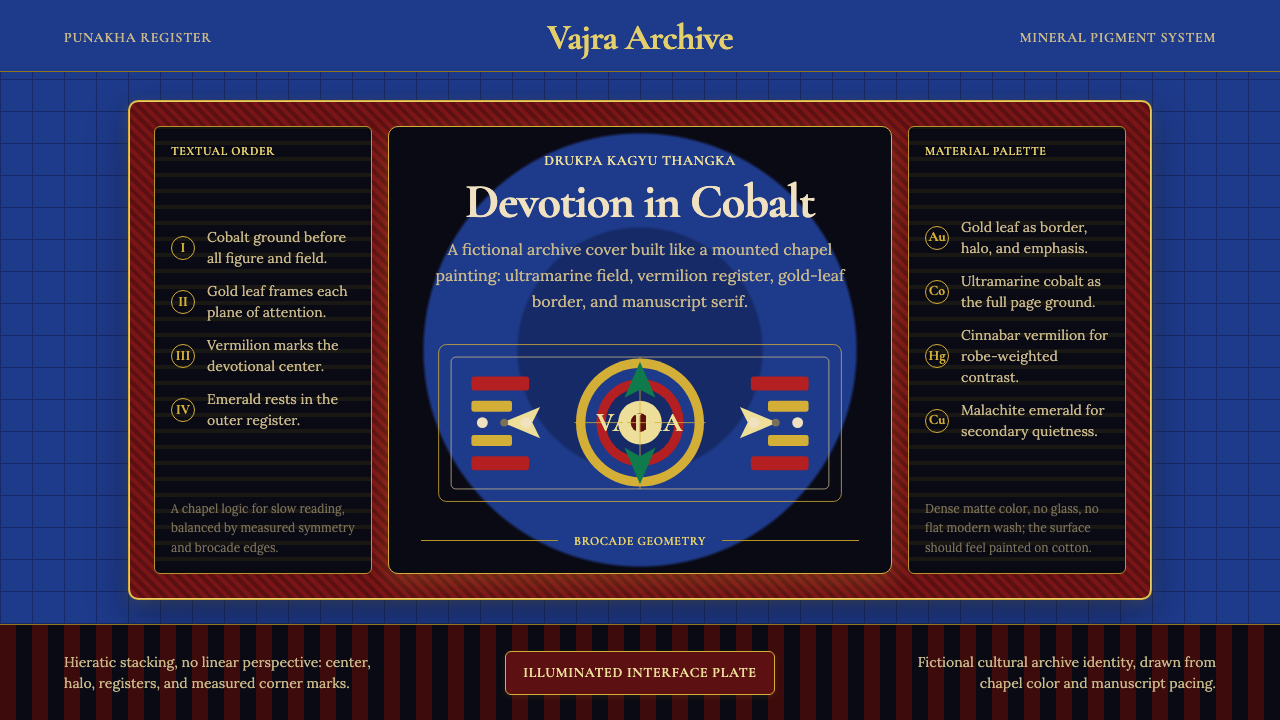 Bhutanese Drukpa Kagyu ThangkaDevotion made cobalt. Gold frames, Cormorant serif, and vermilion marks hold…