What is Patent Cyanotype Drawing (1880)?
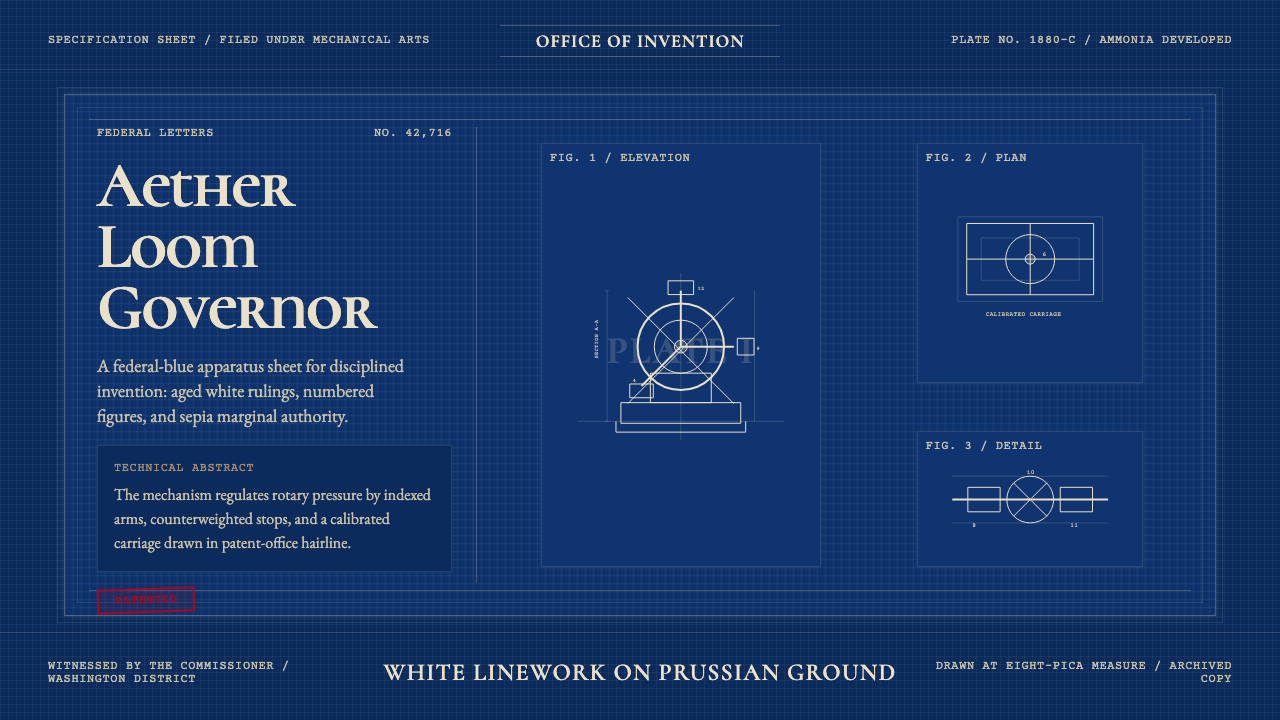
Every invention that reshaped the modern world — the light bulb, the telephone, the airplane — was first made official in white hairlines on deep Prussian blue, the chemical grammar of American patent authority.
Patent Cyanotype Drawing (1880) in brief
Patent Cyanotype Drawing is the visual system of American federal invention documentation from the Gilded Age. Between 1875 and 1920, every patent drawing submitted to the US Patent Office was rendered in white lines on a deep blue field, produced through the cyanotype photographic process — a contact-printing technique in which iron-salt coated paper turned the now-iconic Prussian blue wherever light did not strike it, leaving white wherever lines blocked the exposure. The result was a technical illustration of exceptional precision and an unmistakable aesthetic authority.
The visual language is defined by its constraints: hairline technical draftsmanship on a saturated, atmospheric blue ground, with ornamental borders drawn from Victorian legal document conventions, figure reference numbers in neat serif numerals, and the occasional title block rendered in the formal copperplate hand of the professional draftsman. Everything serves the legal and technical function of the patent record — yet the aggregate effect is one of austere beauty, the beauty of a system working at its full capacity.
This design system captures two things simultaneously: the authority of government documentation and the craft of the professional patent illustrator. The deep blue carries connotations of officialdom and permanence; the white linework speaks to precision, expertise, and the trained hand. Applied to contemporary design work, the vocabulary signals institutional credibility, technical depth, and a respect for process — values that are rare and therefore legible when authentically deployed.

Where does Patent Cyanotype Drawing (1880) come from?
The cyanotype process was invented in 1842 by the English scientist Sir John Herschel, who discovered that ferric ammonium citrate and potassium ferricyanide, when combined and exposed to ultraviolet light, produced a stable Prussian blue compound. Herschel developed the process as a means of duplicating notes and drawings — not as photography in the artistic sense, but as a reprographic tool. The botanical illustrator Anna Atkins immediately grasped its potential for scientific documentation and in 1843 produced the first photographically illustrated book, cyanotype prints of British algae that combined scientific precision with an otherworldly blue-on-white beauty.
The process migrated from scientific documentation to engineering and architecture in the 1850s and 1860s, where it became the dominant means of duplicating technical drawings — the origin of what we still call a 'blueprint.' Its advantages were practical: the chemistry was cheap and stable, the paper required no darkroom to process (daylight or a UV lamp sufficed), and the resulting prints were durable, chemically stable, and resistant to fading under normal archival conditions. By the 1870s, the US Patent Office had standardized cyanotype as the required format for patent illustration submissions, and a cottage industry of professional patent draftsmen had developed in Washington DC, New York, Boston, and Philadelphia to serve the exploding volume of Gilded Age invention.
The period from 1875 to 1920 represents the high-water mark of American patent culture. The US Patent Office processed hundreds of thousands of applications during these decades, and the visual conventions of the cyanotype drawing became deeply standardized: mandatory figure numbers, reference numerals keyed to written specifications, ornamental borders adapted from legal document conventions, and the use of hatching and cross-hatching to indicate material and surface. Orson Desaix Munn and Alfred Ely Beach, editors of Scientific American and operators of a prominent patent agency, were among the figures who helped codify and disseminate these conventions through the widely read patent filing guides and specimen sheets their agency produced.
The cyanotype era ended gradually as photostatic copying and, later, xerographic reproduction made the process obsolete. By the 1920s, the Patent Office had shifted to accepting drawings on white paper with black ink — the format still in use today. But the 1875–1920 corpus of cyanotype patent drawings survived in federal archives, and their aesthetic has experienced a sustained cultural revival since the late twentieth century, as designers and historians recognized in the deep-blue technical drawings not just historical artifacts but a fully realized visual system of remarkable coherence and authority. The drawings of Edison's lamp, Bell's telephone, and the Wright brothers' Flyer No. 1 are among the most reproduced technical images in American cultural memory.
What defines the Patent Cyanotype Drawing (1880) look?
Ground Color
The defining element is the deep, saturated Prussian blue ground — a blue that sits between navy and cobalt, neither warm nor cold, with a chemical density that reads as institutional and permanent. This is not a decorative choice but a chemical fact of the cyanotype process: the blue emerges wherever iron compounds are oxidized by ultraviolet exposure, creating a field that functions simultaneously as background, atmosphere, and authority. The specific depth of the blue varied with exposure time and chemistry, giving individual patent sheets subtle variations within the same tonal family.
Linework
All drawn elements appear in white or near-white against the blue ground, produced by the opacity of the original ink or graphite blocking light during contact printing. Professional patent draftsmen worked at a level of precision demanding hairlines, consistent weights, and the ability to render complex mechanical assemblies in clean, unambiguous outline. Line weight is used hierarchically: heavier lines define major outlines and section boundaries; finer lines indicate surface details, hatching, and annotation. The overall effect is diagrammatic clarity elevated to a craft standard.
Ornamental Borders
Each patent sheet carries a formal border drawn from Victorian legal document conventions — typically a double-rule frame with corner ornaments, or a single heavy outer rule with a thinner inner rule creating a margin of official gravity. These borders are not merely decorative; they signal the document's legal status and establish the sheet as a formal record rather than a working sketch. The border vocabulary draws on the same tradition as stock certificates, legal briefs, and government currency of the period.
Figure Numbers and Reference Numerals
Every patent drawing is organized through a formal numbering system: figure numbers identify each distinct view (Fig. 1, Fig. 2, and so on), and reference numerals keyed to the written specification identify each component. These numerals are typically set in a clean, upright serif — the preferred hand of the trained patent draftsman — placed with enough spatial separation from the linework to remain legible without crowding. The numerals are functional annotations, but their consistent placement and weight contribute to the overall typographic authority of the sheet.
Hatching and Material Indication
Patent drawing conventions required draftsmen to indicate material and surface type through standardized hatching patterns: parallel lines for metal, cross-hatching at specific angles for different materials, stippling for certain surfaces. These conventions were codified in Patent Office rules and enforced during examination. The hatching serves both a functional purpose — making sectional views readable — and an aesthetic one, adding texture and tonal variation to what would otherwise be a purely linear composition.
Aged and Archival Quality
Surviving cyanotype patent sheets carry a characteristic aged quality: the white lines have yellowed slightly to warm ivory, the blue ground has shifted subtly in areas of uneven original exposure, and the paper itself shows the texture of period stock. This patina is not degradation but accumulation — evidence of a document that has endured. In contemporary design applications, invoking this quality requires restraint: the aged effect should feel inherent to the process rather than applied as a surface treatment.
Diagrammatic Clarity
The overriding visual principle of the patent drawing is unambiguous legibility. Every element must be readable by a patent examiner, a judge, or a manufacturer attempting to replicate the invention. This functional demand produced an aesthetic of diagrammatic precision: multiple views (plan, elevation, section, perspective) organized on a single sheet, with each view self-contained and consistently scaled relative to its neighbors. The patent draftsman's art was the art of explanation — making the invisible mechanism visible, making the complex assembly readable.

Who shaped Patent Cyanotype Drawing (1880)?
Herschel invented the cyanotype process in 1842 as a scientific reprographic tool, not as a visual art form. A polymath who also coined the terms 'photography,' 'negative,' and 'positive,' he understood the process as a means of making exact copies of handwritten notes and drawings without manual transcription. His decision to publish the process openly rather than patent it ensured its rapid adoption across scientific, engineering, and eventually governmental contexts — a choice whose consequences include the entire corpus of American patent drawings.
Atkins was the first person to grasp the cyanotype's potential for scientific illustration and the first to use it to produce a published book. Her 1843 series 'Photographs of British Algae: Cyanotype Impressions' placed botanical specimens directly on sensitized paper and made contact prints, producing images of extraordinary precision and an almost dreamlike blue-and-white beauty. Her work established the visual grammar — white form against deep blue ground — that would define the process's aesthetic identity for the remainder of the century.
As co-owner of Scientific American and founder of Munn and Company, the largest patent agency in nineteenth-century America, Munn occupied a central position in the Gilded Age patent ecosystem. His agency handled tens of thousands of patent applications and published widely read guides to the patent process, including detailed specifications for acceptable drawing formats. The visual standards codified and distributed through Munn's agency were among the most influential forces shaping the professional practice and aesthetic conventions of the American patent draftsman.
Beach was Munn's partner at Scientific American and served as the magazine's editor for decades. In addition to his editorial role, he was himself an inventor and patent holder — most famously for a pneumatic transit tunnel beneath Broadway in New York, completed in 1870 — which gave him an unusual dual perspective as both patent system advocate and patent applicant. His close involvement with both the documentation and promotion of American invention culture made Scientific American under his editorship a key vehicle for establishing and spreading the visual conventions of technical illustration.
Edison's prolific patent record — he held over a thousand US patents — makes him the single most important figure in the visual canon of the cyanotype patent drawing era, not as a draftsman but as a subject. The cyanotype drawings for his incandescent lamp (Patent No. 223,898, granted 1880), phonograph, and early motion picture apparatus are among the most recognized technical images in American history. Edison's Menlo Park laboratory employed dedicated draftsmen who worked to the Patent Office's exacting specifications, and the visual language of those drawings has become inseparable from the cultural mythology of invention itself.
How do you use Patent Cyanotype Drawing (1880) today?
Patent Cyanotype Drawing is a high-specificity style: it communicates institutional authority, technical precision, and historical credibility with unusual efficiency. Applying it correctly requires understanding that its power comes from coherence — the deep blue ground, the white linework, the period-appropriate borders, and the diagrammatic organization must work together rather than be borrowed piecemeal. Lifting only the blue color or only the linear diagram aesthetic will produce something that feels like a vague historical reference rather than a fully realized system.
For presentation slides, the style is most effective on covers and section dividers, where its poster-like authority creates immediate impact. A cover slide benefits from centering a single technical diagram — a stylized machine, a schematic circuit, an architectural cross-section — against the characteristic deep blue, with the title set in a clean upright type that echoes the numerals of the period. Content slides should use a lighter interpretation: the blue as an accent or header background while body text sits on near-white, with data visualizations rendered as crisp white-on-blue diagrams. Charts and graphs become technical drawings in their own right — axes drawn as fine rules, data series rendered as precise linework rather than filled areas.
For web interfaces, the style translates naturally to dashboards, technical documentation hubs, and platforms positioning themselves around precision and credibility — analytics tools, engineering platforms, scientific or medical applications. The approach: use the deep blue as the primary background for key interface zones (navigation bars, hero sections, data cards), with white type and fine-rule dividers. Interactive elements — buttons, toggles, selected states — can pick up warm ivory or off-white as the active state against the blue ground. Pricing pages benefit from the style's natural hierarchy: tier names set in the manner of patent figure titles, feature lists rendered as annotated diagrams rather than generic bullet points.
For editorial and marketing work, the vocabulary of the patent drawing supports a distinctive combination of historical gravitas and technical credibility. Feature spreads about innovation, engineering, or industrial history are natural fits. Full-bleed deep-blue section openers with white diagram illustrations establish the tone; body copy pages shift to black-on-white with blue used only for pull quotes, section markers, or illustrative elements. Marketing campaigns for technical products — hardware, instrumentation, precision manufacturing — can use the style to signal craft and deliberateness without the sterility of contemporary flat design. The patent border motif works particularly well as a recurring structural element across multi-page layouts.
A common mistake when applying this style is using it as pure nostalgia — deploying the blue ground and aged texture without honoring the diagrammatic logic that makes the original drawings coherent. Authentic patent drawing style is organized, not distressed. Every line serves a function; the borders frame rather than decorate; the numerals and annotations are legible and intentionally placed. Adding artificial aging, noise, or decay textures on top of a disorganized layout produces something that reads as costume rather than character. The style works best when the underlying information architecture is as clean and purposeful as a real patent examiner would require.

Patent Cyanotype Drawing (1880) — FAQ
Can this style work on a light or white background, or does it require the deep blue ground?
The deep blue ground is the defining element of the style — without it, you are working in technical illustration rather than patent cyanotype. A light-background variant is possible but requires a deliberate inversion: use near-white or warm cream as the ground, render all diagram elements in deep blue rather than white, and carry forward the border conventions and numeral annotations. This inverted form is readable and shares the stylistic DNA of the original, but it reads as a modern interpretation rather than an authentic deployment of the vocabulary. For contexts requiring light backgrounds — long-form reading, print on standard stock — the inverted approach is preferable to stripping out the blue entirely.
Is there a risk of the style reading as simply 'retro' rather than authoritative?
Yes, and the risk is real. The patent cyanotype aesthetic sits close to the border between historical authority and nostalgic decoration, and which side it lands on depends almost entirely on execution discipline. Authentic deployment requires the diagrammatic logic of the original to be present: organized multi-view layouts, functional annotation, purposeful borders. When those structural elements are present, the style reads as institutional and precise. When they are absent — when only the blue tone and an aged texture remain — the result reads as vintage wallpaper. The discipline required is the same discipline the original patent draftsmen applied: every element must justify its presence.
How does this style handle color photography or rich imagery?
The honest answer is: it does not, and this is a feature rather than a limitation. The patent cyanotype system is a two-value world — the blue of the ground and the white of the lines — with no accommodation for photographic tone or color imagery. Contemporary deployments that attempt to incorporate full-color photography alongside the style invariably dilute it; the photograph introduces naturalistic light and atmospheric color that contradicts the chemical flatness of the cyanotype ground. The most coherent approach is to treat photographs as diagrams: crop aggressively, convert to blue-and-white duotone using the palette's specific tones, and frame within the border conventions. This honors the style's logic while accommodating photographic content.
What kinds of brands or products is this style most and least suited for?
The style is best suited to products and brands where technical credibility, institutional authority, and depth of craft are the primary value propositions: precision instruments, engineering software, scientific research tools, financial analytics platforms, advanced manufacturing, and any context where the user should feel they are engaging with something built by people who understand their domain at a deep level. It is also well suited to educational contexts and cultural institutions — museums, archives, reference publications — where the historical register reinforces rather than distracts. The style struggles with consumer-facing products that depend on warmth, approachability, or cultural playfulness: food and beverage brands, lifestyle products, children's applications, wellness platforms, and anything where the user experience depends on sensory pleasure rather than rational confidence.
How should ornamental borders be used without looking like clip art?
The key is to treat borders as structural framing rather than applied decoration. In the original patent drawings, borders establish the legal and archival status of the sheet — they are analogous to a document's official letterhead, not its wallpaper. In contemporary use, a border should define the compositional boundary of a major layout element — a full-page section, a data panel, a featured diagram — rather than being placed around arbitrary content. The border lines themselves should be consistent in weight with the other ruling lines in the layout: fine enough to read as systematic, not so ornate as to dominate. Corner ornaments, when used, should be geometric rather than naturalistic — the Victorian legal document convention used simple repeated units, not floral flourishes.
Related design styles
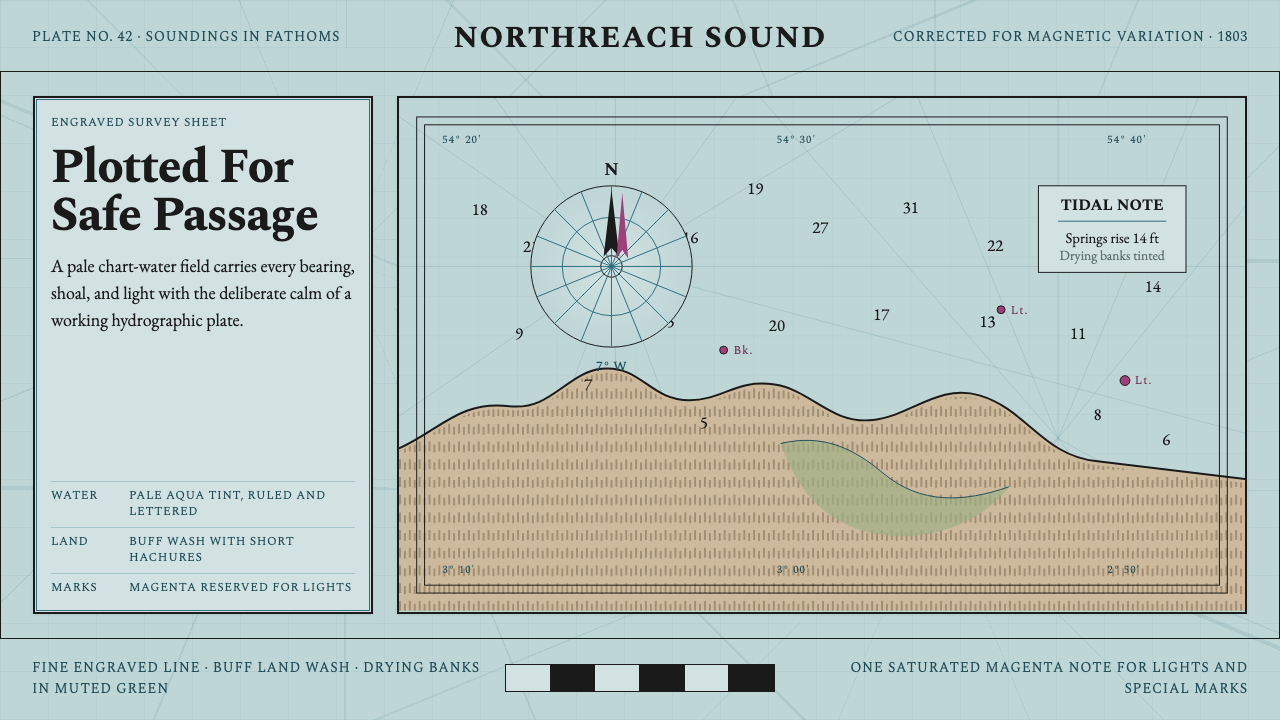 Admiralty Sea ChartSurvey authority, engraved. Aqua chart water, black soundings, buff land, one…
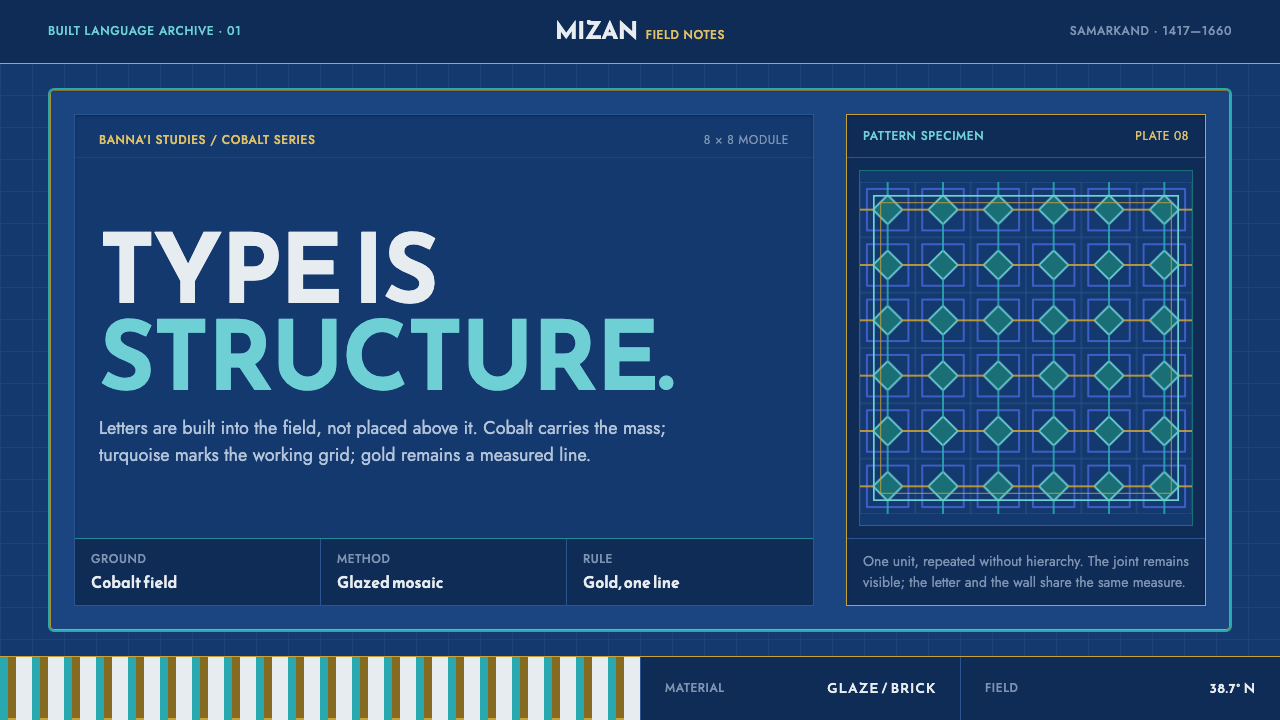 Registan TileworkType becomes structure. Turquoise geometry locks into cobalt, edged with spar…
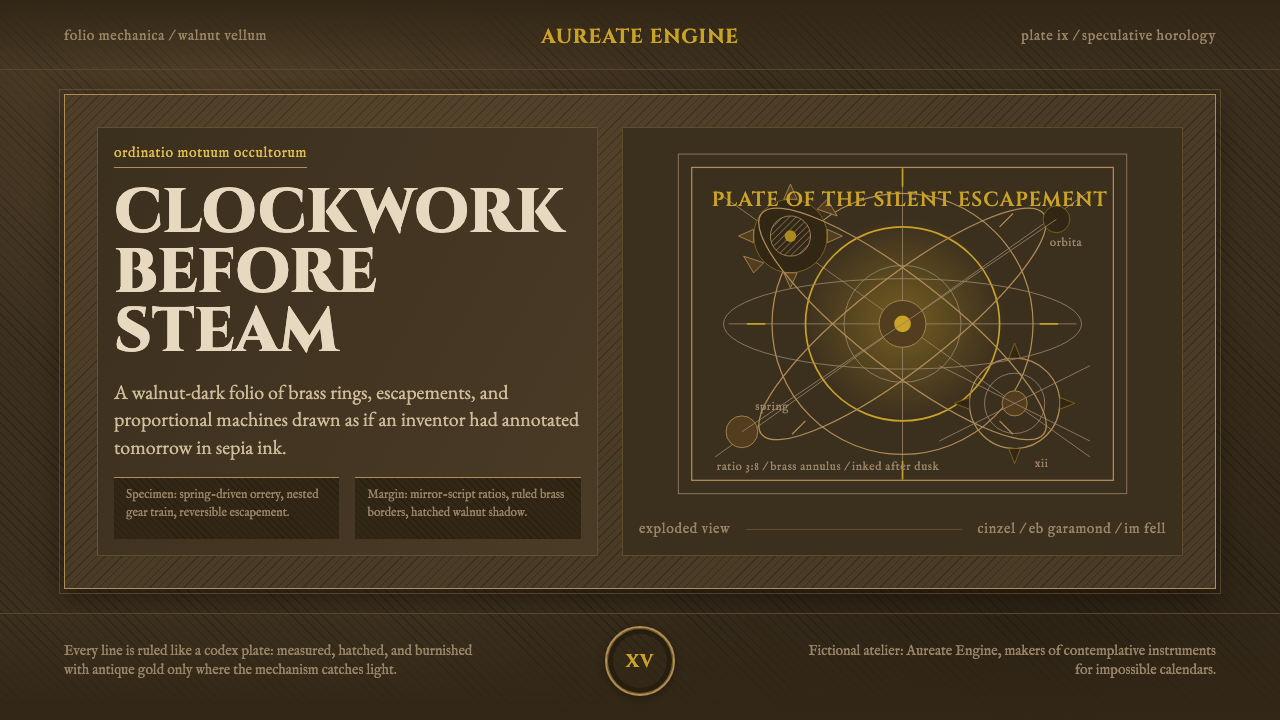 ClockpunkInventive antiquity. Walnut vellum, Cinzel capitals, brass orrery rings, and…
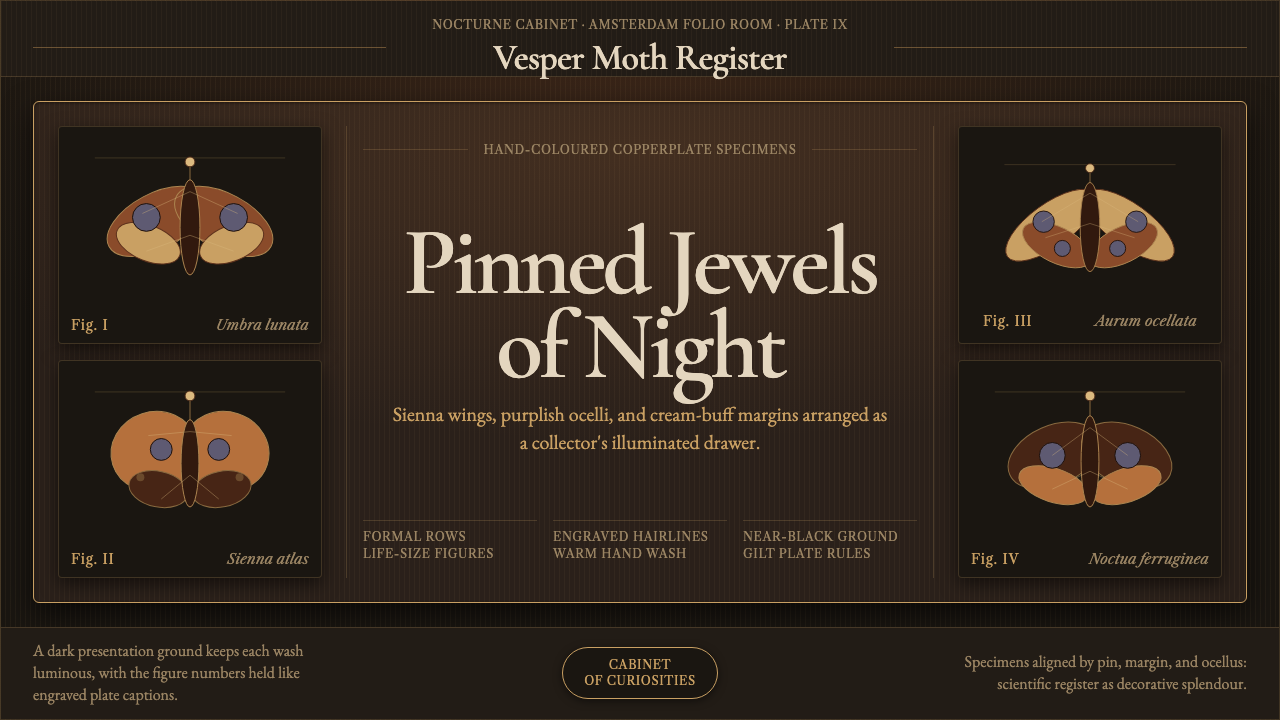 Cramer Exotic MothsJewel-like precision. Sienna specimens glow in formal rows on a near-black pl…
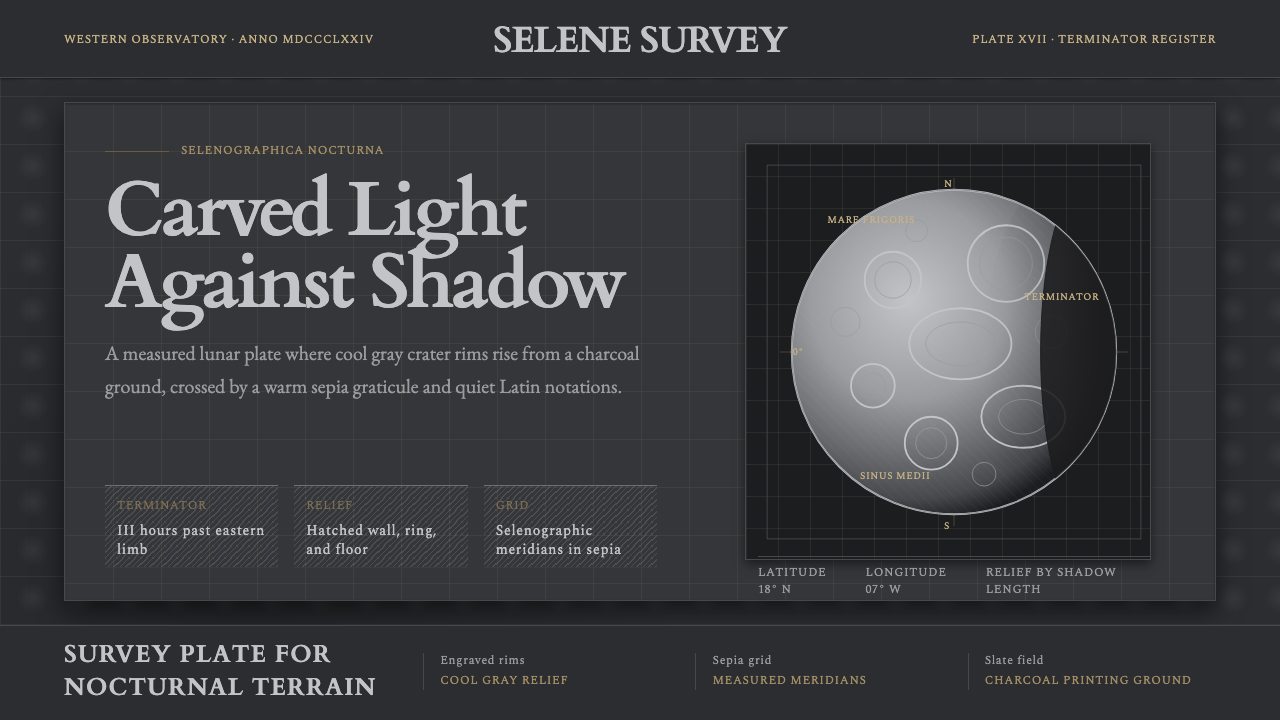 Lunar SelenographyMoonlight becomes measurement. Slate ground, sepia grid, and hatched gray cra…
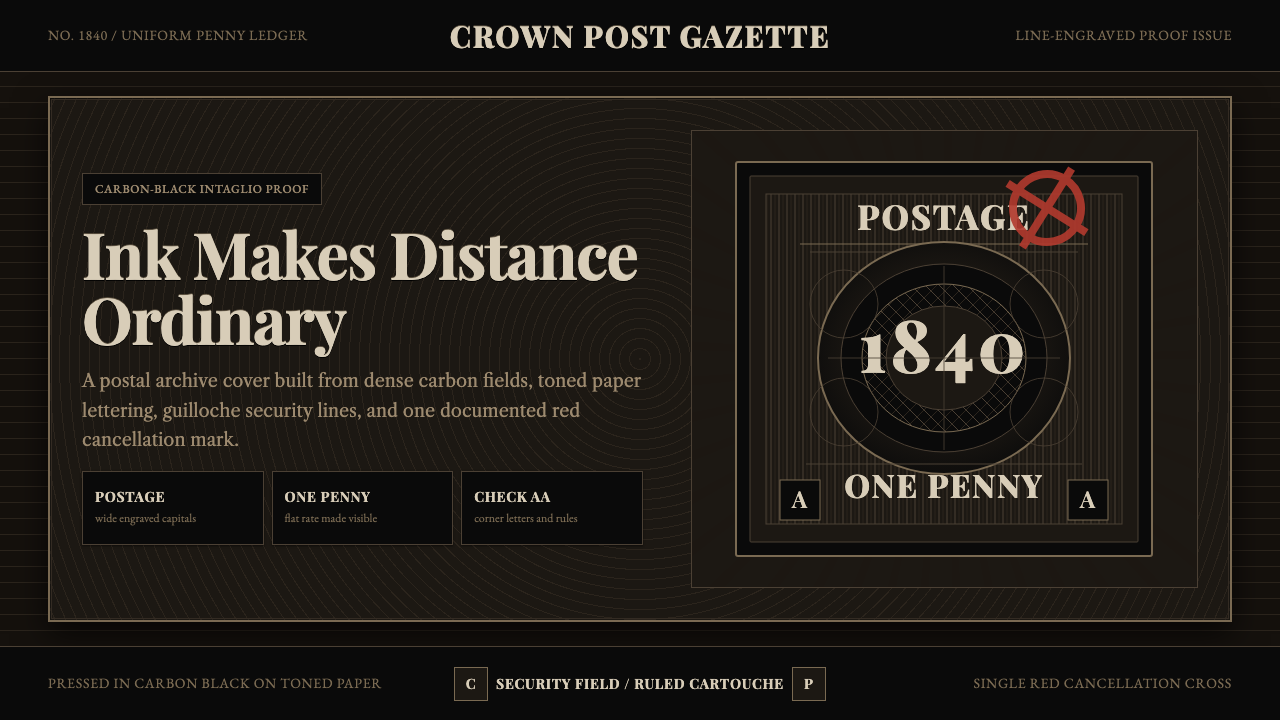 Penny Black StampBlack carries authority. Guilloche lines, Victorian serifs, and one red cross…