What is Patagonia?
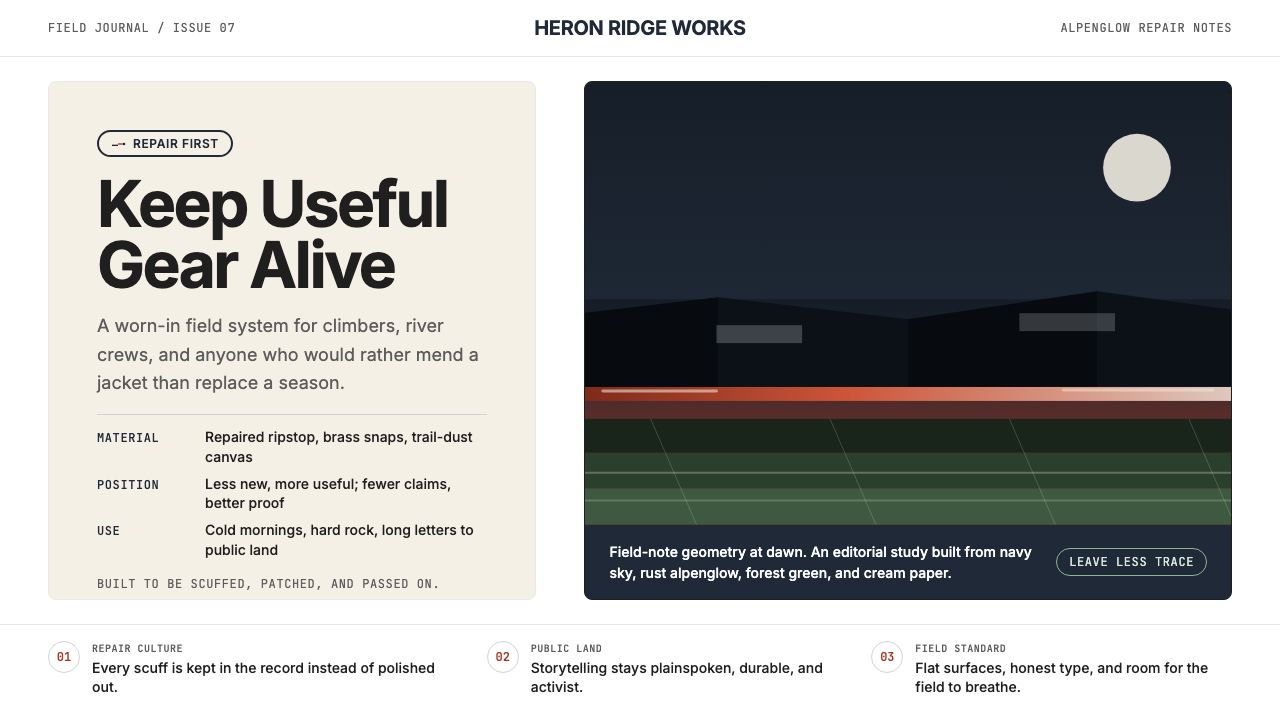
Patagonia's visual language is granite and glacier light translated into print — deep navy skies, rust alpenglow, and cream editorial paper worn honest by decades of activist purpose.
Patagonia in brief
Patagonia is an American outdoor clothing and gear company founded in 1973 in Ventura, California, whose visual identity became one of the most coherent and purposeful design systems in contemporary retail. Its palette — deep navy, rust-orange alpenglow, and worn cream — feels less designed than discovered: these are the colors of dusk at a granite face, of a weathered expedition journal, of the ocean at low tide. Nothing in the system reads as fashionable, because the system was never built for fashion cycles. It was built to last.
The visual language operates on a principle of earned authenticity. Full-bleed adventure photography carries the primary communicative weight, placing the viewer inside landscapes of scale and consequence. Typography is set with the confidence of a field journal — clear, unhurried, readable at altitude. Generous whitespace does not signal luxury; it signals respect for the landscape being depicted. The system prizes durability and honesty over novelty, in the same way the gear it accompanies does.
What makes Patagonia's aesthetic distinctive among outdoor brands is its inseparability from mission. The company has described itself as a business that happens to sell jackets, and the visual identity enforces that inversion. Editorial photography documents climbers, surfers, and activists with equal weight. Copy reads like journalism rather than advertising. The result is a design system that communicates environmental conviction as fluently as it communicates technical performance — a rare alignment of brand values and visual decisions.

Where does Patagonia come from?
The Patagonia visual identity cannot be understood separately from the biography of its founder, Yvon Chouinard. A self-taught blacksmith and climber, Chouinard began forging reusable steel pitons in his parents' Burbank backyard in the late 1950s and selling them from the back of his car at Yosemite. By 1970 his company, Chouinard Equipment, was the largest supplier of climbing hardware in the United States. The same period saw Chouinard and fellow climber Doug Tompkins begin importing colorful rugby shirts from Scotland for use as climbing layering pieces — an experiment that would become Patagonia, incorporated as a separate clothing company in 1973 and named after the remote Argentine-Chilean wilderness that both men had crossed by van in 1968.
The visual sensibility of those early years was shaped by the culture of Yosemite's Camp 4, the informal community of dirtbag climbers who were rewriting the rules of big-wall ascent through the 1960s and 1970s. Camp 4 aesthetics were anti-establishment, anti-consumerist, and rooted in the physical reality of rock and weather. Patagonia's early catalogs absorbed this ethos directly: photography by and for climbers, copy that assumed the reader already knew what a belay device was, layouts that prioritized information over seduction. The rust, navy, and cream of the emerging palette were not strategic choices — they were the colors already present in the images.
The environmental dimension of the brand's identity crystallized in the late 1980s and early 1990s. In 1988, Patagonia opened a store in Boston and sent in a ventilation crew; workers became ill from the fumes emanating from the conventionally produced cotton products in the building. An internal audit of the company's supply chain followed, culminating in a 1994 decision to convert the entire sportswear line to organic cotton by 1996 — a move that nearly bankrupted the company and became the founding act of its environmental reputation. The visual identity shifted in parallel: the environmental campaigns, the documentary films produced under Patagonia Films, and the editorial journalism in the company's catalogs began to occupy the same visual register as the product photography, reinforcing the message that buying a jacket was an act with ecological consequences.
By the 2000s, the Patagonia visual system had stabilized into the form recognized today: full-bleed photography by climbers, surfers, and environmental photographers; Inter-weight type set with editorial confidence; a palette that reads as found rather than invented; and a consistent voice that moves between gear specification and environmental manifesto without tonal disruption. The 2022 announcement by Chouinard that he was transferring ownership of the company to a purpose trust dedicated to fighting climate change — with the statement 'Earth is now our only shareholder' — was not a departure from the brand's visual or verbal identity. It was the logical conclusion of a design system that had always treated the landscape as the client.
What defines the Patagonia look?
Color Palette
The palette centers on three anchor tones: a deep navy that reads as a night sky above treeline, a rust-orange that evokes alpenglow on granite at dusk, and a warm cream derived from unbleached paper and cotton. These are supplemented by earthy ochres, slate greys, and the deep teal of cold water — tones found in the environments the brand documents. The palette is never bright or synthetic; saturation is kept deliberately subdued, as if the colors have been weathered by exposure. Black and near-black appear for typographic weight. No color in the system signals luxury or fashion; every tone signals place.
Photography as Primary Language
Adventure photography is not decorative in the Patagonia system — it is load-bearing. Images typically run full-bleed, consuming the entire available field and refusing to be contained by borders or cards. Subjects are depicted in conditions of genuine difficulty: wet rock, breaking surf, alpine weather. The photographer's perspective is participant rather than observer — the images look as though they were taken by someone who also climbed the route. Color grading leans toward the cool and honest rather than warm or cinematic. Post-processing is restrained; nothing looks retouched into fantasy.
Typography and Editorial Voice
Type in the Patagonia system carries the register of considered journalism rather than retail copy. Headlines are set with confident weight but without the aggressive scale contrast of advertising; they read as statements, not shouts. Body text is given genuine space — line lengths and vertical rhythm are calibrated for sustained reading, not scanning. The system does not rely on decorative dividers, pull-quote styling, or typographic flourishes to create visual interest; hierarchy comes from measured scale and weight relationships. The typographic voice is unhurried, specific, and assumes an intelligent reader.
Whitespace and Landscape Breathing Room
Generous whitespace in Patagonia layouts does not signal minimalism in the contemporary lifestyle sense — it signals editorial discipline and respect for the images. Margins are wide enough that landscape photographs are not crowded by text or interface elements. Section transitions use space rather than dividers. The system allows content to sit in silence before and after it, the same way a documentary film allows a shot to breathe before cutting. This breathing room is one of the qualities that distinguishes Patagonia's aesthetic from more commercially aggressive outdoor brands that fill every available pixel.
Material Honesty and Anti-Artifice
The Patagonia visual system resists the artificial on principle. There are no product shots taken in studios with seamless white backgrounds and cinematic lighting setups designed to make a jacket look like a luxury object. Products appear in use, in weather, on real bodies doing real activities. The same anti-artifice principle governs color: no neon accents, no gradient washes, no color-grading tricks designed to make images look more spectacular than the actual landscapes. The system trusts the raw material — both the gear and the environments it was made for — and declines to oversell either.
Mission-Integrated Layout
Perhaps the most distinctive structural feature of the Patagonia system is the integration of environmental content into commercial space without visual hierarchy separating them. A catalog page might show a jacket spec sheet followed immediately by a page-width essay on the ecology of a threatened river system, set in the same type at the same scale, with equivalent photographic treatment. This layout decision communicates that the company regards its environmental advocacy as equivalent in importance to its product offering — not a footnote, not a brand values sidebar, but content with identical standing. The design enforces the mission.
Restrained Graphic Devices
The Patagonia system uses graphic devices sparingly and functionally: the mountain-silhouette wordmark, which appears without modification across all contexts; simple line-weight rules as occasional structure; maps and topographic details used journalistically rather than decoratively. There are no mascots, no custom illustration styles that compete with the photography, no iconographic systems that require a style guide to decode. The restraint is not the restraint of minimalism — it is the restraint of a design system that trusts its primary content, the images and the words, to carry the entire communicative load.

Who shaped Patagonia?
Chouinard founded Patagonia in 1973 after more than a decade of climbing in Yosemite, where he developed a philosophy of low-impact ascent that translated directly into product and brand values. His background as a craftsman — forging his own gear rather than accepting what the market offered — shaped Patagonia's design ethos of making things that last rather than things that sell. His 2022 decision to transfer ownership of the company to a climate-focused purpose trust, foregoing billions in personal wealth, remains the most dramatic act of brand value alignment in corporate history, and it was legible as a logical extension of the visual and verbal identity he had built over fifty years.
The Patagonia brand team has operated for decades on a principle unusual in corporate design: that the people who design the catalogs, campaigns, and editorial features should be, or work closely with, the athletes and activists who appear in them. This proximity between maker and subject is visible in the work. Catalog photography and editorial layouts read as if produced by a community that actually uses the gear in the conditions depicted, because they largely are. The brand team's long-tenured contributors have produced a body of work with unusual visual consistency across fifty years — not the consistency of a rigid style guide, but the consistency of a shared set of values applied to changing circumstances.
Established as an internal production unit, Patagonia Films has produced documentary content — including works such as 'DamNation,' examining dam removal in the American West, and 'Artifishal,' on wild salmon and fish hatcheries — that extends the brand's visual language into long-form narrative film. These films are made to the same production and color standards as the brand's print and digital editorial work, with the same restraint in post-processing and the same preference for found light over constructed lighting setups. The films demonstrate that the Patagonia visual system is scalable across media without losing its defining qualities, and they have won awards in environmental documentary contexts entirely outside the brand's commercial sphere.
Tompkins co-founded The North Face before partnering with Chouinard in the early adventures that seeded Patagonia's origin story. His later work as a conservation philanthropist — purchasing and protecting millions of acres of Chilean and Argentine wilderness, ultimately contributing to the creation of several national parks — embodied the values the Patagonia brand would spend decades articulating. Tompkins and Chouinard shared a formative visual sensibility rooted in the actual landscapes of Patagonia, and the brand's consistent treatment of those landscapes as subjects deserving documentary respect rather than scenic backdrop reflects that shared foundation.
Malinda Chouinard co-founded Patagonia alongside Yvon and shaped the company's early editorial and catalog voice as much as its visual identity. Her influence is present in the brand's treatment of community — the catalogs' insistence on depicting real athletes, real working environments, and real social contexts rather than idealized lifestyle imagery. She also championed the company's early work on environmental and social responsibility in supply chains, which became the subject matter that gave the editorial content its moral weight. The editorial seriousness of the Patagonia catalog — its willingness to run long essays and investigative journalism alongside product pages — reflects her formative contribution to the brand's character.
How do you use Patagonia today?
Patagonia's visual system is among the most purposeful in contemporary design, and applying it to new contexts requires understanding why each element exists before attempting to replicate its appearance. The palette was not chosen for trend; it was derived from the environments the brand documents. The photography conventions were not developed for aesthetic reasons alone; they reflect a commitment to depicting subjects honestly. Before adapting the style, the designer should ask whether the content being presented shares the same commitment to authenticity that the original system was built to communicate.
For presentation slides, the Patagonia approach works exceptionally well on cover pages where full-bleed landscape photography can occupy the entire slide. Choose images with strong environmental character — the kind that feel documentary rather than stock. The title should sit in clear, weight-confident type against a portion of the image where the background tones are dark enough to ensure legibility, or against a cream or near-white field positioned at the edge or base of the slide. Content slides should use a generous single-column or two-column layout with wide margins, treating each slide as an editorial page rather than a bullet-point container. Data slides translate naturally into the system when charts are built with the palette's earth tones — rust for primary data series, navy for secondary, cream or light grey for backgrounds — and when axis labels and annotations are set with the same typographic restraint as body text.
For web interfaces, the Patagonia visual language is well-suited to dashboards and editorial platforms where the primary content is photographic or data-rich. The approach: use deep navy or near-black for primary UI surfaces where the interface frames the content; bring in the cream and rust tones for informational elements, active states, and calls to action; keep backgrounds light and uncluttered for content-heavy reading views. Navigation should be typographic and restrained — clear labels at moderate scale with no icon decoration that competes with the primary imagery. For marketing or landing pages, full-width image blocks alternating with cream-background text sections create the same editorial rhythm found in Patagonia's own digital properties. Pricing or feature comparison pages benefit from the palette's inherent sense of authority: navy headers, cream table backgrounds, and rust used for the recommended tier only.
For editorial and marketing work, the system rewards the same discipline that governs its source material. Set body text at a comfortable measure — not too wide — with vertical spacing that encourages reading rather than scanning. Use the photography to carry the primary communicative weight; text should contextualize and deepen what the image establishes, not compete with it. Section breaks should be handled with space and a simple rule rather than decorative elements. When the content is environmental, activist, or mission-oriented, the system's visual conventions are its most natural application: the combination of documentary photography, journalistic type, and honest color creates a register of conviction that few other visual systems can match. Marketing materials that adopt this approach communicate credibility rather than aspiration.
The most common mistake when applying Patagonia's visual language is treating its palette as warm and accessible and then deploying it with the production values of lifestyle marketing — soft shadows, warm studio lighting, models posed in attractive outdoor settings rather than athletes in actual conditions. This produces a visual language that looks superficially similar but reads as inauthentic, because the original system's authority comes not from the colors themselves but from the relationship between those colors and genuinely documented reality. A second common mistake is over-saturating the rust-orange accent — in the original system, it appears at natural, weathered intensities that feel found rather than chosen. Used at high saturation or applied to interface elements across the board, it loses its documentary character and becomes merely decorative. The palette should always look as though it was discovered in the landscape, not selected from a swatch.

Patagonia — FAQ
Can Patagonia's visual system work for brands that are not outdoor or environmental companies?
Yes, but with important caveats. The visual system's qualities — documentary photography, generous whitespace, honest color, editorial typography — translate to any context where credibility, transparency, and long-term thinking are desired values. It works well for B-Corp companies, mission-driven nonprofits, food and agriculture brands committed to provenance transparency, and publications covering environment, science, or social issues. It does not work well for companies whose values are in tension with the system's underlying commitments — a fast-fashion brand or a fossil fuel company adopting this visual language would produce something that reads as greenwashing precisely because the aesthetic carries specific moral weight. The style is inseparable from its source values in a way that purely aesthetic systems are not.
How does the Patagonia style handle dark-mode or dark-background layouts?
The Patagonia system is fundamentally a light-ground system — cream and near-white backgrounds dominate in editorial and catalog contexts. However, a dark variant exists naturally in its own vocabulary: the deep navy serves as a strong dark ground for layouts where a night-sky or underwater quality is appropriate. On a navy ground, cream type and rust accents maintain the palette's integrity. What does not work is using a generic dark grey or black background with the palette's accent colors — this loses the environmental specificity that gives the palette its character. The dark variant works when it reads as a specific place — a night sky, a deep ocean — not as a generic dark interface.
What distinguishes authentic Patagonia-style design from imitation outdoor aesthetics?
The primary distinguishing factor is the quality and intention of the photography. Authentic Patagonia-style work uses images where the environment is the subject, not the backdrop — images in which weather, scale, and physical difficulty are present and legible. Imitation outdoor aesthetics typically use lifestyle photography where an attractive person is posed in front of a beautiful landscape; the landscape is decorative, not documentary. A second distinguishing factor is restraint in graphic design: the original system trusts the images and typography to carry all the communicative weight and does not add graphic devices, overlays, or stylized treatments to supplement them. Imitations frequently add badge graphics, vintage texture overlays, or custom illustration that signal 'outdoor brand' rather than emerging from actual outdoor experience.
How should data visualization be handled in the Patagonia visual system?
Data visualization in this system should follow the same editorial discipline as the typography and photography: every element earns its presence by serving the data, not by decorating the chart. Use the palette's anchor tones for primary data series — rust-orange for the most important series, navy for secondary, with earth-tone greys for tertiary or background data. Chart backgrounds should be cream or near-white, not grey. Gridlines should be extremely light — present enough to anchor the eye, absent enough not to compete with the data. Avoid three-dimensional chart treatments, gradient fills, and shadow effects entirely. The goal is a chart that reads with the same documentary honesty as the photography: this is what the data says, without visual argument or ornament.
Does the Patagonia visual system suit product-focused commercial contexts, or only mission-driven content?
The original system integrates both without visual distinction — product specification sits alongside environmental essay at the same typographic weight, and this integration is the system's defining contribution. Applied to purely commercial contexts, the system works well for products and services where quality, durability, and material honesty are genuine selling propositions. It performs less well as a wrapper for products or services whose actual qualities contradict its visual vocabulary — the aesthetic carries an implicit promise of honesty, and contexts that cannot make good on that promise will produce cognitive dissonance in audiences familiar with the original. The system asks more of its adopters than most visual styles: it requires that the content it contains actually merit the level of conviction it communicates.
Related design styles
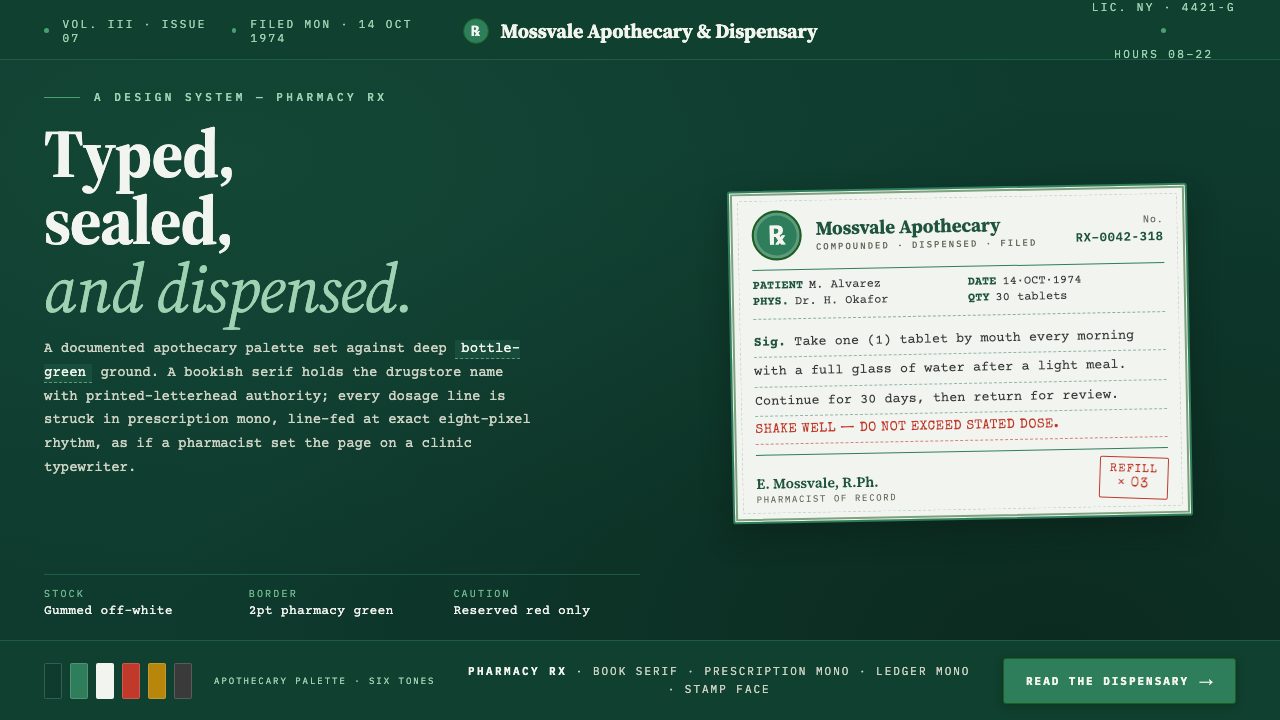 Pharmacy RxThe drugstore label, documented. Pharmacy-green border, Rx seal, typewriter d…
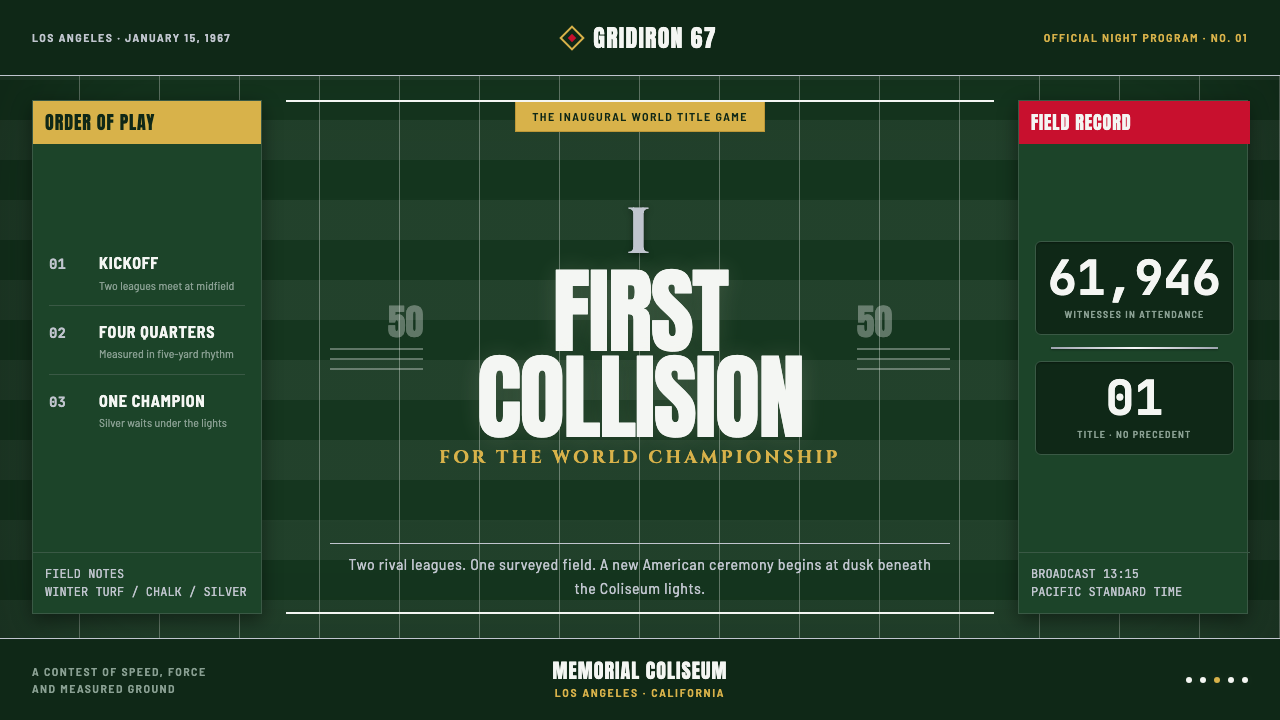 Super Bowl (1967)Athletic spectacle becomes ceremony. Chalk grids, silver rules and Roman type…
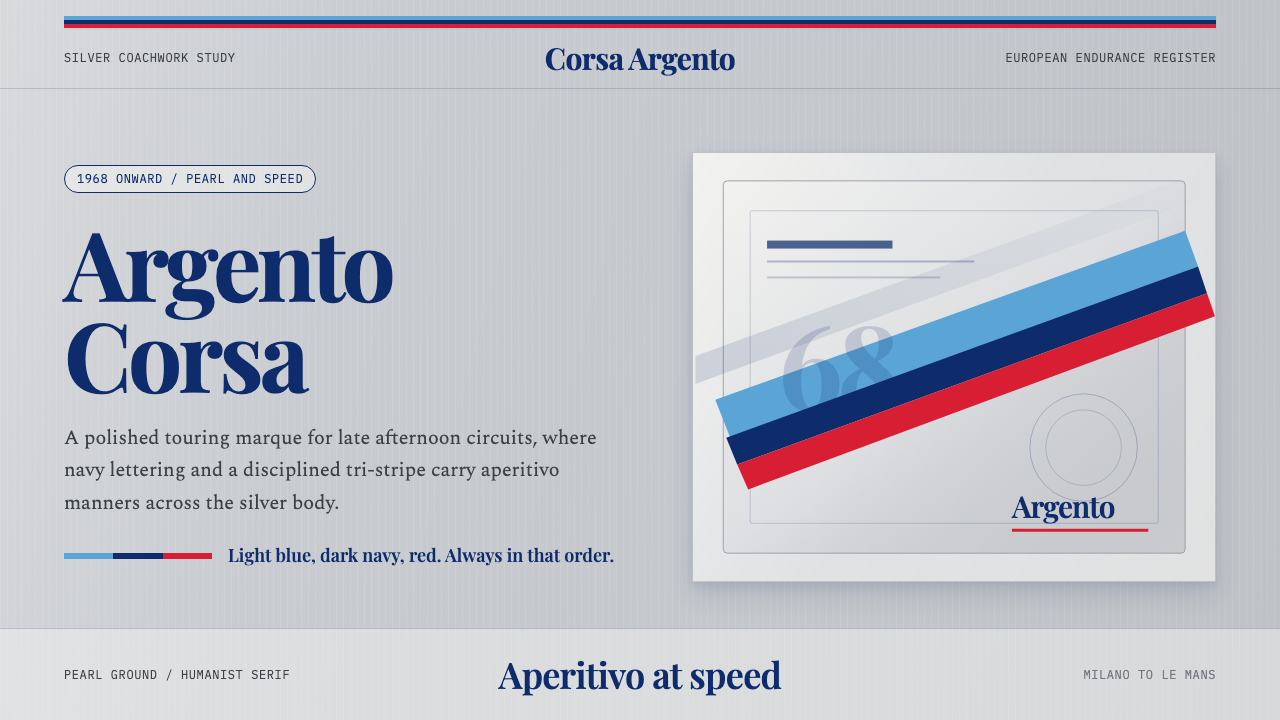 Martini Racing StripesAperitivo elegance at speed. Silver ground, Playfair serif, and a blue-navy-r…
 Par Avion Air MailPostal lightness made strict. Onionskin blue, Oswald caps, and red-blue edge…
 Bill of LadingRecords become an artefact. Blue rules, typewriter black, violet and oxblood…
 Broadsheet LetterpressAuthority in ink. Lampblack serif decks lock into tan paper with strict ruled…