What is Otto Neurath ISOTYPE?
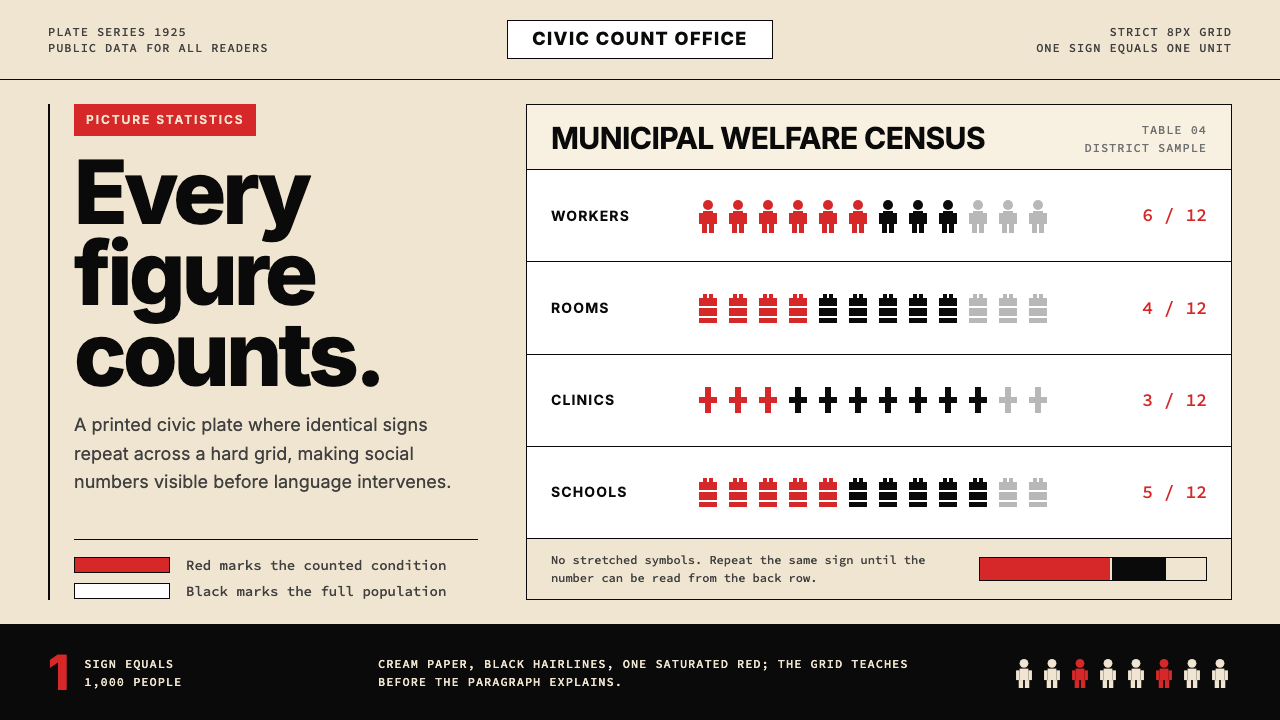
ISOTYPE transformed census tables into countable pictures — cream paper, deep-black icons, and a single red that anyone could read across a room.
Otto Neurath ISOTYPE in brief
ISOTYPE — the International System Of TYpographic Picture Education — is a visual language developed from 1925 onward in Vienna to communicate social and economic statistics to audiences who could not read official government documents. Its defining method is the isotype chart: instead of drawing a bar proportional to a number, the system repeats a small standardized pictogram — one figure equaling one thousand people, one factory equaling ten thousand workers — so that quantity becomes literally countable rather than abstractly scaled.
The visual system is deliberately spare. A warm cream or off-white field forms the ground. Pictograms are rendered in deep flat black, each one reduced to its most legible silhouette — a standing worker, a ship, a house — without perspective, shading, or internal detail. A single saturated red appears as the measuring accent: the one color that marks the unit of measure or highlights comparative difference. No other hue is required. The restraint is not poverty of means but economy of meaning: every visual element is there to carry information, and nothing is there to decorate.
ISOTYPE sits at the intersection of two modernist currents — the Bauhaus commitment to geometric clarity and the Vienna Circle's ambition to make knowledge universally legible. The result is a graphic language that is simultaneously statistical and humanist: the repeated small figure is an abstraction, but it is also, unmistakably, a person. Data becomes population; numbers become people.

Where does Otto Neurath ISOTYPE come from?
Otto Neurath was not primarily a graphic designer. He was a social scientist and philosopher, a member of the Vienna Circle of logical positivists who believed that knowledge should be communicable across barriers of language, class, and education. After the First World War, Neurath directed the Museum of Society and Economy in Vienna (Gesellschafts- und Wirtschaftsmuseum), an institution explicitly founded to educate the working class about economic conditions through visual means. The museum's audience could not be assumed to read complex statistical tables or German prose; Neurath needed a visual grammar that required no reading at all.
The key collaborator who made the system graphically viable was Marie Reidemeister, later Marie Reidemeister Neurath, who served as Neurath's 'transformer' — the person who translated raw statistical data into visual sequences according to the system's rules. Reidemeister understood both the statistical logic and the graphic constraints, and her role was central to everything the Vienna Method (as ISOTYPE was originally called) produced. She and Neurath married in 1941 and she continued developing the system long after his death in 1945, writing the definitive account of the transformer's role.
Gerd Arntz, a German graphic artist associated with the Cologne progressive art movement, joined the team in 1928 and became the primary designer of the pictogram library. Arntz brought a woodcut aesthetic — flat, hard-edged, high-contrast — to the icon design. He eventually produced over four thousand standardized pictograms covering occupations, industries, social classes, and demographic categories. These symbols were cut as linoleum blocks and reproduced by hand, giving every chart a quality somewhere between statistical diagram and printed woodcut. The Arntz library is the direct ancestor of every modern icon system.
The political context was inseparable from the aesthetic one. Vienna in the 1920s was Red Vienna — a Social Democratic city government was attempting one of the most ambitious public housing and social welfare programs in European history. The museum and its visual language were instruments of civic education in a literal sense: the charts appeared on the walls of municipal housing projects, in labor union publications, and in public exhibitions designed to show workers the conditions of their own lives in comparative, historical perspective. When Austro-fascism suppressed the Social Democrats in 1934, Neurath fled first to the Hague, where he continued the work with Reidemeister, then to Oxford during the Second World War. The name ISOTYPE was coined during the Hague years as a way to frame the system as an international standard rather than a Viennese political instrument.
What defines the Otto Neurath ISOTYPE look?
Pictogram as Unit of Measure
The isotype chart does not scale a single shape — it repeats identical small pictograms in a row, so that quantity is expressed through count rather than size. One figure equals a fixed real-world quantity declared in the key. This makes comparison literal and requires no understanding of axes or proportional scaling. The repeated unit is always the same size, always the same orientation, always the same weight — variation in number is the only variable.
Silhouette Reduction
Every pictogram in the ISOTYPE system is a flat black silhouette, recognizable from its outline alone. Internal details, facial features, clothing folds, and perspective are stripped away. A worker is a standing human shape; a factory is a rectangular block with a smokestack. The discipline of silhouette reduction ensures that symbols remain legible when printed small, when reproduced across media, and when viewed from a distance on an exhibition wall.
Restricted Palette
The palette is structurally fixed: a warm cream or off-white ground, deep flat black for all pictograms and type, and a single saturated red reserved for the unit marker or comparative emphasis. No gradients, no tints, no additional hues. The red is not decorative — it marks the quantity being measured or the difference being highlighted. When a second color appears, it typically signals a contrasting category, not aesthetic variety.
Strict Horizontal Grid
ISOTYPE charts are organized on a strong horizontal axis. Rows of pictograms read left to right, categories stack vertically, and labels align to a consistent left edge. The grid is implicit but absolute — no pictogram drifts, no row is misaligned, no element is placed for compositional flair. This regularity is functional: the eye can compare rows at a glance precisely because spatial position is completely predictable.
Typography as Label Only
Text in ISOTYPE charts is minimal and subordinate. Labels identify categories; the key declares what one pictogram represents; a source line may appear at the base. Beyond these functional roles, type does not appear. There is no explanatory prose within the chart, no decorative headline, no pull-quote. The visual carries the argument entirely, and text exists only to anchor the reference points that the image cannot itself supply.
Standardized Symbol Library
ISOTYPE's visual power depended on a shared, reusable set of symbols. Gerd Arntz's pictogram library was not a collection of illustrations — it was a designed vocabulary, each symbol developed to be combinable, stackable, and interchangeable across different charts and subjects. The same human figure could represent a worker, a citizen, or a soldier depending on context. Consistency across symbols is as important as the design of any individual symbol.
No Decorative Ornament
Borders, frames, decorative rules, drop shadows, gradients, and background textures are entirely absent from ISOTYPE charts. Every element present is a carrier of information; every absent element is a deliberate omission. This is not minimal style — it is a principled decision about the purpose of visual communication. Ornament, by definition, adds without informing, and adding without informing is a violation of what ISOTYPE was built to do.

Who shaped Otto Neurath ISOTYPE?
Neurath was the originating mind behind ISOTYPE — a social scientist and philosopher who directed the Museum of Society and Economy in Vienna from 1925 and conceived the visual language as a tool for civic education. His driving conviction was that statistical knowledge belonged to everyone, not just to those with formal education or German literacy. After fleeing Vienna in 1934 and the Hague in 1940, he continued developing the system in Oxford until his death in 1945. His broader philosophical project — unified science, visual education, internationalism — gave ISOTYPE its moral urgency as well as its formal constraints.
Reidemeister was the transformer: the person who translated raw data into ISOTYPE charts according to the system's rules. In Neurath's methodology, the transformer role was a distinct intellectual function — not mere execution but interpretive judgment about which facts to show, in which sequence, and at which scale of comparison. After Neurath's death she wrote the definitive account of the transformer's role and continued applying and teaching the method through the 1970s. Her contribution was long underappreciated because it did not produce signed artworks; the charts were collective, not individual, products.
Arntz was the graphic artist who designed the ISOTYPE pictogram library, eventually producing over four thousand standardized symbols. He came from the German progressive art movement and brought a woodcut sensibility — flat, high-contrast, hard-edged — to the systematic design of icons. His symbols were not illustrations but designed units: each had to be immediately recognizable, consistent in visual weight with every other symbol, and reproducible across scales and media. The Arntz library is the most direct historical ancestor of contemporary icon systems, from wayfinding pictograms to software interface icons.
Modley brought ISOTYPE thinking to the United States after working with Neurath in Vienna. In the 1930s he founded Pictograph Corporation in New York, which adapted the Vienna Method for American magazine publishing, corporate reports, and government information campaigns. His work introduced pictographic statistical charts to the American mainstream and influenced the visual language of mid-century American information design, from Time magazine to government wartime posters. Modley represents the channel through which ISOTYPE's formal language entered Anglophone commercial design.
The Isotype Institute was the organization through which Neurath and Reidemeister systematized and disseminated the method after leaving Vienna — first from the Hague, then from Oxford. The Institute produced hundreds of charts for books, exhibitions, and public health campaigns across Europe and the United States. Its output demonstrated that the system could be applied by teams working from a shared rule set, not only by its inventors. The Institute's archive, now held at the University of Reading, is the primary scholarly source for the history of ISOTYPE and its visual standards.
How do you use Otto Neurath ISOTYPE today?
ISOTYPE is directly applicable to any contemporary design context that needs to communicate quantitative comparisons to a broad, diverse audience. The principles translate naturally to modern infographics, data dashboards, annual reports, and public-facing statistical visualizations. The essential discipline is the same as it was in 1925: choose a single pictogram to represent a defined unit, repeat it a countable number of times, keep the palette to near-white ground with dark pictograms and a single accent color, and let the quantity speak for itself without editorial framing.
For presentation slides, ISOTYPE logic works exceptionally well on both data and comparison slides. A cover slide can use a single oversized pictogram repeated in a grid as a background texture — the repetition communicates scale before the title is read. Data slides should commit to the row-and-repeat method: one category per row, identical icons in sequence, a clear key declaring the unit. Avoid mixing scaled bars and isotype rows in the same chart — the two methods encode quantity differently and their combination confuses rather than clarifies. For section dividers, a single bold pictogram centered on a cream field communicates more cleanly than a decorative abstract shape.
For web interfaces — especially dashboards, pricing pages, and data-heavy product pages — the ISOTYPE palette and icon discipline provide strong visual hierarchy with low cognitive load. The approach: use a warm off-white as the base background, black or very dark type for all text, and a single accent color for interactive elements, status indicators, or tier labels. Icon sets should follow the silhouette discipline — no gradient fills, no drop shadows, no fine interior line work — so they remain legible at small sizes and high information density. Pricing tier comparison tables rendered with isotype-style row icons communicate plan differences more intuitively than feature checkmarks alone.
For editorial and marketing design — magazine spreads, annual report pages, social media data cards, and public health communications — ISOTYPE's authority comes from its combination of simplicity and specificity. A data card showing employment figures becomes memorable when the number is embodied as a row of human figures rather than printed as a numeral. The key design decisions are the same across contexts: define the unit, choose the pictogram, commit to the grid, limit the palette. Marketing applications should resist the temptation to vary the pictogram style for visual interest — consistency across a set of charts is more powerful than the most beautifully illustrated individual chart.
The most common mistake when applying ISOTYPE is adding color for decorative rather than informational purposes — using multiple hues to make a chart more visually appealing rather than to encode additional data categories. A second color in an ISOTYPE chart should always mean something: a different time period, a contrasting group, an anomalous value. If additional color carries no meaning, it should be removed. Similarly, replacing the flat silhouette pictograms with detailed illustrations — even stylistically coherent ones — undermines the system's legibility at scale and at small sizes. The discipline of the silhouette is not a stylistic limitation; it is what makes the system work across media, scales, and contexts.

Otto Neurath ISOTYPE — FAQ
Is ISOTYPE the same as modern icon design?
ISOTYPE is the historical origin of modern icon design, but the two are not the same practice. ISOTYPE icons were designed specifically for use in statistical charts, where their primary function is to represent a countable unit of a defined quantity — a person, a factory, a ship. They are always used in multiples, always in a grid, and always in service of a specific data comparison. Contemporary icon design generally serves navigation, labeling, or interface affordance, and icons appear as individual symbols rather than counted rows. The silhouette discipline of ISOTYPE — flat, high-contrast, outline-legible — remains the most robust approach for interface icons at small sizes, and most modern icon systems implicitly follow it.
How does ISOTYPE differ from a standard bar chart or pie chart?
A bar chart encodes quantity through the continuous length of a rectangle; a pie chart encodes it through angle and area. Both require the viewer to estimate magnitude visually — to judge that one bar is roughly twice the height of another, or that one sector is about a third of the circle. ISOTYPE encodes quantity through count: the viewer does not estimate, they enumerate. One row of twelve figures versus a row of four figures is a three-to-one ratio that requires no visual estimation at all. This is the system's core pedagogical advantage — and also its limitation, because it becomes unwieldy when quantities involve fractions or very large numbers.
Can ISOTYPE be used in dark-mode interfaces?
The canonical ISOTYPE presentation is light-ground: cream or white background with deep black pictograms. A dark inversion is possible, but it requires care. On a dark background, the pictograms need to shift from black to a light cream or near-white to maintain the same flat silhouette quality. The accent color — historically a saturated red — may read very differently on dark grounds, and a warmer or softer accent may serve better. The critical discipline is maintaining the silhouette's flat, high-contrast quality regardless of the ground color. What must not happen is the introduction of glows, gradients, or soft lighting effects that simulate depth — those imports from contemporary dark-mode aesthetics directly contradict the system's founding logic.
Why is the transformer role so important in ISOTYPE?
The transformer — a role formalized by Marie Reidemeister — is the person who decides which statistical facts to show, in which sequence, and at what unit scale. This is not mechanical work. A dataset can be visualized many different ways, and the choice of what to show, what to omit, and how to set the unit (one figure equals one hundred people versus one thousand) fundamentally shapes what the audience understands. Neurath was explicit that the transformer must be statistically literate and intellectually honest — the role carries responsibility for the argument the chart makes. In contemporary terms, the transformer is the data journalist, the information architect, or the analyst who shapes the chart before the designer executes it.
Is ISOTYPE suitable for complex multi-variable data?
ISOTYPE is optimized for communicating one or two variables to a general audience quickly and memorably. It is not well suited to multi-variable analysis, correlation display, or continuous data distributions. Scatter plots, heat maps, and network graphs serve those purposes better. The system's power is proportional to its simplicity: the more variables introduced, the more the counting logic breaks down and the more the chart begins to require the kind of trained reading that ISOTYPE was built to avoid. The right question to ask before reaching for ISOTYPE is not whether the data is interesting, but whether the main point can be expressed as a comparison of countable units — if it can, ISOTYPE will communicate it more broadly and durably than almost any other format.
Related design styles
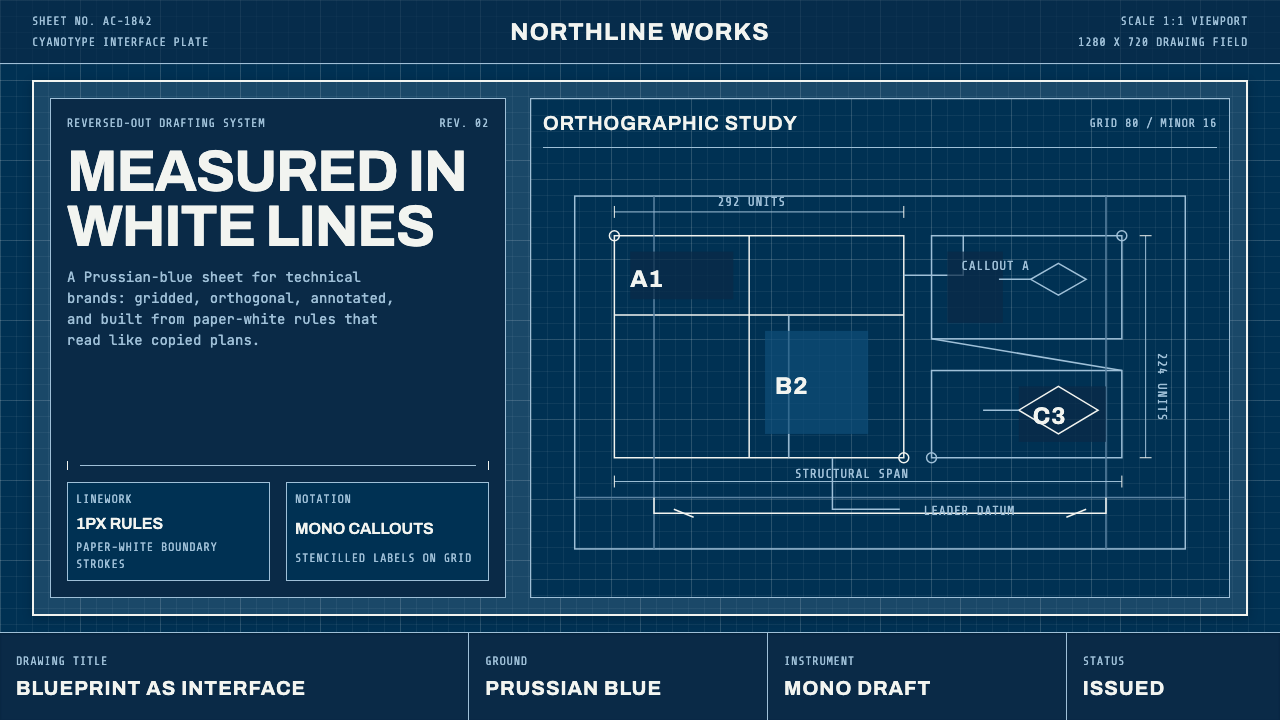 Architect CyanotypePrecision in negative. Prussian blue ground, paper-white grid, mono dimension…
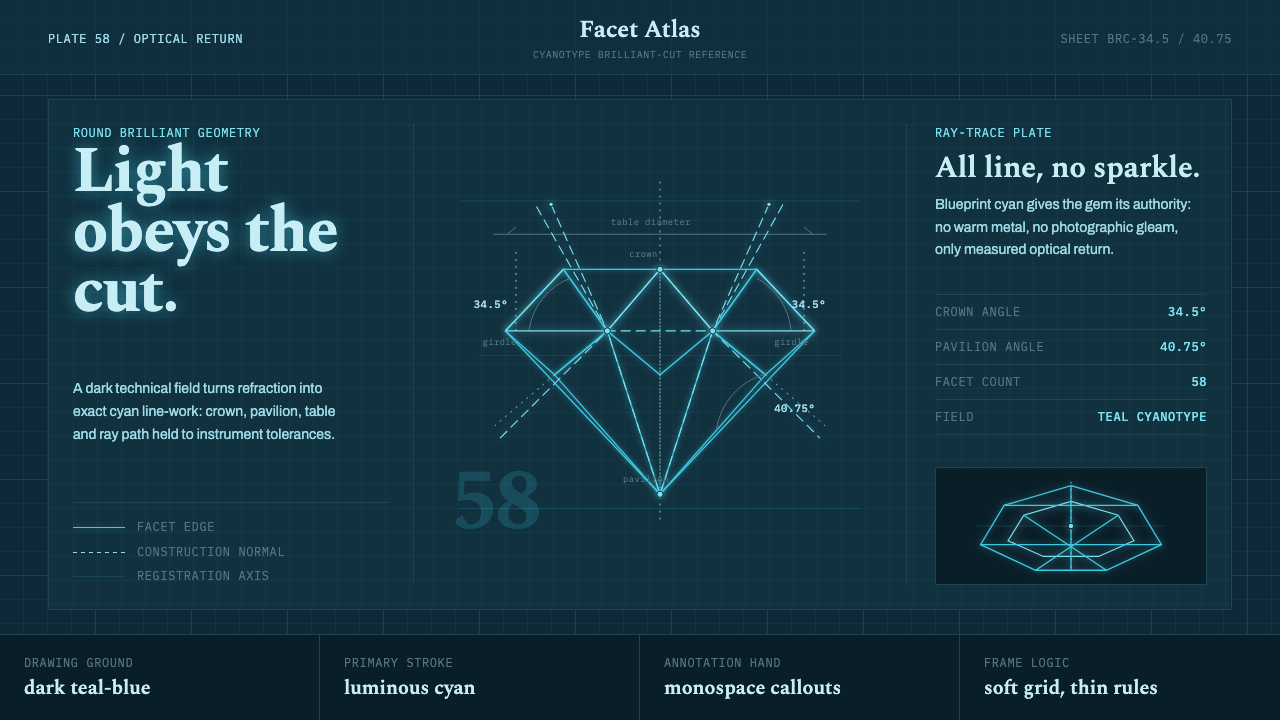 Brilliant Cut Facet DiagramOptics becomes blueprint. Cyan facet lines and ray paths glow on dark teal.
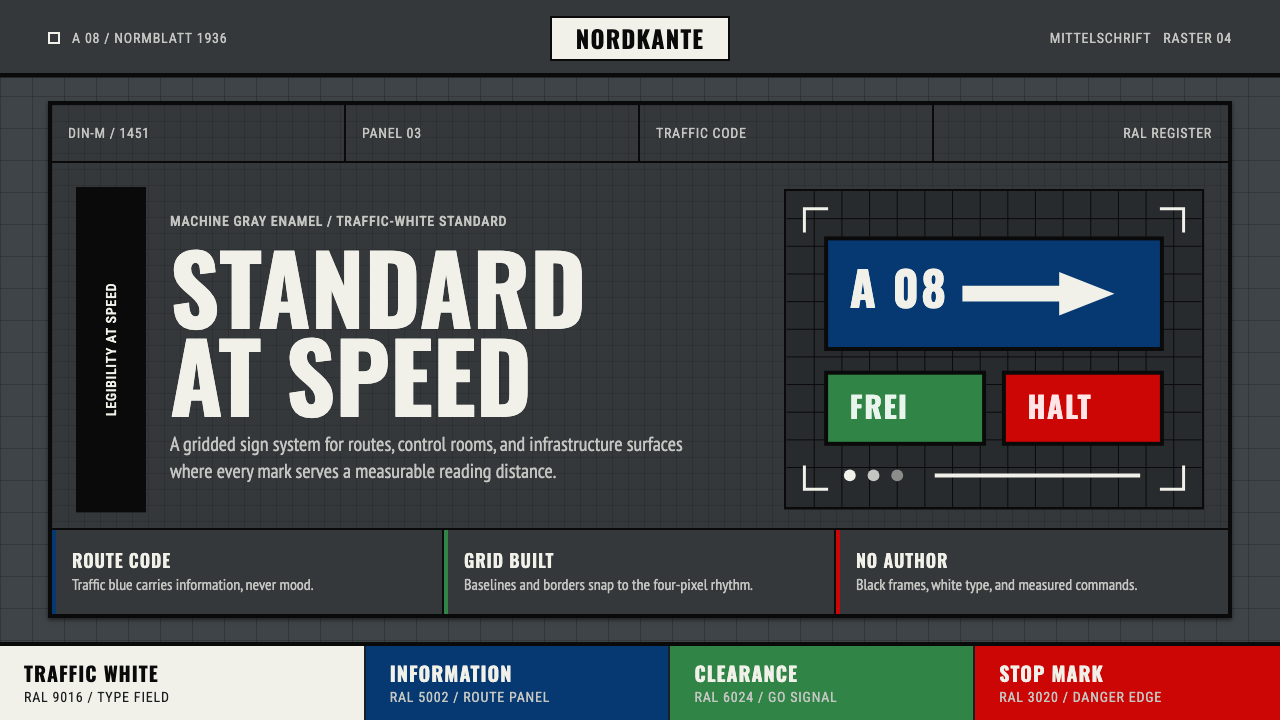 DIN 1451 SignageAuthorless and exact. Enamel gray grid, traffic-white DIN type, and RAL signa…
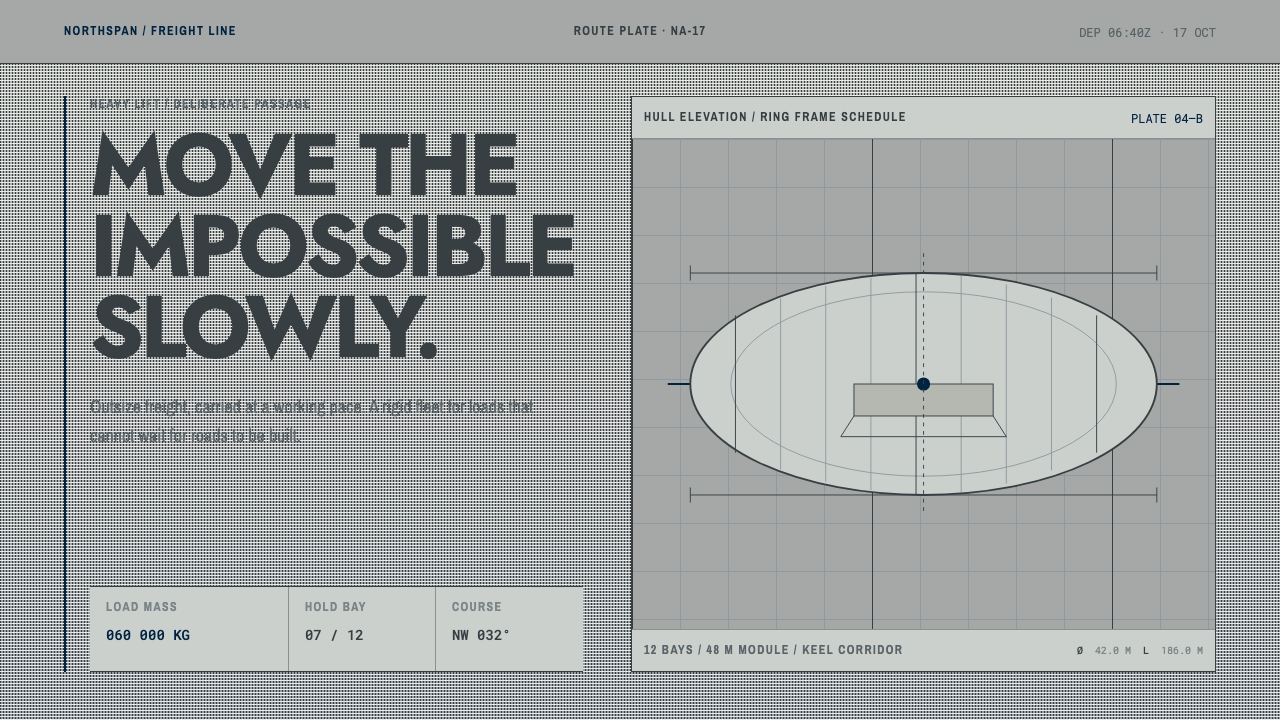 Hydrogen Airship FreightSlow freight is a capability. Matte aluminium grey, DIN grids, and a measured…
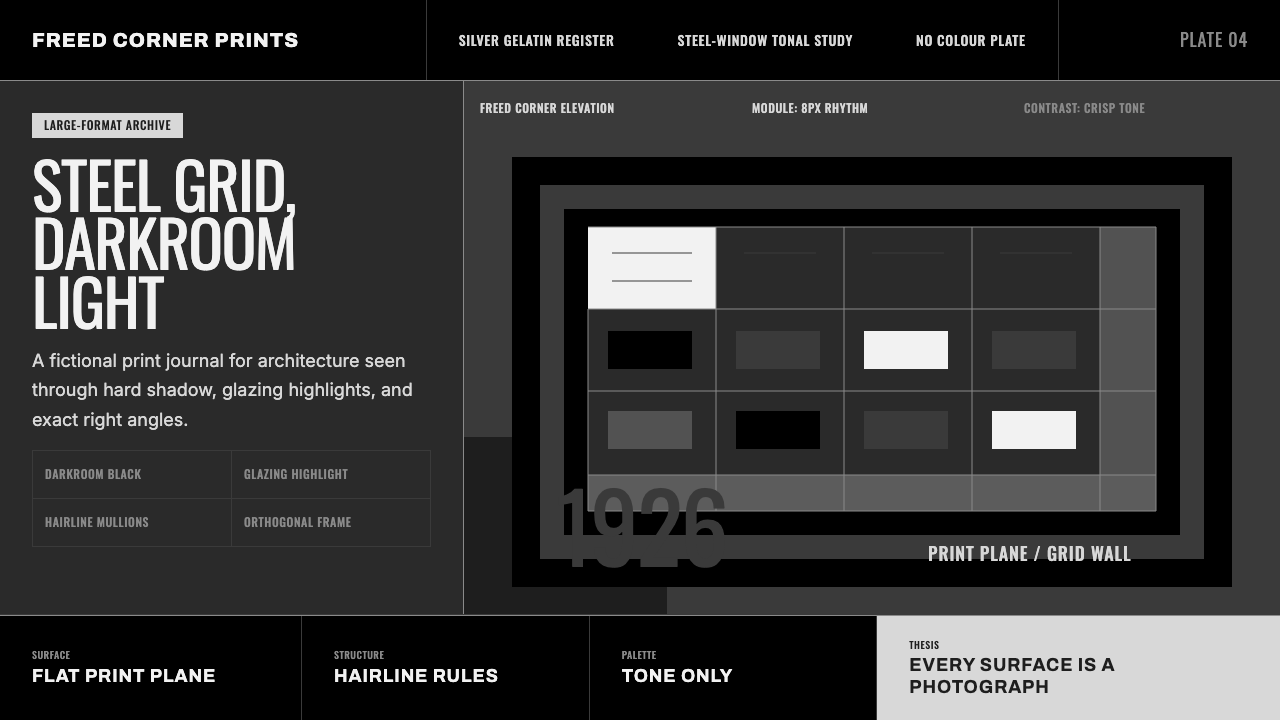 Dessau GrayscaleAustere monochrome authority. Darkroom black, glazing gray, and a steel-windo…
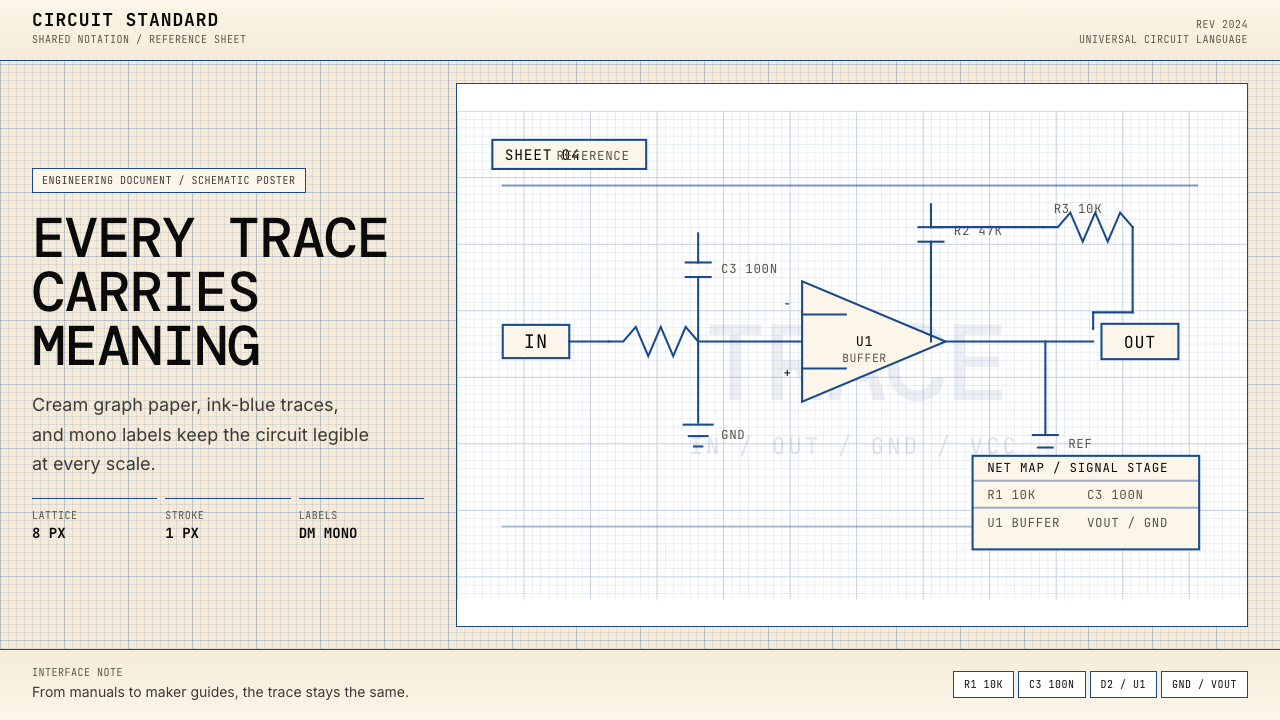 Electrical Schematic WiringAustere and exact. Cream graph paper, ink-blue traces, and mono labels make e…