What is Odisha Palm-Leaf Etching?
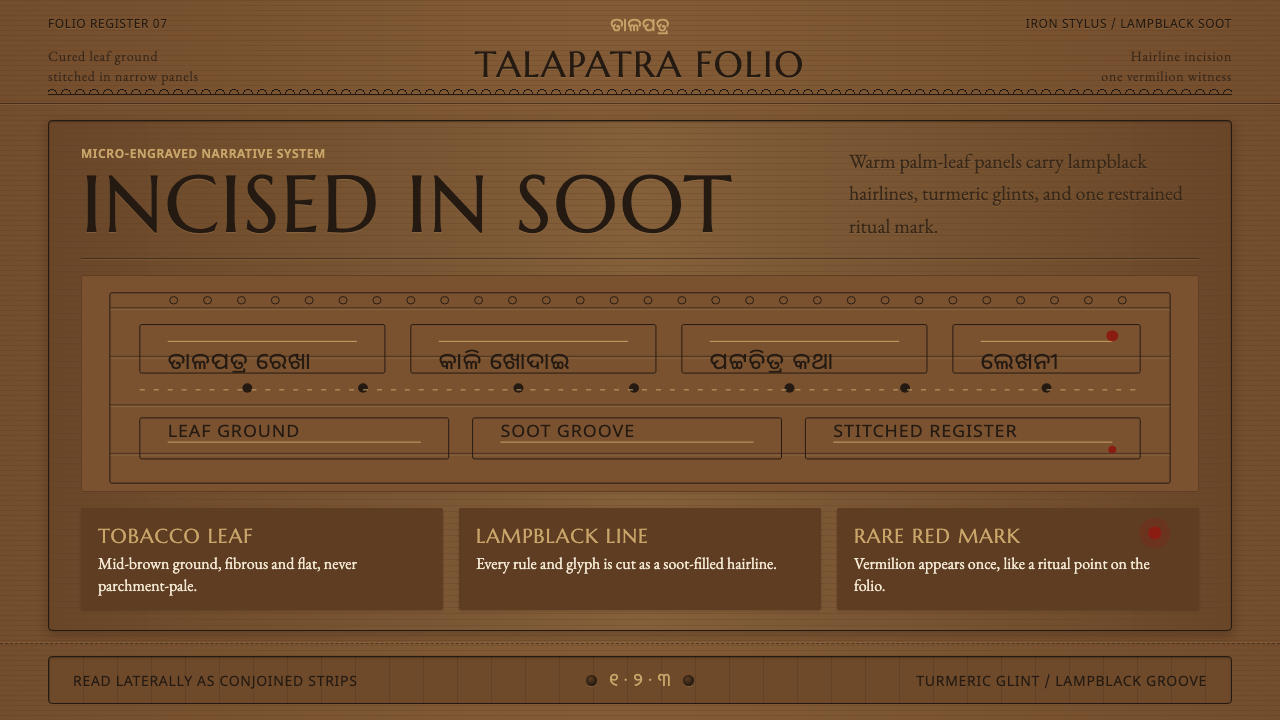
Odisha Palm-Leaf Etching makes sacred narrative microscopic: lampblack hairlines, turmeric glints, and hand-cut marks held against the warm darkness of cured leaf.
Odisha Palm-Leaf Etching in brief
Odisha Palm-Leaf Etching draws from the living palm-leaf manuscript and sacred narrative tradition of eastern India, especially the craft villages of Odisha and Raghurajpur. Artisans prepare palm leaves with turmeric, dry them in the sun, and turn them into supple tobacco-brown strips. Rather than painting a scene onto the surface, they incise it with an iron stylus known as a lekhani. Lampblack soot is then rubbed into the grooves, making the drawn image emerge as a near-black network of hairline marks.
The resulting visual language is dense without feeling crowded. Krishna epics, temple deities, narrative scenes, and micro-inscribed Odia script occupy the same field, each rendered with the patience of engraving rather than the broad gestures of painting. Faces, ornaments, garments, foliage, borders, and text are not separate visual systems; they are all variations of the same cut line. A figure can be both an image and a container for story, surrounded by ornamental detail that continues the narrative instead of merely framing it.
As a digital design system, the style translates that material discipline rather than imitating a palm leaf literally. It uses a warm mid-brown ground as the visual equivalent of cured leaf, lampblack line-work for structure and imagery, turmeric-gold for sparing illumination, stitched panel registers to organize narrative, and a restrained vermilion accent for moments requiring special emphasis. The governing impression should remain etched, intimate, tactile, and deliberately handmade.
Where does Odisha Palm-Leaf Etching come from?
The tradition belongs to the centuries-old palm-leaf manuscript culture of Odisha, eastern India, and is associated with the broader Indic pothi tradition. Its form is inseparable from its support: palm leaf is not simply a background for an illustration, but the physical condition that determines the work’s narrow registers, linear rhythm, and engraved character. The practice continues today in Odisha, including Puri and the craft village of Raghurajpur.
Preparation is foundational to the aesthetic. Palm leaves are cured in turmeric and dried in sunlight before they become workable strips. Their warm brown surface is neither blank paper nor a neutral digital canvas; it already carries tonal depth and material presence. The artisan’s task is therefore not to cover that surface with color, but to cut a precise image into it. The lekhani makes an incision whose clarity depends on restraint, steadiness, and the accumulated density of repeated fine marks.
Lampblack completes the drawing. Soot worked into the incised grooves converts the carved path into visible line-work, allowing forms to appear from the leaf rather than sit above it. This process explains the style’s distinctive contrast: a deep brown field, near-black graphic detail, and the quiet glow implied by turmeric preparation. The aesthetic is built from revelation through incision, not from layers of opaque paint.
Odisha Palm-Leaf Etching also sits beside Pattachitra sacred narrative art. Its subject matter includes Krishna epics, temple deities, and devotional storytelling, while its manuscript lineage accommodates text as carefully as imagery. In contemporary screen translation, those linked traditions suggest a design language in which text, ornament, scene-setting, and symbolic detail should remain connected. A panel can read as an interface section, but it should still feel like a continuous register of story.
What defines the Odisha Palm-Leaf Etching look?
Leaf Ground
The visual field should resemble cured palm leaf: warm, mid-brown, dark enough to hold fine black marks but never empty or cold. It should feel absorbent and aged by handling rather than polished like a generic dark interface. The ground is an active material presence, giving every line a surface to emerge from.
Incised Line
Lampblack line-work is the system’s primary voice. Lines should remain extremely fine, crisp, and hand-cut in character, with small irregularities that imply pressure and engraving rather than vector perfection. Illustration, dividers, icon-like details, and borders belong to one continuous graphic vocabulary: the mark of an incision.
Turmeric Illumination
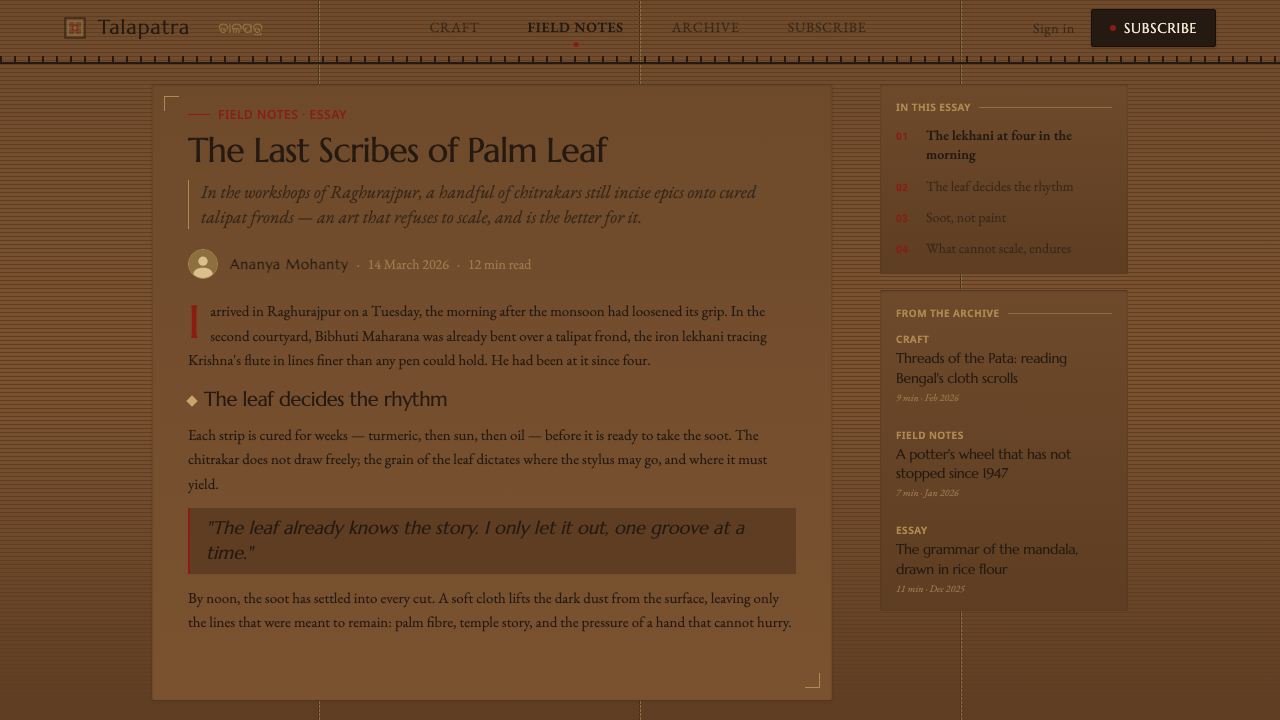
Turmeric-gold should be used as a glint, not as a broad decorative fill. It can pull attention toward a sacred emblem, a heading, a small navigational cue, or a pivotal narrative detail. Its value lies in contrast with the dark leaf field and lampblack drawing; if it becomes dominant, the etched discipline disappears.
Narrative Registers
Composition favors stitched or linked horizontal panels, recalling the elongated format of palm-leaf strips. These registers can contain scenes, text, metadata, or interface modules, but their boundaries should feel joined rather than boxed off. The rhythm is sequential and manuscript-like: the eye travels across a chain of related marks.
Micro-Inscribed Type
Text should carry the intimacy of inscription. Odia script in the source tradition appears at the scale of engraving, integrated with image rather than treated as a detached label. In a contemporary application, typography should remain compact, deliberate, and closely related to the line-work, while preserving sufficient clarity for reading.
Restrained Vermilion
A single vermilion accent introduces urgency without disrupting the predominantly monochrome system. It is best reserved for a selected action, a sacred focal point, a warning, or one decisive marker in a larger composition. Its rarity makes it meaningful; repeated everywhere, it becomes decoration rather than signal.
Who shaped Odisha Palm-Leaf Etching?
Raghurajpur is the craft village most closely identified in the source tradition with Odisha palm-leaf work. Its chitrakara artisan families sustain the material knowledge behind the style: turmeric-cured leaf, sun-dried strips, iron-stylus incision, lampblack rubbing, and sacred narrative rendered through minute line-work. In a design translation, their importance is a reminder that the visual result is inseparable from making.
Odia palm-leaf manuscript scribes represent the textual side of the tradition. Their work places micro-inscribed Odia script alongside sacred image-making, demonstrating that writing is not supplemental content but part of the visual field. This relationship is especially useful for editorial design: language can become texture, structure, and narrative continuity without losing its role as information.
The lekhani is the iron stylus used to incise the palm leaf. Although it is a tool rather than an individual maker, it is central to the style’s identity because it defines the mark: narrow, cut, deliberate, and dependent on pressure. Any digital interpretation that replaces this logic with broad painterly strokes loses the character that makes the tradition recognizable.
How do you use Odisha Palm-Leaf Etching today?
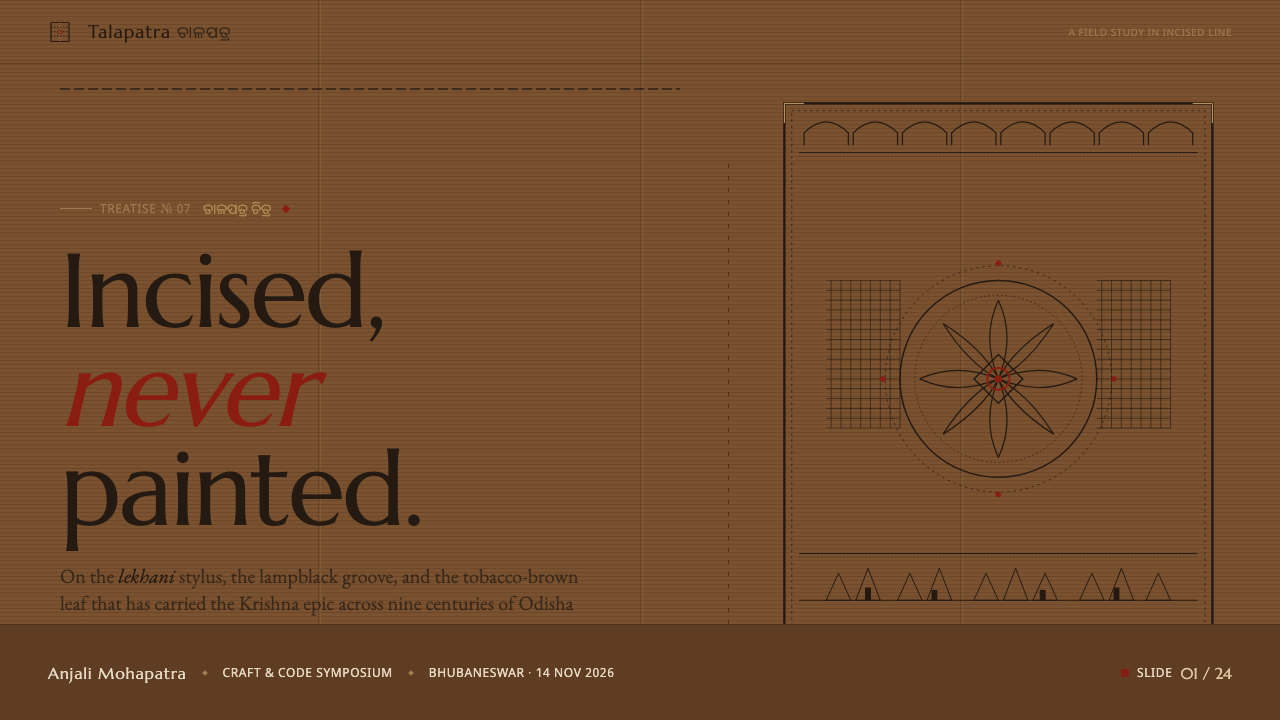
For presentation covers, Odisha Palm-Leaf Etching works best when the slide is treated as a single engraved field rather than a generic dark backdrop. Use the warm leaf ground, place a compact title within or beside a stitched register, and let one line-drawn deity-inspired, narrative, or botanical detail carry the composition. Content slides should extend the same register logic: keep headings, body copy, annotations, and dividers connected by fine line-work instead of separating every content block into unrelated cards. Data slides can use etched axes, restrained lampshade-dark marks, and turmeric highlights for the most important comparison, so that a chart reads like a precise inscription rather than a bright dashboard.
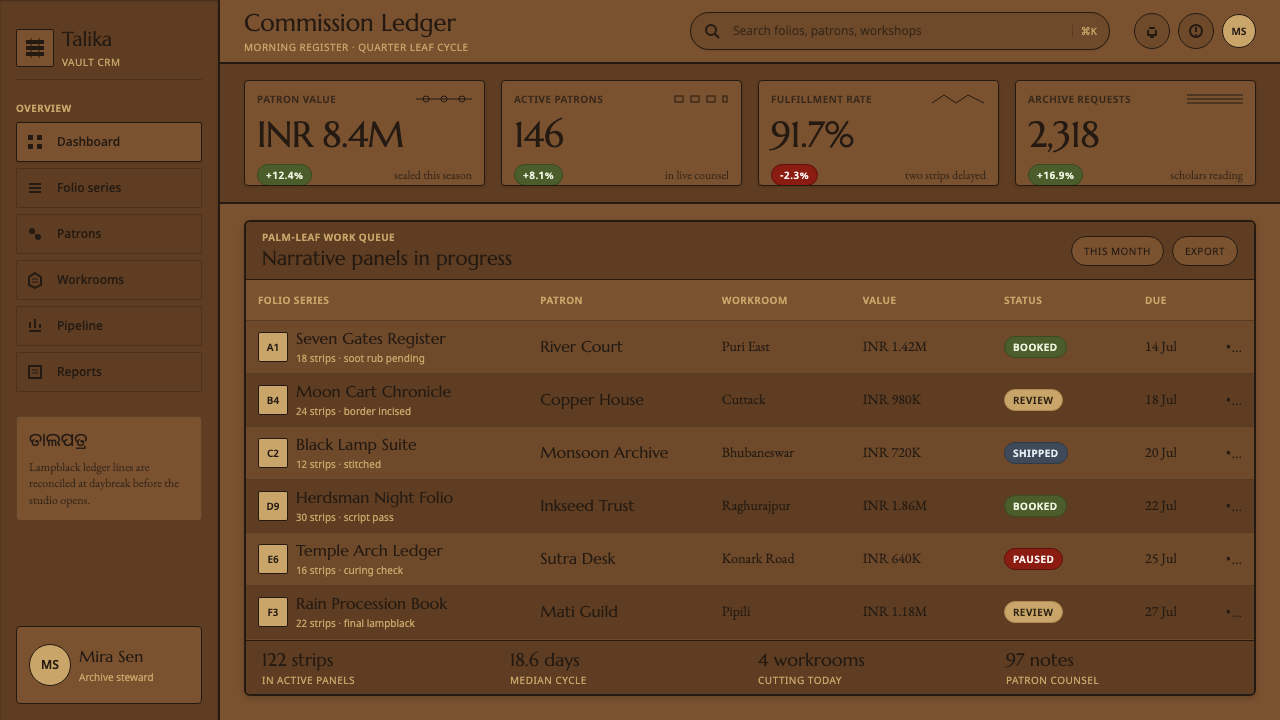
For web interfaces, the style suits cultural archives, story-led platforms, collections, learning experiences, and dashboards that benefit from a sense of attentive reading. A dashboard can organize modules as linked leaf panels, while thin incised dividers establish hierarchy without heavy containers. Pricing or membership pages can use the vermilion accent for the chosen action and turmeric for selected emphasis, keeping the rest of the interface anchored in brown and lampblack. Interaction cues should remain clear, but they should feel like marks inserted into a manuscript system rather than glossy controls placed over it.
For editorial and marketing work, this language is strongest when content has a narrative sequence: a long-form article, an exhibition page, a product story, a cultural program, or a campaign centered on craft and memory. A lead image can be replaced or accompanied by etched line illustration, while section breaks become horizontal registers stitched through the page. Small notes, dates, captions, and pull quotes can gather around the main narrative as marginal inscriptions. The result should feel rich through accumulation of detail, not through large photographic spectacle or decorative surface effects.
The common mistake is to treat the style as a brown background with ornamental black doodles. That approach copies the palette while ignoring the craft logic. The line must appear incised, imagery and text must share a disciplined scale, color must remain scarce, and every panel should contribute to a story or reading path. Overly smooth illustration, broad soft shapes, frequent bright accents, or unrelated decorative motifs make the work feel theatrical rather than etched. The most convincing applications preserve the sense that each visible mark had to be deliberately cut.
Odisha Palm-Leaf Etching — FAQ
Is Odisha Palm-Leaf Etching the same as Pattachitra?
They are closely related within Odisha’s sacred narrative culture, but the source material identifies them as distinct traditions. Pattachitra is named as a sacred narrative art movement, while palm-leaf etching belongs to the palm-leaf manuscript and pothi tradition. Their relationship is visible in shared devotional subject matter and storytelling, yet palm-leaf etching is specifically defined by cured leaf, iron-stylus incision, and lampblack revealed in grooves.
Why is lampblack so important to the style?
Lampblack makes the incision legible. The stylus creates grooves, but the soot rubbed into those grooves reveals the figure as near-black line-work against the tobacco-brown leaf. This is why the digital version should privilege fine dark lines over broad painted forms: the essential visual event is not color applied to a surface, but a cut made visible.
Can the style use more color than brown, black, turmeric, and vermilion?
The supplied design system is intentionally restricted to a warm brown leaf ground, lampblack line-work, turmeric-gold highlights, and a single restrained vermilion accent. Adding many competing colors weakens the visual relationship between leaf, incision, soot, and selective illumination. If additional variation is needed, it is usually better created through line density, panel rhythm, spacing, and narrative sequencing than through a broader palette.
Where does this style work poorly?
It is less suitable when a product depends on rapid, high-volume scanning, broad photographic storytelling, or a bright and playful emotional register. The style asks viewers to attend to fine marks and connected narrative panels, so it can lose force when crowded with large controls, frequent alerts, or unrelated visual effects. It works best when the subject benefits from patience, material awareness, sacred or cultural narrative, and close reading.
Related design styles
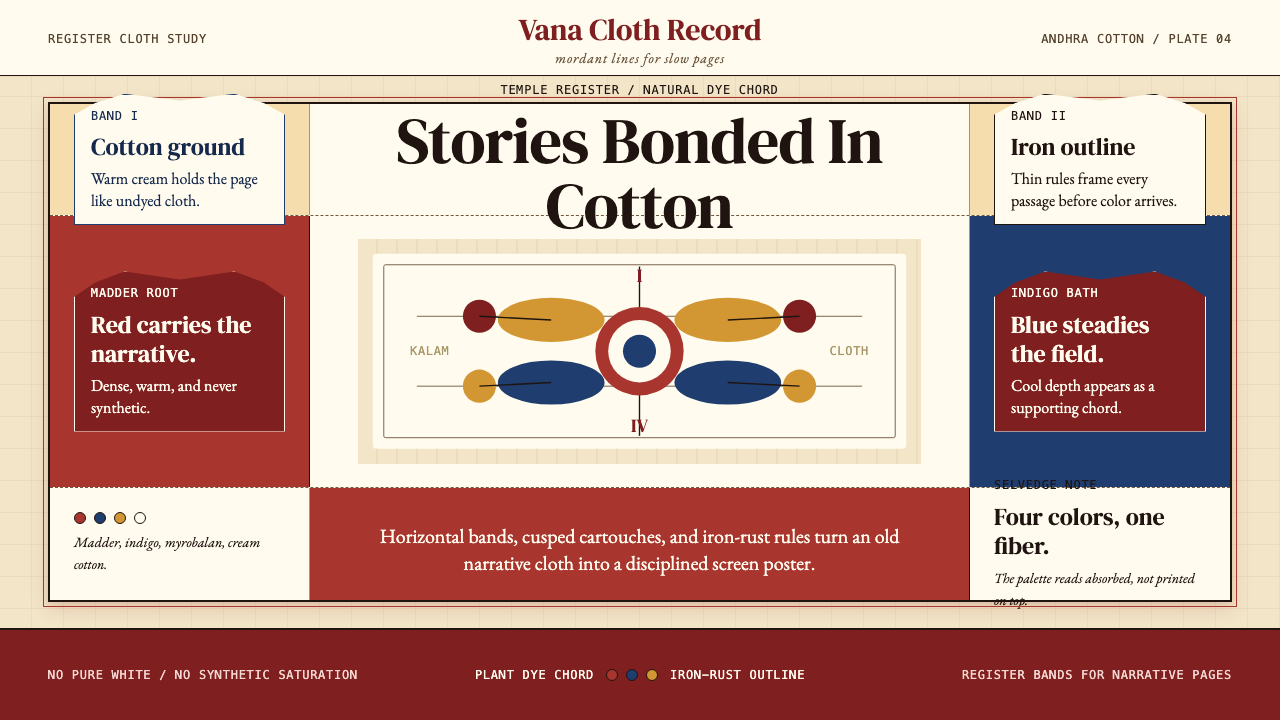 Kalamkari (Andhra Pradesh)Cloth becomes narrative. Madder bands, indigo panels, and iron rules stack li…
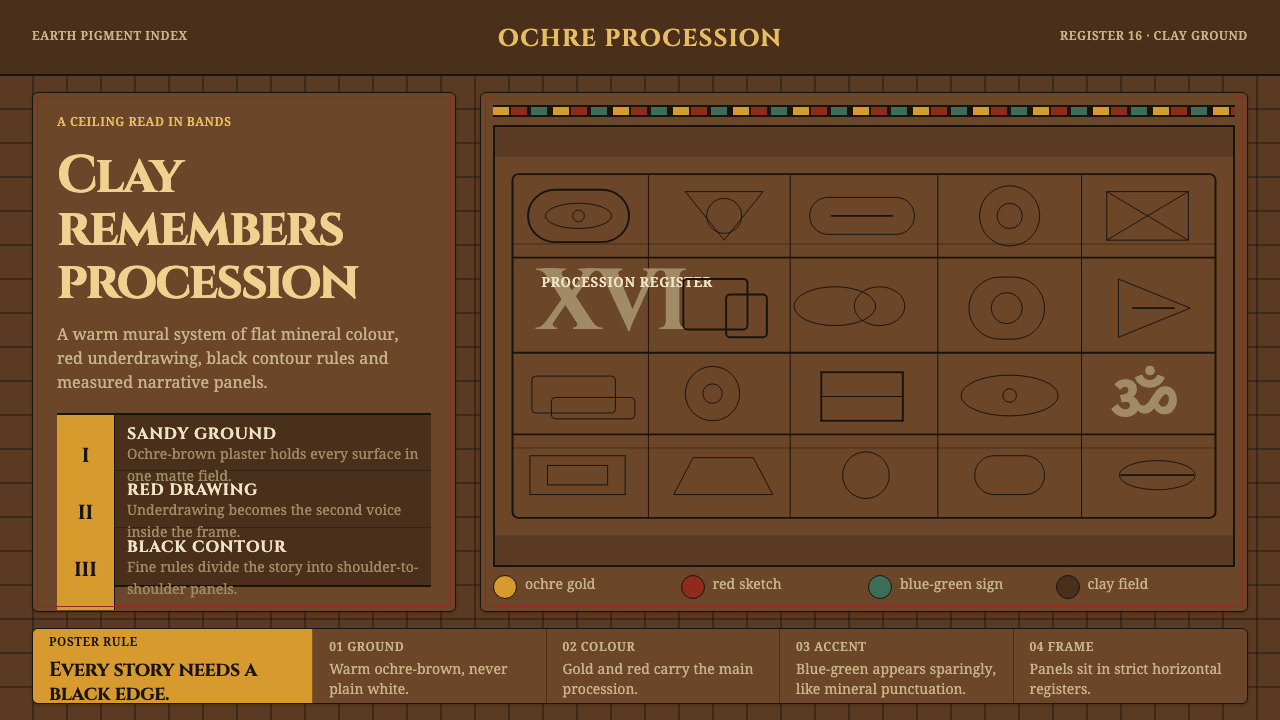 Lepakshi Vijayanagara CeilingEarth remembers in registers. Ochre gold, red underdrawing and black rules ma…
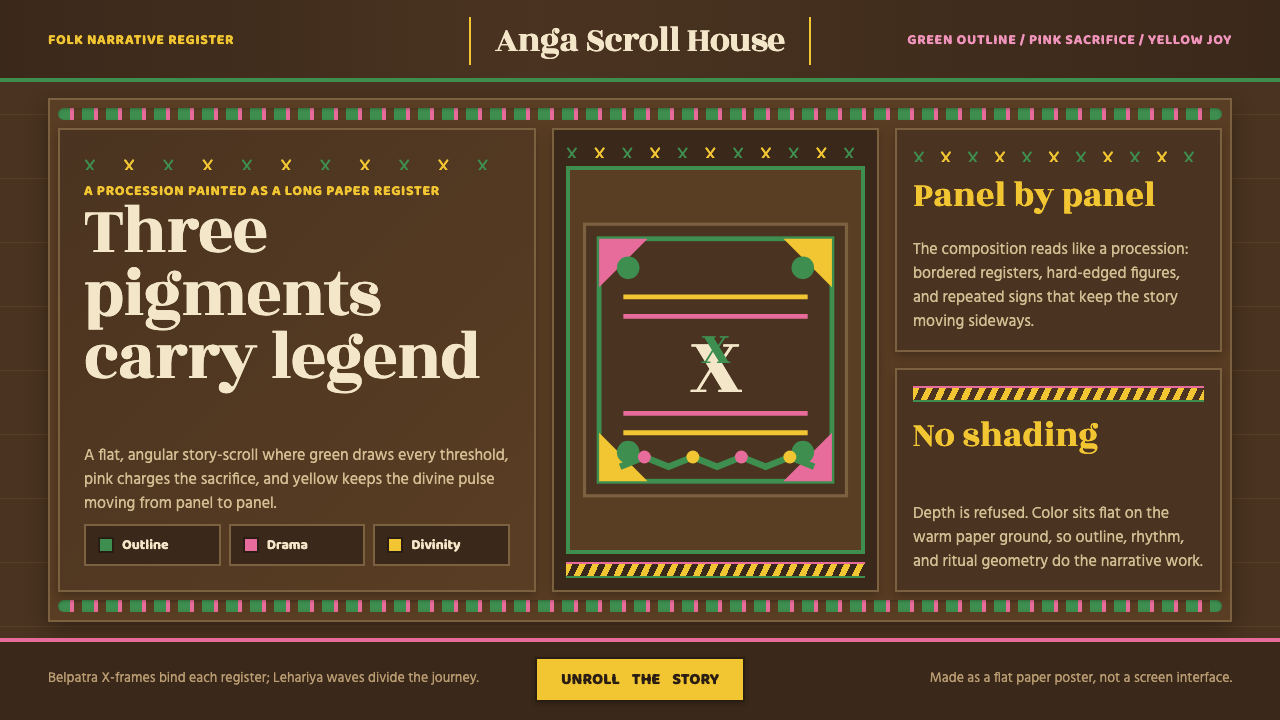 Manjusha Anga Snake-ScrollLegend moves in three pigments. Green outline, pink drama, yellow divinity on…
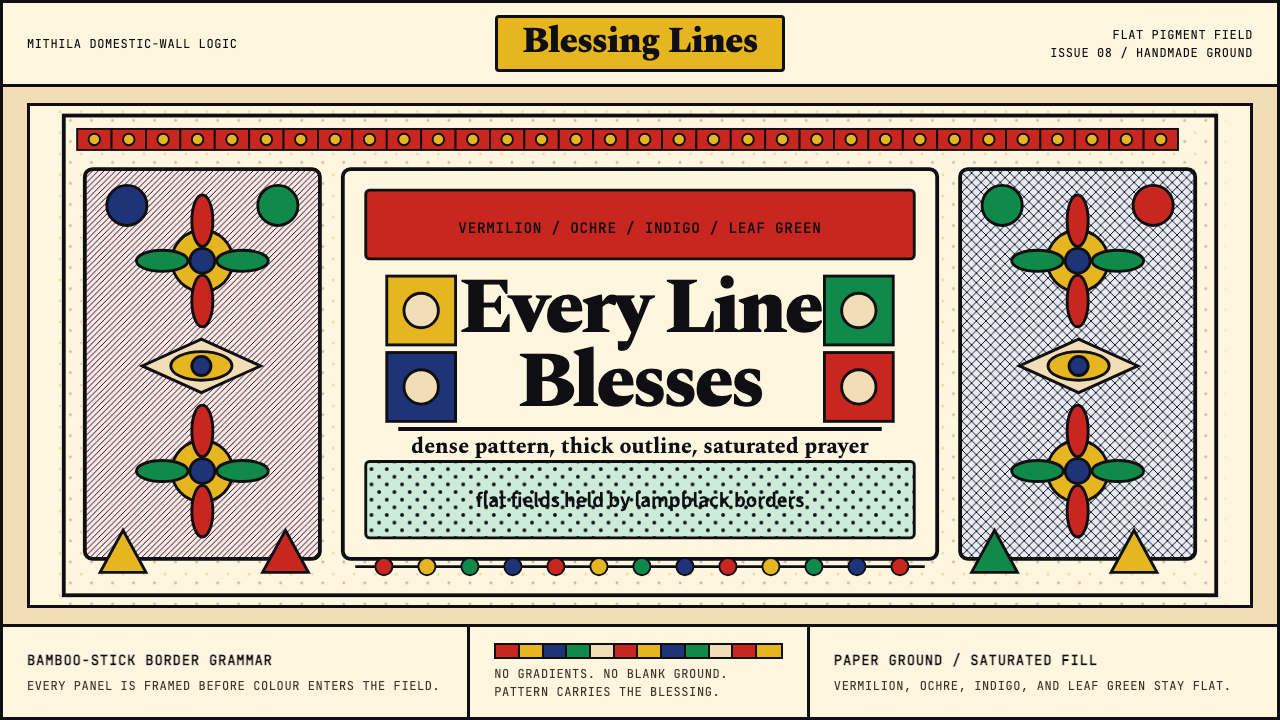 Mithila (Madhubani) PaintingEvery inch is blessed. Lampblack borders lock vermilion, ochre, indigo, and l…
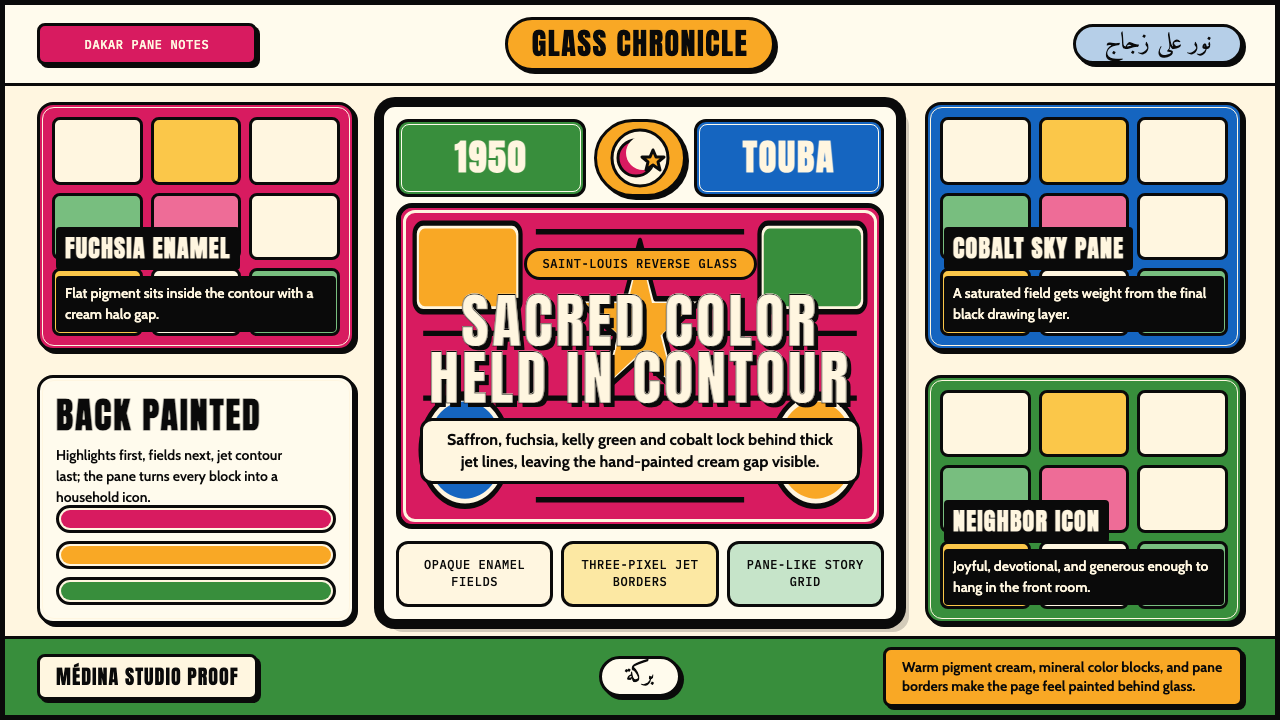 Senegalese Sous-VerreSacred joy in enamel. Fuchsia and saffron panes lock behind thick jet contour…
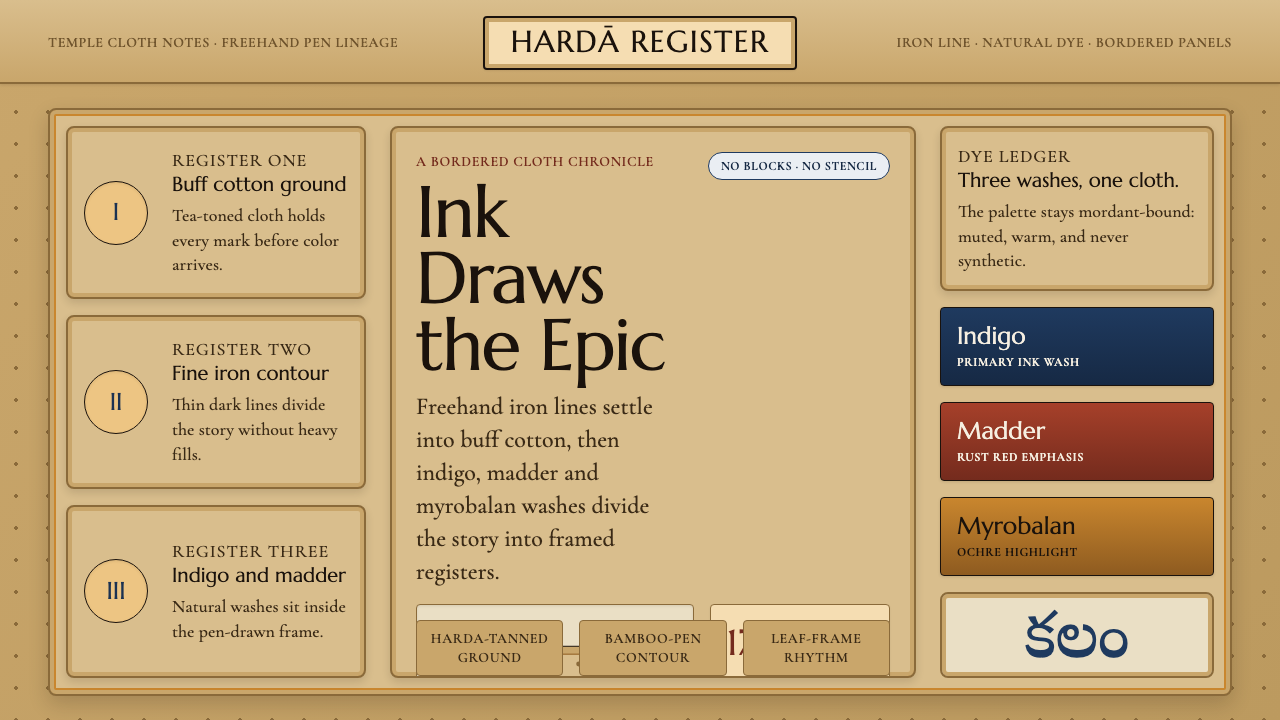 Srikalahasti Kalamkari Pen-WorkHand-drawn cloth storytelling. Buff tan ground, iron lines and indigo-rust pa…