What is Manjusha Anga Snake-Scroll?
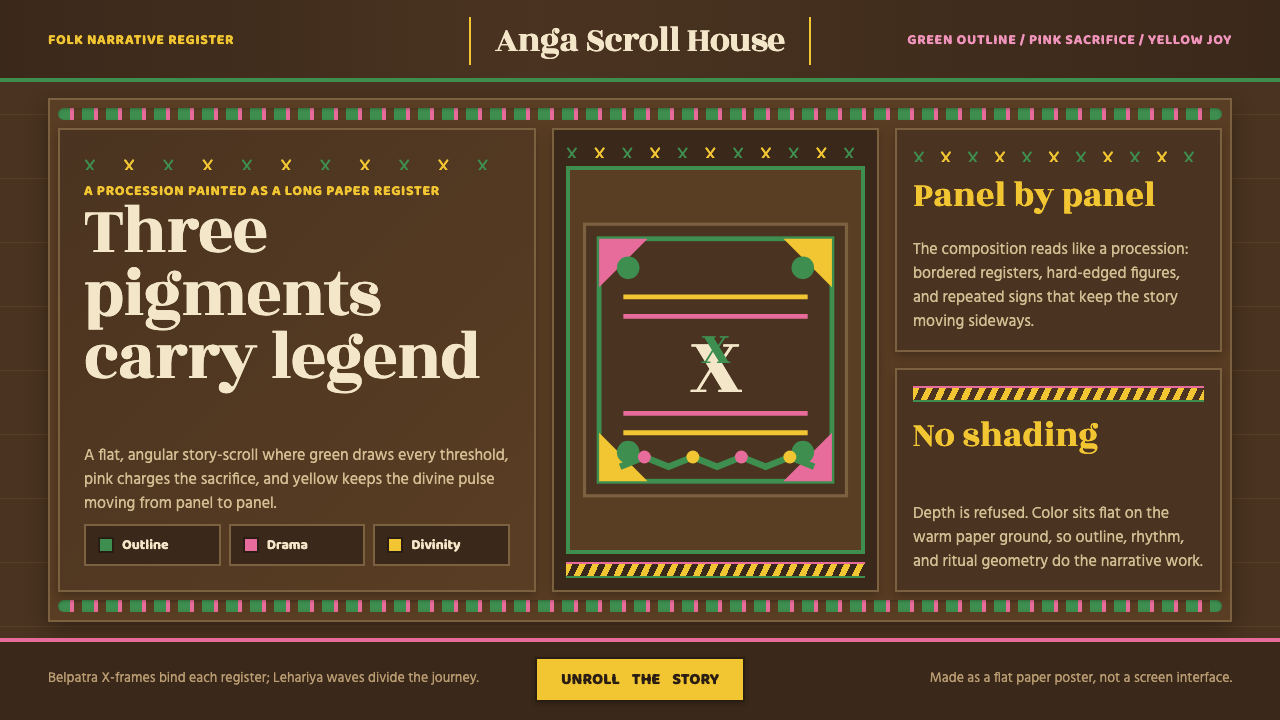
The Manjusha Anga Snake-Scroll turns legend into a moving sequence of green contours, pink drama, and yellow divinity, carried across brown handmade paper like a folk comic unfolding in ritual time.
Manjusha Anga Snake-Scroll in brief
Manjusha art is the narrative scroll painting of the Anga region around Bhagalpur in Bihar, India. Its stories are rooted in the Bihula-Bishahari snake-goddess legend and the annual Bishahari puja. Scenes unfold sequentially across handmade paper scrolls and temple-shaped Manjusha boxes, allowing the image to function as both storytelling surface and carried ritual object.
The visual language is deliberately restricted. Artists work with green, pink, and yellow on brown scroll paper: green establishes outlines and natural forms, pink carries excitement and sacrifice, while yellow signals joy and divinity. Figures are flat, angular, and economical, with a stick-letter quality often described as English alphabet style. The result is symbolic rather than naturalistic.
Every panel is held together by recurring motifs. X-shaped belpatra frames, wavy Lehariya lines, and continuous rows of snakes create borders, rhythm, and visual continuity. These elements do more than decorate the scene: they make the scroll feel connected from one episode to the next, so the entire object reads as a sustained visual narration rather than a collection of isolated pictures.

Where does Manjusha Anga Snake-Scroll come from?
The roots of Manjusha art are placed in an Anga folk tradition traced to around the seventh century. Its home is the region around Bhagalpur in Bihar, where narrative painting developed in close relation to local legend and ritual practice. The tradition remains living rather than merely historical: Manjusha is still practiced today as a sequential folk-painting form.
Its central narrative world is the Bihula-Bishahari snake-goddess legend, kept present through the annual Bishahari puja. The story gives the paintings their reason to proceed from panel to panel. Rather than presenting a single emblem or decorative scene, the art organizes visual episodes around a legend that can be followed as it unfolds.
The tradition takes two closely related physical forms. Artists paint on handmade paper scrolls, whose sequential structure naturally supports a story that is revealed in stages. They also paint on temple-shaped Manjusha boxes, objects carried in procession. The format therefore shapes the reading experience: the image is not only viewed on a flat surface but encountered as an object with direction, movement, and ritual presence.
Manjusha folk artists and Bihula-Bishahari temple-box makers are the practical keepers of this visual system. Their work preserves the restricted pigments, angular figures, recurring snake bands, belpatra frames, and Lehariya lines that make the tradition recognizable. The continuity of the style depends on this combination of narrative knowledge, surface-making, and repeated visual grammar.
What defines the Manjusha Anga Snake-Scroll look?
Three-Pigment Symbolism
The palette is compressed to green, pink, and yellow against brown scroll paper. Green defines outlines and belongs to nature; pink heightens excitement and marks sacrifice; yellow carries joy and divinity. Color therefore behaves as narrative information rather than surface decoration. A restrained palette gives every pigment a clear role and keeps the story legible across the full scroll.
Angular Figures
Human and symbolic figures are rendered as flat, angular forms with an economical stick-letter quality. The so-called English alphabet style favors recognition over anatomical detail. Bodies, gestures, and attributes are reduced to decisive lines and shapes, allowing the viewer to identify the action quickly. The figures feel assembled from signs, not modeled through light, volume, or realistic shading.
Sequential Storytelling
Manjusha panels unfold like a folk comic strip. Each image contributes an episode, and the order of the panels gives the work its narrative force. Repetition is essential: recurring forms help the eye travel while changes in pose, arrangement, and color emphasis mark the movement of the story. The scroll is consequently read through progression, not through a single centered composition.
Belpatra and Lehariya
X-shaped belpatra frames and wavy Lehariya lines create a distinctive boundary system. The belpatra motif gives the panel a firm structural enclosure, while the waves introduce movement and a softer counter-rhythm. Together they separate the narrative field from its edge without relying on ornamental complexity. Their repetition makes neighboring panels feel related even when their internal scenes change.
Snake Continuity
Unbroken rows of snakes bind the panels into a continuous visual band. The snake is not treated as an isolated illustration placed beside the story; its repeated presence acts as a connector, a border, and a reminder of the legend's subject. This continuity gives the scroll a measured visual pulse. The eye encounters the snake row again and again, moving through the narrative without losing the larger frame.
Scroll and Temple Form
The work is inseparable from its carriers: handmade paper scrolls and temple-shaped Manjusha boxes. The scroll supports unfolding sequence, while the box gives the painted narrative an architectural silhouette and a place in procession. Both formats resist the idea of a neutral image container. Surface, shape, and movement all participate in how the story is encountered.

Who shaped Manjusha Anga Snake-Scroll?
Bihula is one of the paired names at the center of the Bihula-Bishahari legend that gives Manjusha painting its narrative foundation. In the visual system, the name belongs to the story being unfolded across successive panels rather than to a detached portrait tradition. Bihula therefore represents the human-facing presence of the legend as it is carried through scrolls and temple-shaped boxes.
Bishahari is the snake-goddess presence named in the legend and honored through the annual Bishahari puja. Her place in the tradition connects painted narrative with ritual observance. Within the Manjusha palette, the themes associated with divinity and joy find their strongest visual counterpart in yellow, while the surrounding snakes and repeated borders keep the sacred subject inside the larger visual grammar.
Manjusha folk artists maintain the painting language through disciplined repetition: restricted pigments, angular figures, sequential panels, belpatra frames, Lehariya lines, and snake bands. Their role is not simply to illustrate a pre-existing story. They preserve the relationship between narrative order, material surface, and symbolic color that allows the tradition to remain recognizable as Manjusha.
The makers of Bihula-Bishahari temple-shaped boxes extend Manjusha art beyond the paper scroll. Their objects provide a shaped, portable surface for the same narrative vocabulary and are carried in procession. They demonstrate that the tradition is concerned not only with painted panels but also with the form, movement, and public presence of the object that carries them.
How do you use Manjusha Anga Snake-Scroll today?
For presentation covers, use the brown scroll ground as the field and let one symbolic color establish the first emotional signal. A yellow divine mark can anchor the composition, while green contours and a pink narrative accent suggest the story waiting to unfold. A belpatra frame or a continuous snake band can provide the cover edge, giving the title the feeling of entering an illustrated scroll rather than sitting on a generic slide.
Content and data slides should behave like sequential panels. Give each slide one clear episode or idea, repeat a small set of border motifs, and use green, pink, and yellow according to meaning rather than decoration. Green can organize natural or structural information, pink can mark tension or change, and yellow can identify a conclusion, highlight, or moment of importance. Charts should remain flat and legible, with repeated forms creating continuity from slide to slide.
For web dashboards and pricing pages, the style works best when the interface adopts a dark brown foundation, flat angular surfaces, and a limited semantic palette. Green, pink, and yellow can distinguish states, tiers, or moments in a user flow, while snake bands and wavy lines can guide movement between sections. The interface should feel sequential and diagrammatic, with clear panels and strong edges instead of soft, atmospheric depth.
Editorial and marketing pages can borrow the scroll as a storytelling structure. Break a long narrative into connected visual episodes, use a recurring snake band as a section thread, and frame important passages with an X-shaped motif. Marketing campaigns can present a product or idea as a legend unfolding across panels, while the brown ground and restricted pigments provide a consistent identity across posters, landing pages, packaging, and social images.
The common mistake is to treat Manjusha as a ready-made decoration kit of snakes, bright colors, and folk-looking borders. That approach keeps the surface but loses the system. The motifs should support sequence, the colors should carry distinct narrative roles, and the angular figures should remain economical. If every element competes at once, the result becomes generic pattern-making rather than a visual language rooted in storytelling and ritual form.

Manjusha Anga Snake-Scroll — FAQ
What is the Manjusha Anga Snake-Scroll style?
It is a dark-ground, three-pigment narrative style rooted in the Manjusha art of the Anga region around Bhagalpur, Bihar. Its defining features are green outlines, pink dramatic emphasis, yellow divinity, flat angular figures, sequential folk-comic panels, X-shaped belpatra frames, wavy Lehariya lines, and unbroken snake rows. The style is best understood as storytelling through a repeated visual grammar.
Why does Manjusha use green, pink, and yellow so consistently?
The pigments carry distinct narrative duties. Green is used for outline and nature, pink expresses excitement and sacrifice, and yellow represents joy and divinity. Because each color has a role, the palette remains readable even when the figures are highly simplified. Using the colors arbitrarily would weaken the relationship between the painted surface and the story being told.
Are Manjusha paintings only made on scrolls?
No. Handmade paper scrolls are one important format, but Manjusha art is also painted on temple-shaped Manjusha boxes carried in procession. The scroll emphasizes sequential unfolding, while the temple-shaped box adds an architectural and portable form. Both formats preserve the connection between image, story, and ritual movement.
How can the sequential logic work in a modern interface?
Treat each screen or section as a panel in a larger story. Give every panel one clear purpose, repeat a small number of framing motifs, and assign the palette according to meaning. A continuous snake-like line or wavy border can guide movement, while angular flat forms can turn status, categories, or milestones into quickly recognizable symbols. The interface should feel connected from state to state.
What is the biggest risk when adapting this style?
The biggest risk is copying visible motifs without preserving their narrative function. Snakes, bright pigments, and angular figures can easily become disconnected decoration. A convincing adaptation keeps the palette symbolic, uses borders to create continuity, and lets the format support unfolding sequence. The style becomes strongest when every repeated element helps the viewer understand where the story is and where it is going.
Related design styles
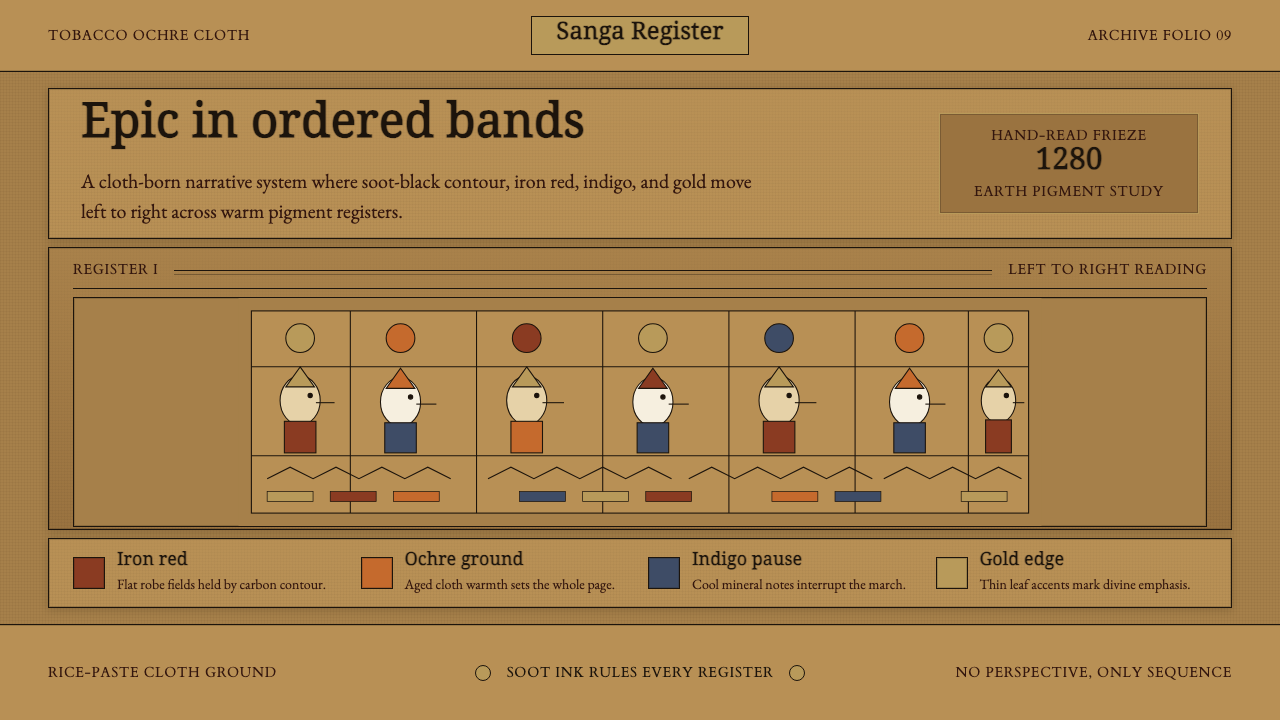 Balinese Kamasan PaintingAncient cloth, ordered as story. Ochre bands, soot outlines, indigo and gold…
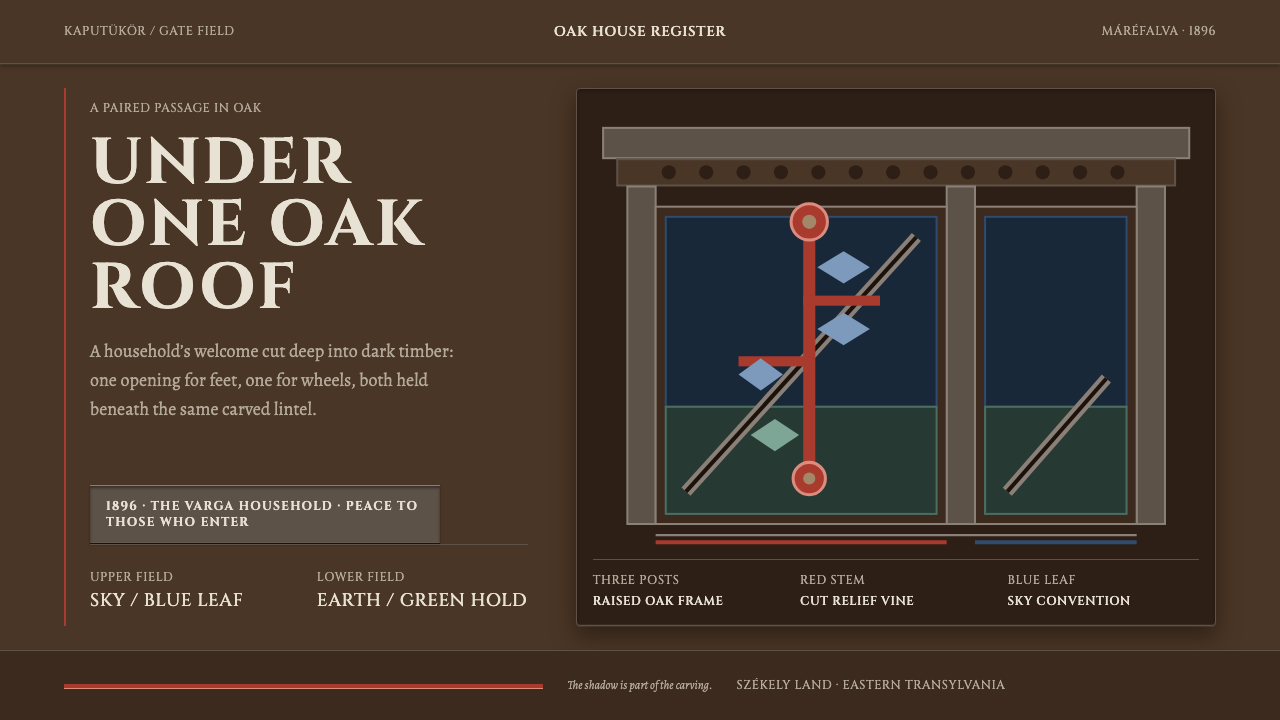 Szekely GateA gatehouse, not a door. Red vine and blue leaf relief cut into tannin-dark o…
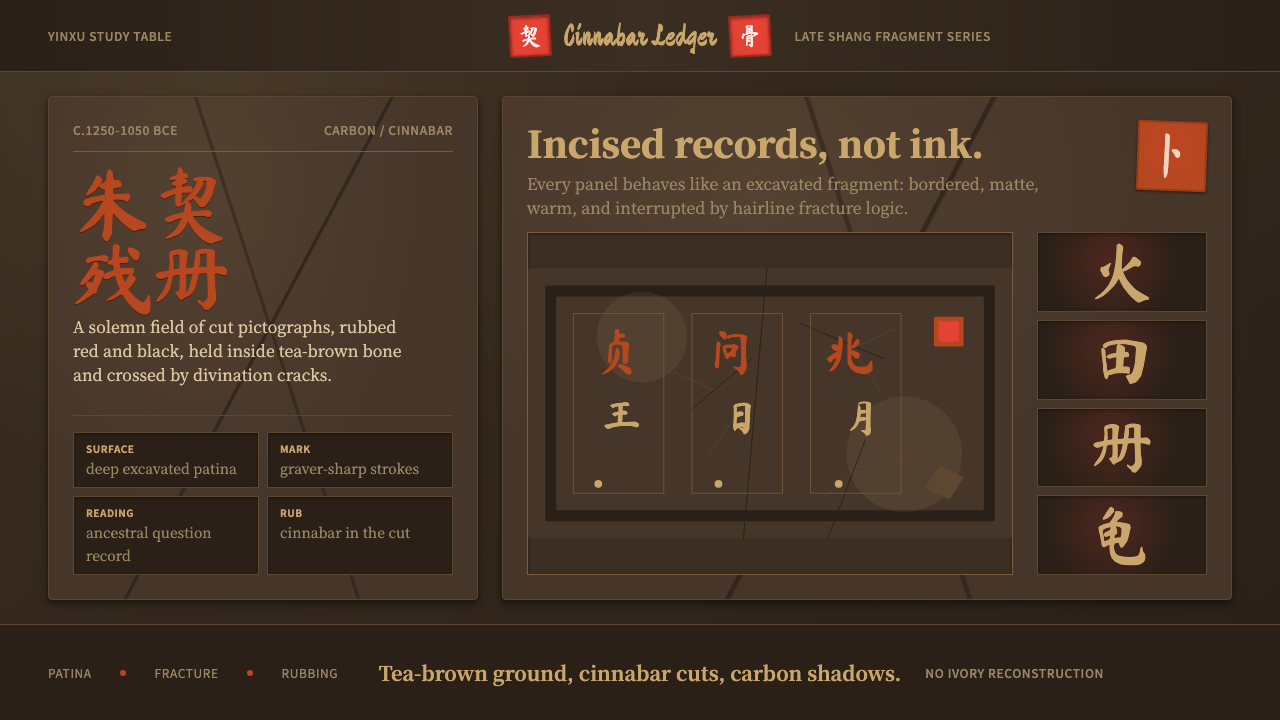 Oracle Bone 甲骨文Feels excavated, not restored. Tea-brown panels carry cinnabar glyphs and cra…
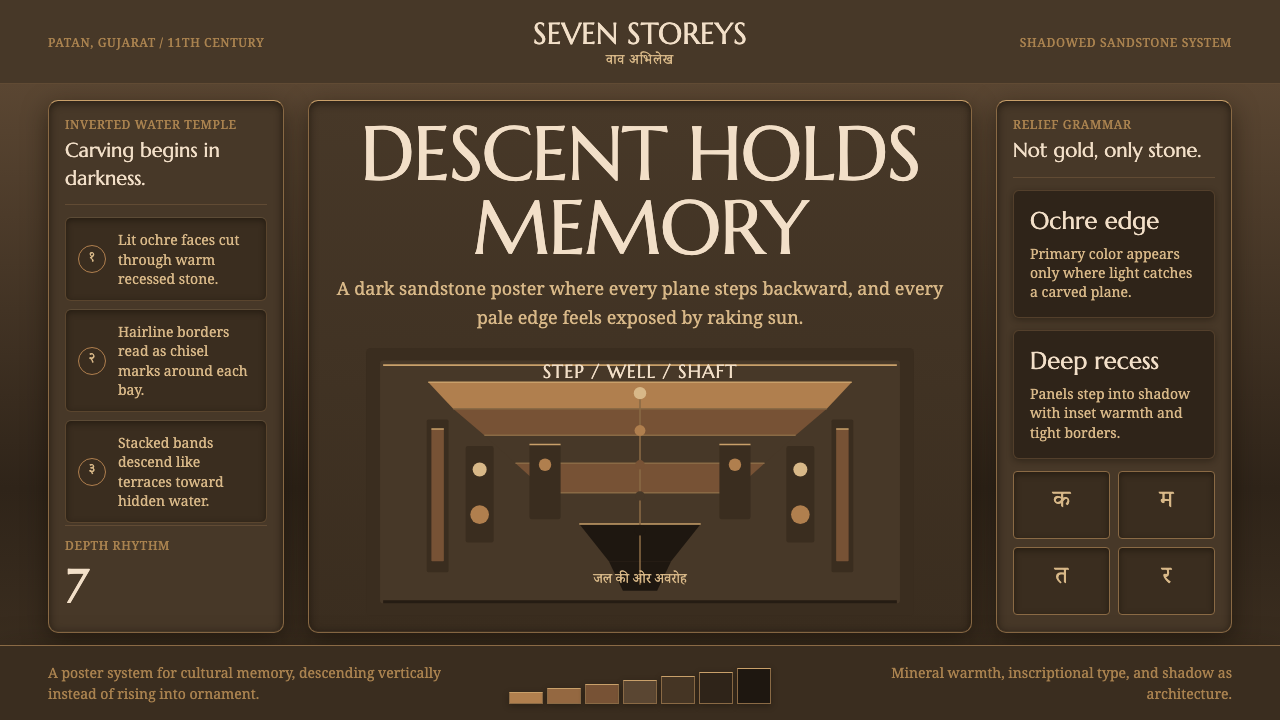 Indian StepwellStone descends into shadow. Ochre serif type and stacked terraces carve the f…
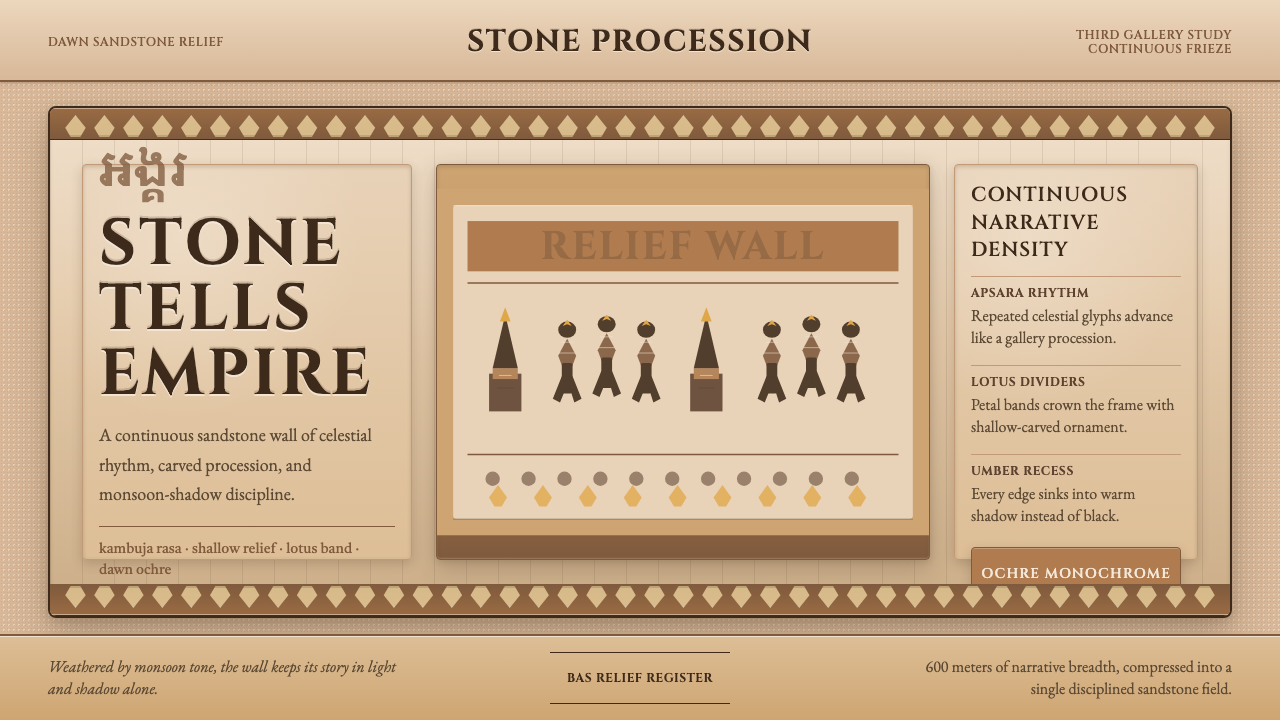 Khmer Angkor Wat ReliefStone remembers everything. Ochre friezes, Cinzel capitals, and lotus bands h…
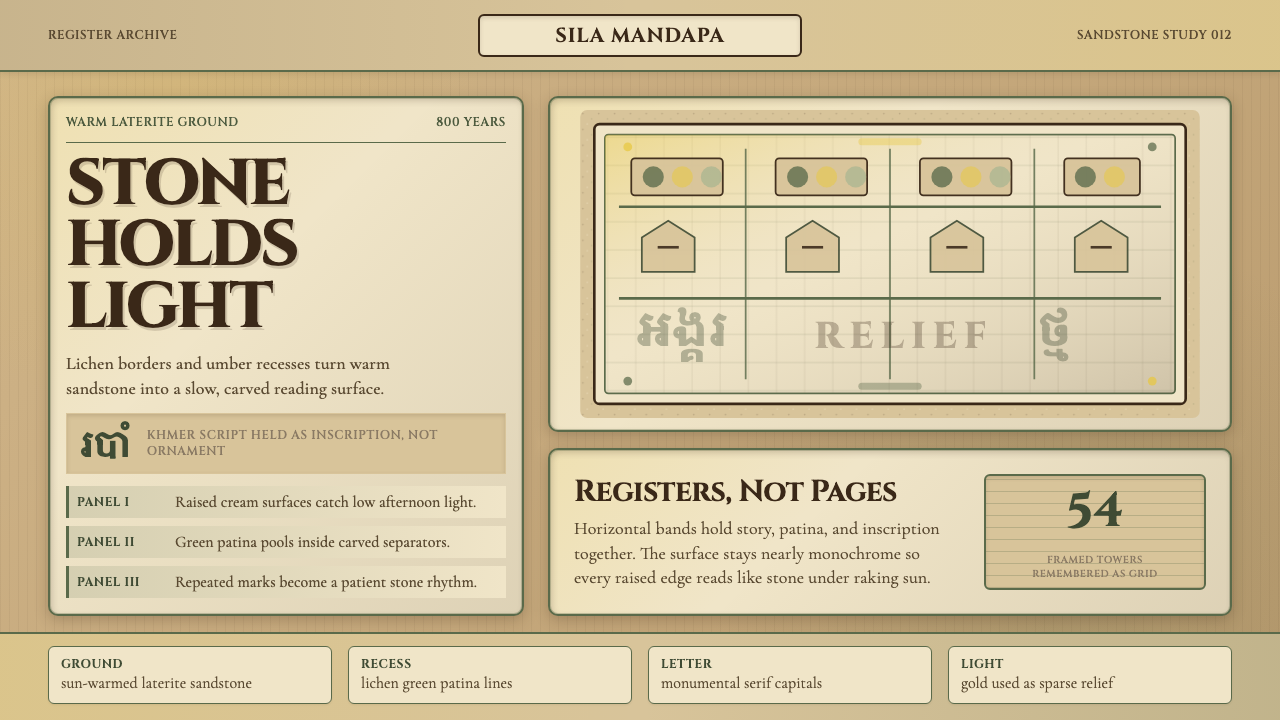 Khmer Apsara Relief (Bayon)Contemplative stone weight. Cinzel capitals sit on sandstone registers with l…