What is Balinese Kamasan Painting?
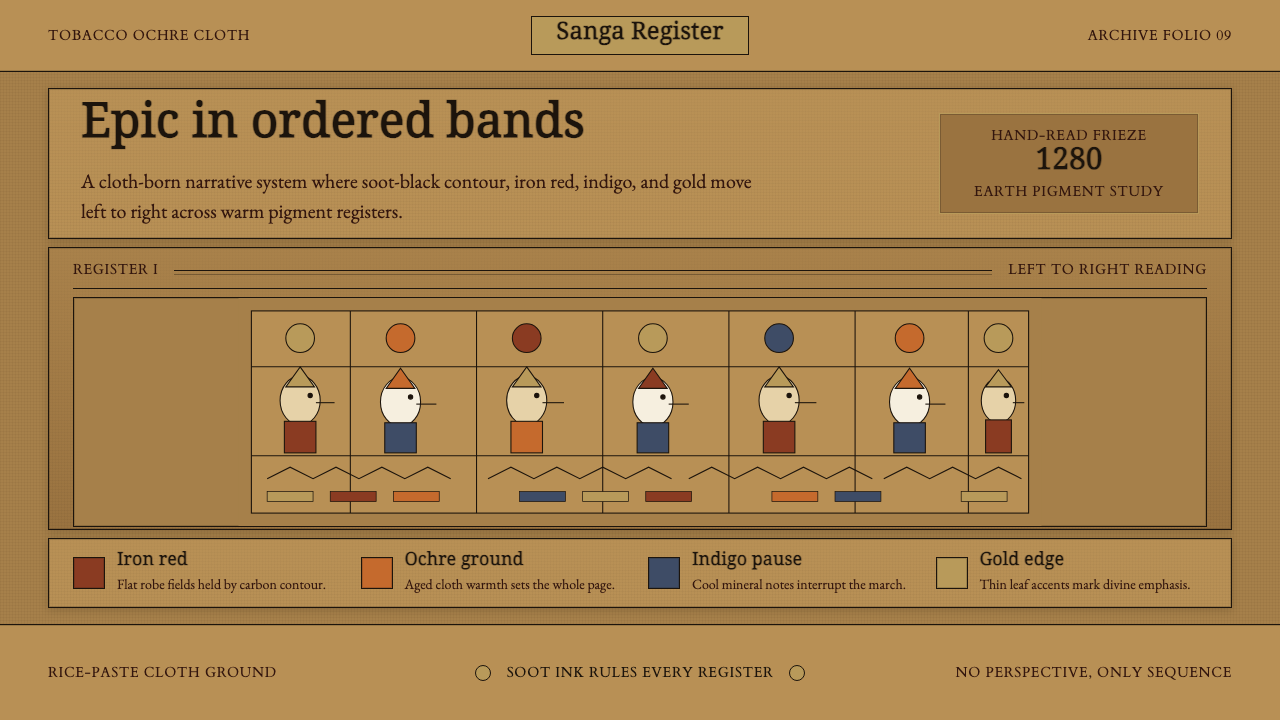
Kamasan painting is Bali's oldest surviving pictorial tradition — hand-inked wayang figures marching in narrative rows across cloth aged to the color of tobacco and earth.
Balinese Kamasan Painting in brief
Kamasan is the classical narrative painting style of Bali, named for the single village in Klungkung regency where it has been practiced, almost without interruption, for centuries by hereditary families of painters. Its subject matter comes almost entirely from the Hindu epics — the Mahabharata and the Ramayana — along with local moral tales and calendrical texts, rendered as continuous picture-stories rather than single framed scenes. A finished Kamasan work reads like a scroll frozen into a grid: the eye moves left to right, row by row, following armies, courts, and gods through episodes that unfold in sequence.
The visual grammar is instantly distinct from other Southeast Asian painting traditions because it is inseparable from Balinese shadow-puppet theater, wayang kulit. Figures are drawn in strict profile with elongated limbs, ornate crowns, and stylized facial types that signal moral character at a glance — refined heroes have narrow eyes and serene expressions, demonic or coarse characters have bulging eyes, fangs, and heavier proportions. This is not incidental decoration; it is a coding system the original audience could read instantly, the same way a viewer today reads a traffic light without thinking about it.
Color in Kamasan work is not applied for vibrancy but for legibility and permanence. The base pigments are mineral and earth-derived, and because the cloth itself is prepared rather than pre-primed white, the entire painting sits on a warm, aged ochre ground rather than a neutral one. Iron-oxide reds, soot-black ink outlines, and small, disciplined passages of indigo and gold leaf carry the narrative weight, but the ochre field underneath is what gives Kamasan its unmistakable, weathered warmth — closer to old parchment or tea-stained paper than to a modern white canvas.
Where does Balinese Kamasan Painting come from?
Kamasan village sits in the Klungkung regency of eastern Bali, and its painting tradition is tied directly to the fortunes of the Klungkung royal court, historically the senior kingdom among Bali's nine traditional principalities. Painters worked as court artisans, producing narrative cloths for temple ceilings, palace pavilions, and ceremonial banners, and the craft passed down through family lineages rather than through an open school or academy. This hereditary, workshop-based transmission is why the style has remained so stable for so long: technique, iconography, and even specific compositional formulas for well-known epic scenes were taught directly from parent to child, master to apprentice, inside a small number of related households.
The narrative content draws overwhelmingly on the Mahabharata and Ramayana as filtered through Balinese Hindu religious practice, alongside distinctly local material such as the Bhima Swarga (an underworld-journey text) and calendrical almanacs used for ritual timing. Because these paintings were functional objects — hung in temples, used to instruct on dharma and cosmology, displayed at ceremonies — the pictorial style prioritized clarity and recognizability over individual artistic expression. A painter's skill was measured by fidelity to established figure types and narrative conventions, not by innovation away from them, which is part of why Kamasan iconography reads as remarkably consistent across generations of otherwise unrelated works.
The clearest bridge to the style's visual logic is Bali's wayang kulit shadow theater. Both traditions share the same cast of stock characters, the same profile silhouette convention, and the same moral-legibility system built into facial and bodily proportion. Kamasan painting has sometimes been described as wayang theater rendered permanent — the puppeteer's cast, fixed in pigment on cloth instead of moving in lamplight and leather. This kinship is not superficial borrowing; both art forms likely developed within the same courtly ecosystem, serving the same religious and educational functions for Balinese audiences over centuries.
The tradition nearly lost its living practitioners in the twentieth century as fewer young people entered the hereditary painting families, but it was deliberately preserved and revitalized through the efforts of figures such as Nyoman Mandra, who founded a formal painting institute in Kamasan village to train new generations outside the strict family-lineage system, and I Nyoman Dogol, among other senior painters who maintained the classical technique through the mid-1900s. Their work ensured Kamasan survived as a living practice into the present rather than becoming a museum-only artifact, and Kamasan-trained painters continue to produce ceremonial and commissioned work for temples across Bali today.
What defines the Balinese Kamasan Painting look?
Ground and Field
Every Kamasan composition sits on the same warm, aged ochre field — not a neutral white or cream, but a deep tobacco-earth tone born from natural cloth preparation rather than pigment. This ground is treated as a constant, unifying stage rather than an empty backdrop; nothing in the composition floats free of it, and the field itself carries much of the work's aged, hand-touched character. Any digital application of this style should treat that ochre ground as load-bearing, not optional texture.
Line and Outline
Fine, confident ink outlines in a soot-derived black define every figure and object, drawn by hand with a bamboo pen. The line is the primary carrier of information — it establishes silhouette, gesture, and the profile stance that identifies character type — while color is filled in secondarily within those bounded shapes. This is a linework-first discipline, closer to the logic of illustrated manuscripts than to painterly blending.
Registers and Sequence
Narrative unfolds in horizontal bands, or registers, stacked one above another, with each register reading left to right like a line of text. Figures within a register are arranged at consistent scale and spaced with clear intervals, giving even the busiest battle or court scene an underlying orderliness. This register logic is what makes Kamasan compositions feel structured and sequential rather than chaotic, despite the density of figures.
Figure Typology
Characters follow a fixed typology borrowed from wayang puppet design: refined figures are drawn with narrow, downcast eyes and slender proportions to signal nobility and self-control, while coarse or demonic figures are drawn with wide bulging eyes, exposed fangs, and heavier, more exaggerated bodies to signal lack of restraint. This is a legible moral vocabulary encoded directly into anatomy, not an incidental stylistic quirk.
Restricted Accent Palette
Beyond the ochre ground and black outline, color is used sparingly and with discipline: iron-oxide red for garments, thrones, and blood or fire; a small, careful amount of indigo for shadow tones or specific costume elements; and gold leaf reserved for crowns, jewelry, and divine or royal attributes. No hue is applied for decorative variety alone — each accent color is tied to a specific narrative or status signal.
Density and Repetition
Kamasan compositions favor an all-over density: armies of near-identical soldiers, repeated floral or cloud motifs filling negative space, and ornamental borders framing the whole scene. Empty ground is rare — the field is meant to feel full and continuous, closer to a woven textile pattern than to a Western painting's use of open, breathing negative space.
Frontality and Profile Balance
Bodies are drawn almost entirely in profile, echoing the flat silhouette of a leather shadow puppet held against a screen, while certain symbolic elements — a crown's front face, a decorative panel — may be rendered more frontally to display their full form. This mixed convention, inherited directly from puppet-making, produces a graphic flatness distinct from any tradition built around naturalistic perspective or foreshortening.
Who shaped Balinese Kamasan Painting?
Kamasan's core innovation was never a single named master but a closed system of family workshops that transmitted technique and iconography directly from parent to child over many generations. This lineage-based transmission is why the style shows such remarkable formal consistency: newcomers were trained inside an established visual grammar rather than encouraged toward personal invention, and the resulting body of work reads as a coherent tradition rather than a collection of individual artistic voices.
As artisans attached to the senior royal court of pre-colonial Bali, Klungkung's court painters produced Kamasan work for temple ceilings, palace ceremonial cloths, and courtly commissions, embedding the style within the highest tier of Balinese religious and political life. This court patronage is part of why the iconography carries such formal, ceremonial weight — it was made to serve ritual and royal function, not private aesthetic taste.
A pivotal preservationist figure in the twentieth century, Mandra founded a formal painting institute within Kamasan village specifically to train new painters outside the traditional closed family-lineage system, at a time when fewer young people were entering the hereditary workshops. His institutional approach — teaching classical technique as a curriculum rather than a private family inheritance — is widely credited with keeping Kamasan painting a living, practiced tradition rather than one that faded out with its last hereditary masters.
Among the senior painters who carried the classical Kamasan technique through the middle decades of the twentieth century, Dogol represents the generation of masters whose disciplined, hand-taught skill kept the tradition's core visual vocabulary — the fixed figure typology, the register-based narrative structure — intact and transmissible even as broader social change reshaped village life across Bali.
How do you use Balinese Kamasan Painting today?
Kamasan's most transferable quality for contemporary design is its narrative-register logic: the idea that a composition can be organized into clear horizontal bands, each read in sequence, each holding a consistent scale of figures or content. This makes the style unusually well suited to any format that already tells a story in steps or stages, rather than presenting a single static image.
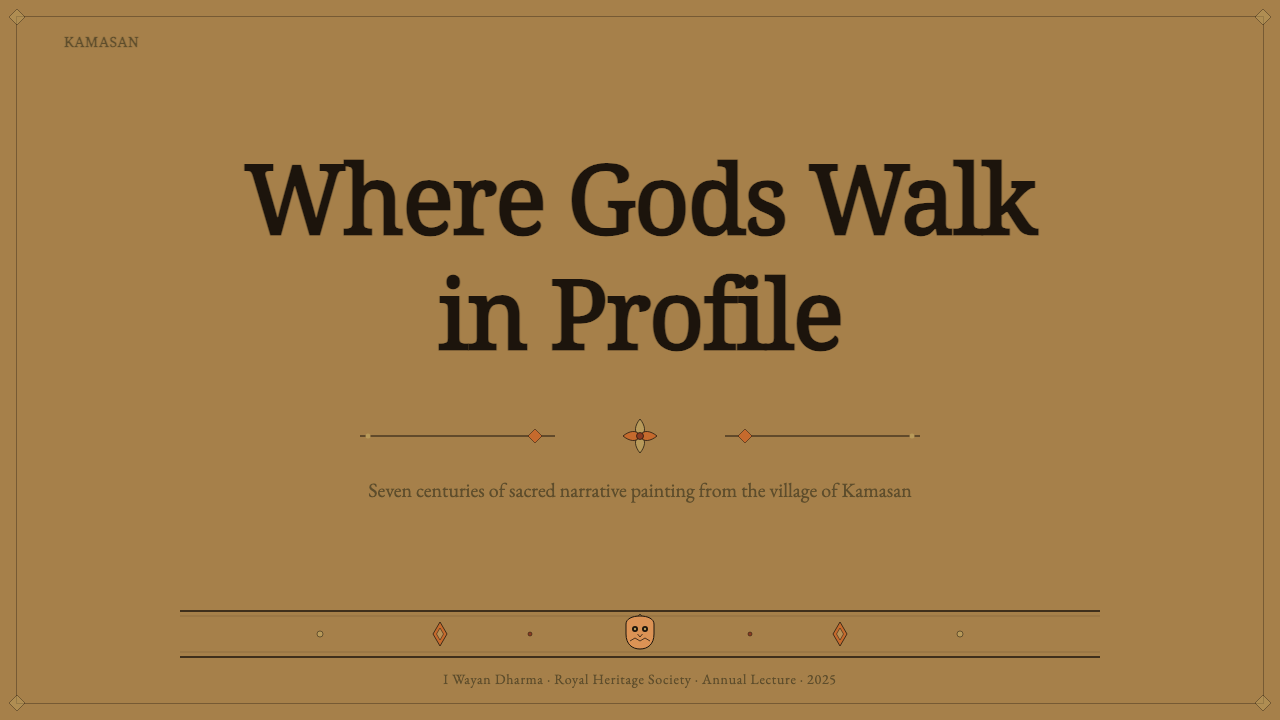
For presentation slides, Kamasan's register structure translates naturally to sequential storytelling decks: a cover slide can use the warm ochre field and a single dense, ornamental band of imagery to set tone, while content slides adopt the register principle directly — one horizontal band per key point, each holding consistent visual weight, moving the eye top to bottom the way the original moves the eye left to right. Data slides benefit from the style's disciplined, restrained accent-color logic: a chart's few emphasized data points can borrow the iron-oxide red or gold-leaf role, reserved for what matters most, against a calm ochre-toned field rather than a stark white one.
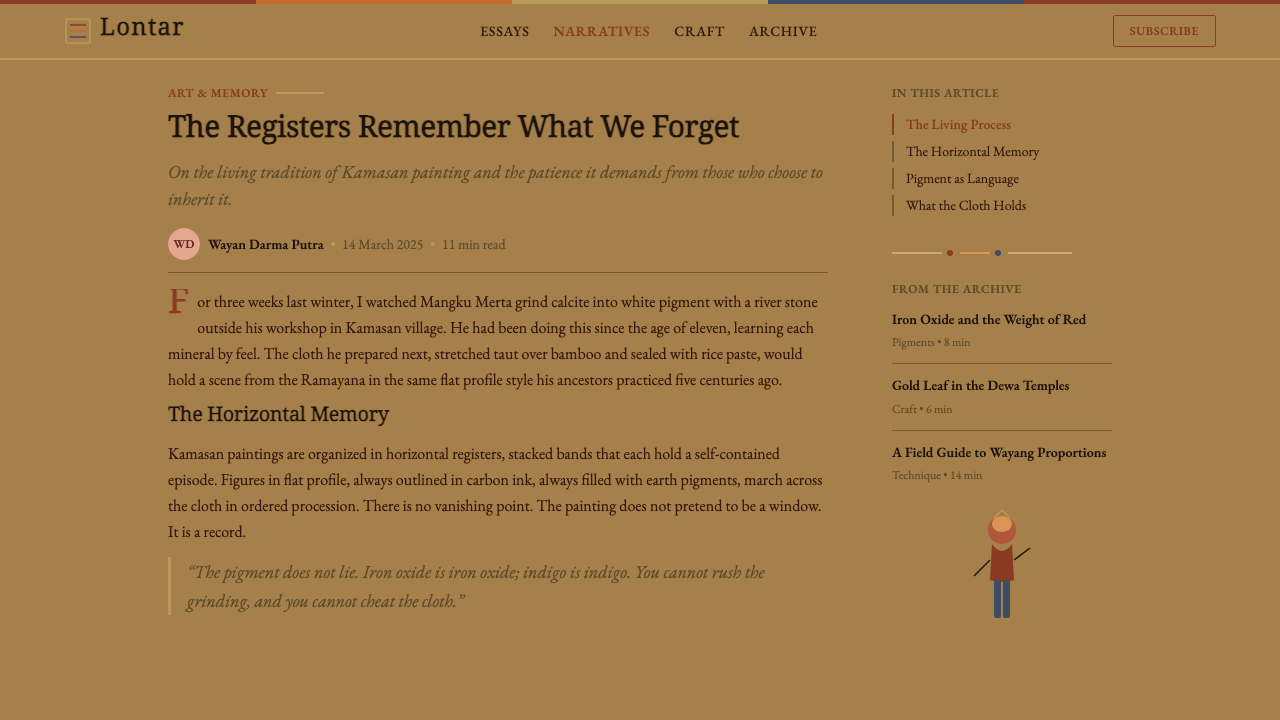
For web interfaces, the style is a strong match for editorial and storytelling-driven products rather than dense utility dashboards — think a narrative-first landing page, a long-form cultural or historical product, or a UI that wants to feel handcrafted and warm rather than clinical. The ochre ground and restrained accent palette read as considered and aged rather than performance-app bright, and the register logic can organize a scrolling page into clear, sequential sections with a consistent rhythm from one to the next.
For editorial and marketing work, Kamasan's density and all-over ornamental quality make it well suited to feature spreads and brand storytelling that want richness without visual noise — pattern-filled borders, a consistent accent color reserved for calls to action, and a warm aged field replacing the more common stark-white magazine ground. The style communicates heritage, craft, and permanence, which suits brands built around tradition, provenance, or slow-made goods.
A common mistake when applying Kamasan is treating it as a generic 'ethnic pattern' skin — dropping in busy ornamental borders on a white background without the ochre field underneath, or scattering red and gold decoratively rather than reserving them for specific points of emphasis. The style's power comes from restraint within density: every accent color is doing narrative work, and the field itself is never neutral. Losing either principle collapses the style into surface decoration rather than the structured storytelling system it actually is.
Balinese Kamasan Painting — FAQ
What does the word 'Kamasan' actually refer to?
Kamasan is the name of a specific village in the Klungkung regency of eastern Bali, and the painting style is named after that village because it has been the geographic and family-based center of this hereditary tradition for centuries. It is not the name of a technique, an artist, or a historical period on its own — it identifies a place whose painter families have practiced and preserved this particular visual grammar across many generations.
Is Kamasan painting the same thing as Balinese shadow puppetry?
They are closely related but not identical. Wayang kulit is a performance tradition using flat leather puppets moved against a lit screen, while Kamasan is a static painting tradition on cloth. What they share is the same cast of stock characters, the same profile-silhouette convention, and the same coded system linking facial and bodily proportion to moral character. Kamasan painting is sometimes described as wayang theater rendered permanent in pigment, but the two developed as distinct art forms serving related but different functions within Balinese culture.
Why is the background always a warm ochre tone instead of white?
The ochre ground comes from the traditional preparation of the cotton cloth itself, which naturally ages to a warm tobacco-earth tone rather than being pre-primed to a neutral white. Because the field is a byproduct of the material process rather than a decorative choice, it functions as a constant, unifying element across the entire composition — every figure and motif is understood to sit within that same aged, warm-toned world, which is part of what gives Kamasan work its distinctive, weathered character.
What subjects does Kamasan painting typically depict?
The dominant subject matter is drawn from the Hindu epics — the Mahabharata and the Ramayana — depicting courts, battles, and the deeds of gods and heroes. Alongside these, Kamasan painters have historically produced works based on distinctly Balinese texts, such as the Bhima Swarga underworld narrative, and calendrical or astrological content used to time religious ceremonies. Because the paintings originally served temple and palace functions, subject matter tends toward material with religious or moral instructional value rather than purely decorative scenes.
Does Kamasan-inspired design work well for modern, minimal interfaces?
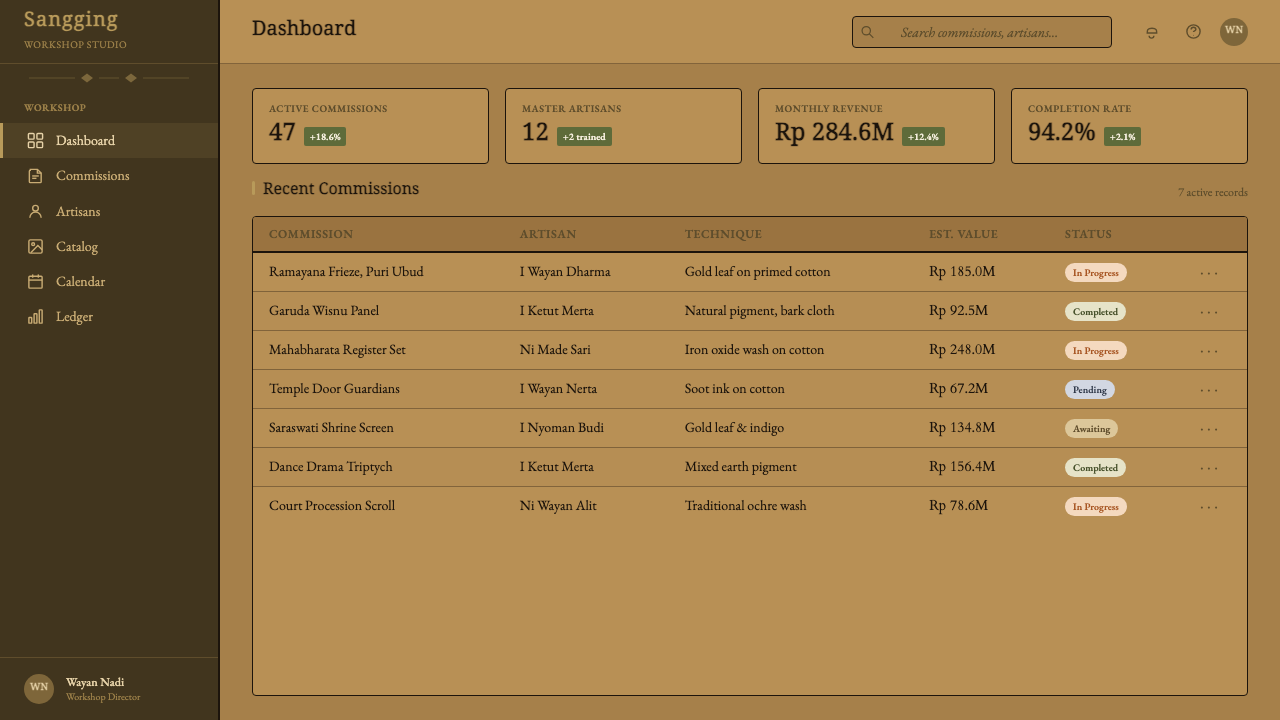
It works best when a product wants warmth, heritage, and narrative density rather than clinical minimalism — the style's aged ground, all-over ornamental fill, and restrained-but-present accent colors are fundamentally at odds with the stark white space and sparse accenting typical of minimal digital interfaces. It reads strongly on storytelling-first products, cultural or heritage brands, and long-form editorial contexts, but applying it to a dense, purely functional dashboard tends to fight the tool's need for fast, uncluttered scanning rather than support it.
Related design styles
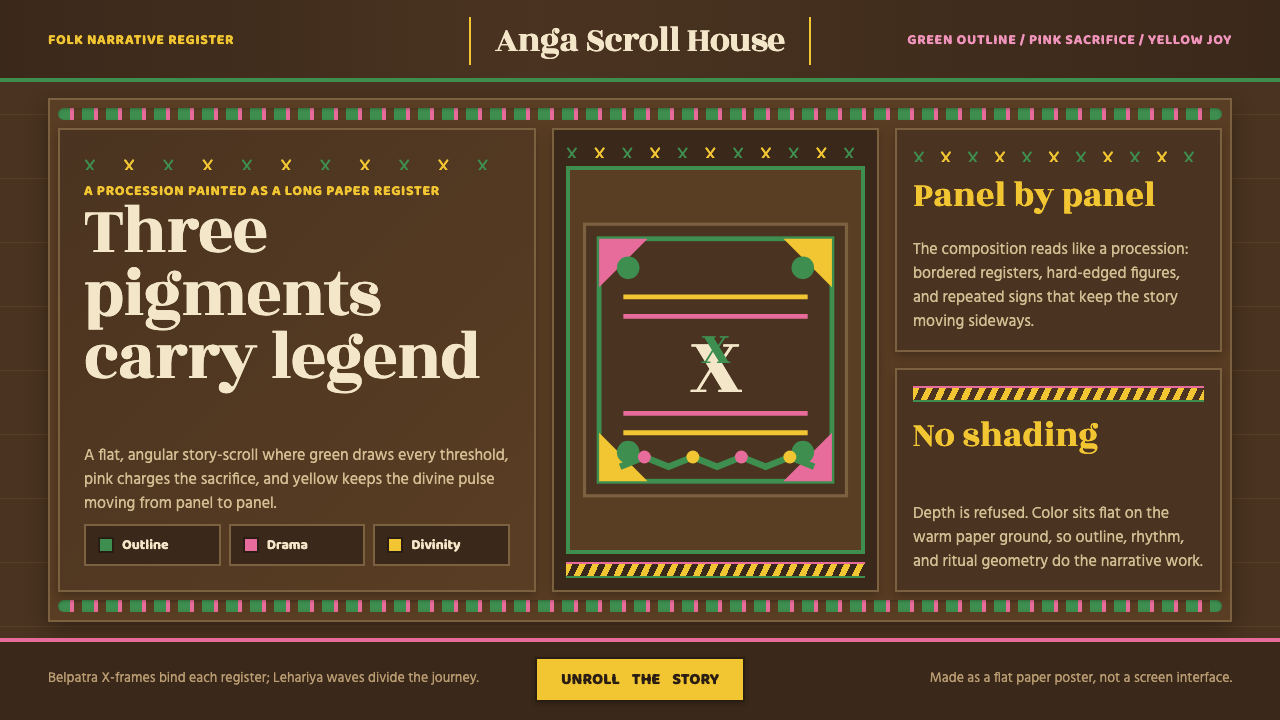 Manjusha Anga Snake-ScrollLegend moves in three pigments. Green outline, pink drama, yellow divinity on…
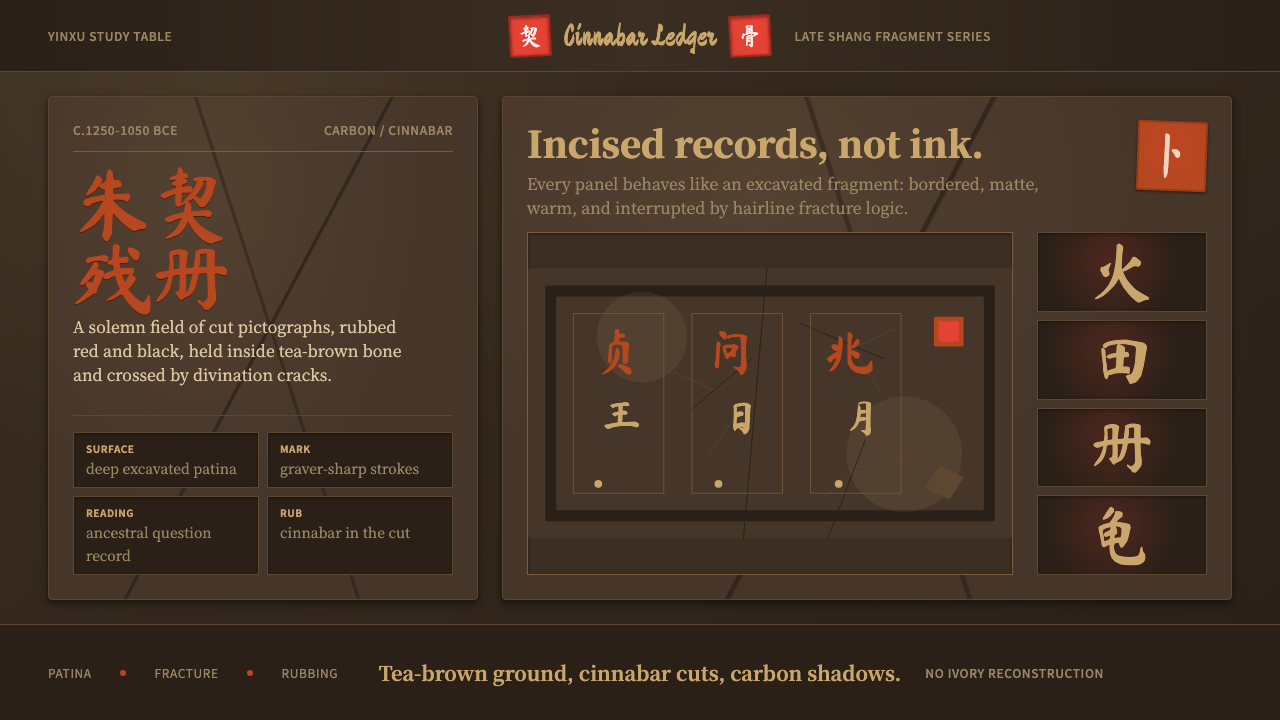 Oracle Bone 甲骨文Feels excavated, not restored. Tea-brown panels carry cinnabar glyphs and cra…
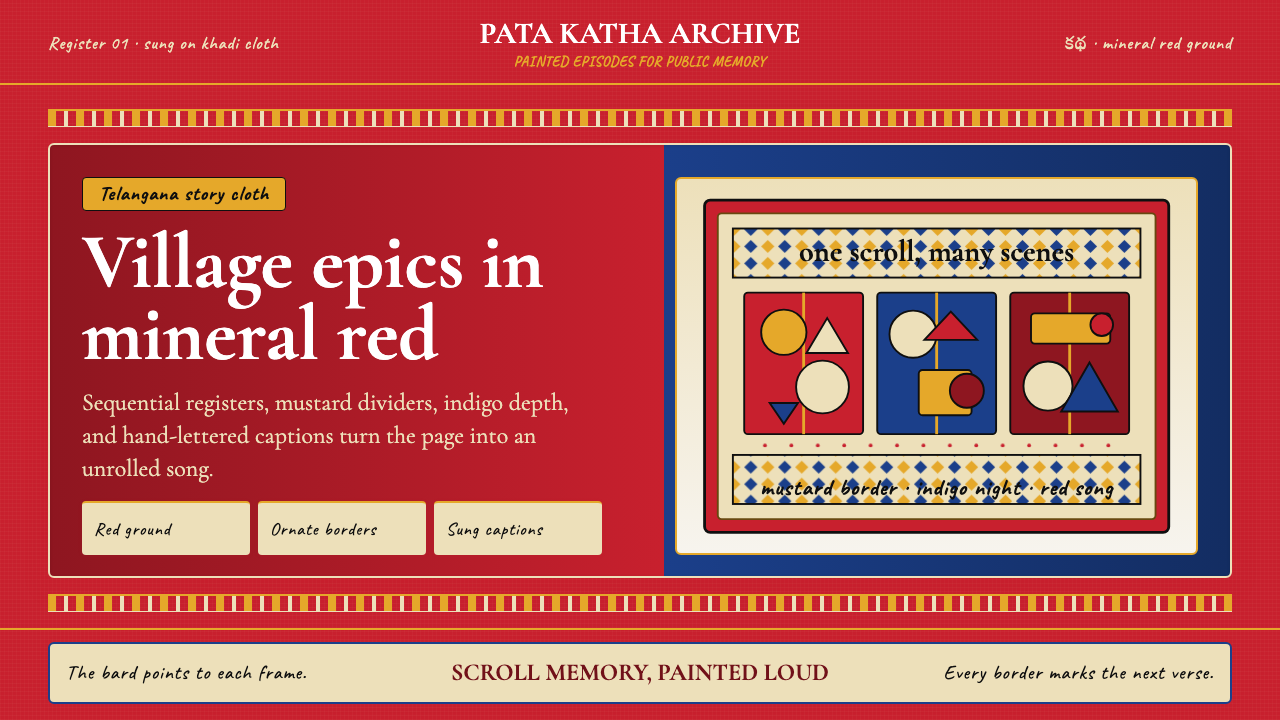 Andhra Cheriyal Scroll PaintingSaturated oral memory. Mineral red registers, mustard diamonds, and serif son…
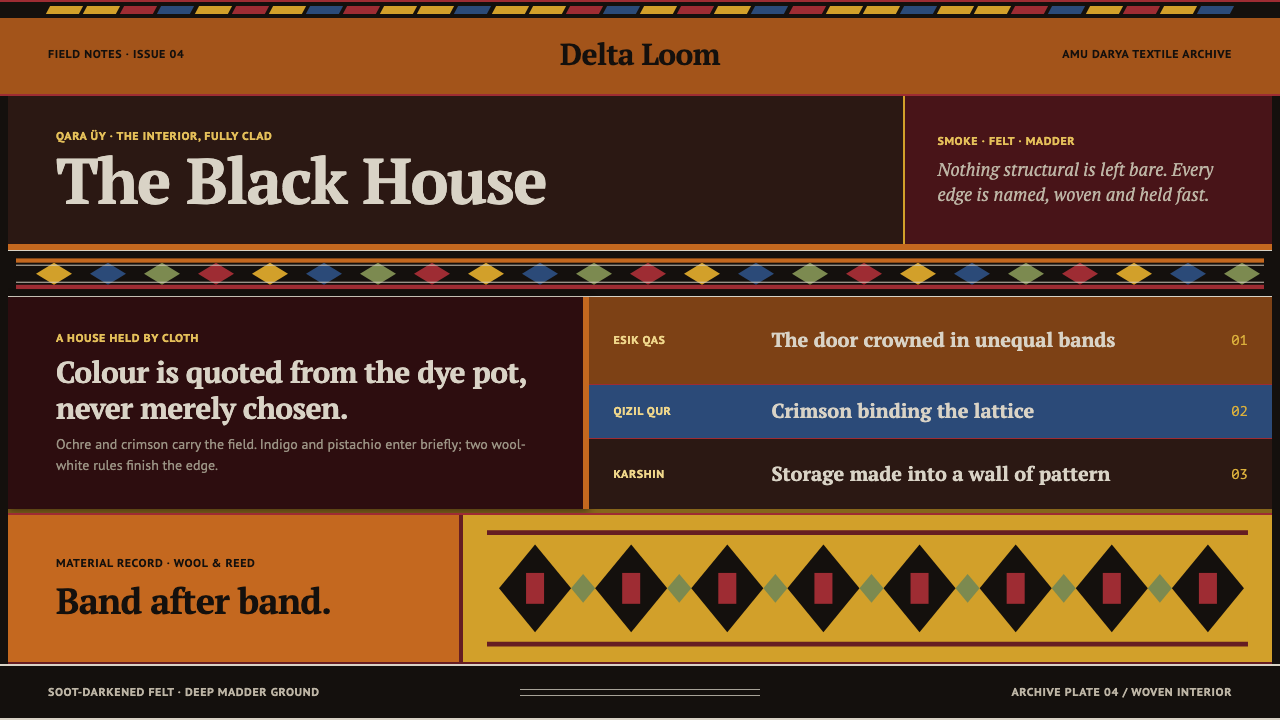 Karakalpak Yurt InteriorNo surface is left bare. Ochre, crimson and indigo bands wrap a smoke-darkene…
 Akan Adinkra (Ghana)Proverbs become cloth. Russet grids, lampblack serif marks, and gold-edge ban…
 Akan Carved StoolMatte wood carries memory. Honey amber, Marcellus type, and crescent-column r…