What is Obsidian Volcanic Glass?
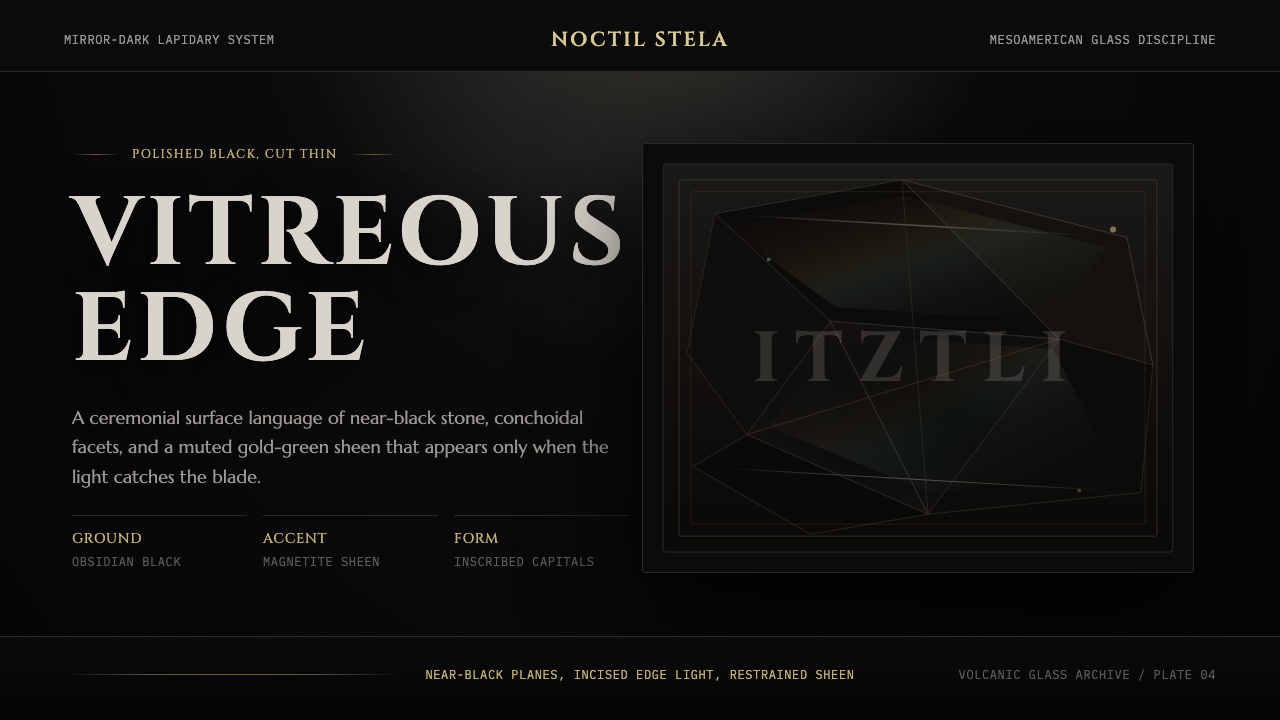
Obsidian Volcanic Glass carries the discipline of itztli — the mirror-dark stone Aztec craftsmen ground into scrying mirrors and knapped into blades sharper than steel.
Obsidian Volcanic Glass in brief
Obsidian Volcanic Glass takes its discipline from itztli, the Nahuatl name for the jet-black volcanic glass that Aztec artisans ground into scrying mirrors dedicated to the god Tezcatlipoca and knapped into the razor-thin cutting edges of the macuahuitl, a wooden war club lined with obsidian blades. The surface this system draws from is mirror-dark and vitreous, carrying a faint golden-green sheen that fine mineral inclusions throw back at the light when the stone is turned.
As a design system, this translates into a monochrome language of carved-stone gravitas and edged precision: near-black grounds that behave like polished stone rather than flat digital fill, facets that fracture the way obsidian itself fractures — in smooth, curved conchoidal shells rather than straight geometric planes — and thin metallic highlights traced along those facet edges rather than washed across whole surfaces.
Lettering in this system reads as inscriptional: sturdy Roman capital forms that look cut into a stone stela rather than printed on a screen, echoing the carved glyphic traditions of Mesoamerican monuments. Crucially, nothing here is gilded. The golds present are muted rather than bright or reflective — the visual weight comes from the stone's own luster and the precision of its edge, never from applied ornament.
Where does Obsidian Volcanic Glass come from?
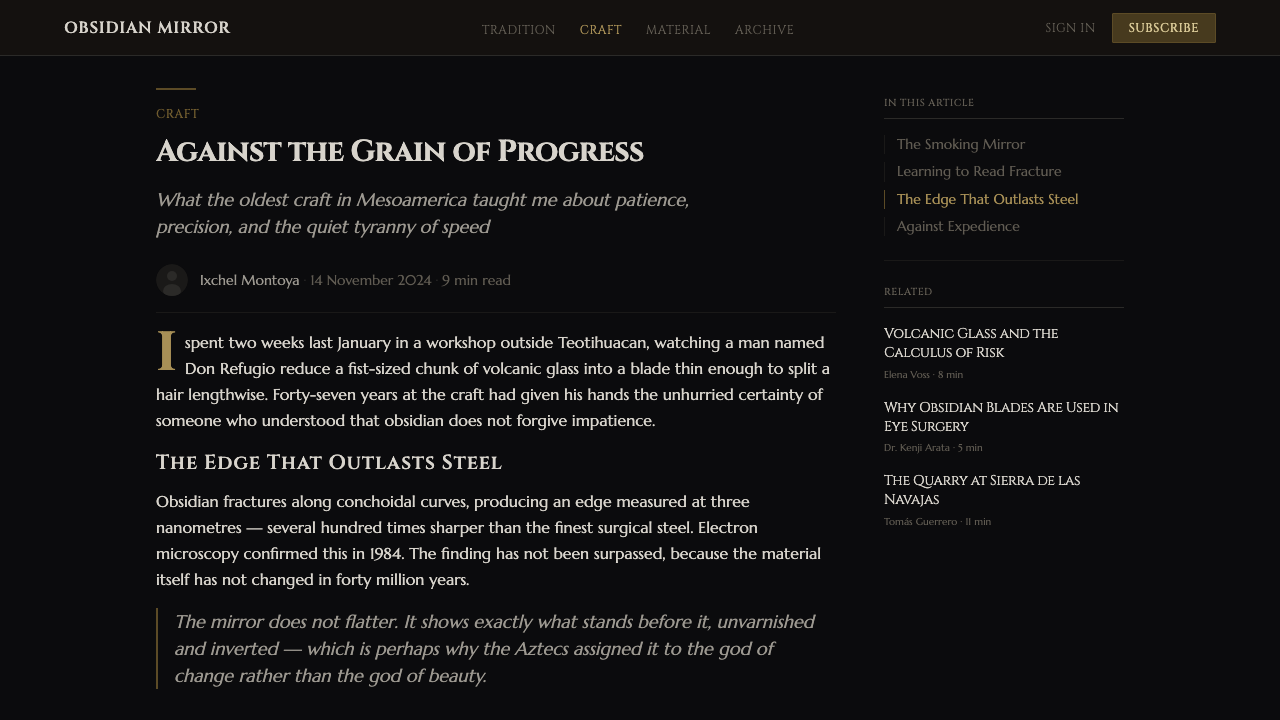
Obsidian forms when felsic lava cools so rapidly that its minerals have no time to crystallize, producing a natural glass rather than a crystalline rock. Because it lacks a crystal structure, obsidian fractures in smooth, curved conchoidal shells — the same fracture pattern seen in thick window glass — producing an edge that can be thinner and sharper than a surgical steel blade. Cultures across the world, from the Mediterranean to the Pacific, prized obsidian for cutting tools for this reason alone, but Mesoamerican civilizations developed by far the most elaborate visual and ceremonial culture around the stone.
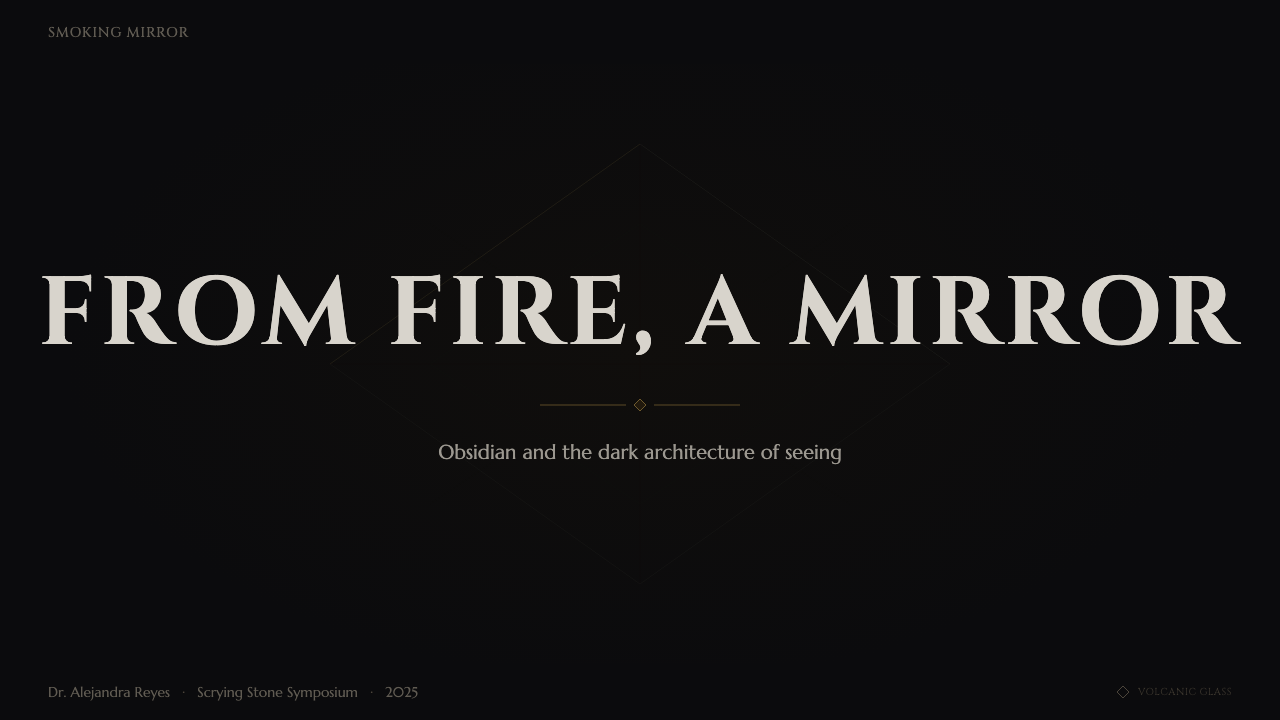
In the Aztec world, obsidian carried meaning well beyond utility. Polished obsidian discs and mirrors were associated with the god Tezcatlipoca, whose name translates to 'Smoking Mirror,' and were used in divination — the dark, reflective surface was understood as a window into hidden knowledge rather than simply a reflective object. High-status obsidian mirrors and ornaments circulated through the pochteca, the long-distance merchant class who controlled trade in luxury goods across the Aztec tribute and exchange networks, with especially prized green-tinted obsidian sourced from the Pachuca region.
The stone's martial application was equally significant: the macuahuitl, a flat wooden club edged with rows of knapped obsidian blades, was capable of inflicting severe wounds and was documented with evident astonishment by Spanish chroniclers who encountered Aztec warriors during the conquest of the early 16th century — accounts describe blades sharp enough to decapitate a horse in a single blow, a claim that speaks to how genuinely formidable the material's edge was considered, whatever its precise accuracy.
Obsidian's mystique also crossed into Europe: an Aztec obsidian mirror, likely brought back in the aftermath of the Spanish conquest, later came into the possession of the English Renaissance polymath John Dee in the 16th century, who used it in his angelic scrying practices. That mirror survives today in the British Museum, a direct physical link between Mesoamerican lapidary craft and European esoteric history, and a reminder that the stone's association with hidden vision long outlived the civilization that first ground it into mirrors.
What defines the Obsidian Volcanic Glass look?
Mirror-Dark Vitreous Surface
Grounds read as polished volcanic glass rather than matte fabric or flat digital black — there is a glassy depth to the darkness, as though light could theoretically penetrate a short distance before being absorbed. This vitreous quality is what separates the style from a generic black background.
Conchoidal Fracture Facets
Faceting follows the smooth, curved fracture pattern natural to obsidian rather than straight-edged geometric cuts. Panels and dividers should feel like they were struck from a larger mass, with gently curving edges rather than crisp rectilinear boundaries.
Golden-Green Sheen
A faint, shifting golden-green luster plays across the dark surface, echoing the way magnetite inclusions in genuine obsidian catch and scatter light. This sheen should appear only at edges and highlights, never as a broad wash, and should feel like an inherent property of the material rather than an applied glow.
Muted Metallic Edge Highlights
Where metallic accents appear, they trace the edges of facets as thin lines rather than filling whole surfaces, and the gold used is deliberately muted rather than bright or reflective. This restraint is intentional — the material's own luster, not applied gilding, is meant to carry the sense of value.
Inscriptional Capital Lettering
Type reads as though cut into stone rather than printed — sturdy, evenly weighted Roman capital forms with the gravitas of text carved into a stela. This lettering treatment reinforces the sense of permanence and ceremonial weight running through the system.
Near-Black Monochrome Palette
The overwhelming majority of any composition stays within a narrow range of near-black tones, with the faint golden-green sheen and muted metallic highlights serving as the only departures. Wide swings into bright or saturated color would undermine the stone-like discipline the system depends on.
Carved-Stone Gravitas
The overall feeling is weighty and deliberate rather than light or fast — elements feel struck and shaped from solid material rather than rendered from nothing. This gravitas should extend to motion and interaction as well: transitions favor slow, weighted movement over quick, bouncy animation.

Who shaped Obsidian Volcanic Glass?
One of the principal deities of the Aztec pantheon, Tezcatlipoca's name translates to 'Smoking Mirror,' directly referencing the polished obsidian discs used in his worship and in divination practices, which linked the stone's dark, reflective surface to hidden knowledge and fate rather than mere ornamentation.
The English Renaissance mathematician, astrologer, and advisor to Elizabeth I acquired an Aztec obsidian mirror, likely brought to Europe in the aftermath of the Spanish conquest, and used it in his angelic scrying sessions; the mirror survives today in the British Museum, linking Mesoamerican lapidary craft directly to European esoteric history.
A Spanish conquistador and chronicler who accompanied Hernán Cortés during the conquest of the Aztec Empire, Díaz del Castillo documented Aztec warriors' use of the obsidian-bladed macuahuitl in his firsthand accounts, providing some of the earliest European written descriptions of the weapon's formidable cutting power.
The obsidian-working communities centered near Pachuca, source of a prized green-tinted obsidian, developed the specialized knapping techniques that produced Mesoamerica's finest mirrors, blades, and ceremonial objects, feeding the material into trade networks controlled by the pochteca merchant class.
How do you use Obsidian Volcanic Glass today?
Obsidian Volcanic Glass carries a register of gravitas, precision, and quiet luxury that suits products wanting to feel weighty, expert, and considered — but its severity works against contexts that need to feel casual, playful, or approachable.
For presentation slides, the style is strongest on cover pages and closing statements, where a near-black field with a single faceted, golden-green-lit form can carry significant visual authority on its own. Content slides should keep the same near-black ground but use the metallic highlight sparingly — reserved for a single key figure or callout per slide — so that its rarity preserves its impact rather than becoming routine decoration.
For web interfaces, the aesthetic suits premium product pages, luxury e-commerce, and portfolio sites for craft-forward brands far better than everyday utility interfaces. A pricing page can use faceted card edges and muted gold accents to differentiate tiers, but dashboards and data-dense tools should generally avoid the style, since its deliberate visual weight works against fast scanning.
For editorial and marketing content, the style rewards long-form storytelling about craft, heritage, or material quality — a landing page hero built from a large faceted near-black form with restrained metallic edge lighting sets an immediately serious, premium tone. Marketing calls-to-action should use the muted gold sparingly as a signal of importance rather than a decorative flourish repeated throughout the page.
A common mistake is brightening the gold accents until they read as gilded rather than mineral — genuine obsidian luster is subtle and shifts with viewing angle rather than glowing uniformly, and pushing the gold toward brightness collapses the material honesty the style depends on. A second mistake is using straight, geometric faceting instead of the smooth, curved conchoidal fractures obsidian actually produces, which makes the system read as generic 'dark luxury' rather than specifically stone-derived.
Obsidian Volcanic Glass — FAQ
What exactly is obsidian, and why does it fracture so distinctively?
Obsidian is a natural volcanic glass formed when felsic lava cools too quickly for its minerals to crystallize. Because it lacks the internal crystal structure of ordinary rock, it fractures the way thick glass does — in smooth, curved conchoidal shells rather than along straight crystal planes — which is why knapped obsidian can produce an edge thinner and sharper than surgical steel.
Why does the name 'itztli' matter for understanding this style?
Itztli is the Nahuatl word for obsidian, and grounding the style in that specific term rather than a generic label like 'black glass' keeps the design anchored to its actual Mesoamerican origin — the scrying mirrors, the macuahuitl blades, the trade networks — rather than letting it drift into a vague, placeless 'dark luxury' aesthetic with no cultural specificity.
Where does the golden-green sheen in genuine obsidian actually come from?
In real obsidian, this sheen — sometimes called 'gold sheen' or 'rainbow' obsidian depending on the effect — comes from microscopic mineral inclusions, often tiny crystals of magnetite or other minerals, aligned in layers within the glass. Light scatters off these aligned inclusions at certain angles, producing a shifting metallic luster rather than a uniform, flat color.
Was obsidian only used for ceremonial mirrors, or did it have practical applications too?
Obsidian's practical uses in Mesoamerica were extensive and predate its ceremonial associations — its extreme sharpness made it valuable for everyday cutting tools, surgical blades, and weapons long before any specific ceremonial or divinatory use developed. The macuahuitl, an obsidian-bladed war club, was a functioning weapon documented by Spanish chroniclers as capable of inflicting severe wounds, not a purely symbolic object.
Why does this style avoid bright gilding even though gold appears in it?
Because the visual authority of genuine obsidian comes from the stone's own subtle luster, not from applied decoration — a bright, reflective gold reads as something layered on top of the material, while a muted, shifting gold reads as an inherent property of the stone itself. Keeping gold muted preserves the sense that value here comes from precision and material quality rather than from ornament.
Related design styles
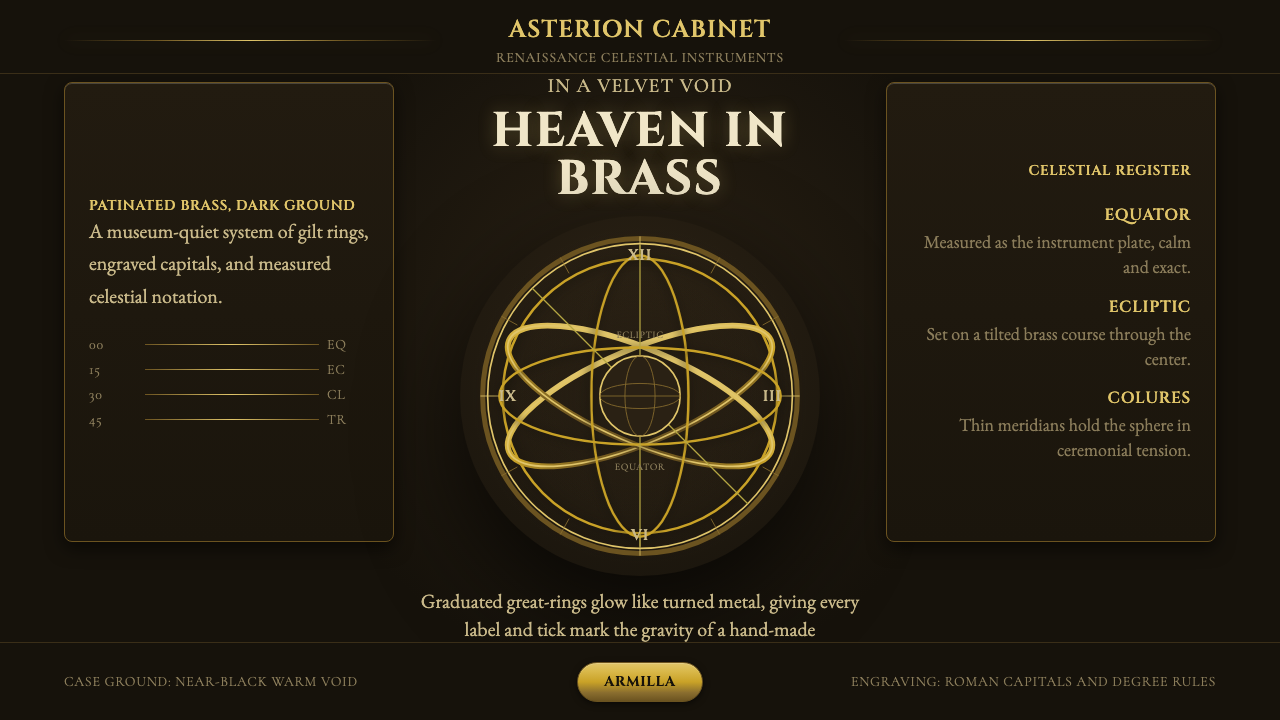 Armillary SphereMuseum darkness makes brass celestial. Cinzel capitals and concentric gold ri…
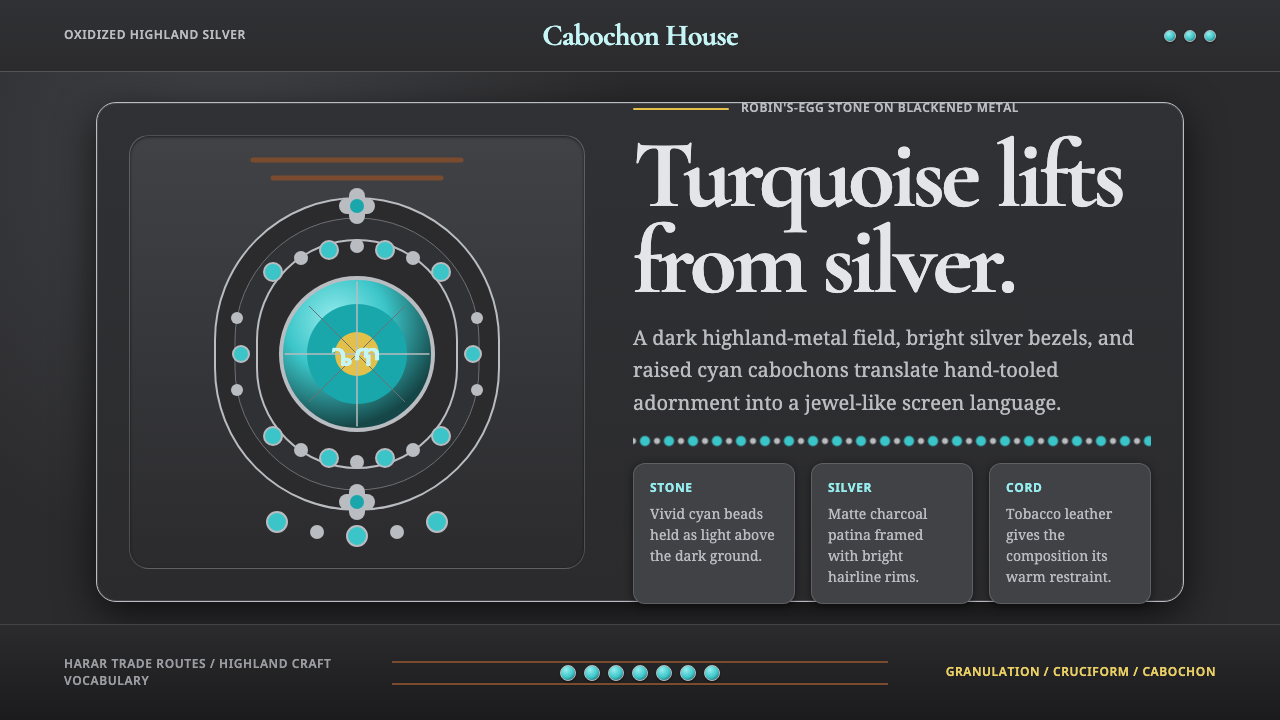 Ethiopian Turquoise SilverDark metal makes stone glow. Cyan cabochons and silver bead rows frame a matt…
 Inca Tocapu TunicA dark grid becomes authority. Teal, cochineal, and ochre squares read like c…
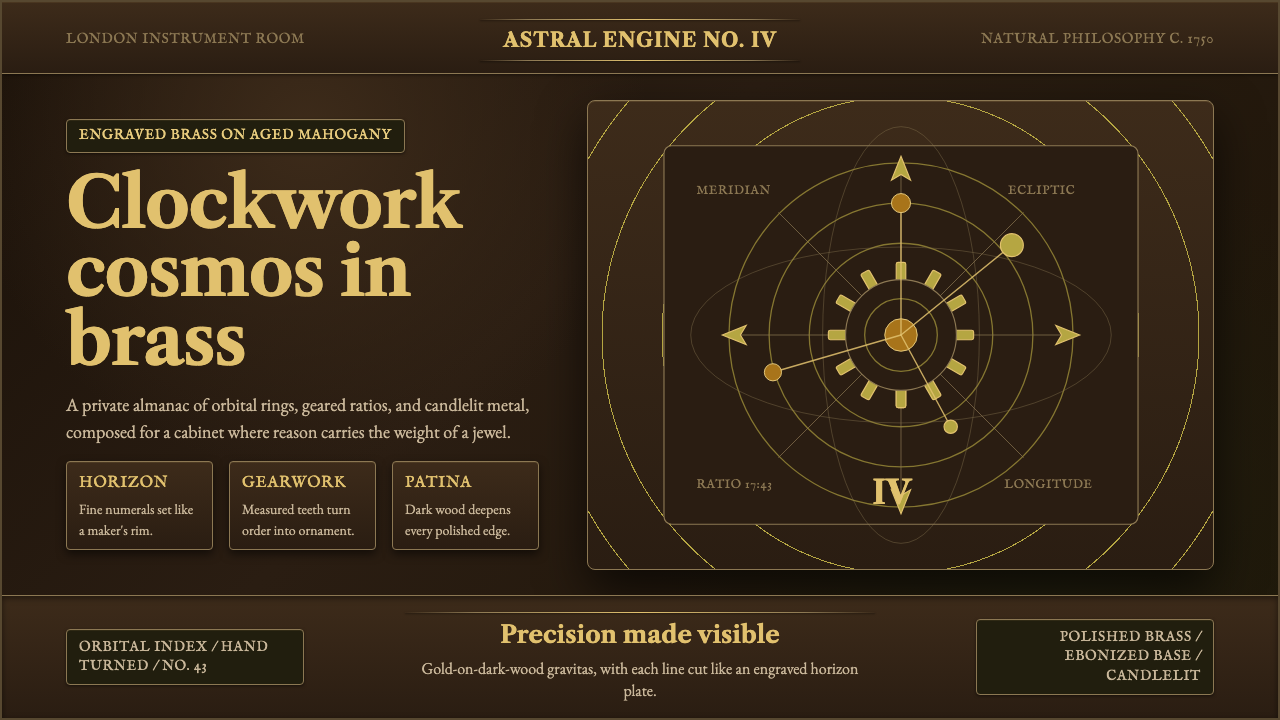 Brass OrreryTurns reason into gold. Brass rings and Caslon type glow over near-black maho…
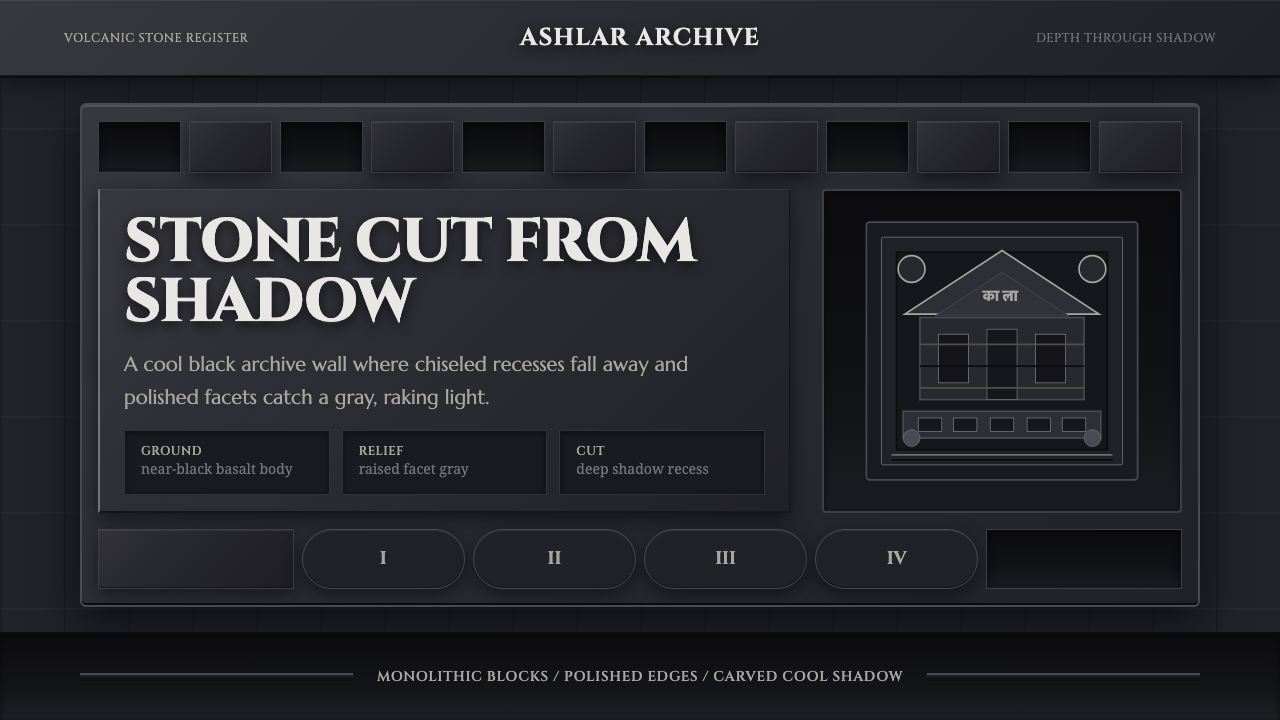 Deccan Basalt TempleMonumental shadow, carved. Near-black basalt, Cinzel capitals, and relief gri…
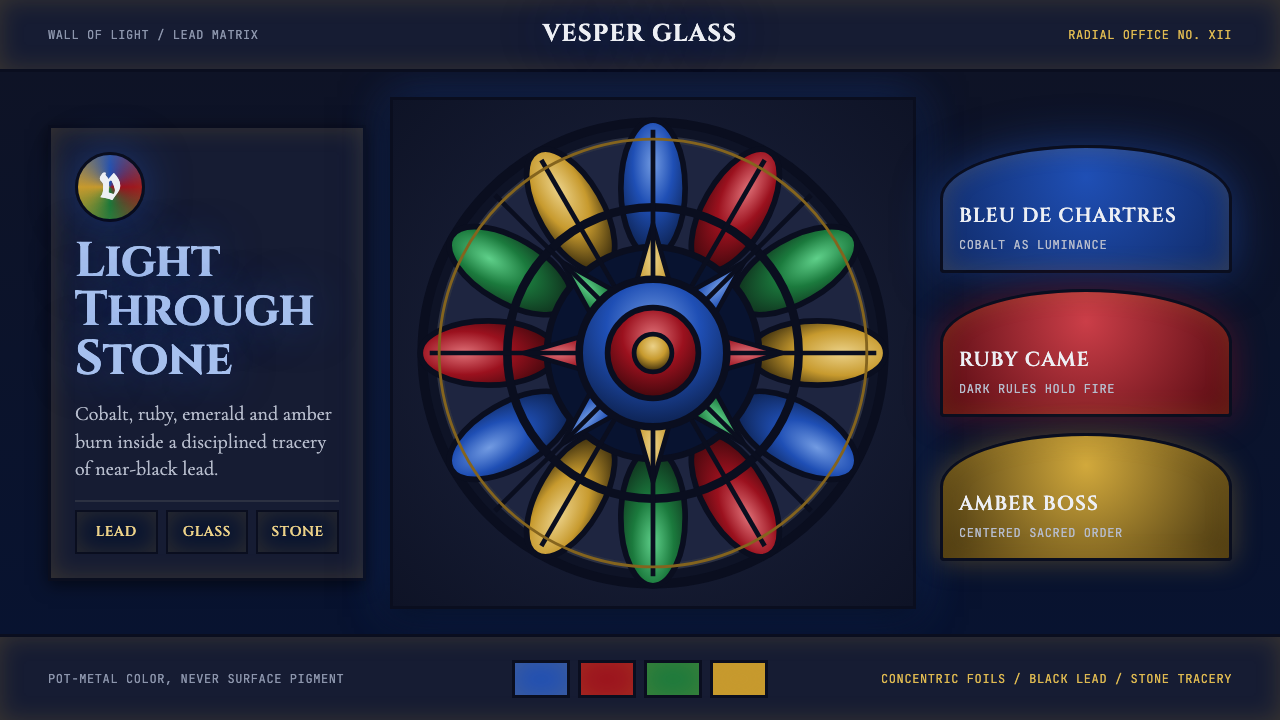 Gothic Rose WindowDarkness becomes light. Cobalt glass, ruby foils and black lead form a radial…