What is Nike "Just Do It" (1988)?
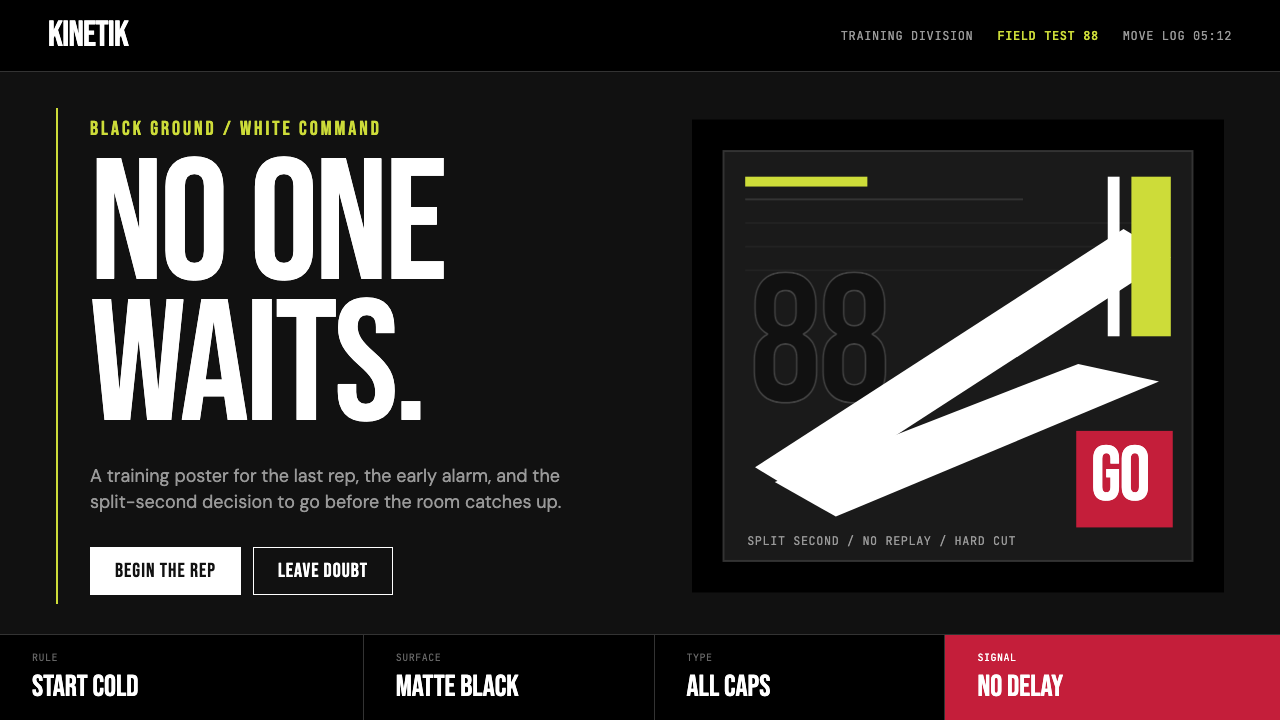
Nike's 1988 campaign condensed athletic ambition into three words — and a visual system of black, white, and one electrifying flash of color that has never stopped commanding.
Nike "Just Do It" (1988) in brief
Nike's 'Just Do It' visual identity is the defining athletic design language of the late twentieth and early twenty-first century. Its vocabulary is spare to the point of severity: a deep black or white field, a single curved white Swoosh, full-bleed action photography, and condensed uppercase letterforms that shout rather than speak. The palette introduces color only as a deliberate strike — a volt-yellow accent, a heritage orange-red — never as ambient decoration.
The power of the system lies in what it omits. There are no gradients softening the background, no ornamental frames around the athlete, no explanatory subtext competing with the headline. Every element earns its presence by being load-bearing: the photograph carries narrative, the type carries command, the Swoosh carries brand recognition, and the surrounding negative space carries intensity. Remove any element and the construction collapses.
Visually, the identity operates at two simultaneous registers — documentary and mythological. The photography is cropped and framed to feel immediate and kinetic, as though the camera just caught the decisive moment. But the graphic system around it — the pure fields of black, the commanding type — elevates the athlete into archetype. The result is a design language that feels both personal and universal, both fleeting and permanent.

Where does Nike "Just Do It" (1988) come from?
Nike was incorporated in 1971 in Beaverton, Oregon, evolving from Blue Ribbon Sports, a company Phil Knight had started in 1964 to import Japanese running shoes. That same year, graphic design student Carolyn Davidson was commissioned to create a logo. Knight reportedly said he did not love it, but paid thirty-five dollars for it and put it into production. The form she designed — a curved, wing-like check mark suggesting motion — was originally called the 'Stripe.' The name 'Swoosh,' which would become one of the most recognizable marks in commercial history, came later, coined internally at the company.
Through the 1970s and early 1980s, Nike built its reputation on performance product and athlete endorsements, but its advertising remained conventional. The pivotal shift came in 1988, when the Portland advertising agency Wieden+Kennedy — already Nike's creative partner — was preparing a national campaign. Dan Wieden, the agency's co-founder, was reportedly struck by the last words of convicted murderer Gary Gilmore before his 1977 execution: 'Let's do it.' Wieden transformed this into 'Just Do It' and applied it to a campaign that launched with an eighty-year-old marathon runner named Walt Stack. The tagline was designed to be universal — applicable to every athlete at every level, from the elite to the ordinary.
The broader visual identity that 'Just Do It' inhabits was shaped across the late 1980s and 1990s as Nike grew from a running-shoe company into a global sports conglomerate. Tinker Hatfield, Nike's most celebrated footwear designer, contributed to the visual culture by designing shoes — the Air Max series, the Air Jordan line with Michael Jordan — that became as visually iconic as any graphic element. The black-dominant, high-contrast aesthetic became associated with Nike's premium positioning and its stable of elite athletes: Michael Jordan, Bo Jackson, Andre Agassi, and later Tiger Woods, Serena Williams, and LeBron James.
Wieden+Kennedy developed a film and print advertising language to match: athlete close-ups in high contrast, minimal text, the Swoosh placed without a wordmark, and the tagline occupying its own visual field with nothing competing for attention. By the early 1990s, the 'Just Do It' campaign had contributed to Nike's revenue growing from approximately eight hundred million dollars to over four billion dollars in under a decade. The visual system had become inseparable from the cultural mythology of sport itself — not just a brand, but a posture and a set of values that millions of people wanted to claim as their own.
What defines the Nike "Just Do It" (1988) look?
Color
The foundational palette is extreme: pure black grounds against pure white marks, or the reverse. Color is introduced not as a fill or ambient hue but as a singular accent — a volt-green yellow, a blazing orange-red, a clear sky blue — deployed in a single element per composition. This 'one-strike' color logic means the accent always reads as a decision rather than a decoration. When multiple colorways appear across a campaign, each colorway is disciplined to a single accent, never a gradient or a blend.
Typography
Uppercase, condensed letterforms dominate all headline and campaign text. Letters are set tightly — tracking reduced to near-zero — so that words read as solid graphic blocks rather than sequences of individual characters. This condensed, close-set approach maximizes the visual weight of short phrases like the three-word tagline. Body copy, when it appears, is set in a neutral, highly legible grotesque at a much smaller scale, creating extreme size contrast that reinforces the hierarchy: command first, detail secondary.
The Swoosh Mark
The curved check mark — the Swoosh — functions as both a brand identifier and a compositional anchor. In Nike's mature visual identity, it frequently appears without any accompanying wordmark, relying entirely on its form to communicate brand. The Swoosh is often placed asymmetrically: in a corner, at the edge of a photograph, or as the sole graphic element on a black field. Its directional quality — the mark reads left-to-right, curving upward at its tip — reinforces the forward-motion narrative of the whole visual system.
Photography and Cropping
Athletic photography is treated as the primary narrative carrier, but it is rigorously controlled in how it enters the composition. Images are cropped tightly — often showing the athlete in extreme close-up or cutting away limbs and background — to isolate the peak of a gesture or the expression of effort. The frame is frequently filled edge-to-edge with no breathing room between the photograph and the border. High-contrast processing emphasizes muscle definition, sweat, and texture. The result feels immediate and urgent rather than composed and considered.
Negative Space as Pressure
Where negative space does appear in Nike's visual language — particularly in product photography and brand-only compositions — it functions not as breathing room but as pressure. A small shoe floating in an enormous field of black does not feel comfortable; it feels exposed and tense. The empty space is charged rather than restful. This is the inverse of most minimalist design, which uses negative space to create calm; in the Nike system, emptiness is an intensifier.
Scale and Simplicity
The visual system is designed to work at every scale from a billboard to a shoebox hang tag, and this scalability is not incidental — it is baked into the design logic. By limiting the system to one mark, one typeface treatment, one accent color at a time, and full-bleed photography, the design avoids any element that would fail at small sizes or become illegible in translation across media. The fewer the elements, the more any individual element can be scaled aggressively without creating visual noise.
Command Over Invitation
The tonal register of every element in the system is imperative, not interrogative or suggestive. Headlines are statements, not questions. The tagline is a command, not a brand promise. The Swoosh does not suggest belonging; it asserts it. This design posture — which made the style controversial in some cultural contexts — is integral to the visual language, not separable from it. Softening the typography, adding a question mark, or warming the color palette would not produce 'a warmer Nike'; it would produce a different identity entirely.

Who shaped Nike "Just Do It" (1988)?
Knight co-founded Blue Ribbon Sports in 1964 and renamed it Nike in 1971. His vision of building an authentic athlete's brand — rooted in performance rather than lifestyle — shaped the company's early identity and determined the strategic choices that made the 'Just Do It' campaign possible. Knight's autobiography, 'Shoe Dog,' published in 2016, offers a firsthand account of the decisions and relationships that built the Nike visual and cultural empire, including the company's early commitment to endorsing elite athletes and making product quality the foundation of brand credibility.
Davidson was a graphic design student at Portland State University when Phil Knight commissioned her in 1971 to create a logo for the shoe company's new line of cleats. She produced the Swoosh — a curved, winged form suggesting speed and forward motion — for thirty-five dollars. In 1983, Knight gave her a diamond ring engraved with a Swoosh and a parcel of Nike stock, a gesture of retrospective recognition. The Swoosh Davidson designed has remained essentially unchanged across more than five decades, making it one of the most durable and successful logo designs in commercial history.
Wieden co-founded Wieden+Kennedy in Portland in 1982 and became Nike's most consequential creative partner. His coinage of 'Just Do It' in 1988 — reportedly derived from condemned killer Gary Gilmore's final words — gave the brand its defining verbal identity and established a template for advertising that was provocative, emotionally raw, and athlete-centric rather than product-focused. Wieden's approach of treating Nike campaigns as cultural statements rather than sales messages influenced the entire subsequent generation of sports advertising and made Portland an unlikely capital of American advertising creative culture.
Hatfield trained as an architect under Nike founder Phil Knight at the University of Oregon before joining Nike's design team in 1981. His shoe designs — particularly the Air Max line (which broke convention by making the air cushioning unit visible through the sole) and the ongoing Air Jordan series — became central objects in the Nike visual mythology. Hatfield's footwear did not merely support the 'Just Do It' era aesthetically; his designs became the subject matter of the campaign's photography, making the product and the identity inseparable.
Jordan signed with Nike in 1984 as a rookie and became the athlete most completely embedded in the Nike visual identity across the 'Just Do It' era. His silhouette — the Jumpman logo, derived from a 1984 promotional photograph — became a sub-brand of Nike that functions as a self-contained visual system. Jordan's visual presence in Nike campaigns defined the template for athlete-as-icon advertising: minimal context, maximum intensity, the athlete's body treated as a graphic element as much as a human presence.
How do you use Nike "Just Do It" (1988) today?
Applying the Nike 'Just Do It' visual language to designed artifacts requires understanding what the system actually does: it uses extreme constraint — one color at a time, one typeface weight, minimal copy — to concentrate attention and create a sense of urgency. It is not a minimalist system in the soft, breathing sense; it is a high-pressure system where every element is at maximum load. This distinction matters enormously when applying the style, because adding elements 'for balance' will diffuse the tension the style depends on.
For presentation slides, the style works most powerfully on cover pages and section dividers. A cover should commit to a full-bleed image — ideally high-contrast and action-oriented — with the title in condensed uppercase occupying its own visual zone at the bottom or top, separated from the image by pure black or pure white. The presentation tagline, if there is one, should sit alone with substantial empty space around it: not centered, but placed with intention. Content slides should resist the temptation to add color; a strict black-and-white or one-accent system across all content slides will produce more coherent results than varied palettes. Data visualizations benefit from high-contrast treatment — solid bars, bold axes, a single accent color for the key data series.
For web interfaces, dashboards, and pricing pages, the style translates well when the product has a performance or achievement orientation. The approach: commit to a near-black or pure black primary background, use white text for all readable content, and assign the accent color exclusively to calls to action, active states, and primary metrics. Navigation should be purely typographic — condensed uppercase labels, no icon decoration beyond directional chevrons. Card components should have hard edges, not soft shadows; borders should be visible, not dissolved into the background. The style struggles in applications requiring warm guidance or nurturing tones.
For editorial and marketing work, the style supports bold information hierarchy and benefits from the same constraint discipline applied to slides. A marketing page in this idiom works best as a sequence of full-width sections alternating between black-ground and white-ground, with photography that is always cropped to the edges of its section and never floated with margins. The accent color — used for a single button, a single metric, a single pull-quote highlight — should appear no more than once or twice per page to preserve its impact. Headlines should be short, declarative, and set in condensed uppercase at a scale that reads as a physical commitment.
A common mistake when applying this visual language is treating the dark palette and condensed typography as the style, while omitting its most essential characteristic: relentless discipline. Designers often introduce a second accent color 'for variety,' soften the photography with overlays or vignettes, or add a subhead wherever silence would serve better. Each of these additions is precisely what the style argues against. If applying this system feels too sparse, the instinct should not be to add elements — it should be to interrogate whether each existing element is truly necessary and whether the photography is strong enough to carry the emotional weight that copy would otherwise compensate for.

Nike "Just Do It" (1988) — FAQ
Is the Nike style the same as general sports branding?
No. Nike's visual language is distinctive and not representative of sports branding as a category. Most sports brands use gradients, multi-color palettes, dynamic angles, and energetic texture overlays — effects that signal 'sport' through visual noise. Nike's system does the opposite: it achieves urgency through reduction and contrast rather than addition. The Swoosh identity is closer in discipline to a luxury fashion house than to a typical athletic brand. Adidas's three-stripe system, Under Armour's shield mark, and Puma's leaping cat all operate on different visual logics, even when they share the dark-background, condensed-type tendency that Nike popularized.
Can this style work for a non-athletic brand or product?
Yes, with significant caveats. The Nike visual language is not intrinsically about athletics — it is about commanding authority, urgency, and the posture of high performance. These qualities translate to any context where the user or audience is expected to take action, make a commitment, or meet a challenge: fintech platforms, productivity tools, B2B enterprise software, political campaigns, and certain luxury goods have all borrowed effectively from this visual grammar. The system fails, however, when the product's fundamental promise is comfort, ease, or nurturing — attempting to communicate warmth through a black-dominant, command-register design system creates an uncomfortable tonal contradiction that audiences detect immediately.
How do you use this style without making it look like an obvious Nike imitation?
The Swoosh is Nike's and should never be appropriated. Beyond that, the visual principles — extreme contrast, condensed uppercase type, one-accent color, full-bleed photography, hard edges — are a design language, not a trademark, and can be used independently. The key is to derive the specific visual choices from your own content rather than copying Nike's exact compositions. Use your own photography with your own cropping logic. Choose an accent color that is meaningful to your brand. Set your type in a different typeface that shares the condensed, weight-forward quality without imitating the specific cuts Nike uses. The underlying system will read as high-performance and urgent without triggering a brand attribution reflex.
How does this style handle text-heavy or complex information?
Poorly, if applied literally. The Nike visual language is optimized for short, declarative communication — taglines, headlines, athlete names, product names. Applied to dense explanatory text, the condensed uppercase treatment becomes illegible, and the extreme contrast can cause eye strain at reading lengths. The correct adaptation is to separate the system into two tiers: apply the full intensity of the style to headlines, section markers, and call-outs, while shifting body text to a well-spaced, normally-weighted grotesque with adequate line height and a slightly softened background tone. This preserves the style's command presence at the hierarchy's top without making the document unreadable.
Does the style work in light-background or white-dominant layouts?
Yes — Nike's own identity uses both polarities. White-ground layouts in this system follow the same logic as black-ground layouts, but with inverted contrast: black type and the Swoosh read as the dominant graphic mass against white, and the accent color becomes even more prominent when surrounded by white rather than black. The key discipline is the same in both cases: one dominant field, one mark, one accent, maximum type scale for the primary message. A white-ground layout in this style should never feel soft or approachable; it should feel clean and uncompromising, as though every element has been stripped away until only what is essential remains.
Related design styles
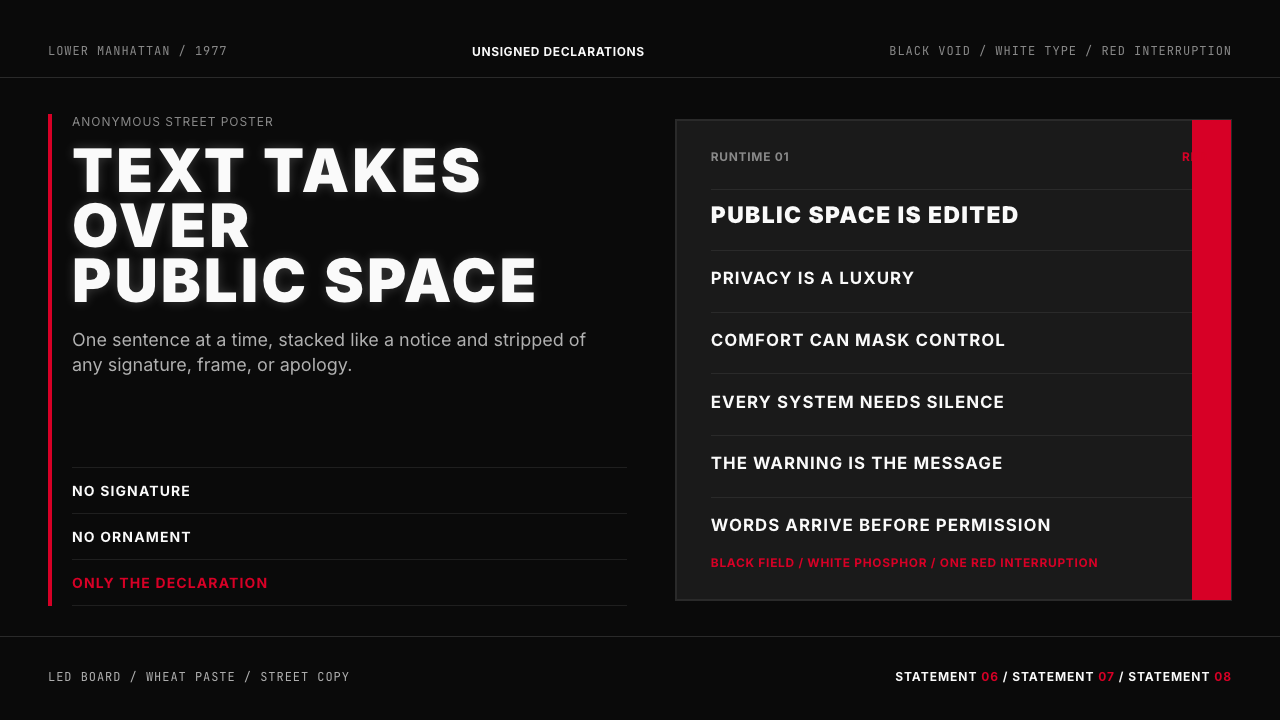 Jenny Holzer Truisms (1977)Austere declarations. White all-caps on black, cut by a single red warning.
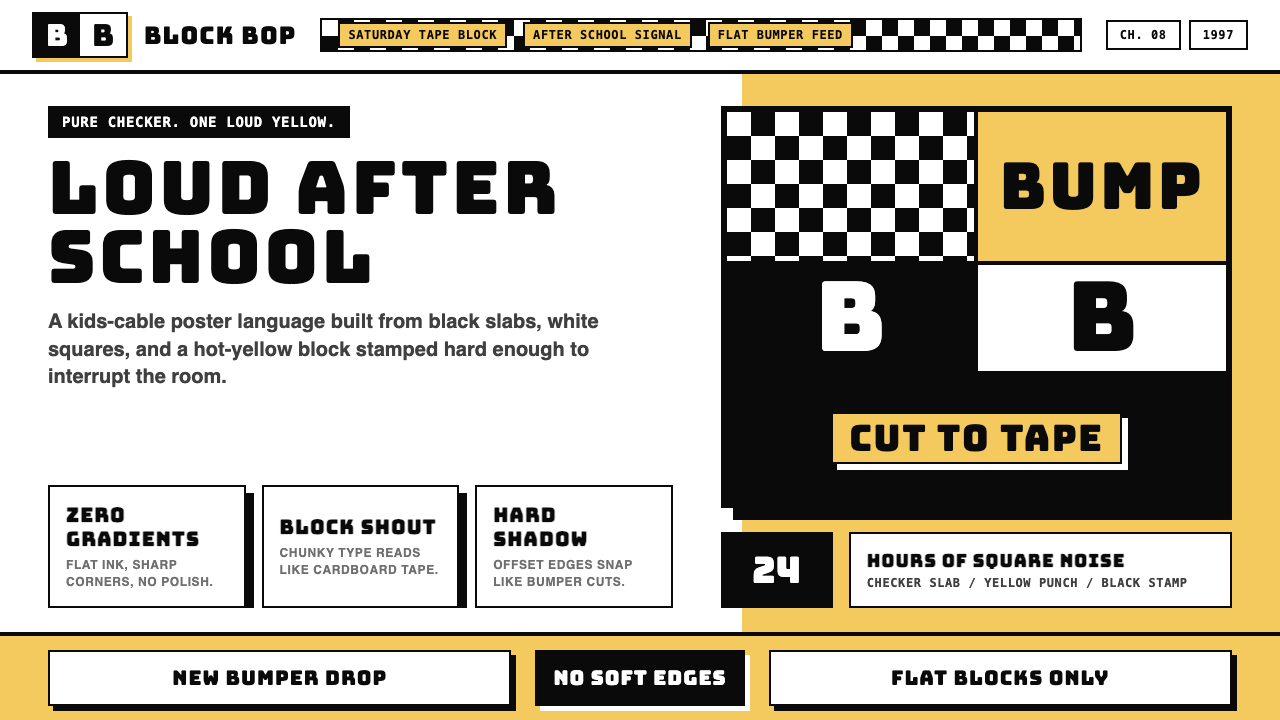 Cartoon Network 90s BlocksKids-cable noise, squared. Black-white checkerboards crash into hot-yellow Bu…
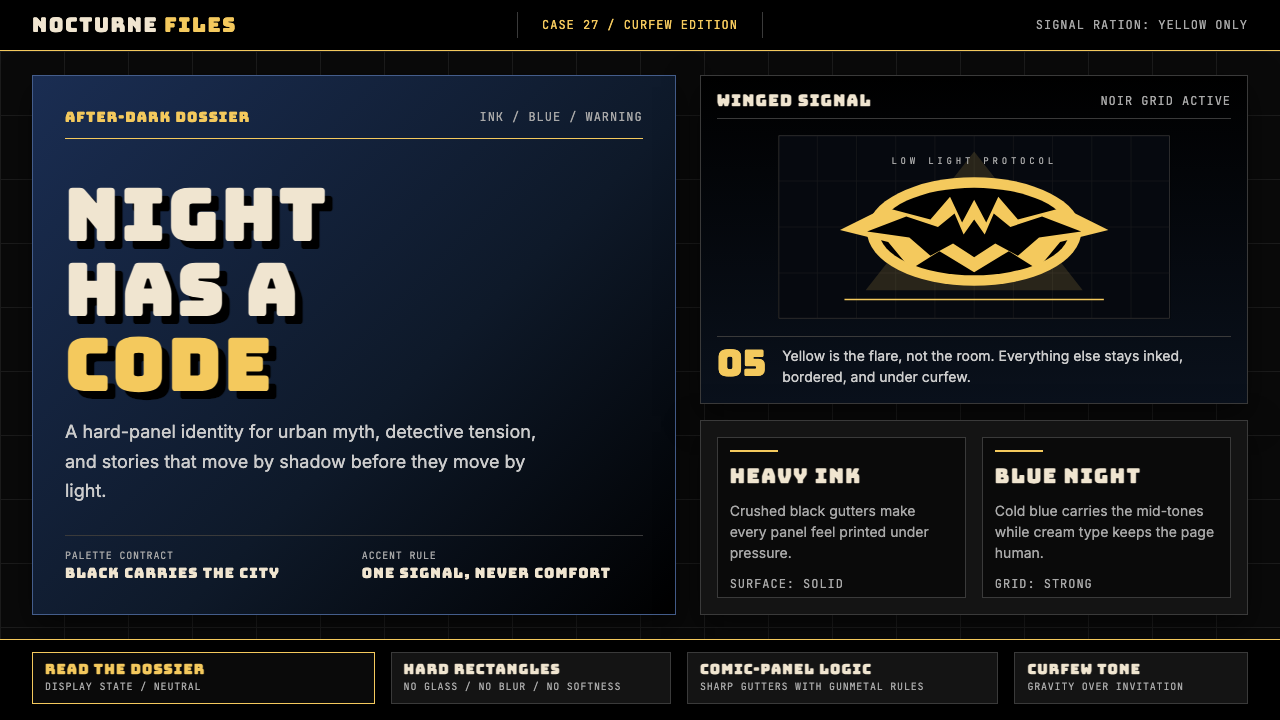 DC Comics Batman NoirGravity, not cheer. Black panels, Gotham blue, and one bat-yellow signal cut…
 Death Metal BlackletterUnreadable by design. Bone fraktur on black, cut by one blood-red geometric s…
 Fallout Vault-Tec Pip-BoyIrradiated optimism. Vault yellow and CRT green lock into a bordered bunker g…
 Gothabilly Horror RevivalHaunted swagger. Blood-red marquee type, coffin frames, and pulp halftone on…