What is NASA Worm Logo (1975)?
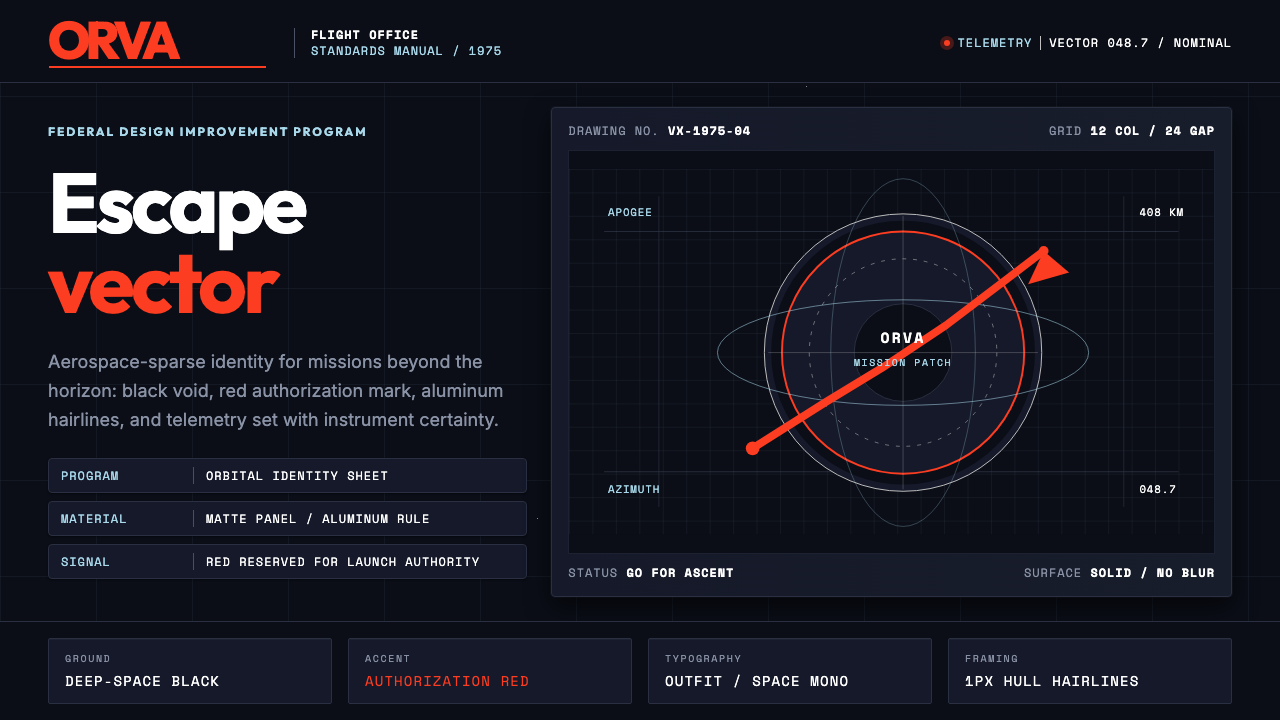
A single red wordmark against infinite black — the NASA Worm logo of 1975 made aerospace modernism the face of human ambition at the frontier of space.
NASA Worm Logo (1975) in brief
The NASA Worm is the informal name for the logotype created in 1975 by graphic designers Richard Danne and Bruce Blackburn under the Federal Design Improvement Program. It replaced the agency's previous emblem — a dense, illustrative roundel known as the 'meatball' — with a single custom wordmark: the letters N-A-S-A rendered in a rounded, flowing sans-serif form, unified by continuous curved strokes and set in a deep, authoritative red. The result is not merely a logo but a complete visual identity system built for government authority at planetary scale.
The visual language of the Worm system is aerospace-spare. A deep black ground evokes the void of space and serves as the canvas against which all other elements register. NASA red — a warm, saturated crimson that reads with confidence across any surface from a spacecraft hull to a printed document — functions as the sole accent color. Technical white carries informational text and readout panels, while an understated aluminum gray occupies structural borders, data panels, and the implied surfaces of spacecraft geometry. The system refuses embellishment: no gradient, no texture, no decorative element that cannot be justified by information.
Retired in 1992 in favor of a return to the meatball emblem, the Worm nonetheless achieved a kind of immortality. Its 2020 revival on the SpaceX Crew Dragon — the first crewed commercial launch to the International Space Station — reintroduced it to a generation that had never seen it in active service. Today the Worm occupies an unusual cultural position: a piece of government graphic design from the mid-1970s that reads as perpetually contemporary, as comfortable on a mission patch as on a streetwear release.

Where does NASA Worm Logo (1975) come from?
The origins of the Worm lie in a federal initiative that had nothing to do with rockets. In the late 1960s and early 1970s, the United States government recognized that its visual communications — spanning hundreds of agencies, departments, and programs — were a chaotic patchwork of inconsistent insignia, typefaces, and color schemes. The Federal Design Improvement Program, launched under the Nixon administration and championed by the National Endowment for the Arts, set out to bring professional graphic design standards to federal institutions. NASA, as the most prominent and visually ambitious of all federal agencies, became a flagship case.
The contract for NASA's new visual identity went to Danne & Blackburn, a New York design firm. Richard Danne and Bruce Blackburn were practitioners of American corporate modernism — the mid-century tradition, descended partly from Bauhaus principles and partly from the Swiss International Style, that had given major corporations like IBM and American Airlines their clean, systematic visual identities in the 1950s and 1960s. For NASA, they produced a comprehensive standards manual — the NASA Graphics Standards Manual, published in 1976 — that specified every application of the identity, from vehicle markings on the Space Shuttle to letterhead and signage. The manual is a masterpiece of systematic design thinking and was itself rediscovered and republished by fans and designers decades later.
The Worm wordmark itself was a radical departure from the meatball, which had been designed in 1959 by NASA engineer James Modarelli and was rich with symbolic elements: a sphere, stars, a chevron, an orbital ellipse. Danne and Blackburn stripped all of that away. Their new logotype was strictly typographic — no illustration, no symbols, no representational elements whatsoever. The letterforms they designed share a family of curves: the C-shaped bowl of the A, the open rounded terminals of the N, the flowing S all participate in a continuous visual rhythm. The letters were custom-drawn, not adapted from any existing typeface, making the Worm unique in the truest sense.
The broader cultural moment mattered. The mid-1970s were years of American institutional ambivalence — the Vietnam War had ended, Watergate had eroded public trust in government, and the Apollo program, the defining achievement that had given NASA its cultural prestige, was over. The Space Shuttle program was underway but had not yet launched. Against this backdrop, a clean, confident, forward-looking identity was not a neutral aesthetic choice — it was an argument that American public institutions could still project competence and vision. The Worm, intentionally or not, carries that argument in every application, from the side of a launch vehicle to the cover of a mission report.
What defines the NASA Worm Logo (1975) look?
Color System
The Worm palette is built on three values, each assigned a specific role. Deep, near-total black functions as the ground — evoking the void of space and ensuring maximum contrast for every overlaid element. NASA red, a warm and fully saturated crimson, is the identity color: it appears on the wordmark itself and on primary accent elements. Technical white carries all informational content — readout text, data labels, body copy — and registers cleanly against the black ground. Aluminum gray, cooler and more neutral than white, is reserved for structural elements, borders, and secondary panels. The system never deviates from these four values and never introduces a fifth.
Wordmark and Custom Letterforms
The Worm's letterforms are bespoke — drawn specifically for NASA and not based on any pre-existing typeface. The design principle is continuity of curve: each letter's strokes share the same radius family, so the letters feel like they belong to a single unbroken gesture rather than four separate characters. Notoriously, the crossbar of the A is omitted — its role is implied by the shape of the surrounding letterforms — and the letters share connected terminals where possible, creating a flowing, almost calligraphic quality entirely at odds with the mechanical nature of the aerospace industry it represents. This tension between the organic letterform and the industrial context is a defining quality of the design.
Information Hierarchy
The Worm system organizes information in strict, horizontally-structured bands. The dominant element — the wordmark or mission designation — occupies the widest and most prominent zone. Secondary identifiers, mission names, and program titles sit in a clearly subordinate band, typically rendered in the monospaced typeface associated with telemetry and technical documentation. Tertiary metadata fills the narrowest registers. This banding approach echoes the instrument panels and readout displays of aerospace hardware: information is parceled into discrete channels, and nothing bleeds between channels. Vertical relationships are functional; decorative white space does not exist.
Monospaced Telemetry Type
Alongside the Worm wordmark, the standards system specifies a monospaced typeface for all supplementary text. Monospaced type — in which every character occupies an equal horizontal measure — is the typographic language of data terminals, flight computer printouts, and mission documentation. Its presence in the visual system serves a double function: practical, because technical data is genuinely easier to scan and align in monospaced columns; and semiotic, because it signals the register of scientific instrumentation rather than commercial advertising. Every line of secondary text feels like a data readout, lending the system an air of operational authority.
Geometric Support Elements
Beyond the wordmark, the Worm system employs a vocabulary of hard geometric forms. Circles appear as mission patch containers — the circular patch is itself a convention of the American space program — and as structural framing devices. Horizontal rules separate information zones with the precision of engineering drawings. Thin rectangular panels, evocative of instrument-readout strips, hold secondary data. These elements are always rendered at the full value of their assigned color — no tints, no screen values, no semi-transparency. A red circle is fully red; a white rule is fully white. The system's geometry is binary: present or absent, never intermediate.
Dark Ground and Spatial Depth
The canonical presentation of the Worm system is on a near-total black field. This is not merely aesthetic preference — it is a deliberate evocation of the operational environment: outer space. Light elements placed against absolute darkness do not simply have contrast; they appear to float, to occupy a void. This spatial reading transforms the informational elements into luminous objects — the red wordmark glows the way a star glows, the white type reads the way an instrument panel reads in a darkened cockpit. The black ground is the system's most powerful and most frequently underestimated design decision.
Restraint and System Completeness
The Worm system is remarkable not only for what it contains but for what it refuses. In an era when space exploration was regularly depicted with starburst graphics, lens flares, photorealistic spacecraft illustrations, and patriotic iconography, the standards manual excluded every one of these conventions. No photography was integrated into the identity. No stars or celestial objects appeared as decorative elements. No gradients softened the transition between ground and figure. The restraint is absolute and deliberate. This discipline is also what makes the system scalable across five decades: every visual trend that the Worm refused has dated; the Worm itself has not.

Who shaped NASA Worm Logo (1975)?
Richard Danne was the principal designer at Danne & Blackburn who led the NASA identity project from conception through the publication of the 1976 Graphics Standards Manual. A committed advocate of American corporate modernism, Danne believed that government institutions deserved the same level of systematic, professional design as the private sector's most sophisticated clients. His work on the NASA identity was recognized in 1976 with the Presidential Award for Design Excellence. Decades later, Danne remained a vocal defender of the Worm, publicly opposing its 1992 retirement and writing and speaking at length about the reasoning behind every element of the system's design.
Bruce Blackburn brought to the NASA project a background in systematic corporate identity work. Before the NASA commission, Blackburn had developed identity systems for major institutions and understood the operational demands of a mark that must work at every scale — from a spacecraft decal to a printed envelope — and across every reproduction method available in the 1970s, from offset printing to painted application on metal surfaces. His contribution to the Worm was the rigorous standards thinking that made the identity reproducible without degradation, a requirement that became especially important when the Worm was applied to the Space Shuttle fleet.
James Webb served as NASA Administrator from 1961 to 1968, presiding over the Mercury and Gemini programs and the early Apollo missions that culminated in the Moon landing. Though he left before the Worm was designed, Webb's tenure established the institutional culture that made the Danne & Blackburn commission possible: a belief that NASA's public-facing communications should match the agency's scientific and engineering ambitions. Webb championed the Arts and Artifacts program, using NASA imagery for public education and cultural engagement, and set the precedent that NASA's visual presence was a form of institutional argument, not merely bureaucratic housekeeping.
Not a person but an institutional force, the Federal Design Improvement Program (FDIP) was a government initiative of the early 1970s, supported by the National Endowment for the Arts, that brought professional designers into federal agencies to improve the quality of government visual communications. The program commissioned identity systems for dozens of agencies and produced design standards that applied to everything from transit signage to printed forms. NASA was its most prominent commission, and the Worm its most enduring artifact. The FDIP represents a rare moment when the United States federal government treated graphic design as a matter of public service quality rather than an administrative overhead.
The Worm's second life began not with a formal institutional decision but with grassroots design advocacy. Christopher Moody, a NASA designer, and a small internal team spent years making the case for the Worm's revival as a companion mark to the meatball rather than a replacement. Their argument succeeded: when NASA announced the 2020 Commercial Crew launch on the SpaceX Crew Dragon, the Worm appeared on the launch vehicle for the first time in nearly three decades. The revival was a cultural event reported far beyond the aerospace press, underscoring how thoroughly the Worm had escaped its original institutional context to become a free-standing icon of a particular vision of the future.
How do you use NASA Worm Logo (1975) today?
The NASA Worm system is one of the most directly applicable historical identities for contemporary design work, because its underlying logic — dark ground, single accent color, geometric information hierarchy, and absolute restraint — maps cleanly onto modern digital interfaces, presentation decks, and editorial layouts. Applying it well, however, requires resisting the temptation to treat it as a retro space aesthetic and instead understanding it as a functional system built around operational authority.
For presentation slides, the Worm system works with particular force on both cover and content pages. A cover slide benefits from the full canonical treatment: a near-total black field, the subject name or title rendered in a warm red wordmark-style typeface positioned in the upper or lower third, and any subtitle or date set in monospaced type that reads like a mission designation. Content slides should treat the dark background as an instrument panel: information is organized into clear horizontal bands, each with a defined role — heading, body text, supporting data — and nothing migrates between bands. Data slides gain exceptional clarity in this system: charts and graphs rendered in red, white, and gray against black read like aerospace telemetry, lending technical content an air of scientific authority.
For web user interfaces and dashboards, the Worm system is particularly effective when the product needs to project competence and authority. A canonical application uses an absolutely dark background, red for primary interactive elements and active states, white for all body and label text, and gray for borders, containers, and secondary UI elements. Avoid simulated depth: no soft drop shadows, no blurred backgrounds, no glass-morphism effects. Hard borders and flat fills are consistent with the system's logic. Navigation elements should be typographic and horizontally banded, with active states signaled by a color shift rather than a shape change. Pricing pages and tier comparisons work especially well, as the system's banding naturally organizes comparative information.
For editorial and marketing work, the style supports extreme information density without visual chaos. A publication layout in this system uses the dark field for feature sections — full-bleed opener pages, pullquote treatments, section dividers — while reserving a white-ground variant for long body text to maintain readability. Marketing pages can deploy the full drama of the dark system: alternating full-width content blocks between the canonical dark treatment and an inverted near-white ground, with red used consistently for calls to action, hover states, and primary buttons. Headline type should feel custom and authoritative — a geometric or humanist sans with enough weight to hold at large sizes — while body and supporting text should be set in a neutral, readable face at a size that suggests technical documentation rather than consumer advertising copy.
A critical mistake when applying the Worm aesthetic is adding visual elements the original system refused: starfields, lens flares, nebula textures, or any photographic space imagery. These additions feel redundant — the black ground already reads as space — and immediately mark the work as a pastiche rather than a principled application. A second common error is introducing additional accent colors beyond the red-white-gray triad. The Worm's power comes precisely from its refusal to use more than one expressive color. A third error is softening the geometry: introducing rounded corners on panels, blurred dividers, or gradient fills destroys the instrument-panel logic that gives the system its authority. When in doubt, add less.

NASA Worm Logo (1975) — FAQ
Why was the Worm retired in 1992, and why was it revived in 2020?
The 1992 retirement was partly political and partly institutional. NASA Administrator Richard Truly and associate administrator for public affairs, among others, had reservations about a logotype that lacked the symbolic richness of the meatball — its planets, stars, and trajectory lines told a story about what NASA did; the Worm simply said a name. The meatball was also more recognizable to a general public that had grown up with it. The 2020 revival on the SpaceX Crew Dragon was a deliberate signal — NASA was entering a new era of commercial partnership and wanted a mark that read as forward-looking and modern rather than institutional and historical. The Worm, paradoxically, had become the more contemporary of the two marks precisely because of the decades it spent retired.
Is the Worm actually a typeface I can use, or is it purely a custom logo?
The Worm wordmark was entirely custom-drawn and was never released as a typeface. Several typefaces have been designed in tribute to its aesthetic — featuring similarly rounded, flowing letterforms with connected terminals — but none of these are the Worm itself. For work in the NASA Worm system, the closest authentic approach is to use the wordmark only in its approved form for the logotype element, and to select a separate geometric or humanist sans-serif for all accompanying text. The supplementary type does not need to mimic the Worm's curves; it should complement them through contrast — more upright, more conventional — and through restraint of color and size.
Can the Worm system work on a white or light background?
It can, but the light-ground version sacrifices the system's most powerful quality. Against white, the red wordmark remains effective — it carries authority and warmth — but the spatial reading of elements floating in a void is lost entirely. The light variant also makes the information-banding structure harder to maintain, because the boundary between content zones must be drawn with rules and typography alone rather than with the contrast between dark panels and darker voids. Where a light ground is necessary — long-form body text, printed materials requiring white paper, certain web contexts — treat it as a pragmatic accommodation rather than a design preference, and preserve as much of the dark treatment as possible for headlines, feature sections, and primary navigation.
How does the Worm system relate to other Space Age design aesthetics?
The Worm occupies a specific and narrow position within the broader Space Age aesthetic family. It shares the era's preference for sans-serif type and geometric clarity, but it deliberately rejects the more exuberant visual conventions of Space Age popular culture — the starburst patterns, the chrome gradients, the retro-futurist optimism that characterized everything from American diner design to science-fiction film titles of the same period. The Worm is closer in spirit to the European institutional modernism of the same era — the systematic identity programs of German and Swiss corporations, the Otl Aicher signage system for the 1972 Munich Olympics — than to the American pop version of the space future. It is Space Age stripped of nostalgia and optimism, reduced to authority.
What makes the Worm feel contemporary rather than dated?
Several factors work together. First, the Worm refused every design trend of its own era — no decorative elements that would later look dated, no visual conventions borrowed from popular culture, no color choices driven by fashion. This principled refusal means the system has no period tells: nothing in it signals 1975 specifically. Second, the system's values — dark ground, single saturated accent, monospaced technical type, geometric structure — happen to align with conventions that contemporary digital design independently rediscovered, particularly in developer tools, technical dashboards, and the dark-mode interfaces that became dominant in the 2010s and 2020s. The Worm did not predict these trends; it arrived at the same formal solutions through different reasoning. Third, the emotional register of the system — authority, competence, ambition without ego — is timeless in a way that warmth, playfulness, or irony are not.
Related design styles
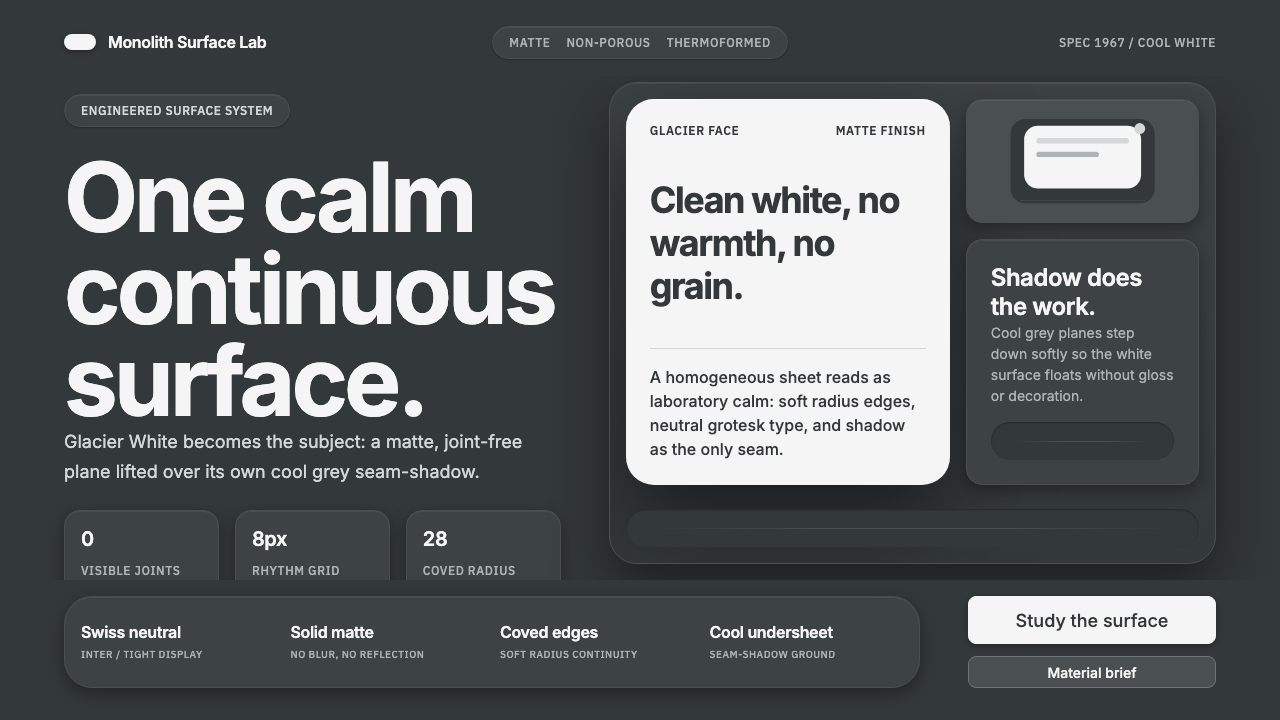 Corian Solid SurfaceSeamless matte calm. Glacier White floats over cool grey shadow with neutral…
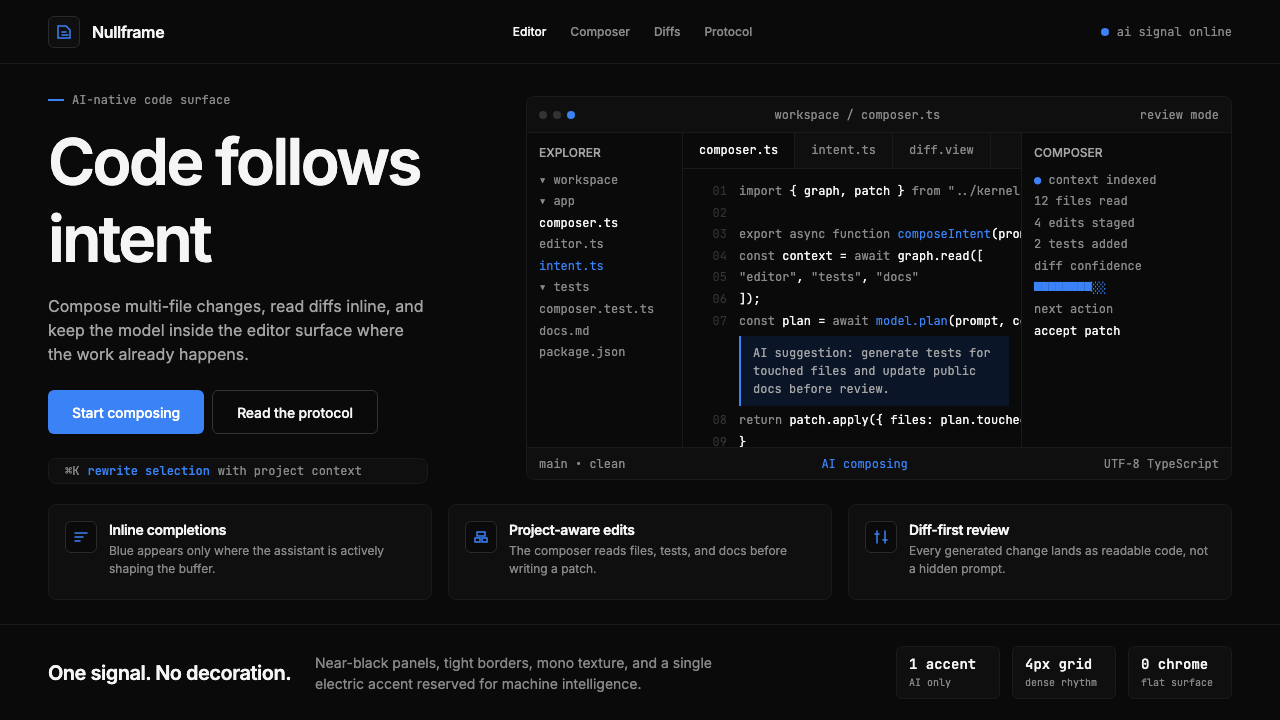 Cursor IDEAI-first code editor. Pure dark surfaces, off-white text, electric blue reser…
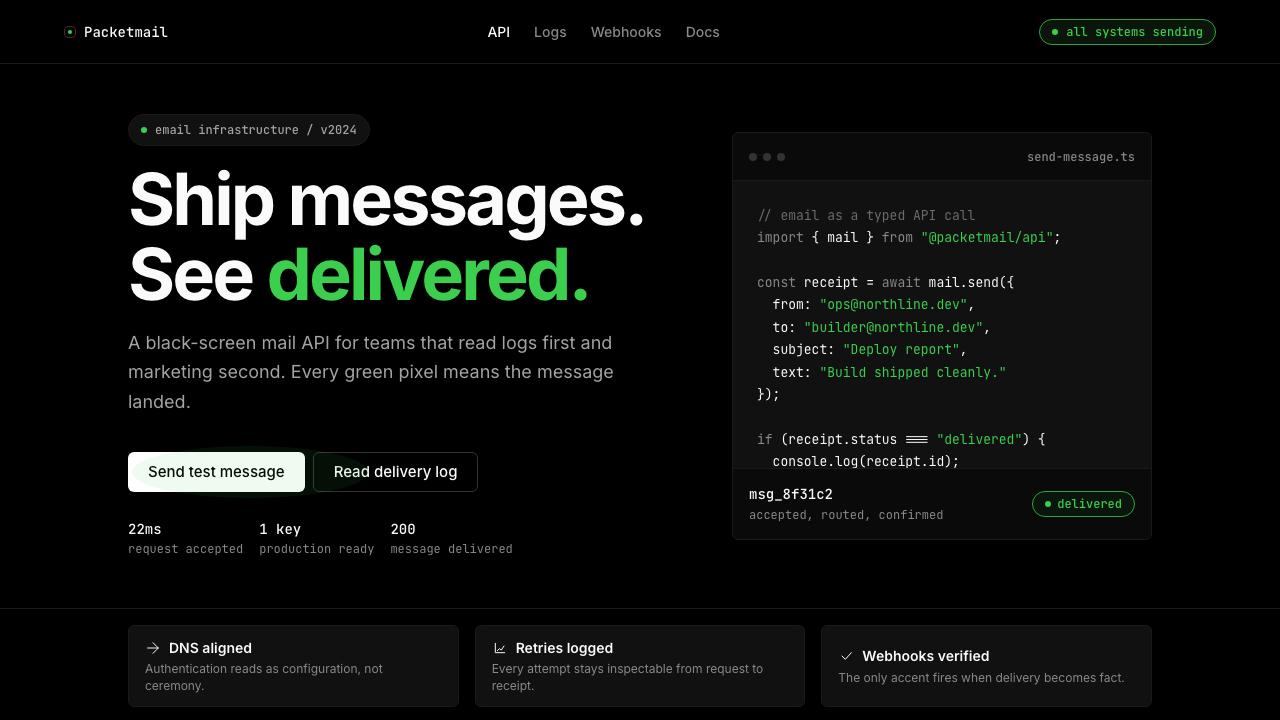 Resend 2024Clean code becomes brand. Pure black, JetBrains Mono, and one green delivered…
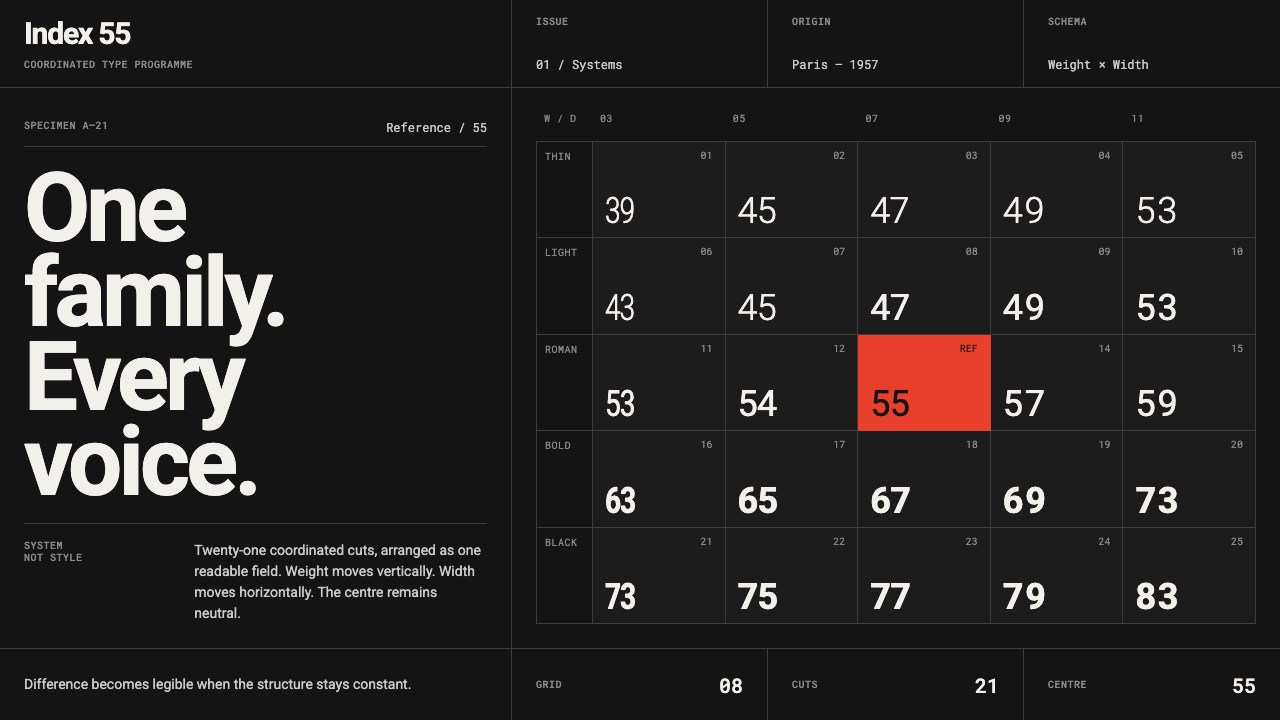 Univers Frutiger Numbered GridDifference becomes a system. Numbered grey type locks to a dark grid, with on…
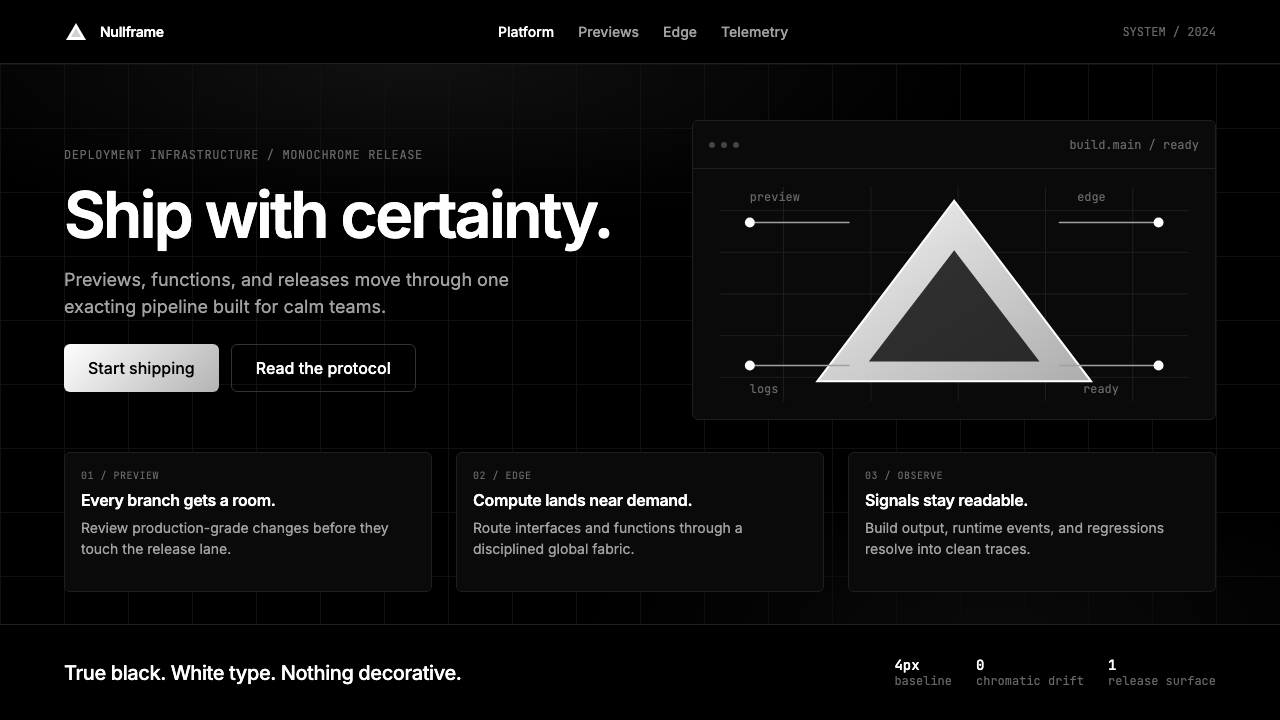 Vercel 2024Developer luxury by subtraction. Pure black, white Inter, rigid grid, triangu…
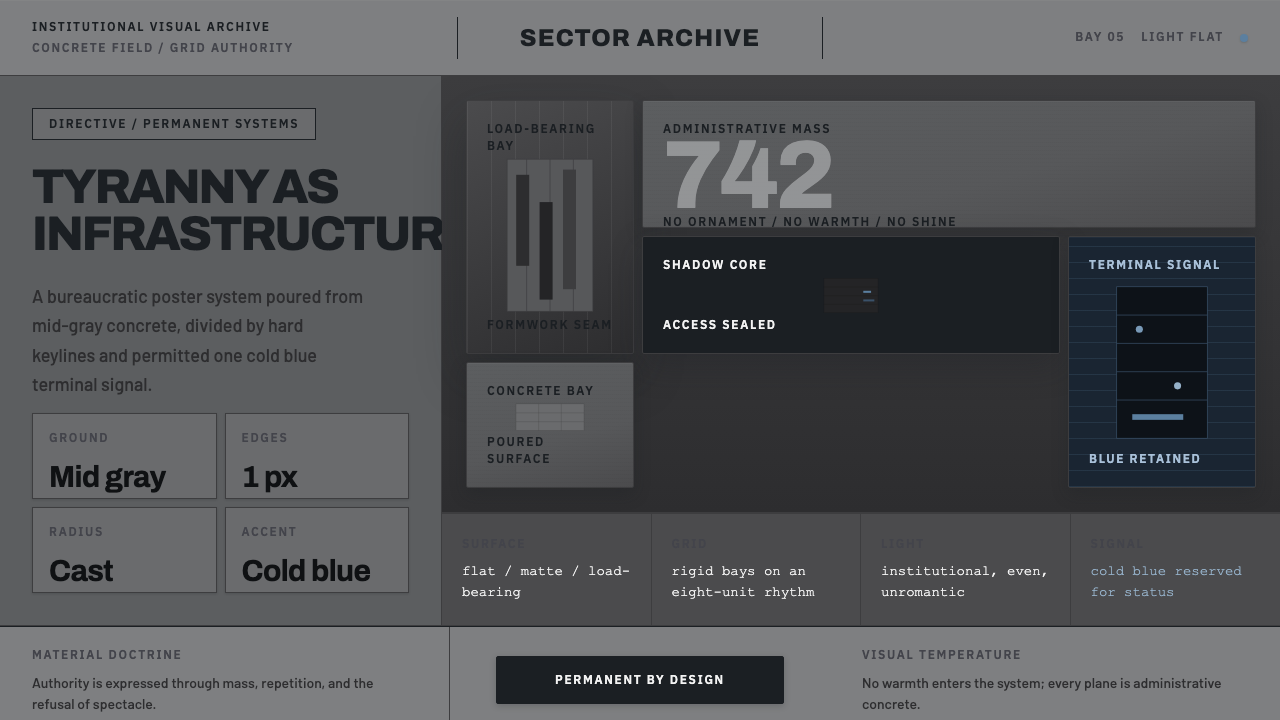 Andor Imperial GrayOppression made ordinary. Mid-gray concrete slabs, hard keylines, one cold bl…