What is Nanai Amur Spiral?
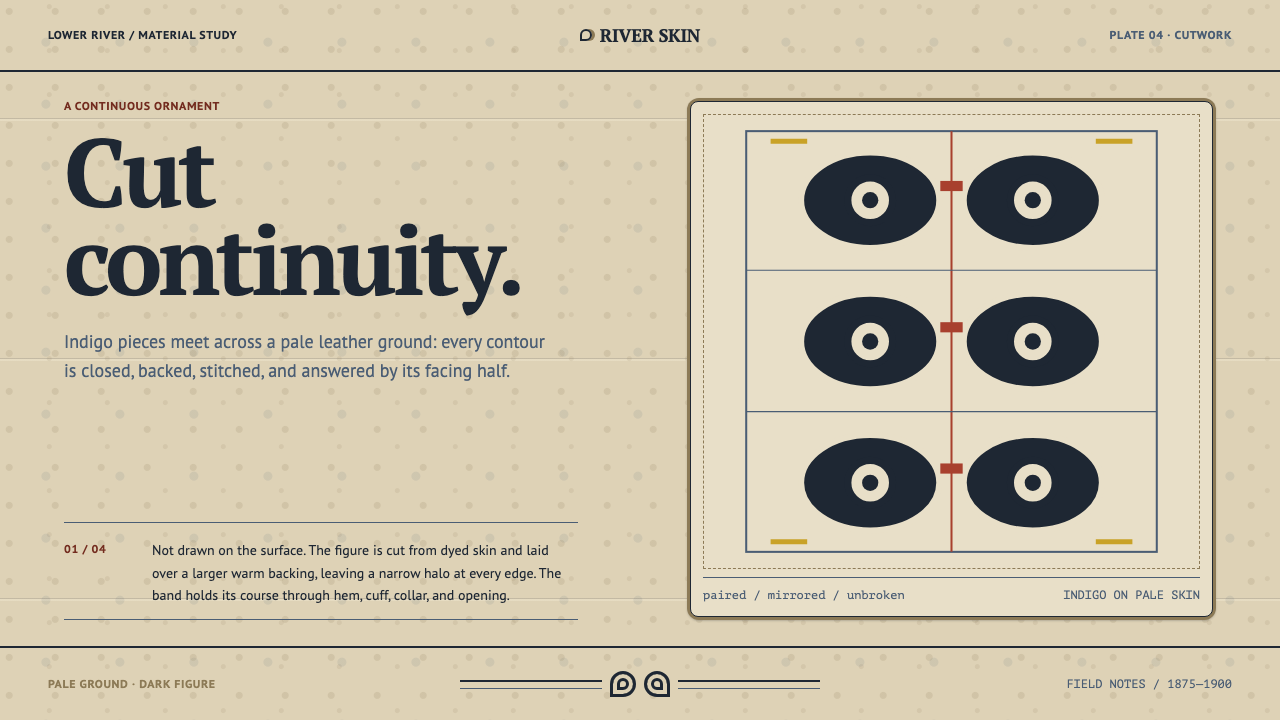
Nanai robes were ornamented by cutting, never by drawing — dark indigo shapes cut from fish skin and stitched onto a pale, mottled ground, with a pair of facing swirls, the Nanai eyes, at the centre of the vocabulary.
Nanai Amur Spiral in brief
Nanai Amur Spiral is a design style drawn from the fish-skin robes of the Nanai people of the lower Amur river. The robes were made from tanned salmon and carp leather and decorated by cutting, never by drawing. Motifs were cut from indigo-dyed fish skin, each shape laid on a slightly larger backing piece, and the whole was stitched onto the pale robe. The result is one consistent visual relationship: a dark figure on a light field.
The signature form is a pair of facing swirls, called the Nanai eyes, cut by the positive-and-negative papercut method. Ornament does not appear as scattered spots. It runs as unbroken bands along the hem, the cuff, the collar and the centre opening of the robe, and it is mirrored about that opening. The same visual language appears on wedding robes and on shaman coats, which tells us that this is a general grammar of ornament rather than a single sacred or decorative category.
For a designer the interest is the discipline of the method. Everything is a closed silhouette; nothing is a line. The ground is a living material, mottled with scale patterns and seams, and never a clean sheet. The ornament has a visible construction, with stitches and a rim of backing skin around every piece. It is a graphic system whose constraints come entirely from how it was physically made.
Where does Nanai Amur Spiral come from?
The Nanai live along the lower Amur river basin, in the Russian Far East and on the opposite Chinese bank, where closely related people are known as the Hezhen. The source material places the tradition before 1900 and notes that the robes preserved in collections were gathered at roughly 1875 to 1900. The movements it lists, Amur appliqué and papercut ornament, Tungusic shamanic dress and Jesup North Pacific Expedition ethnography, together describe a craft, a ritual setting and a way in which the craft became known to the outside world.
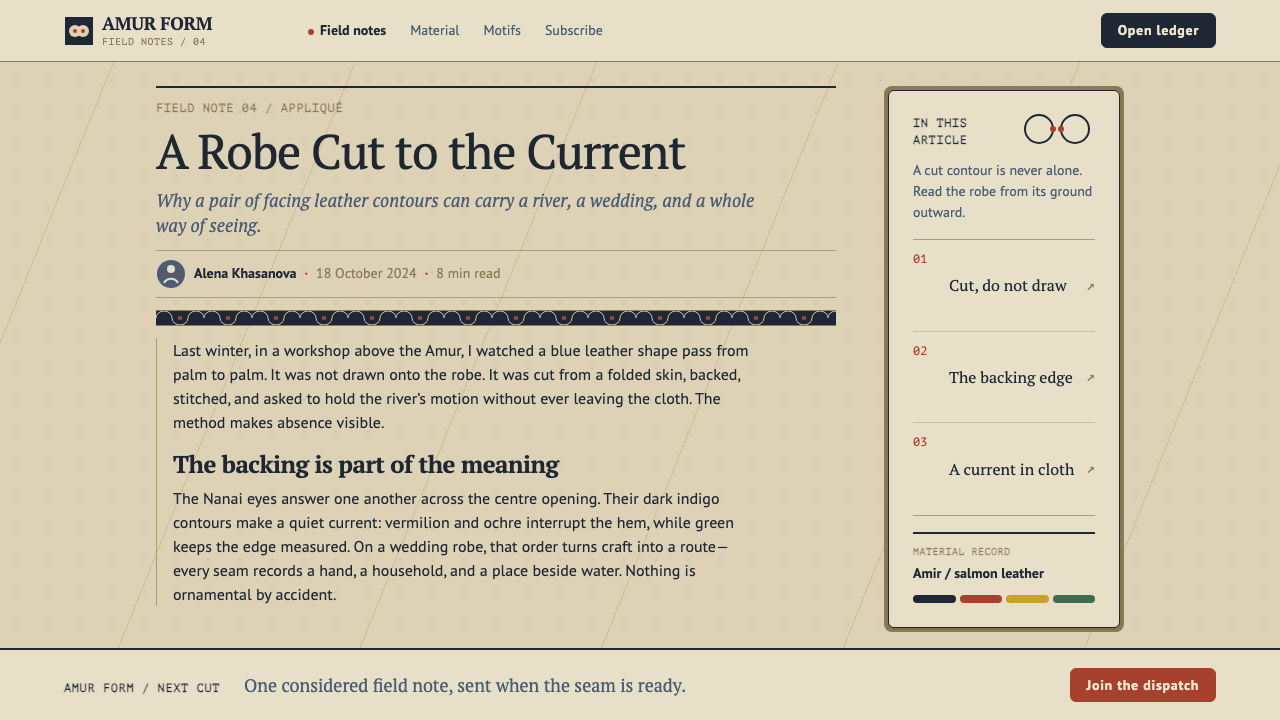
The material is the first clue to everything else. In a river economy, salmon and carp supplied food and also cloth: the skins were tanned into soft, pale leather and sewn into robes. Fish skin carries its own pattern, a faint mottling of scales and patches, and it comes in pieces of limited size, so seams are unavoidable. The ground of the ornament is therefore never uniform. Against it the makers set shapes cut from skin dyed with indigo, which the source notes was available in Russian territory from 1835. That dyed skin gives the deep blue-black figures the system depends on.
The method is cutting. A shape is cut as a closed outline, using the positive-and-negative papercut approach in which the figure and the gap around it are designed together. Each piece is then laid on a slightly larger backing piece and stitched to the robe, so a thin rim of lighter skin remains around the dark figure and the stitches stay visible. The facing swirls, the Nanai eyes, come out of this method: two mirrored spirals looking at each other, not a generic tribal spiral but a specific paired form. Bands of such pairs run along the hem, the cuff, the collar and the centre opening, and the whole robe is mirrored about its opening.
Outsiders learned of this ornament largely through late nineteenth-century ethnography. The Jesup North Pacific Expedition, an American Museum of Natural History project, worked among peoples on both sides of the North Pacific, and Berthold Laufer's work on the decorative art of the Amur peoples drew on collected robes of exactly the kind this style describes. Lev Shternberg, a Russian ethnographer, worked among the indigenous peoples of the same region. These sources preserved the objects and the patterns, but they were written from outside; this article follows the source material in describing how the robes were made and what they look like, and does not assign meanings that the sources do not give.
What defines the Nanai Amur Spiral look?
The Mottled Fish-Leather Ground
The ground is a pale, warm skin colour, between cream and light salmon, never a clean white. Scale marks, patches and the occasional seam give it a quiet mottling, so the surface reads as a material and not a sheet. The mottling is low in contrast and irregular, because it comes from real skin. It supplies texture without competing with the figures that sit on it.
Dark Figure on a Light Field
Every motif is a solid, near-black indigo shape on the pale ground. The polarity never reverses: there are no light figures on dark fields and no mid-tone fills. A single deep colour does all the work, which makes the system extremely legible at any scale. Weight and rhythm are created by the proportion of dark to light, not by adding more colours.
Cut, Never Drawn
Shapes are closed silhouettes with a continuous outline, not strokes. There are no thin lines, no hatching and no outlines around fills. Positive-and-negative design means that the gaps between shapes are as deliberate as the shapes, and a spiral is a ribbon of dark with a ribbon of light beside it. The contours feel scissor-made: confident, continuous and slightly angular where a cut turns.
The Halo of Backing Skin
Each dark piece is laid on a slightly larger piece of backing and stitched down, so a narrow rim of lighter skin surrounds it like a halo, with stitches visible along the edge. This rim is a structural detail, not a shadow. In an interface it appears as a thin pale offset around dark shapes, sometimes with a dotted stitch line, giving the figures a hand-assembled, layered quality without any blur or depth effect.
The Facing Swirls, the Nanai Eyes
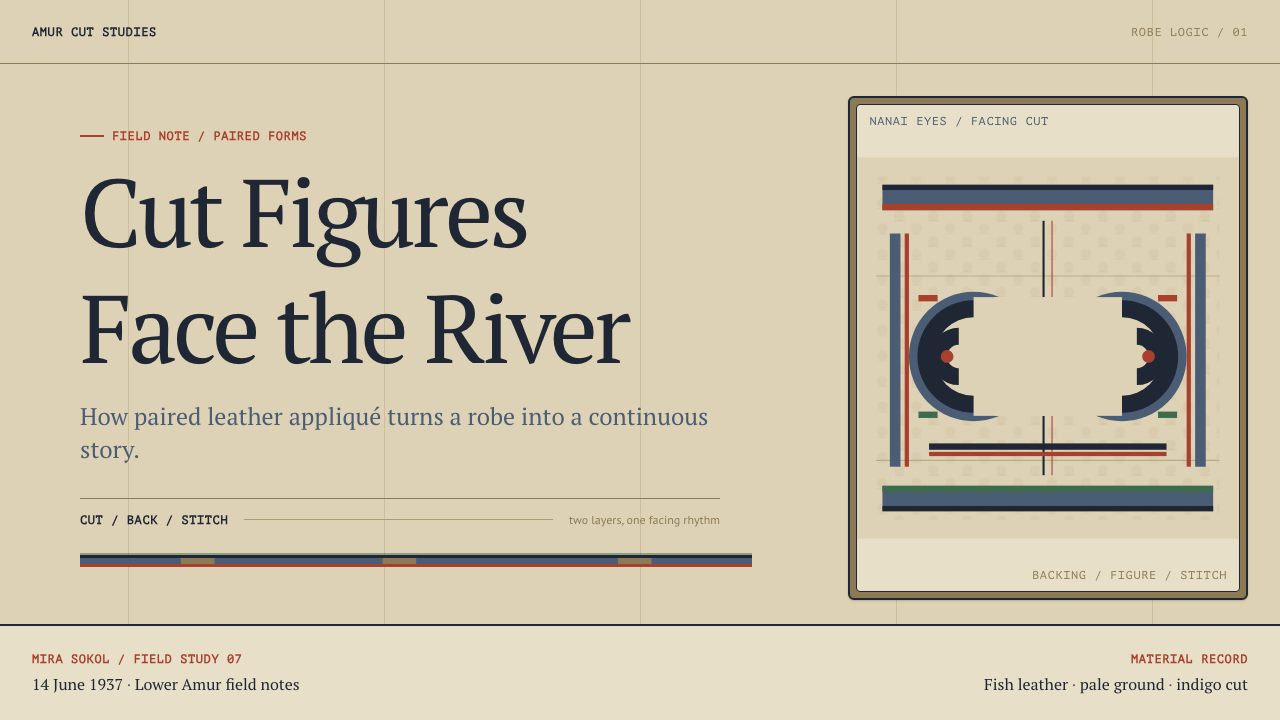
The signature motif is a pair of spirals turned toward each other. The unit is the pair, not the single spiral, and the two halves are mirrored. The pair works as a focal element, a border repeat or a divider, and can be scaled without losing its identity. Its character depends on the facing relationship: two spirals with their backs to one another, or one spiral alone, would no longer be the Nanai eyes.
Unbroken Bands, Mirrored at the Opening
Ornament runs in continuous bands along the hem, the cuff, the collar and the centre opening, rather than as separate patches. The opening is the axis: the left half of the robe mirrors the right. In layout terms this gives a strong frame at the edges of the composition and a central seam that divides the page into two matching halves, with the content resting in the calm pale field between the bands.

Who shaped Nanai Amur Spiral?
Laufer was an anthropologist who worked on the Jesup North Pacific Expedition and wrote about the decorative art of the Amur peoples. His study drew on collected robes and is one of the main routes by which the appliqué and papercut ornament of the Nanai became known beyond the region. For designers he is a useful starting point, and also a reminder that this knowledge reached the wider world through an outsider's collection and eye.
Shternberg was a Russian ethnographer who worked among the indigenous peoples of the Amur region and neighbouring lands. He represents the Russian side of the documentation, the line of fieldwork and description that preserved how these peoples lived, dressed and made things. His work and Laufer's are best read side by side, as two outside perspectives on the same set of objects and traditions.
The Jesup North Pacific Expedition was an American Museum of Natural History project of the late nineteenth century that studied and collected among peoples on both sides of the North Pacific. It stands in this style's sources for the ethnographic moment in which Amur robes were gathered into museum collections. The ornament is documented because of that moment, but it belongs first to the people who made and wore it.
How do you use Nanai Amur Spiral today?
Nanai Amur Spiral suits work that wants a graphic, two-tone clarity with a human, hand-made undertone. Applying it well means respecting how the ornament was made: closed silhouettes cut from a single dark colour, laid on a mottled pale ground, in unbroken bands mirrored about a central opening. It does not call for outlines, gradients or a rainbow of accent colours.
For presentation slides, the cover can be a pale, mottled field with a single dark band of paired swirls running along the lower edge like a hem, leaving the centre clear for the title. Content slides keep ornament to the edges and use the central seam as a vertical axis, so comparisons fall naturally into two mirrored halves. Data slides are an excellent fit: draw bars, areas and shapes as solid dark silhouettes on the pale ground, and use facing, mirrored charts when comparing two groups, as in a back-to-back bar chart.
On the web, a header band can play the role of the collar and a footer band the role of the hem, with the main content sitting on the pale field between them. Dashboards stay light, with dark solid blocks for key figures and a pale offset rim to separate layers instead of drop shadows. Pricing pages can use a two-column mirrored layout about a central seam, with each plan's feature list on its own pale field and the paired-swirl motif as the divider. Login and onboarding screens work well split in two matching halves.
In editorial and marketing work, the style suits craft and textile stories, natural-material brands, river and fishing culture, heritage and museum content and sustainable fashion. Photography should be close and tactile: leather, thread, skin texture, hands. Section breaks can be marked with a narrow band of paired swirls, and long-form text should rest on the clear pale ground with generous margins. Keep colour to the single dark and the pale; let the cut shapes provide the richness.
A common mistake is to draw the swirls with strokes. Line-art spirals, outlines around fills, thin hairline decoration and Celtic or generic tribal spiral clip-art all contradict the cut logic and the particular paired form. A second mistake is flattening the ground into clean white or a pure gradient, which removes the mottled skin that gives the figures their setting. A third is to add more colours; the system is two-tone. Finally, treat the ornament with care: it appears on wedding robes and shaman coats alike, so avoid using it as a casual exotic flourish.
Nanai Amur Spiral — FAQ
What are the Nanai eyes?
The Nanai eyes are the signature motif of this ornament: a pair of spirals turned to face each other, cut by the positive-and-negative papercut method. They are not a generic tribal spiral but a specific paired form, and they are carried across wedding robes and shaman coats alike. The source material does not assign them symbolic meanings, and this article does not either.
Why is it a dark figure on a light ground, not the reverse?
Because of how the robes were made. The ground is pale tanned fish skin, and the ornament is cut from skin dyed with indigo and stitched on top, so the dark shape sits on the light field by construction. Reversing the polarity would abandon the physical logic of the object, and with it the halo of backing skin that surrounds each figure.
How do I suggest a fish-skin ground on screen without making it noisy?
Keep it low in contrast and irregular. A pale, warm base with soft, uneven patches and an occasional faint seam is enough to read as skin. Avoid repeating tiles with an obvious pattern, avoid harsh grain, and keep text areas calm. The mottling should make the surface feel like a material while the dark figures remain the strongest thing on the page.
What does positive-and-negative papercut mean?
It is a way of cutting in which the figure and the gap around it are designed as a pair. The shapes you cut out and the shapes left behind both carry the pattern, so a spiral is a ribbon of dark with a ribbon of light alongside it. In design this means treating the space between elements as an active part of the ornament, with edges and gaps planned together.
Is it appropriate to borrow this ornament for commercial design?
It can be, with care. The ornament appears on wedding robes and shaman coats alike, and it belongs to the Nanai people who made it; our knowledge of it comes largely through outside ethnographers. Credit the origin, keep the paired form and cut logic intact rather than inventing new symbols, avoid sacred or exoticising framing, and be cautious about using it where the context would trivialise it.
Related design styles
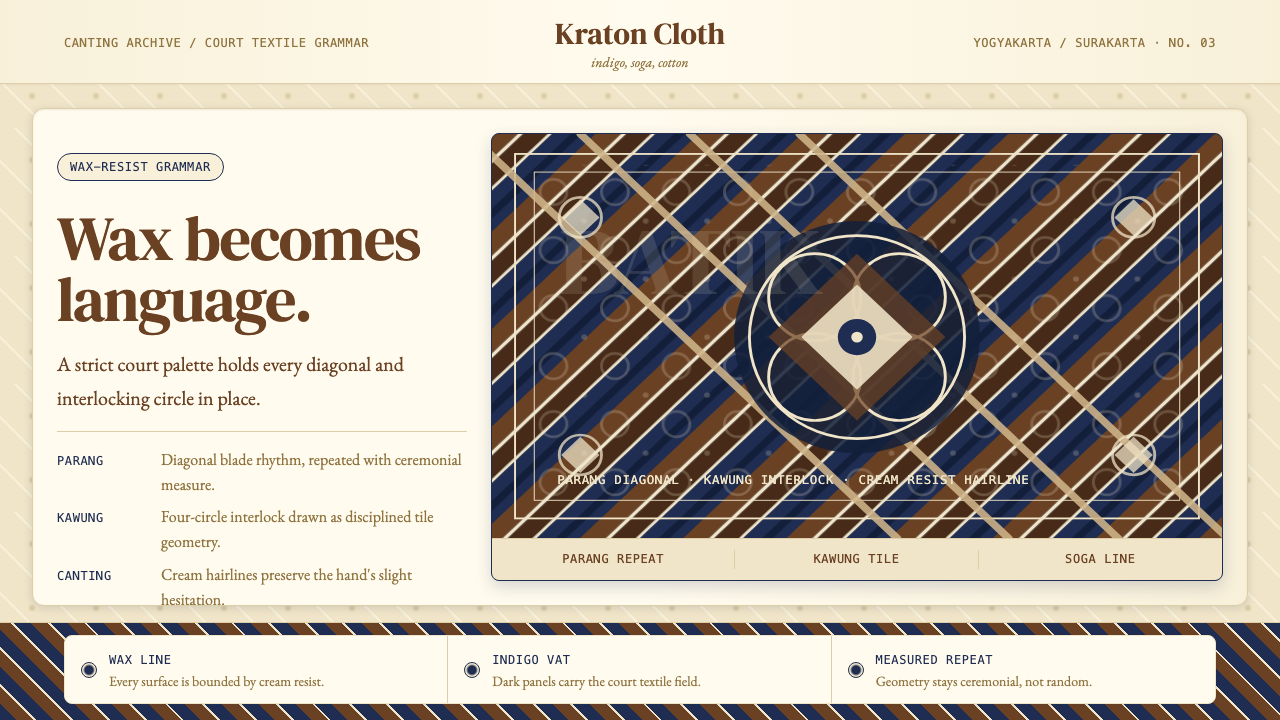 Javanese BatikCeremonial repetition. Indigo, soga, and cream frame a tiled canting motif.
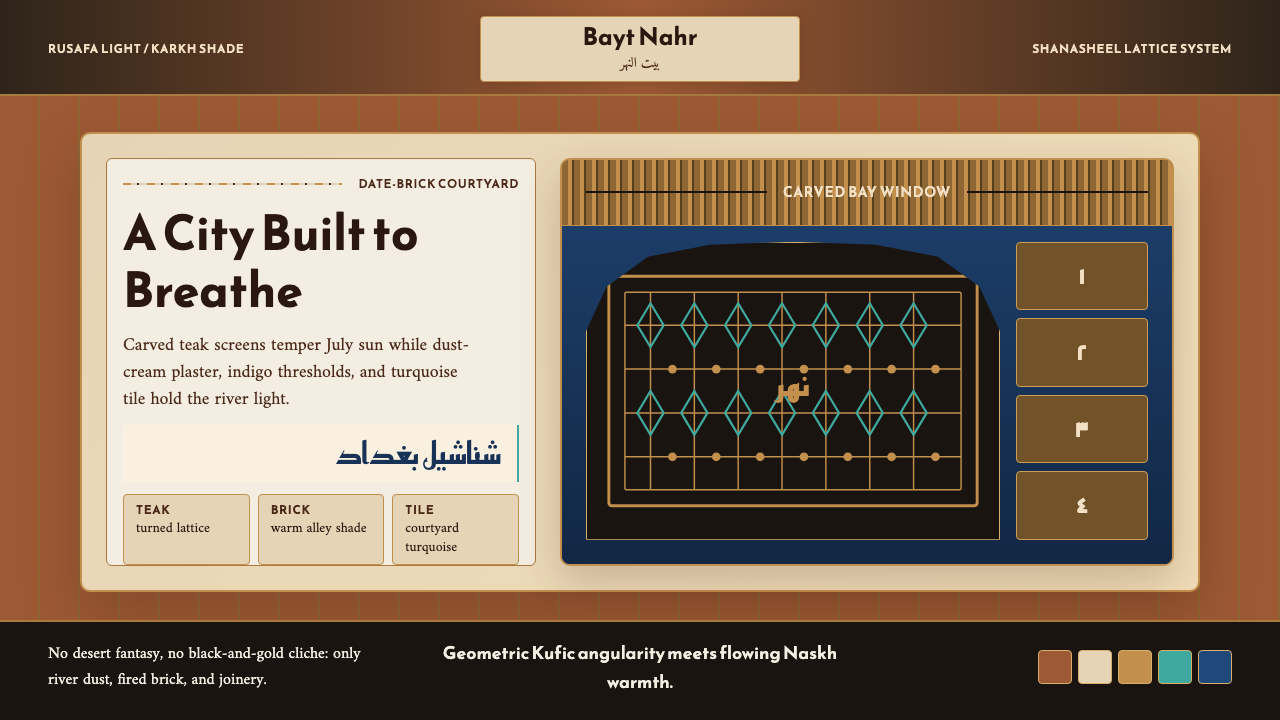 Iraqi Baghdad Shanasheel HouseBreathes through ornament. Date-brick ground, teak lattice, and turquoise til…
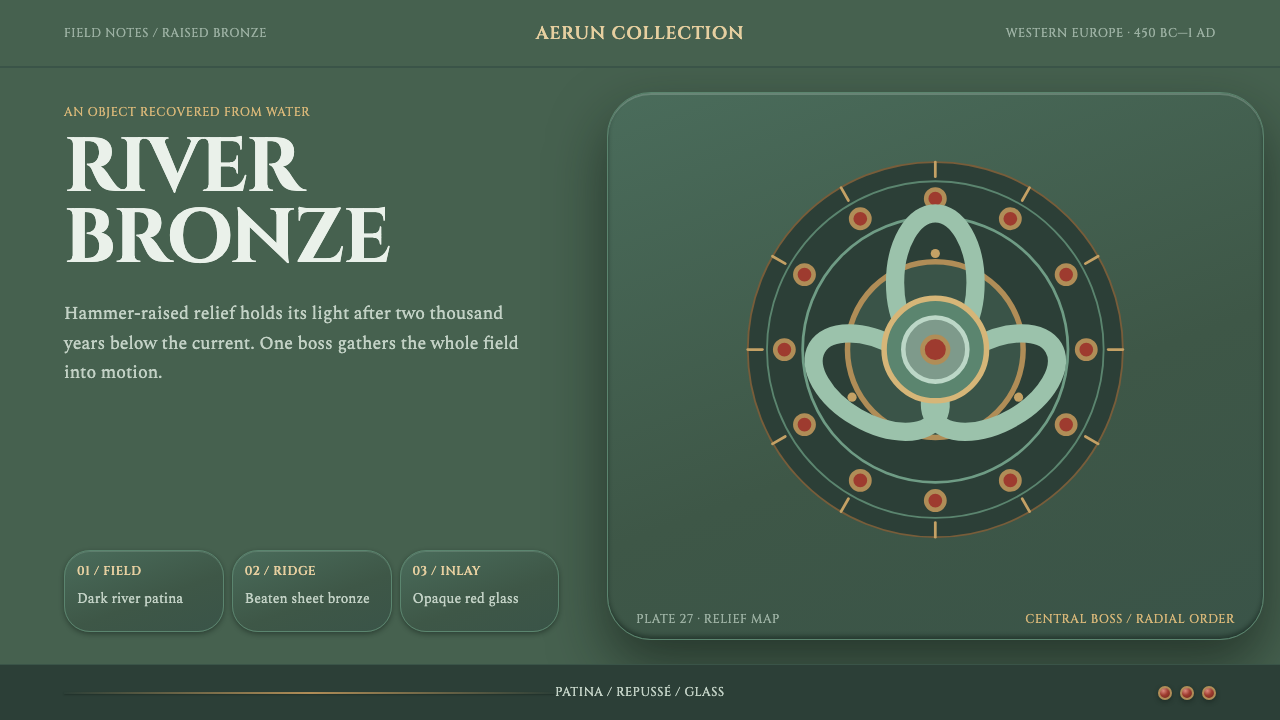 La Tène Celtic MetalworkMetalwork that still moves. Patina-green relief radiates from a bronze boss,…
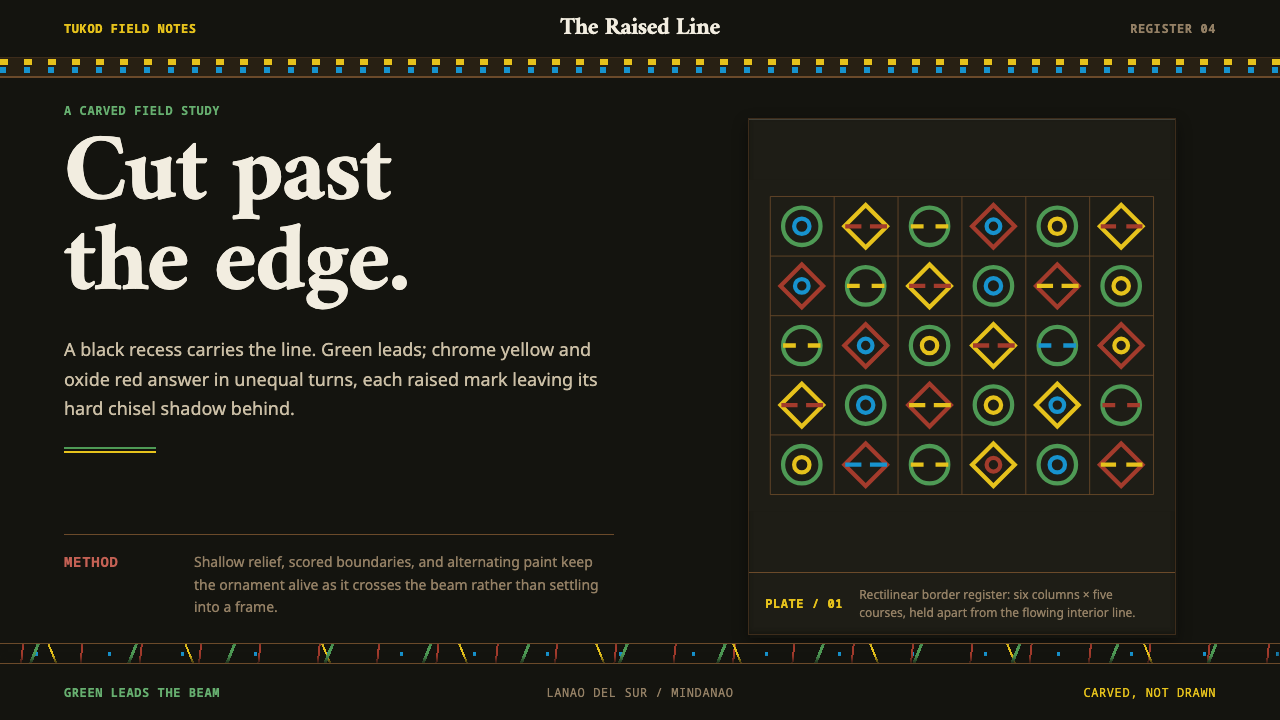 Maranao OkirCarving commands the field. Green, yellow and oxide-red lines rise from black…
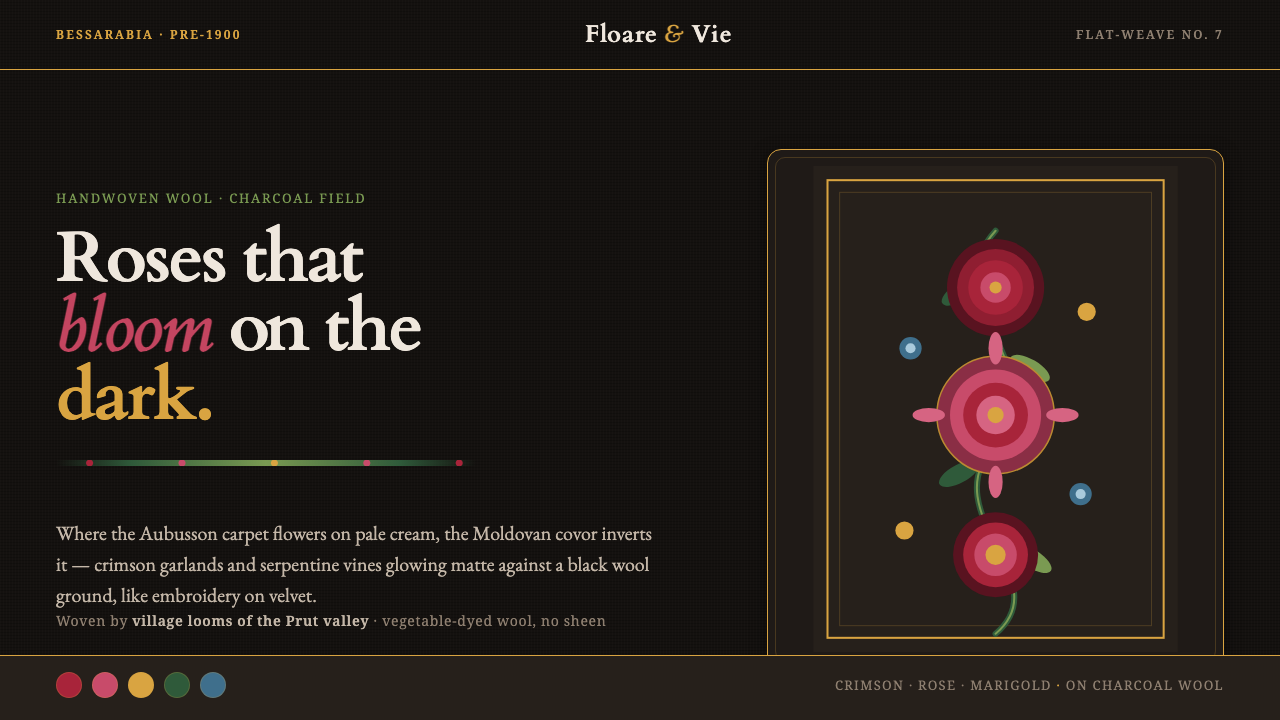 Moldovan Covor KilimRoses that bloom on the dark. Crimson garlands glow matte on a charcoal wool…
 Paraguayan Itauguá Ñandutí Spider LaceReverent craft glows. Snow lace medallions radiate over rose velvet with Guar…