What is Maranao Okir?
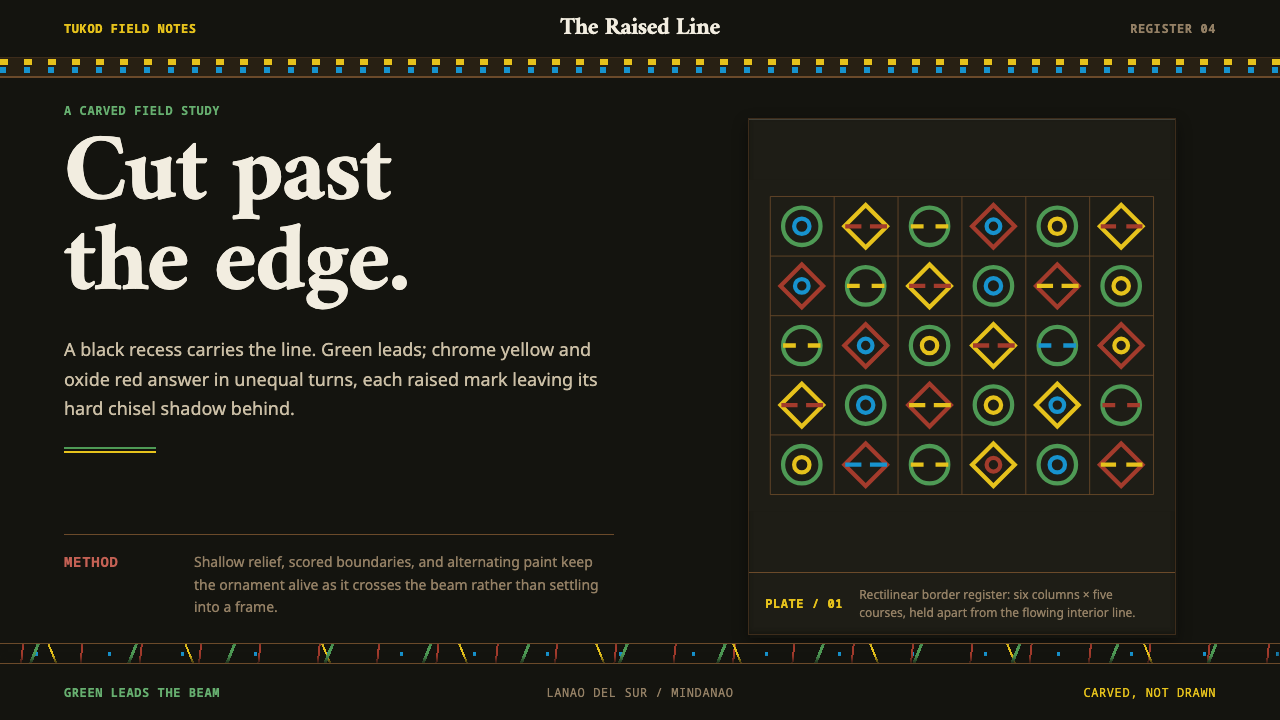
Maranao okir is ornament that is cut, not drawn — serpent curves carved in shallow relief and lifted out of a black field in green, yellow and red.
Maranao Okir in brief
Maranao Okir is a design style drawn from the carved ornament of the Maranao people of Lanao del Sur, in Mindanao, the southern Philippines. Maranao panday — hereditary carvers — cut the ornament in shallow relief into the hardwood of the torogan, the datu's great house, then painted the field black and brought the raised scrollwork up in green, chrome yellow, oxide red and sky blue. The order of operations is the whole aesthetic: carve first, black second, colour last, so that every line you see was physically raised from its ground.
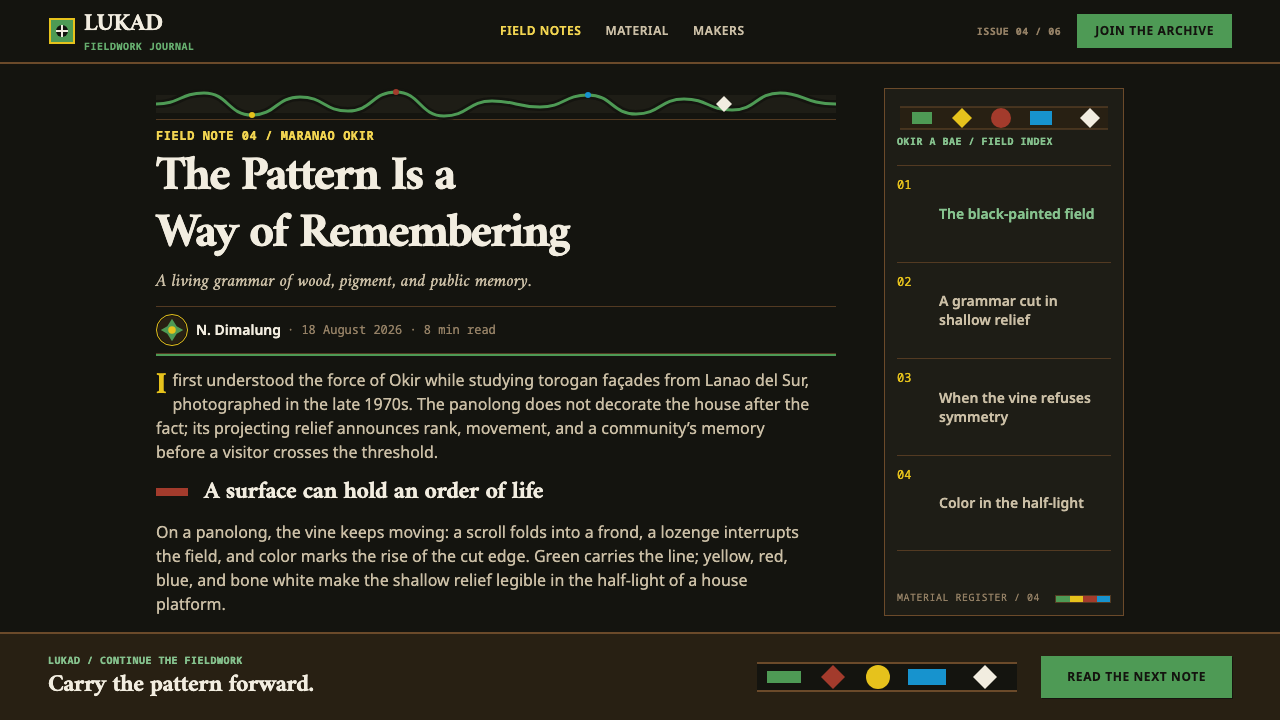
As a design system, Maranao Okir takes that sequence literally. The page is the black field. Everything that reads as content sits above it with a hard cut shadow, the way a chisel leaves an edge rather than the way a lamp casts a glow. Colour alternates along a line instead of filling a shape, borders are rectilinear rather than curved, and the ornament runs out to the edge of the frame instead of sitting politely inside a margin.
The result is a dark, high-contrast, ornament-forward style, and it is unusual among historical references because ornament is the structure, not the garnish. Many heritage styles survive into interface work by being reduced to a palette and a typeface. Okir resists that reduction. It has a grammar — a curving serpent line, curling fronds that are never mirrored, a straight-edged border register, a fixed sequence of ground and pigment — and it only looks right when the grammar is respected.
Where does Maranao Okir come from?
The tradition belongs to Lanao del Sur, in Mindanao. The source material dates it to before 1900 and continuing onward, with the great torogan of the nineteenth and twentieth centuries as its most monumental surviving expression. A torogan is the great house of a datu, and it is the building type in which okir is most fully displayed. Its carving is where a household's standing is made visible.
The people who make okir are the Maranao panday, hereditary carvers whose skill is held within families and exercised for the datu households that commission the great houses. The method matters for the look. The ornament is cut in shallow relief into hardwood — not scratched in as a thin groove and not carved as deep, rounded sculpture, but raised just far enough to stand proud of the ground. The field is then painted black, and the raised scrollwork is brought up in colour. Because the colour sits on a physical step, every edge in the finished work is also a real shadow line, and the two-level logic of ground below and ornament above is never ambiguous.
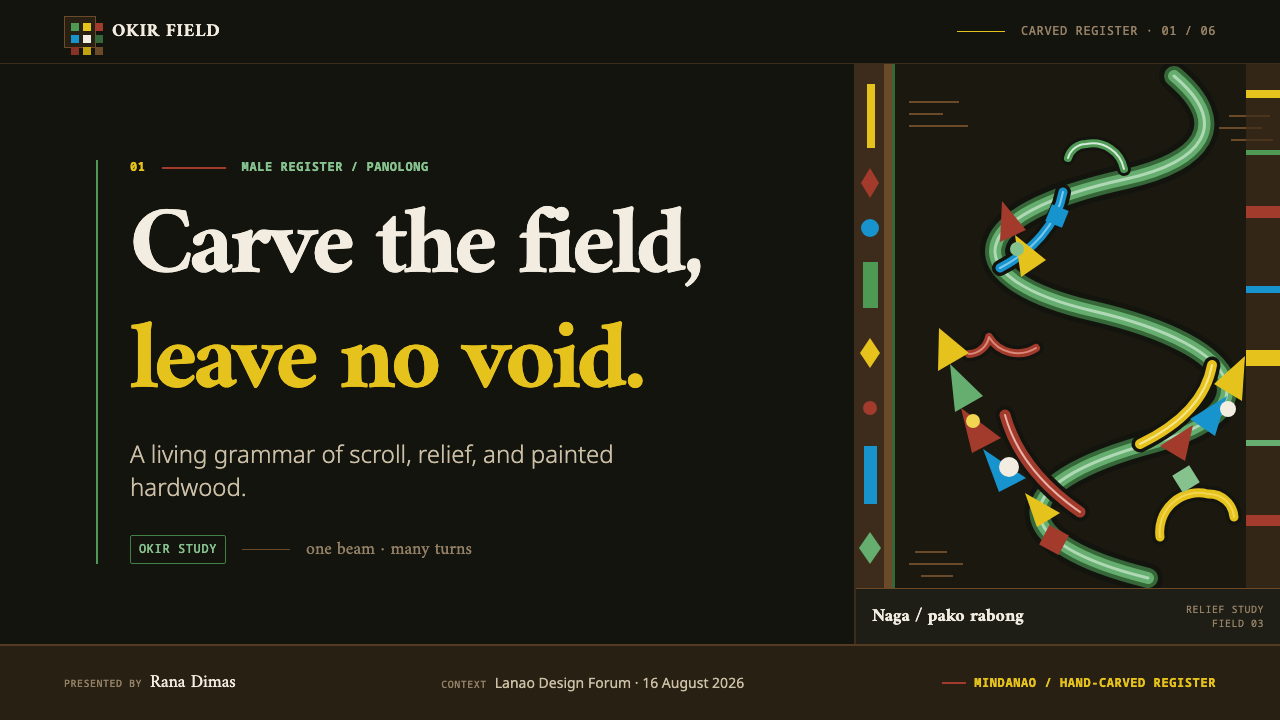
The panolong is where okir is loudest. It is the wing-shaped beam projecting from the front of the torogan, and its whole length is given over to a single movement: a naga serpent's S-curve running along the beam, with pako rabong fronds curling out of it. The composition is deliberately not mirrored. Left and right carry different curls, so the eye is led along the beam by rhythm rather than settled by symmetry. This asymmetry is the second thing, after the black ground, that separates okir from decorative systems built on mirrored repeats.
Two registers organise the vocabulary. The source names okir a dato, the male register, and okir a bae, the female register; this system takes the straight-edged bae pattern for its borders and leaves the serpent-and-frond movement to carry the interior. The tradition is also documented and held in public institutions: the National Museum of the Philippines and the NCCA, the National Commission for Culture and the Arts, are named among the references for the style, which places okir within the frame of national heritage as well as regional craft.
What defines the Maranao Okir look?
The Black Field
The ground is black, and that is a material fact before it is a mood. In the carved original the black is paint applied to the wood after carving, the dark plane out of which the raised scrollwork rises. In design terms it makes the style dark by origin rather than by inversion: the colours are chosen to glow against black, and content is understood as something standing on that plane. A light-mode okir would not be a variation on the style; it would be a different style.
Pigment Colour on a Line
The palette is four pigments — green, chrome yellow, oxide red and sky blue — and they behave like paint on a carved ridge, not like fills in a vector shape. Colour alternates along a line: one stretch of a scroll in green, the next in yellow, then red, so a single curve reads as a sequence of segments. Saturation is strong, but the hues are earthy and pigment-like, closer to oxide and mineral than to screen neon, and sky blue works as the cool counterpoint to the warm run of yellow and red.
Hard Cut Shadow
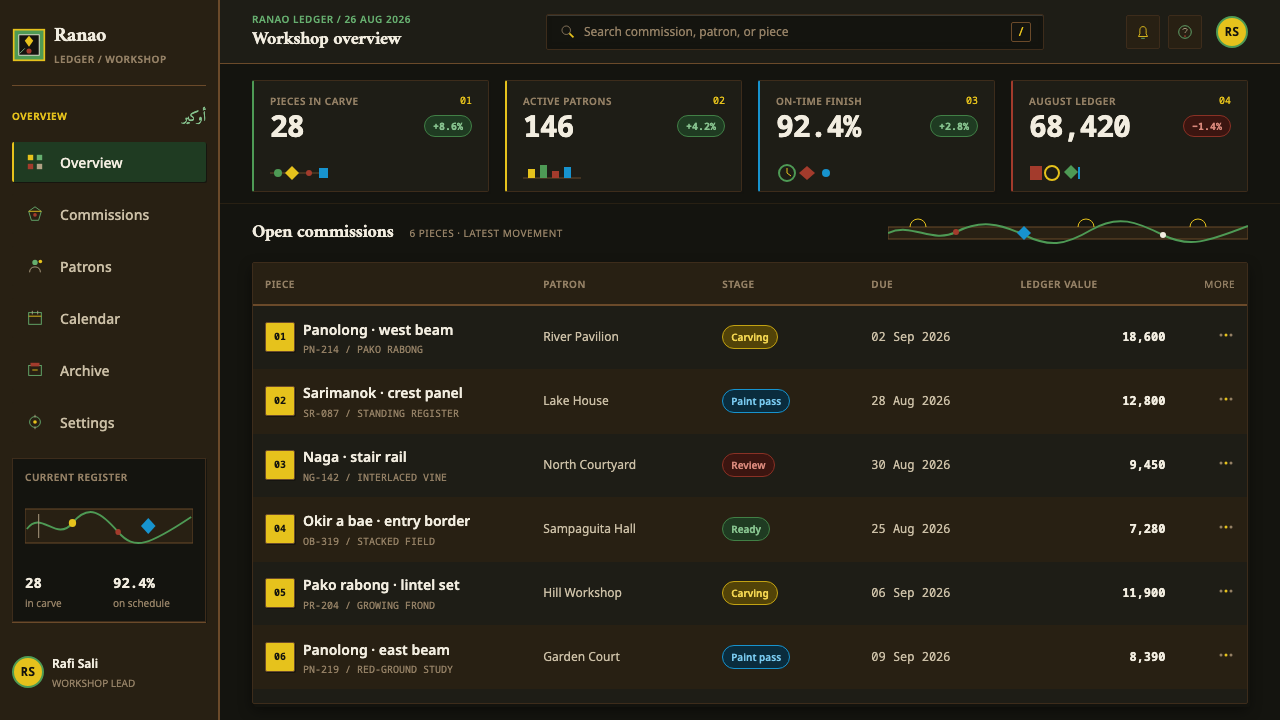
Shadow is offset, solid and free of blur — the shadow of a ridge, not of a floating object. Content blocks sit above the black field with an edge that looks cut with a chisel, and the shadow falls in one consistent direction. There are no soft glows, no ambient haze, no gradient fades. Depth in okir has exactly two levels, ground and relief, and the shadow is simply the visible wall between them.
Serpent Curve and Frond
The characteristic movement is a long S-curve, the naga serpent, from which curling fronds branch. It is a line that travels: it enters at one edge and leaves at another, and the fronds are attached to it like growth rather than placed around it like decoration. Crucially, the two sides are never mirrored. The curls on one side answer the curls on the other without copying them, which gives the composition momentum and keeps it from collapsing into a symmetrical badge.
Rectilinear Borders
Where the interior curves, the frame goes straight. The borders in this system come from the okir a bae register, which is built from straight runs and right angles rather than from scrolls. The contrast is productive: a rigid, stepped frame makes the sinuous line inside it look freer, and the frame itself becomes a second voice in the composition, a measured counter-rhythm to the serpent's flow.
Ornament to the Edge
Okir does not leave a polite white margin. The ornament runs to the edge of the beam, and in layout terms it runs to the edge of the screen or slide. Negative space, where it exists, is black field rather than blank paper, which means empty areas are still part of the carved board and still carry weight. The style rewards fullness, but it is fullness of a ruled kind: lines move in one direction at a time and never pile up into noise.
Who shaped Maranao Okir?
The hereditary carvers of the Maranao and the real authors of okir. They cut the shallow relief into hardwood, paint the black field and raise the scrollwork in pigment. When this style asks for a hard shadow, a two-level surface or colour that alternates along a line, it is describing decisions that panday make with a chisel and a brush.
The households whose great houses, the torogan, carry the finest okir. In the source's framing they are the setting and the occasion for the carving: the ornament exists on and for these houses, and the panolong beam at the front of the building is where a household's ornament speaks loudest to the world outside.
A national institution named among the style's references. Museum collections are one way Maranao carving reaches people beyond Lanao del Sur, and a designer working from this style should treat such collections and their documentation as the primary record, rather than reconstructing motifs from memory.
The Philippines' national body for culture and the arts, named in the style's references. Its presence in the source marks okir as part of the country's recognised cultural heritage, which has a practical consequence for designers: attribute the tradition properly, and name Maranao carving as the source rather than describing the result as generic ornament.
How do you use Maranao Okir today?
Maranao Okir is a tone-setting style rather than a neutral toolkit. It carries ceremony, richness and cultural weight, and it is best used where those qualities belong to the subject — a cultural institution, a craft brand, a festival, a heritage story, a product with something to say about making. Because it is dark and ornamental by origin, it asks for a layout that has somewhere for the ornament to live and somewhere for text to rest, and the most successful applications keep those two zones separate.
For presentation slides, the cover is where okir is most at home. Use the black field edge to edge, run a single serpent line across it in one pigment colour so that it enters at one side and leaves at the other, and set the title in pale, high-contrast type on a hard-shadowed block sitting above the field. Content slides should be quieter: a rectilinear border frames the slide, text blocks float above the black with the same cut shadow, and the curving ornament is reserved for one corner or one edge. For data slides, let the chart itself play the serpent. A line chart is already an S-curve; colour its segments in alternation, keep bars as flat blocks with hard shadows, and draw each series from the four pigments rather than from tints of one colour.
For web interfaces, okir suits dashboards and product pages that want a dark, ceremonial register. Cards become raised panels with a hard offset shadow, which fits dark mode naturally because the shadow reads as a cut rather than a haze. Pricing tiers can be distinguished by the colour of their border line instead of by filled backgrounds. Navigation should stay plain and typographic. The ornament belongs in headers, dividers and empty margins; it should never sit behind body text, where it would fight legibility.
For editorial and marketing work, okir gives a long-form page a strong sense of place. A heritage feature, a craft maker's story or a festival site can open with a full-bleed carved band that runs off the edge, then settle into clean text columns on the black field with a single colour reserved for headings and links. Section breaks can reuse the rectilinear border as a rule, which keeps the ornament systematic instead of scattered.
The most common mistake is to treat the four pigments as neon and the black as a generic dark theme, which produces something that looks like a game interface rather than a carved beam. A second mistake is to mirror the ornament left to right, which removes the asymmetry that gives okir its momentum. A third is to fill shapes with colour instead of alternating it along a line, and a fourth is to use the style for subjects with no connection to making, ceremony or heritage, where its weight reads as costume. Name the tradition when you use it, and respect the grammar.
Maranao Okir — FAQ
What is okir?
Okir is the carved ornamental tradition of the Maranao people of Lanao del Sur in Mindanao, the Philippines. Panday carve it in shallow relief into hardwood, most famously on the torogan, the datu's great house, and the raised scrollwork is painted in colour against a black field. The curving serpent line and the unmirrored, curling fronds are its best-known motifs. As a design style, it translates that process into a dark ground, hard cut shadows, colour that alternates along a line and straight-edged borders.
What are the torogan and the panolong?
The torogan is the datu's great house, the building type where okir is displayed most fully. The panolong is the wing-shaped beam that projects from the front of the house, and it is where the ornament is loudest: a naga serpent's S-curve runs the length of the beam, with pako rabong fronds curling out of it.
Does Maranao Okir only work as a dark theme?
In practice, yes. The black field is part of the tradition itself: it is the paint laid onto the wood after carving, and the pigments are chosen to stand against it. Placing the same colours on a white page changes their behaviour, removes the sense of relief, and leaves the shadows without a plane to fall on. If a product needs a light surface somewhere, keep the okir logic in a dark panel or band inside it rather than trying to invert the whole system.
Why does the style use hard shadows with no blur?
Because the shadow in the original is a property of the carving. Shallow relief creates a real step between the raised scroll and the ground, and the edge of that step is crisp, like the mark a chisel leaves. A blurred shadow would imply a floating object and a soft light source, neither of which exists on a carved beam. Hard shadows also keep the two-level depth model honest: the interface has a ground and a raised layer, and nothing in between.
What are okir a dato and okir a bae?
They are the two registers of okir named in the source material: okir a dato, the male register, and okir a bae, the female register. This system takes its rectilinear borders from okir a bae, while the sinuous serpent-and-frond movement of the beam carries the interior of the composition.
Related design styles
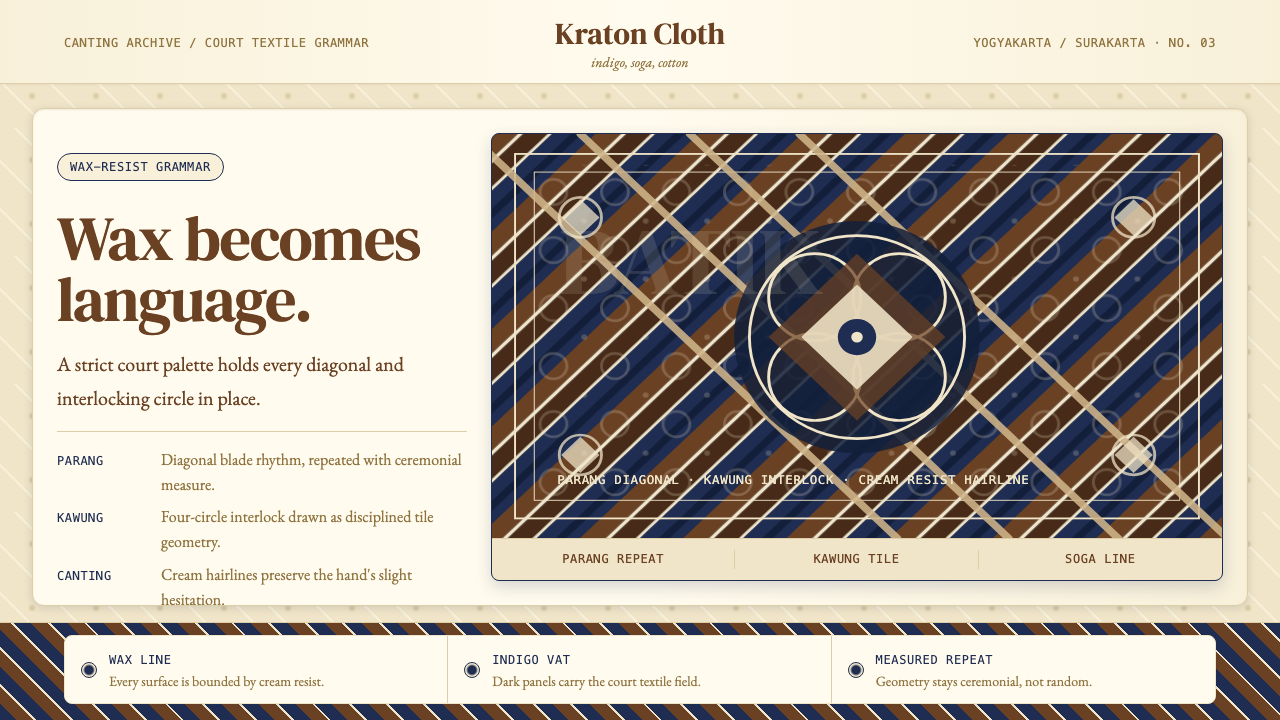 Javanese BatikCeremonial repetition. Indigo, soga, and cream frame a tiled canting motif.
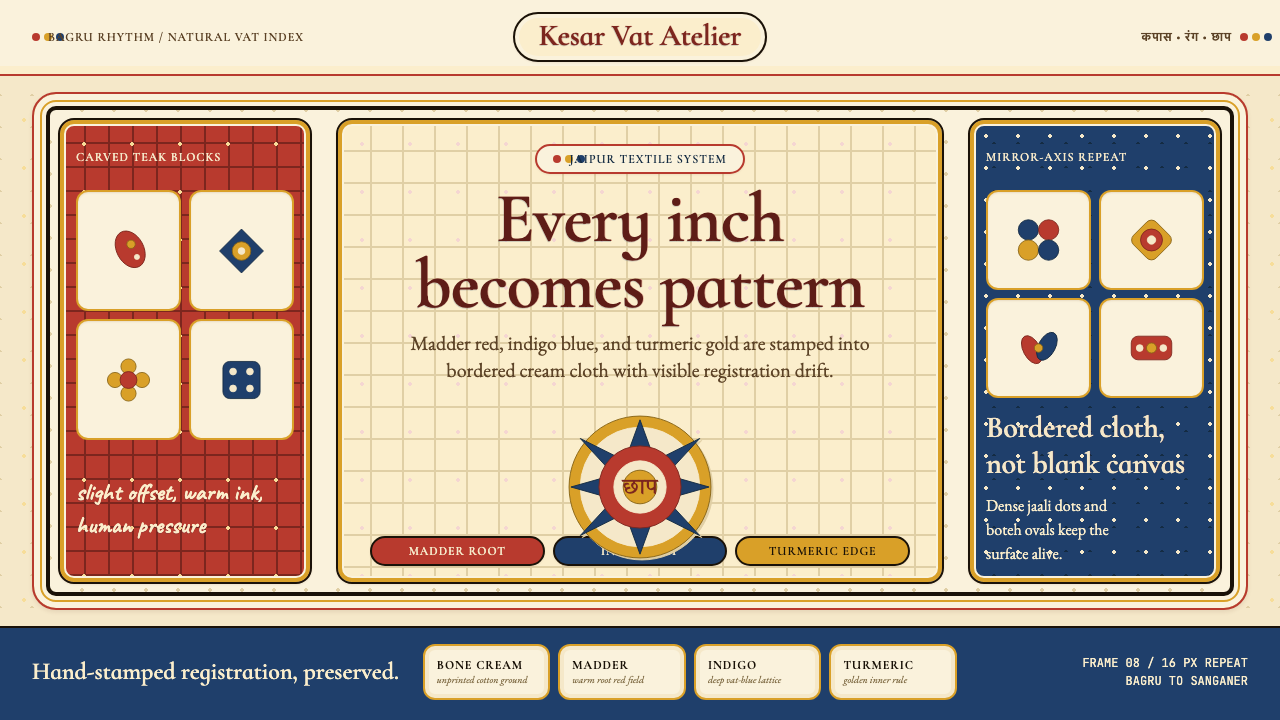 Indian Block PrintPattern claims every inch. Madder, indigo and turmeric stamp dense bordered c…
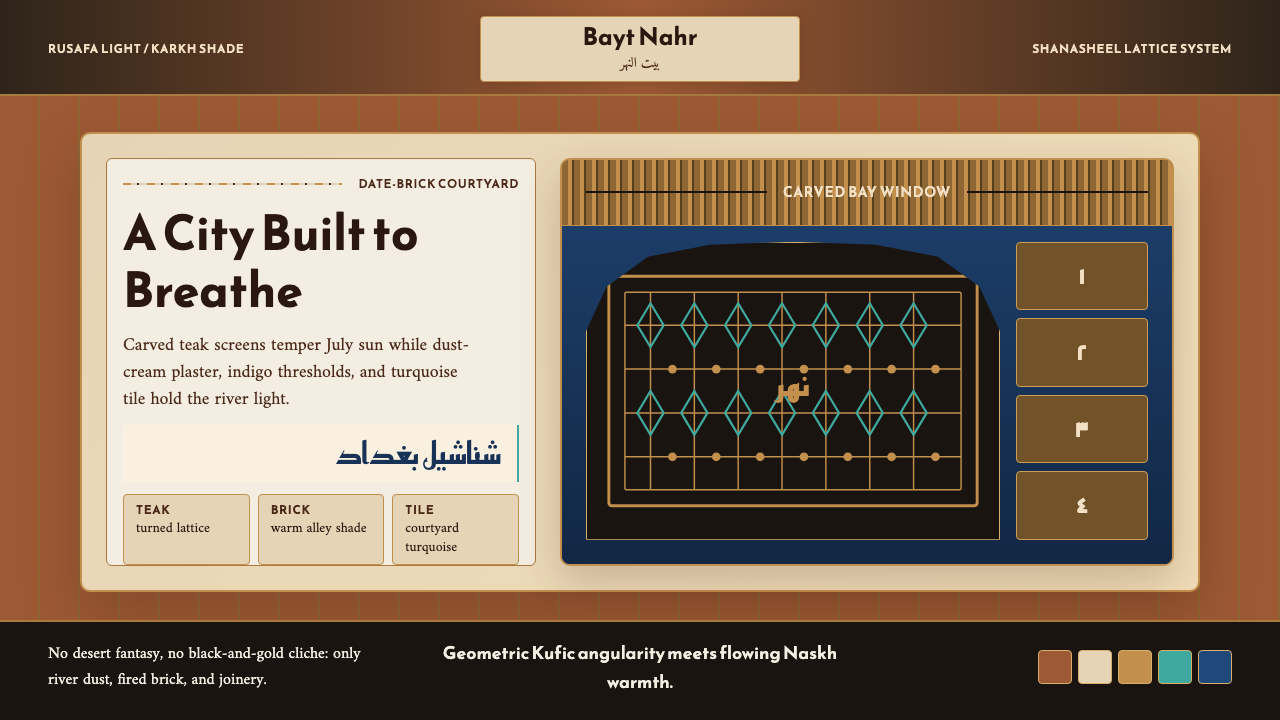 Iraqi Baghdad Shanasheel HouseBreathes through ornament. Date-brick ground, teak lattice, and turquoise til…
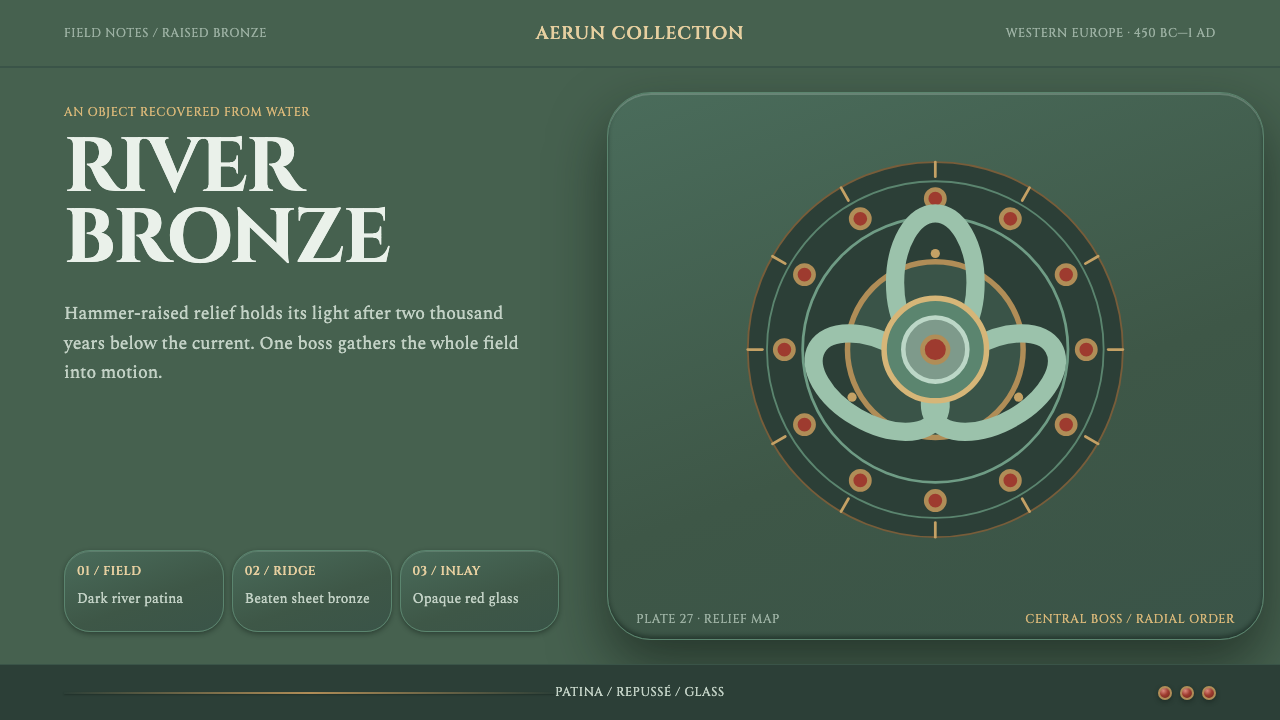 La Tène Celtic MetalworkMetalwork that still moves. Patina-green relief radiates from a bronze boss,…
 Moldovan Covor KilimRoses that bloom on the dark. Crimson garlands glow matte on a charcoal wool…
 Nanai Amur SpiralCut continuity, never drawn. Dark indigo pairs run across mottled salmon-leat…